A Tea Addict's Journal

Entries tagged as ‘young puerh’

2003 Crab claw cake

July 29, 2007 · 1 Comment

It seems like I am having most of the 2006 Tasteoff teas in 2007. A few of them I did drink, and now I’m drinking the remainder. The others I didn’t drink, and am now drinking for the first time. The 2003 Crab Claw cake from Hster is one such cake.

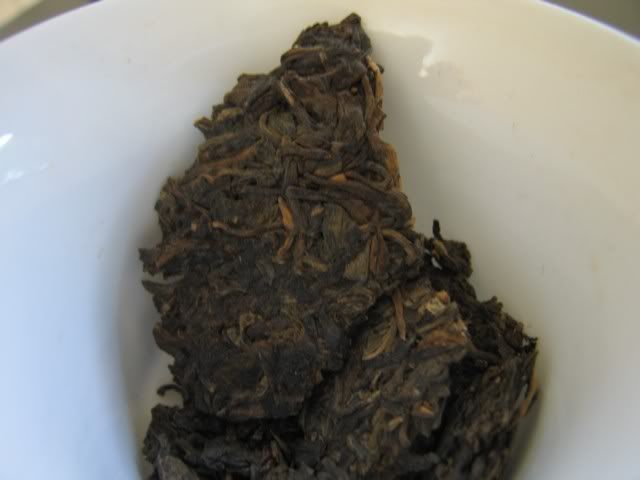
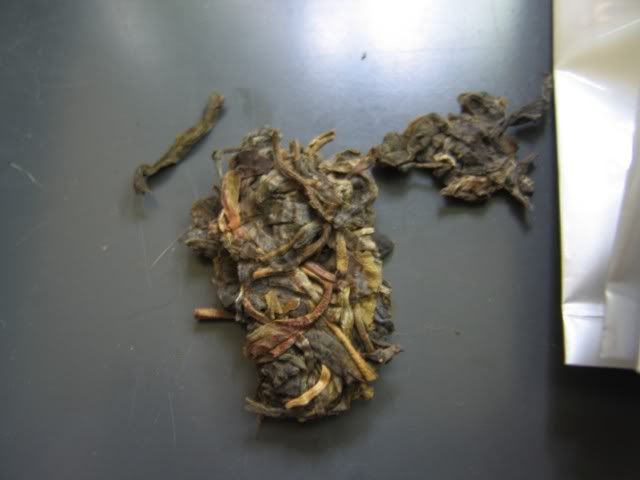
Crab claw is some parasitic vine that grows on tea trees, supposedly only on older trees and supposedly mostly in Jingmai area. They look rather flat and are a bit orangy in colour when dry. I didn’t notice any in the small sample I got. It looked more or less like pretty normal young puerh.
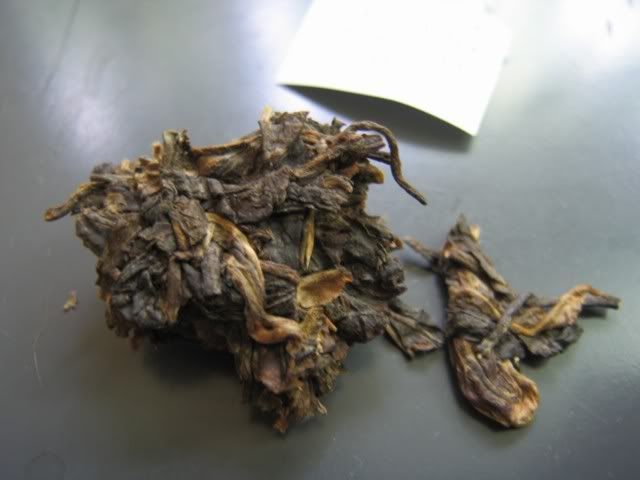
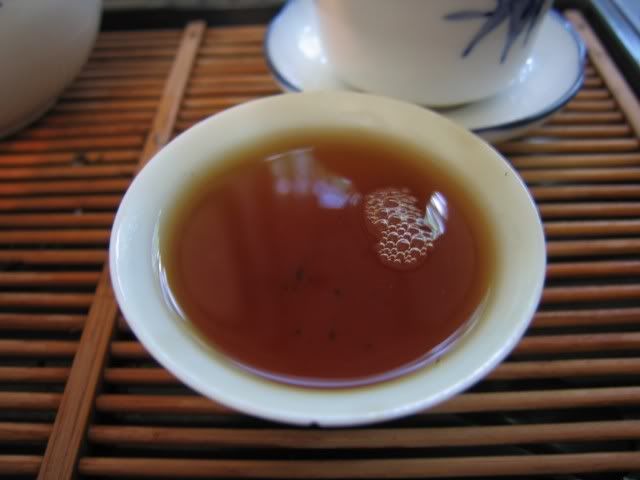
The tea has a bit of a spicy note to it when brewed, with a lingering aftertaste. The first few infusions were quite good, strong without being too harsh. Among the teas from the tasteoff, this one is on the aged side of things and tastes that way. The first hint of agedness is showing through, and it yields a rather agreeable drink. Later on the spicy taste fades a bit into a sweeter, mellower version of itself. Aftertaste doesn’t last that long anymore though….

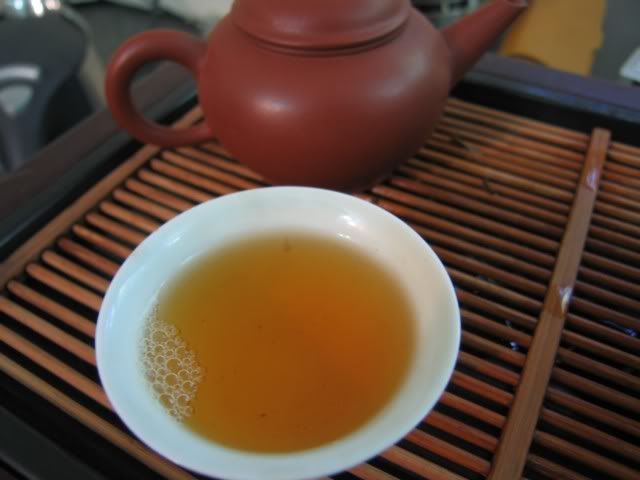
This is around 4th infusion
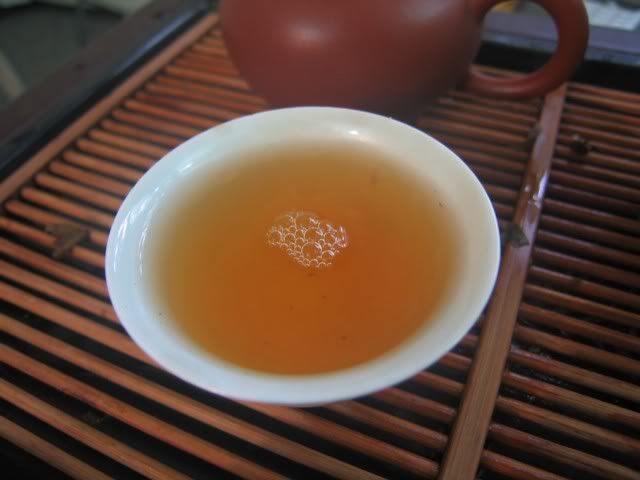
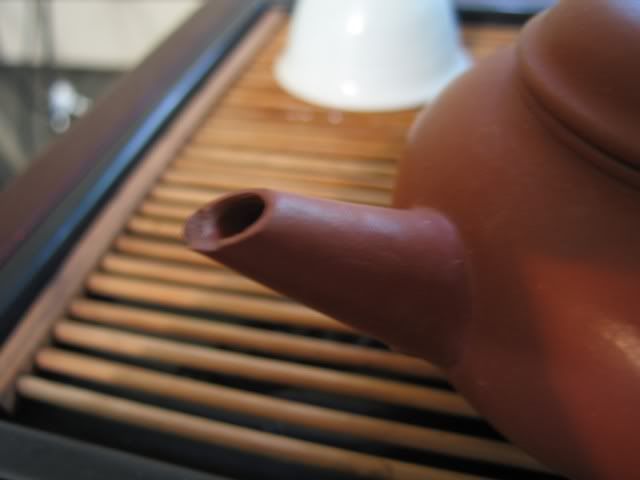
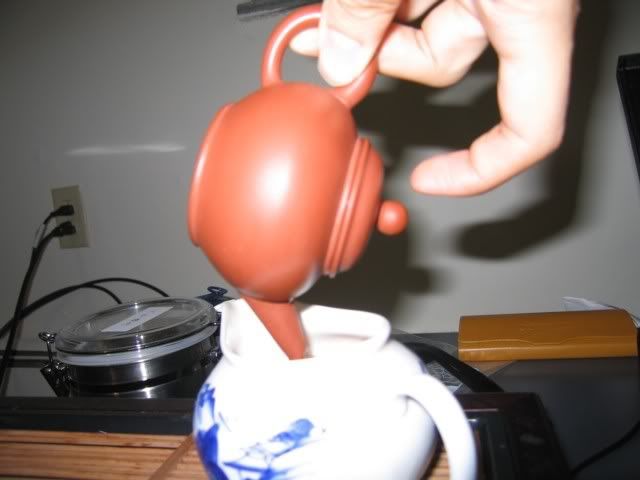
Somehow, when I was brewing it, it kept clogging my pot. Other young puerhs I’ve used for my pot have so far behaved themselves, but this time, no matter what I did, every infusion involved some struggle with the clogging problem. I wonder why that was the case. I tried pouring the water differently, pushing the leaves in right before I pour out, etc… to no avail 🙁

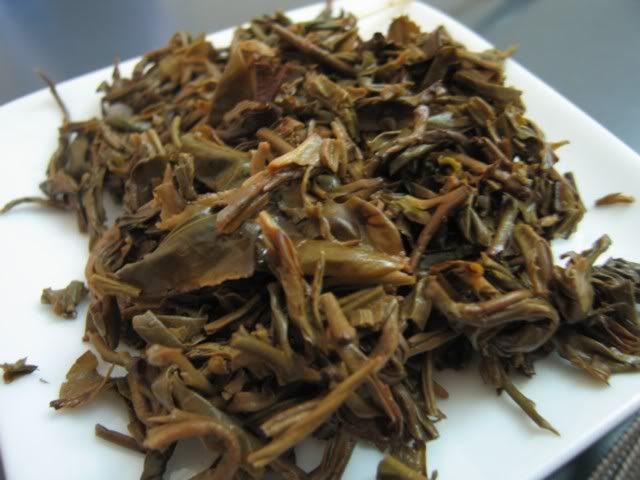
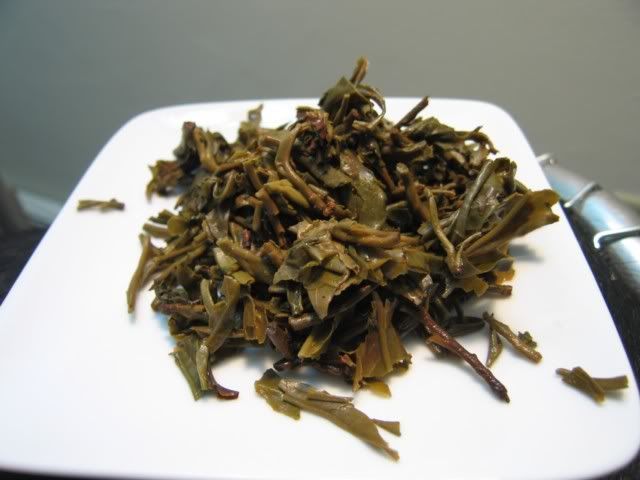
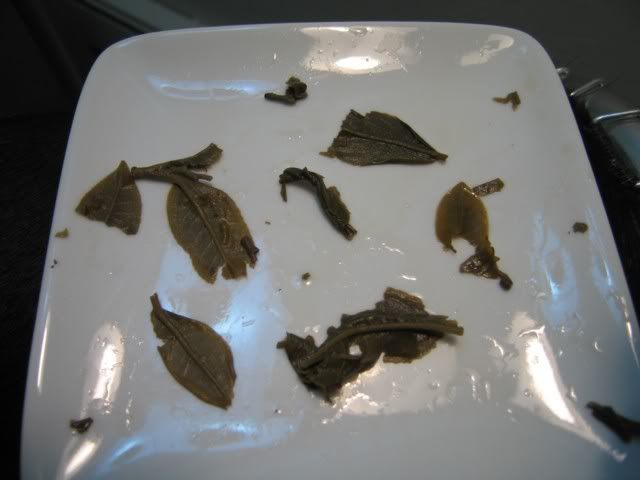
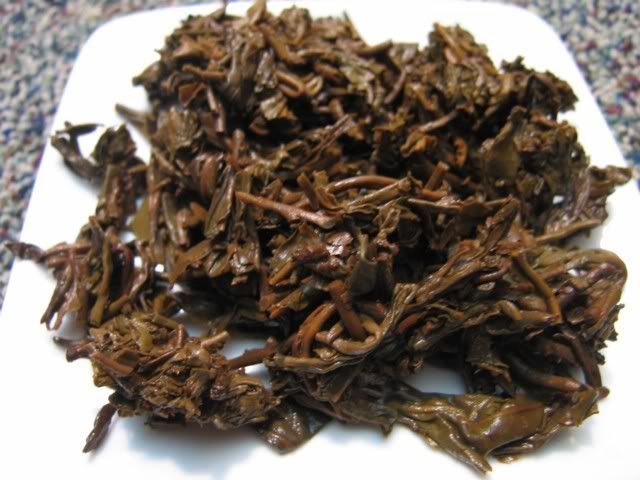
Can I tell if there’s any crab claw taste? Not really. Going through the wet leaves… I didn’t really find anything incriminating either.
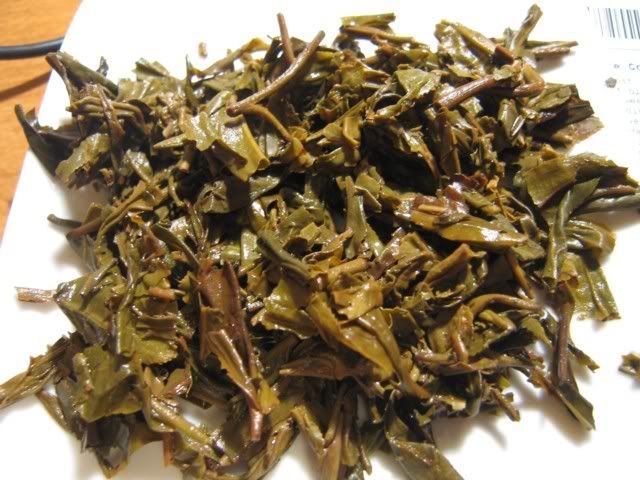
It’s very likely that this, like most crab claw cakes, only have a few of them on the surface of the cake, so unless you got those pieces, there’s basically none. I’ve never been sure of the value of these things. Why put them on the cake? On their own, crab claw doesn’t taste terribly good, IMHO. Supposedly it has medicinal value, but so does everything tea related, supposedly. If you really believe those claims…. you should be living to 250 and still be active like a 20 years old. Maybe novelty? Gimmick? As if there weren’t enough gimmicks in puerh already…
Categories: Old Xanga posts · Teas
Tagged:

2005 Longyuan Hao 2kg anniversary cake

July 27, 2007 · 1 Comment

This is another one of those old samples that I never quite got around to drinking last year. The reason I have so many of them is because 1) my tolerance for young puerh at that point was lower, 2) It was near my moving date — after which all of them got packed, and 3) there were even more samples that I did dispatch at that point. So…. now I’m trying to at least give them all a fair go.

Anyway, this is a sample provided by Toki, and although labeled as Menghai Factory Anniversary cake, reading the packaging and the neipiao, it seems to actually say this is a Longyuan Hao cake and made by “Yunnan Xishuang Banna Old Tea Mountain Tea Industry Co. Menghai Tea Factory”. Which I think isn’t actually the same thing as Yunnan Xishuang Banna Menghai Tea Factory, i.e. the one we usually just refer to as Menghai. It’s one of those things that newer companies do to make you think it’s the grand old factories….

Of course I only got a little piece of the 2kg bing

Not too compressed, although given other opinions, it seems mine is the exception rather than the rule.

The liquor is clear and medium in colour

The initial infusion was remarkably light, deceptively so, but there’s a deep aftertaste that lingers, and which I like. The next few infusions, oddly enough, reminds me of beer. It’s a strange thing, but perhaps it is the hops of a beer that it is reminding me of. Bitter, grainy… something like that. Not too bitter, mind you, just enough to make me feel like I’m drinking a non-bubbly version of some malted beverage or another. The colour deepens. Aftertaste still strong, and I can feel a little bit of a caffeine buzz. It then progresses on to something else, perhaps more tea like now, sweeter, but strength remains. In fact, overall the tea lasts quite long and I gave up before it did.

Toki says there’s old tree leaves in there. I think it’s entirely possible, given the deeper aftertaste and the lingering effects that I found. Normally plantation teas tend to be more immediately stimulating but without the long tail. I’m not sure I detected very strong qi — certainly a buzz, but it doesn’t quite do the warmth thing to me. I think this is definitely good tea, and if the whole 2kg cake is made with this stuff (as in not just the front and back with a covering of good leaves) this can make a pretty interesting drink down the road.

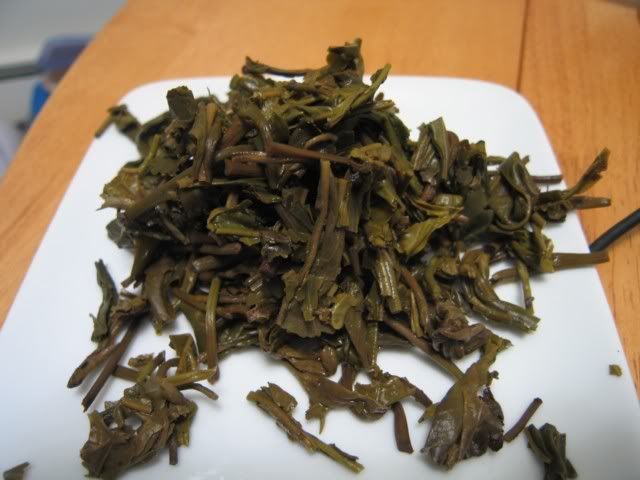
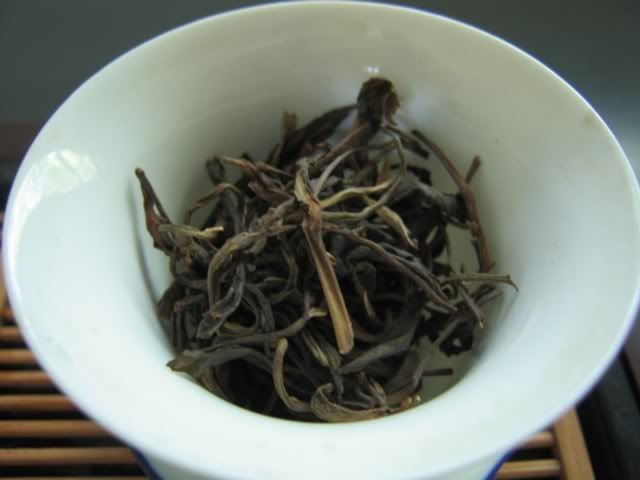
A mixture of leaf grades, mostly larger. Some are stiff yellow leaves, a good amount of stems, and some smaller leaves. No buds in sight.

Unfortunately, one can’t say the same for many other anniversary cakes. Most of them I find to be overpriced versions of other cakes simply because they’re anniversary cakes of one sort or another. Some are merely very standard factory issues type cakes with some excuse or another to commemorate — be it the opening of a new mall or the 10 years return of Hong Kong to China. Some factories, such as Six Famous Tea Mountains, tell you every single cake they make is a limited edition — which is of course logically true, since no production is going to be unlimited when it comes to agricultural products…

Categories: Old Xanga posts · Teas
Tagged:

Mystery puerh, age unknown

July 26, 2007 · 2 Comments

While yesterday’s tea’s origins are not very well known, today’s tea’s source is obvious. I got it from Phyll, who in addition to blogging just helped organized the puerh tasting that happened in Pasadena a month ago, and also helps write (and edit?) TChing and moderates (?) Winexiles. A busy man. 🙂

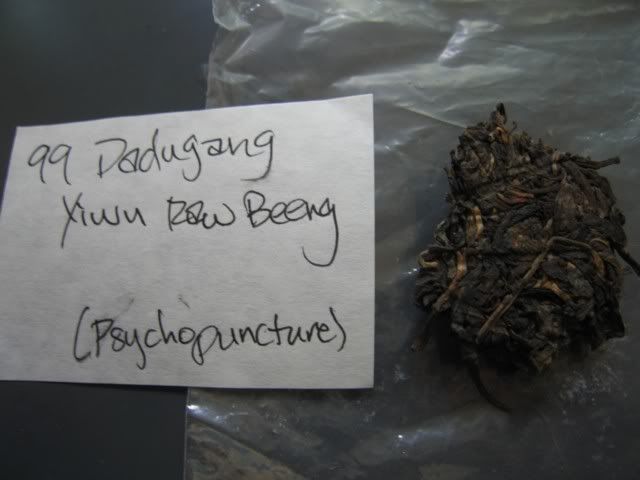
Unfortunately, however, I got this tea more than a year ago. That itself is not a big problem. The problem is it was labeled simply as “1”. Nothing more. I think there was an email as well as a little note of paper that came with the package, telling me what they were (there were 1, 2, 3, 4, and I think I drank two before I left for China). I asked Phyll today, who couldn’t recall off the top of his head. So… it’s a guessing game.

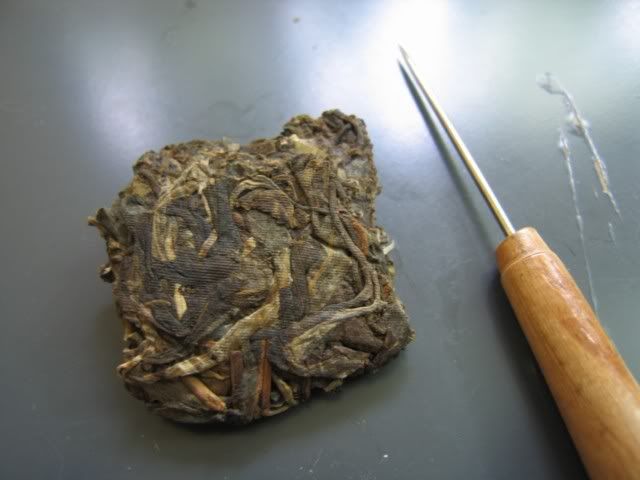
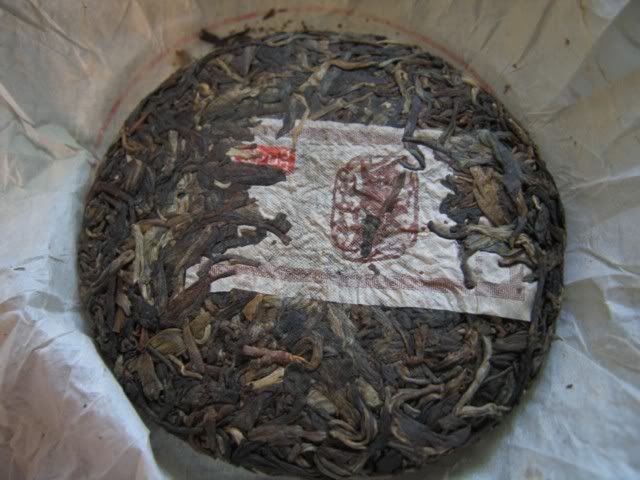
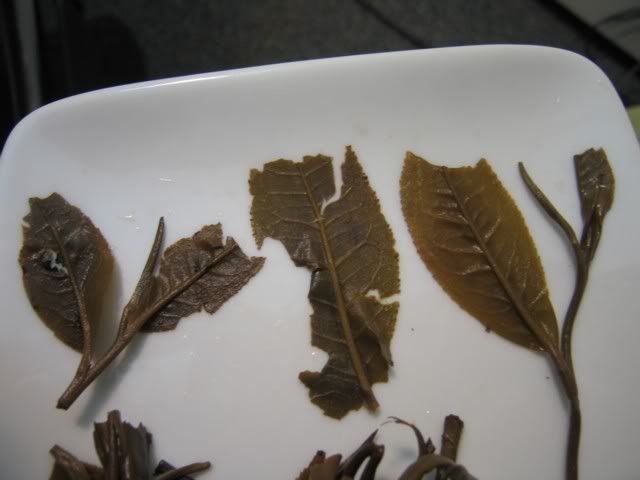
So this is the tea

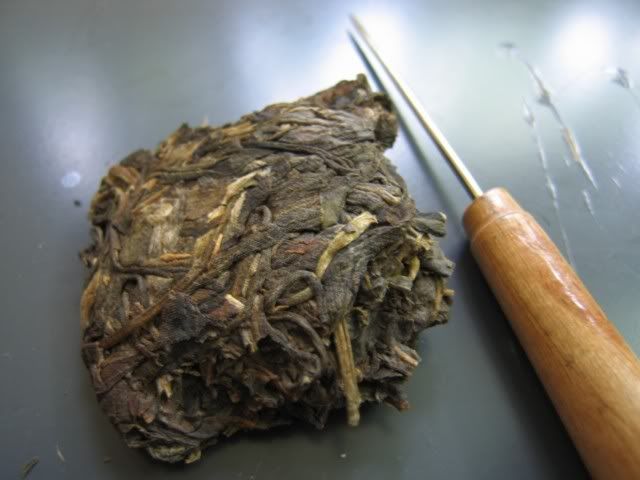
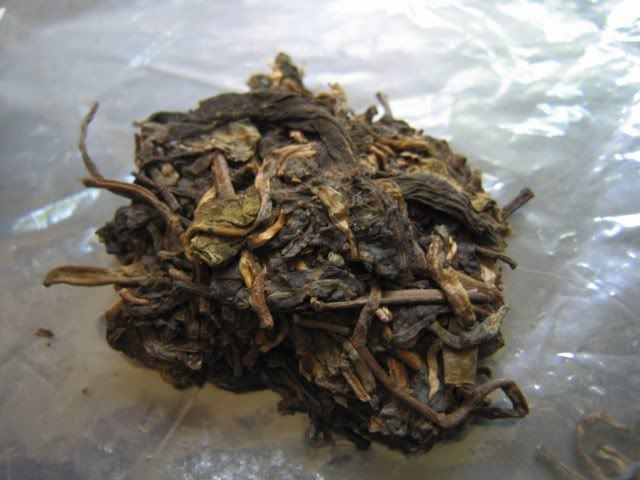
A closer shot of the other side

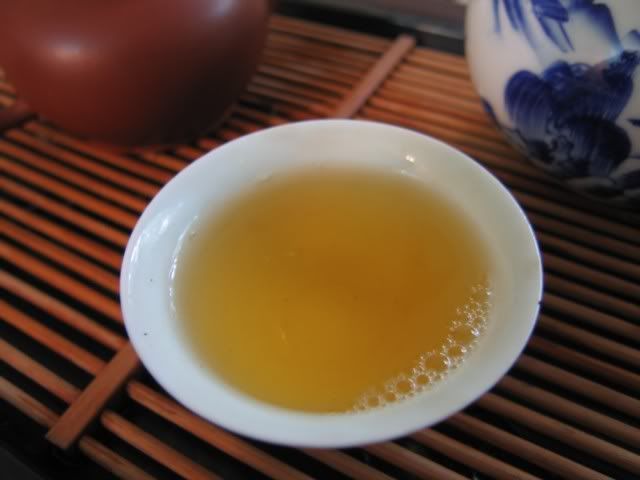
I used half the leaves, which might have been a tad low on the leaves, but I didn’t want to overstuff my pot again like the last two times. The tea is obviously a little aged — maybe 2-4 years? It’s lost some of the initial harshness, and some of the bitterness is gone. Now the tea is not too bitter, instead it comes through with a minty type of stimulation on the back of the throat and a muted sense of fruity taste. It’s slightly similar to the Mengku Rongsi 2005 mini bing that I tried a few days ago, but different. This one’s definitely less bitter, but that’s not saying a lot. It’s also less astringent. It’s hard to say which one’s more powerful, as the amount of leaves used was quite different so it is difficult to judge. This tea does taste like a plantation tea, but it is not difficult to drink. In fact, given the amount I used today, I think anybody can enjoy this cup.

I would wait a few more years before doing so though, because I think this can get better. Later infusions yielded a nice sweet water without being too bland. It held up well enough to keep things interesting. I don’t think it is particularly complex a tea, but again, I probably didn’t put quite enough leaves in there. Had I thrown in the whole piece, however, it would have been far too much.

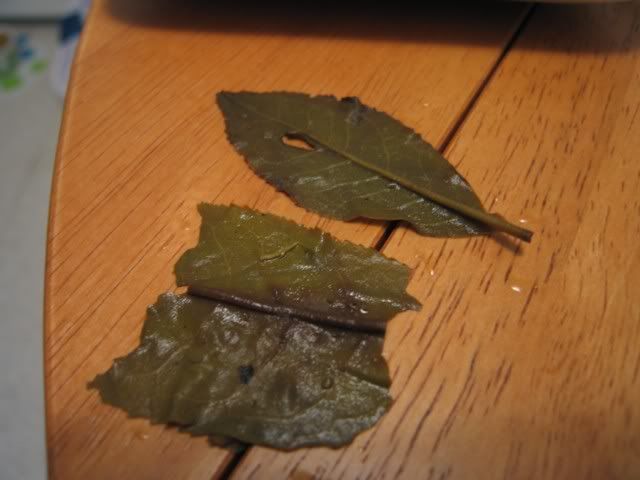
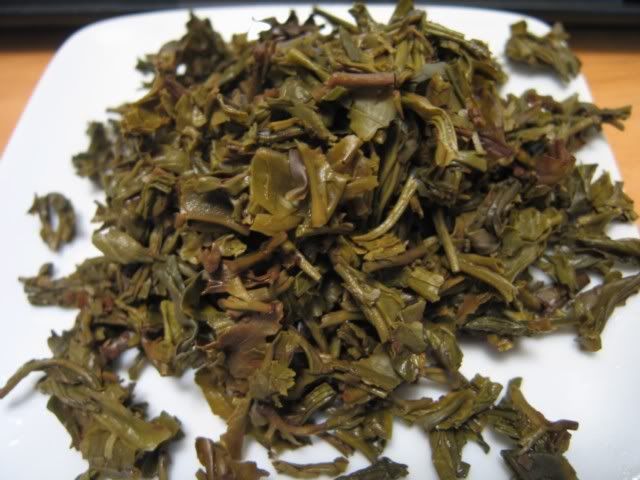
The wet leaves look mostly big

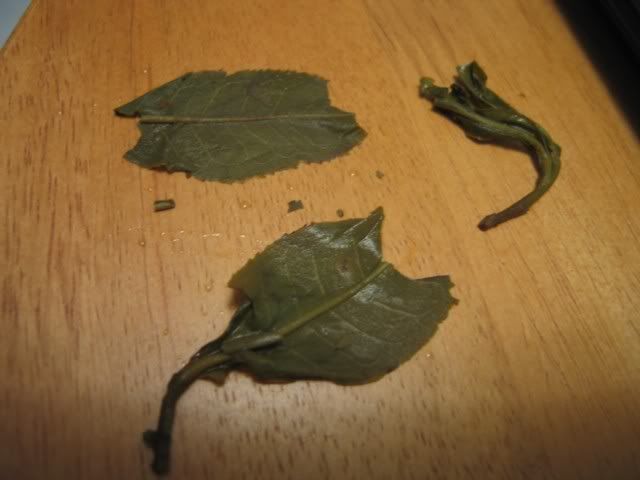
But among them are tiny buds as well. The leaves in general don’t look or feel like spring tea. There’s a certain stiffness to some of them.

So… does this jog your memory at all, Phyll?

Categories: Old Xanga posts · Teas
Tagged:

Mengku Rongsi 2005 mini-bing

July 23, 2007 · 2 Comments

Dear Davelcorp,

Thank you, very belatedly, for sending me this sample. It’s been more than a year since its arrival, and only till now have I found time to drink it. I’m sorry it took so long, but I’m sure, as you know, I went to Asia shortly after your tea arrived, and in the rush to pack things up, move, and… move again, I haven’t found time to drink the tea. I suppose since it’s puerh, it doesn’t matter so much how it was stored. In fact, your smell-neutral paper bag probably worked pretty well since it allowed some air exchange for the bits of tea in there.

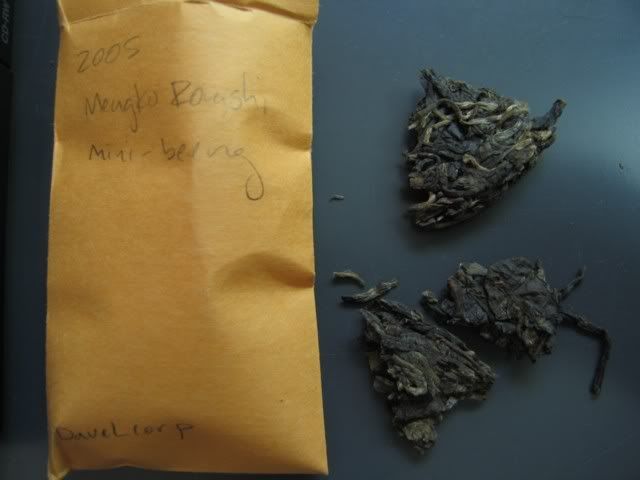
So I finally opened the well-labeled packet today, complete with your name in the bottom

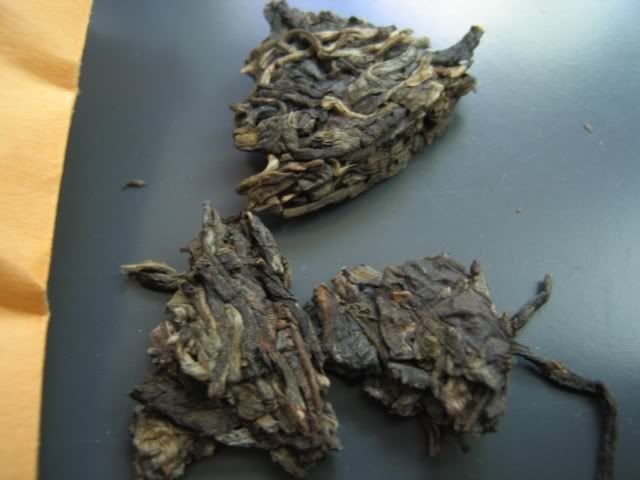
These are not all — there’s a bit more tea in there, loose leaves, mostly, but the small bits make picture taking easier. Here’s a closeup

Mengku Rongsi factory is one that I’m somewhat more familiar with, having visited their factory store in Maliandao multiple times, and having tried quite a few of their products, young and old. Their young teas I found to be somewhat floral, at times quite bitter, but always possessing some strength and complexity. The older teas are a bit more of a mixed bag — some turn out a little like a dianhong, but retains a chocolate/nutty flavour that can be quite interesting, even only after 4-5 years of aging. I myself bought some of their teas, and have hopes that they will, at least, turn into something interesting.

These mini-bings I did see in Maliandao, but I’ve never tried nor bought any of them. I’ve found that many of their products, despite their different names, often taste quite similar. No doubt this is partly due to their use of maocha from generally the same area.

This tea therefore didn’t surprise me with the way it tasted. There’s something vegetal and slightly floral, without an initial bitterness, but it shows through after it’s been in your mouth for a little bit. After swallowing, at least for the first few infusions, there’s a throatiness that lingers, which is nice. The flavours are almost sort of subdued — it’s light in a way, but heavy in another. Perhaps elusive is a good term. It’s not bad that way — just the way it behaves. The bitterness doesn’t last very long, which is good. The tea, however, stays quite potent through many infusions. I liked that about this tea, and I find it to be generally true of their productions. For the price, at least at the time (it seems it’s gotten pricier) it was probably a very good buy. I’m not sure if it’s as good a purchase now, but it might be interesting to see how these age compared to a big bing.

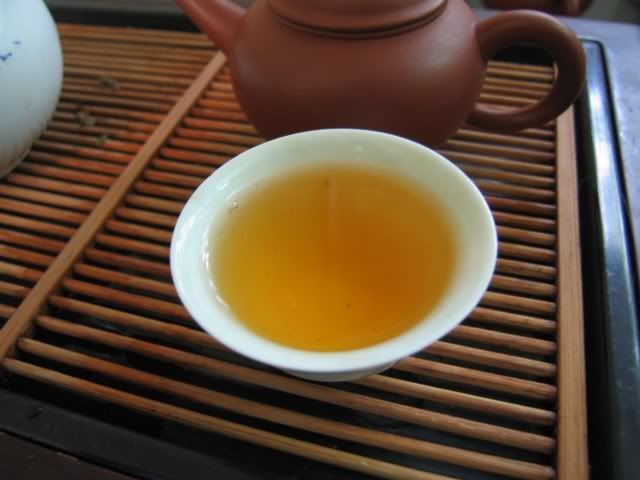
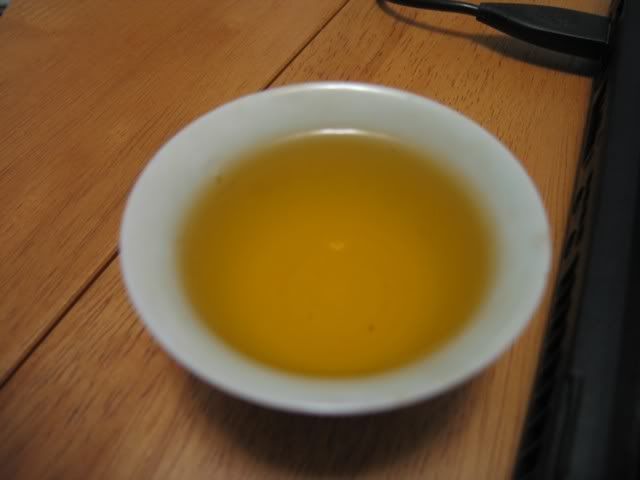
The colour of the tea is a little dark, but not too unlike the young puerhs I’ve been having the past few days

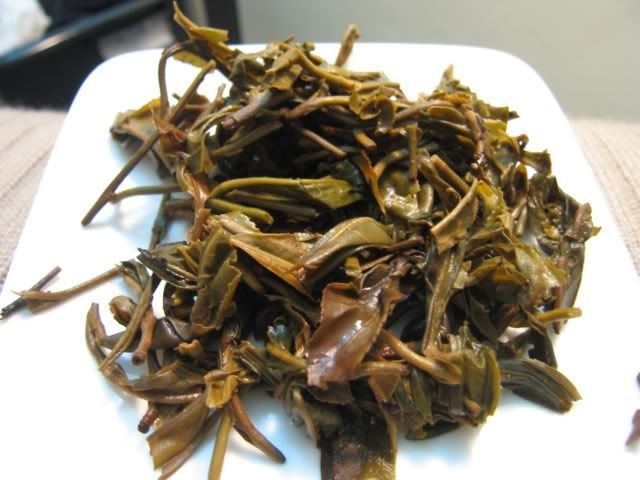
The wet leaves are quite thick, compared to what I’ve been drinking. They’re also mostly whole buds or small leaves. Some are broken, others whole. Some stems too, but not a whole lot.

On Chinese forums such as Sanzui (which has strangely been hard to get to these days) some have pondered whether the new products from Mengku Rongsi has been processed at too high a temperature. It doesn’t seem this tea has that problem, given that it’s been about two years since its production. I can’t say for certain, but I’ve had much nastier teas that are two years old.

I very much enjoyed this tasting, and I look forward to trying this again perhaps a few years down the road with a sample exchange with you for something else.

Yours,

MarshalN

Categories: Old Xanga posts · Teas
Tagged:

Longyuan Hao Yiwu 1999

July 21, 2007 · 2 Comments

Continuing the parade of 2006 Tasteoff leftovers

This is one of the older teas that was passed around for tasting, and judging from everybody’s comments, including mine, it was not too well received.

I must say I have to revise my statements a bit. I think it has to do with the amount of leaves I used.

I used up the rest of the sample, which must be around 7g of leaves. I brewed… and what I tasted was something that could credibly be a Yiwu. It’s a bit cloudy, it’s a little mellow, but I don’t think it was mellow in a bad way. There’s bitterness in there, if you brew it longer. There’s also some nice floral notes, much sweetness, although not much of the minty flavours I found first time around. I think there’s even some throatiness, although not too much. This is not a great Yiwu, but it probably is one. I must say I liked it, not a lot, but I liked it enough. There might be some less-than-perfectly processed tea in there, as there’s a bit of sourness and a bit of an unsettling taste… but it’s not fatal.

While I wouldn’t say this is a great tea, I don’t think it’s a bad tea. Whether I would buy it or not depends entirely on the price, but it’s not something I’d categorically rule out. I don’t think it’s that bad, and I think it’s turning a corner in its aging process.

The tea does brew a bit cloudy… might be a storage issue, or something.
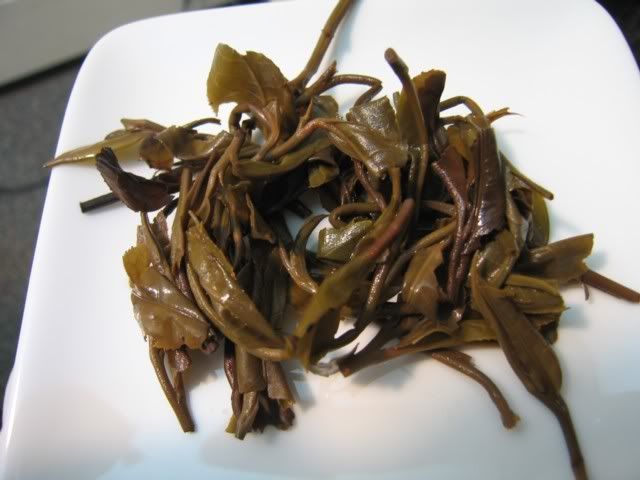
The leaves are a mixed bag… some large, some small. On the whole it’s a bit on the thin side, and a little limp. Not the greatest leaves, I don’t think, and claims of old trees is a little doubtful — perhaps summer picked?

Whatever it is… it’s at least more enjoyable, I think, than the teas I tried the last two days.

Categories: Old Xanga posts · Teas
Tagged:

Menghai 2005 1st grade bing

July 20, 2007 · Leave a Comment

Another dug up sample from the 2006 Tasteoff… this one thanks to BBB.

I brewed it again in my new pot. I am having some adjustment issues with the pot — namely I am putting in far too much leaves. I haven’t been able to gauge how much leaves I am actually putting into the pot versus the volume, and both yesterday and today I think I have basically overstuffed the pot, making it very strong and slightly difficult to swallow at times.

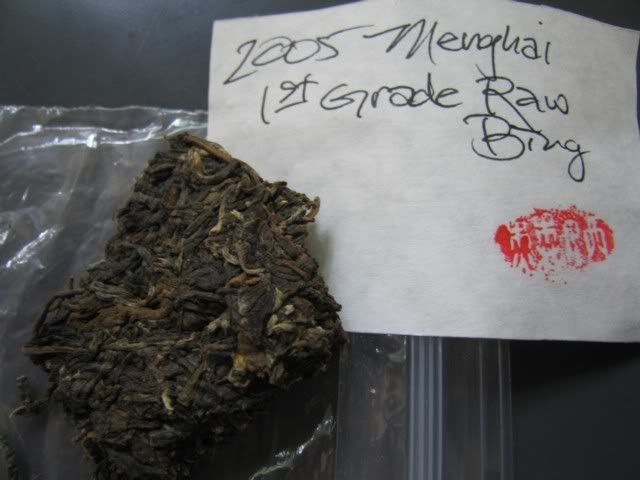
The dry leaves didn’t smell like much of anything, having resided in the plastic bag for the whole year last year. The piece I got was pretty compact, and obviously made of small buds, as the name “First Grade” bing suggest. In Chinese the cake is actually called “Jia Ji”, or better translated as “A grade”. I think it is safe to say that the leaves are not indeed all first grade leaves, but instead a mixture of high grade (i.e. small) leaves.

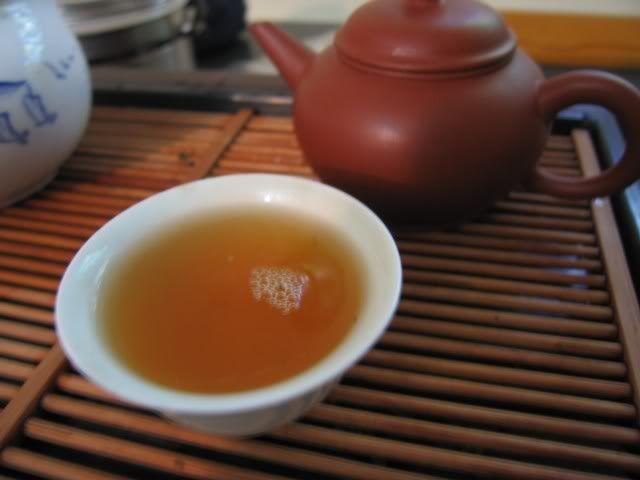
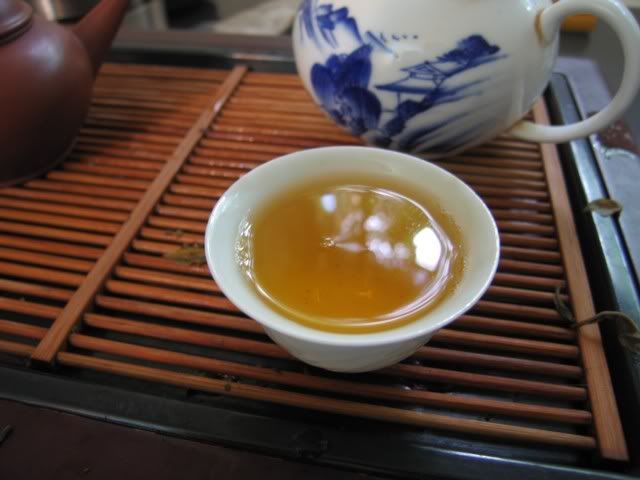
It brews an orange infusion. No doubt, the high leaves to water ratio has something to do with the saturation….

It was bitter. Quite bitter, but not so bitter as to be entirely unenjoyable. It’s not bitter in the way a green tea puerh is bitter. There is a huigan, albeit a slow one. In fact, this tea tastes rather similar to the tea I had yesterday. The tea I had yesterday was a little mellower, whereas this one’s a little more punchy. Taking into account the age difference and the slightly higher amount of leaves I put in today (as I discovered halfway into the brewing) I think it explains pretty well what’s going on. It does hold up better than the tea yesterday, but that might also have to do with the higher amount of leaves present. It’s not a great tea, I think, but it’s a regular puerh made by Menghai. Retail for this on Taobao is 230 RMB, which translates into something like 30 USD. BBB said he got it for 18.50, but probably won’t buy it again at that price. At $30… it’s not worth it at all.

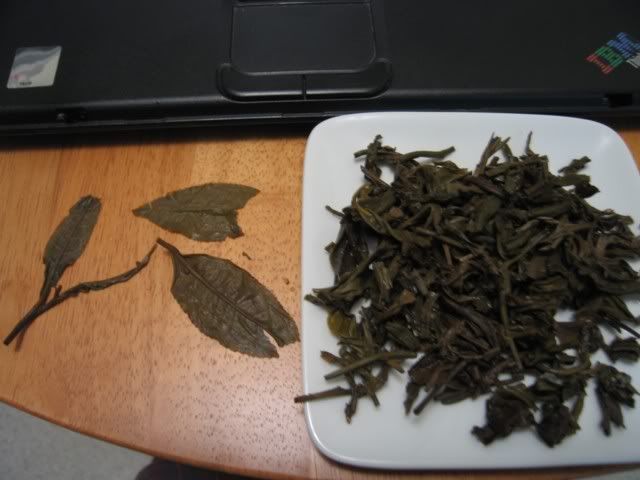
The leaves, as you can see below, are very small, and quite chopped up

They are mostly small, under 3cm in length. There’s some variety in how they look like when unfolded… but nothing too exciting either way

A factory tea through and through. I think what factory teas do well is consistency… at least before the whole craze really got to them. With enough blending, you can come to expect a certain type of taste from a certain factory. Small producers don’t have that consistency, but that’s part of the fun in trying the differences and to see how different people make them differently. It’s also more of an exploration… whereas I’ve had many Menghai cakes that are very roughly similar (especially the newer productions) with differences that are usually relatively minor. There are exceptions, of course, but by and large, that’s been my experience.
Categories: Old Xanga posts · Teas
Tagged:

Fengqing minibings

July 19, 2007 · 4 Comments

Again going back to the old stash I have here, I dug up a cake of the Fengqing mini cakes that I own. Last time I tried this was before the 2006 Tasteoff, at which point I sent samples of this tea out to various people. It’s time to try it again, a year later, to see if I can find anything I missed. I probably would, because at that point I haven’t tried all the young puerhs that I’ve recently tried in Beijing…

Small cakes always look rather cute.

The liquor seems to be darker than I remember

But then, I added quite a bit of tea today. The taste is mellow, but with a bitter edge. The bitterness dies a bit, but it never quite goes away entirely. There’s a strong initial rush of flavours in the first few infusions, but it drops off a bit after about 5 infusions and then seems to skate on a lower plane of flavours — more subdued, less bitter, colour obviously weaker, but despite its light colour, taste is there. Clearly this is plantation tea, but not horrible, I think. At least I don’t think it’s been weirdly processed. There’s just a hint of age in there, but it’s still pretty raw. It’s got some time to go yet… I think I’ll let it sit some more before trying it again.

Worth mentioning though is also the christening of a new teapot — my friend L gave it to me as a parting gift of sorts. This is a prototype that was made for him to inspect before they make a larger production of the pots, and through him I’m ordering some pots for myself as well as some members of the LA group. He had a few of the prototypes sitting around, so he gave me once since it was going to be the last time I see him for a long time.

Unfortunately, I chipped the pot a little yesterday when I boiled it in water to clean it. I think initially the boiling was a little too vigorous and it bumped the pot I was boiling it in….

Sigh… luckily, it doesn’t really affect the pouring at all. The stream is still rather clean and crisp, and so for that, I’m thankful. It did do something that I haven’t really done before with my own pots though

When I poured I noticed the lid wasn’t really coming off. I suppose that’s a good thing, despite the rather short “legs” the lid has. I do wonder if the tea tasted different given my use of a pot. It probably did — pots seem to soften the teas that are brewed in them. Chances are the tea today would’ve been more stimulating if I brewed it in a gaiwan.

The wet leaves are mostly broken

And tiny

A pretty mediocre tea all around. At least it was cheap. I don’t think I’d buy this again, but it might be ok 20 years down the road…

Categories: Old Xanga posts · Teas
Tagged:

2005 Nanzhao cake

July 15, 2007 · 1 Comment

As I was digging up samples of old things to try, I found the stash of unopened 2006 Tasteoff samples that I have yet to try. I remember I didn’t get around to trying them all because of moving, etc, and now, perhaps, is a good time to go through the rest.

The first one that I plucked out of the samples is the 2005 Nanzhao cake, made by Xiaguan factory. From what I know this is supposed to be better than their regular stuff, such as the usual tuos.

The piece I got was very compressed, as is customary of Xiaguan stuff, plus bits and pieces.

The tea brews a bright orange.

The first two or three infusions were rather bland…. not very interesting, and generally felt a little weak, in fact. Then, the tea became stronger, but also more bitter. Part of this might be because of the tight compression, but I think at least some of it is because Xiaguan teas are mostly baked dry at higher temperatures, and thus behave a little more like a green tea. There’s some huigan to the tea, but not very obvious, and neither is the aroma very pleasing. I’ve tried stuff like this in China, and I didn’t like them. I don’t like the increased bitterness over time in the infusions, nor the way the tea felt weak (but strangely uncomfortable as I drank it — as if my body doesn’t like it).

The wet leaves are very chopped up

Typical, again, of Xiaguan stuff in general. This is definitely a tea that is diffcult to enjoy now. I’m not sure if it’s going to be good in the future… but it somehow lacks that energy and strength that I like, and really doesn’t sit very well with me for some reason. Perhaps this will be great in twenty years, but I think even then, it might require a more humid climate to age in order to show something good. Storing them dry might just not change it enough for long term consumption.

Categories: Old Xanga posts · Teas
Tagged:

Menghai 1999 Yiwu Speical Reserve

July 14, 2007 · 2 Comments

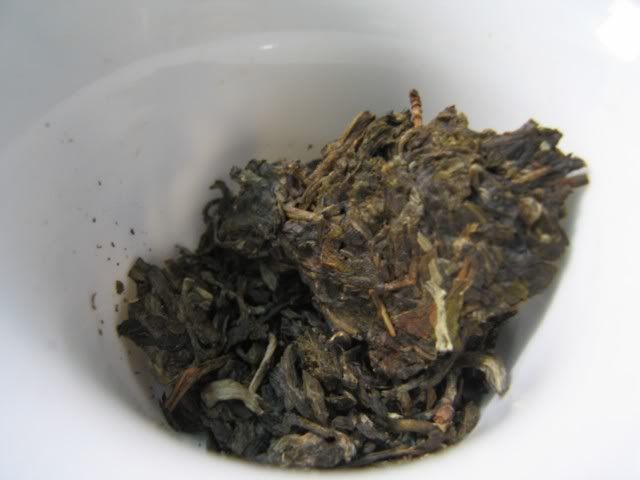
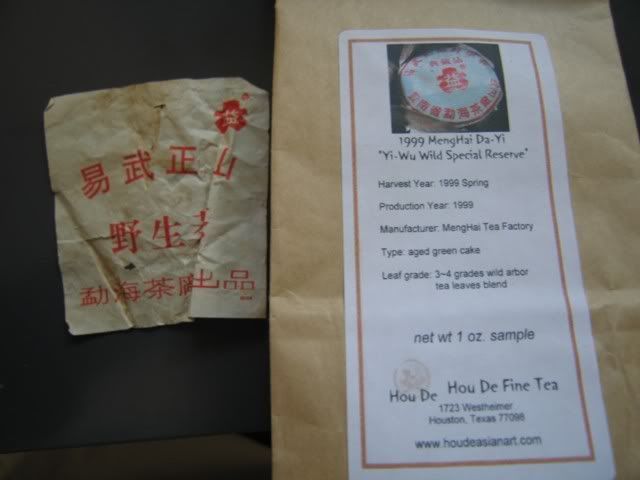
I was digging up old samples today to drink, and found this

The last time I tried this tea was before I went to China, so at least a year ago. It’s been a while. Why not?

The tea is very tightly compressed. I decided to use up the remaining sample I have. I could try to split it into two sessions, but I decided not to.

The last time I tried it I didn’t say much about it. I don’t think I had enough experience with younger puerh at the time to know what I was talking about. Now I think I’m slightly better equipped to deal with this tea.

The short version is — I’m not sure if this is Yiwu, if this is 99, if this is a wild tea, or if this is a Menghai. I don’t think this is a Yiwu because it is too bitter for what it is. It also doesn’t taste very much like a Yiwu that’s aged a few years. In fact, it reminds me most of my 2002 Mengku cakes. The taste profile are very very similar — some bitterness, some astringency, chocolate like flavours, etc. I don’t think this is necessarily 99 because of some of the same reasons, but also because I don’t think I’ve encountered another 1999 Yiwu from Menghai other than Green Big Tree. I can very well be wrong on this. I don’t think this is a wild tea because the tea lacks any sort of throatiness — the flavour stays entirely on the tongue and nowhere else. Huigan is basically nonexistent, especially given the relatively high amount of leaves I’m using. As for Menghai… something about the wrapper (or the little picture of the wrapper) makes me wonder. The very large Menghai words in the bottom looks different than the versions I’ve seen, which have a small font. I’m not saying this is fake, it might not be, but it does look a little funny.

Either way, I don’t think this is a Yiwu, never mind the special reserve designation. Even if it were Yiwu, I don’t think it is a particularly good one. I’ve had better. It lacks the high perfumy notes I’ve encountered in aged-a-bit Yiwus. Instead, it tastes heavy like Mengku tea, which are way cheaper.

Not that this thing is on sale anymore, so it doesn’t really matter anyway. It’s good to know though that I didn’t miss out on a treasure.

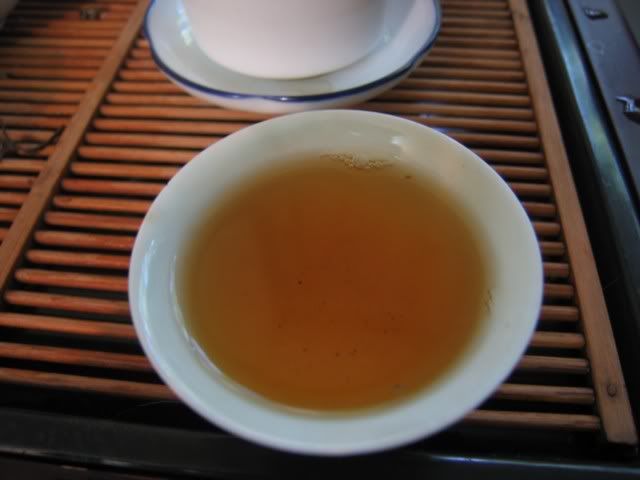
Some pictures of the tea and the wet leaves….

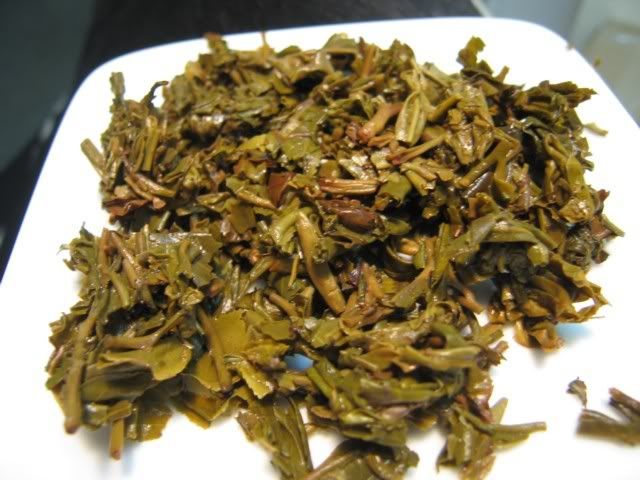
The wet leaves are turning brown, but still mostly greenish tinted (not too obvious in this picture). The leaves are very heavily compressed and also quite chopped up.

Categories: Old Xanga posts · Teas
Tagged:

Back to the regularly scheduled programme

July 12, 2007 · 1 Comment

After almost two weeks of traveling, finally I’m settling down, at least for a little bit before I go again to Taiwan. Now comfortably situated in rural Ohio, I can finally get back to drinking tea that isn’t “100% leaf tea”.

Before I did that though, there’s the issue of water. Ohio’s not known for great drinking water. When I went to college in northeast Ohio, I remember the first sip of water I had there on the first day of having gotten to the school was very memorable — it was nasty. It tasted like swimming pool water. Having arrived from a city where one could get crisp, great tasting water straight from the tap, it was a big change. I eventually got a Brita filter, which served the purpose of getting rid of the foul chlorine taste, but it was still bad water.

I was reminded of the water problem here when I bought a big jug of “White Oak drinking water”. I thought it would at least taste ok, but I forgot to check the source — it’s apparently from an artesian well in northeast Ohio. Drinking it… it was… salty. I got more thirsty drinking the thing. A great way to sell more water, I suppose, but probably not good for me. I eventually ran all that through my Pur filter (which, by the way, I think makes much better tasting water than Brita). It tasted much better… sweet, not salty. We’re ready to brew.

I brewed up the first maocha I bought at Maliandao when I got there last year… sometime in September. I don’t actually remember where the maocha is supposedly from.

From the looks of it, it’s a six mountains maocha, but from the taste, it is not Yiwu or Manzhuan. Whatever it is, it has been sitting in my tea storage unit in Beijing for almost a year now before I took it with me to travel. I drank it on the trains to and from Shanghai, and also on the plane back to the US, each time in a cup with some hot water. It was nice and sweet, with a minty feeling, but I haven’t had it in a gaiwan for a long, long time. It’s time to try that.

The tea, as you will notice, is of a decidedly dark hue when brewed.

Colour wise, it looks very aged. In fact, I’d say that even when drinking it, it feels a bit aged — I think it can easily fake it as a 4-5 years dry stored tea. The taste is sweet, mellow, with some throatiness and not very bitter at all. Bitterness show up if I try to overbrew the tea, but for the most part, it’s very subdued. It’s lost a lot of the very green taste that you’d expect from a very young puerh, and starting to gain something like an aged dry stored puerh. Perhaps this is proof that Beijing storage, so long as it’s not overly dry, can be quite good?

When I overbrew the tea, the colour comes out even darker, with a stronger sense of bitterness, but no roughness. In fact, the tea is smooth throughout, which is a very nice thing. It moves from being a bit minty to being somewhat fruity, but not in the same way that the mystery sample A was fruity. Here you know all along that this is a puerh of some sort, only that the fruity is there in the back when drunk. The tea has good endurance. It yielded many infusions, and when I brewed the last few as hour long brews, they still came out tasting rather good despite the abuse.

The leaves are a bit broken after all the traveling, but still keeping mostly to their original shape and not too chopped up. I must say I’m rather pleased by the tea. I know it didn’t taste like this when I bought it, although I no longer remember what it tasted like. I am now kicking myself for not buying more of it at the time… back then I think a kg of it was maybe half the price of what it would be now. Oh well….

Categories: Old Xanga posts · Teas
Tagged: