A Tea Addict's Journal

Entries categorized as ‘Objects’

Telling tetsubins apart

May 18, 2008 · 18 Comments

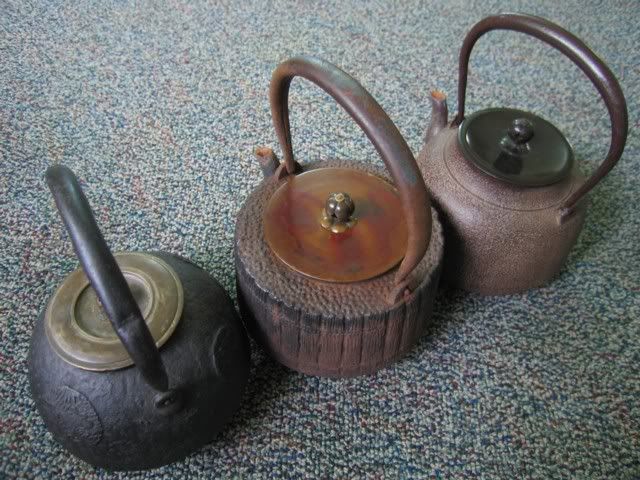
Tetsubins come in all shapes and sizes. Here are three that I own, as well as the smaller, flatter hobnail one that I had trouble with trying to de-smell. Since switching to it, I’ve found it does help with the tea I brew — it’s gained a bit of a deeper flavour, and is probably especially suited to the types of tea I normally drink, which is mainly aged teas these days. It also gives Wuyi teas a nice aftertaste that is more pronounced than with my Braun kettle.

As you can see… they’re not the same at all.
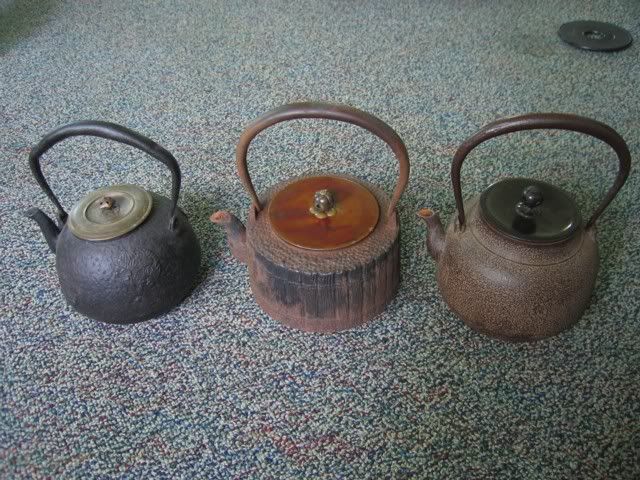
I think when picking out a tetsubin, there are a few things to keep in mind, aside from the obvious question of cost. First — is it a used item or is it new? New ones tend to have enamel lining inside, which neutralizes any effect it might have on your water. The enamel will break off eventually, especially if you heat the pot on the stove directly. If it’s used — how much rust is there in the pot? Does it leak? When I bought my leftmost pot, that was the problem — there was a hole in it and it leaks. Then, I got the rightmost one, which was a newer make, and lightly used. A bit of rust (I’ve since added to it a little — iron will rust no matter what you do), but nothing problematic and makes nice water. Then, very recently, I acquired the middle one for a very low price (around $50). It’s a heavily used item, also not very well kept, thus the outer surface is rusty. You can see it clearly here
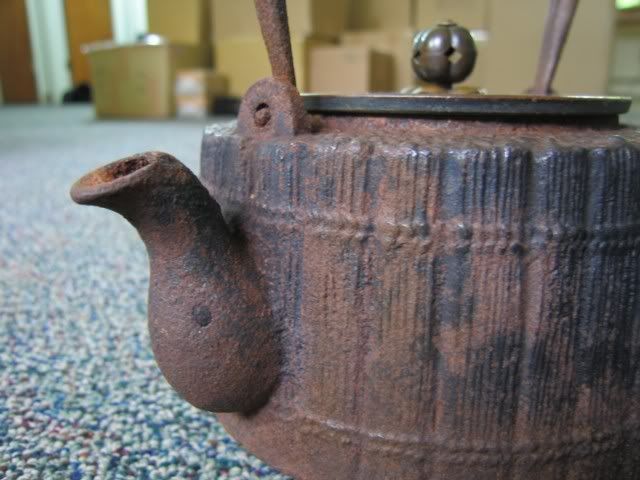
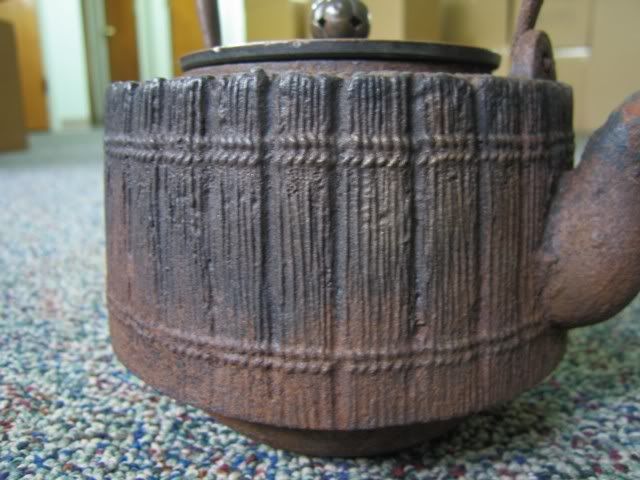
Not the prettiest, but I liked the shape of the thing. I also liked the minor details
Generally speaking, after having looked through many, many of these online, I’ve noted that the cheaper ones are the ones with the solid iron lids — lids that are made of the same cast iron as the kettle itself. Better ones will invariably have other kinds of lids, made of some sort of copper alloy usually, but very rarely also of silver (which sends the price of the tetsubin skyrocketing). Under the lid is sometimes written the name of the maker
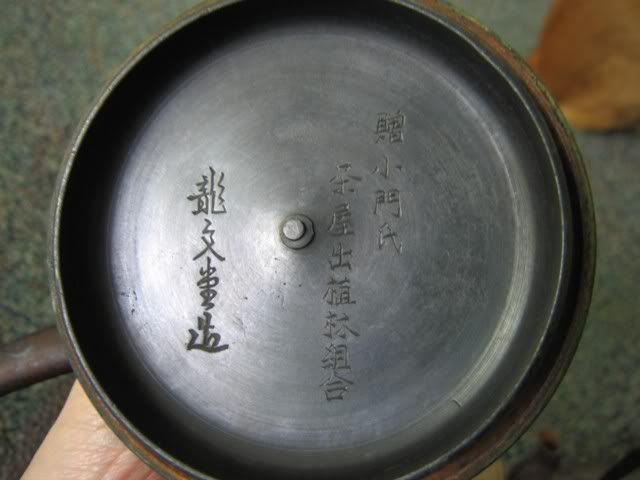
In this case Ryubundo, a famous and also very prolific tetsubin maker that, I believe, got started in the Meiji period. They’re still making tetsubins today, I think, and although well known and famous, Ryubundo tetsubins are actually quite common — you can easily find one from Japan if you look. However, I’ve seen places that sell just lids for tetsubins by the dozen — of various kinds, usually, I’d imagine, from old rusted and broken tetsubins. The lids, however, are worth money, and a non-famous maker tetsubin can be made into something else with the addition of a nice (and hopefully fitting) lid.

I think my right hand one, i.e. the most often used one, is of the usual simple design — a plain pattern with some sort of uniform surface. These are quite common, and generally cheaper, especially if there’s no maker’s name, but even if there are they don’t exceed maybe $200 or so in price. The ones that are wholly iron are even cheaper.

Then, however, you get into more expensive territory when they start having designs on them. The left hand one is of a simpler form — some sort of relief pattern of whatever it is — ranging from animals to leaves to geometric patterns to flowers to VERY elaborate relief patterns of houses, rocks, etc. Some are tasteful, others are gaudy. Some also have old kamon, or family crests, of important families. Those can be quite nice and rustic, but those also tend to be expensive. Of course, these things depend on individual taste.

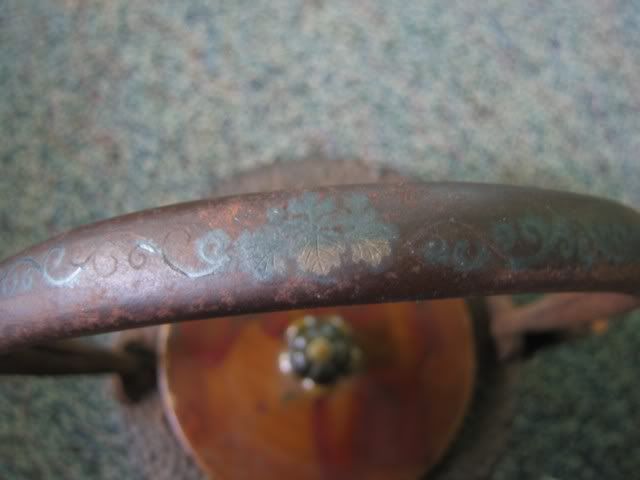
It’s worth keeping an eye out for the way the handle is made too — sometimes the handles are also elaborately designed, whether with some inlaid patterns, as my middle one does (though much faded), or in some cases, with detailed sculpted patterns and figures. Both the patterns on the handles and on the body itself can be highly decorative and sometimes made of other precious metals, usually silver, sometimes gold. Those, again, will drive the price of the items up into the stratosphere.

I sometimes see these tetsubins having a very shiny black surface with zero rust, which I find incredible because if you use it, it’s going to rust, in and out (slight rusting on the outside is hard to avoid when it deals with water all the time). So my guess is, they somehow rub it off or polish it with something, although I don’t know what. If anybody does know, please let me know 🙂

Find ones with original boxes — and make sure (if you can read Japanese — or ask friends who do) they’re the original, not some substitute. Of course, that’s not always possible, and if you just want function, ones without the original wood box work just as well, but the wood box cost money, and the value of your item is substantially lower to collectors if there’s no box that comes with it. My “new” one comes with a very nice weathered box. I don’t think it’s the original, but I wasn’t about to complain for the price I paid, flawed though the piece may be. The box, if nothing else, gives the item an extra air of history to it. I’m a sucker for those things.

Tetsubins are by no means rare, since the Japanese seemed to have produced them in prodigious quantities. A search on Trocadero will yield a number of fine ones, some of which I personally think are fairly reasonably priced (for the quality, anyway). One downside to these things — they’re heavy, so I think I’ll be capping my purchase of these things for now until I don’t have to move again any time soon, because otherwise, it’ll be hell to move.
Categories: Objects · Old Xanga posts
Tagged: ,

Drinking matcha

May 17, 2008 · 4 Comments

Last time I had matcha, it was in Uji about five years ago. There’s a tea culture center in Uji, behind the magnificent Byodo-in. There, you can have the cheapest proper tea ceremony done for you in Japan — I think it was 500 yen per person. The tea room is a bit on the big side, as I’m sure they have to accomodate a large number of people sometimes, tour groups and all. I don’t remember much of the tea — it wasn’t something to really write home about. I just remember my legs almost giving out by trying to sit properly with my knees in front of me. I think I lasted 15 minutes before giving up.

So here I am, trying to make this drink again. I’ve trying playing with matcha before, but only briefly.

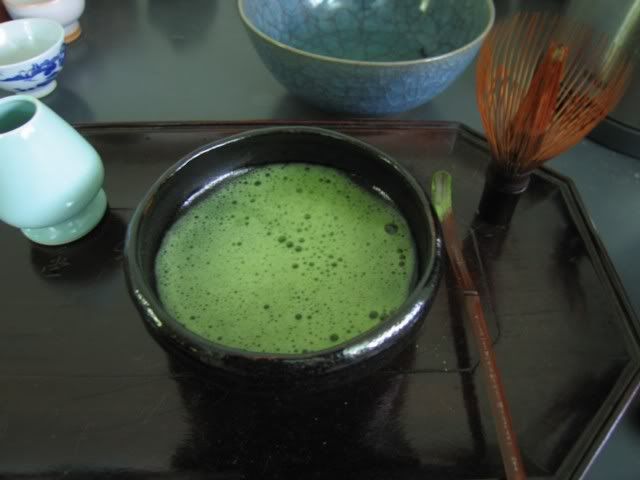
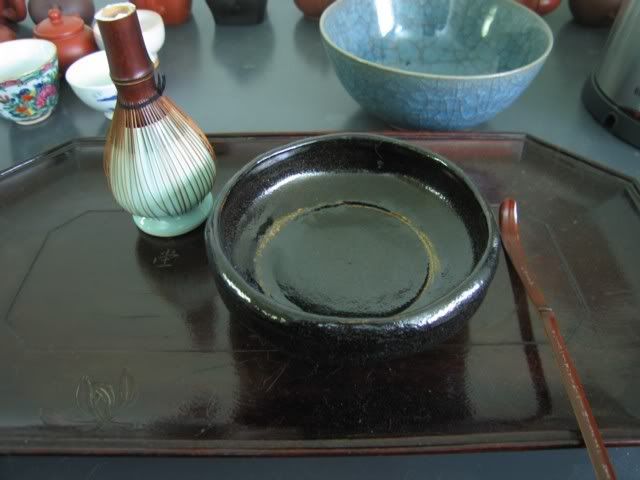
Chawan, chasen, chashaku… and you’re in business. Pretty simple, really.

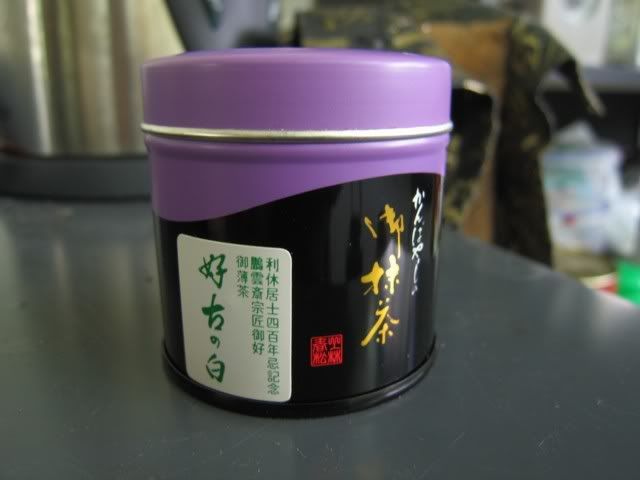
The matcha I used is some stuff I got with the chasen and the chashaku.

Made by a store that is, supposedly, continuously in existence for 450 years in Uji. I believe them. Walking down the street from the train station to Byodo-in really makes you feel like you’re back in an Edo period town. The stores are all obviously old and, thankfully, escaped damage from the war.

I tried

Interesting, because in the mouth, the tea isn’t particularly strong. I made it lightly, in case I did something horribly wrong. I used hottish water — water that was boiled and then let cooled for a bit. I don’t know how hot, or how much exactly, I used. I just eyeballed it as best I can. After drinking it though, I can feel a nice, sweet aftertaste. It also gave me a feeling that is akin to cha qi. A little later, I can feel a jolt, probably from the caffeine.

Interesting. When cooled, it can be a nice summery drink. I don’t see myself drinking this stuff too often — I went to an aged baozhong right after. However, I do feel a sort of obligation, at the very least, to be experimenting a little more in this area.

Now I sound like a drug addict….

Categories: Objects · Old Xanga posts
Tagged: , ,

New toys

May 16, 2008 · 4 Comments

A big package arrived today, with my new toys. Too lazy to take pictures at this point, but you’ll see them tomorrow.

Now….

Anybody has any suggestion on ways to make matcha? I’ve tried it before, but am by no means skilled. Usucha seems more appropriate at this point, since I know making koicha can be tricky.

Categories: Objects · Old Xanga posts
Tagged: , ,

Pot experiment

May 2, 2008 · 3 Comments

No, not that kind of pot.

So I tried to do the “drink the same tea in different pots” bit yesterday and today, especially with a view of trying out the “new” pot with young puerh. My selected victim was my Zhangjiawan puerh

Using the “new” pot first

And then, today, the pot I normally use

Both of the second infusion

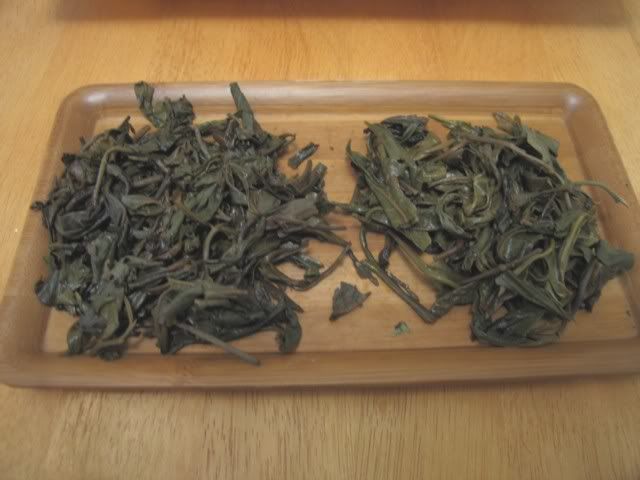
And the leaves

Now, I am by no means claiming this to be scientific. After all, I don’t have a scale, I am not measuring carefully the volume to weight ratio. I’m not calibrating the temperature of the water precisely….

But somehow, the “new” pot has things coming out darker and the flavour generally “older”. It added a year or two to the age of the tea, methinks. I don’t know how that happened.

I might’ve put in a little more leaves, which might explain the difference, somewhat. If you look at the wet leaves, the left side is from the “new” pot. I’m sure the fact that it has been sitting around the pot for a day has changed it a bit, or has it? I don’t know for sure. I do remember, however, thinking that the leaves look awfully dark sitting in the pot when I made it yesterday.

So, no conclusions. Just…. lots of questions.

Categories: Objects · Old Xanga posts
Tagged: ,

Trying out a new pot…

April 30, 2008 · 1 Comment

I used my newly cleaned pot today to make Iwii’s sample 5. Originally, the thought was to see if this pot is any good for young puerh. However, I realized that I don’t know the tea well enough to really judge whether it is making it any better than usual or not, and since I used up the rest of the sample, I have no real way of comparing. One tasting does not a good impression form, I suppose, and so…. I decided that what I might be doing for the rest of the week (or even beyond..) is to use this pot to make a number of different kinds of tea, and see which one it goes the best with. I might actually brew the same tea two days in a row, except that one day it will be with the newer pot, one will be with my usual, and see if that makes any difference….

The new pot I got is really quite porous, so I am thinking it might be good for things like wet stored puerh…. but I guess we’ll find out soon enough, or at least, I’ll have fun trying.

Categories: Objects · Old Xanga posts
Tagged: , ,

A new toy

April 29, 2008 · 6 Comments

Yes, many new toys these days, this one’s slightly different though

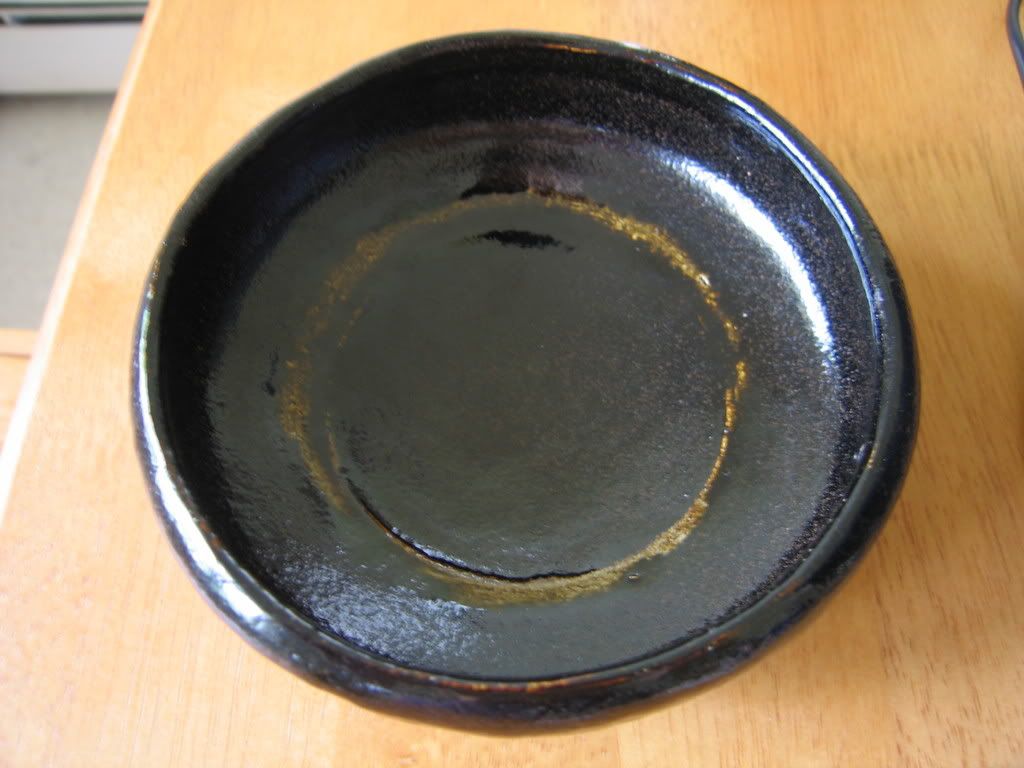
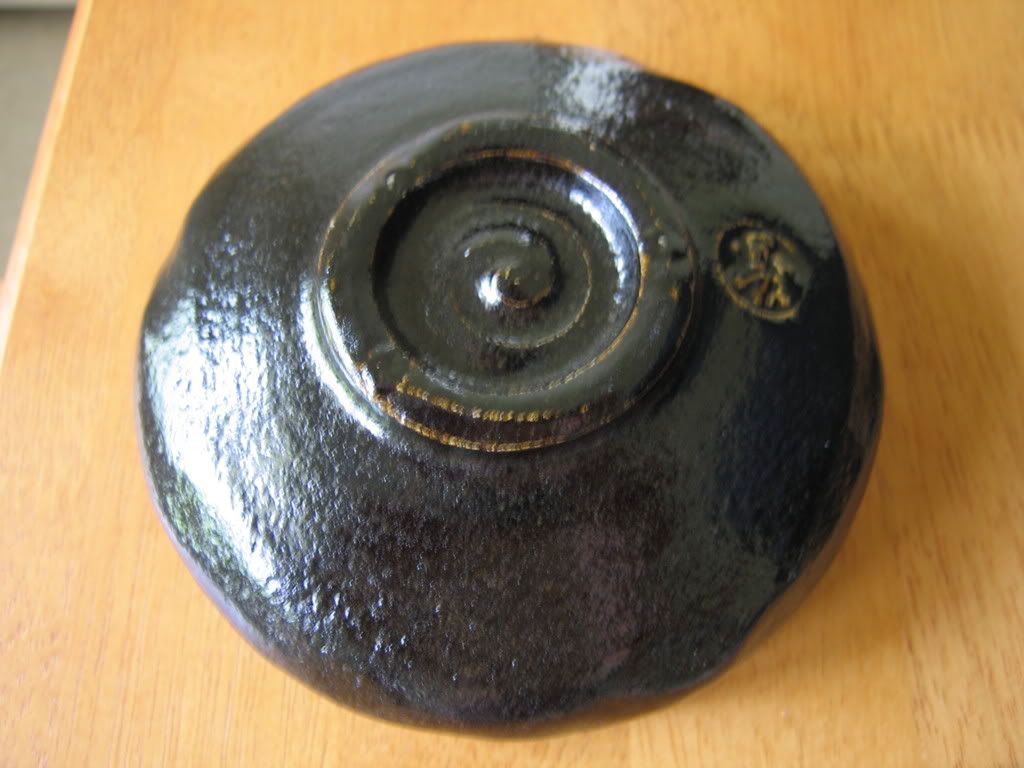
A chawan, a kuroraku hira chawan, specifically, but a chawan nonetheless.

I don’t drink much matcha, but I plan to play with it a bit in the coming days. This stuff isn’t so good for me in the winter, that’s for sure, but in hot summer days, a nice cool cup of matcha can actually be quite nice.

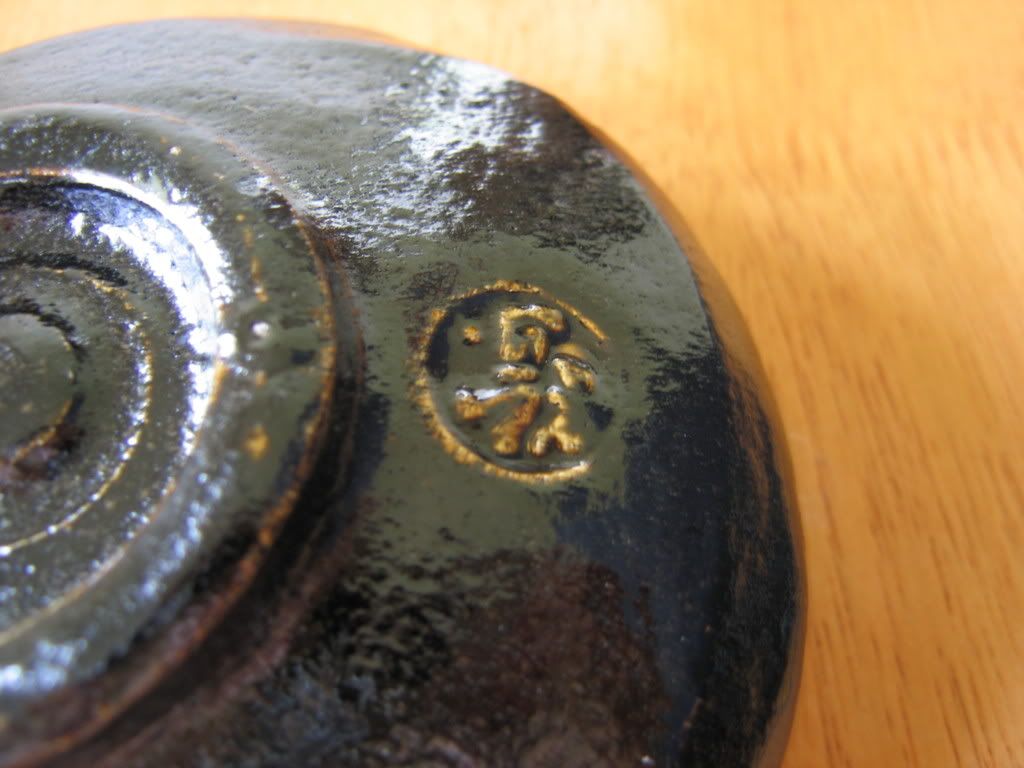
Meanwhile, I’m trying to decipher the artist’s seal

My first instinct is that this is a really stylized version of the word “raku” or “le” in Chinese. I tried thinking up what else it could be, but can’t. It’s a funny shaped raku, for sure…. or is it matsuraku (in which case this is upside down)? I can’t tell. Does anybody have any idea where one can go find better info on such things? Japanese books are fine…

Categories: Objects · Old Xanga posts
Tagged: ,

The power of bleach

April 28, 2008 · 8 Comments

Before:

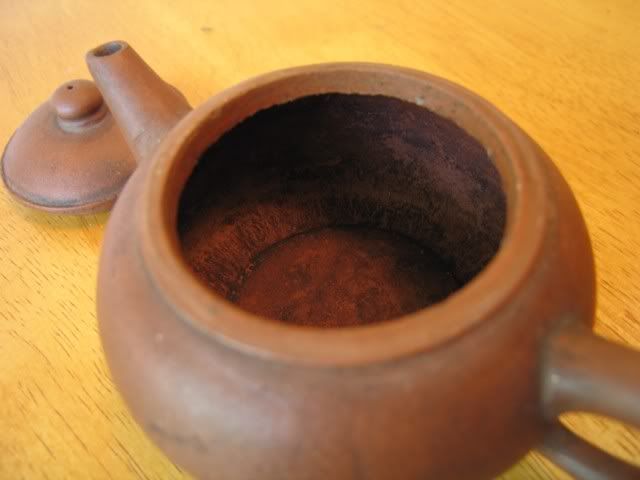
A pretty dirty pot, if I may say so myself. I got this recently, and it hasn’t been cleaned. Time to clean it.

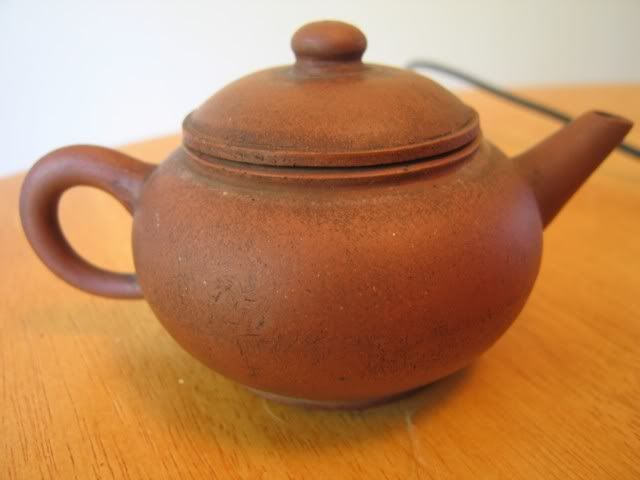
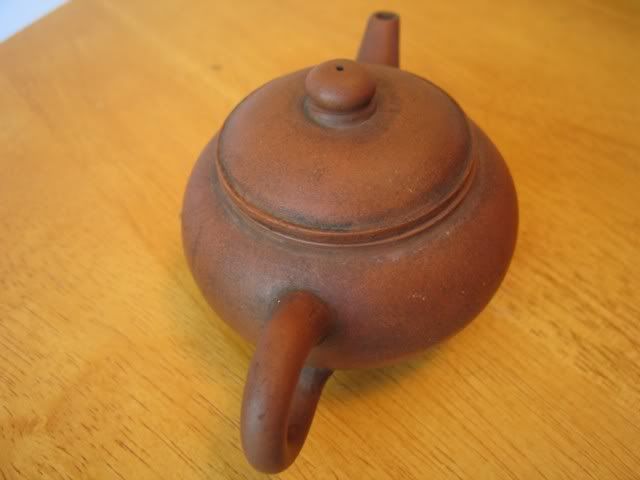
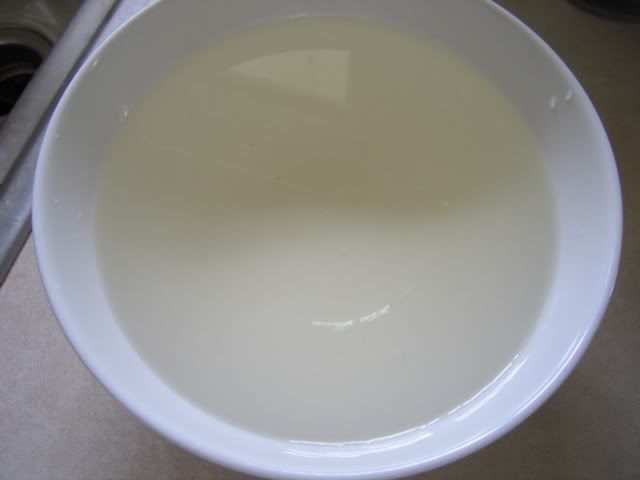
It took a dip in a diluted bleach bath for an hour or two. Then I dunked it in water to try to “de-bleach” the thing. I figured I’d first soak it with some water and see how it does, and then try to do some tea with it. It’s interesting to note that the water turns yellow after a while of soaking — I was using cold water at this point. There’s truth to the “old pots will brew tea on its own” theory.

The pot is now very clean

Now I’m going to let it soak some more, then probably sink it in some tea to wash away the bleach…. then it’s time to try making some tea in this thing.

Exciting, isn’t it? I should’ve taken more chemistry.

Categories: Objects · Old Xanga posts
Tagged: ,

Thoughts on seasoning pots

April 26, 2008 · 7 Comments

My method of seasoning pots is really very simple — use it. I remember when I first started out, I’ve learned all these tricks and things you do when you get a new pot. These days, I find myself not caring so much about all that, since I now tend to think they’re mostly just myth. I do still boil my pots when I get them new, because there are gunk and things that you don’t really want that you may wish to clear out of the pot. The first time I brew a tea in it I won’t drink, because new pots can be nasty. Otherwise though…. I just use.

I do polish my pots sometimes, with a wet (very important — must be wet) towel. Dry towels can make your pot look really shiny but in a slightly undignified way. Rub the pot with the wet towel while the pot’s hot… it will give it a nice shine without that “dry rub” look.

It is important to keep the lids more or less even coloured with the body of the pot, so it is necessary to pay extra attention to the lid. It is also important to make sure that mineral deposits don’t form on the pot — those can be rather difficult to get rid of once they set in. If you have a habit of pouring water over the pot, for example, they can congregate in certain parts of the lid/pot and gradually build up mineral rings. I’ve had one pot that I had to then meticulously work out the ring by constantly rubbing/seasoning that part. Not fun. Use a brush to brush out the liquid so that it won’t happen.

Other than that….. there really isn’t much to do. I’ve found that just by repeated brewing, without even much polishing, the pots gradually will take on a bit of a shine. It’s nice when you can see it change like that — somehow there’s a sense of accomplishment. It’s part of the fun.

Categories: Objects · Old Xanga posts
Tagged: ,

New thoughts on gaiwan vs yixing

April 24, 2008 · 9 Comments

As many of you have probably noticed, I almost never use gaiwans anymore. In fact, last time I touched any of them was when I sold one of them in my teaware firesale. Before that…. I don’t remember when the last time I used a gaiwan was.

I’ve found that there’s really no good reason to use gaiwan when one can use a yixing. I used to think that it is better, for the purpose of testing a tea, to use a yixing rather than a gaiwan, because, so the thinking goes, the yixing might change the way the tea taste in a way that a gaiwan would not. So, gaiwan is thus more accurate as a way to assess a tea.

I think that is still true if and when I am trying to test out a larger number of teas all in one go using the same parameters, as in a multiple sample tasting using, say, 5 minutes brewing. However, I almost never do that. Instead, I brew them normally and form my opinions based on that. If that’s the case, why should I use a gaiwan? After all, if, say, I were making a purchase decision, ultimately after I do buy the tea, I’ll be using my yixing to make it anyway. It would be foolish to use a gaiwan to test it and then never use the gaiwan again to brew it for drinking. As anybody who has used multiple pots for the same tea would probably know, teas behave differently in different pots. Shouldn’t I be testing the tea based on how I would normally drink it, rather than how I never drink it?

Of course, the other thing is that one realizes that there are so many other variables involved, one thing (i.e. vessel) doesn’t really make that much of a difference. Once I saw past that…. I’ve never used a gaiwan since, basically.

Besides, using more teas in pots season them faster. That’s always a plus.

Categories: Objects · Old Xanga posts
Tagged: , , ,

Having tea outside

April 23, 2008 · 7 Comments

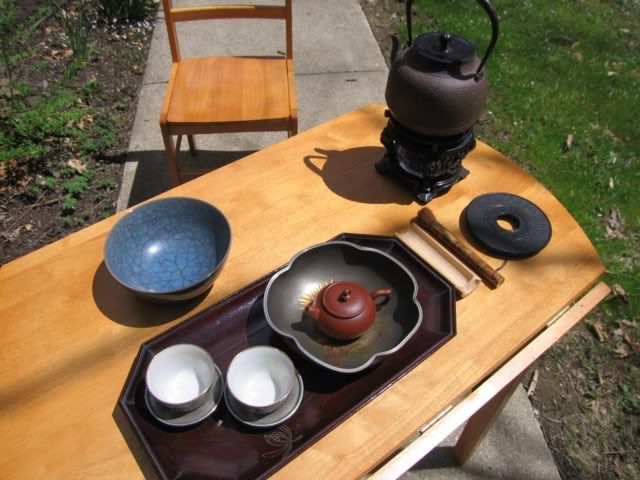
It was nice having tea outside yesterday. The weather was perfect — not too cold, not too hot, not too sunny. Having a way of making water while outside frees you from electrical outlets and lets you make tea anywhere you want…. that’s always a plus.

The first tea we had was a tieguanyin I got from Beijing about three years ago.

You can tell it’s not that fresh anymore, and now that I’m tasting it, I don’t think it was very very good to begin with. Very average stuff, in fact, and probably not even tieguanyin — maybe this is benshan.

For the purpose though, it worked well enough. It was a tea that’s light and not too hard to make. Easy going enough.

The colours are pretty

We then had a beidou #1, also from Beijing. It’s interesting what two or three years of drinking does to you — stuff that you used to think is good no longer seems so good. The beidou is only ok — then again, it’s quite cheap. Compared to the rougui I had two days ago… it’s no match.

What was nice though was to drink outside at all — listen to birds, watching the deer walk by, etc. It’s just not the same.

Categories: Objects · Old Xanga posts
Tagged: , ,