A Tea Addict's Journal

Roasted oolong

December 3, 2007 · Leave a Comment

The second sample I got from the same place

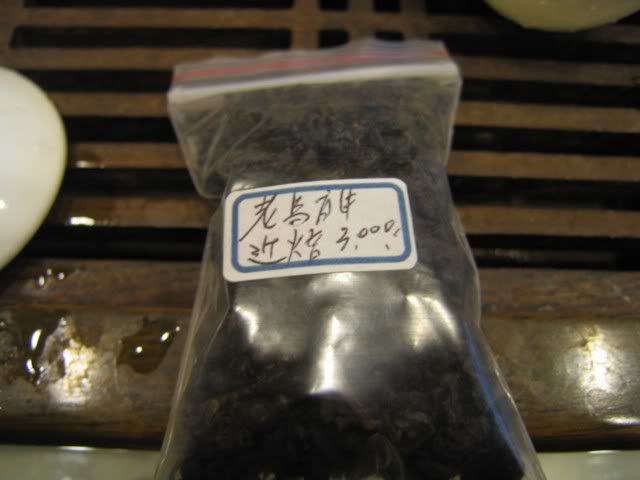
“Old Oolong — recently roasted, 3000 (this refers to NTD/jin)”. That’s what I drank.

Today I was wiser and only put in about half a bag…. no more overfilling of the gaiwan

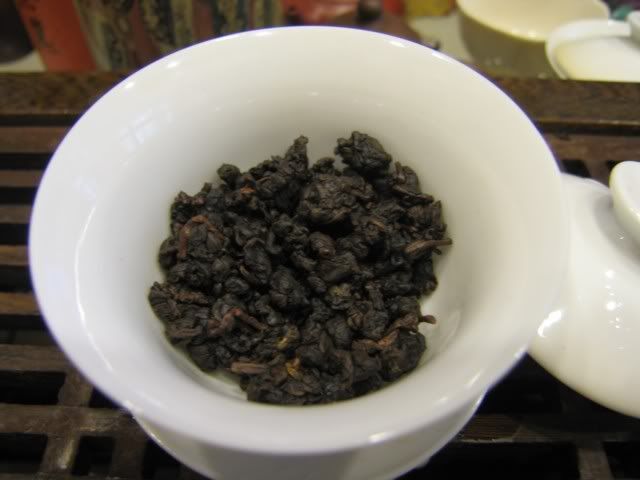
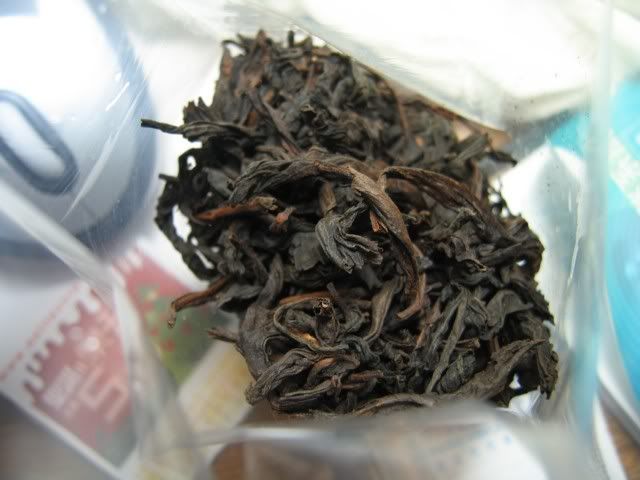
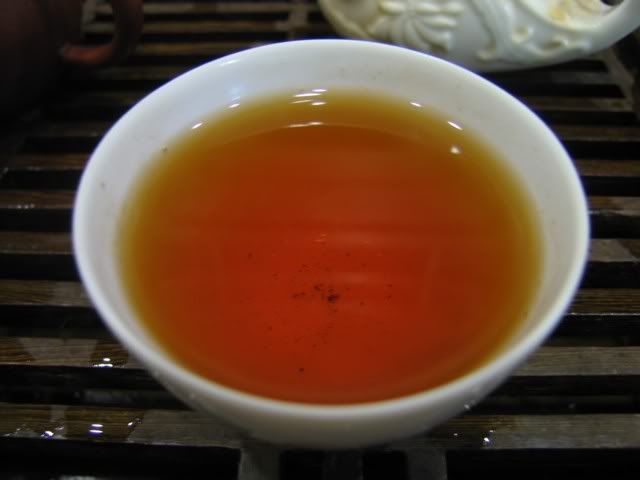
Looks roasted all right.

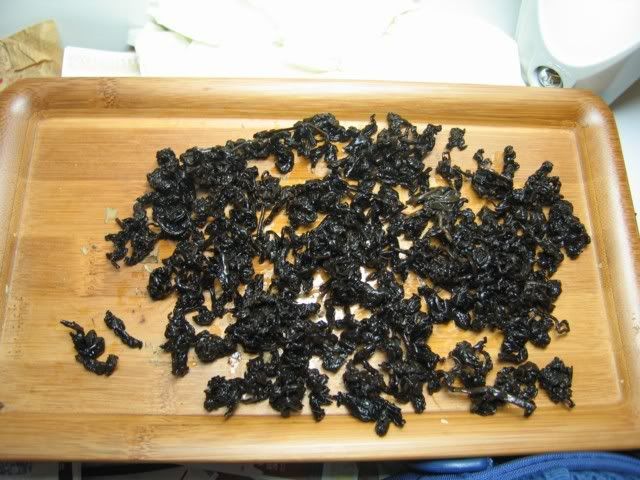
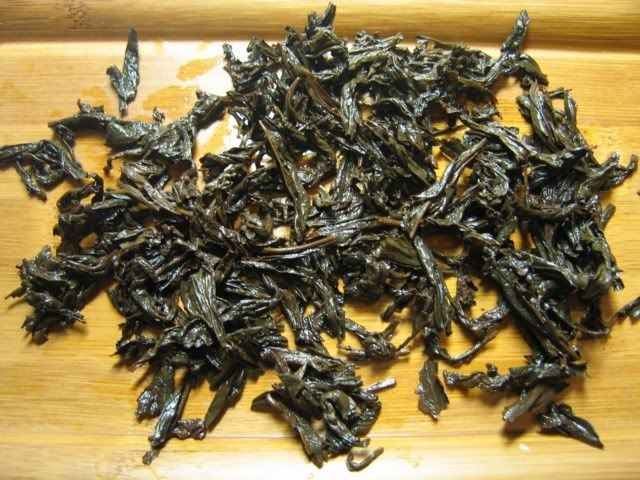
Sure looks roasted all right.

The tea actually is less charcoal-tasting than I thought, but still charcoal tasting, a bit. Cool in the throat, a bit, and when the dust settles, you can feel the aftertaste of an aged oolong. It’s not the most exciting thing, but it’s actually better than I thought. Some roasted stuff can taste more charcoal-like and less pleasant… sometimes that’s fixable by just leaving it around for a while. The charcoal taste will dissipate. Sometimes though the roasting is too much… and the tea becomes flat and boring. Thankfully, it wasn’t the case here.

I also put in exactly one pebble of the biyuzhu from two days ago in today’s tea — I noticed it was sitting in the other sample bag. Can you find Waldo?

→ Leave a CommentCategories: Old Xanga posts
Tagged: ,

Another candy store

December 2, 2007 · 2 Comments

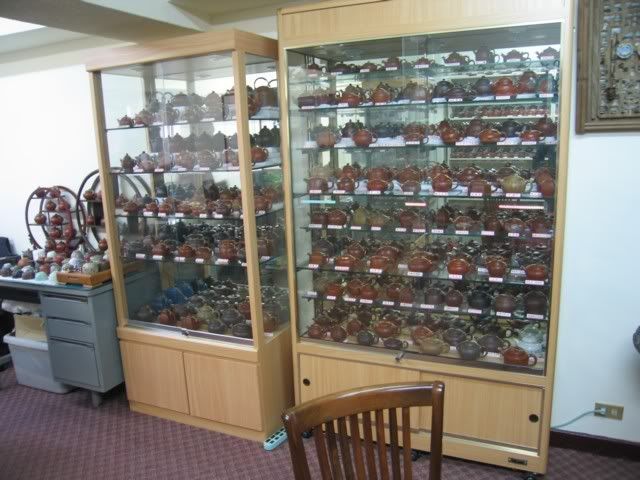
I went to another kind of candy store today

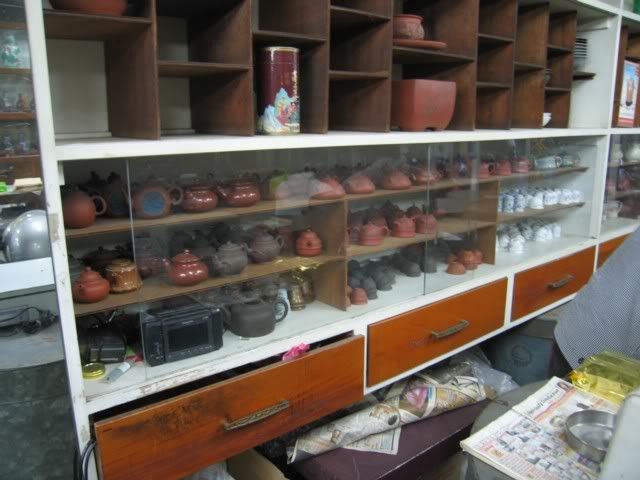
In case you can’t see very clearly — the back of those cabinets are mirrors, and you can see another line of cabinets on the wall opposite of these ones.

This is the antique teapot store that I visited a while ago. As I said, they say they have a lot of old pots…. and I am really no good judge of whether any of these are real or not. Some looked authentically old, some less so. Almost all pots, however, are of high quality — good make, no real flaws, etc.

I ended up spending a few hours there looking over many of the pots he has. The guy is interesting…. rather laid back and just likes to talk about his wares. He keeps throwing me pots to look at (while I’m reading for others myself) and he just wants to show off his collection while talking about it. He claims he has more stuff at home — some are duplicates of the ones he is selling. Entirely possible… Yixing pots are made in batches of three, anyway.

The prices of these things go from the rather reasonable (under $100) to the very high ($1000+). Sizes also vary, and looks too. It’s a dizzying array of stuff, and I honestly am out of my depth. Do the clay all seem good? Most, yes. Do they all seem old? Many do. Some are obviously youngish, while others look old, but maybe faked. But if a fake pot that is well made is, say, $120…. is it worth it? I don’t know.

I took pictures of a few pots I saw, but these aren’t the best ones… I felt sheepish asking if it’s ok to take pics of the best looking ones for some reason. I don’t even know why.

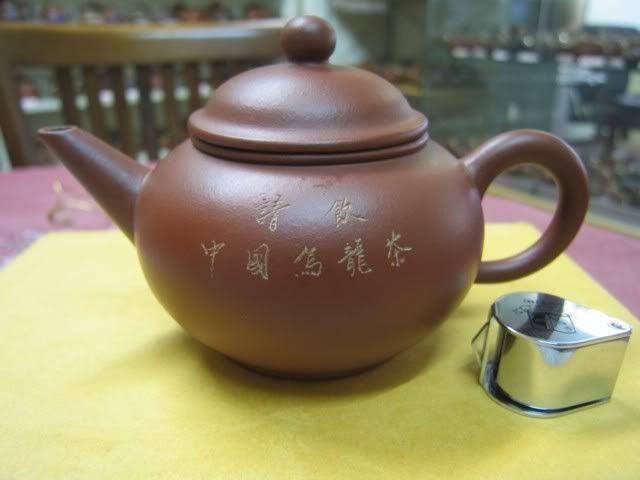
So here’s a “Please Drink Chinese Oolong Tea” shuiping.

With the maker’s name under the lid

Another shuiping — supposedly earlier, actually. Very thin walls. I felt like I could crush it in my hands.

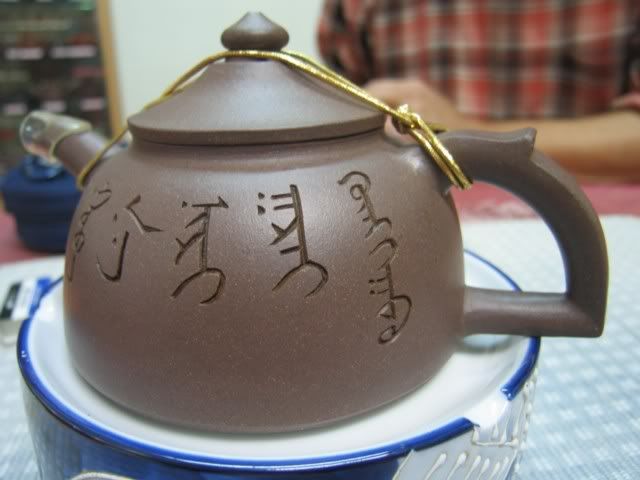
And then a weird one…. a big pot with possibly Manchu carved on it. My girlfriend is trying to figure out if that is actually Manchu — some of the spellings are off.

I really should’ve taken pics of the better looking pots….. maybe next time.

→ 2 CommentsCategories: Objects · Old Xanga posts
Tagged: , ,

Biyuzhu

December 1, 2007 · 2 Comments

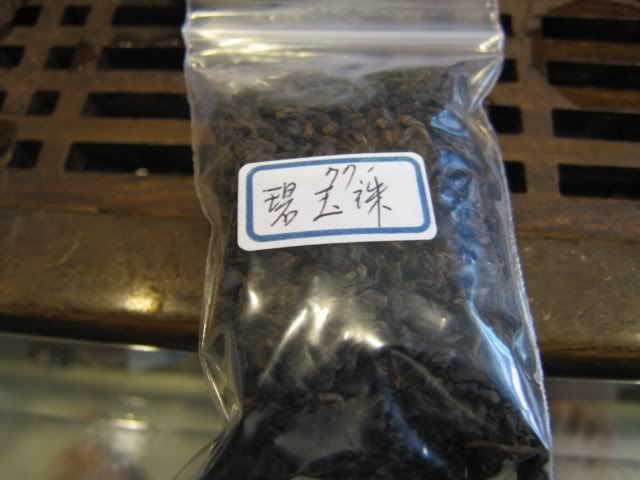
So I went ahead and tried one of the free samples I got from yesterday’s store.

ROC Year 77, Biyuzhu, which literally means “Bluish-Green Jade Pearl”, or perhaps slightly better, “Bright Jade Beads” or some such. There’s nothing jade-ish about them, since they’re now rather black, but I suppose once upon a time, they were really nice and green.

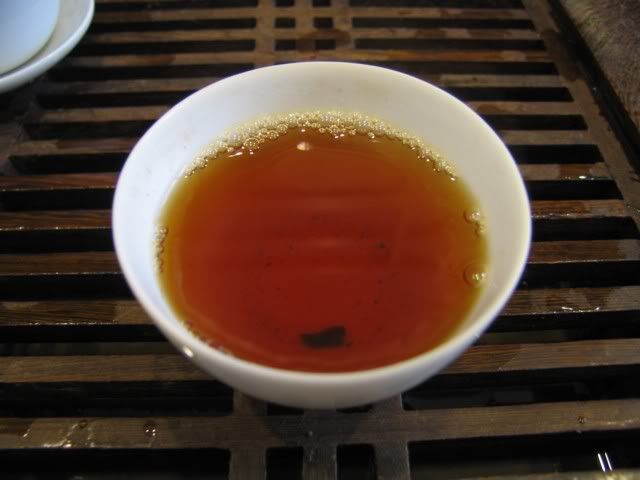
The tea was a spring pick, and the leaves are all very small and tender. The tea brews a darkish colour

Although by the time of the third infusion, I realized I had horribly underestimated the amount of leaves in the little bag, and had overfilled my gaiwan. I took a bit of leaves out of it, but I suspect I could’ve taken out more and still gotten a good cup. The tea is nice… very perfumy despite the long age, no sourness detectable, not too sweet, and in fact, still a little green in the taste — you can sense that this was once a green Taiwanese oolong. Now it’s an aged green Taiwanese oolong. The laobanniang said this tea was never re-roasted, and I sure believe that, because I don’t detect any sort of roasted taste. It’s a very interesting tea, although perhaps not an everyday kind of tea.

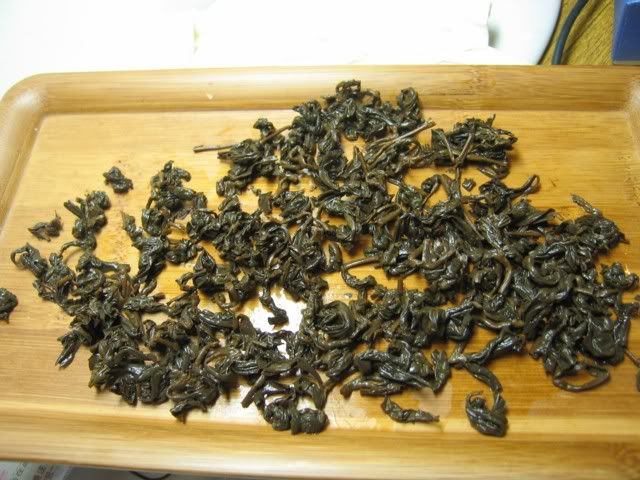
The wet leaves are still greenish-brown.

Definitely worth picking some up though. The perfume notes are quite alluring. I should try making it with even less leaves next time — brew it just like a light Taiwan oolong.

→ 2 CommentsCategories: Old Xanga posts
Tagged: ,

Treasure troves

November 30, 2007 · 6 Comments

I had some extra time today, so I went back to the same tea shop that I visited last weekend today. Specifically, that was the one with the big tea canisters (picture in the bottom of the post) and where I picked up a few aged oolongs.

I wanted to get some of the tieguanyin which was so good, and hopefully, to find more stuff there that’s hidden in those big canisters.

The laobanniang (literally owner’s wife, or female owner, of a shop) was pretty happy to see me coming back, and when I asked for the tieguanyin, she promptly went to it. I also asked if she has other stuff — stuff that is more like this and less like the qizhong, which I told her is a bit too sour. She said there are lots of different stuff in her store, but she might need to spend some time looking for them. I think she could sense that if she finds anything good, I’ll be willing to buy them. I also venture to guess that she doesn’t sell much of this stuff normally.

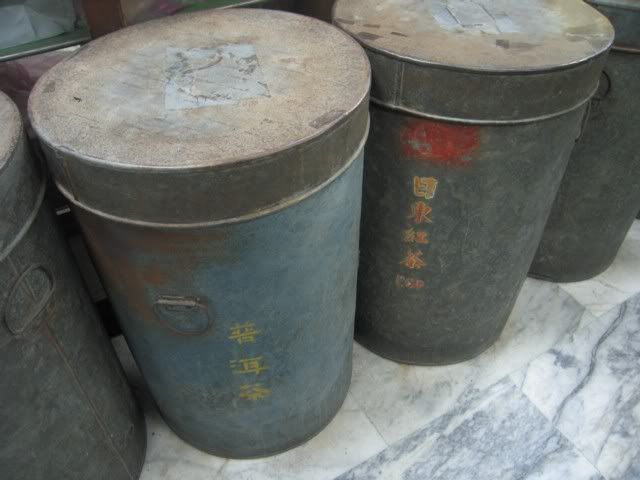
Now, to give you an idea of what we’re talking about…. this is a closeup of one of those tea cans. This is the smaller sized ones (the ones you see lining up on the left in the last entry about this shop)

On one can it says “Pu’er Cha”, the other “Ridong Hongcha”, a type of Japanese red (black) tea (here’s a link to Nittoh Black Tea, their proper name). What’s in the can has nothing to do with the words on them, and this is true for pretty much all of them in the store — about 4-5 dozens of them.

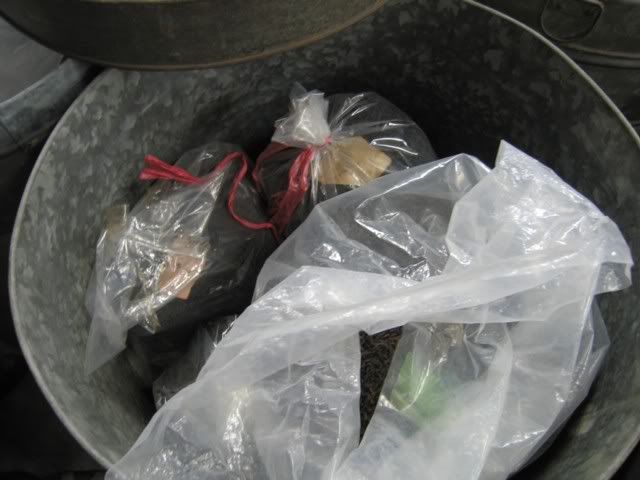
Inside each of them are bags

Like this (this is a picture of one of the bigger cans on the right hand side). In each of these bags are kilos of tea — some more, some less. The little slip of paper indicates what it is, and how much it should be. Some of these bags probably haven’t been opened for years, and I suspect many of them are simply leftovers from stock they had years ago — half a kilo here, two kilos there, etc. Tea that is valuable enough to keep, but after a certain time passes, not easy to sell. How do you tell a regular customer that you have some three year old oolong you can sell them? They’d think you’re a crook. So in the bags they sit. Year in, year out, and the older bags probably sink to the bottom. The opened bag is the one with the tieguanyin that I want. The other two unopened bags? Other kinds of aged oolongs that I haven’t even tried. She opened one bag for me and got me a sample. The piece of paper says “ROC Year 77 (1988), Spring, 2400”, 2400 being the price of the tea. It’s a lightly rolled oolong. Not sure exactly what it is, but it sure looks old and doesn’t smell sour. Let’s hope it’s good. If I could, I’d spend a whole day at the store, opening each can, and looking through them, trying teas. I’ll be like a little kid.

She said she will prepare some more samples for me when I go next time. I told her I’d like to try anything she has and decide what I want. I know that other than Taiwan, buying aged oolongs is difficult, and so I should take advantage of the fact that I’m here to snap up enough for at least a year or two’s worth of consumption.

Not only do they have old tea… they also have old neglected teaware

Too bad teapots don’t age the way teas do. Most of the teapots are pretty mediocre anyway.

So…. I made off with some of the tieguanyin, and two samples. One’s that 1988 tea, the other is also an old tea that was recently re-roasted. I want to compare them and see. I think, though, that given what I’ve tried so far, I prefer stuff that haven’t been re-roasted.

→ 6 CommentsCategories: Objects · Old Xanga posts
Tagged: , , ,

What I learned about aged oolongs

November 29, 2007 · 5 Comments

Ok, I was going to talk about the Wuyi Qizhong that I got along with the aged Tieguanyin and the aged shuixian that I got…. but that got derailed, because the tea turned out sour, enough so that it’s no longer pleasant to drink. If made lightly, I can probably get something out of it as an occasional beverage, but that’s about it.

So…. instead, let’s talk about aged oolongs in general.

As those of you who’ve been reading the blog have probably noticed, I’ve been on a binge for the past few months drinking various sorts of aged oolongs. Much like what I was doing with youngish puerh, I’ve been trying to get my hands on a wide variety of aged oolongs and drink them, becuase I think that’s the only way I can learn about them properly. What other people tell you is all fine and good, but nothing replaces actual drinking experience.

So with that in mind I went around Taipei looking for them. I asked about them no matter what tea store I walked into. The first thing I’ve learned is that everybody has some “laocha”, or “old tea”. When you say old tea here, you are usually talking about aged Taiwanese oolongs. Some people have assumed I was talking about puerh, but that’s often because I’m young and young people usually don’t drink old oolongs. Puerh is more fashionable to drink.

Just because everybody has them doesn’t mean they’re all real, or good. First of all there are very very roughly two kinds of Taiwanese teas that are often aged, at least among the stores I’ve been to. Baozhongs come in abundance, but there are also a number of places that sell aged oolongs — the rolled kind, often from Dongding, but sometimes from other places.

There are roughly three types of aged oolongs, I think. One is your “often reroasted” kind. Liquor from these will be dark and sweet, mellow, not too floral. One is the “dry stored from strong roast”, I think anyway, with a more puerh-like flavour and a residual note of floral quality. Then you have the younger, “still kinda green” aged oolongs. Those are actually nicer than current year stuff, I think, but I’m not sure how viable they are for long term storage. More honey like, some floral notes…. still quite nice.

This is, of course, discounting the fourth and most common kind – oolongs turned sour. These are teas that are usually stored improperly — picked up moisture, or itself had too much moisture when stored. Reroasting will take care of it, sometimes, but not always. There will also be people who tell you that some sourness is natural in an aged oolong, and some might even say it’s the mark of a good aged oolong. Take that with many grains of salt. A hint of it can be a nice thing, but…..

And… there are also the fakes. Since there is simply no way for you to tell with certainty (at least I haven’t discovered a surefire way) just by observing the dry leaves if the tea really has been aged or not, fakes happen. Most often, they are just heavily roasted teas that have been, one way or another, doctored to make them seem aged. I’ve been to stores that gave me a few aged oolongs that are obviously just roasted oolongs with no age behind them. I’ve managed to avoid most of those, but still, a few slipped through because I couldn’t taste the tea or because I wanted to make sure. For people who haven’t had a lot of exposure to this type of tea, it’s an easy trap to fall into.

Because of aging, firing, etc, no two aged oolongs are exactly the same. Especially since there are no identifying marks of an aged oolong — there are no wrappers, neifeis, etc (unless your tea came from a competition with the accompanying documentation) so stuff from store A will always be different from store B.

This gets us to the question of price. Prices for these things vary wildly. Among the types of teas I’ve tried, they range from something like $50/600g to $300/600g. Yet, stuff that are on opposite ends of this range can taste remarkably similar. I’ve also had stuff that taste better but are cheaper than the more expensive counterparts. Obviously, taste is taste, and some others might disagree with me with my preferences, but generally speaking, when the price difference is, say, 3 or 4 times, and when the tastes are very similar…. one starts questioning whether the more expensive tea is worth the extra cost. It is also worth noting that the places with the high priced aged oolongs are generally speaking of the more “arthouse” variety — nice decor, good location, etc, that means you’re paying for a lot more than just the tea itself. In fact, some of these teas are probably sourced from the places where I’m buying the cheaper varieties — many of these arthouses haven’t been around long enough to store the teas all the way since their birth.

I haven’t really tried any of the aged oolong offerings that one can buy off the internet, so I don’t know how they compare, or what categories they fall into, or if they’re even aged at all. But aged oolongs can be wonderful, and I think the good ones offer many nuances that can rival (or even beat) an aged puerh. This is especially true when you factor in the price of many older puerhs these days, and the high proportion of fakes out there. Anybody who makes a trip to Taiwan should at least give this stuff a try — I think it’s well worth the effort.

→ 5 CommentsCategories: Information · Old Xanga posts
Tagged: ,

The hermit store

November 28, 2007 · 3 Comments

I was running an errand today that took me somewhere very near a store that was recommended to me. I had some extra time, and it was tea time anyway…. so why not?

I found the place after walking a little bit. The store can be best described as… shabby. On a scale of 1-10 for decor, it rates a 0. It is dark, with an old table, some old teaware, old tea (lots of it), a broken display case with some old cakes in it, and after some time drinking tea there, an old cockroach running around that the owner killed with bugspray.

If nobody recommended this place, I don’t think I would’ve spent much time in it.

But, the guy said this store has a lot of old tea, so, heck, why not.

When I walked in a woman was chanting Buddhish sutra loudly. She didn’t even notice me, and it was only after I (deliberately) made some noise fumbling the (some broken) teaware that she realized somebody’s in the store. After some talking, she called the owner back. He’s her husband, and probably in his 60s. An interesting looking guy, who, after sizing me up, asked me what I want to try. 80s? 90s? 00s? Sheng? Shu? I tentatively suggested 90s sheng, and then he asked “do you want the strong ones or the smooth ones?”. Strong. So… he reached back into a little canister, pulled out some tea, and started making it.

It’s some early 90s 7542. Not bad at all. Sweet, a bit mellow now, not too rough…. quite right, actually, and definitely dry stored. Then we had an early 90s 8653 (Traditional Character) that was stronger, lasts more infusion, but also a little rougher. Very good tea, both. I wonder if either of them might be worth the asking price.

Here’s the dilemma… it’s a cake that isn’t quite yet good for drinking, but is obviously much closer than anything newish. I suppose the price is affordable, but is it worth that much?

Food for thought. For now though, he’s said if I want to I can come back and drink tea with him. I’ll probably go back at some point.

→ 3 CommentsCategories: Old Xanga posts
Tagged: , ,

Aged tieguanyin

November 27, 2007 · Leave a Comment

This is an aged tieguanyin that I picked up along with the aged shuixian I had yesterday

No indication of when this was, other than that the loosely rolled style signifies something from at least probably 10 years ago — nowadays tieguanyin are mostly tightly rolled, Taiwan style. I haven’t seen many tieguanyins that are new that are loose like this.

The tea smells musty when water first hits it. I thought puerh. In fact, the wash and first infusion smelled so much like puerh, for a little bit I wondered if she gave me a puerh instead.

Doesn’t it look right?

When I sipped it, it tastes almost just like the Yetang aged Dongding that I have. There are subtle differences — this one is a little less floral (it’s orchid like), and a bit thicker — perhaps because it is a tieguanyin and not a Taiwan oolong. The finish is also different, with this one being obviously stronger. Yet, the similarities are stirking.

The tea lasted many infusions — mostly keeping to the orchid like quality, but at times something else shows, a different kind of aroma than what I got from the Dongding… I don’t really know how to describe it, but it’s unique to this tea. It also cools the throat a bit, like a puerh sometimes will. Doesn’t happen too much with tieguanyins though.

And to think this is only about 1/3 of the price of the Dongding, ugh.

The leaves are quite robust

Much better than the shuixian yesterday. Costs more, but not that much more. Between the two, there’s no competition. I’m surprised this tea isn’t sour at all, but it isn’t. It’s really quite a nice find, I think. Now I have one more tea left from this store — I have high hopes now, given how the last two have turned out. I wonder why it’s kept so well?

→ Leave a CommentCategories: Old Xanga posts
Tagged: ,

Shuixian from …. 1988, supposedly

November 26, 2007 · 2 Comments

At the store that I took a picture of, I picked up some of this tea as a sample.

It is supposedly from 1988 — there’s a little piece of paper in that big bag of tea that says ROC year 77 — which translates into 1988. I don’t know if it’s real, but the chances of somebody asking for that particular tea is so slim, and the price is too low, for the ticker to really work. It also smells aged.

I didn’t use enough leaves today

The tea turned out weaker than I imagined. It’s a bit on the thin side, but that might very well have to do with the fact that I didn’t use enough leaves. I should’ve made it in a gaiwan, but didn’t. It’s got that aged taste, but instead of the Taiwan finish, it has a very strong “yanyun”, or rock afterglow, that is typical of Wuyi teas. It’s actually much stronger than some of the more recent shuixians I’ve had. I wonder if it’s because teas in the 80s were just… well, better. I should give this another try before deciding. No sourness, which is always a good thing.

The leaves don’t look that bad, but nothing too interesting either.

→ 2 CommentsCategories: Old Xanga posts
Tagged: ,

A tea meeting

November 25, 2007 · 3 Comments

I went to meet some guy from the Taiwanese tea forum t4u today. He just posted an open invitation for anybody in the Taipei area to come. It was supposed to be a 3 people affair, but I was the only one who showed up at his place, so it ended up just being me and him.

The original focus of the meeting was to drink “Big Tree Tea”, referring to puerh. When I got there, we weren’t sure if the other person was going to show, so he offered to make some Taiwanese shuixian first. This is Wuyi varietal planted in Taiwan (these are mostly gone nowadays). It’s been aged about 20 years… and it’s a very good tea. I quite liked the complexity in the taste, and since I’ve been dabbling in aged oolong these days, it was an interesting contrast. I’ve met a tea or two that tastes like it.

The other guy was still a no show, so we went on to an aged dongding. This is a very different kind of aged dongding than the one I bought. It’s not as heavily fermented, and the agedness is lighter — it has a mild fruity sourness that is interesting instead of revolting. I think I prefer the style of the first instead of the second — not that the second is bad at all.

Still no show, so we proceeded with the puerh. I brought three samples, which we tasted in quick sucession. Nothing too interesting there, with one he thinks more like an old tree tea than the other two, which were more plantation-esque. It’s always nice to exchange views with somebody else on tea, especially youngish puerh. So much tea out there are called “old tree”, but yet very few actually are. I haven’t really devoted much thought to this problem recently, but now that I think about it… one of these cakes is indeed aging faster than the other two, obviously so, in fact. Aging faster in the first few years seems to be something that big tree tea is supposed to do. Maybe that gives me the explanation I needed… not that it really matters either way.

The other thing that we ended up agreeing is that the big tree teas are often less interesting initially — they can be very subdued things that only gradually show their true worth. They’re not teas that will wow your mouth — that’s the work of plantation tea. Instead, they are subtle but strong. The subtlety though can be mistaken for weakness. I know people who routinely think that these are crap because they seem weak.

Will it be better in the long run? This friend (let’s call him N) thinks it will. N thinks, from his experience of drinking teas from the 70s or before, that this is more like the sort of thing that was put into the old cakes. He thinks early spring puerh are a bad deal (the really buddy ones), which I concur as well.

We moved on to two more teas (that’s 7 for those of you who are counting). The first is a 2002 Yiwu which he has and likes… and tastes quite similar in some ways to the Yisheng tea that I bought a few of in Beijing, but only more aged, since the Yisheng is 05. It’s a nice tea, very mellow. The second is a 1996 Purple Dayi… a little more “big factory” ish. N thinks it’s mixed in with some (not a lot) big tree material. Perhaps, although the big factory taste still dominates. At today’s prices for this sort of thing, I’m not sure if it’s all that worthwhile. Interesting stuff though.

I was a bit high on caffeine at the end, but not too terribly so. Still, it was nice to meet somebody new who’s obviously interested and engaged in tea, and has that sort of intellectual curiosity in exploring different things. I wish someday I can throw a tea party for all the people whom I’ve met (and whom I haven’t met, like you lurkers out there), but alas, I’m not Toyotomi Hideyoshi.

→ 3 CommentsCategories: Old Xanga posts
Tagged: , ,

A tea walk

November 24, 2007 · 3 Comments

I decided to go for a walk today, since the weather is finally nice (albeit briefly) after many many days of rain and almost-rain (which is I think partly why the cake started growing mould). So, where to go? I went to the Chongqing N. Rd area, where the old shops are. I’ve only explored a small area of that street, so I decided to walk the other way and come down from the north.

There are indeed lots of teashops on the way, many of which look like old wholesale stores. Some scenes from the street


I visited three stores. The first is a more touristy/retail oriented one. I drank an aged oolong that’s more fired than aged, but it was pretty interesting, especially the strong tangerine peel notes in the aftertaste. There isn’t much else of interest there though, and I wanted to keep walking…

I passed by a few stores that pretty much ignored me — the man might be watching TV, or busy doing something else. I just poked around. Then I passed by this store that looked newish, with puerh and stuff and not at all like all the other places I walked by today…. so I went in. My, the guy was rude. He didn’t look too happy to start out with, and then asked “so what do you drink? sheng or shu?”. This is a pretty typical question to ask a new customer in a puerh shop. I said I drink pretty much only sheng. Then came the response, “oh, these days it’s pretty hard to afford to drink sheng”. It was said in a way that actually meant “it’s pretty hard for people like you to afford sheng”. Needless to say, I walked out of the place right away. I don’t mind stores that ignore me or whatever — it’s almost charming, but I’m not about to walk into a store that actually insults its customers. And this wasn’t even one of those charming old stores. This place is for “rich” people who can afford their teas (which were for the most part standard issue 80s or 90s teas… nothing spectacular)

Anyway, I left with a sour taste, but quickly forgot when I was further ignored at another store that was obviously some Grand Old Shop that does wholesale. One kilo of jasmine for $2 USD, anyone?

I ended up walking into a random store. I don’t know why I ended up there instead of the other ones, but I walked in, and first poked around, looking at the (bad) pots they had along the wall. Then I asked the lady if she had some aged oolongs, my standard opening line these days. She did (they all do, no matter what). I saw it, asked around…. and then saw there were cans that said “Wuyi Shuixian”. So I asked if they had shuixian…. of course she does, and then she proceeded to open some of these cans. Interestingly enough, the ones she opened said “puerh” on them. In fact, the cans are basically unlabeled — the names on the cans have no relation to what’s actually in them, but she remembers exactly what’s in which. I ended up buying a bit of aged qizhong, and some aged tieguanyin. I also got some shuixian from the 80s.

Now I only need to try my new acquisitions….

→ 3 CommentsCategories: Old Xanga posts
Tagged: , ,