A Tea Addict's Journal

A nostalgic tieguanyin

January 14, 2008 · Leave a Comment

One of my boxes from Taiwan arrived with a bunch of tea in it. I couldn’t wait to pull out the bag of that tieguanyin that I felt reminded me of how tea used to taste… and taste it.
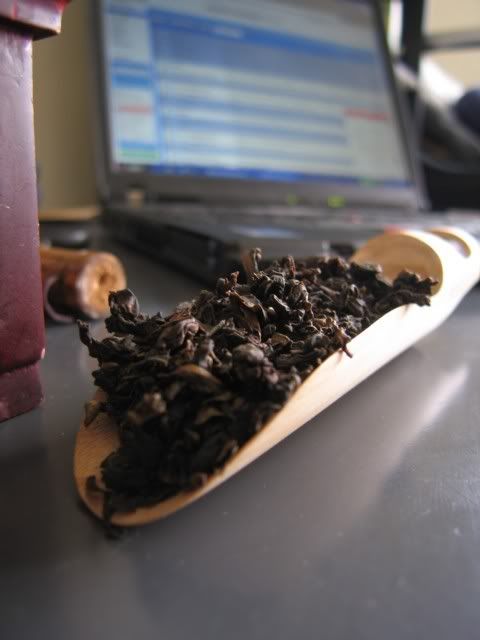
The dry leaves of the tea is unremarkable. It looks more or less like a roasted tea, but you can see how the rolling of the leaves was light — it was done in the old style when leaves were much less tightly rolled than today’s teas, which are so tightly rolled into a ball that you can actually throw them around. I’m not sure of the exact time when the switch happened, but I think this is at least 10 years ago when the mainland started switching to the more tightly rolled teas.

The liquor also looked like roasted oolong
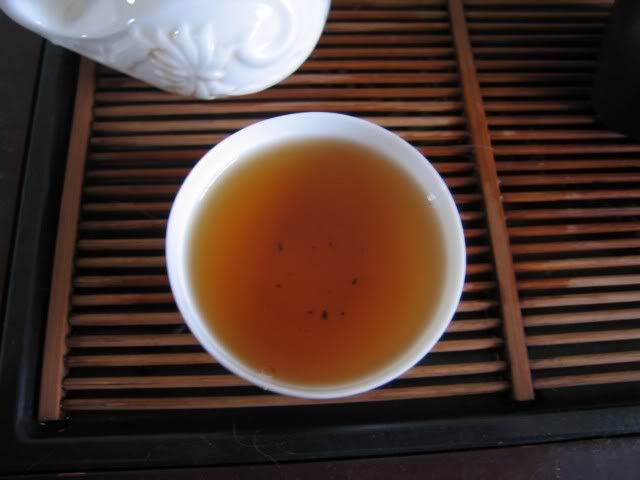
But there’s very little roasted taste, in my opinion, in this tea. I’ve sent it to people who thought it tasted more roasted, so perhaps it’s because I’ve tasted stuff that have been very roasted that I don’t feel it. To me, it doesn’t really have any charcoal taste, and it also doesn’t have much of that “fire” taste in roasted teas. It’s mostly just sweet…. quite sweet with a soft aftertaste that lingers in the mouth, a sort of plummy taste. I don’t know what it is, exactly. Maybe somebody with a better range of taste-related vocab can do a better job.
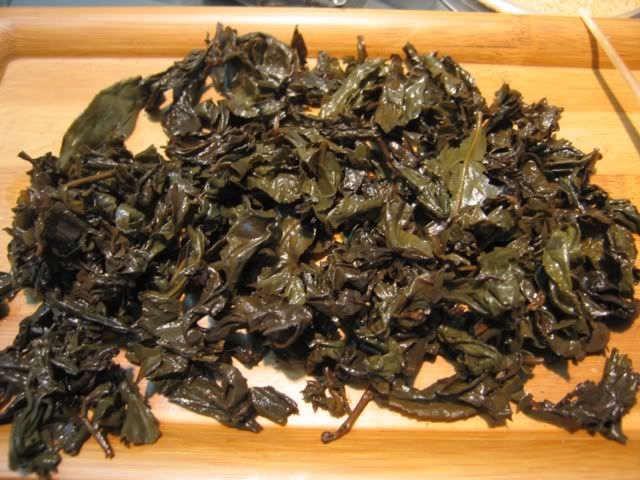
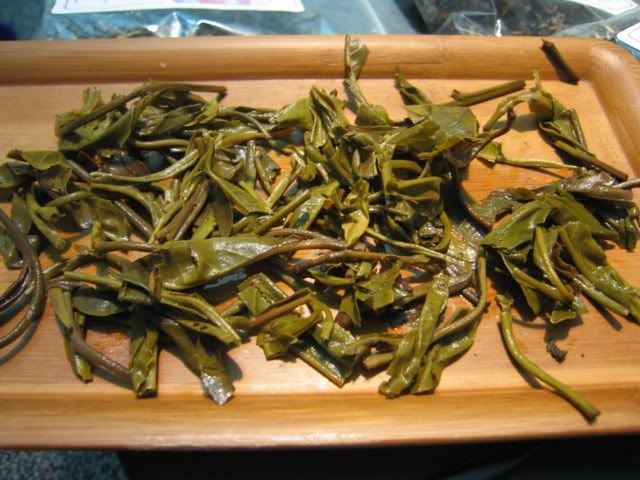
The leaves are, as you can see, rather green. I was a little surprised myself, as I never brewed this tea in Taiwan after buying it from the store. There isn’t really that scaly, “toad” surface of highly roasted teas. Instead, it unfurls to something that looks more like what nowadays is a green tieguanyin. Mystery.

What I like about this tea is still the aftertaste and the sweetness. I think this tea is something that everybody can easily enjoy — there’s nothing that needs to be “acquired” for somebody to like this tea. There’s, of course, more to get from it if you’ve had more experience, but I think anybody who isn’t offended by tea can probably appreciate it. It makes me wonder why I didn’t buy more of it.

→ Leave a CommentCategories: Old Xanga posts
Tagged:

Xizihao fall 2007 Nu’ercha

January 14, 2008 · 8 Comments

I got these in the mail the other day

I haven’t really tried anything new for quite a while, and definitely haven’t tried anything from Xizihao for a long time — since April, I think. Some of these cakes, especially the higher priced ones, have been selling like the world’s about to run out of puerh. I’m not sure who’s buying these things sight unseen, but it seems like a lot of money to spend on cakes that one hasn’t tasted at all. Now I’m curious to find out what they’re actually like.

I get the sense that the nu’ercha (daughter’s tea, literally) is the lowest grade of the three, so I figured it’s a good place to start.

The leaves are big and good looking. They’re quite green, which I’ve found to be pretty typical for 2007 teas. At any rate, looks deceive.

The tea brews yellowish green. It also tastes that way. There’s an interesting floral quality to it somewhere during the second or third infusion, which I tend not to associate with young puerhs. I found the tea to be generally a little meek, and the bitterness somewhat lingering. The tea hits the throat quite well, but in a way that some green tea puerhs have also done before. I’m not saying this is definitely problematically processed, but it does seem to raise some questions. Having tried some 2004 or 2005 stuff before, I have to say this tea, on the whole, behaves differently. The floral like quality to the tea especially makes me wonder if something is going on there.

The leaves are big, long stems, but largely in keeping with what an autumn tea might look like. Some leaves have some redness or what not to it, which is normal, but others are so uniformly green, it worries me. I hope puerh isn’t going through a change in process that tieguanyin went through in the past decade. If it is…. it’ll be a sad day.

When I went and met with the guy from Taipei whom I contacted through the internet, he mentioned how the Taipei tea drinkers don’t view the Tainan tea makers who have their hands in puerh very favourably. There’s a certainly difference in philosophy. He didn’t elaborate, but I get the sense that it’s about materials and processing. There’ve been a few times when I thought certainly Xizihao products are designed more for better current consumption than long term storage. Not all their stuff give me that sense, but this nu’ercha is one of them.

→ 8 CommentsCategories: Old Xanga posts
Tagged:

Teazone

January 12, 2008 · 4 Comments

Today I was in the Pearl District here, and ran into a place called Teazone. Why not walk in and check it out?

It’s not a big place, and there’s a section where they serve alcoholic drinks in the back.  There are some standard racks with teaware on it — ok teaware for those who don’t have much in the way of teaware, but not too useful for those who do have a collection of something.  A few gaiwans, a few other things, not cheap…. but these are never cheap in a store like this.

The tea menu is actually fairly extensive, and thankfully, most are actually teas and not some strange concoction.  I wanted to try this tea from Georgia (the country), but…. they ran out, so instead, I opted for a supposedly pretty good Sri Lanka.  Unfortunately, I should’ve remembered that even the best Sri Lanka tea are often not terribly great…. at least that’s what I’ve found from my experience.  I find them a bit rough and without enough of an interesting character — there are better blacks in different ways, whether aroma, body, aftertaste, etc, so that they’re rarely worth the trouble.

I think this place is actually fairly typical of teashops in the US — you can drink tea there, you can buy some teaware, and you can buy some tea there.  The teas they serve are not glamourous.  It’s not terribly interesting, if you’ve got a fair amount of tea experience, but the shop does try to serve interesting teas.  Bread and butter teashops, basically.  They do one important thing though that are absolutely essential though — they provide that gathering place for people who are interested in tea, should the shop be sufficiently good.  It’d be a better location if, say, the shop didn’t smell like cooking oil the whole time I was there (ventilation problems with their kitchen…).  Still, I wish every neighbourhood would have at least one or two of these places.  It’d make tea drinking more interesting in the States.

→ 4 CommentsCategories: Old Xanga posts
Tagged:

The Dreaded Box

January 11, 2008 · 8 Comments

Having been back to the US for about two weeks and having been forced to eat out since I’m not spending time at home, I am reminded by how most Americans view tea — they either come in bottles, iced, in bad teabag varieties, such as those Nestle 100% real tea bags, or they come in the Dreaded Box.

The Dreaded Box I’m talking about is, of course, the great wooden thing they bring to you in supposedly nice restaurants.  I think most of you who’ve eaten out in the US have probably seen it before.  They’re made of some sort of dark wood, maybe about 8 times 8 inches, sometimes with some writing on top, other times blank.  Inside is usually lined with some sort of blue velvet thing, and compartmentalized into (usually) 8 sections.  In these 8 sections, of course, are great delights such as Constant Comment, Orange Spice, English Teatime, or other great offerings from (usually) Bigelow or, horror of horrors, Celestial Seasoning (which is the same as Bigelow anyway).   80% of these are not even teas…. tisanes of various sorts with various artificial or less than artificial flavourings involved.  The packaging already looks bad, and the box is such a waste of the wood because, honestly, Bigelow needs to hire a brand manager and redo their image.

Once in a blue moon, you might have teabags from Harney, which is sadly a welcomed sight when given the alternatives.  When a restaurant actually serves loose leaf, it’s such a rare thing that I sometimes almost feel like jumping up and down.  Yes, some of you will tell me that you don’t order tea outside, and you’d rather drink their (often very good) coffee instead of the nasty “tea” they serve.  Others will say I should just bring my own.  But why is it so hard to find decent tea?  I don’t ask for much.  A good Assam or Keemun will do.  Those are pretty easy to find — just source from Peets or whatever, throw in an infuser and a pot, and let the customer do their own thing.  It’s really not that difficult, and is probably a lot less involved to make for a restaurant than a cappuccino.  I sometimes feel it’s rather ridiculous for, say, a great restaurant to serve up such awful tea.  There are sommeliers for wine, so where are the ones for tea?  My cousin is now working to redo a restaurant’s menu and winelist to make sure they go together.  I wonder if they do Bigelow.

Perhaps if we all start to demand better tea, places will take notice.  After all, I don’t think all places served good Italian or other styles of coffee 20 years ago.  Over time, people have asked for better, and when customers vote with their feet, vendors take notice.  Today I went to a hotel where they have, in the room, teas from Peets, and the room has an electric kettle, a pot, and an infuser, so you can make the tea easily in the room.  Nice touch, but this is Portland, where tea is more common than most of America.  Now if only that were standard.

→ 8 CommentsCategories: Old Xanga posts
Tagged:

Pot warming

January 10, 2008 · 4 Comments

I was in Peet’s today, waiting for a guy to make me a pot of (too much leaves) keemun.  When he was preparing the pot, I noticed something — he actually warmed the pot.

That was a surprise for me.  I didn’t expect to see it.  Perhaps Peet’s is more meticulous, or perhaps because this guy drinks tea, or perhaps because this is Portland?  Pot warming, methinks, does help you up the temperature of the water you use to eventually brew the tea significantly, especially if the pot is initially quite cold, as it could prone to be in colder climates.  I don’t know how much heat it will require to heat up a ceramic pot of that sort of thickness to close to the temperature of boiling water, but I’d imagine it’s enough to drop the temperature of the water by a few degrees if the pot started out cold.

I’m purely guessing here, but I’d think that it will matter the most for English style brewing, because there, you only get one, maybe two shots at making the tea, and a lower temperature will change the way the tea comes out.  For a short, multiple infusions brewing style, a lower temperatured first infusion might not be horrific (although I sometimes wonder if too low a temperature in the initial rinse will mess up the tea for the session — as I sometimes feel is the case).  I couldn’t even get more than one cup today, as there was simply too much leaves in the pot and I couldn’t drink another without feeling queasy from the caffeine because I already had an earlier session with my survival kit and aged oolong.  Mainly I was just impressed that the staff at Peet’s bothered to heat the pot at all.  I wonder how long it will take them to start rinsing the leaves….

→ 4 CommentsCategories: Old Xanga posts
Tagged: ,

Travel day

January 9, 2008 · 2 Comments

Another travel day today, this time to what Davelcorp has aptly termed “Rainland”.  It’s cold, nasty, and rainy — just like how Pacific Northwest is supposed to be in the winter.

Rainland (i.e. Portland OR) has decent tap water.  This is, I think, largely true of this region, where they get plenty of rainfall plus a good dose of glacial water coming down stream.  I remember living in Vancouver BC where the water was always crisp and clean, even in the relative heat of summer.  The only problem, it seems, is that tap water will always have a bit of chlorine in it, no matter what you do, because they need to process the water to make it potable.  Even after they run it through the plant which usually tries to dissipate the chlorine taste, there’s still a bit of it left by the time it reaches your faucet.  If nothing else, a water filter will get rid of the chlorine taste.  Boiling it seems to take care of most of it, but sometimes if the water hasn’t reached full boil the chlorine taste doesn’t quite go away.

Meanwhile…. I have to survive a few more days on my survival kit with random aged oolongs.  I can’t complain too much, I suppose.

→ 2 CommentsCategories: Old Xanga posts
Tagged:

Ebay misadventures

January 7, 2008 · 10 Comments

I think almost anybody who’s tried buying stuff from Ebay or other auction sites have had bad experiences with inaccurate descriptions, false advertising, etc. I am just reminded how sometimes things don’t work out on these things.

I bought a tetsubin through Ebay from a Japanese vendor. It looks nice, the price’s reasonable, and I have been wanting to get my hands on one to play with. So far, so good. It arrived…. and it looks good. Except one thing — there’s a small hole in the bottom of the tetsubin that the seller didn’t mention. Since there was no shot of the bottom of the pot, it was not possible for me to look at it either. So… I got a pot that will leak water right through the center. Since my name’s not Moses, I can’t part the water in the middle to keep it from dropping through the hole.

So now I’m dealing with the seller through paypal. Has anybody tried using the conflict resolution thing? How did it go?

Oddly enough, I felt somewhat uneasy when I purchased the first one, and I stumbled upon a second one, obviously inferior, but still a tetsubin… and very cheap (cheaper than one of those small enamel-lined tetsubin teapots you normally see). So, I ended up buying that one too, and that has arrived at the same time. It works — although I don’t know what the previous owner has used it for, because water that’s been through it smells like chamomile, and the outer surface of the pot was covered in some sort of grime. Now I’m trying to boil out the nasty sweetish chamomile smell from it… hopefully it’ll be usable after some treatment.

But tomorrow, I’m back on the road…. this time to Portland OR. Fun.

→ 10 CommentsCategories: Objects · Old Xanga posts
Tagged: , ,

Survival kit

January 6, 2008 · Leave a Comment

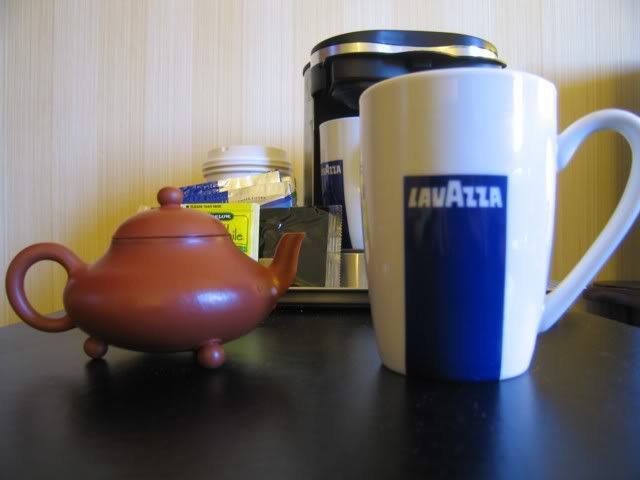
This is what I’m surviving on while away from home

It does the job. They have a fancy Cuisinart coffee machine with Lavazza coffee, but the only tea the hotel can muster up is some Celestial Seasoning Chamomile. Hasn’t anybody told them that chamomile isn’t even really tea?

Good thing I decided to bring my pot, and my electric kettle, because otherwise, I won’t have anything to drink tea with. Now, some hot water, a mug, and some aged baozhongs, and we’re in business.

Incidentally, because I’m relying on bottled water (boiled tap water in DC tastes awful — I tried) I got to test out two different waters for this baozhong. There’s Fiji, which worked really, really well. There’s also Poland Springs, which is so obviously inferior I wonder why anybody should pay money for it. It’s actually similar to the conclusion I reached almost two years ago in the early days of my blog — Fiji is a pretty good tea water, in that case a qingxiang tieguanyin. The aged baozhong is much heavier, but it also benefits from the Fiji water. It’s definitely better than my usual mix of filtered tap water plus some mineral water. It worked really well, actually.

→ Leave a CommentCategories: Objects · Old Xanga posts
Tagged: ,

Teaism

January 4, 2008 · 2 Comments

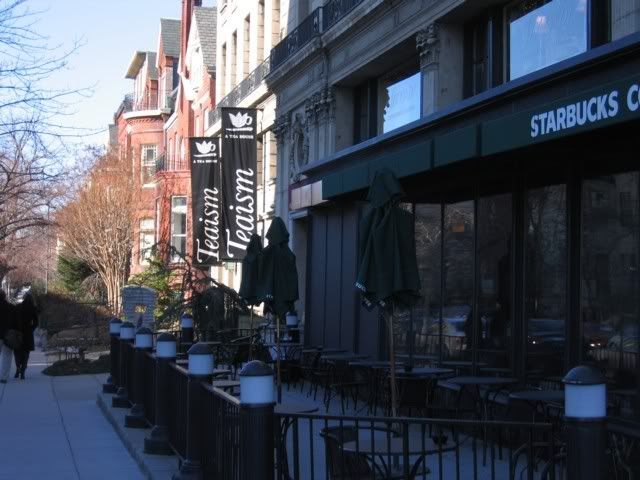
There are a few places in Washington DC where one can have tea. I don’t have that much time to check them all out, but since one of them — a place called Teaism — is nearby, I figured it won’t hurt.

The store I went to is near Dupont Circle, and it’s located next to the local branch of the Evil Caffeine Empire

What my fiance remembered of the place and its current incarnation are actually a little different. Supposedly, they used to be more tea focused, but this time, when we went, it seems to be more of a lunch place that sells some tea on the side. The tea menu is quite undistinguished, and consist mostly of regular stuff you can find in any self-respecting tea store. My guess is that they discovered selling tea alone does not pay rent, as I suspect is the case in the USA for independent stores.

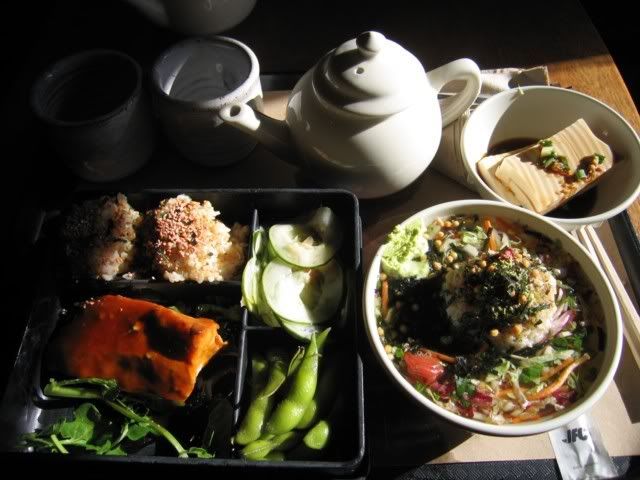
We did get some lunch though

A bento with (cold) salmon, and ochazuke — basically leftover rice with bad sencha. In this case, the sencha wasn’t so bad (I tried a little of it independently) — it was sweet and not grassy. The other pot of tea was something we ordered – a “Golden Monkey”, which is actually quite disappointing, considering they serve a pot of tea without actually giving you any leaves. The tea is underbrewed, and rather boring, and not having the leaves, I couldn’t even tell if they brewed it from teabags. For $3.75 a pot, I expected a little more.

There’s a store called Ching Ching Cha which seems a little more interesting, but it’s a little farther out, and I have a feeling I won’t have time to go… oh well

→ 2 CommentsCategories: Old Xanga posts
Tagged:

Heavy teas, light teas, and the water they drink

January 3, 2008 · 5 Comments

Food for thought while driving 6 hours to go to Washington DC for a conference and sipping bad teabag teas — there are, I think, two types of teas out there, heavy and light. Heavy teas are things like cooked or aged puerh, roasted oolongs (and some aged oolongs), black tea, and that sort of thing. Light teas are green, white, light fermentation oolongs, etc.

That’s probably pretty obvious. I think though that generally speaking, in terms of tea preparation, there are one set of requirements that will work for heavy teas, and one set that will work for light teas. This is of course not accurate, because they each vary individually and each batch of tea will perform differently. However, I think that over time, I’ve noticed things are different waters and different teas that seem to play out consistently roughly within the heavy/light classification. So, for example, a water heavy in mineral content does not work very well with the light teas — the water is often too strong in taste or texture and destroys the beauty in the light teas. A really light water with a heavy tea, on the other hand, can make an otherwise thick and luscious tea seem thin, even though the tea will gain a bit of crispness and perhaps freshness not common in those types. This is not a science, and it is certainly not precise, but it is a beginning of a thought.

Has anybody else noticed this, or is this just induced by drinking Nestle “100% real leaf tea” teabags?

→ 5 CommentsCategories: Old Xanga posts
Tagged: