A Tea Addict's Journal

Buying yixing pots

October 24, 2013 · 23 Comments

As somebody with a, er, teapot problem, which has only gotten worse since then, I thought maybe I should summarize what I’ve learned and unlearned through the years.

The first thing you learn when you set out buying yixing pots probably go something like this

1) You should only use one tea for one pot

Then there’s a whole slew of supposed “practical” advice, things like how the lid should fit well, how the spout and handle and top of the pot should be level, how things should all line up perfectly, filter vs no filter…. etc. This is before you start bothering with things like clay, which is a whole another hornets’ nest.

I think after having bought a whole bunch of pots, and using pots basically exclusively to brew tea for years, I can say that almost all of those beginner advice are bogus.

Take, for example, the bit about using only one tea for a pot. I suppose that’s sort of true, to a small extent, in that the tea does impart some flavour on your pot over long term use. The pot I usually use for my older, traditionally stored puerh, for example, smells like the tea it brews. When I pour water into the pot, it comes out brown. If I try to brew younger stuff in it, it’s going to get contaminated with the flavours of the storage heavy tea. So, in those cases, yes, you probably want to separate them to avoid too much interference.

At the same time though, it’s entirely pointless and silly to divide the teas into ever finer divisions and brew only that tea in one pot. For example, you can cut oolongs up into a million classifications – tieguanyin, shuixian, yancha, dancong, Taiwanese gaoshan, and within each of those big categories, you can further subdivide them into mountains, seasons, etc etc. The possibility is endless, and very early on I also thought maybe I needed to do that. Then it occurred to me – no, you don’t need to do that. First, the teas themselves, while distinct in taste, are not going to impart such a significant flavour effect on the pot that makes it easily distinguishable. Second, by doing so, you need a million pots, each of which see relatively little use. Third, observing others who have gone before me, such as folks who’ve been doing this for 50 years, they generally don’t care that much – oolongs go into the oolong pots, puerh likewise, and that’s that. So far, I’ve found that it works. You might, for reasons I already stated, want to divide them into two or three categories (heavy roast vs light roast, for example) but otherwise, just let it be.

As for the more structural things with teapots, I think in general those rule of thumbs are useless. Take, for example, lid fit. The easy version of the lid fit test says that you should be able to stop the flow of water if you hold onto the air hole. The more robust, and in my opinion silly, version of the test claims that the lid ought to stay in place and not fall if you fill the pot with water, hold the spout close, and flip the pot over. The idea of this is that this is a sign of good craftsmanship – that the lid fits well because the craftsmen make good pots. That’s true if your pot is made entirely by hand, like this video of master Zhou Guizhen. However, in these days of mold-assisted making (this is a nice series of pics that show how it’s done – and it’s an old technique), or much more likely (if you’re buying low priced pots) full on liquid-clay-in-mold pots (i.e. pouring a liquid clay into the mold, then remove mold after it dries a bit to reveal a pot) there is very little value in a well-fitting lid if it’s just the result of an industrial process that churns out massive amounts of pots. You can see the images here of a CCTV report on the mass manufacture of dubious yixing pots here (sorry, in Chinese, but you can see the images). Labour isn’t so cheap in China anymore. That $30 yixing pot you just bought is not going to be fully, or even partially, hand made. So stop imagining that the lid fit has anything to do with worksmanship.

Nor do things like this really help with brewing tea. A tight fitting lid doesn’t aid tea brewing in any real way. The same can be said of the level line between the spout, handle, and pot – you don’t want the spout a lot lower than the top of the pot, but it’s not going to kill you, or your tea, if it’s not perfectly level (and again, getting it perfectly level is a lot easier if it’s mass manufactured in molds). The value of these tests are dubious, at best.

What I think one should watch out for, insofar as structural things are concerned, generally have to do with pouring and the mechanics of water/tea going in, and water/tea coming out. I think a very important thing to watch for, when buying pots, is how long it takes for the tea to pour out. If it’s slow, then you’re going to be frustrated and have trouble using the pot. This has to do with the size of the airhole and the shape and size of the spout. Also, just testing it with water is not always good – tea has somewhat higher viscosity than water, and I’ve used pots before that seem to work well with water, but when you throw tea in it the pot slows to a trickle. It’s annoying, but it happens, and if you’re buying online, unfortunately you’re on your own.

Another thing is size – it seems like a lot of folks in North America and Europe love the smaller pots, especially things sized around 60ml. I, for one, cannot understand why. I find pots that sized far too small, and are not very good for general usage, even if just brewing for one person. Yes, using a small pot does reduce the amount of tea you use, which is a little more economical, but I also find that it makes controlling brewing a lot harder. I also believe that most of the stuff available on the market at that size tend to be mass produced stuff of low quality – it’s not economical for the producers to hand make these kinds of pots. My personal preference is for something around 100ml, which, after accounting for the tea, is usually one big cup per brew, or a few small cups.

Who made the pot also seems to be something folks worry about, a lot. I think part of it is just wanting to know about the product you bought – there’s a seal on the pot, so naturally you want to know what it says, which is usually some person’s name. Then, you want to know who that person is. In 99.9% of the cases, however, that person is basically a nameless craftsman who toils in the yixing teapot industry. Having someone’s name on a pot does not actually mean they made it – oftentimes (as the CCTV videos I linked to discuss) they are subcontracted out to lesser workers who use the seal of the slightly-more-famous person so that they can sell the pot, possibly using molds to aid in the uniformity of the product. So, while it’s nice to know “who made it”, the real answer is, sadly, a lot more complicated and a lot less alluring. When a pot is in the tiny fraction of pots where the maker is famous, there’s a high likelihood that it’s a fake. In cases where it’s not fake, you already know what it was because you paid thousands, if not tens of thousands or even millions, for the privilege of owning that pot.

All this and I haven’t bothered with talking about clay, which is another beast entirely and not something I want to touch on here. What I will say though is this – worrying about and obsessing over what type of clay a certain pot is is definitely a waste of time. Demanding vendors to tell you that sort of info will usually provoke some answer, but the answer, more likely than not, is probably just made up or at best an educated guess. It also is basically entirely meaningless in terms of what it actually does to your tea. I personally believe the density of the clay and the size of the particles have more to do with your tea’s outcome than the type of clay. Whether a pot is dicaoqing or benshanluni really makes very little difference to a tea drinker, unless the tea drinker also happens to be a big pot collector with the intention to collect different types of clay (in which case, buying over the internet is the wrong thing to do).

So, I suppose if I need to summarize my thoughts on buying yixing pots, it’s this: focus on the function and cut out the noise. The noise includes anything that forms a “background story” that helps sell a pot – name, clay, story of acquisition, etc. Instead, function – clay density, size and shape, water flow – are the things to watch out for. If it’s too good to be true – claims of fully hand made and the price is anywhere under, say, $100, or “Republican” or “Qing” and it’s only $300 …. you should think twice about the reliability of that seller and their value proposition. On the other hand, high prices don’t mean quality either. All this does mean that buying pots over the internet is generally not a great idea. Unfortunately, for most of my readers, that makes buying teapots a tough call. Try to find vendors who have good access, usually on the ground or have deep connections with suppliers, and don’t get too carried away like me.

→ 23 CommentsCategories: Objects
Tagged: ,

Hong Kong milk tea

October 18, 2013 · 6 Comments

While we’re on the subject of what regular people drink, it’s hard not to talk about the traditional Hong Kong milk tea.

Normally, milk tea of any sort usually consist of some milk or cream and a regularly brewed black tea of some type, maybe lipton or something along those lines. Hong Kong milk tea doesn’t follow that. It’s a very heavy blend of evaporated milk and tea. Witness the colour

These things are usually served without any sugar. You can add your own, if you want, as sugar is usually on the table in large quantities. The way this stuff is brewed is what some people call the “stocking milk tea” – it actually is a cotton bag that looks like a long sock, with tea inside. They use two pitchers with no lids. The brewer repeatedly pour boiling water (after the first infusion, tea) back and forth between the two, while having it on the heat source so it’s kept at a very high temperature. They do this until it reaches the desired strength, which is somewhere between super strong and incredibly strong. Then, to serve, they add a few big spoonfuls of evaporated milk and then pour the tea into it with force – the “clash” between the two elements is important, and the resulting drink is a very smooth tea/milk concoction. Without the milk, the tea itself is a very bitter, sour, and strong drink that isn’t very good.

The tea they use is pretty low grade stuff, and is usually a blend of various kinds of teas. The base is this

The right hand bag is the tea (left side is coffee). If you really want, you can buy a bag of this stuff over Taobao at the paltry price of 168 RMB for 5lbs (incidentally the Taobao page also has a couple pictures of people making this tea). They claim this is Ceylon black tea, with different grades mixed in. Oftentimes various restaurants will use these as a base and may or may not add things to the mix to create their own flavour – cooked puerh for example is sometimes used to give the tea more body.

Evaporated milk (right) is the preferred fat source in Hong Kong.

I think in Singapore you see condensed milk instead (left), which is already sweet. The results are very different. There are also different kinds of evaporated milk. Something you run into sometimes is a particularly nasty one – basically imitation evaporated milk made using mostly vegetable fat and milk powder. It looks like the real deal, but the taste is off, and the body is thin and gross.

There are other variations on a theme, most notably the yuenyeung (pinyin: yuanyang) which is a perculiar mixture of half coffee, half tea, plus milk. I’m not a fan, but it has its devotees.

You’d think something like this should be pretty simple, but I’ve been to restaurants where the result is so horrible I’ve never gone back again. It’s really one of those drinks that can define your shop, and if your ability to make this singularly Hong Kong drink is not there, your business will suffer.

→ 6 CommentsCategories: Teas
Tagged:

Tea and sugar

October 12, 2013 · 5 Comments

These two things do go together, sort of. Like this HK style french toast (two slices of deep fried white bread with peanut butter in the middle) and lemon tea.

I normally don’t drink my tea with any sort of sugar, as you can probably imagine. But sometimes I’m reminded why so many people do – it really softens the tannins in the tea, and tannins in tea, when it’s strong, can be pretty nasty.

The point was driven home while I was in Turkey, which, to my surprise, is mostly a tea drinking country, despite the fame of its coffee tradition. Tea was cheaper, and drunk far more often, than coffee. The preferred tea is samovar style – super concentrated concoction watered down. This process makes sense especially in settings where you need to make a lot of tea quickly – you make as strong a brew as possible, without regard for how it tastes, and then you water it down so that it’s more palatable. That’s how tea is made in Hong Kong too in most places – the tea is made super strong, with repeated boilings of leaves with water, and then you finally water it down to the desired strength.

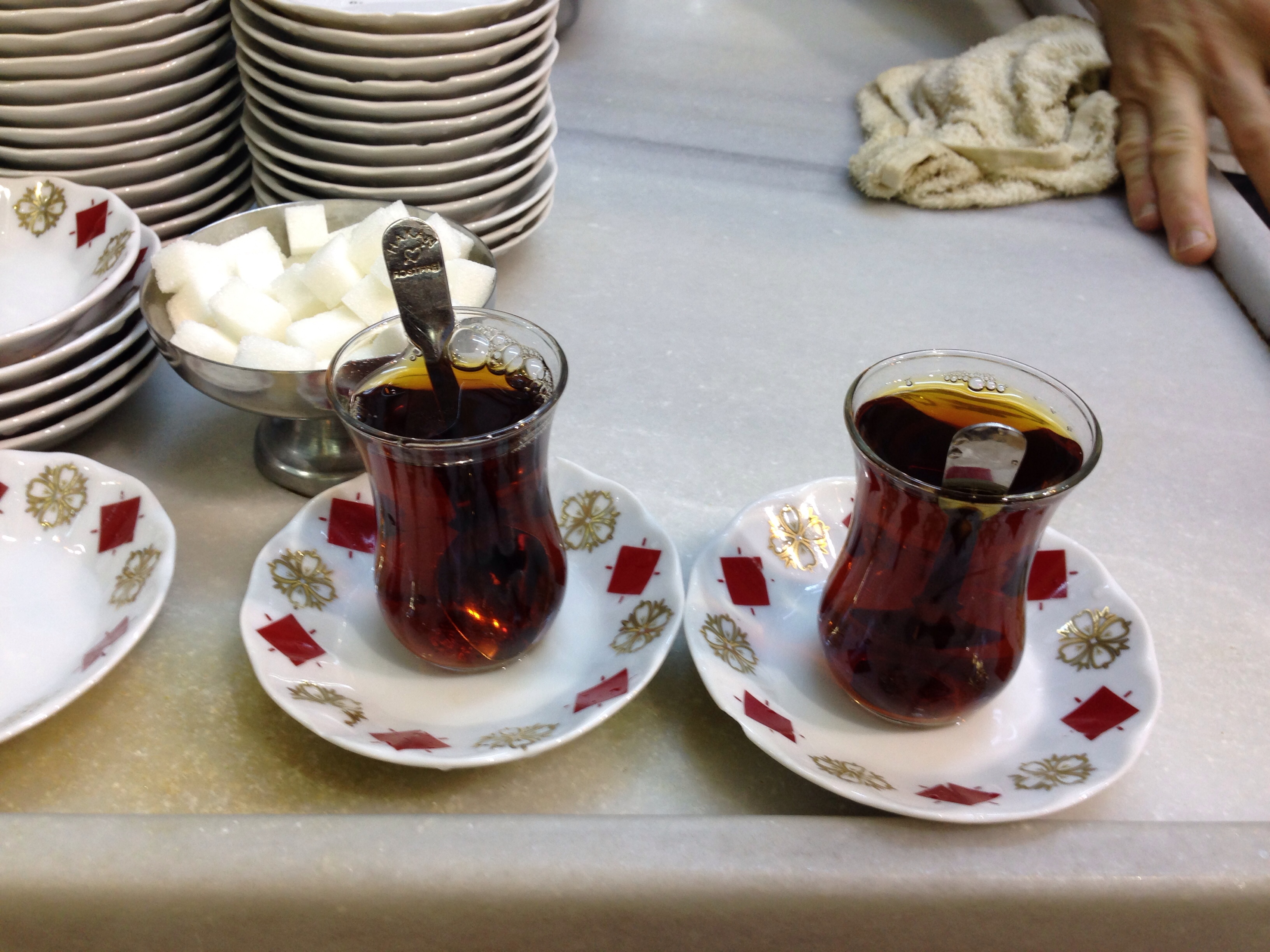
The watering down, however, is also where things go wrong – usually when it’s still too strong when watered down. While in Turkey I sometimes would add a cube of sugar (two always comes with your cup) because they made the tea too strong. While that can be nice, sometimes, when it’s overly strong, it can be pretty unpalatable, since the tea itself isn’t much to write home about. Adding that sugar, however, magically transforms it into a much softer, gentler drink – the tannins are gone. What was a pretty strong and pretty harsh drink is now quite nice, and with one cube, you still only barely taste the sweetness. This is especially true if you then wash it down with some baklavas – or maybe it’s the other way around.

Cream, of course, has a similar effect, but cream influences the way tea tastes far more than sugar does. A small amount of sugar has a fairly neutral effect on the taste, but a small amount of cream is just nasty, making your tea look like sewage, while a large amount will of course change everything. I’m not about to dunk two cubes of sugar in all my tea every day, but sometimes it’s good to be reminded of why most of the rest of the tea drinking public love their sugar with tea.

→ 5 CommentsCategories: Teas
Tagged: ,

Turkish delight

October 1, 2013 · 6 Comments

These cups are everywhere in Turkey, and usually accompanied either by a big bowl of sugar, or two cubes of it on the side. It’s really quite a nice way to get a little tea in the middle of the day – that caffeine hit you need for those of us who don’t imbibe that other drink.

This particular place was in the middle of Istanbul’s Grand Bazaar. It’s a tiny corner rented out to these tea purveyors

Interestingly enough, there is something vaguely similar between this and the way they make tea in Hong Kong. The pots you see up top are full of concentrated tea – tea brewed very, very strong. Then, when it’s time to serve, they dilute it with water from the spigots. Three old men take care of the station and do some short deliveries, and some younger men are there for the somewhat further shops. I suspect each of these stalls have their own “region” in the bazaar – since it’s quite large – and serve their local area. The tea never comes with any milk or cream, just sugar. One cup costs a lira each (about 50 cents USD) and it’s drunk fairly quickly – the cup is small.

The best part of this is, it’s on demand.

Throughout the bazaar are these men carrying the dishes – delivering tea (and other drinks, but tea mostly) to the various shopkeepers. There’s also food that gets sent too, and interestingly, I didn’t see much coffee sent around. Maybe coffee isn’t drunk in this sort of setting? None of the deliveries involve any sort of throwaway boxes or cups – they are all reusable, glasses or dishes. It’s quite environmental. I wish Hong Kong still does that. There’s an old world charm about this, and it’s on full display here in this historic city.

→ 6 CommentsCategories: Teas
Tagged:

Really young puerh is not really puerh

September 18, 2013 · 5 Comments

The title of this post is perhaps slightly confusing. When is puerh not puerh? Let me explain what I mean…

What I’m talking about here only pertains to raw puerh. For cooked puerh, the whole process is different and the tea is puerh (cooked) as soon as the post-fermentation happened. For raw puerh, however, the tea does not go through such a post-fermentation process where it is basically composted to create the flavours you find in cooked tea. What you have instead, at least in theory, is a long period of aging where the tea changes from young to old, and in the process, transforms itself from a very green looking thing to a dark, brown or black cake of tea, with flavours to match.

Presumably, we buy young tea to age because we want aged flavours and profile. Cooked puerh is also an attempt to recreate the aged taste without the time – at least that was the original intention of the process, although now it has taken on a life of its own. Puerh, at its core, is a tea that requires post-fermentation of some sort. It is that process of aging which gives the tea its unique flavours, complexity, and aromas. It’s what makes it different from all other teas.

So it is a bit confusing when we use the term puerh to denote anything coming from big leaf varietal trees in Yunnan compressed into cake or brick or tuo form. This is partly because we don’t have a name for such things – what, for example, do we call current year products that are meant for aging? For whisky, we can call them “white dog.” I’m afraid I don’t know the name of what you’d call wine that hasn’t gone through barrel aging – but the idea is the same. When we have something that is newly compressed and newly made, but hasn’t gone through that post-fermentation yet, calling those things puerh can be a bit misleading. White dogs aren’t really whisky – they are more like dirty vodka. The colours, aromas, and taste profile are not the same as whisky that has gone through aging. Likewise, wine that hasn’t been aged at all is going to taste funny. In those cases, there are legal limits to when you can call them by their names – in scotch whisky, for example, it’s three years. For cognacs, it’s two years.

Puerh, unfortunately, has a very confusing definition officially, so that such nomenclature is all jumbled. The official definition of the tea (at least in the 2006 update) makes room for both raw and cooked tea, but leaves out post-fermentation for raw tea completely, perhaps at the behest of producers who want to be able to call newly pressed raw teas puerh as well (note the date of 2006 – at the height of the first bubble). So we are left with a definition that is wholly incongruent for raw tea, all it requires is shaqing, rolling, sun drying, compression. For cooked tea, it includes “special techniques” that will cause “slow or fast post-fermentation.” So, the first is really a green tea that is only distinguished by the sun drying process, and the latter is what puerh tea probably should be – post-fermented tea.

I have been drinking a sample series of teas made by the same producer but from different years – ranging from 2006 to 2013. Since they were (and still are) stored in the same condition, it is possible to compare them against each other in terms of aging. The experience of this matches what I think to be true – that it takes about two to three years for a young puerh cake to lose the “greenness” of the tea and to start taking on some of the aged characteristics. Of course, the whole thing is a gradual process of change, but it is clear that by about three years old, the initial green flavours of the tea disappear. Of course, this depends also on compression strength, type of tea, storage environment, etc, but generally speaking, it takes a few years for a tea to start taking on aged flavours.

It also takes a few years for the wheat be separated from the chaff. I personally no longer buy anything younger than about three or four years. Yes, it is possible that you will have to pay more, but actually, I haven’t found that to be the case really. Considering how expensive new cakes are this year, with reasonably good tea often costing over $100 or $150 a cake, teas from 2007-2009 are actually quite competitively priced. Sometimes they are even cheaper, with the added bonus that now you can sort out the ones that are turning bad or bland. Not all tea will age well, just like not all wine will age well. It is a lot easier to pick and choose at the three year mark, with much higher probability of success, than picking them when they are brand new. I think that’s a good cutoff for when we can call them puerh.

Of course, some people just prefer them green and new. That’s all good – drink them if you want. You can buy new ones every year to satisfy that need. No need to store though – because unless you vacuum seal them (which some people apparently do right from the beginning) the flavours will change. If you are vacuum sealing the tea, you’re treating it as green tea. That’s fine, just don’t call it puerh.

→ 5 CommentsCategories: Teas
Tagged: ,

The retaste project 17: 2005 Yichanghao Mansa

September 11, 2013 · 5 Comments

Once upon a time, in a land far far away, tea was cheap. Puerh was considered very cheap tea, and things like the Laotongzhi, admittedly a very regular cake, would fetch about 25 RMB on the market. The vaunted Dayi, which is now attaining mythical status, was only slightly more expensive. In those halcyon days of plentiful and cheap tea, Yichanghao was among the new stars that promised greatness. They rapidly expanded from their initial foray into tea production in 99 to an important player by 2005. Times were good.

Fast forward half a dozen years, and now there are persistent rumours of imminent collapse of Changtai Group, the company behind Yichanghao. Fact is, ever since the 2007 bubble burst, Changtai hasn’t been doing much – at least, not much that anyone has paid any attention to. They still produce tea every year, but they haven’t had a “hit” for a long, long time.

It was in those blissful days when I bought this thing

Compared with the photos I took right after I bought this cake (romanized as Mengsa, because that’s how the characters are sometimes written, but not on this particular cake), it’s pretty obvious that it has aged a little bit over the years. The tea was stored in Beijing for a year, then for the rest of its life has been in Hong Kong. I haven’t had a chance to drink it since buying it, until a few days ago, anyway. I bought two cakes, of course, and this seems to be not the one that was pictured, but I’m sure they were similar in colours. The liquor is suitably dark.

I thought, when I bought it, that this cake has aging potential. Well, six years later, I can report that the cake has indeed aged. I think my taste is a little more… picky than it used to be, so I am not judging the teas with the same yardstick. Having said that, it’s a cake with this age that’s still generally better than most of its counterparts from relative big factories from 2005. It hasn’t gotten worse, and it has a nice, rounded taste. It’s a bit on the thin side, all things considered, but since I didn’t pay great tea prices for it, it’s hard to expect great tea from it. I seem to remember paying something around 60-80 RMB for one cake at the time, which was ok, but not terribly cheap. Well, now you can find this tea on Taobao for about 300, but RMB has appreciated by almost 30% since then, so it’s actually about 5x the price I bought it for. Is it still worth it at these prices? In the context of new tea prices, absolutely – for a couple cakes anyway, and for more immediate consumption. I wouldn’t invest thousands for tongs of this stuff, but as a drinker and something to be had casually, it’s not bad, so long as the storage conditions are broadly similar and the tea hasn’t been dried out or been stored way too wet.

There is a taste among many Taobao cakes I’ve bought that are of this low-mid price range with 5-7 years that I really hate – I suppose it might be what people describe as “straw” which I find to be the precursor to thinness and blandness. I can see a hint of that here – just a hint, whereas a lot of times that is the dominant taste in cakes. I wonder if it has to do with the temperature and humidity that it’s stored at. I don’t know what the Taobao vendors’ cakes will taste like, it might be interesting to compare, but I don’t feel like throwing 300 RMB at it just to give it a try.

→ 5 CommentsCategories: Teas
Tagged: ,

Here, there, and everywhere, at the same time

September 3, 2013 · 3 Comments

Recently I received a pricelist for a puerh vendor’s new offerings. This is one of those higher end outfits that purport to sell gushu teas and which are priced anywhere from a few hundred RMB a cake to a few thousand, all for 2013 new teas. The owner, like many owners of such shops, was already a successful businessman in other ventures, but because of his love of tea (what else?) has gone into tea making and now presses his cakes every year for sale. You can probably find half a dozen such outfits in every major coastal city these days in China.

Also like many such shops, the offering is vast – in fact it’s so vast that it’s completely unbelievable. There are about twenty single origin offerings of various mountains, from Guafengzhai in the east, to Mangfei in the west, and everything in between. For some villages there are multiple offerings, while for others there is only one. This is not counting the dozen or so blends that they offer as well – blends of different mountains, some of which have single origin counterparts, and some don’t.

I say unbelievable, because for it to be top notch tea (and the prices definitely scream top notch) the person making it had to spend some time in each of these places to buy the maocha – maocha, at least of a certain quality anyway, don’t really come to you, especially if you’re not a particularly big outfit with enough muscle to do the buying. Conservatively, if we say the owner needs to spend at least 3-4 days per village to at least gather enough material for pressing the cakes, sort out the logistics, travel etc, that’s already over 70-80 days needed. If he started on one end in late March, by the time he gets to the other end it’s already June. The good tea is not going to wait three months – someone else would’ve bought it already.

It is also unbelievable, because unless you spend an inordinate amount of time in one of these places, being able to tell apart real versus fake (or at least, inferior quality) maocha from various village is difficult. Maocha smuggling – the practice of shipping cheap maocha from cheap production area to expensive villages to sell as the expensive place’s tea – is very common. It’s also not unheard of to pass plantation tea off as gushu, or to adulterate spring tea with fall tea, or other such practices. Just because you got to the village doesn’t at all mean you got the real thing, and even if you’ve gone a few years in a row doesn’t mean people stop trying to cheat you. I have talked to experienced vendors who have been going for a dozen years who still have people bring them inferior tea, hoping to pass muster. If you’re in a hurry and are not picky, you will get scammed, and the tuition gets passed on to the consumers.

Nor is the much vaunted “buy-out contract” model going to work, not well anyway. Over the years various brands and individuals have claimed to have signed contracts with local farmers of some village or another, buying up all their production for the year for a fixed price, limiting production to spring only, etc. In almost all of these cases, there are reports (and confirmed) that the farmers are still selling the tea on the side to others. The fact is, these contracts are basically impossible to enforce. How do you prove that a bag of maocha is indeed covered under the contract in question? In a court of law? How do you prove they harvested in the fall when they were not supposed to under the contract? You can’t, basically. It’s also hard to fault the farmers, who, until about 2006, have sold their teas for virtually nothing. Ten years ago a kilo of raw maocha from gushu material in a not-so-famous village might fetch you 10-20 RMB a kilo. That’s when 8 RMB equaled one USD. Many cut down their old trees to plant rubber instead, because rubber was more profitable. So, it’s hard to fault the farmers for wanting to cash in when the going is good.

It takes skill to press good cakes. It’s not a matter of just going to a village, meeting a few farmers, trying a few different bags of maocha, and buying the best of the bunch – that’s in fact almost a guaranteed recipe for getting scammed. The best cakes I’ve tried all tend to be from people who have had decades of experience drinking tea – all kinds of tea – and who also know the area of production intimately well. This means they spend weeks, if not months, there, often pressing only a few cakes a year or have a regional specialization – only Bulang, say, or only around Yiwu, because you need to control for quality and that takes time and local knowledge. For local producers who are, say, based in Kunming or further south, it is probably possible to have enough contacts and access to do more, but for these fly-in-fly-out type of cake pressers, claiming to be able to do a dozen, or in this case, two dozen different villages, and do them all justice, is pretty much impossible.

Going back to the teas of this outfit – I only tried one, the Wangong. Oddly, it tasted like some Bulang area tea and nothing like a tea from eastern Xishuangbanna, and compared with Zhou Yu’s Wangong, which I also had recently and also from 2013 – it’s not even close. Yet, the tea from this outfit costs almost double what Zhou Yu wanted for his tea. I don’t know who’s buying the story, but you certainly aren’t paying for the tea.

→ 3 CommentsCategories: Teas
Tagged: ,

Temperature, humidity, and storage

August 30, 2013 · 14 Comments

I just got back from Southern Germany, where the land is flat and the beer is good. The weather was beautiful. I also came back with chapped lips, which led me to think about storing puerh tea in these places.

There’s a general consensus that the higher the temperature and the humidity the tea is stored in, the faster the tea changes. People disagree as to whether that’s a good thing or not, and some of it comes down to personal tastes (some people like their tea young tasting for reasons I don’t understand). Above a certain point, the high temperature and humidity will induce mold, which is generally seen as less desirable this day and age. However, under normal circumstances in natural settings, it is difficult to generate enough moisture to attain the level of humidity and temperature used in traditional storage facilities (we are talking +30C and relative humidity of 90% or even higher, in a tightly packed enclosed space). If you store your tea naturally, in an environment in which human beings are comfortable and not exposed to the elements, your worry shouldn’t be mold.

Instead, I think the worry should be too low a temperature/humidity. The problem, at least on an anecdotal level for me, is that tea stored too dry will begin to exhibit undesirable traits such as roughness, thinness, and lack of aroma, in addition to just not changing (or changing very slowly). I am presuming that the whole point of storing your tea is that it changes and ages – for those who want their tea young and fresh, you can stop reading now.

The dryness-induced changes are usually not very obvious problems, and may not even be apparent until you tried it side by side with a tea stored in a more optimal environment, at which point it becomes really clear that the tea stored in really dry climates is lacking something. Opinions are mixed on whether that can be revived, but it’s not at all clear that it is easy to do so without running risks.

Leaving aside why exactly higher temperature and humidity seems to allow teas to age in a more interesting manner, I suspect that it is not as simple as pointing to your humidity gauge and saying humidity is high in you neighbourhood. Since both of these factors are actually related to one another, I will attempt to talk about this in more absolute terms.

Hot air can hold more moisture than cold air. That’s just a matter of fact. Relative humidity in general is a poor indication of the amount of moisture in the air at any given time, unless you also give a temperature reading. So, if you look at this chart, you’ll see that at 30 degrees Celcius and 50% relative humidity, the air still has more moisture in it than 15 degree Celcius and 100% relative humidity. At the same time though, we know that the air has more capacity to suck in moisture – so it can dry things out faster. Experienced hands here who have long stored tea all believe that it is important for the tea to breath through the seasons – meaning that it goes through wet and dry periods. The winter, when it’s dry and cold (relatively) here, is when the tea rests. Then spring comes, when it’s quite wet, and then the summer, when it’s hot, and by the fall, it starts drying out again. And the cycle repeats itself. Slow changes in the climate seems to beget changes in taste.

I remember when I came back to Hong Kong one time during my study overseas, I noticed that one of my tongs of tea was moved to closer to the window, and this being early spring, it was extremely wet and warm in Hong Kong. The tong was almost wet to the touch – the tea, while not quite soaked, was certainly not dry. I moved it to a higher location on the shelves and, now, years later, the tea is no worse for wear, and in fact is quite nice last time I tried it. It has also certainly aged from when it was first purchased, when it was a green, young, rather bitter thing. That’s what we want after all – for that bitterness to recede and slowly replaced by aged tastes of sweetness.

So when I was in Germany, I noticed that the weather was quite warm, but it was very, very dry. It also gets cold rather quickly at night. Of course this is far from desert like climate, but it reminds me of Beijing, where the weather can also be pretty dry and warm. In my experience, places like that produce really badly stored cakes – they literally feel dry when you drink them, and are usually devoid of fragrance and flavour. Heat with too-low humidity is no good – the ones I’ve tried where they have been stored in high heat, low humidity places tend to be really, really nasty. When people use the term “dry storage” they really meant it in relation to “wet storage” or what I like to call traditional storage. It’s not “bone dry” storage. That’s what you do for mummies. I think the reason it’s dry during the day is because of the low temperatures at night, the moisture condenses, and over the course of the day as it heats up, the humidity drops because temperatures go up – and before there’s a real chance for the moisture to be evaporated again, temperature drops again at night, keeping things fairly dry during the day. I’m not sure what this does to tea, but I suspect it’s not a great environment.

Having said that, I generally think it’s not very wise to build elaborate pumidors to try to artificially inflate humidity for your storage. The reason is simple – it’s very risky, and you can easily cause mold or other undesirables. What you can probably do without much harm is to take precautions – don’t let too much airflow into your storage area, maybe add a little water container that has little risk of spillage. I really wouldn’t do more than that.

→ 14 CommentsCategories: Information
Tagged: ,

Tea is poison

August 20, 2013 · 5 Comments

I’m currently in Heathrow waiting for my plane to Munich, where I’m going to be giving a (pretty terrible and rough) paper that I’ve been working on regarding early ideas about tea in Britain in the eighteenth and nineteenth centuries. Specifically, I was trying to look at how people thought about tea’s connection with health. It was quite interesting, really, because for anyone trying it for the first time, tea is obviously doing something to your body. It’s not just water – it’s more than that. If you drink a strong cup of tea, it will do certain things to you – and these are effects that are universally noticed.

However, that doesn’t mean people all have the same conclusion when it comes to tea and what it does to your body. Whereas in the very early eighteenth century when tea was still a rare and unusual commodity, people writing about it were still most introducing it, by the mid century it was obvious that tea consumption had become very popular (with mentions of ladies drinking tea in the afternoon, people using tea in copious amounts, etc) worries about tea also increased. You start seeing people writing about it and saying it causes health problems – everything from physical problems to causing neurological diseases. In one instance, an author even claimed he tested and found that tea caused scurvy, which is of course the opposite of the truth (tea in fact cures scurvy with its vitamin C).

Then by the late eighteenth century, people seemed to have started to calm down a bit, and worried more about the economic effects of tea. This is when George Macartney was sent to China to try to persuade the Qianlong emperor to open up trade, only to be rebuffed. You see this anxiety reflected in writings at the time – a lot of pages devoted to the economic health of Britain and how tea was draining it. Tea is not physical poison, but it’s economic poison. People also drank a lot with their tea – adding alcohol in it. So it got mixed up with the whole temperance movement. Not quite tea as a poison itself, but tea as the conveyor of poison, in this case.

It’s only by the nineteenth century that we seem to see that subside as well – of course, things had changed a lot by then. But it’s pretty clear that for almost a hundred years, there were doubts, worries, anxieties, and uncertainties about this drink. Contrast that with today’s unequivocal belief that tea is healthy, in any circumstances, things have definitely changed. Is that really true though? I think, as with anything, tea is best only in moderation. Claims of the cure to cancer are, unfortunately, probably exaggerated.

→ 5 CommentsCategories: Information
Tagged: ,

2007 Spring Xizihao Yiwu Chawang

August 18, 2013 · 5 Comments

Some of you might remember this, or even have it

Yes, this. There was a time when puerh cakes were selling like they were going to run out – which they did, promptly, when Hou De put them up. At least it happened for Xizihao teas, which were (and still are) made by Sanhetang in Taiwan. Back then they were basically the first of the gushucha wave available in the West. The 2007 ones sold out rather quickly – some as soon as within a day. There have since been some newcomers, of varying quality, but even now, I think some of the Xizihao remain the better ones that were sold as gushu puerh.

This cake, however, I did not get from Guang. I bought this at the Best Tea House in Hong Kong. For some reason, they had a tong of this – for 750HKD a cake, which is a bit less than $100 USD. This was in 2011, which makes this extremely underpriced – the cakes came out around that price, and so weirdly, it was selling for a pretty low price for some reason. I dithered for a while, and when the other six cakes were sold (to a single person) leaving this one display one, I snapped it up at a discount. Why not?

I haven’t tried it since I bought it – it’s been sitting in my storage. Unfortunate wrapper aside, the leaves themselves look good

The tea is a nice, solid performer – definitely has gushu material in it, good body, nice balance, etc. It isn’t mind blowing, but it’s really not bad. Although a bit on the weak side, it may very well have to do with the fact that my cake was the “display” that was sitting out on a store shelf for more than a year. I’m not sure if Sanhetang themselves have this tea available anymore – oftentimes these outfits no longer have their past runs, or the supply left is so limited that they are not making it available for the public (instead, dripping it out as a “favour” for important clients). I didn’t buy any back in the Hou De days, mostly because, well, they were sold out before I saw them. I probably should’ve bought the whole tong of tea when I had the chance, especially since it’s a pretty good price. But then, I already have a lifetime supply of tea, so maybe I don’t really need more. Or, maybe I can stock up for “the future,” but I think that’s usually just rationalization for an otherwise unhealthy hoarding behaviour…

→ 5 CommentsCategories: Teas
Tagged: