
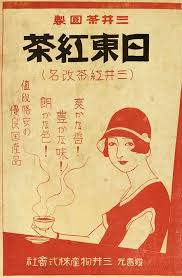
Taiwan produces black tea today, but much of the stock of assamica varietal trees in Taiwan actually were imported during the 1920s and 30s by the Japanese authorities. Back then, the hope was to create a Taiwanese black tea industry that could compete with the rest of the world. Up until that point, Taiwan mainly exported oolong and baozhong (baozhong back in the day was scented, like jasmine tea). Oolongs went to North America mostly, while baozhong were sold to SE Asia. Black tea, however, had worldwide appeal, and if only their colony could compete!
So, at the government’s expense they imported a bunch of trees from South Asia, as well as modern machinery that were designed to make black tea en masse. This tea was mostly produced by Japanese owned companies – chief among them Mitsui, which still exists today as a going concern. Mitsui was heavily involved in the Japanese colonial enterprise and had their hands in everything. Tea was merely one of the many, many products they sold.
Here’s another wrinkle though – it was not legal for most people to export tea directly. To export you had to have a license, and to get that license required you to pass certain capital and technical thresholds which normal tea farmers would never dream of making. This also was way back in the day, when traveling from the mountains to the big city already took a long time. The tea industry was quite different, where logistics reared its ugly head all over the place. In this way, big companies dominated.
This is especially true at the final export stage, where the sales overseas were controlled mainly by a handful of foreign-owned firms. Jardine Matheson was one of them, but they were not the biggest. Among their competitors was Tait & Co, Carter, Macy & Co, Anglo-American Direct Tea Trading Co., Boyd & Co, and of course Mitsui. Quite a few of these have been in the tea business for almost a hundred years by the 1930s. Among these only Jardine Matheson, Mitsui, and Tait & Co still survive at least in name only. Anglo-American is, in a way, still sort of alive as a former subsidiary of Finlay’s.
Thing is, these export companies traditionally did not involve themselves too much in the production side of things – it’s too complicated dealing with all the farmers up country. Instead, it’s better to just have some operation where you buy raw leaves, or you can buy maocha or done leaves from the farmers and then blend/finish yourself and then export. There were lots of middlemen in the business, but that was part of the deal.
Given this, you can sort of see how Mitsui occupies a unique position because all of a sudden you have the first true vertical conglomerate. They wanted to monopolize their position as the biggest (but not only) black tea producer in Taiwan. So, they forbade their factories from selling black tea to their competitors, and tried to offer Taiwanese black tea for a more competitive price on the world market. Other firms who wanted in on the action had to buy from other suppliers, but those alternative suppliers usually didn’t have the technology or skills, so their teas were less good. You can still compete on price, but it’s tough work.
Up until around 1932, Jardine Matheson’s operations in Taiwan was run by a man called Hugh Lachlan. He had been at the company for thirty years, focusing on the tea business, but by this point he was sort of a broken man – in poor health, low in energy, and the decade plus he spent in Taipei had sapped him. Taipei back then was seen as a true backwater, especially when compared with the cosmopolitan cities of East Asia like Shanghai, Tokyo, or Hong Kong. According to J.J. Paterson, future Taipan of Jardine: “Remember that Taipeh is a hell of a place for a white man to live, and it is only fair to allow them to get away for the sake of sanity, health and morale.”
Lachlan retired at the end of 1932, and was replaced by a man called C. S. Hayley. He was coming from the Shanghai tea department, which was the center of operations for all tea businesses in East Asia at the time for Jardine – they bought mostly green teas there for export. Hayley was much younger, single, and seemingly quite energetic. The Taipei branch had been losing money for years at this point, with HQ wondering if they should shut it down for good despite doing decent amounts of business. Hayley’s job was to increase sales and so to pull the division into profit.
The first year there Hayley did seem to succeed – the division made a profit for the first time in years, and successfully exported some black tea from Taiwan, which was a first, because up till that point only oolongs were sold. Generally speaking, Jardine was quite conservative in how they operated, and only bought tea to export when they have an order coming in from an overseas client. They almost never exported teas “on company account” meaning that there was never any real financial risk of selling the tea – it was a volume business. They were merely acting as agents and earning a commission on every trade. It was a safe but slow business.
Hayley tried something new, which was something that hadn’t been attempted in years. He tried to export some black tea on company risk to Australia, attempting to open a new market. Those 100 packets of tea sold pretty quickly, at a modest profit. That worked! Next year, in 1934, Hayley got ambitious. He had pre-ordered 7000 packets of black tea from Chinese producers not associated with Mitsui, with the Australians agreeing to buy 5000 of them and the rest planning to be shipped to the US. While these were not as good as the Mitsui ones, he was confident he can beat them on price. Besides, all the farmers were switching to black tea production because the market was doing well, so he was confident it would work.
Well… it didn’t. The producers he contracted with couldn’t come up with enough packets of tea for him to sell, so Hayley was forced to buy on the open market, but because of that, he had to pay market price, which was substantially higher than the price he had contracted to sell to his customers. In other words, he had to cover his own order at a loss-making price. It was going to lose him tens of thousands of yen – multiples of what the Taipei branch made the previous year (it made a modest profit of something like 15k yen the year prior). This would’ve wiped out all the profits and then some, and would represent a substantial loss. Keep in mind this is still a world economy reeling from the Great Depression. Things were not looking great.
Hayley panicked and wrote a few letters plus telegrams to Hong Kong asking for help. J.J. Paterson, the boss, sent a man named Pollack to go to Taipei to see what they can do. Pollack was an experienced tea man based in Hong Kong, and helped at least sort out the basic crisis at hand, fulfilling orders as possible and comforting Hayley in the fact that the firm will lose some money – but it can easily withstand it. After all, Jardine was one of the premier trading firms with over a hundred years of history by then, and some losses over some Taiwanese tea wasn’t going to put it under.
Hayley cheered up and Pollack, after having finished the business in Taipei, decided to go take a look at Kaohsiung at Hayley’s urging. He went down south on the night train, spent the day, and took the next night train back up to Taipei, and upon his return, he found Hayley had shot himself in the head after downing a whole bottle of whisky. He had written a few letters in his very drunken state, one to Pollack. I’ll quote a little bit of it here:
“I’m getting rather drunk but I’m trying to state that its my own fault that I’ve got myself into the present jam. You have been awfully decent in telling me that the firm didn’t care a bit about losing money (this isn’t strictly true) but my brain is kinked and I can’t think already.
Cheerio Pollack and this will be a new and interesting experience for you.”
In the end, the firm’s trading losses weren’t nearly as much as initially feared, and customers, while they received teas inferior to what was promised, were able to make do with the goods and made smaller claims on the price paid. There were still losses, but it was entirely manageable.


 RSS - Posts
I took you at your suggestion and have been reading some of your old post-Covid posts. I haven’t been to…