A Tea Addict's Journal

Practical tea brewing advice

January 28, 2014 · 18 Comments

On this eve of the Lunar New Year, I thought I can offer some advice gleaned from over 15 years of tea drinking.

1) Use a vessel of suitable size — This means that if you’re drinking by yourself, don’t use a 300ml teapot unless you’re trying to make weak tea. Likewise, if you have a lot of people over (for holidays, for example) using that 100ml favourite of yours is really not a great idea. If you are short on wares, err on the side of small. You can always double up infusions and serve them together to fill volume, but it’s harder to deal with a large quantity of tea for a small number of people.

2) When rinsing, do not steep too long — I read in forums and other places sometimes of when people say things like “1 minute rinse”. I don’t know about you, but a 1 minute steep is no longer a rinse. Rinses are fast – 10-15 seconds at most. 1 minute, plus time to pour in and pour out water, really means more like 1 minute 30 seconds. That’s an eternity and you lose a lot of the “stuff” you should get from your tea. Don’t do it. Teas are never that dirty.

3) When brewing compressed puerh, break up the pieces — in the Western tea drinking culture I sometimes see a certain obsession with having whole pieces. I think this is partly because a lot of people drink mostly samples, so they like to see whole chunks, somehow, and oftentimes said chunks are thrown into the pot/gaiwan as a whole thing. This is not going to be good for your tea drinking experience – large chunks have a relatively small surface area for water-contact, and this is especially problematic when it’s compressed tightly. If you rinse it the water only touches the surface, and oftentimes the cores of those chunks might still be dry after one or two infusions. The proper way to do it is to break it up – yes, even if it means breaking some of the leaves. Chunks in the pot/gaiwan should be smallish, no more than about 1cm in diameter or so. If the tea is loosely compressed you can have bigger pieces. Ideally, it should actually be a mixture of chunks and loose leaves (from the same tea, of course). Remember, they all came from the same cake. As long as you’re not only brewing with fannings, it’s fine.

4) Adjust brewing time according to what your tongue tells you — a pretty common problem for novices is to ponder how long the infusions should be. Once you have thrown in the leaves, you’re stuck with your leaf/water ratio, so the only thing you can really adjust are 1) water temp and 2) time in steeping. The easier to adjust among those two is time, so you should adjust that accordingly. Is the tea way bitter/strong? Then be quick about pouring in and out. Is the tea getting weak? Lengthen the time of steeping. That’s not what the vendor recommended? Ignore the vendor. Do not ever automatically add time every infusion, as is often dispensed as advice for newer drinkers. It’s not a great idea.

5) Keep the water hot — aside from green teas, most teas should be brewed with water that’s kept very hot. That’s how you get the most “stuff” out of your tea, and gives you the most depth in flavour. If the brew is coming out too strong, you either added too much leaves or left the water in too long (or, possibly, the tea is just bad). Yes, you can get a really sweet, pleasant, and non-offensive brew by keeping the water to 60C. But you can just as well argue for cold-brewing aged oolongs overnight in the fridge. You can do it, but it’s really not the best use of the leaves. Leave the cold brewing for the cheap teas (where hot water can bring out some nasty bitterness if the tea is truly bad) and keep your water hot. Otherwise, you’re wasting perfectly good leaves.

6) Grandpa the tea when you’re finished — if you really liked the tea, one way to keep drinking it is to grandpa it.

On that note, may the year of the horse be one filled with good teas!

→ 18 CommentsCategories: Information
Tagged: ,

Gambling in Macau

January 25, 2014 · 2 Comments

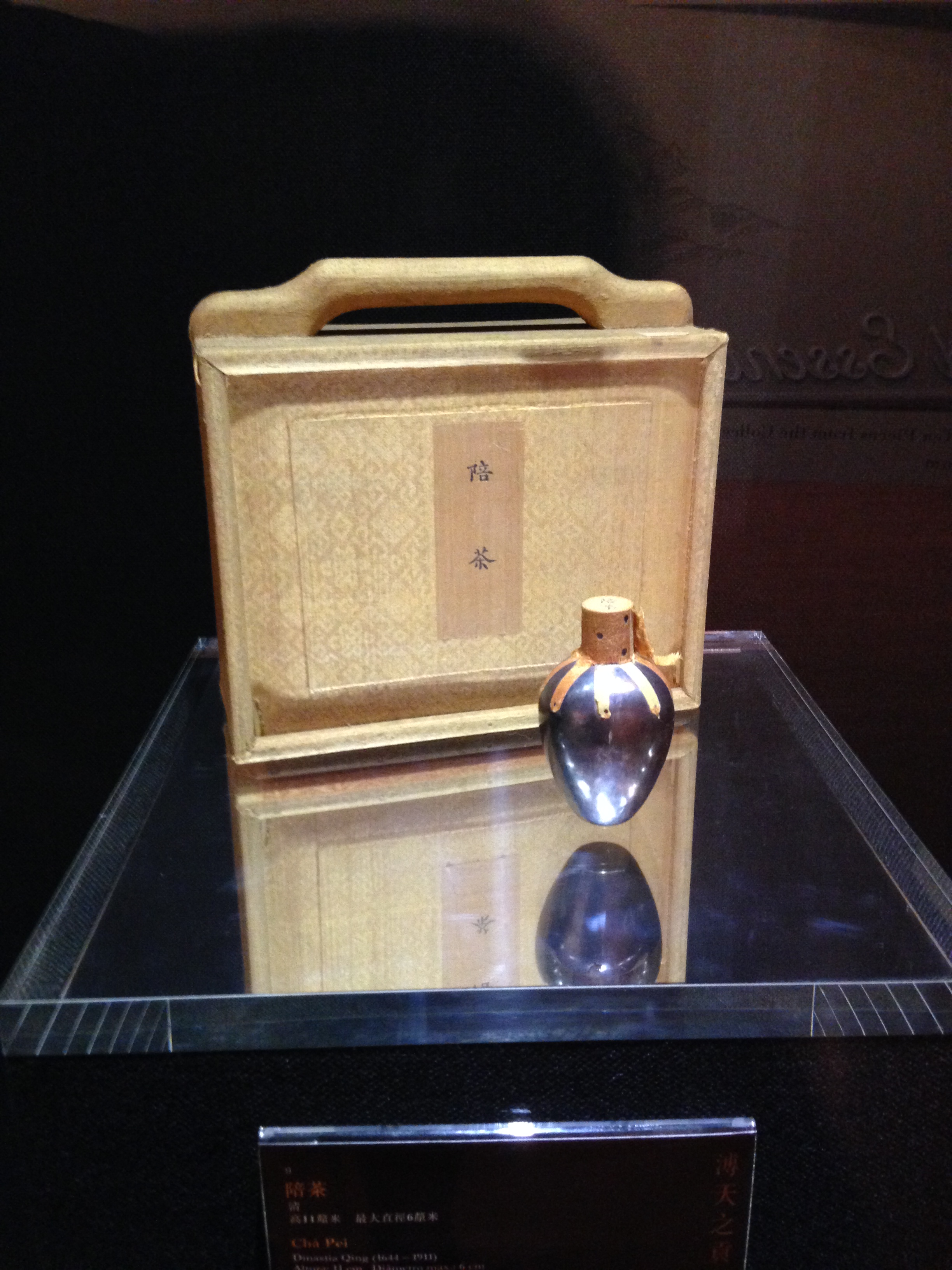
As many of you know, Macau is now the gambling capital of the world, having taken over Las Vegas for the number one spot a few years ago and now with a very sizable lead. I recently went, but not to gamble. One benefit to a city built on gaming revenue is that there often are things that are built around it because the city wants to attract tourists who (like me) don’t gamble – make them attractive enough so that their friends who might won’t get vetoed. Among these things in Macau, aside from the great food and the historical buildings, is a beautiful art museum. There’s a current show on teawares, with half of the items from the imperial palace, and the other half from the Victoria and Albert Museum in London. Some of the items there are stunning. There’s a supposed 150 years old ball of tribute puerh, a 400 years old yixing pot, and my favourite, a number of tea canisters for imperial use. I took a snap.

This isn’t even for the highest grade of tribute tea, but rather the second highest. It’s not clear what’s actually inside though.

Or, take this charming box

Being emperor seems like a good idea.

I did end up gambling a little – not by sitting at the blackjack table, but rather, buying some tea. There are a few older teashops in Macau in the more residential neighbourhoods. I ended up at one and bought a cake of what I think is 2003 Xiaguan.

Not too expensive at all, and not too bad. Better than risking some scary looking thing on Taobao, although admittedly some of them are cheaper and maybe even better gambles. Then again, the store was so old looking and so run down, it was half the fun of shopping there. The female proprietor (I dealt with her husband) was sleeping on the bench in the shop, but covered herself in such a way that I didn’t even notice her until she woke up halfway through our exchange, giving me a bit of a startle. Who can beat that for excitement in a tea store?

Anyway, if you ever come by Macau, I heartily recommend a visit to the museum. It’s certainly worth the trouble.

→ 2 CommentsCategories: Objects
Tagged: ,

Things that matter, things that don’t

January 8, 2014 · 18 Comments

Over the years I’ve seen/heard/read many purported “rules” when it comes to buying yixing teapots. They all claim to help you buy a good pot. I’ve believed some of them at some points, although, increasingly, I no longer rely on any of them. I thought I will list a few of the common “rules” that people have developed – ones that I think are actually leading you down the wrong path, and offer up an alternative instead.

Keep in mind that everything written here is from the point of view of someone buying to use their pots, especially smaller pots that are for, at most, 3-4 people. If you are looking to buy things for your collection – then it’s mostly a question of personal taste and preferences. I’m also fully expecting to see people who think what I write here is wrong. If you disagree, let me know why.

1) The pouring test – basically, putting water in the pot and then pouring it out. This test is supposed to check, mostly, for whether or not the pot drips or not. It is true that pots that drip are annoying, especially if you pour slowly, but actually, I’d argue that dripping is not the worst thing that can happen. The thing is, when it’s a small pot and you’re using it mostly for personal drinking (as I think many of my blog’s readers do) it’s actually quite rare that you will use it for pouring into multiple cups – that’s when dripping becomes a serious problem. During my normal day to day drinking, for example, I’d pour the contents of my pot straight into a cup that’s large enough for the pot’s size. Also, when pouring, the pot is tilted basically 90 degrees so the spout points down. In that case, whether a pot drips or not makes very little difference – it will pour into the cup, regardless. The same is true if you use a fairness cup and you empty your pot into that.

Instead, something to pay more attention to is actually the speed at which it pours. Crucially, it’s the speed at which it pours when it’s tea that is hot, not water. I’ve used pots that pour well when it’s cold water (what you’d use to test in a shop) but do poorly when it’s tea – tea has slightly higher viscosity, and in some cases, it does seem to matter. If you have a slow pouring pot, it can kill your tea drinking experience using it.

2) The lid test – there are various versions of this out there. The simple one is just whether or not the lid fits well or not – if it wiggles, the theory goes, it’s a badly made pot. The extreme ones claim that you should put water in the pot, fill it to the brim, put the lid on, hold the pot by the handle and spout while covering the spout, and then turning the pot over. A supposed truly well made pot will have a lid that doesn’t fall out.

Aside from the very obvious problem of running the risk of having the lid fall out and break (and thus making it very unlikely that vendors will let you try this before you pay) it also serves no purpose in tea making. A tight fitting lid doesn’t actually make your tea better. It doesn’t really help pouring (in fact, it might exacerbate slow-pouring problems) and it doesn’t even necessarily denote good craftsmanship. Most pots these days are made with molds – which seriously lower the bar set for tight fitting lids. Just because it fits tight doesn’t actually mean much for the drinker. A lid that is a bit loose, as long as it’s not excessive, is perfectly acceptable. We are not talking about lids that are almost falling into the pot here – those are annoying (I have one). A bit of wriggle won’t really matter much though.

3) Factory 1 is everything – there is a certain fascination with factory 1 teapots. In case you missed the memo, Yixing factory 1 was the main factory for making teapots back in the state-controlled days. Many famous potters got their start there, and so many early period pots might have (emphasis on might) been made by said famous potters. There are various theories out there as to what the signs are for a master-made pot – seeing, for example, 宜興南孟臣製 as opposed to 荊溪南孟臣製 as the seal, for example. The idea is that factory 1 controlled the best clay, the best talent, and so the pots they made were the best.

Sure, that may be the case, and in terms of collectible value, a verifiable factory 1 pot is certainly worth more than one that isn’t. However, there’s a problem – it takes a serious amount of work to learn to distinguish what’s a factory 1 and what isn’t, and most people who sell these things haven’t a clue. They are just told by their friends (who sold them the pots) that they are, indeed, factory 1, and pass them on as such. There are probably way more factory 1 pots out there than factory 1 ever produced, just like there are far, far more Lao Banzhang on the market than all the tea Lao Banzhang has ever made in its entire history.

This is even more of a problem when you buy pots online, as many of my readers are likely to do. The signs of a well made pot – clay, craft, etc, are hard to discern through pictures alone. Unless and until you can handle the pot, or, if you feel adventurous, buying online is a real gamble. And also, given the cost of a real factory 1 pot these days, it’s a non-trivial amount of money (hundreds of dollars) to be gambling with.

Finally, the supposed value of a factory 1 pot is not really in tea making – and even if it does somehow improve your tea slightly, as I’ve stated a long time ago, the incremental difference (if any) is going to be pretty minor, all things considered. If you are hoping to buy one of these pots because you think it will dramatically improve the tea in your cup, you should invest the money in buying better tea leaves instead.

4) XXX clay is good for XXX tea – there has been an explosion of the names of clay types in recent years. An old teapot dealer here in Hong Kong who’s seen more teapots than I have drunk cups of tea tells me that until maybe 15 years or so ago, nobody cared what clay a pot is made with – the names are simply “red clay” “purple clay” or “duanni”. None of this “dicaoqing” “qingshuini” and a million different types of zhuni, etc etc. That, he thinks, is all just a ploy for sellers to get people to buy more pots – and I can sort of see why, as the completists in us want to collect something of everything. To him, the only thing that matters with the clay is whether it’s good or not – which is told not by the type (or more specifically, the name) of the clay, but rather by its texture and look and feel. He can’t name you what it is, but he can most certainly tell you if it’s good clay or not. Likewise, the idea that a certain type of clay, itself a dubious idea, is only good for certain type of tea, is a double dose of such myth perpetuation. Don’t buy into it. You don’t even need to use a pot with one single type of tea – using it with one family of teas is usually good enough.

At the end of the day, if you’re buying a yixing pot, just know that you’re not buying a power-booster to your tea – that’s not what it’s going to do. It may change your tea that you normally brew in, say, your gaiwan, but it won’t necessarily improve it – in some cases (depending on the pot) it may even make the tea worse. If you buy a pot, it’s because you want to use a pot and like to use a pot. If you want flexibility, stick with gaiwan. They’re cheaper and more versatile. Just don’t buy an expensive one – it will break.

→ 18 CommentsCategories: Teas
Tagged: , ,

Explaining the impossible bargain

January 2, 2014 · 3 Comments

Sometimes when shopping for tea, one comes across the impossible bargains – prices that are simply too good to be true. Over the years, I’ve found those to fall into three main categories.

1) It really is too good to be true. This is probably something that isn’t what it claims to be, or possibly, not the whole truth. There’s often some fudging going on with these – an aged tea that isn’t quite aged, old tree tea that is, well, not that old, high mountain tea from areas that really don’t qualify, etc. “Revivals” or “the area of XXX” or “1990s” are all labels that may pertain to these sort of teas. So, in other words, these are trying to upsell as much as possible. There’s a reason they are so cheap.

2) The seller has no idea what s/he is selling. This happens most often in smaller shops, out of the way shops, shops with really old stock, or personal sales – people who don’t know what they’re doing. They are also invariable teas that are older – if it’s new tea, and s/he had to buy it and resell it on the open market, they’re not going to get good prices that you can pass on to the customer unless they operate at a loss. You have people who inherit old puerh cakes by the boatload and throw them away thinking they’re stale tea. You have people selling their own collection on the cheap because they’re in a hurry to get cash. You have sellers who just want to get rid of something and don’t care what prices it goes at. These are real bargains, if you can find them, but they are pretty rare. It also takes a lot of energy to seek these out.

3) The seller knows exactly what s/he is doing and doesn’t care. I’ve met some of these before, and these are the most interesting cases.

Modern economics has as one of its basis the assumption that actors are, by and large, rational. They generally do things that are in their own best interests, and sellers of a commodity like tea would, normally, behave that way. If the market price is $100/jin for a given tea, then a seller who sells it for considerably less must have some reason to do so – the reasons should include some return on the lower price they accept. That could be liquidity (like the guy who needs cash now) or relationship building (selling you something cheap so you’d come back for more). Or maybe it’s part of the business strategy (hypermarkets). There’s a good reason they do such things.

But over the years I’ve met a few sellers who don’t care, and whose motivations for selling at below market defies economic logic. I’ve bought cakes before from people who know it sells for, say, $250 a piece on the market, but sold to me for half the price. I’ve bought aged oolongs that are quoted at the same price they were sold 30 years ago (granted, prices for Dongding in the mid-80s was high), when the same tea can only be had at other joints for 3x the price. Why?

Oftentimes the answer I’ve gotten goes something like this: I sell this tea for cheap because I need to sell to my own customers. However, these are customers who generally don’t do a lot of business. For example – I only go to Taiwan a few times a year, and I buy, at most, a few jins (one jin = 600g) at any given shop. My total purchase within a year at any one shop will probably not exceed 10jin. That’s peanuts. While I was there this time, one of the shops was readying a shipment of 20jin of Dayuling for a store in Tokyo. I’ve sure that order alone outpriced whatever I bought by a factor of 5 or more. What’s the point of keeping customers like me happy?

The answer to this rather silly question is that to some, wringing maximum amounts of money is not quite the point. It’s somewhat interesting, as the rationale told to me is usually something like “well, I have to make sure I have stuff for you guys” or “I don’t know how to just mark it up like them.” There are also others who do it to stick it in people who change prices monthly for their tea – although in these cases selling tea tend to be a sideline of sorts to something else. Also, if they know that the buyer is a vendor, the price is not as friendly – therefore in these cases, buying small quantities through retail is actually better than buying dozens of jins of tea wholesale.

I’m not complaining about this, of course, if I’m the beneficiary. It’s just an interesting case where the textbook assumptions in economics fails. I think for these sellers, they derive pleasure in actually selling to retail customers who are loyal and come back year after year. Earning an extra 200 HKD or not on that sale is not that important to them. This is also why I have, over the years, stopped going to places that keep their prices very current – there’s something cold and unfriendly about places like that. I might not get the latest fashionable tea from them, but what I do get is a very nice reliable supply of teas that I like. That’s good enough.

→ 3 CommentsCategories: Teas
Tagged: ,

Diversity

December 18, 2013 · 3 Comments

When I spend any amount of time in Taiwan, a lot of tea is almost inevitable. This is not only because I actively seek it out, which I definitely do, but also because even at places where you aren’t looking for tea, it comes to you.

So, in the past five days, I’ve had

Early 90s Alishan
A couple aged Oriental beauties
An old baozhong
Fall 2013 Gaoshan
1950s “Paperless” Red Label
Two 2013 Fall productions Yiwu from Wisteria
2013 Dayuling
Three or four aged baozhongs, various ages
Two new baozhongs, 2013 Fall
One aged dongding, or something similar
Another 90s Alishan
A 2013 gaoshan
An aged cooked puerh
A 1980s teabag of aged oolong
A very nice aged shuixian
Two award winning, slightly aged Oriental Beauties
A 2012 Winter Gaoshan
A beautiful 2012 Beipu black tea
A perfectly stored early 90s Gaoshan
A 30 years old dongding, reroasted
A 25 years old dongding
A wet 30 years old baozhong

And this is with only one tea shopping trip (to Wenshan and a couple old haunts) – the rest were just drinking with people.

There’s also a wide variety of places that I ended up at, from teashops that have bags of tea littering the floor

To various types of more refined establishments, one of which happened to be a Nanguan studio where we basically enjoyed a private show, with tea

It’s hard not to be picky about your tea when you live in a place like this. It’s also a place where you can enjoy tea high or low – whether it’s a casual cup of tea from one of those chains that serve it cold with ice and shaken, or fancy with the full setup and some exotic tea with a story to match in someone’s home. There’s something for everyone here who drinks tea – if you haven’t been here (and are reading this blog), you should.

→ 3 CommentsCategories: Teas
Tagged: ,

Back to the Island of Tea

December 12, 2013 · 11 Comments

How do you know you’re in the Island of Tea?

Well, not immediately, but when you check in to your hotel, and you walk around a bit, and notice that less than a block away at the street corner, there’s this

and this

and best of all

Did I mention this is all on the same street corner? And of course, within the same block and half radius, there’s at least two or three more shops that only sell tea.

But still, this could be just the one district where there are a bunch of tea shops. Well…. until you get back to your room, flip on the tv, do some channel surfing, and while doing so, finding that two of the tv shopping networks sell tea (among more normal things, like women’s underwear). Yes, they sell tea via tv.

In retrospect, I really should’ve recorded it via video, but I’ll spare you the hard sell, since it involves a lot of yelling about how great a deal is. The first channel was selling puerh.

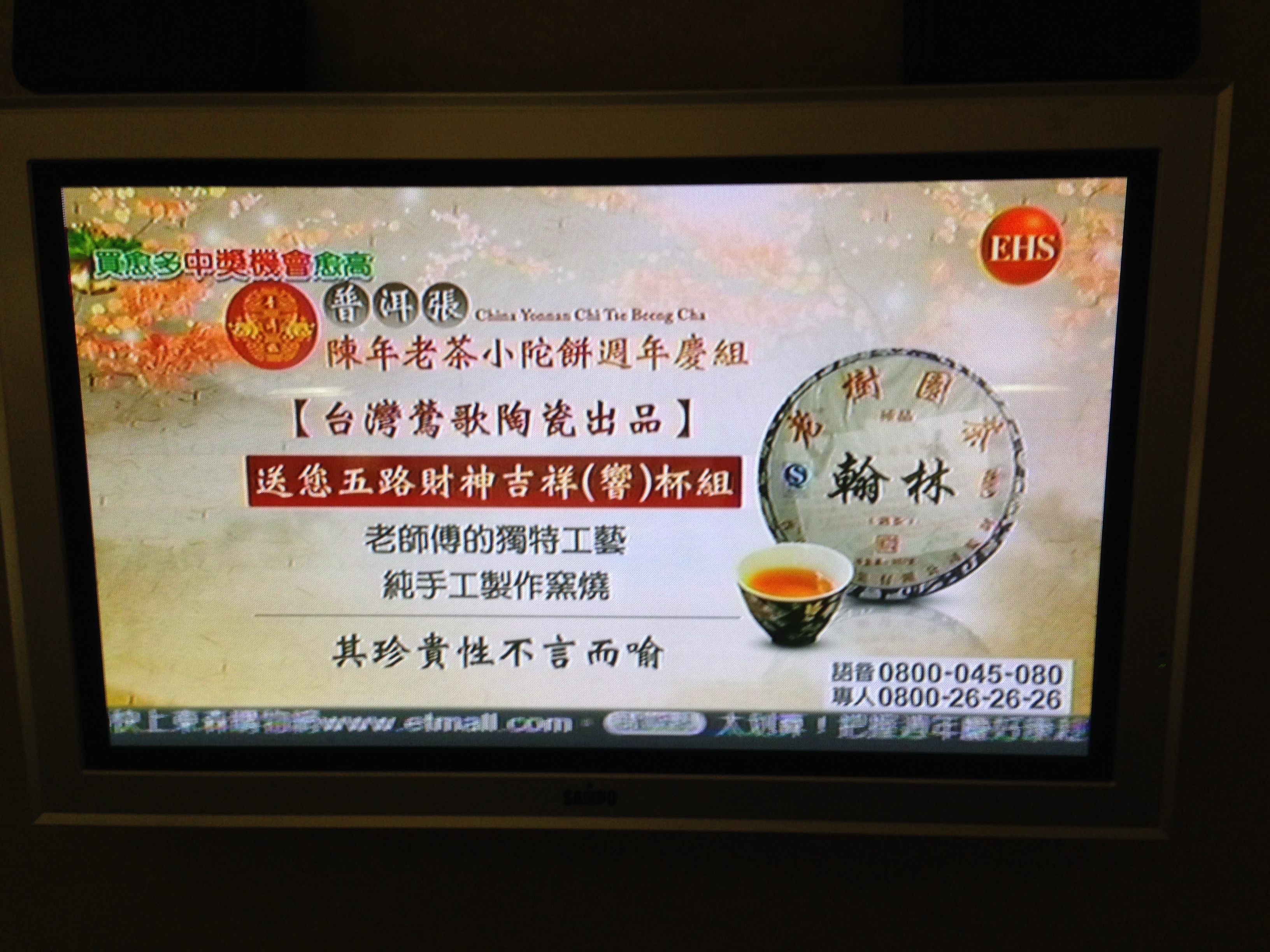
As you can see, only 3 and half minutes remaining, so I didn’t catch the initial pitch. In any case, they were too excited about this amazing deal to actually tell me how much tea they were selling for the price they were quoting, and they had to keep reminding me how there’s only a few minutes left. From this chart, I figured the following:

It seems like they were claiming that they had this great cake from year 2000, somehow broke it up and made them into mini-tuos – don’t ask me how, why, or whether that’s even possible. Anyway, that’s the claim, and for the low, low price of 1980 NT (about $60 USD) you can get a can of these minituos. If you buy five! You can even get a free ceramic cup! In case you want to see what cake it is:

As the last line said, the preciousness of this tea does not need to be said.

The other channel was selling something a little more conventional

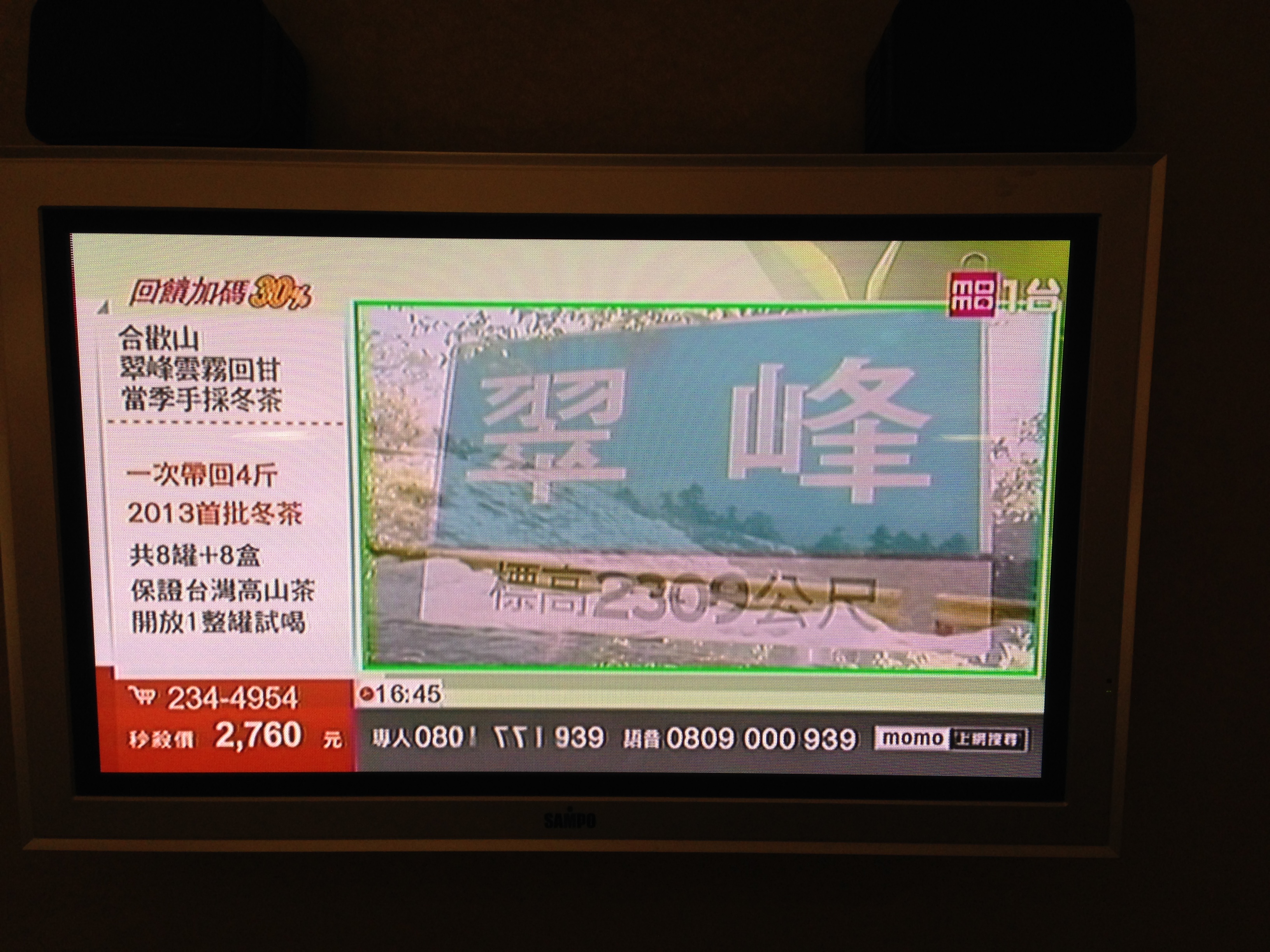
Yes, Cuifeng, in Hehuan Mountain, winter harvest. What sounds like half a jin (300g) for 2760 NT, about 90 USD, which is really not very cheap at all. To prove that it’s really high, they of course had to bring out the maps

Oh, and if you buy 4 jins total, they’d give you a free 4oz sampler of the same tea!

Yes, welcome to Taiwan.

→ 11 CommentsCategories: Teas
Tagged: , , ,

I was tagged

November 27, 2013 · 1 Comment

So Michael J. Coffey tagged me to answer these “confessions of a tea blogger.” Here goes

1) First, let’s start with how you were introduced & fell in love with the wonderful beverage of tea.

Growing up in Hong Kong, I don’t think anyone is actually “introduced” to tea. You just drink it as a matter of course, because it’s everywhere, whether it’s the diluted tea water you get at local crap restaurants or the stuff you get when you go out for dim sum, you encounter tea every single day, in all shapes and sizes. So tea, as it were, was always a part of my life. My grandfather was never far from his tea – in fact, he almost never drinks plain water. So some of my earliest memories are people just sipping their cups when they come to visit, etc.

As for falling in love with it, I suppose it took place during college, when I bought a little bit of mingqian Longjing, wondering why this particular Longjing cost 5x the regular stuff. Well, turns out it was indeed a lot better than the regular stuff, and it’s been a one way street since.

2) What was the very first tea blend that you ever tried?

This is when you know the questions were written by someone who drinks mostly Western style tea, if we can call it that. Blends? I don’t know, probably some Lipton tea they use in restaurants here in Hong Kong. What else? I’ll be surprised if this isn’t the answer for pretty much everyone out there.

3) When did you start your tea blog & what was your hope for creating it?

January 28, 2006. That makes this blog almost 8 years old. It started out as, really, just a journal for myself to record what I drank and what I thought about the tea, on that most horrible (and now dead) of platforms, Xanga. Back then I think there were only three blogs on tea that I know of – Teamasters, which is still in the same business; Chadao, which has been dormant for a long time, and The Mandarin’s Tea, which has morphed a bit. There was also the Livejournal Puerh community, which has died a long time ago (and LJ is not far behind). Things were a lot simpler back then.

4) List one thing most rewarding about your blog & one thing most discouraging.

Rewarding: meeting people, sometimes in real life, who I otherwise wouldn’t have met, because I write this blog and they read it and we get in touch somehow. Discouraging: when obvious misinformation is spread and sometimes, despite my feeble attempts, it persists. The tea world is a much better place without all the myths and sales pitches.

5) What type of tea are you most likely to be caught sipping on?

Darker oolongs or puerhs, depending on the day.

6) Favourite tea latte to indulge in?

Huh? No thanks.

7) Favourite treat to pair with your tea?

Usually nothing.

8) If there was one place in the world that you could explore the tea culture at, where would it be & why?

I haven’t been to India yet, and would love to go see some tea plantations there. It’s a totally different mode of operation.

9) Any tea time rituals you have that you’d like to share?

Don’t complicate things when they are not necessary.

10) Time of day you enjoy drinking tea the most: Morning, Noon, Night or Anytime?

Afternoon, usually. People act surprised when I tell them I only have one tea a day normally. I try not to overdose.

11) What’s one thing you wish for tea in the future?

More people caring about it and less marketing-speak, but there’s no chance of the latter, I’m afraid.

– Whom do you tag?

I think Dr. Hobbes is untagged until now.

→ 1 CommentCategories: Misc
Tagged:

Raising a yixing pot

November 18, 2013 · 17 Comments

How to season teapots? That was one of the comments on my last post. It’s actually not that difficult, although advice on the internet being what they are, and just from the first page of google results looking for “how to raise a yixing teapot“, I see some instructions that are of dubious utility (the first link, funny enough, has pictures of a ceramic cup, not yixing pot, and the second step of the second set of instructions is a death wish for a pot, as I will explain shortly). The basic premise is – keep it simple, and don’t do anything that will endanger your pot.

Before you use the pot, the instructions will tell you to do the following:

1) Clean the pot. 2) Boil it. 3) Brew some tea in it and then discard the tea. 4) Use

Now, the general outline of this I can agree with. Cleaning the pot is simple enough – wash it with water and clean out any debris that might be in the pot, which in brand new pots is often present. If you’re buying antiques or older pots, you may need to do more deep cleaning – ranging from acid baths to bleach baths. For pots that are new, that’s unnecessary.

I think I have, at some point in the life of this blog, also mentioned the need to boil a teapot. I have to say I no longer think boiling is a good idea, and since it is a very risky activity, I do not encourage people to do it unless they have a death wish for their pot. I have personally damaged two of my pots in the process of boiling them, and I am not sure if there’s any good reason to do so that cannot be achieved just by soaking the pot in very hot water for an hour in a pan/bowl that has been pre-warmed (along with the pot) and covered and perhaps insulated. The theory behind boiling the pot is that it opens up the (some say mythical) pores on the surface of the pot and “prime” them for seasoning. I’m not sure of the truth of this need – but if you believe in it, I think a hot soak will do the trick.

The problem with boiling is that even if you simmer, at the lowest heat, the water will still bubble up, unless your heat is so low that the water is kept only warm, and not hot, in which case you are doing what you can do with just a covered bowl with no heat source. When the water bubbles, however, the parts of the teapot in the pan will rattle, either a little or a lot, depending on your luck, and once in a while, it will rattle in such a way as to damage it – usually the victim is the tip of the spout or the edge of the lid. If you insist on boiling, start with cold water with the pot already in the pan and heat everything up, very slowly, together. Putting the pot in boiling water, like Verdant suggests, is extremely risky. Putting anything extra, like a spoon in the pot (as they also suggest) is even riskier – the less things the pot can knock against, the better. I know people here who boil with some elaborate contraption they’ve devised with wet towel lining the inside of a rice cooker or something along those lines. I, frankly, don’t see the point.

Whatever your belief regarding yixing clay’s porosity, I can personally attest that they do soak up smell very well. For example, the pair of pots in my last post – I just tried, for the sake of experimentation, to brew some tea in the relatively unseasoned pot the other day without doing any cleaning. What I got was a slightly salty and old-sock like smell from the pot and the tea – and the tea did not recover even when I transferred it to another brewing vessel. This tells me I needed to clean it, and it also tells me what many yixing users already know – the pots do, over time, take on smells. In this case, it’s the musty smell of whatever storage facility it was in.

So having picked a tea to use the pot with (I’d generally suggest wide genres – oolongs, pu, black, greens, and not be too fussy with specificity – as in a previous post) I normally will actually soak the pot in said tea – spent leaves are fine – for some time, usually a few hours at a time, and refresh if deemed necessary. This should drive away the fresh clay smell (a mixture of sandy and clay-y). Then, your pot is more or less ready to use.

When using it, I almost never pour water over the pot, nor tea. There’s a reason for this, especially if your water source is high in minerals – over time, there will be a nasty ring of mineral deposits on your pot, usually right around the edge of the rim of the lid. This rim will be difficult to clean. The point of using the brush, as some of you might have seen people do, is to distribute the water evenly throughout the pot, so that this line of mineral doesn’t form (or at least, form a lot slower). Also, as a good chemist friend pointed out a long time ago, pouring water over a pot actually helps it to lose heat faster – that water evaporating off the surface of the pot is taking heat away from your pot. I do not believe that there is any tangible and discernable benefit to pouring water over the pot. Some believe the extra heat (if any) will help get more flavour out of the tea, but since your infusions are quick (a few seconds) and the difference in temperature between water in the pot and water-on-pot is minimal (a few degrees, at most?) I have a hard time imagining a physical process that will help you extract meaningful amounts of flavour out of the leaves in that short period of time.

Now, you will often read about the need to polish your pot, usually with the suggestion of using a wet towel, maybe with tea, after every single use. I normally don’t do this either, for another reason – very frequent use of a wet towel to polish your pot will result in what people often call, derisively, “the monk shine.” 和尚光 This is in reference to a Buddhist monk’s shiny, hairless head (although in reality, any bald head will do). Pots that have been over-buffed will be really shiny. Some people prefer it that way, others think it crass. The right hand pot in my last post, in person at least, is borderline “monk shine.” Personally, I prefer my pots seasoned but not shiny – like the lion pot here. If cleaning is a must (and sometimes it is – because of stains, etc) wet a cloth with warm water, and wipe, gently, the pot while it is warm.

When done drinking, clear the pot of leaves and rinse it out if you wish. Whatever you do, please do keep the lid off until the pot is absolutely dry. I know people who close the lid while it’s still wet because they want to season the inside. Sometimes it’s tea in there, other times it’s wet with clear water, but even then, when I open the lid of those pots, sometimes I can smell a bit of an off smell – mold. It’s far too easy to grow something in a pot if it’s wet and closed. Dry it out. If you use your pot often enough, it’ll season through use. There’s no need to rush, and if you forgot to clear the pot just once, you’ll have to start over by cleaning it inside out. There’s nothing worse than realizing that you forgot some tea in a pot you left around because you wanted to season it, and to discover that what was tea has now turned into a gooey, sickly smelling gel-like substance. I’ve done it before, and it’s nasty. Clean, and keep the lid off.

Finally, a word of etiquette – I was chided a long time ago for doing this by friends with far more experience. If you are drinking tea with friends and you want to admire someone else’s pot, ask before you pick it up, and when you pick it up, keep either the lid or the body on the table when you look at the other part of the pot. Never, ever hold the pot in one hand while you hold the lid in the other (or worse, the same hand) when you’re peering into the pot. Even if you think you have steady hands, all it takes is one accident. Two hands on one pot or one lid is far better than thumb and index on the lid’s knob while your hand holds the pot itself. It’s someone else’s pot, and someone else’s effort – the pot might not be worth a lot, but the time and effort and the memory it comes with are not replaceable. Minimize the risk to others by respecting their wares. You can always break your own teapots.

Addendum: A friend also suggested I add two things to the etiquette section. The first is don’t knock someone else’s pot against itself – in other words, don’t use the lid and hit the body of the pot with it. Yes, some people do that to test to see if the pot rings, but yes, it sometimes can damage the lid or the body of the pot. It happens, and you don’t want to be the one doing it. The other thing not to do is to start doing water tests or whatever else tests you do with pots as if you’re buying them – it’s someone else’s pot. They already bought it. Unless they asked you to evaluate it, don’t. You don’t size up someone’s kid (or cat, or car) and start testing their IQ or kicking the tires, so why would you do that with a teapot?

→ 17 CommentsCategories: Objects
Tagged: , ,

Separated by accident

November 14, 2013 · 4 Comments

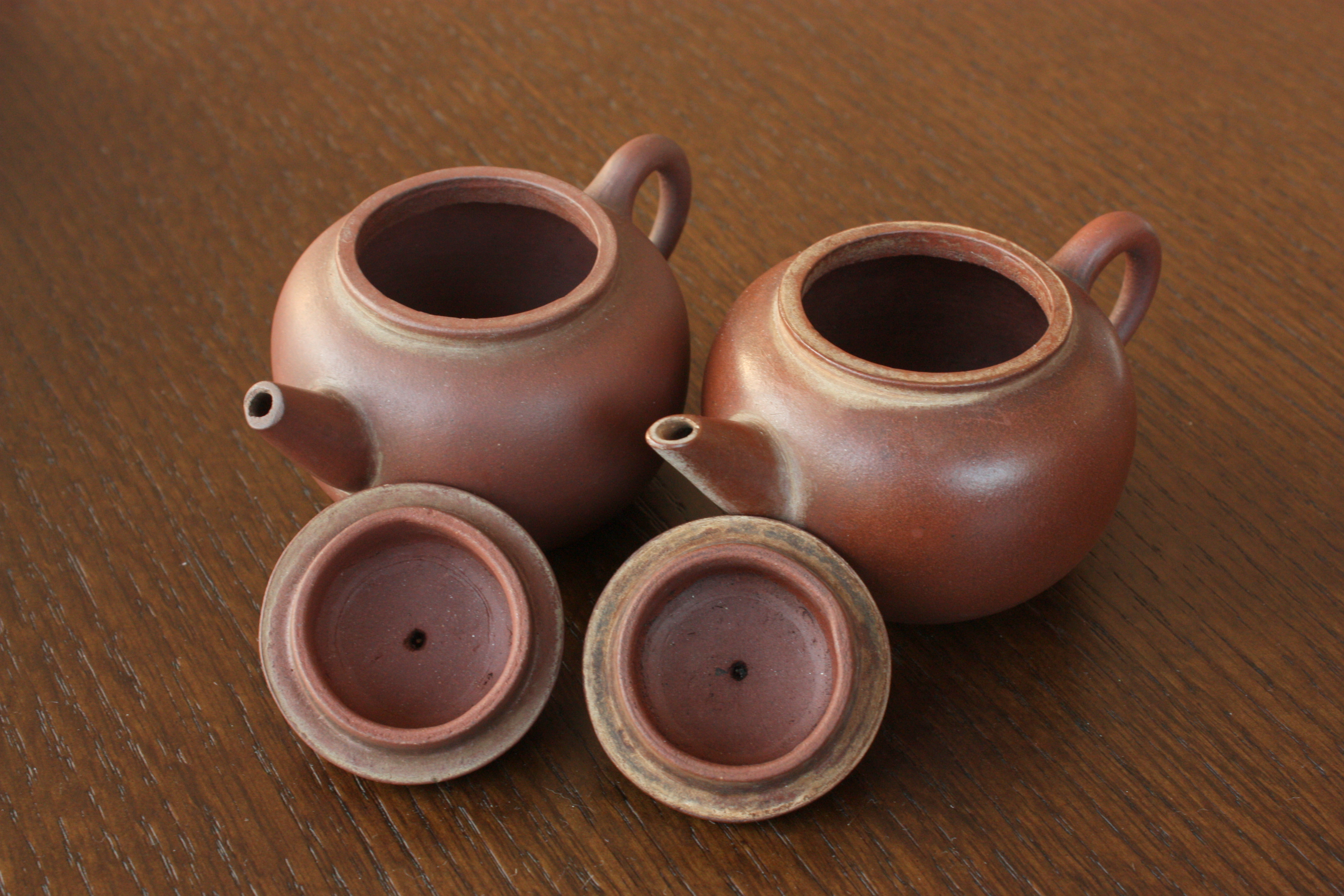
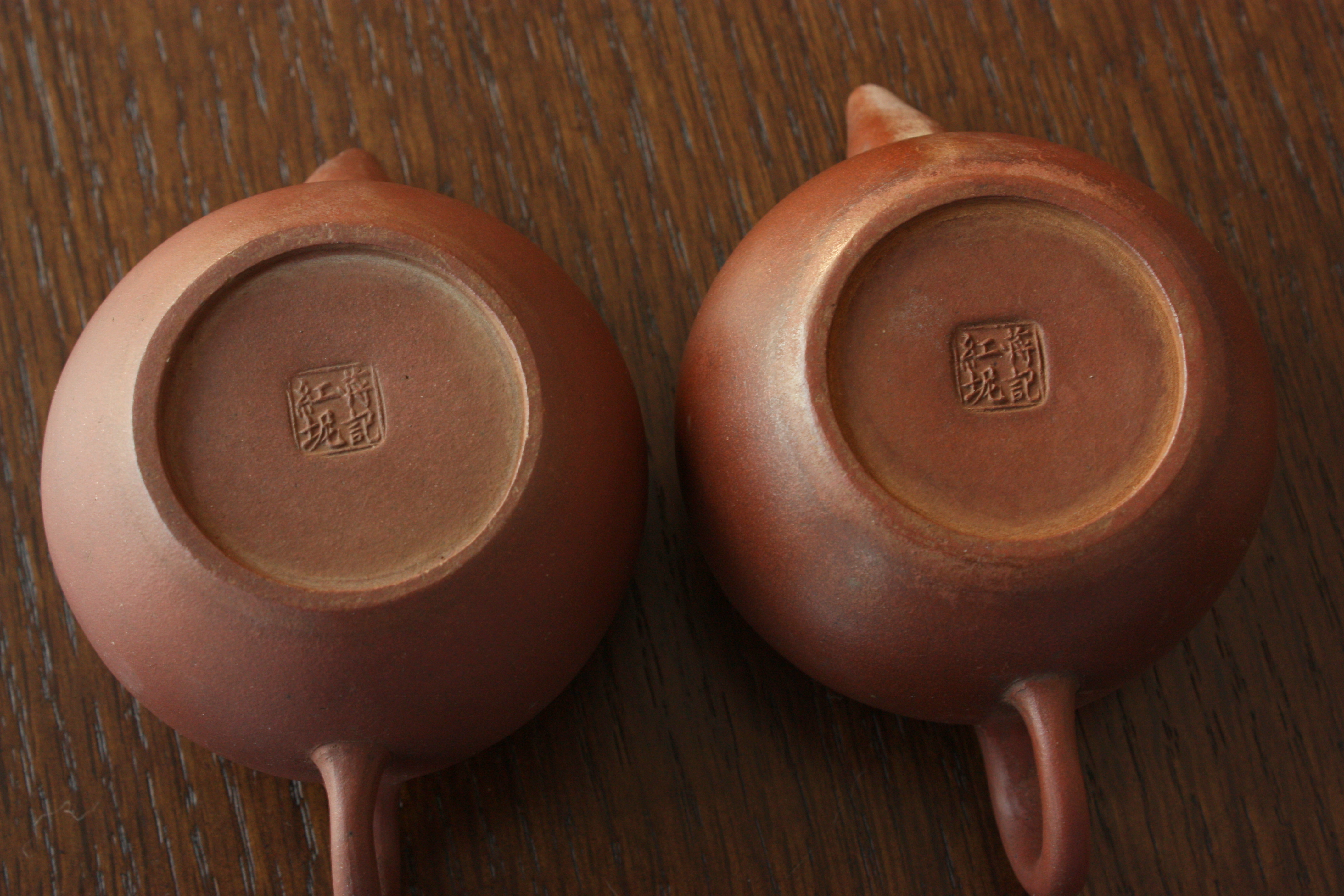
Some friends have been saying I should post more of my pots online. Well, here’s one, or two, rather

I’m a real sucker for these pairs with matching pouches, conveniently colour coded so that they are easily identifiable without needing to fish them out and check. There’s a reason that’s necessary

As you can see, they are different – but actually, not that different. The two were clearly made the same way. The only thing is, the one on the left seemed to have, early in its life, suffered an accident. The tip of the spout seems to be filed down to give it the current appearance. It should’ve looked like the one on the right, but for reasons of accident, it isn’t (there’s some residual damage under the spout). As a consequence, whoever owned the pair probably never really used the broken pot, and stuck with the one that isn’t broken. So, now you have even more difference – one has a lovely, shiny patina, the other one has none. If you want evidence that Yixing clay seasons over time, well, this is exhibit A.

You can see that under the lid the clay of both pots are virtually identical.

You can think of these as identical twins who suffered different fates. One got an unlucky break early on, and as a result, is loved that much less and spent that much less time with the owner of the pot. Whoever owned it took enough care to fix the broken pot – it probably had an ugly break of the tip and so the tip was filed down for aesthetics, but for whatever reason, it never got the attention it needed. The other got everything – loving care, attention, all the tea it needed to nourish its surface. So, many years later, I see the end result of it. It is probably safe to say that most will find the seasoned pot much more pleasing to the eye, but now that I am the owner of these two, maybe I’ll try to right the wrong and give the broken pot some love. It deserves it after all these years.

→ 4 CommentsCategories: Objects
Tagged: ,

This is how you use a tetsubin

November 3, 2013 · 14 Comments

Now if only I had a setup like this. This is a sitting area for guests who are coming in to soak at the onsen and resting up before they leave. The water is kept warm all day long with a slow charcoal fire going under it. It’s nice and warming to just sit there.

→ 14 CommentsCategories: Objects
Tagged: ,