A Tea Addict's Journal

Entries tagged as ‘young puerh’

Maocha in a cup

June 29, 2007 · Leave a Comment

I spent most of the day on a train from Beijing to Shanghai.  On the way, I drank a maocha I bought way back when I first got to Beijing.  I think I must’ve bought it on my second or third trip to Maliandao.  I remember getting 100g of it, wondering whether it will age well, or if it’s good at all.  I knew very little about maocha at that point, having not tried any before.  It was all an experiment.

Almost a year later, I am brewing it, grandpa style, in a paper cup with train water. Unfortunately, I packed the cable for camera-to-computer in my luggage that I left in Beijing, so no pictures… but the tea is surprisingly sweet that way.  Of course, I didn’t use much leaves.  Using too much leaves will mean it will get nasty, bitter, and astringent.  The key to making young puerh palatable, at least in these long, uncontrolled infusions, is to use little leaves and not quite boiling water.  Then, almost everything tastes good.

The leaves are very thick, and the taste reasonable.  It’s not too strong, although there’s some throatiness to the tea.  I think it’s fall tea, or possibly summer tea.  It’s definitely not spring picked.  I need to evaluate it more properly in a gaiwan under normal conditions to be able to say anything definitive about it, but as a drink to pass the time on a train ride, it does its job admirably well.  At the very least, I don’t think this is green tea puerh and should age.

Categories: Old Xanga posts · Teas
Tagged: , ,

A bad day for tea

June 18, 2007 · 4 Comments

Weather was horrible today. Or more specifically, the air was horrible today. I walked outside this morning, and what greeted me was a nasty industrial smell. The air was yellow. It smelled like sulphur or something. Pollution at its worst. My eyes could feel the sting of the bad air. It’s that bad.

So I basically holed myself up at home. I should’ve gone for something safe, something nice, to cheer myself up despite the bad air. Instead, I went for adventure…

Going through the samples again, I found a bag that was given to me many moons ago by YP, a very experienced tea friend from Hong Kong. She gave me a corner of a cake she thought was interesting and worth experimenting with. It was a silver needle cake. I’ve now come to the conclusion that silver needles generally don’t age so well, but maybe YP has a better eye for these things than I do (I’m sure she does, actually). She said she bought it because she didn’t know what to make of it, so it was an experiment. Now it’s at least two years old. Let’s see how it went.

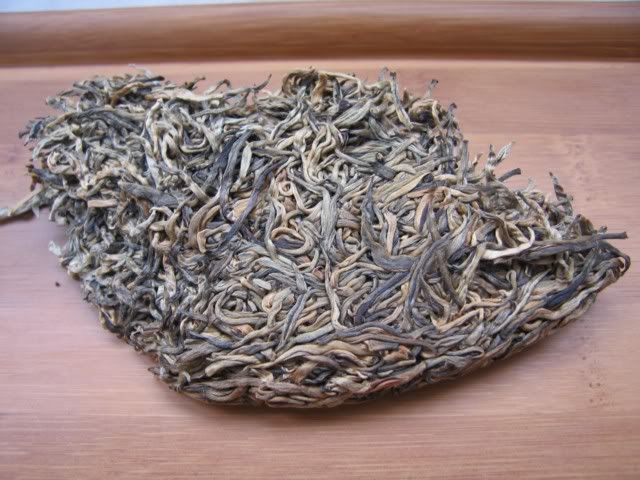
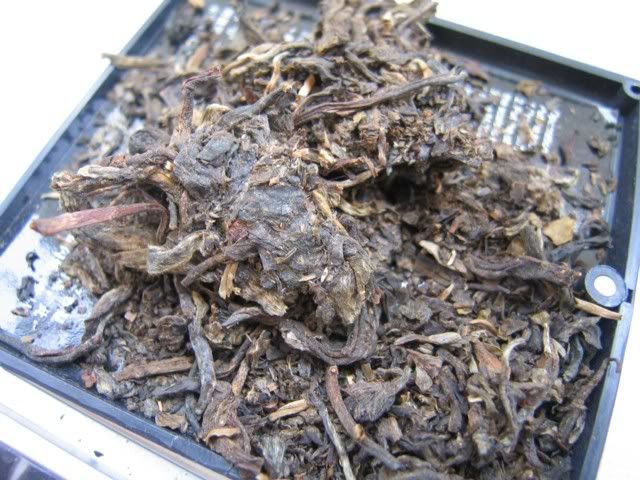
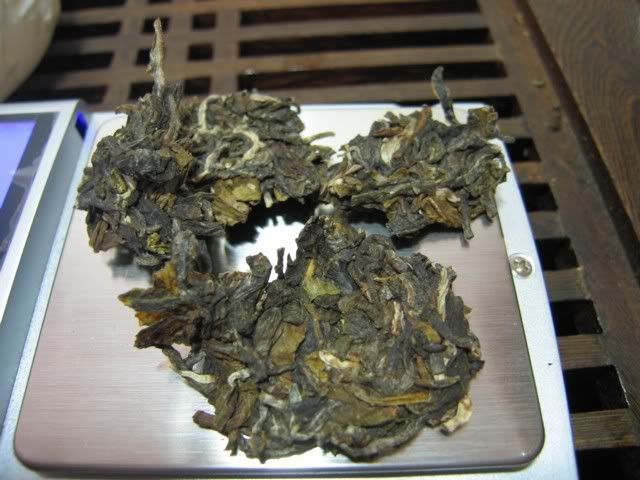
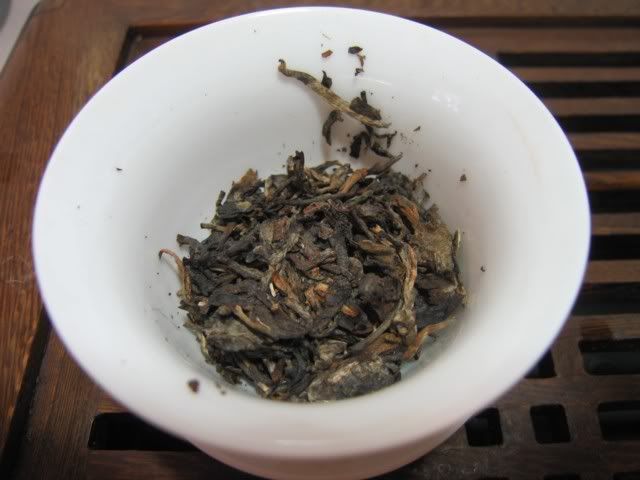
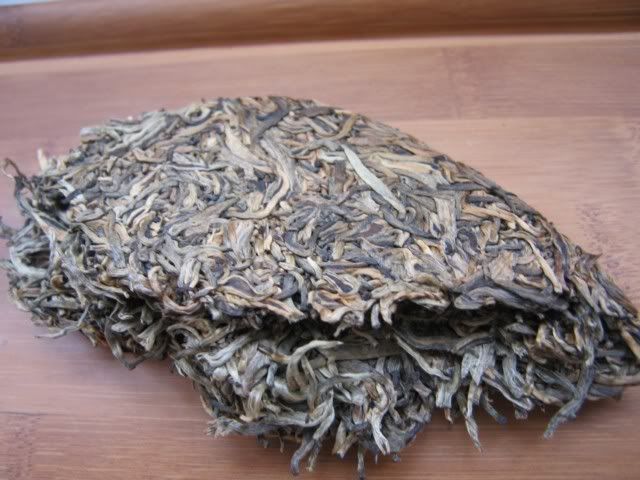
As you can see, it’s a big piece. In case you have any doubt about the fact that this is a silver needle cake

It’s 100% pure. The tea has a reddish tint now. If it’s a little redder, it could pass as a Yunnan Gold pressed into cake.

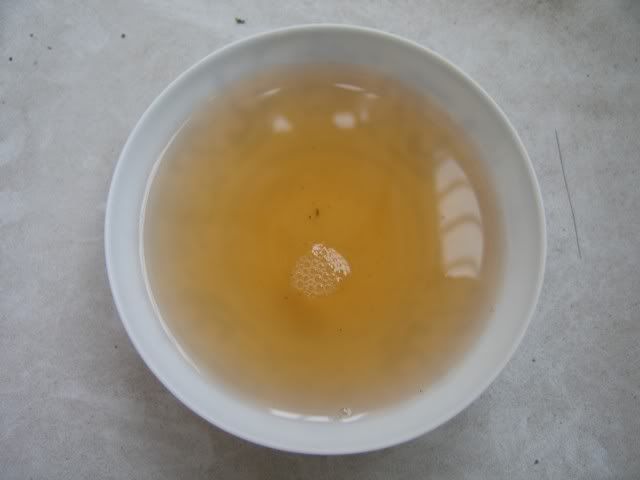
The first infusion was great. Light, sweet, fragrant, with a slightly odd but somewhat familiar smell/taste. I couldn’t quite pinpoint it. It was interesting. The second infusion was similar, but a little roughness crept in at the end. The third:

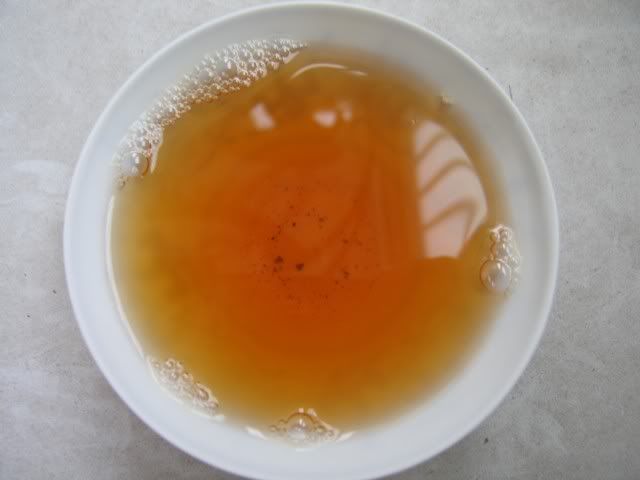
Was a little more rough…. a little more bitter. The fourth was worse… I think I can see where this is headed now, and I stopped before the tea turned nasty on me. Four infusions in, and the first was the best.

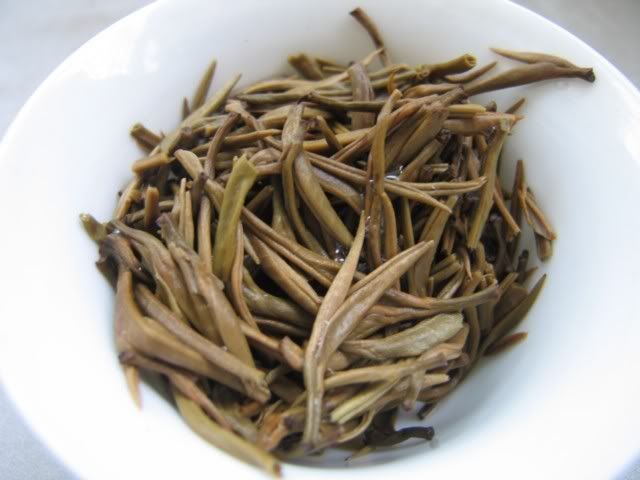
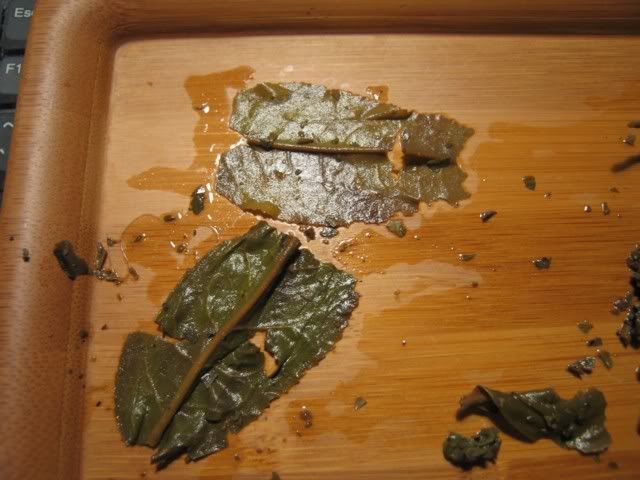
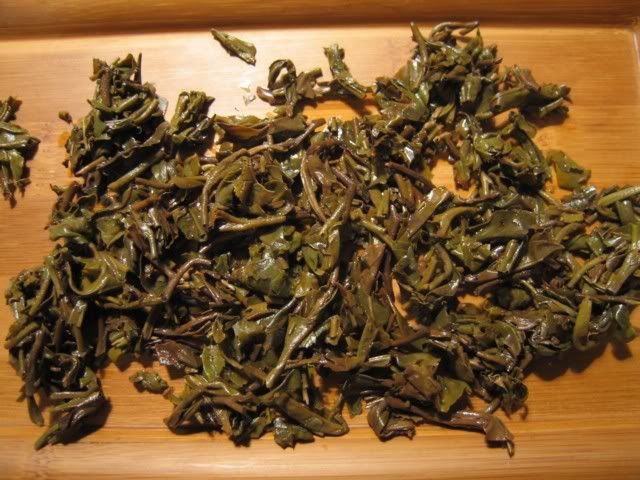
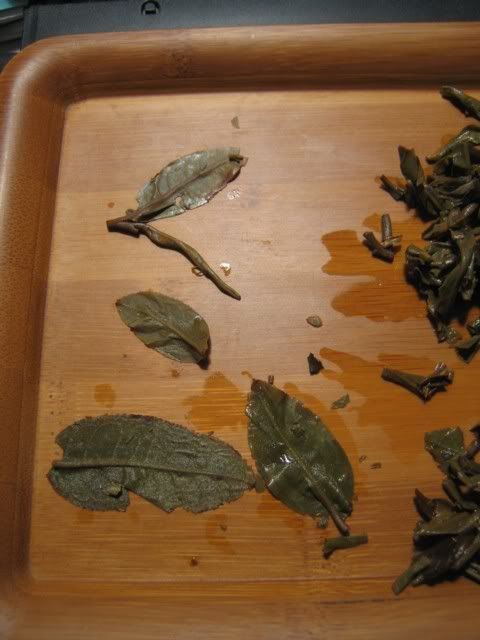
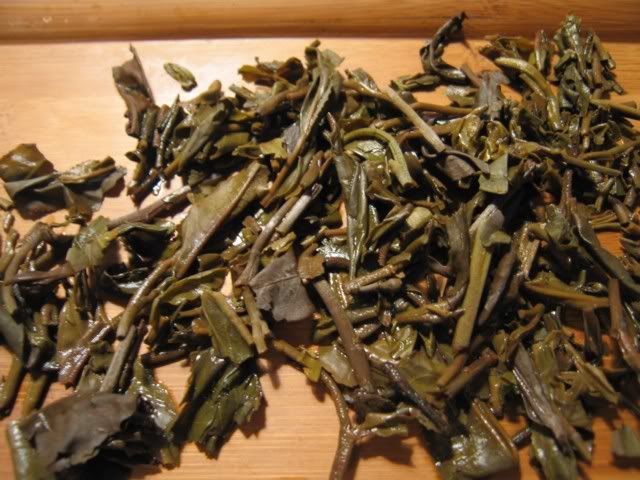
The wet leaves really make me wonder what I was drinking. Is this puerh? I’m not sure it is. Is this green tea? Maybe… stale green tea? I don’t know. What do you think? I know YP got it at a pretty cheap price. Good thing too. I don’t think it will compare to her Traditional Character Zhongcha in 25 years.

Dissatisfied by the rather lacklustre drinking session, I opted to drink another tea. I picked up the samples from iwii. The last two had some plastic bag smell in them, so I let them air on a dish. I sniffed… seems ok. So I picked up what he labeled as sample A, and which, he told me, is a Wisteria House (of Taipei) Yiwu via M3T in Paris, sent back to me in Beijing….

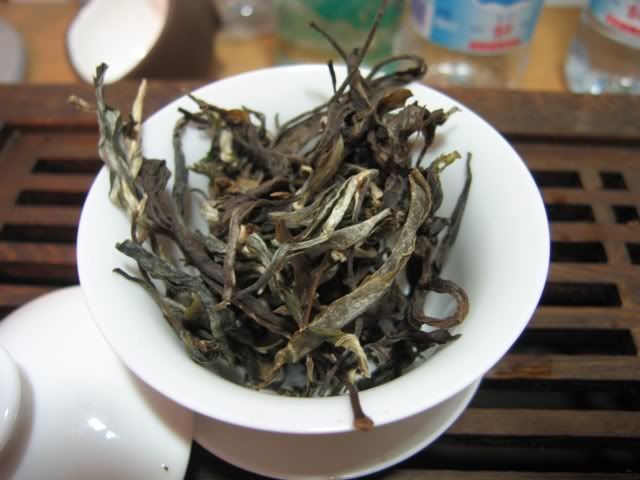
I forgot to take a picture of the dry leaves, but they are not really remarkable in any way — broken loose pu, a bit black/dark, and not too distinguishable from any other puerh that’s a few years old.

I brewed it up… and realized that even though the smell of the plastic bag was gone from the dry leaves…. the tea is already deeply infused with the plastic bag smell. Uh oh. I am drinking floral tea, except that this is not jasmine.

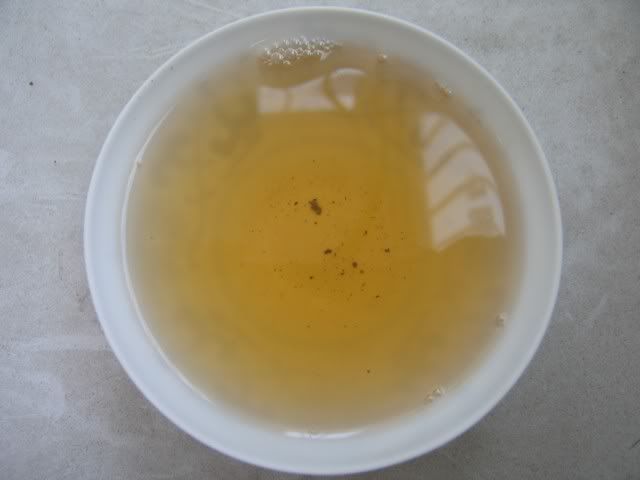
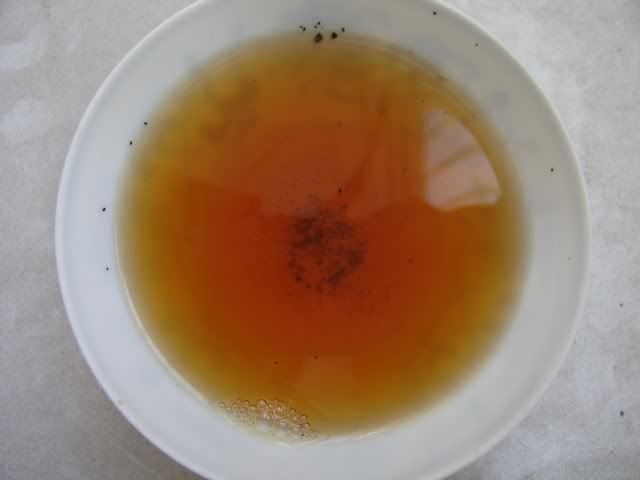
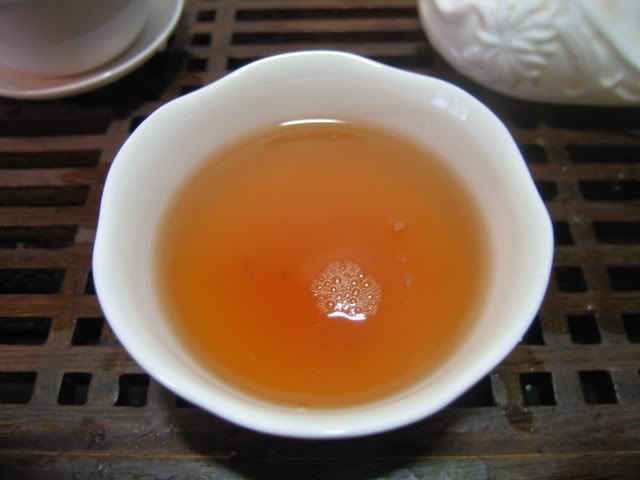
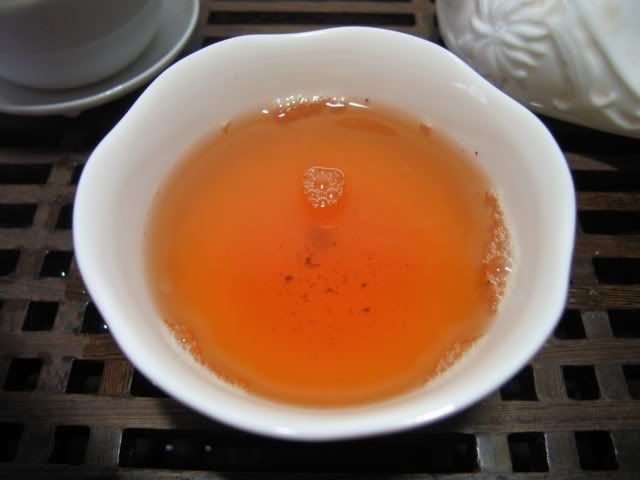
The tea brews a deep colour

Iwii said it’s 2003. It looks a bit dark for 2003, but it was probably stored in Taiwan.

Unfortunately, because of the plastic bag smell/taste, it made it rather difficult to pass any sort of real judgement on the tea. All I can say is that the tea is a little rough for my taste, after about 3 infusions, it started getting astringent. There’s some qi, and definitely something that resembles huigan (hidden in the sea of plastic). There’s also some throatiness, or is that my throat acting up because of some chemical component doing something to me? I’m probably making it up here, but whatever it is… I don’t know what to say about it. I feel this is sort of an ok tea, but not a great tea, but I really shouldn’t say that because I’m shrouded in a sea of plastic bag smell…. I’m sorry Iwii, I should’ve waited. In fact, I should let the rest of the samples sit around for much longer than just a few weeks before trying them ever again.

I was still dissatisfied, but my body has had enough caffeine. Oh well.

The wet leaves of the sample doesn’t look all that impressive.

Some of the leaves are more yellow-leaf like, or seem a little stiff. I wonder why.

Now I’ll wake up in a few hours to catch an early morning train to Shenyang, in Liaoning province in the northeast in China, for about a week. Among other things, Shenyang was the capital for the Manchus before they conquered China (it was retained as a nominal capital after they moved to Beijing). I wonder if I can find cheap puerh there like Hobbes did recently. Somehow I don’t think that’s likely.

Categories: Old Xanga posts · Teas
Tagged:

Revisiting a Yiwu maocha

June 16, 2007 · Leave a Comment

I thought about this tea after drinking the Yiwu Zhengpin a few days ago. As I noticed an obvious change in the Yiwu Zhengpin, I wondered if this tea I’m drinking today has changed as well since I last had it, probably sometime in December in Hong Kong with Tiffany. I got this from the Yiwu girl when I was dealing with her, trying to get the tong of tea from her that I wanted. The tong is now with me, and I still have some of this maocha left. Not a whole lot, mind you, but enough for a few more sittings.

I duly measured 7g of tea.

Last time I drank it and actually posted a full set of notes, I thought it was nice, very nice, in fact. Of course, back then my experience with young teas was considerably less than what I know now, purely because I’ve had so many more teas in the past year 8 months (wow, it’s been that long). I think this tea is memorable for the fact that it was the first time when I felt all those things that people talk about but I have only seen glimpses of — the throatiness, the huigan, the qi, all mixed into one. I’ve since had other teas that are like that, but this one was the one that first allowed me to taste what I now seek in young puerhs.

I’ve really liked the results of me taking pictures of the liquor of the tea in my little clothes-drying area — the lighting in the afternoon works well to give it a consistency that I needed, and looks more natural than artificial light. Too bad I’ll be leaving Beijing soon and have to find some other way to replicate this.

The colour of the liquor, I think, is comparable to the last time I tried it. Although the dry leaves do look a touch redder than the last time, the tea doesn’t taste that way. It’s slightly bitter, sweet, an obvious Yiwu taste, and good huigan as well as qi. The tea is medium bodied. There’s some throatiness as well, more, I’m sure, if I brew it for a little longer, as I employed fairly short (5s or under) infusions until about the 7th.

The tea is smoother than last time, I think, and only displayed some minor roughness when hitting the 5th or 6th infusion, but it died soon after as the tea turned to a sweeter taste. Bitterness is more obvious if I employ longer infusions, but I’ve tried avoiding that.

A very interesting thing is the way the different teawares smell after each infusion. After I pour the tea out from the gaiwan into the fairness cup, I smell the bottom of the lid, which smells like that slightly sour, slightly off smell of young puerhs — some have called it “stinky green” in Chinese parlance. It’s not an aromatic smell. Rather, it’s more like an odor. Some have said this is the sun smell. I’m not sure, but I have taken it to be a typical young puerh smell. The leaves themselves don’t display much of a smell at all.

Then, pouring the tea from the fairness cup into my drinking cup, I smell the fairness cup, which, in this case, smells quite floral. It’s that Yiwu smell. After drinking, I smell the drinking cup, which is sweeter than the fairness cup.

It’s quite fun smelling all the different things. I think a wenxiangbei will only give you one kind of smell. I am personally not a fan of those things, as must be obvious, and it seems my preference against it is shared in some circles, more in mainland and Hong Kong. In Taiwan they seem to employ it more often.

After quite a number of infusions, I poured our the leaves

Since it’s maocha, it’s pretty.

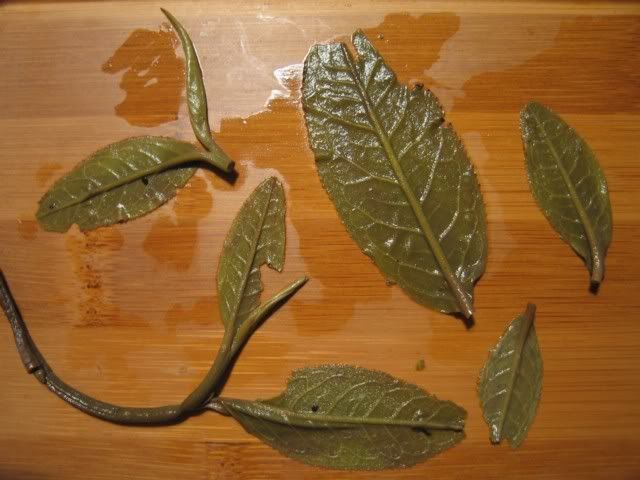
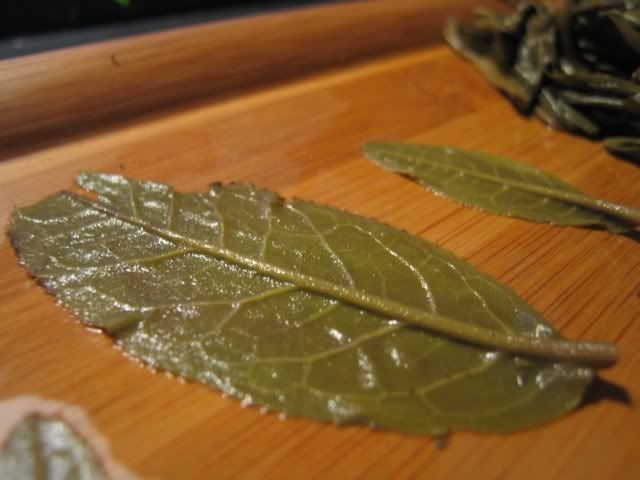
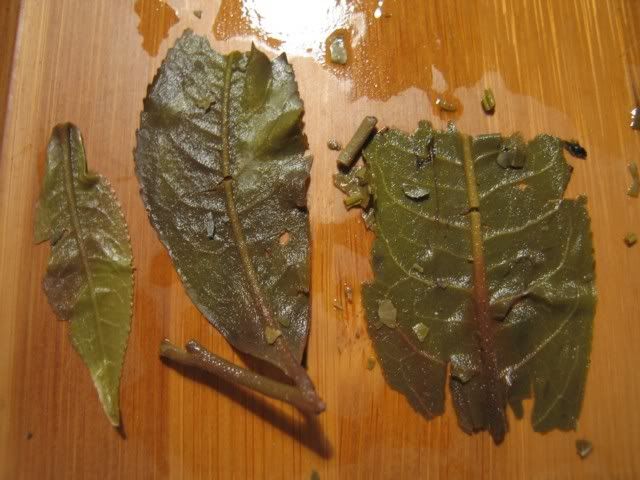
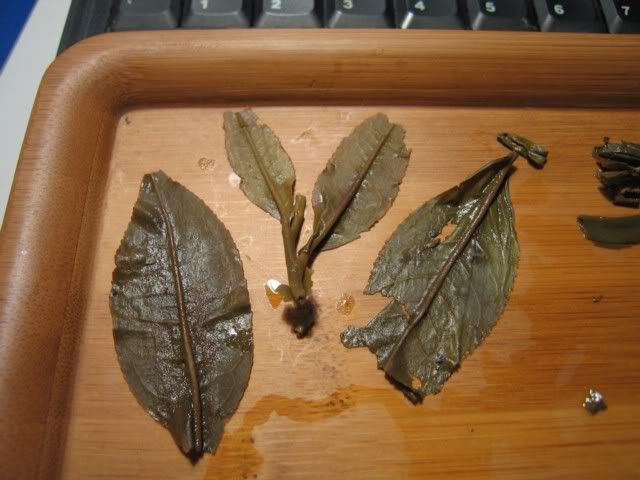
I should note, at this point, that I no longer think thick center veins have anything to do with the age of a tea. I’ve seen plantation teas with very thick center veins. I do, however, think that if the secondary veins are obviously popping, that could be an indicator of the fact that the tea is from older trees. Don’t ask me why, and I don’t know if biologically this makes any sense, but among the teas I’ve seen, obviously popping secondary veins are pretty rare, and seem to happen most often with old tree teas. This picture might make my point clearer

In the pictures for the 6 mountain maocha series that I drank (link to the left), you can also see this in action. Although, I don’t think that is universally true and certainly shouldn’t be used as a reliable indicator. Rather, it’s more like an observation….

Categories: Old Xanga posts · Teas
Tagged:

Yiwu Zhengpin revisited

June 14, 2007 · 6 Comments

I actually finished a sample today — the sample of Yiwu Zhengpin that Phyll gave me back in October, when Bearsbearsbears brought it over. I had it twice, and then just let it rot in its little bag while I moved onto other things. It’s time to finish this one up.

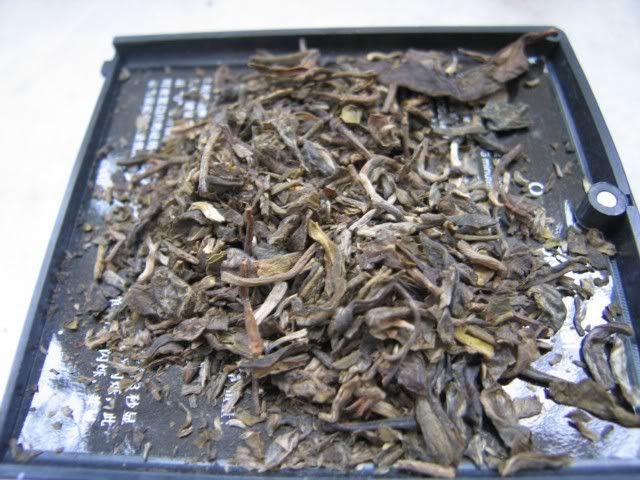
As you can see… this is even more chopped liver than yesterday’s. Among the small compressed pieces… I also noticed that there were some very fined chopped leaves pressed into the cake, perhaps leaves that were crushed when pressing.

Since it’s so broken, I tried my infusions very very short… any shorter, and I’d have to pour the water directly into my cup.

The resulting tea though, came out pretty dark

Much, much darker than I remember them. Last time I tried it on its own I said it’s a little odd. I think I will maintain that stance, although the oddness is a little clearer this time, no doubt partly due to me having had a lot more young puerh in the past 8 months. The tea, like I said last time, came out a little rough, and drying. There’s a definite note of sourness that wouldn’t go away no matter how many infusions I brewed — up until pretty much the end. The tea was astringent, but it had decent aromas and also gave a sweet taste. It’s just that the sweet taste was accompanied by some not-so-sweet taste. It’s bitter to a point, although the bitterness fades a bit, but also never entirely going away. There’s a sharpness to the tea that is a little unpleasant. I’m sure the heroic amount of leaves for the gaiwan has something to do with it, but the fact that a lot of it got washed out in the first few infusions in the form of really tiny bits, as well as the fact that most of that flavour should’ve been brewed out in a few infusions, mean that the remaining sharpness must be from the tea itself and not from the amount of tea.

Why is the tea darker now than what I remember last time? I don’t know. Perhaps age has something to do with it. After all, it’s been sitting around for 8 months without anybody touching it. But is it enough to give it such a big change? I’m really unsure.

Phyll suggested, at one point, that I should try it out, but somehow I couldn’t find a 2004 version of this cake, having only seen mostly the 2005 ones. Perhaps it’s the 2005 one that had the big production run, whereas the 2004 was more limited. Who knows?

It was fun to drink this tea again after having tried so many other things. I guess this is one thing we can all look forwrad to — trying teas again after a long break from them, seeing what has happened to them. I noticed that I didn’t say much of anything about the sourness in the tea, but this time it came out much more pronounced… I wonder if it’s a function of me not having noticed, or it not being there…

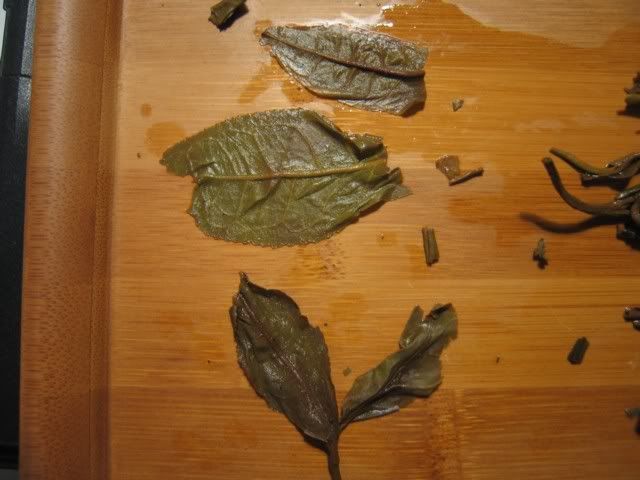
The wet leaves were very chopped, but I did find a few that were a little more complete

Thanks again Phyll for the sample 🙂

Categories: Old Xanga posts · Teas
Tagged:

Bangwei Fall 2006

June 13, 2007 · 3 Comments

I think I probably have a month or more worth of samples to drink, so eradicating them is really not entirely possible. Right now I’m just trying to pare them down, and to drink up the little bits or broken leaves that are in each bag. At least this way the shipping that I have to do soon can be done a little easier with less mess.

Before I go on about today’s tea, I should mention this: If anybody has experience shipping a fair amount of tea, or has any ideas about how to pack said tea for medium term storage (a month or two) please let me know. Right now I am thinking of sticking the tea in a cardboard box and ship it over to Hong Kong. The tea will be divided into tongs, and be wrapped in plastic bag (perhaps double plastic bag) that are odorless and tightly knotted so that they are more air tight. This way I hope to keep the tea from absorbing any excessive moisture or funny smells. If anybody can see a big problem with this arrangement… let me know that too.

Digression aside, today I took out one of the older bags of samples I got last fall. This is from a guy who makes tea in Kunming. He goes up to the mountains, collect maocha for old tree teas, and then presses and sells them. He seems to sell a lot through Sanzui, although he probably has other channels to do so, as well as having a store in Kunming. The teas he makes are consistently of decent quality, but the prices are not low. In some ways, this is definitely one way for a tea merchant who can’t compete on cost to do well — the boutique teashop that makes great tea. It’s nice to know, at the very least, that when you buy from this guy the tea won’t have funny problems like green-tea or deliberate pre-fermentation or anything like that.

So the sample I tried was the Bangwei mountain 2006 fall tea.

As you can see…. it’s really the shavings, broken bits, and loose leaves of the piece he sent me. There’s still probably 20g of the piece intact, but since the shavings is about 6g, I brewed that.

I only drank this tea once or twice, and my memory of it is faint. I think both times it was drunk in a long tasting session with other people, so there was never an individual, clear impression of the tea. This is my chance, I suppose.

The tea brews up slightly dark.

The first infusion…. was strong. The second stronger. The tea reminds me of the days when I first started drinking young puerh without knowing much about them… there’s that strong, bitter, taste with that slight hint of sourness to it, hitting you head on and reminding you that this tea really shouldn’t be drunk right now. I think the fact that the leaves were so chopped up has something to do with the harshness of the tea. The bitter does turn to sweet, and rather quickly too, but the first second or two was powerful. I did feel a bit of throatiness, but the strength of the tea was most obvious when I got up with my cup to take a picture of the liquor with natural light at the third infusion. My heart was pumping — this was more caffeine than qi, but either way, it was making its presence known.

The tea didn’t last that many infusions, having endured about 10 before just becoming sweet water, although the tea taste remained and I brewed a further few infusions after dinner to clear my mouth of MSG. I tried finding leaves in the chopped liver, and eventually found a few more complete pieces…

I got two cakes of the spring 2006 after trying this sample. I still haven’t opened the spring cakes to drink yet, and probably shouldn’t for a while yet. I think this will make pretty interesting tea in a few years.

Categories: Old Xanga posts · Teas
Tagged:

Trying to get the old price back

June 11, 2007 · 5 Comments

It seems like everybody who deals with puerh is trying to get the old price back, although which old price depends on your vantage point.

I went to Maliandao today. I was there to buy some gifts for somebody, as well as buying some tea for myself. I had planned to buy some of the Bulang cakes (aka sample 1), which I only have one of right now. So I went to the store — the only store on Maliandao that has it — and hoped to get some more.

It was on the shelf, just like last time, although the girl who sold the two to me wasn’t there, which isn’t a good thing, as I had hoped for a smooth and quick transaction. I asked the girl working there how much the tea is, hoping for an easy quote…. but I got a quote of more than four times what I paid last time.

Lovely.

Incensed, I started telling her in a rather angry tone how I bought two cakes last time at my previous price, and I didn’t even bargain about it because I was only buying two cakes (I didn’t tell her that also because I thought it was really good value). No no no, she said, it couldn’t be. There’s no way they sold that tea to me for so low. It must’ve been another one. It’s below their cost, etc etc….

I will spare you the whole details of our discussion and arguments, but about two hours later, I got her to agree to sell it to me at the price I paid last time. I was hoping for a better price than last time before I went, partly because I was buying more this time than last, but at this point, I really didn’t have it in me to continue any further, and I really have no reason to believe she will budge any further.

Then… apparently, she couldn’t find it in the store. We looked, and looked, and looked… and indeed, no tongs of this tea was to be found. They might have it in their warehouse, but trying to find a tong or two of a tea in a warehouse is a pretty meaningless exercise, at least on such short notice. I ended up leaving just with the four bings that were in the store… less than what I had hoped for, but alas, this is what I had to live with. At least I got my old price back.

While there, I did try a cake that she purports to be a Shuilanyin from the 80s, which sounds fishy. The tea couldn’t be more than 10 years, and most likely is less than 10 years. Smells of storage, but not wet storage. Not great at all, and asking for far too much.

I then went to Xiaomei’s store to ask for information on something. While there, two people came in whom I’ve met before. Turns out after some discussion that one of them actually owns a lot of tea — something I wasn’t aware of previously from our prior conversations. The guy has jians of, among other things, Menghai’s Classic 66, Gongting Qingbing, Yiwu, “Big Bokchoy” (a nickname for a Banzhang tea that sells for something like 1000 RMB a cake)… etc etc. From the sounds of it, this guy has at least a million RMB worth of tea sitting in storage. I think he’s at Xiaomei’s store to try to push some teas on her to sell for him — he brought along samples. Xiaomei, from what I understand anyway, thinks Menghai tea is too risky now to enter the market. The only time she does anything with them is if she has secured a buyer already, and then connects the buyer and seller and essentially takes a small commission. Holding any Menghai tea is very risky.

Anyway, this million RMB Menghai owner was saying to me how this current dip in the market, with Menghai prices being about half of what it was early this year, is just an opportunity. New spring teas are, once again, starting to arrive from the factory. Guangzhou already received new teas — first time in two months, and the 702 batch of 7542 is all sold out already. There’s rumblings that prices will rise again, and this is a great time to buy some more Menghai tea again and catch this wave.

Somehow, I could almost feel this guy was trying to get me to buy some tea. Perhaps he thinks I actually have that kind of money to spend on tea, and perhaps he’s just getting desperate. Very early on in the conversation I already said Menghai is too pricey for my tastes, but he kept going on and on about how great their teas are. I could feel a sales pitch.

I escaped with a phone call, but it’s clear that some other people — those with great stocks but nowhere to sell them to — are hoping for the old price. It’s just that in their case, they want the higher one. I can imagine many, many, many people being in the same boat, having bought a boatload of tea a while ago and now wondering how they can turn it into cash, unless they want to start cooking with the tea leaves for food. This makes me think that whatever rise in price we might see in the next few months might be quickly quashed by some people who will be eager to use the slightly higher price to get rid of stock on their hands. I also can’t imagine the same fervour in buying that has gripped the market in late 2006. People are now very, very aware of the risks of this investment (as evidenced, among other things, by yesterday’s article), and are, in my opinion, unlikely to jump in with the same enthusiaism.

I ended my trip today with a stop at a Wuyi tea shop, since this was the stop for the gift buying. I went in, told them how much of their 200 RMB/jin shuixian I wanted, in what kind of packaging, paid, and left… no fuss, and all done in minutes. I sat down just to chat with the owner a bit and try one of their new teas while the packing was being done. No bargaining either — prices, at least at this store, are more or less fixed. I didn’t even try the shuixian I bought, since I’ve bought a bunch before and know it’s quality. I must say it was a welcomed relief compared to the endless testing, bargaining, doubting, and regretting in the world of young puerh.

Categories: Old Xanga posts · Teas
Tagged: ,

Zhongcha Bulang Fall 2006

June 9, 2007 · Leave a Comment

Rummaging through my samples, I found a small bag with a little piece of paper, written by me, saying “Zhongcha Bulang Fall 2006”. Why not, I thought to myself. So, I took out the pieces and measured 7.3g

I’ve been using the amount of tea I use these days to give myself a more uniform way to taste the teas, as well as giving the readers an idea of what I do with them, generally speaking. I realized, after the notes for the samples I sent out, that brewing parameters vary greatly, and it is more meaningful if I provide some sort of parameter when I talk about my tea tastings. Otherwise, they’re less useful.

For this tea, infusions were kept short (5s or so) until about the 7th or 8th infusion, after which it lengthened. The tea went through some pretty interesting progression. It started in the first two infusions in a very mild manner, sweet, fragrant, but with a decent “hit” in the back of the throat. Very promising. Then it sort of went through a transition period in the next few infusions, when the tea gradually got a little more astringent and also a little more bitter. Then, it hit the final stage, when if I brew with a short time, the tea comes out tasting sweet and nice, like a good young puerh should, or unpleasant and bitter, like a fake green-tea puerh would.

I should perhaps explain again what I mean when I say green-tea puerh. Somebody asked me today what I meant. I think what I mean is what Chinese would call “hongqing”, or baked green. This is different from “shaiqing” or sun-dried green. Hongqing basically means tea that was processed/dried at a high temperature, while shaiqing is that of a low temperature processed tea. The difference between the two is that hongqing brings out aromatics that shaiqing won’t, but at the expense of ageability. Think of a typical longjing — the first infusions (or the first minute of infusion) would bring you a highly aromatic, sweet, and nice cup of tea, but oversteeped green would taste astringent, rough, and bitter. A proper young puerh, on the other hand, has the reverse order — bitter first, but turns into sweet water later on. This is probably not the only way to tell, nor is it the surefire way to tell the two apart, but I think it is one way, and I feel that having tasted a whole bunch of younger stuff… this has generally held. I have especially noticed among the 2007 cakes I’ve tried that the proportion of green-tea puerh has been pretty high this year. This is also the concensus in online forums like Sanzui — that this year’s puerh production has been uncharacteristically green for some reason. Don’t know why — some speculate that the farmers all got richer and bought drying machines instead of just leaving it to the whims of the weather.
I should now caveat this all by saying that much of this has been knowledge that I have gleaned from various sources, online and offline. I have, however, tasted a few hongqing samples of a few years old that… are bitter and nasty (think stale old green tea). So, given that to be the case, what I say here should be taken with a grain of salt.

That said, I don’t feel confident enough with the tea I drank today to ever buy it. It’s probably a mix of the two, and the mix of hongqing tea is probably less than the “Banzhang Zhengshan” I drank about a week ago. Yet, it’s still enough to deter me from thinking of buying this tea.

The wet leaves

As Lew has pointed out in a recent comment on the day when I mixed the Yiwu with the Banzhang — trying to pick out which of these leaves have been improperly processed is going to be a mightily difficult job. In fact, I doubt it’s at all possible. Buyer beware, I suppose.

Categories: Old Xanga posts · Teas
Tagged:

101 Plantation 2004

June 7, 2007 · Leave a Comment

Continuing the campaign of samples eradication, I drank part of the 101 Plantation Jingmai 2004 cakes that Lew Perin gave me when I visited New York. I never got around to them until now, sorry.

I have heard that 101 plantation has closed out Jingmai mountain for themselves, but I think that’s obviously not true, unless all the Jingmai teas out there are all fake, which I don’t think is the case. Jingmai teas tend to be rather aromatic when young, and turns a deeper tone once aged a few years. I’ve had a few cakes that are a few years old from He Shihua, among others, that have a deeper tone and quite different from the light and fragrant young Jingmai. It’s actually slightly similar to some Mengku cakes in the progression from a very light and fragrant tea that turns deep very quickly.

I again had the option of using the broken bits or the big piece. I opted for the broken bits, which came to around 8.5g of tea. A rather heroic amount for my small gaiwan (since my big one broke), but what can we do.

The two years of aging has done some work to the tea

It’s thick, fairly bitter, very slightly sour, and smooth. My girlfriend identified the aroma as dried apricots, which actually lasted through all the infusions with very little obvious change. The bitterness dissipated after about 5-6 infusions. There wasn’t a lot of huigan, nor was there much in the way of throatiness, but the tea remained mostly smooth throughout, no doubt thanks to the buddy leaves. In those respects it’s actually rather similar to the tea I had yesterday, except that the tea yesterday was sweeter and lighter, and today’s was heavier. Drinking a young Jingmai though, one would not really expect the taste to turn so much in so little time.

Since I used broken bits… the wet leaves are obviously quite chopped

The few complete leaves I could find were all very tiny — early picked teas, for sure.

I personally am not a great fan of Jingmai. While the young young teas are nice, I think I prefer other areas. It’s also gotten very expensive, being one of the priciest mountains in Yunnan these days. Nevertheless, it was nice and smooth drinking, and thanks Lew for the sample 🙂

Categories: Old Xanga posts · Teas
Tagged:

Mystery sample alpha

June 6, 2007 · Leave a Comment

I’m trying to clear out my samples, if you haven’t noticed. Samples are a bit of a pain to carry around, and since I’m going to be leaving Beijing in about a month, having too many samples will make shipping more of an annoyance than it already is. So… today I picked up the sample labeled alpha from iwii and drank that. There was a piece of solid tea, and then the loose stuff. The loose stuff end up being around 7g, so it made sense to drink the loose stuff first.

The tea brewed a somewhat dark liquor

That deepened in colour by infusion 3

The taste is a bit odd, and not immediately pinpointable. I know this must have been aged a few years, maybe 3-5 years. The taste is mellow, if a little subdued. The first infusion or two were a little bland, but there is some aftertaste, though no feeling down the throat. The tea is soft and reasonably thick, and smooth. The subsequent infusions, around 3-4, developed a slight sourness that had me worried. That, thankfully, went away by around infusion 5-6. There was a bit of bitterness that showed up in infusion 3-5, but overall the tea is not bitter at all. Aftertaste is a bit stronger here as well, but still no real cooling effect. There’s a slight feeling of astringency, but the tea is overall pretty smooth. No doubt the few years has done some good, and probably softened out the edges, but I have a feeling the tea, to start off with, was never very bitter nor rough.

This makes me think that it could be a Yiwu, and the late infusions (9+) tasted sweet and more Yiwu like. The earlier infusions had hints of what I thought was a Yiwu taste, but dissimilar enough so that the thought didn’t occur to me until the tea turned a corner in the later infusions.

I asked iwii with this in mind, whether if this was a Yiwu or not. Turns out it’s Stephane Erler’s 2003 Yiwu. Iwii also reminded me that Stephane himself said this cake is more precisely from Jiangcheng. This might explain the unfamiliar flavours I had in the beginning.

I must say this time it tasted quite a bit better, and very different, than last time when I tried it in Shanghai with Bearsbearsbears, when I thought it tasted odd and uninspiring. I think there might be a few things at work here. One is that it was traveling in his backpack for a few weeks before getting to Shanghai, the other being differences in water used. I must say that while there are still things that worry me a bit, such as the sourness and the general lack of a physical effect, it’s not nearly as problematic as I remembered from January when I had it in Shanghai.

Since I used the shavings, one wouldn’t expect to see many whole leaves in the sample

I did manage to find a few after some sifting

It’ll be interesting to try the big piece next time, probably in yet another place since I don’t think I’ll get to it before I leave Beijing. It is also a good reason why tea samples sent for honest opinions shouldn’t be labeled 🙂

Categories: Old Xanga posts · Teas
Tagged:

Tea jamming

June 5, 2007 · 2 Comments

When you have a lot of samples, you have a lot of leftovers. Sometimes I have the presence of mind to use up all the samples, but sometimes I don’t. So, I have a few of these “odds and ends” samples that really isn’t enough for a session on their own, but just enough to throw away. This is what Chinese call “chicken ribs” — “tasteless for eating, but lamentable to throw away”. (There’s a long story for this, from the Romance of the Three Kingdoms.)

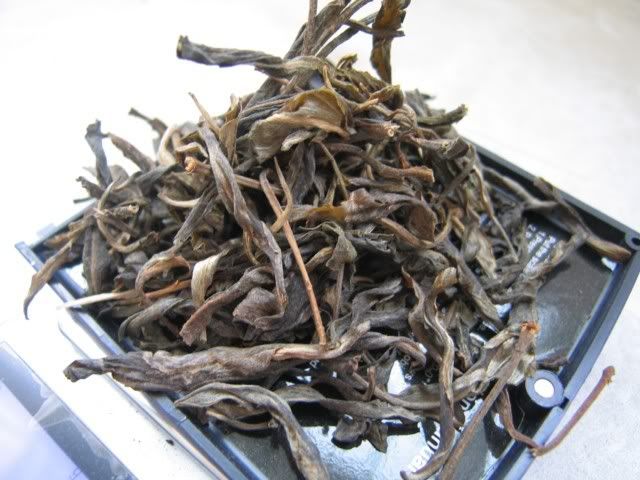
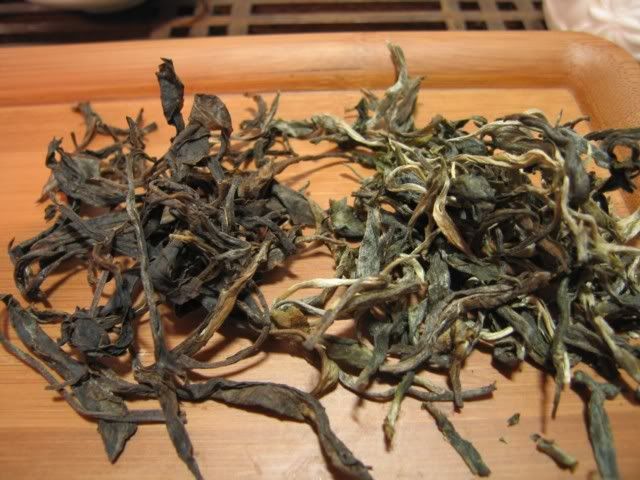
So today I decided to dispose of two of these samples by mixing them together and drinking it. One is a leftover Yiwu from a long time ago. The other is the supposedly Lao Banzhang. I had a bit more of the Lao Banzhang than the Yiwu, but they add up to about 6g of tea. You can see how different they look

I think the Yiwu is 2005, and the Banzhang is new — this spring’s pick.

So I mixed them up… and stuffed them into the gaiwan

And out came the tea

The taste is a little interesting. There’s the up front bitterness and strength of the Banzhang, and then the sweetness of the Yiwu appears. Except something’s not quite right. A few infusions later…. yup…. the Banzhang is, as I had suspected, a green tea. Last time I wasn’t sure partly because it was so fresh off the mountain. I thought perhaps it is a product of its extreme young age. Now, almost two months later, it’s still tasting like that… in fact a little worse… and I start getting suspicious. The bitterness is the kind that doesn’t go away. It’s quite an uncomfortable feeling, drinking the tea. You can see the mixture of the leaves in this

The body of the tea is good, but I think the greeness of the Banzhang killed it. Would’ve been more interesting if it were a properly processed tea… which it isn’t.

I eventually picked out all the Banzhang leaves (it’s not very hard to do). I then brewed the Yiwu more or less just on its own, with maybe a few of the Banzhang leaves in there. Much better, with a solid sweetness that one would expect from the Yiwu.

This made me realize two things

1) If mixing two teas together, the sweeter/lighter one should probably account for more of the blend in order to show its flavour. Otherwise, the more up front/obvious tea will overpower it.

2) In small enough quantities, oven-dried green tea is not noticeable as long as you have enough real puerh to cover it up.

1 is not a bad thing to know, 2 is a little unsettling, unfortunately.

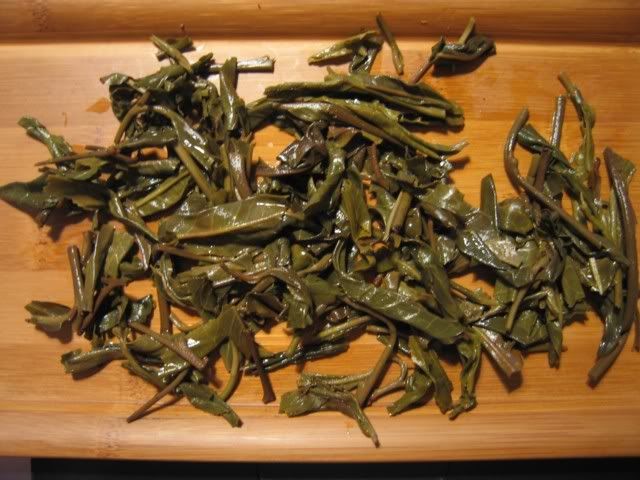
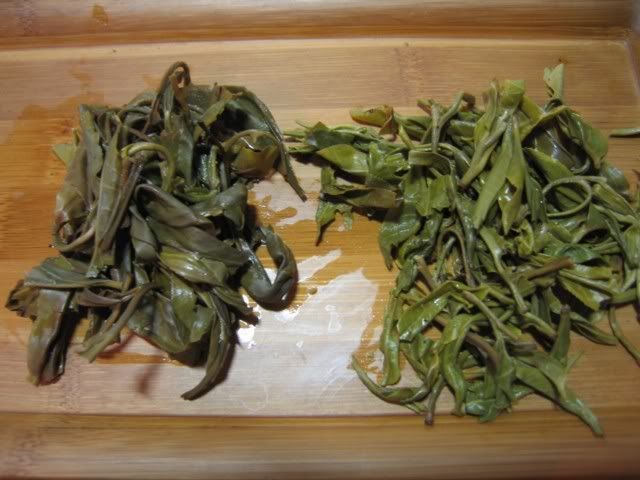
Here are the two piles of leaves, wet. You can see how they look very different… and how the Banzhang looks just a little too green. Smelling the wet leaves, it has that classic Yunnan green tea smell. No good. My friend got gibbed buying this in Yunnan (this is a tea they didn’t pick themselves).

Categories: Old Xanga posts · Teas
Tagged: