A Tea Addict's Journal

Entries tagged as ‘young puerh’

1995 Shuilan yin

August 28, 2007 · 3 Comments

Before I start babbling today — congrats to Lew Perin, whose Babelcarp is now 2000 phrases strong. It’s a wonderful tool for those of you who don’t know Chinese and are (rightly) confused by all those funny phrases that annoying people like me sometimes throw out, or the strange spellings of teas you don’t recognize on some vendors’ sites… so if you haven’t yet, go take a look there and play around with it.

I went out for stinky tofu today for dinner, and after coming home, I wanted some tea, not having had any today (apart from some sweetened instant tea type thing with my lunch). As usual, I was looking through my tea cupboard and noticed a bag — a really flat bag. It was the sample bag of the 1995 Shuilan Yin from Hou De that I bought …. more than a year and half ago now, or thereabouts. There’s still a little left in there… 3.5g. Enough for a drink for post-dinner in my small gaiwan. Why not?

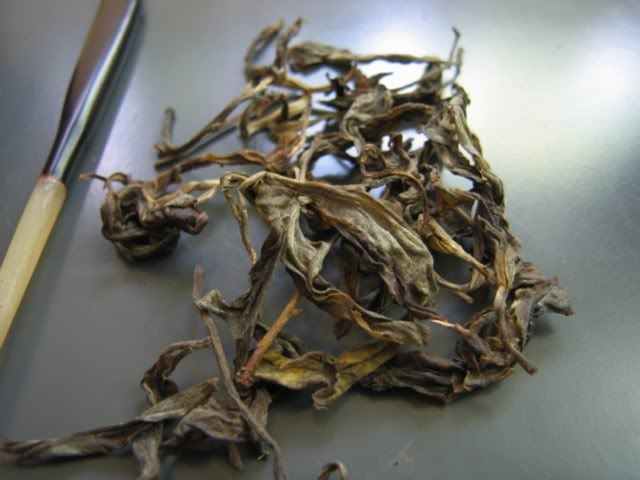
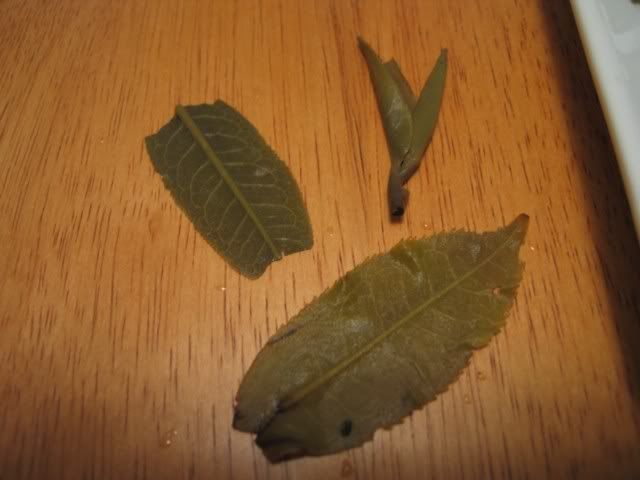
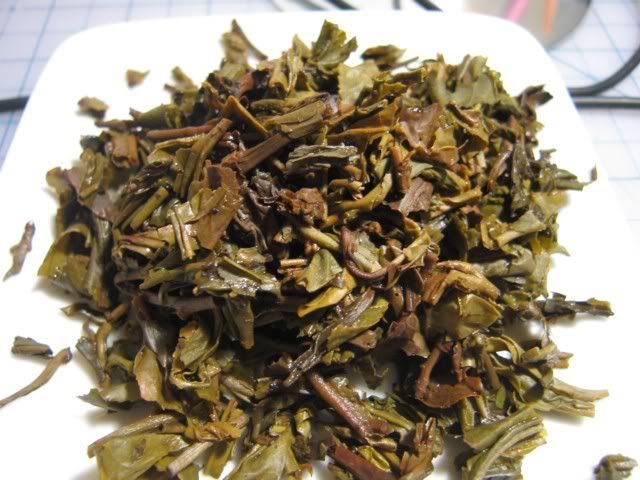
The dry leaves were mostly very very broken little bits. It’s not terribly interesting. It is, after all, the remains of what used to be solid chunks of tea. When I made it… this is what came out

Looks good to me.

I remember thinking this tea being a bit sharp, thin, and metallic in its aftertaste. Oddly enough, I didn’t find much of that this time. It tasted fuller than I remember the past two attempts. I also noticed that it has mellowed — less bitter than before. I think the fact that it’s been so broken up and sat around in a bag might have aired it out a bit? The taste is that of a tea that has at least been through some wet storage. Dry stored teas don’t taste/feel like this, I think. Not a problem though. Given its slightly bitter nature (there’s still a bit there — as well as a bit of roughness on the tongue) a pure dry stored tea might be rather harsh.

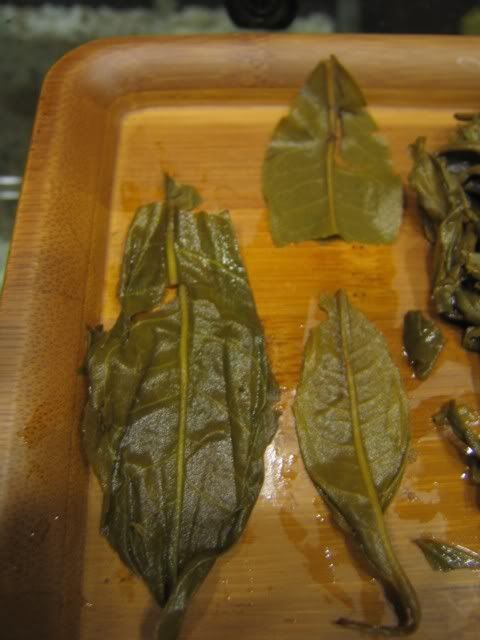
There’s not a lot to say about a really broken sample. It didn’t last too long — 6-7 infusions and the tea was getting pretty weak. The broken nature of the leaves, again, definitely has something to do with that. You can see it for yourself…. another 1/3 of the leaves were stuck to the bottom of the gaiwan, since they were all little fannings that don’t come off easily

It served its purpose. The thing is no longer available in any form anymore anyway. Anybody still has some? How does it taste now?

Categories: Old Xanga posts · Teas
Tagged: ,

Jingmai Fall 2006

August 23, 2007 · Leave a Comment

When I was organizing things in my apartment today I found a sample bag of puerh from last year, a fall 2006 Jingmai that I got from this guy who operates a shop in Kunming and who sells through Sanzui. I bought a few cakes from him, and he always gave generous amounts of sample with the cakes purchased.

The cakes this guy makes are all very pretty. He claims they’re all “pure material”, i.e. single mountain, and all using big old trees. For the most part, I find that bang for the buck, his teas are really quite decent. This Jingmai actually happens to be one of the lesser teas both in terms of quality, and especially in the price/quality ratio.

What’s wrong with this tea is that it is very rough on the tongue and the mouth. After about 3 infusions the tea turns extremely rough, and never really recovers. Unlike yesterday, this has nothing to do with water becuase I’ve tried it a few times before with different water and brewing methods, and none of them have gotten rid of this roughness. Today’s no exception. The flavours are actually quite decent, and one can feel a good bit of qi from this tea. If you’re going to store this thing in a regular home storage though, the roughness is not giong to go away given its prominence. Funny enough, the spring production does not have this problem at all. There, the roughness is very subdued and the tea is quite lovely. Since they’re about the same price (although now sold out, I’m sure) there’s almost no reason to buy the fall. This, I think, is one of those cases where one problem in the tea completely destroys it. Drier storage will never remove roughenss entirely — that requires more moisture and microbial action. Given that… it’s a no go.

The tea looks quite nice when dry, and wet

Notice the colour difference

I probably need to get a desk lamp. The lighting in this apartment is not quite ideal for tea picture taking….

Categories: Old Xanga posts · Teas
Tagged:

Water troubles

August 22, 2007 · 1 Comment

Everybody knows that only two things go into making tea — the leaves, and the water. We talk about tea often enough. Despite the attention paid to it from time to time, however, water is still a rarely discussed subject. My drinking today is a good reminder of why we should always be mindful.

I pulled out an old sample that I haven’t tried for a long time — the 2nd puerh trade fair cake from Houde. I got what appears to be the center piece
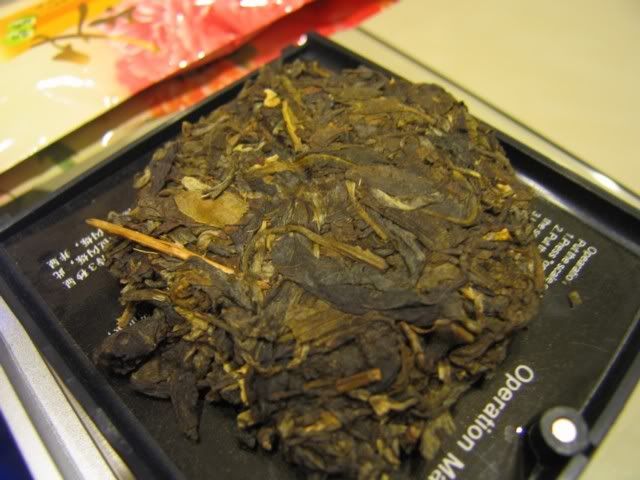
So I broke off a chunk, about 7g in all, into my young puerh pot and brewed.

The first two infusions were fine
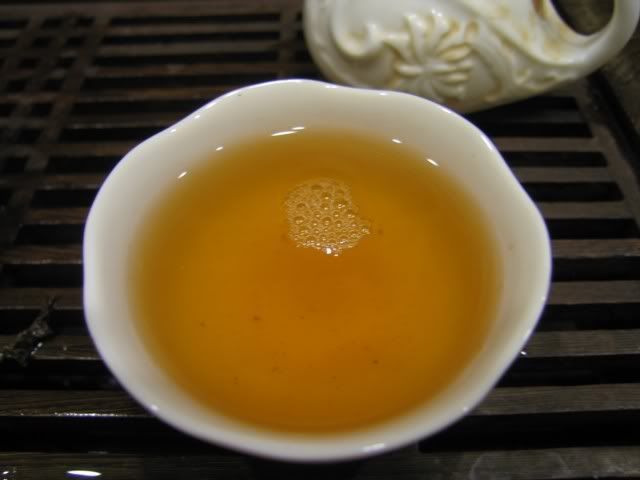

(this, by the way, is white adjusted, while the other one was not)

It was crisp, a little sweet, somewhat bitter, and had a decent finish. You can taste the Menghai area characteristics in this cake. Nothing too fancy, but a solid performer.

Then… as I added water to my kettle to reheat, I poured in some of the mineral water I bought recently from the local supermarket. It’s a water from France, of a lesser known brand, and quite heavy in minerals. I usually only add a splash of this sort of thing to my regular source of filtered tap water. That’s what I did today, although I may have added a little more than just a splash or two.

I reboiled the new water, and brewed…. and something seriously wrong happened. The tea became quite bland, rough, and generally less pleasant to drink. I don’t think it has to do with just the temperature. I brewed another infusion…. same thing. I can’t believe a tea will turn on me this fast. I tried some of the water on its own… hmm, tastes a little different than usual, no doubt because of the few splashes of the mineral water I used. I then poured all of it out into a glass and refilled the kettle with filtered tap water, boiled it, and brewed again… and the tea returned on the trajectory it was going on before I switched water on it, skipping two infusions. It was still a bit rougher than earlier, but that’s often to be expected. It also brewed up slightly weaker, which is definitely expected.

The lesson here, though, is not that tap water can be better than mineral water in a bottle. That I think everybody already knows. What I have noticed over time is that different teas require different water. That might seem an obvious point, but what I have found is that even different kinds of the same tea can often have completely different water requirements.

I have brewed young puerh that want opposite kinds of water. Using two kinds of water with two kinds of young puerh, they will behave in opposite directions with the two waters used. I’ve done this side by side with Tiffany before, so I don’t think it’s just placebo because you would at first expect most young puerhs to behave similarly. The difficulty is to know what it needs, and that, I am afraid, will only come with experimentation with each particular kind of tea in hand. If you want to get really technical, perhaps weather, air temperature, humidity, and all those other things also affect the water requirements, but since we can’t really control all of that, it’s almost not worth our time and effort to do so.

I don’t think there’s one or two kinds of water that’s universally good for all teas. There is, of course, cost and practical considerations involved in this. The carbon footprint of a bottle of water traveling all the way across the globe from some pristine location to your home in the middle of a metropolis is huge. The price is often high. The differences often subtle. Whereas ages ago people can write that “spring water is the best, and do not use well water” or some such absolute statements when talking about water to make tea, they can do it because I think the variety of teas they had was much smaller than our current day market. They could not possibly have had access to many more than a few kinds of tea, and the means of production were also more similar than it is today. Nowadays teas are made using a wide variety of methods, many of which are quite new. How that changes the way the tea reacts to the minerals in the water is going to involve a lot more complications. That’s not even counting the fact that there’s spring water, and then there’s spring water….

I like having a few bottles of different kinds of water around, and usually only add a little bit of one or the other to my kettle while brewing tea to experiment with such changes. For teas that I drink often, I sometimes try to figure out better what best to use for it in particular. At some point, though, it becomes too much work and detracts from the enjoyment of the drink itself. As long as one is satisfied, perhaps it doesn’t matter at all.

Categories: Information · Old Xanga posts · Teas
Tagged: ,

Searching for good tea

August 21, 2007 · 2 Comments

Action Jackson has been in town for a few days, but it was only yesterday that we finally met, mostly thanks to the wonderful typhoon. We agreed that today we’ll go tea shopping, as she will be leaving tomorrow.

Since I don’t know where we might find decent tea shops, I decided to take my chances with the Yongkang area, since Corax said on Chadao that it has quite a few teashops. I figured it won’t hurt to try.

After having a vegetarian lunch, we eventually made our way to a shop that looked interesting enough. We ended up spending the rest of the afternoon there, not having found time to go anywhere else.

After browsing around a little, we settled down for some tea tasting. The first we tried was a 2000 Xiaguan tuo. I didn’t quite know what to expect, but it looks dry stored. It turned out quite decent — much mellower than a new Xiaguan tea, sweet, fragrant, still youngish and not much like an older puerh. 6-7 years isn’t that much for a small tuo, and it shows. Not too expensive either, so perhaps it’s worth an investment.

After going through 10+ infusions, which still hasn’t exhausted the tea, we went on to a Mengku “Pristine Forest” cake from 2005. Special order, so the storekeep says. It was one of those “wild wild” teas, darker in colour and …. weird in taste. I don’t find those teas very attractive, preferring more orthodox tastes. We had a few infusions of this when some Japanese tourists came in and interrupted proceedings.

After the tourists came and went (they bought a bunch of Taiwan oolong) we had a 1998 Menghai tuo. This one’s obviously weaker than the Xiaguan, but the flavours are of deeper tones — two years of storage, as well as differences in material and worksmanship, has done something to the tea. It brews a darker liquor, a little rougher on the tongue, but it didn’t last as long as the Xiaguan. I think the Xiaguan is a superior tea, quality wise, but which one you prefer depends greatly on what you’re looking for.

We then had a 80s 7542, which was quite delightful. I should figure out how much it costs, because if it’s not too pricey, I might look to buy a few for future consumption. It was beautifully stored — certainly some “wet” storage at some point, but it has the nice, sweet taste of the Traditional Character Zhongcha cake sample that YP gave me, and which I dearly love. Slight differences, as they’re from different factories, but overall the general characteristics are quite similar. The liquor is a gorgeous amber, clear, robust, and flavourful. If I can afford it, I will definitely get it.

She gave us a few cups of a 70s tea that she brewed yesterday, and which is still a bit sweet and mellow to drink. By this time, however, we were really quite full with tea, and with her next appointment due, Action Jackson had to go, so off we went, with two tuos in hand for her to bring back to Shanghai. It was a pretty good day.

Categories: Misc · Old Xanga posts · Teas
Tagged: ,

Back to tea shopping!

August 19, 2007 · 1 Comment

Well, it’s a Sunday. It’s before my work starts in earnest here in Taiwan…. so I figured, why not, let’s go tea hunting.

Unfortunately, there isn’t a Maliandao here in Taipei, as far as I’m aware. There’s an area with more older teashops, but for the most part, they’re scattered around the city. Searching around, I found a few places near me, so I tried those first.

I first went to a place that sells only Wenshan baozhongs. I was pretty quick there — bought a few things and moved on. Basically, one ounce of a good grade, one of a bad one, and two of a high roasted variety. I look forward to the high roasted stuff the most, as it looks positively cooked. It might be a bit on the charcoal tasting side of things, but we’ll find out. It was in such small quantities (and thus relatively low prices) I didn’t even bother to taste — it’ll be weird to taste them and only buy one ounce.

Then I walked along the street — which was eerily quiet, because most stores are closed on Sunday — to the next destination. This place sells mostly puerh, but as I discovered, they also deal in Taiwanese teaware. There are some pretty interesting looking cups there, fired by their own kiln. Some of the ones look very metallic-ish, and not very cheap, but might be quite nice to drink large cups of tea from. Interesting, regardless.

I only tried one raw puerh there, since we then proceeded to drink some cooked stuff as a friend of the owner arrived. I was informed that they normally close on Sundays, and it is only because yesterday was a typhoon day that the owner was there today — he was there to check on the store.

I ended up taking that one cake with me home. It was an interesting specimen, claiming to be Menghai but I think it’s not. The owner said it’s a “special order”, which I think is a euphemism for “fake” in this particular instance. Menghai cakes just don’t look like this. Whatever it is though, the tea itself is fine — a bit bitter, but the bitterness goes away pretty quickly, and there’s definitely strength in the tea. Aged a few years already — 5-7, I’d guess.

What’s most interesting about the whole thing was the way the owner made this tea for me. It started out quite normal — leaves in gaiwan, water in gaiwan, dump water, water in gaiwan again…. and then…. he poured about 1/10 of the liquid into my cup, and maybe another 1/10 into his. The rest were left stewing in the gaiwan as I drank my first cup. He then repeated… so the liquid got progressively stronger. It was quite strong in the end, bitter, a hint of sour (keep in mind this is very concentrated tea!), but still quite drinkable. Good consistency. It was certainly not an enjoyable drink anymore, but it was not too bad. Interesting way to test it — slightly like a 5-minute standard brew, but not really. This was even more concentrated because usually for those 5-minute tests you don’t use a lot of leaves. This one, though, he used a “normal” amount of leaves but brewed it long.

Needless to say… the caffeine buzz was obvious.

It was an interesting first trip to teashop on this visit to Taipei. I’ve been here before, but not that long, and the teashops I went to were mostly Taiwan oolong shops. I probably won’t go back to these for a while, and search out for other places to buy tea… it should be an interesting few months.

Categories: Old Xanga posts · Teas
Tagged: , ,

“Impressions”

August 17, 2007 · Leave a Comment

Today I went out for tea with Y, who’s my friend L’s business partner. Y’s from Taiwan, so he has some friends here. I went to where one such friend opens a (non-tea related) store and had some tea with them.

We didn’t stay for long, as the threat of the third typhoon since I arrived kept our session short. We only had two teas. The first was rather interesting — it was a new cake made by Zhongcha, for which L/Y is a primary distributor. The cake is called “Yiwu Impressions”. Now…. it’s a fancy name, but really, what it means is that it is sort of Yiwu-ish, but with no claims by the maker to be selling a tea that is old tree or anything like that. The overwhelming impression I got was mediocrity — the tea is thin, bland, and not very interesting. It’s unoffensive, but also unpromising as something for aging. Is it Yiwu-ish? I suppose, but only barely. It also turns rough on you rather quickly.

The tea used is supposedly just plantation tea, yet a cake at wholesale prices is around 100 RMB, and more if you buy retail. Prices are ridiculously high, and quality is just not there. I don’t think I’ll ever pay that much for this tea.

Y did give me a free cake though. I can’t complain about that. It’ll be interesting to compare notes a few years down the line to see how this tea aged relative to others.

Sorry for the inconsistent colours and the poor quality of the photos — I’m still trying things out with the lighting here, and it’s proving more difficult than I thought.

We only got a few cups of a second tea before we split. It was a yinhao tuo, cooked, and somewhat aged. Quite nice and mellow, and very enjoyable. The provenance of this tuo is a little suspect, but whatever it is… it’s fine as a drink. As something that’s worth a lot of money? That, I’m not so sure.

I have a feeling tomorrow I won’t be going anywhere while this typhoon hits. It’s supposed to be quite strong and I’m already hearing the wind howling outside my window.

Categories: Old Xanga posts · Teas
Tagged:

Storage

August 16, 2007 · 8 Comments

Puerh storage has generally been classified as dry and wet. Of course, dry and wet are absolutes, and nothing in reality really operates like that. It’s more like a sliding scale of wetness — from bone dry (say, sticking it in the desert) to extreme wetness (say, immersed in water). It’s obvious that neither of those are desirable, but how much wetness is good?

I’ve been thinking about this problem recently because I’m been fretting over how to store my tea in Hong Kong. Hong Kong has a reputation for being humid. It is also the place where all these fabled wet stored teas are from. I myself have drank many such teas. They’re fine. They can be quite tasty. They’re, by some accounts, how puerh should taste. I’ve met quite a few extremely experienced tea drinkers in Hong Kong who hold this view.

Then you have the dry storage proponents, who say that wet storage fundamentally changes the tea in a negative way. You can’t get rid of the “storage” smell. The tea is less “lively”. You trade in the “liveliness” and the “freshness” for sweetness and smoothness. Many people who sell new cakes are people who will talk about this as if it’s the gospel. That, also, has a large following and many believe this to be the best way to proceed.

As with most things that have to do with taste, however, there’s probably no one real truth behind this. What I think there are though are misconceptions.

What happens to the cake I think is two fold. Since we know that mould grows on the tea when in wet storage, it’s obvious that those are part of the process of turning a tea into a sweet, mellow brew. There’s also, of course, oxidation that must be going on all the time. Pure oxidation, however, probably doesn’t work so well, since teas stored in very dry areas tend to perform poorly. I’ve had some that were truly hideous. So, the trick must be to get enough moisture to get the little mould spores going, but not too much so that it overwhelmes the tea…

What a lot of people in China, especially in the north, believe is that any sort of wetness is bad, and that the tea must be really dry. This is why I’ve tried the really dry teas — people who literally rented storage spaces in places with desert like conditions. The teas suck in those cases. Truly wet teas end up being a little boring and a little flat, and sometimes can taste too much of the storage and lose its charm. “Dry storage” as proposed then must really mean “wet, but only a bit”. After all, places like Hong Kong and Taiwan are quite wet to begin with. You don’t get a really dry environment unless you do serious climate control, and as far as I know, most of the dry storage facilities for tea merchants in these places are not climated controlled, only mediated by things like closed windows and sealed entrances.

What are the conditions that would produce the optimal amount of bioactivity, without overwhelming the tea and at the same time without it being too slow so as to make the whole exercise pointless? Somebody really ought to do experiments to figure this out. How about fluctuations in the humidity? I would think that fluctuations allow the tea to go in and out of the bio-enhanced aging phase. So sometimes it’s just oxidation, and sometimes it’s both. That, I suppose, must change the way it ages compared to a constant humidity environment. What, again, does it actually do? I’d imagine it can’t be that difficult to figure out.

Meanwhile… I am just praying disaster won’t befall my stash of tea.

Categories: Information · Old Xanga posts
Tagged: , ,

Storing tea…

August 14, 2007 · 14 Comments

I’m trying to find a permanent home for my teas here.

One problem — the only suitable cupboard in the entire house smells.. like wood. Whatever wood it’s made of…. it’s got this smell that doesn’t seem to go away and reappears when I close the door. It’s the best place because it’s quite closed, is away from a window, and is the perfect size.

I don’t really like the idea of having my teas soak up the smell of the wood. In fact, in this case a cheap MDF board cupboard might be preferable, since those are usually pretty quick to dissipate their smell after a little while. The fact that it uses real wood is making it more problematic…

Any ideas on how to handle the smell problem? I fear this might not go away permanently 🙁

Categories: Information · Old Xanga posts
Tagged: , ,

Banpo Laozhai maocha spring 2006

August 4, 2007 · 6 Comments

What I drank today is a tea that is given to me while I purchased some other samples from Hou De. He still has one unit on sale. I’ve been given this about three times already, but it’s hard refusing something free, no?

Since this is a maocha…. it’s loose and it’s whole, for the most part

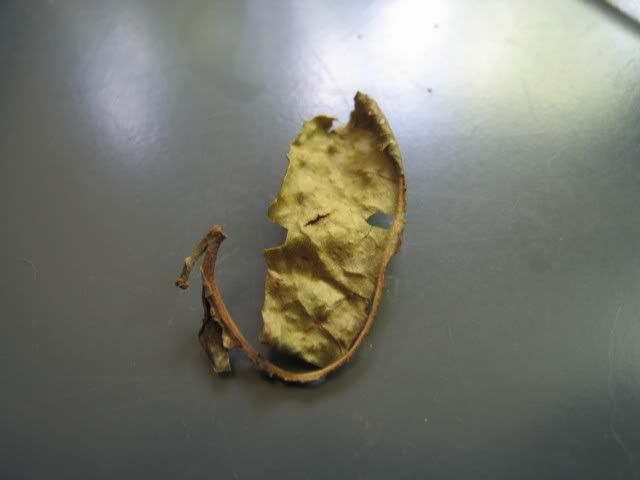
I also found a big yellow leaf in my bag

Which I dumped.

The tea, as I have noted previously, tastes… a little oolong ish. It’s got almost too much fragrance, but this time it’s not as obvious as when I used a gaiwan to brew. I also used relatively less leaves, which might also account for the slightly weaker aromas. It does taste like other Nannuos I’ve tried, but it’s …. a little weak. It’s got qi, but I don’t feel particularly happy drinking this tea, and I’m not sure why. It just doesn’t really do it for me.

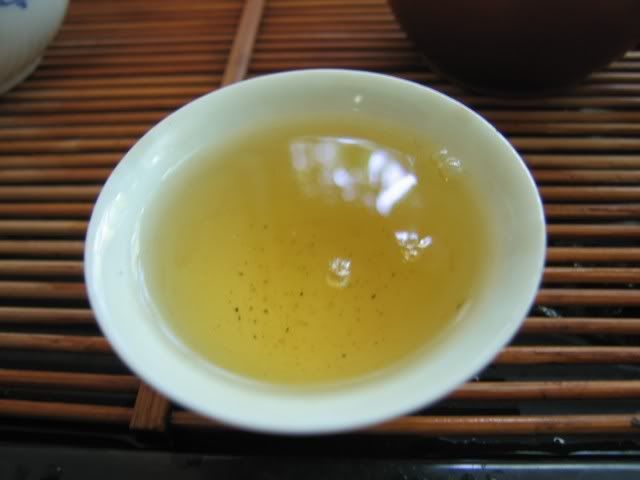
It looks nice enough though, both the liquor

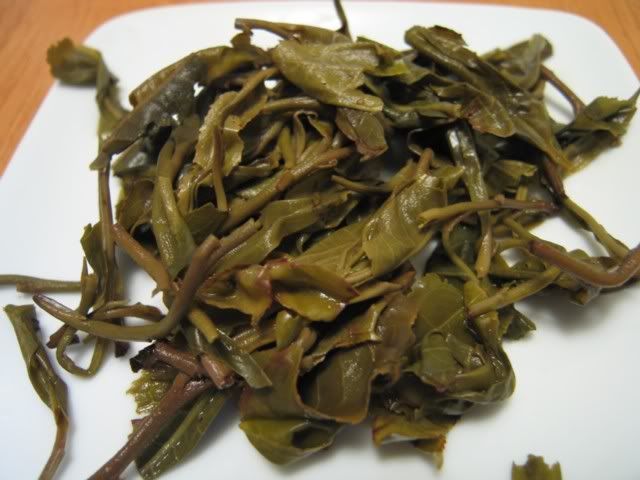
And the wet leaves

But I don’t know why… something about this tea just doesn’t really agree with me. It’s not that it’s bad… but I just don’t particularly find it interesting or anything. Hmmm. I wonder if I should try the other two

Categories: Old Xanga posts · Teas
Tagged:

Xiaguan Baoyan FT 2006 Minicake

August 3, 2007 · 3 Comments

One of the last 2006 Tasteoff teas I haven’t tried — the 06 Xiaguan Baoyan FT minicake, from Estif. You can see a few other people’s here.

FT, or Feitai, is an interesting company. Aside from the obvious fact that they have mafia connection, FT basically specializes in custom order cakes, tuos, bricks, and that kind of thing from big factories, namely Menghai, Xiaguan, and more recently, Zhongcha. There are quite a few of them out there. The Gold and Silver dayi are among them, as well as some very recent, new cakes that I tasted in Beijing, pressed by Zhongcha, called Yunmei (Cloud Plum — actually a varietal of tea grown in Yunnan, mostly used for greens, traditionally anyway). The stuff they make, from the ones that I’ve tried, tend to fall in line with large factory taste — but better. How much better is up to individual taste. I don’t think they’re so far above and beyond regular factory stuff to deserve the high premium that some of them charge. The market disagrees, although I think that’s more because it has a collectible premium (i.e. every special order is a one of a kind cake) than anything else.

The tea in question is made under the Baoyan brand, which is, as some of you know, made largely for consumption in Tibet. Tibet, Xinjiang, and Inner Mongolia has really been shafted by the puerh craze. Prices of puerh of all kinds have shot up drastically, and for these people, tea is not only a luxury — it’s a necessity. In their diet there’s very little vegetables (if at all). It’s high in fat content as well. Tea therefore becomes very important as a source of vital nutrients, such as vitamin C, and also as a way to help digesting the fatty food. Prices being what they are though, the people in those regions are increasingly having to drink poorer and poorer tea. I have read stuff on Sanzui about how some farmers basically trade sheeps for tea. Imagine that… it’s that important to them.

So it is a little odd that FT would order bings being made to the Baoyan brand. It wouldn’t be particularly well known in Taiwan, where presumably this was headed, although Feitai also has a healthy presence in mainland China as well. A new store just opened a few months ago in Maliandao, for example, and the owner was giving out free cakes for people who were coming in the first day. I sadly missed it because I was out of town 🙁

The tea looks better than your usual Baoyan stuff, which is basically teabag material — fannings. This one has discernable leaves

It brews a darkish liquor, quite cloudy, and a little thick.

The taste…. well, suffice to say, this is low grade tea. It’s sour, bitter, not too aromatic. There’s not much smoke that I could taste, I suppose those notes, which were apparently prominent, are no longer around. However, it’s still a pretty unpleasant tea to drink. The one thing it does do is leave a long tail in the throat, but that’s perhaps the only redeeming feature of the tea, and even that tail only lasted a few infusions. There’s no qi to speak of, as far as I could tell, and not much of interest other than the notes I’ve listed above. It’s better warm. For one infusion I went and did something and came back to it with the tea having cooled significantly. I tried it… and wanted to spit it out. It’s quite horrific when cold.

Good endurance, however, since it lasted longer than me (I tried maybe 9-10 infusions?). Judging from other peopel’s notes, 9-10 infusions is already quite heroic.

Wet leaves is… chopped liver. Nothing too interesting to look at, honestly. Quite common factory type stuff. I do think this tea can age well given time and a suitable climate. I somehow don’t think this is tea that will do well in pure dry storage.

Categories: Old Xanga posts · Teas
Tagged: