A Tea Addict's Journal

Entries tagged as ‘black tea’

Crawling back out from the boxes

June 19, 2008 · 2 Comments

Moving, especially long distance moving, entails lots of packing and lots of unpacking. I’m still surrounded by boxes, half packed, half unpacked. It’s frightening to think that it takes about 5 largish boxes to hold all my tea stuff. It’s also obvious to me that, despite my earlier attempt to unload some of my teaware, I still have far too much of it.

So, while my tea stuff are still being unpacked, I have been subsisting on a few samples kindly provided by Mr. Lochan of Lochan Tea. These are all 2008 first flush FTGFOP darjeelings, or “Finest Tippy Golden Flowery Orange Pekoe”. There are a total of 8 samples, and I’ve only tried two, numbered 3 and 4. It’s quite interesting brewing teas you know very little about. I remember once upon a time, when I was first exploring the world of tea, when first flush darjeelings were one of my favourites — especially the greener kind that gives a nice fragrance. I’ve since left that world and pursued other kinds of teas, but brewing some of these reminded me why I liked them in the first place.

I use a 300ml (or thereabouts) yixing with a generous but not over the top amount of leaves, and pour them into a big mug to drink. I suppose you can think of this as a cross between my usual brewing and a more English style, although brew times are short — under a minute at most, usually about 15-30s. The teas are obviously very high quality, especially sample 4. A nice depth and overall very fine fragrance, qi, and body. They are also quite long lasting — sample 4 I brewed for two days. Wikipedia says a joke for FTGFOP is “Far too good for ordinary people”. I can see why…. and I’d imagine this stuff doesn’t come too cheap.

Categories: Old Xanga posts
Tagged:

Making tea lazily

March 14, 2008 · 6 Comments

I had two teas today, since I was rather busy and made tea in a cup, grandfather style, instead of doing my normal routine. The first I had was a Yunnan black of some sort — no labels, as is my bad habit. It’s one of those where there are a number of golden tips in the leaves, but they do not consist of the majority of the leaves. Most of the dry leaves are more blackish. Nice, mellow, a little sweet, robust…. a bit of that caramel Yunnan taste, and not a bad tea.

Then, later, I had an Assam. It looks quite similar to the Yunnan, with some golden flecks among the black leaves. Smells like Assam. I brewed it also in the same mug. Nice, mellow, a little sweet, robust…. not a bad tea.

Then I started wondering if it’s possible for me to identify these teas using the parameters I did (maybe 2-3g of tea in a 250ml? mug) without knowing beforehand what they are. I’m not entirely sure. The Assam certainly was a little more bitter, perhaps, but I think the difference is slight. I could detect Yunnan notes in the Yunnan black, but only just.

Which leads me to think that in some ways, all our gongfu brewing puts us in a very different mindset with regards to the teas we drink. Of course, the amount of leaves I put in my cup today was small, and so the nuances were subdued. Even after many minutes of brewing, however, their differences are not all that great, and will probably be even less if I didn’t know beforehand what they were.

That is of course a great argument for using gongfu style brewing — it gets the most out of your teas, and what might seem like quite similar stuff when brewed with two teaspoons of leaves for five minutes are probably going to be very different beasts when stuffed into a pot 1/5 full of leaves and brewed for five seconds. The great problem with gongfu brewing, as we all know, is space and time. Space, because it eats up a lot of real estate on a table. Instead of just a mug, you need at least a cup, a brewing vessel, and a water dispenser of some sort. Time, because it takes more attention to repeatedly add water than just adding it every once in a while.

There are, I think, ways of making that easier to do. One is to simply drink multiple infusions together. Instead of downing one cup and then adding water and repeating this process, which takes quite a bit of attention and time, it is possible, I think, to use a pot that is of largish size (say 300ml) and make two infusions of the tea drained into a largish mug that will then be consumed over the next 5, 10, or whatever minutes. When another cup of tea is desired, the process can be repeated. Still takes time, yes, and perhaps a walk to the water heater in the office, but I think it does cut down on the amount of attention it requires (and the strange stares from co-workers) significantly. That’s sort of what I do when I’m on the road traveling with a pot in a hotel room. Drinking infusion by infusion just takes too much effort in a sub-optimal space. Doing that, though, still gives some of the same benefits of gongfu brewing, and if you use the right kind of tea, it will last all day.

How do my dear readers make compromises in the office?

Categories: Old Xanga posts
Tagged: ,

Republic of Tea

February 2, 2008 · Leave a Comment

I was out and about today, and on my way home, got a teabag just so I have something warm to drink while driving. The place where I went uses, like many others, Republic of Tea teabags. It brought on a bit of nostalgia. I still remember the first time I encountered RoT way back when I first got to college. My school’s bookstore sold RoT teas, and at that point, I was still a not-very-discerning drinker who mostly drank longjing and some occasional jasmine pearls. The first teapot I bought for myself is actually one of those English style RoT pots.

Over the years though, it seems like they have somewhat faded from view. They’re definitely still there, but many other companies have sprung up in the meantime, and RoT seems to not have really kept pace. Most of their new offerings, as far as I can tell anyway, are heavily flavoured stuff, or tisanes, or the extremely overpriced Chinese tea series.

I suppose it’s a good thing that so many other offerings are now available. Yet, in some ways, it’s nice when a decent cup of Earl Grey was enough to make me happy.

Categories: Old Xanga posts
Tagged: ,

T Salon Darjeeling – aged

August 2, 2007 · 4 Comments

Somebody’s response to my entry on Cha Dao (same as the one I posted here two days ago) mentioned how Darjeeling is rarely talked about, even though it is quite popular among tea drinkers. Indeed, I don’t know quite why it is that us tea bloggers tend to be drinkers of Chinese teas. So in response to that… I thought I could dig up a darjeeling.

Unfortunately, the only thing I have easily available is something that I bought many years ago… almost… 7 years now, I think? It was purchased at T Salon of New York City. They have a website, but it’s basically non-functional (everything is still “coming soon” except the chatty video) so I won’t bother linking you. I should also mention that the last time I went there was at least 4 years ago, and I remember buying some basically stale tieguanyin. That, and the snotty attitude of the owner (the other saleswoman was nice enough) was enough for me to not go back again.

But I still have this tea. It’s not drunk because I just really don’t drink that much Indian teas in general, and between all the teas I have I rarely get to this little tin, almost forgotten among everything I have. I can’t remember what they called it, but it’s a first flush darjeeling, one of those lighter ones with green and red mixed in the colour of the dry leaf.

Perhaps it was a good idea I bought a tin along with the tea, because otherwise it probably would’ve lost a lot of the flavour by now. As it is, however, when I opened up the tin it still smelled strongly of the fragrance of darjeeling, and when hot water first hit the gaiwan that scent of a darjeeling, first flush… you can smell it distinctly. I must say that while there are many darjeelings out there, I generally only find the differences between first and second flush to be really meaningful. The differences among the different estates are generally quite subtle, and given some of the very high prices they charge, I’m not sure if they’re worth all that much.

The tea is holding up well. The first infusion was brewed too strongly, even, and came out a little too bitter. I had to be quicker about it and poured water out of the gaiwan as fast as I could, basically. The tea then came out smoother and lighter, just right, with a long aftertaste that I like out of my darjeelings. I think when it comes to teas like this I’m rarely very picky… and they are usually pleasant enough. I still think, however, that indian reds are generally not meant to be brewed with a gaiwan, and when brewed that way it can get a little boring. Perhaps I should try this tea just in a mug tomorrow.

The wet leaves are typical…. chopped up, with a mixture of colours. It might’ve gotten a little redder since I got it, because I remember it being fairly green, but it’s really too long ago for me to remember.

Categories: Old Xanga posts · Teas
Tagged:

Rishi Yunnan gold

July 16, 2007 · Leave a Comment

I went for something simple today, a Yunnan Gold I acquired some time ago from Rishi. I brewed it simply, in a cup with some hot water. The tea is not too bad, has some vanilla flavour and rather robust, without an overpowering bitterness even when obviously overbrewed.

What concerns me about this though is that the tea tastes remarkably similar to some somewhat aged puerh I’ve had. This tea, I should add, is a Yunnan Gold that only has a little gold tippy buds in them — most of the dry leaves are of the black variety. The combination of sweetness, bitterness, and aroma in the tea reminds me strongly of some 3-7 years puerh I’ve had before (and not just one). I wonder if this is going to be a common thing — puerh that was, perhaps, undercooked, so to speak, and thus has too much of its enzymes still active and working to oxidize the tea.

In many ways, this, and the overcooking of tea (green-tea-ization) are perhaps far, far, more dangerous to any puerh collector than any sort of price gouging, misinformation, or the like. I think I have some rudimentary idea as to how to tell a green-tea-ized puerh to a regular one, but how does one make sure the tea is not undercooked when it’s very young? That, I’m afraid I really don’t know.

I suppose it’s time to start praying.

Categories: Old Xanga posts · Teas
Tagged:

Long drive

July 7, 2007 · 2 Comments

Running around like a madman, trying to finish up all the errands we need to run so that we are ready for our rather long drive tomorrow to Ohio, where my girlfriend will be for the next year. I tried another Keemun today, from Karma Cafe in Cambridge. The tea was insipid, and far worse than the Tealuxe version. I know that I haven’t really spent much time on many other kinds of tea aside from young puerh for the past few months, and I feel now it’s time to revisit some old favourites and the like.

I’ve been poking around teamap to see whether or not there are places that sell tea around where she will be. Seems like slim pickings. Seems like my own stash of tea will come in handy when I come back to the States in 2008.

So the traveling continues….

Categories: Misc · Old Xanga posts
Tagged: ,

Whittard of Chelsea

July 5, 2007 · Leave a Comment

I went to Whittard of Chelsea today, recently opened on Newbury Street in Boston. I remember when I first got interested in teas, I had some Whittard Darjeeling that I liked. Walking into the store, it wasn’t quite what I imagined it to be. The teas they had were mostly blacks, with some green or oolongs thrown in, but they were, by and large, very basic stuff. Most of the store was actually teaware of various sort, mostly of the very big ceramic pot kind. I must agree with DH that they’re not that impressive. They even had…. coffee… and some truly fantastically amazingly expensive coffee machines. Does a $1200 machine brew a better cup than a $700 one?

I think for the next few days I might just experiment with drinking various keemuns from various places. I had a keemun “Haoya B” from Tealuxe today…. must say it has nothing to do with the keemun I bought, almost. It’s more smokey, and less sweet. There’s a touch of vanilla taste in it. With a place like Tealuxe, one can never quite tell if it’s contamination from the next bin over.

Categories: Old Xanga posts · Teas
Tagged: ,

Red Thunder

June 15, 2007 · 4 Comments

Rummaging through the samples I have today, looking for something to kill, I found a blue box with a label on it saying “Gopalhara Tea Estate — Red Thunder oolong”. Hmmm, I’ve neglected to taste this tea! It was kindly given to me by DH, a Boston area tea friend. He got it from somebody in New York, who apparently buys these small lots of premium Indians teas and resells them. There was a few grams in the tin left, perfect for a session with my small gaiwan.

The leaves look a little like oriental beauty, with the mixture of colour and type of leaves.

The tea brews a deep orange, with clear and somewhat thick liquor. The taste… is intensely floral. The first two infusions, as I’ve noticed with these Indian oolongs, coat your mouth with whatever taste the tea has. I was expecting this thing to drop off after a few infusions, as some other Indian oolongs I’ve had tend to do, but this one stayed strong — I brewed probably 10 infusions, and it still had decent taste. I’m impressed.

The floral quality of the tea reminds me of a dancong, actually, or at least the non fruity dancong. The affinity to dancong is most obvious around infusions 2-3. Later on, it came back to a taste that is mostly like a first flush darjeeling. In fact, I wouldn’t know this one’s supposed to be an oolong were it not for the floral qualities in the early infusions. It’s got less of the astringency that one gets from regular darjeelings, and but in some ways, I prefer those more. I think there’s something weird to me when I drink one of these teas — perhaps it’s the fact that the floral/fruity qualities are so concentrated in the first two infusions but then fade away. When I drink teas like this, I always wonder if they’re coated with a layer of artificial flavour. I’m sure they’re not, but it just seems that way sometimes.

This is easily the best Indian oolong I’ve had though. Depending on the price, I could get some of this. If it costs more than what I have to pay for reasonable dancong though, I’d pick up the dancong instead. The novelty value isn’t enough to keep me that interested over time.

You can see the wet leaves also look somewhat like an oriental beauty… I wonder how they did the fermentation, kill-green, and rolling/drying.

Categories: Old Xanga posts · Teas
Tagged:

An outdoor tea party

May 2, 2007 · 4 Comments

Today was a very nice day, and I invited two friends to come to have tea with me.  Since it was a warm but not too warm day, I thought it best to sit outside, next to the blooming roses…

We started off with one of the Douji Maocha samples that I got from the tea expo. To refresh your memory, it’s one of these:
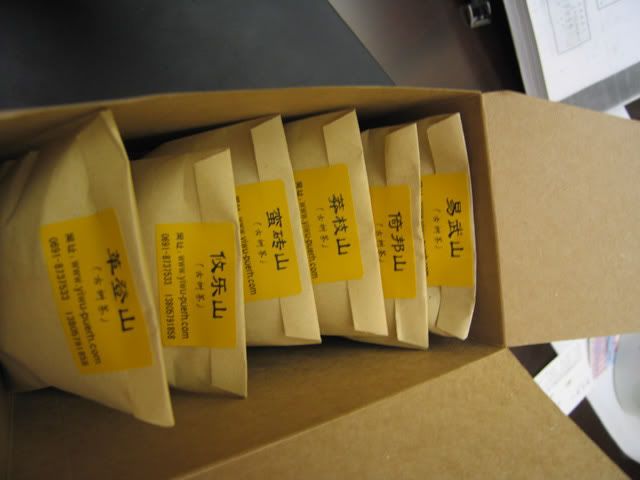
Since I’m a fan of Yiwu… we drank the Yiwu.

The amount of maocha was just right for the gaiwan… not too little and not too much.  One of my friends is a tea novice, so I thought other mountains might be a little too bitter.

The Yiwu turned out to be quite fragrant, thick, smooth, and generally very pleasant to drink.  It lacked a bit of a “throat feel” that I hoped for, and huigan is mild, not as strong as can be.  The tea is obviously spring tea, although I’m not sure if it’s actually 07 spring tea.  I’d imagine it might be, but it could also be an 06.  It’s hard to tell and I personally am not sure.

The wet leaves are quite beautiful

I think I liked this tea quite a bit.  Now I wonder how the other mountains taste.

We then went on to a qingxiang tieguanyin given to me by Toki.  I brewed it using the pot I got yesterday

It worked pretty well.  It’s a little bigger than the amount of tea was good for, but at the same time, we were looking for something a little less strong.  It brought out the fragrance of the tea quite well, although I always find the newer qingxiang tieguanyin these days to be a bit grassy for my taste.  I haven’t had a qingxiang tieguanyin for so long!  Thanks Toki 🙂

This is what’s left of it at the end

We then drank the cheap Yunnan green, or rather, tested the cheap Yunnan green I bought.  I wanted to contrast it with the maocha just to see what’s in the tea…

I think it’s pretty safe to say that if this were pressed into a cake, nobody can tell for sure if it’s puerh or not without being able to smell it and try it.  It can look quite like the real deal.

The taste, however, is distinctively beany.  Many green teas have a “bean” taste, and this tea, I think, has a classic “bean” taste that can go into a tea textbook.  If I ever want anybody to know what a “bean” tasting green tea is like… this is it.  This is also something that a puerh shouldn’t taste like, lest it will not age well in a few years….

The wet leaves are rather green too.

By this time it was getting a little late, and we finished up with the Qimen Haoya B that I bought a few weeks ago here in Shanghai.

I didn’t use too much leaves as I didn’t want to overdose my guests.  It yielded a nice cup of tea, quite nice to drink to finish off this session.  I always like to drink something warming/mellow to finish a tea session to keep everybody on a happy note.  Something too high-strung can really make one feel jittery or uncomfortable after many teas.  The hongcha did the trick, I think, and we proceeded to dinner after the tea.  Not before I take a shot of the wet leaves though…

By this time the sky was turning dark.  The camera was doing funny things to compensate for the lack of light, so the gaiwan is showing up in interesting colours.  I played with the colour balance to try to approximate the colour of the wet leaves, but this is still a little off.  Oh well.

It was fun, and I think I should definitely do this again.  Drinking tea outside has its charms, and so long as it’s not the mosquito season… it’s a very pleasant thing to do.

Categories: Old Xanga posts · Teas
Tagged: , , , ,

Shopping in Shanghai

April 21, 2007 · 6 Comments

I walked to Tianshan Tea City from my place today, looking for some cheap teaware to use in Shanghai.  It’s a 20 minute walk if I don’t walk too fast, and I can make it there in 15 if I walk really briskly.  It’s a bad combination, I know.  Luckily, the place is not big enough to hold a lot of interest for repeated visits.  It’s two floors plus some ground floor open stores.  In total I think there are about 80 stores of various kinds.  Interestingly enough, there are more puerh stores here than last time, and that was only two months ago.

I had set out to look for some cheap teaware to use in Shanghai, since I didn’t want to bring more stuff than I was already carrying.  However, I got sidetracked into a Keemun store.  They sell basically only Keemun, with some other teas as well (some unknown green, plus some Taiwan oolong — a mixed bag).  I was attracted by the Keemun, because she had all the grades, and they were clearly marked.

I ended up tasting two, a Haoya (she said it was B when I asked), and a tea she called the “Li Cha”, which is a new style Keemun which is not broken up — it’s instead using whole buds.  Keemun, as most of you know, is the sort of classic Hongcha (red tea).  It’s got a distinctive flavour, and the leaves are usually quite fine and cut up… is it broken orange pekoe?  Anyway, the Li Cha is not like that.  Instead, it’s buddy, looking a little like a red version of biluochun.  I think I’ve seen stuff like this before called by different names, but didn’t know it’s from the same region as your classic Keemun.

The Haoya is quite nice, although slightly rough on the tongue.  The Li Cha is better, but it lacks that Keemun flavour I was looking for.  I want something that I can use as a sort of benchmark to judge other Keemuns by, and I figured this is a good place to stay (I must confess I know little about Keemuns in general).  I sat there for a while longer, tried their green tea, and had a cooked tuo that she bought for 200 RMB (way overpriced — she wasn’t selling the tea, just drinking).  I then bought some of the Haoya and left.  She offered me a 30% discount without me prompting it, which was nice.

I wandered around the market for a little longer, looking for a gaiwan and a few cups.  The gaiwans are quite nice — I think BBB is right in saying that the teaware here is nicer.  The nice gaiwans, of course, weren’t the cheapest, but they were tempting.  I had to leave to go to another place, so I never finished shopping for teaware… having just bought one tea tray and no cups/gaiwans to use it for.  I’ll either come back here or go to Jiuxing, the other tea market which is a bit farther away.  Maybe I’ll go next weekend or, if I have time, sometime during the week.

On my way out, I noticed another store that specializes in Keemuns.  I should go check that place out.

Categories: Old Xanga posts · Teas
Tagged: ,