A Tea Addict's Journal

Tea in a ceremony

November 11, 2007 · 7 Comments

There are tea ceremonies, and there are ceremonies involving tea.  A Chinese wedding is one of them, at least as practiced in Guangdong (I’m not sure about other areas)

What happens in a traditional wedding ceremony goes something like this — the couple walk into the main all where everybody is already there.  The parents of the groom are present in the house, sitting facing out.  The couple walk up to them, and then they bow three times.  Once to the heaven, once to the parents, and then the third to each other.  Then they serve a cup of tea to the parents (kneeling, of course), and in return they get some good luck money in a red bag and some sagely advice, and this is basically what it takes to get a bride to be accepted into the family.  I heard in Korea it’s not tea, but wine, that is served, but the idea is pretty much the same.

I don’t know if there’s a rationale behind the choice of tea other than the fact that it’s the most common drink and that many Chinese just can’t handle wine.  But perhaps there’s a sense of domesticity in drinking tea that wine doesn’t do — you drink wine to celebrate or some such.  Tea, however, is something you drink all the time.  Marrying into a family is going to be a full time affair — you become part of family, and so perhaps in this sense, tea is very appropriate.

These days (such as the wedding I went to today) the bowing no longer takes place, but at least in HK the tea serving gesture is still generally done, however haphazardly.  Except that nowadays, they are often wearing a tux and a qipao, usually (kneeling in a wedding dress can be a difficult move, methinks).  The parent of the bride also get served these days.  Even though circumstances changed though, there’s still some sort of symbolic power that this ceremony holds, so that even this thoroughly westernized society in Hong Kong still performs this.  It’s this kind of thing that makes Hong Kong quite unique — this is probably the only place on Earth where both Christmas and the Buddha’s birthday are both public holidays.  East meets West at its finest.

→ 7 CommentsCategories: Old Xanga posts
Tagged: ,

Be your own tea master

November 10, 2007 · 7 Comments

I had some tea with Tiffany, YP, and a few others today.  We were talking about buying puerh, buying other teas… and such.  A few topics came up

1) How puerh used to be so cheap nobody wanted it.  Even just a few years ago, a really good grade cake would only cost about $5 USD (all prices here will be USD) or so when it first comes out.  It was pretty much unthinkable for a new, raw puerh cake to cost more than about $10.  Back in the day when YP bought her first 88 Qing (now quoting about $1200 or thereabouts, depends on when, where, and what) it cost her about $10, which was considered a high price already.  A Red Label maybe 15 years ago was something like $500 (now entering the $10000 territory).  Most green cakes back then were only about $1-3.  She said the first time she looked for the 88 Qing, she went to some wholesaler to try to get some.  Asking them, they were like “what? why do you want this stuff?  This stuff is so green!”.  She wanted a cake?  “No, you need to at least buy a jian!”.  Those were the days.  But even now, she agrees with me on this one point — no good reason to pay big money for aged cakes, because for the most part it’s not worth that much given the alternatives.  Of course, she’s in a position of somebody who has a bunch of old cakes to drink, but even then… food for thought.

2)  How the conflation of “tea masters” and “tea sellers” is a dangerous thing and buyers need to be cautious.  This is something I’ve although thought about recently — how many boutique shops are opened by supposed “tea maters” out there who really don’t necessarily know anything more than anybody.  There’s no certification for such status, and there’s definitely no requirement for somebody to open a tea shop.  Many so called “masters” come from other trades; their former employment having nothing to do with tea.  Most of them did not learn their trade from some other “master” either — they acquired the knowledge (whatever there is) through drinking, reading, thinking — just like all of us.  Starting a shop doesn’t make you a master.  Sourcing good tea does not make you a master.  It does, however, make you a tea salesman.

YP and another tea friend present related to me how over time, they have heard 100% contradictory things from the same “tea master” who shall remain nameless.  At first, they’ll tell you one thing, and you, as student, will go buy tea (expensive tea from the same master, of course) according to that.  Then…. a few years down the road, suddenly the tune changed, and now they tell you another thing.  If you were around the first time, you’ll notice that it’s totally different and contradictory from the first.  They simply cannot both be true.  Yet… this sort of thing happens all the time (I’ve seen the same thing happen myself).  Why?  Because at these times, they’re not acting with the “tea master” hat on — they’re wearing the “tea salesman” hat.  When the two roles collide, the tea salesman almost always wins.  Another thing you will notice over time is that many “tea master” disagree with each other on some very fundamental points, especially when it comes to puerh.  This isn’t terribly obvious to those who don’t know Chinese and don’t have access to these people either in person or through print, but the fact that such fundamental disagreements exist means only one thing — nobody really knows the true answer and are all fishing in the dark.  Beware of “tea master”.

3) Which leads me to the third point — puerh production has changed significantly over time.  The few experienced people present agreed on one thing — puerh production has changed about once every decade — the leaves, the mix, the way they press the cakes…. everything’s different, and there are distinctly different tastes that come out of the cakes.  Theories of what made a good tea in the 80s might not apply to the 90s, and what made a good tea in the 90s will not apply to the 2000s.  As YP said today when I first walked in… “I can say I know something about 70s or 80s tea, but I don’t know much about 90s tea, and I definitely don’t know much of anything about teas made in the past five years”.  She’s not being too humble either — I think it’s more because nobody has had enough time to tell yet.

And at the end of the day…. tea is still a matter of taste.  Some people just won’t like a certain taste, no matter how refined it is, supposedly.  Two buck chuck has won blind competitions for wine.  I’ve tasted aged baozhongs costing $50/jin that are far better than stuff costing $250/jin, regardless of the price.  Do I have a screwed up tongue?  Perhaps.  But then… maybe it’s just because I am the only person who knows what I like and dislike, and whatever other people tell me… I will listen, I will certainly learn.  Everytime talking to somebody about tea is a learning experience, even if that person knows nothing about tea.  But I am the only one who knows what I prefer in my cup, “expertise” be damned.

I’d imagine the same to be true for everybody.  I know somebody who likes her tea be Twinings Earl Grey teabag dunked into a cup for about 15 seconds, add milk.  That’s it.  I liken it to sewer water.  But somebody thinks it’s great, so… who’s to say who’s right?  Just hope the Twinings Earl Grey teabag wasn’t sold for $250 and masqueraded as the Best Tea On Earth.

→ 7 CommentsCategories: Old Xanga posts
Tagged:

Storage report

November 9, 2007 · 2 Comments

Just juggled my tea in my HK storage.  They smell fine, except the few cakes at the top that seem to have absorbed a bit of a woody smell.  It’s not overpowering and won’t kill me.  I put the cheaper tea near the top anyway, so that it won’t affect the good stuff as much, which are in the bottom shelf and mostly wrapped in tong wrapping.

I wonder what the cakes will taste like with long term absorption of wood smell?  I mean, I’m sure some cardboard boxes they used to store teas long term also emit an odor…. and sometimes a strong one (especially when wet?).  Those seem to have aged just fine over decades…

I guess we’ll find out in many years what will happen!

→ 2 CommentsCategories: Old Xanga posts
Tagged:

Aaron sample 2

November 8, 2007 · Leave a Comment

Second of the many samples

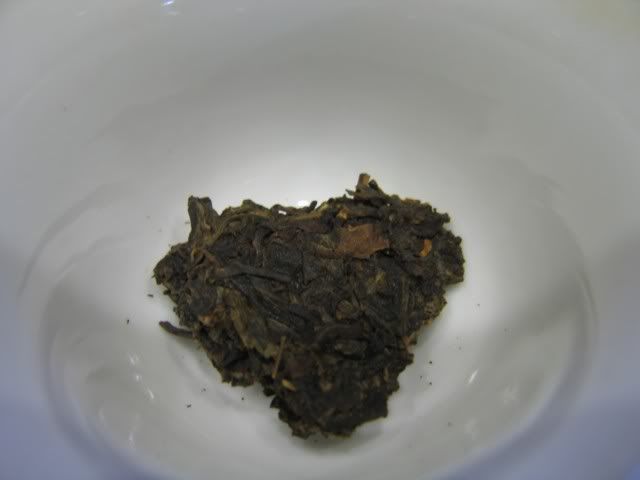
Sorry the picture’s a little dark, but there’s not much to see anyway. It’s a tiny piece, the tea is VERY hard compressed, and it looks and feels quite… regular? I thought it might not be enough tea…

It took two steeps and a little twisting to get it separated enough to actually make a proper brew. The tea is cloudy at first

Yes, cloudy means very cloudy.

The tea is odd. The first infusion — the under the lid smell is that of a the raw leaf. The liquor and leaves smell like a pretty normal young puerh of a few years’ age — a bit similar to the Menghai tuo I’ve had. The tea itself, however, it rather weak…. almost lacking in taste. I tried brewing it longer, and yes, it does come out a little stronger, but all the taste is concentrated on the tongue itself. There’s a fleeting sensation of huigan and throatiness that seems to be there… but also seems to be not. There’s also some weird taste in the tea, I’m not exactly sure what… as well as a hint of smokiness in there. It’s not strong. The leaves is extremely chopped, but probably because of the way the sample came in (but I’m sure the HARD compression has something to do with it). The tea ended up being a little more than I imagined….

As you can see, chopped to high heavens.

→ Leave a CommentCategories: Old Xanga posts
Tagged:

Aaron sample 1

November 7, 2007 · 2 Comments

Aaron gave me a bagload of samples to try, they’re all 2001 and they’re numbered, so I figured I’ll start with 1. These are all fairly small samples. Since the blasted electric scale died on me (this is the second one to die within a year! Damn those cheap Chinese goods) I have to go by instinct.

With sample 1 this wasn’t a problem, since there wasn’t much and I had to throw the whole thing in

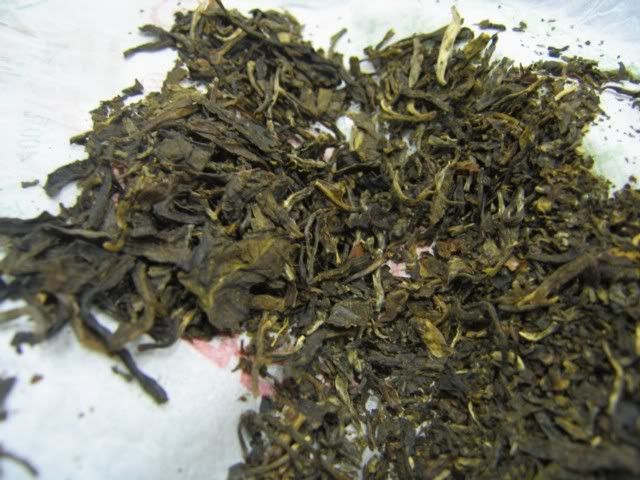
There are some big leaves mixed in with some pretty broken stuff. You can already tell there’s a lot of stems in this sample when looking closely.

The tea is quite smooth, pleasant, a bit fruity, sweetish, aromatic, seems like there’s a bit of qi, but generally a little on the bland side of things. It’s a pleasant enough tea. It reminds me of a few aged-a-few-years Yiwu I’ve had, especially the Fuhai Yiwu that Davelcorp gave me — that lighter kind of stuff, not the Menghai one that I dislike with the heavy tobacco notes. The storage of this tea is “clean” i.e. non-wet, and something about this tea makes me think this is not a spring tea. The tea is durable enough though — it lasted a while.

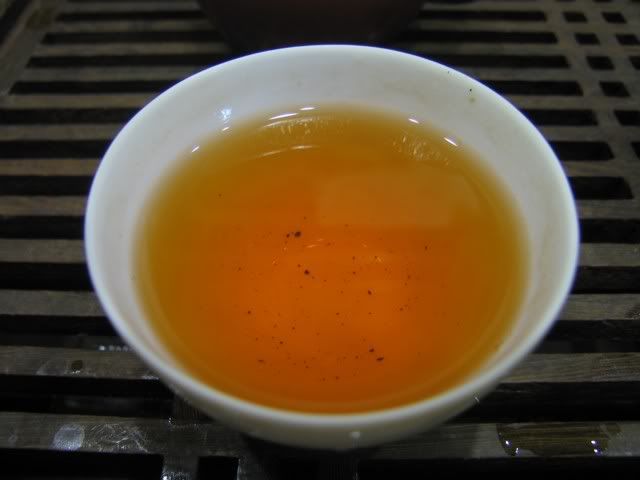
The liquor looks about right

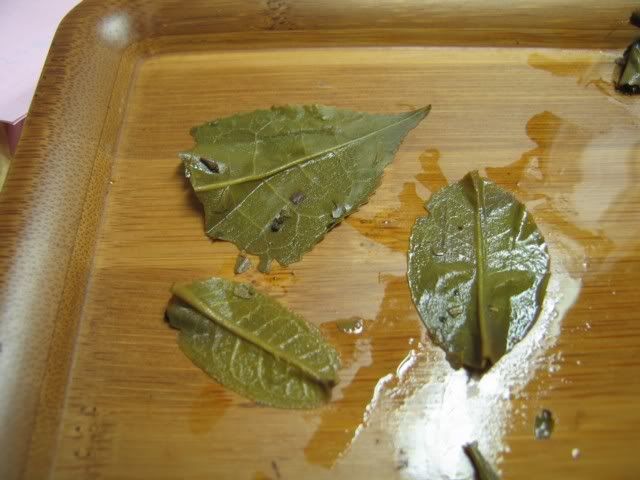
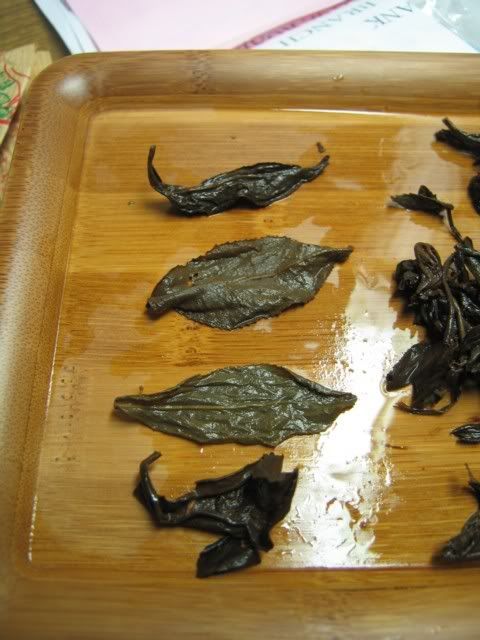
So do the leaves

Given the small amounts, it might’ve been more instructive if I just brewed it with those 5 minute brews, but I want to enjoy drinking this, not just evaluating. I wonder how far off I am from the reality 🙂

→ 2 CommentsCategories: Old Xanga posts
Tagged:

Aged? Taiwan oolong

November 6, 2007 · 2 Comments

One of the things that makes dating aged oolongs difficult is the lack of any sort of packaging. They usually just show up in a canister, and packed for you on the spot depending on how much you want. You’re lucky if the canister is labeled, but the label sometimes has nothing to do with what’s inside, so go figure…

This tea I found in a teashop near National Taiwan University after dinner with a friend. The shop was interesting looking. It was sort of like a regular mom and pop shop, but better stocked (so it seems) than most. I asked if they have aged oolongs, and the owner said he had a bunch. I ended home with just one, although there was another one that was made purely of buds that looked more aged and very interesting, but the price tag was pretty steep and I didn’t want to gamble on it.

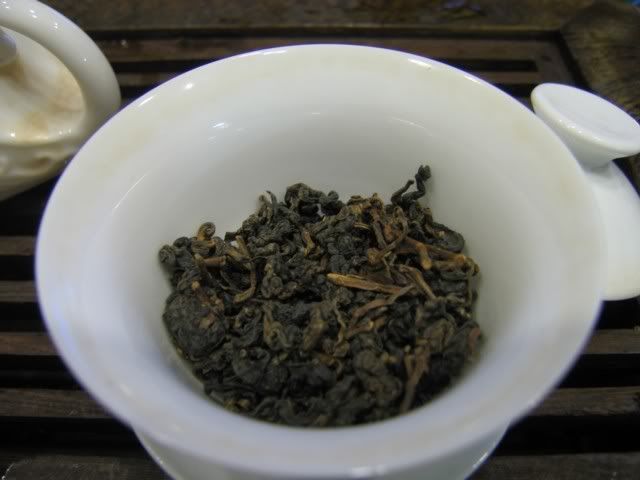
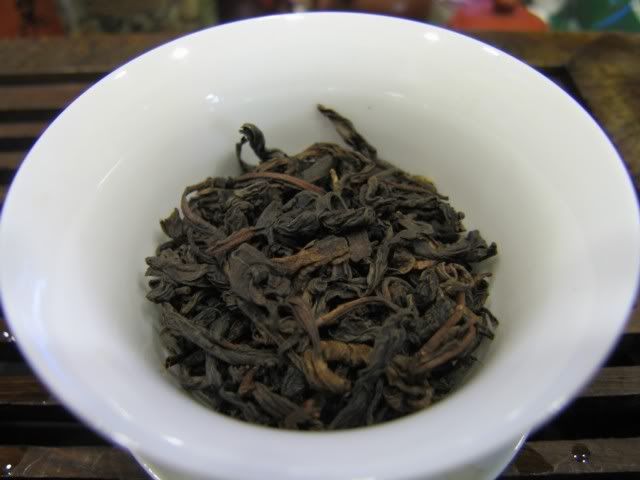
So this is what this tea looks like

Doesn’t look much aged, does it? When he opened the big canister the tea smelled more aged. In smaller quantity, it’s not as obvious.

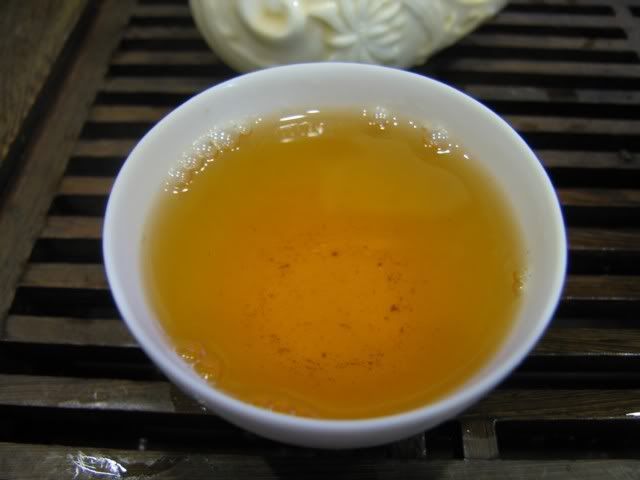
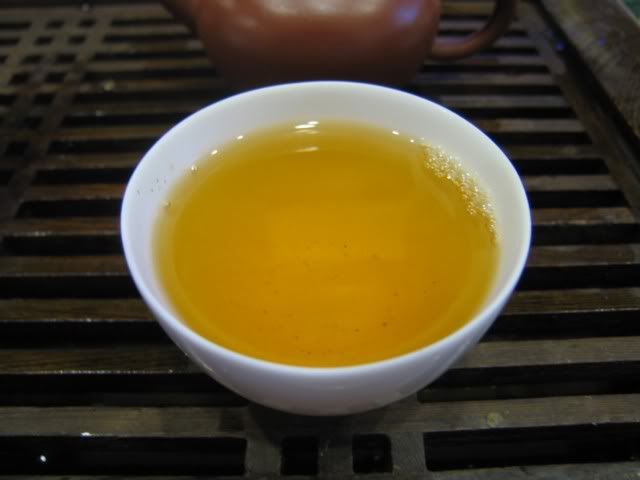
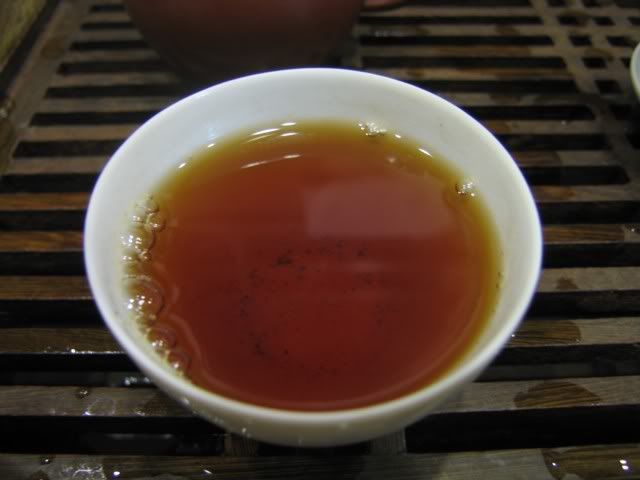
It brews a darkish yellow/orange tea

The taste… is decided that of a younger Taiwan oolong but with a touch of that “aged” character to it. That aged character is very fleeting and isn’t at all obvious at first, but having drunk a lot of that stuff recently where it’s much more prominent, it becomes a lot easier to identify. The taste is without a trace of the grassy notes that I dislike in a Taiwan oolong, and the tea itself is full bodied and VERY smooth, lacking that slightly rough edge that one often finds in the lighter Taiwanese oolong. If there was roasting done for this tea, it must be very minor, and given the small amount of this tea that the store keeps, I doubt it’s worth reroasting. The taste is primarily that of honey-like aromas, plus a bit of that typical Taiwanese floral note. It also has the additional benefit of not making me dizzy even though I drank it on a mostly empty stomach before dinner. Can’t say that for most Taiwanese oolongs.

I think this tea probably rarely sees the light of day, as few people will seek out a tea like this from a store like that one. The price is a bit high, mind you (something like $180 per 600g) but I do like this tea quite a bit. I bought a new, slightly roasted oolong that, from my memory anyway, tastes similar and is cheaper. Maybe I should drink that tomorrow and compare them against each other to see which one’s better and if the aging of this has done anything to it.

The wet leaves are healthy, thick, and the stems are kept

It is probably best drunk just as a typical Taiwanese oolongs with a honey note, rather than anything aged per se. Yet… pretty enjoyable all around.

→ 2 CommentsCategories: Old Xanga posts
Tagged: ,

Lies, damned lies, and sales pitches

November 5, 2007 · 11 Comments

If anybody I know asks me for advice in starting a business selling tea, I’d suggest they pick up a job in a kindergarten telling stories, because they’ll need the practice. I think there are few businesses out there that tell as many stories as a tea store generally does.

Let’s start with the simple ones that everybody buying tea has heard — Monkey Picked oolong. “They’re really picked by Monkeys!” I’ve seen a website saying that, which….. bothered me. Do they believe that? Do they think their customers believe that? Really? Do they consider what kind of message this sends to people browsing their website?

Then you have the “premium”, “reserve”, “special reserve”, “limited edition”, and that sort of thing. This is nothing unique, since most retail industries have them — they’re everywhere from cars to magazines. The thing with tea though is that very often I find these to be merely ok teas… if even. Tea is a difficult thing to judge. A top end longjing look very different from a low grade one, to be sure, but only if you know what to look for. Otherwise, they’re just some green hairy leaves (low grade, of course, has less hair and is darker, generally). Couple this problem with online sales, where you’re at best treated to a high resolution picture, and it becomes nearly impossible to tell one from the other. Kudos to the vendors who sell samples, and woe to those who don’t.

The same sort of thing happens in puerh, where cakes are slightly more distinguishable by production number, factory, etc. So what do you do? You commemorate. 66th anniversary of your brand? Why not. Trade fair? You need a commemoration cake. A China-US Summit? Of course. 10th anniversary of the return of Hong Kong even though you’re a factory in Yunnan? Hey, it’s a day of national significance. Except that when every year you have a commemoration cake for the same event, it gets old fast. I think when they first came out, these things did often mean something. Now, though, every other cake I see commemorates somthing… and they are often made of the same tea (or similar quality) but cost more because they’re “special”. C’mon. Time for a new pitch.

The more egregious and IMO annoying stories are the “this is a special tea only through so and so”. In some ways, this is an extension of the “reserve”, “special reserve” stuf, but with more specific details aimed at making you think this is somehow a special tea. The more common is something like “this tea is made/stored/found by Tea Master X and I have secured a bit for sale here”. The less common is “this is from a deceased Tea Master Y who had a secret way of making this tea taste so good”. Even less common are more convoluted stories such as “this was a tea that was stored in the warehouse of a factory in exchange for cash payment back in the day when puerh was worthless and the factory had no money to pay, and was just rediscovered last year by us and we bought up all of it”. All these, by the way, are stories I’ve heard in person. The first one you’re probably all fairly familiar with, the second conceivable, and the third are usually one of a kind, involving details that are so minute they almost have to be fake. Of course, back in the 70s or 80s, these stories could indeed be true, and I don’t dispute that even now some of these things could potentially be true. However, it is very important to remember that for tea, scarcity does not always mean quality. I can make 2kg of oolong by sneaking into a farm and picking tea at night and making it however I do. That tea will be very scarce, it’ll be one of a kind…. but it doesn’t mean it’s good.

It’s surprising how often the above happens — and I think quite frequently, the person pitching the tea to me him/herself believes the story to be true (told to him/her by whoever who sold it to him/her in the first place). It justifies the higher price being charged, but also helps give the store an air of quality, rarity, etc, all that. Sometimes, these teas are genuinely interesting or good. Other times… they’re just run of the mill. These pitches can also combine with the bait and switch — knowingly providing a tea that is quite regular (say, a Menghai cake or some middle grade tieguanyin) but dressing it up, mixing in something, changing the wrapper, putting it in a nice box… and here you go, a super special reserve limited edition tea provided only through me from some mystery person who I can’t tell you about (this is why I don’t have original packaging/neifei/bag/whatever for you!). Expensive, of course, but it’s worth it!

How many people pay good money for a bottle of wine that has its label obviously ripped out? Probably not many. How come people are willing to tolerate that kind of story when a neifei has been ripped out of a cake of puerh? More than a few, apparently. I’ve received a gift cake that’s sort of like this…. a store-brand cake that is obviously just some regular cooked puerh bing, but I bet the person paid big money for it because the wrapping is nice and the store is upscale (with a functional and pretty website — a rarity for a mainland Chinese store). They probably told him that the tea is very special and old and specially sourced, when it’s obviously just some regular brand new factory stuff that’s been rewrapped.

And don’t even mention Wulong for Life…. if I see one more of their ads when I check gmail, I’m going to kill somebody.

Don’t get me wrong, stories in and of themselves are fine. In fact, they give some “flavour” to the teas and make it more colourful, and I’m fine with that. It’s when things don’t add up, when quality isn’t there, and when they are way too common and transparent (like commemoration cakes) that’s when things start to bother me.

→ 11 CommentsCategories: Old Xanga posts
Tagged: ,

Impressions of a “wild arbour” tree

November 4, 2007 · 1 Comment

I drank this today

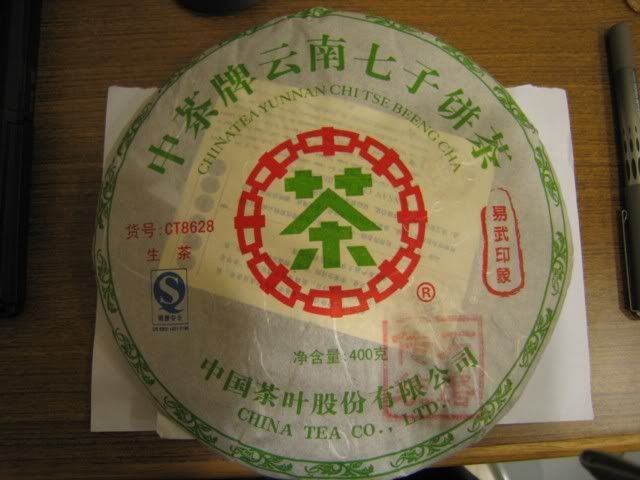
“Yiwu Impressions” from Zhongcha, given to me by L. L is a first line distributor for Zhongcha’s puerh, and as he told me — this is made from plantation tea. The tea’s wholesale price is 100 RMB, which means that by the time it gets into hands of consumers…. it’ll be probably double that, or more, who knows.

There are some broken stuff

So I used those. The colour of the liquor is ok enough

The tea is bland, uninteresting… it has a bit of that Yiwu taste to it, but overall I find it weak and boring. The leaves:

Are varied… but I think looking at this sample, it tells me that everything everybody told me about how to identify an old, wild, arbour tree tea based on looks is wrong, because you can find some leaves in this sample that will satisfy one or even a few of those criterias, yet, this is plantation tea.

So we can forget about trying. It’s all about how it behaves in the mouth, and this tea just doesn’t cut it.

→ 1 CommentCategories: Old Xanga posts
Tagged:

Will travel for tea

November 3, 2007 · 3 Comments

I went to see Aaron Fisher today again at Miaoli. I don’t think I’ll ever go to Miaoli if I didn’t know anybody there. It’s a small town halfway down to Taichung, and it doesn’t have a lot to offer. But hey, if there’s another tea head there, I’ll go.

Especially if said tea head brews up a nice roasted Taiwan oolong (sweet, mellow, nice aftertaste), followed by a late 70s/early 80s dry stored Xiaguan iron cake (it’s fun when the stuff still taste kinda young when it’s closing in on 30, with a mix of aged and young characteristics — proof that iron cakes can probably benefit from wetter storage), then on to the Blue Label (very nice), and then finishing with a 1930s Liu An (BBB, I see why you love this stuff). Thank you, Aaron. They were all great.

Meanwhile we talked about things tea related, and I also watched him cleaning an old pot he just got using some Japanese pot-cleaning stuff, which he gave me a few packs of to clean my pots. Time to experiment.

I didn’t sleep well last night, and so my tea endurance was a little lower than usual, but it was a good day drinking tea. He also sent me off with a bunch of samples — more on those later 🙂

→ 3 CommentsCategories: Old Xanga posts
Tagged: ,

Dry stored aged baozhong?

November 2, 2007 · 2 Comments

I am thinking that if that super-heavily roasted tea can be thought of as a “cooked” version of aged oolong, then this tea today can be called a “dry stored” baozhong.

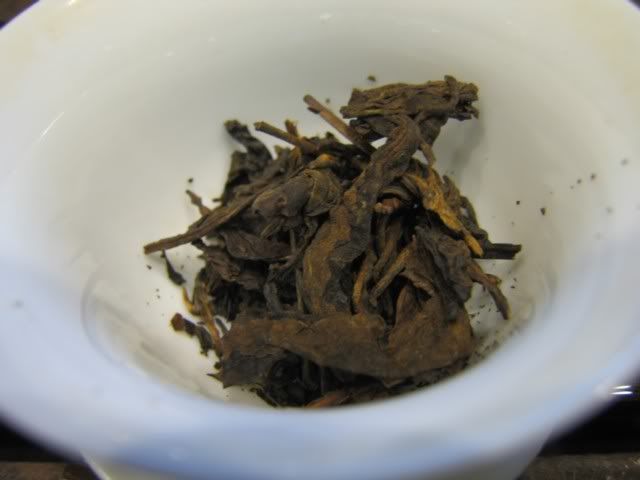
The dry leaves are not too indicative of anything. You can sniff a faint smell of aged oolongs, but the leaves are obviously quite intact and look good — it doesn’t show very well in the photo

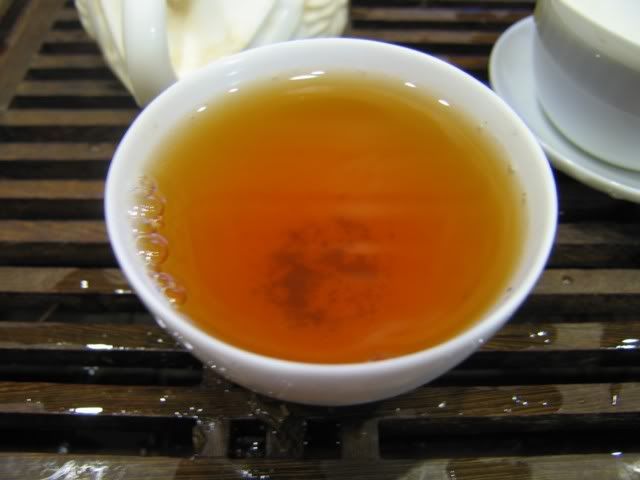
The cup of tea looks similarly good

It starts out a little sour — the first cup or two has some sourness in it, but it dissipates quickly and by the third infusion you’re not getting any sourness from it anymore. Instead, it’s got a nice aged flavour to it — I can’t describe quite how “aged” it taste, but it reminds me of old puerh, plus a little fruitiness. There’s no roasted flavour at all to the tea, and in fact, after a few infusions you start tasting some greeness in the back end — it seems like there’s a green oolong undertone to the tea. It hits the throat well, with an obvious aftertaste that lingers well after I swallowed. There’s also some qi — I was feeling the effects of drinking this tea. It’s always a good thing.

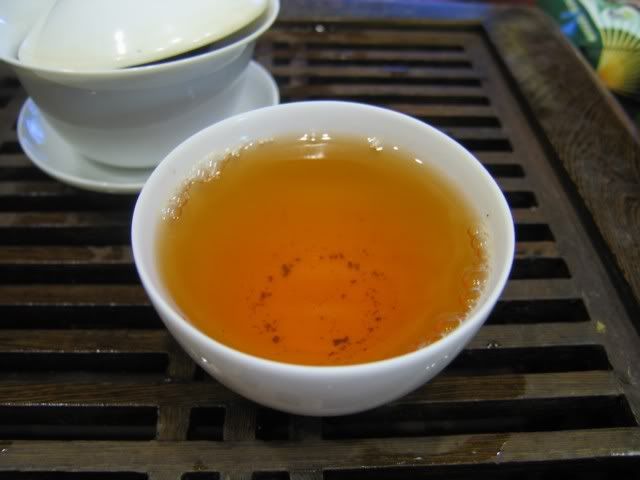
The tea lasts many infusions — this is taken after maybe 10 cups?

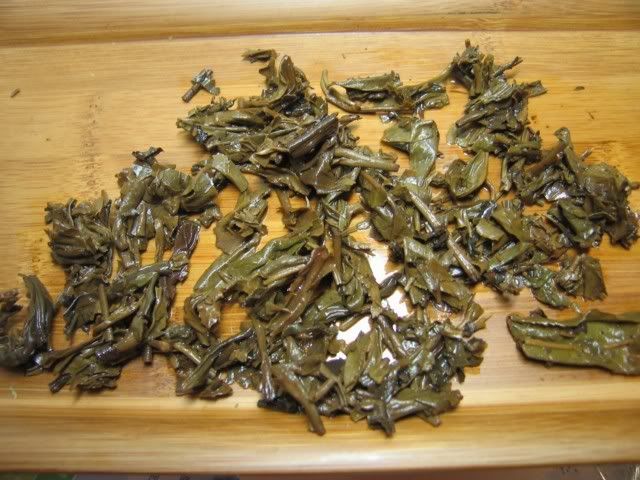
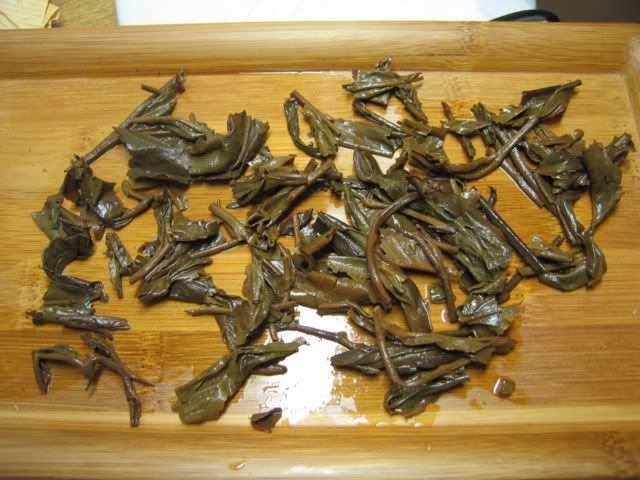
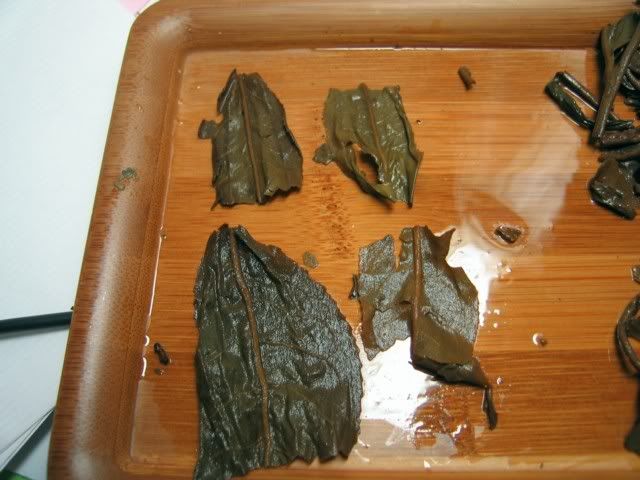
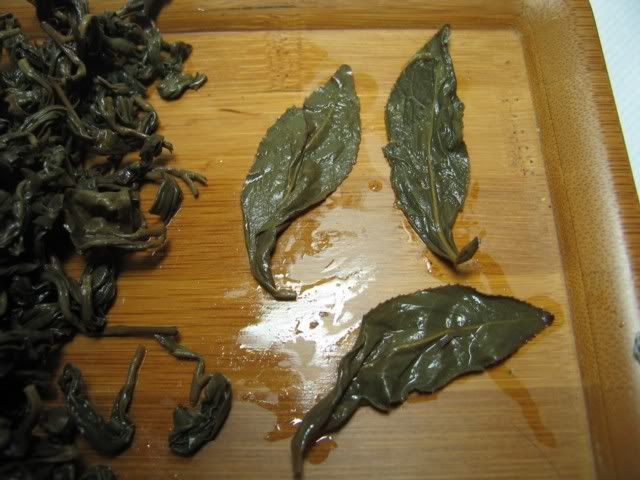
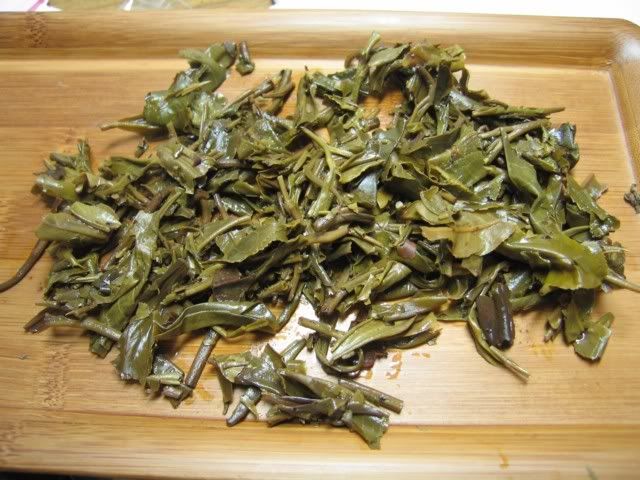
The wet leaves are a bit interesting

You can see there are some leaves that are almost green, while most are brownish. Most leaves feel a bit roasted — they’re not soft and pliable like unroasted oolongs, but are a bit stiffer, but not stiff enough so that you can’t open them up. The roasting done on these teas is probably fairly light — and I even wonder if it was reroasted at all. The taste is sufficiently aged to tell me that it’s probably not faked, and it probably took some time to develop, especially considering the relatively light roasting done.

You can see the slight variations in the colour of the leaves

It did occur to me whether or not this tea was blended with some new baozhongs. I would think though that the dry (and new) baozhong would stick out like a sore thumb with its dark green rather than dark brown colour. I didn’t see any of that when I put the leaves in. I’ll probably look more carefully next time to make sure.

Regardless though, I really like this tea, and it’s also nice that it’s not expensive at all.

→ 2 CommentsCategories: Old Xanga posts
Tagged: