A Tea Addict's Journal

Saturday June 10, 2006

June 10, 2006 · 1 Comment

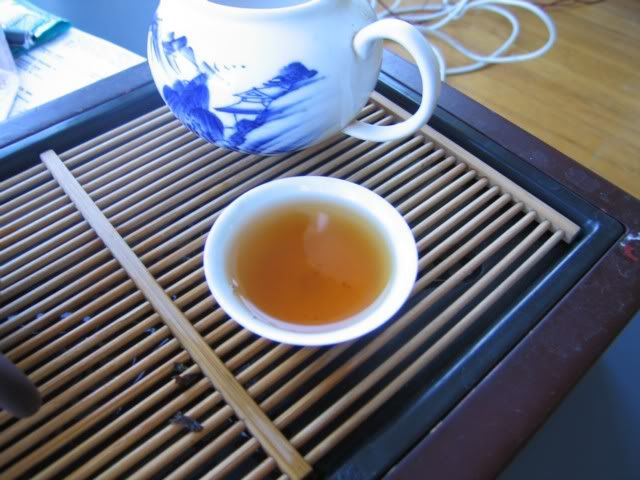
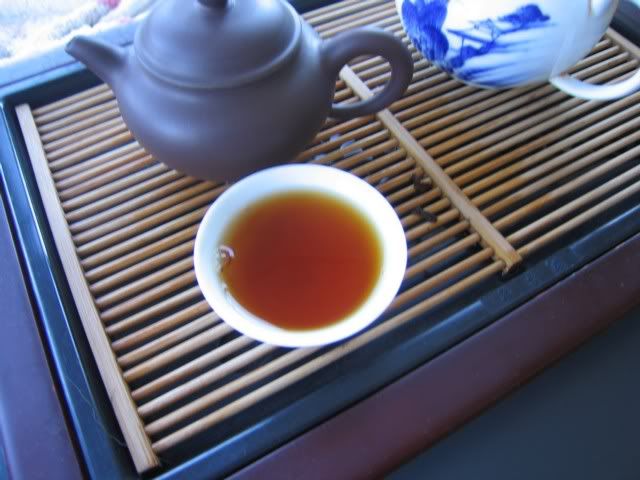
I had some of my nongxiang tieguanyin from Beijing today. I’ve been trying to balance these warmer teas against those stomach eating young puerhs I’ve been drinking (ok, so they weren’t all THAT young). The higher fire teas definitely are mellower on the body and easier to drink. However, at least in the case of high fire oolong, they are not necessarily easy to brew.

With things like qingxiang tieguanyin I find that as long as you are careful, nothing can go horribly wrong when you brew it unless the tea itself sucks. You can get a fairly consist cup of tieguanyin or Taiwan oolong without too much work and sweat. It’s easy, it’s nice.

With higher fire stuff, however, like the nongxiang tieguanyin, or some roasted oolong and the like, it gets trickier. There are various levels of firing. This particular one I had today is only of a medium fire, I would say, and ends up being fairly tolerant when it comes to brewing. I filled my pot with about half of it full with dry leaves, and brewed a nice cup that lasted quite a few infusions without getting sour or bitter. That’s not always how it is, however. The Taiwanese nongxiang tieguanyin I got, for example, ends up being very easily sour. I can’t stuff half of my pot full of leaves and expect it to come out fine, even with very low infusion times. Instead, I have to only use about 1/3 of the pot full of leaves, and still watch out for overbrewing. Sometimes there’s a hint of sourness, which is ok, but if it gets too strong, it’s just bad.

I remember when I brought the Taiwanese nongxiang tieguanyin to the Best Tea House after my visit to Taiwan (bought a box for the salesperson I know there as a gift). There happened to be one of the regulars, who also has some sort of working relationship with the teahouse, sitting there that day in the “master” seat (i.e. the person doing the brewing). Well, he took the box, and filled a gaiwan with about 80% of it full of the leaves. It came out a bit too strong and sour. He then declared that this is no good, and then took out a box of his own shuixian and brewed it the same way, and said “this is how old oolong should taste like!”. I personally find the tea to be quite enjoyable if you play with it and find the right balance to make it — not every tea will work with the set parameters for whatever method you have, and that’s part of the fun.

It’s hard to tell too on the first try what a tea is actually going to be like. You can never know for sure with a higher fire oolong how it will turn out once it hits water. Things can go very awry, very quickly. The first time or two can easily end poorly with some infusions not working out so well, but after a few times, you’ll get the hang of it. That is, of course, until you run out of that particular tea and get a different batch….

→ 1 CommentCategories: Uncategorized

Thursday June 8, 2006

June 8, 2006 · Leave a Comment

I drank another sample today from Davelcorp — the 99 Yellow Label from Hou De. It is surprisingly good. I thought I was going to get some young, greenish tasting thing and expected an above average young cake, but instead I was greeted with an aged tasting tea. I suppose 7 years is the end of the first fermentation period, and thus makes it drinkable. But the liquor and the aroma are closer to those of an aged puerh than that of a young puerh. It’s not clear why that is the case though. I wonder if it’s been through wet storage? I’m really bad at telling wet storage treatment. Sometimes I get a faint hint of it, but I really don’t know for sure.

→ Leave a CommentCategories: Uncategorized

Wednesday June 7, 2006

June 7, 2006 · 4 Comments

After a torrent of younger puerh, I deserve a break from that stomach-killing stuff. So on this very rainy day, I drank more of the Dahongpao from Tea Gallery. Very mellow, and nice. A mellow tea for a mellow mood. I need to buy a pot for my dahongpao.

And my other cat, Sunny, liked some too

→ 4 CommentsCategories: Uncategorized

Tuesday June 6, 2006

June 6, 2006 · 1 Comment

I drank the early 90s CNNP sample from Imperial Tea Court today. It was rather interesting, and seems to hold some promise for further aging. The leaves are mostly buds on the cover of the cake, and larger leaves in the middle. Seems like your typical receipe cake, although I have no idea which one. The tea was strong, and flavourful. I didn’t take detailed notes today, so there’s not a lot of detail I can tell you. The tea still tastes youngish — obviously aged but probably not what you’d expect from a 15+ year tea. Is this the San Francisco environment slowing the aging down? It’s hard for me to say.

One thing that didn’t come out so well is that the tea has a slight persistent sourness/astringency that I couldn’t get rid of. Towards the end, around infusion 6, it started going away, so perhaps it is just something that the tea hasn’t shaken off yet because it needs more time. I would think it would’ve gotten rid of it by now, but it hasn’t.

This is not to say I didn’t like it. It’s, I think, better than the 93 tuo, which is less complex in aroma and taste. I guess only time will tell how it will further develop.

→ 1 CommentCategories: Uncategorized

Saturday June 3, 2006

June 3, 2006 · 5 Comments

A friend from the LJ Puerh Community sent me some samples. According to what he wrote on the little bags, they are:

93 Tuocha from Hou De
99 Dual NeiFei Huanyin, from Hou De
2001 Baoyan mini-bing
99 Menghai Wild Yiwu from Hou De
90 Menghai Region mixed grade brick, maker unknown, from teamasters blog
Early 90s CNNP from Imperial Tea Court

So… lots of tasting to do! Thanks Dave 🙂

I tried the 93 Tuocha today using my gaiwan. Basically, it tastes similar to my brick that I blogged about a while ago. This tuo is supposed to be 13 years old, but doesn’t really taste like it. Instead, it’s a bit on the young side when you drink it. The rawness and greeness of the tuo is still very present, with a strong astringency and smoky (sometimes cigarette like) smell. The leaves are quite broken up as well, just like my brick.

I wonder how long it will be before this is a well aged tea?

→ 5 CommentsCategories: Uncategorized

Friday June 2, 2006

June 2, 2006 · Leave a Comment

I finished off the first bag of the qingxiang tieguanyin I got from Beijing today, two months after my visit. Since I had a bit more than the usual serving left in the bottle, I decided to throw it all into my pot instead of having a little leftover and then mix it with the unopened bag, of which I still have one.

The result was surprisingly good. Since I was consciously aware that there was more tea in the pot, I made sure I was brewing with shorter infusions, and the taste was better than normal. The fragrance was more intense, and the grassy flavour that sometimes was quite dominant in the early infusions was not so obvious, instead taken over by an enveloping flavour that is normal for a decent qingxiang tieguanyin. I think I am going to use a little more leaves when I brew this again!

Now I need to get rid of the rest of my teas…

→ Leave a CommentCategories: Uncategorized

Thursday June 1, 2006

June 1, 2006 · 7 Comments

1996 Zhongcha pai Orange-in-Orange sample from Hou De

More samples from Hou De. I had fun with the last two, so I decided to get more :p. Yes, addict I am.

Dry leaves – the pieces that got to my place are already well broken up, and are fairly loose as puerh goes. There’s a faint smell of raw puerh, but it’s not very pronounced and certainly not that musty. The leaves are a little darker than I expected from a 10 year tea.

First infusion: The leaves smell like a strong camphor smell. The taste is slightly bitter, mellow – not very pronounced sense that this is a young puerh, so the aging has gone farther than I thought. In fact, I think the aging is a little farther than the 8582 cake I had in terms of taste. Then again, the fact that it’s so broken up may be contributing to the way it’s tasting (and the reason why it’s more aged). A sweet lingering taste at the tail end, after everything’s said and done.

Second infusion: Similar, with a stronger taste and the similar mellowness…. Kinda strange, actually. It’s a taste I can’t really describe, but tastes a little different from most puerh I’ve had before. The liquor is very thick. I’m sweaty, but then, it’s also hot today.

Third infusion: hmmm, I perhaps overbrewed this one a little. Slightly bitter, entering the mouth there’s a slight acidity. The rawness of the cake is showing its head a little. I think the first two infusions, as is typical, brings out the more superficial elements first, and now as I dig a little deeper into the tea, some of the other flavours begin to emerge.

Crap – the bag from Hou De is leaking tea!!! (goes puts the bag in a Ziploc)

Fourth infusion: a metallic bitterness is showing up. Hmmm, why is that? Am I messing the brewing up? There’s definitely a “gan” at the back of the mouth, and that is well appreciated, but why is it a little bitter? The colour of the brew is still the same dark brown, very clear and good looking. The dry cup smell is that of camphor/wood. Very nice smell.

Fifth infusion: Waited a bit, since I drank too much too quickly. This brew came out more mellow, the bitterness fading a bit. Colour of the liquor is also lowering. When the tea hits the mouth, there’s a low sense of fragrance/flavour – but the aftertaste is strong, with camphor, medicine, wood… lingering gan is also gone a bit, but the sweetness at the end persists. This is better.

Sixth infusion: Weaker again, but still retaining a strong taste as it goes from your mouth down the throat. It’s odd…. It’s almost flat in the mouth, but as you swallow it shows its tastes. There’s some bitterness, but I think it’s better than the Shui Lan Yin this way. I need to try that again to compare. Their taste profiles are more similar to each other than to the 8582.

The rest: had dinner, then….. just brewed it continuously. Right now I’m on the 9th, still entirely drinkable, and not weak like the Shui Lan Yin. It’s not bad, but I still prefer the bolder 8582.

One of my cats, Smokey, decided to strike a pose in front of my stuff 🙂

→ 7 CommentsCategories: Uncategorized

Wednesday May 31, 2006

May 31, 2006 · Leave a Comment

A very uneventful tea for a very uneventful day. I had some of my Taiwan oolong today, the “Yuqian Jinxuan cha”. Typical jinxuan stuff — not great, not too bad, entirely drinkable, utterly boring. I can see why it’s yuqian — the leaves are still very small, bud like. It’s rolled very tight, Taiwan style, and unfurls nicely. Lasts something like 6 infusions before it dies off, but after the 3rd it’s really not that great anymore.

There’s a slight problem with my Taiwan oolong pot though — it’s got a bit of a different coloured clay around the base of the tip of the lid. I’m trying to figure out how I might be able to remove it. It looks like an extra bit of clay that’s stuck on the pot….

→ Leave a CommentCategories: Uncategorized

Monday May 29, 2006

May 29, 2006 · Leave a Comment

The story goes like this: The Qianlong emperor, ever the playboy, was on one of his money squandering trips down south where he could enjoy better food, better scenery, better weather, and better women than he could ever dream of in Beijing. He was stopping by the Wuyi mountains in Northern Fujian, I suppose, and was served some tea. You know the rest of the story — he thought the tea was mind blowing, and asked what it’s called, and where the tea trees are. The peasants (or more likely, the local county magistrate sucking up to him) told him where it’s from — three trees on the cliffs of the Wuyi mountain reputed to make good tea. He bestowed a red robe on these three trees, and thus Dahongpao was born.

I don’t know if it’s a true story, and I suppose I could check by looking into the Qing Shilu. Then again, I couldn’t care less, and it makes for a nice story to tell.

Dahongpao is the most famous of the Wuyi bushes. When drinking them, what you’re looking for is that “rock” taste, or more properly, aftertaste that it leaves on your tongue and, to a lesser extent, your throat. It looks somewhat like a dancong. Just looking at pictures, it’s not always possible to tell one from the other, but when you brew it and taste it, the tastes are a world apart. Dahongpao is very robust in flavour, but at the same time there’s a softness and mellowness in it. Dancong, on the other hand (and it really depends on what kind you’re having — same with Wuyi rock tea) is more fruity, floral, and maybe you can call it fickle.

Nobody drinks from the original dahongpao trees, unless you wish to fork over tens of thousands of dollars to win that auction every two or three years when they sell a jin of that stuff. I have a box of the “first generation transplanted dahongpao” from Best Tea House, which I think means that they are branches that were taken off from the original plant and tacked onto other tea trees. I’m keeping that though.

What I had today was the dahongpao from Tea Gallery in NYC. Their Dahongpao is on the lighter side — fragrant, mellow, but not necessarily giving you that big bang type of taste that you might get with a stronger version of it. For dahongpao, and most rock teas, one should fill about 3/4 of the vessel with leaves (as pictured). Yes, a lot of leaves, but as long as you keep infusion reasonably fast, the result is very, very good 🙂

→ Leave a CommentCategories: Uncategorized

Sunday May 28, 2006

May 28, 2006 · Leave a Comment

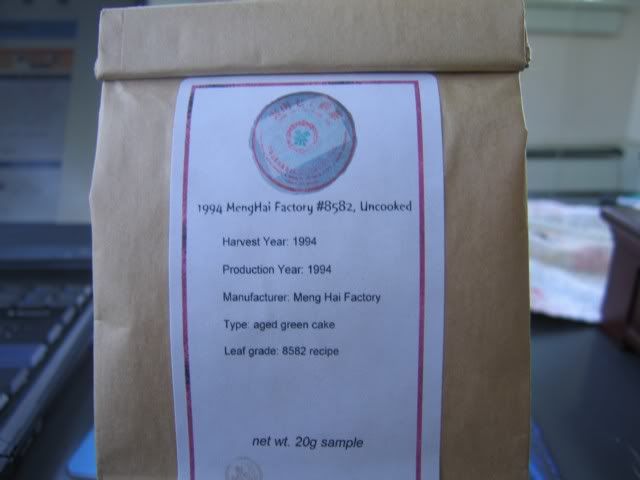
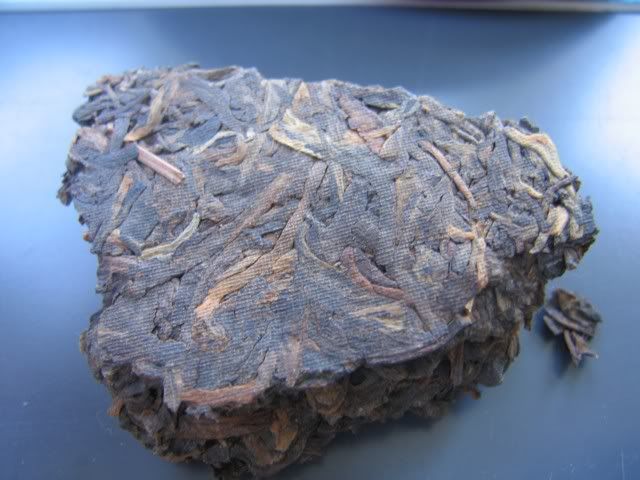
Puerh #2 from Hou De – this is the 1995 8582 cake they sell. They actually charge more for this than the 7542. Let’s see how this goes.


Looks like Rosetta Stone

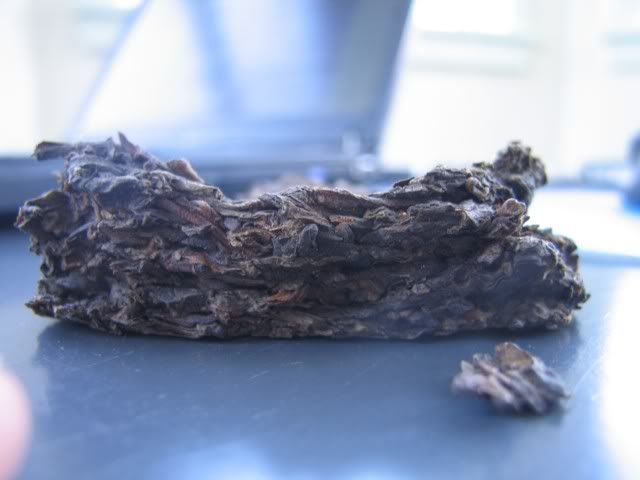
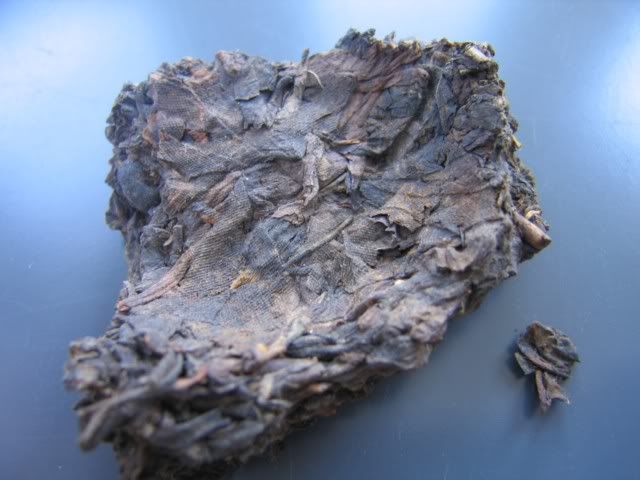
Dry leaves: very solid, hard pressed. You can tell by the way it looks that it’s quite compressed, which would mean, among other things, that it ages slowly. Compared with the 7542 yesterday, which was very loose, this one’s hard. I had to break this piece apart using a good bit of force in order to get the right amount for my pot. Yesterday’s tea just peeled off.

Because of the hardness of the piece, and the way it has been broken for me, I couldn’t peel off layers before it put it in the pot because I couldn’t get a good handle on it. So I dumped it in, gave it a rinse, then peeled off layers. Not surprisingly, even after the rinse, the inside of the piece was completely dry. If I didn’t do this, I’ll be drinking successive, weak brews instead of using all the leaves for one brew. I really need to buy a good puerh knife.

Ah, after the second rinse I can clearly smell the ubiquitous camphor when I opened the pot.

First infusion: The tea’s still warming up, so it’s a bit weak. I can already tell this is obviously less aged than the 7542 yesterday, not surprisingly. Comparatively, it is more sweet than bitter. A bit of the raw flavour in the back.

Second infusion: Hmmm, much stronger. After drinking a few sips… The first noticeable sign of cha qi is showing up, with me sweating down my back. The smell is of sweetness. I think I might’ve put in a tad too much tea and left it in too long, because it came out slightly astringent. Less time next steep.

Third infusion: The sweetness is more pronounced, and has an earlier onset than the 7542 one which only shows when you’re done drinking. It’s very strong, and it’s sweeter without the bitterness. The flavours taste… like… Hmmm, I don’t know how to describe this. Paper? Paper tastes a little like this, I think. There’s that smell of camphor, but not a lot of the taste of camphor. I’m done with the 3rd infusion, and I am still tasting the sweet aftertaste in the back of my mouth. It’s quite strong.

Fourth infusion: It’s gotten a little more medicinal, and in my first cup, a slight hint of acidity. There’s a camphor-like aftertaste. The sweetness is more subdued, taken over by a more woody aroma.

Fifth infusion: Colour wise is similar to the fourth. The camphor taste is showing up stronger, and I think the sweetness has definitely faded now. Still a slight sourness if I swirl it around.

Sixth infusion: Tastes similar to the fifth. There seems to be something else that showed up, but I’m not sure what it is.

Seventh infusion: I think I added a little more leaves than I thought I was – the compression (I guess especially since it’s in the center?) made it harder to gauge how much I was using.

Eighth and beyond: similar to before, but I’m letting it steep longer. It has lasting power, and lingers on. Actually, I’m still drinking it right now, infusion #11. Steeping time is now into the 10 minute zone, but it’s still coming out nicely.

I like this much better than the one I had yesterday. Is it solely due to the fact that I added a bit more leaves? I don’t think it is. The aroma and tastes are more complex. While I don’t exactly find the fruity flavours that their website claims (perhaps the slight acidity is what some call “guosuan” or fruit acidity), it is more complex and more changing than what I had yesterday. Will I pay $39 more for a cake of this over the 7542 from yesterday? Yes, no doubt about it. Will I pay $160 for a cake of this? Hard to say. I think I am too poor as a student, arg.

→ Leave a CommentCategories: Uncategorized