A Tea Addict's Journal

Entries categorized as ‘Objects’

Expensive playthings

July 1, 2008 · 3 Comments

When teaware gets expensive, the temptation is to be more careful with it, but sometimes, the more careful you are with things, the more likely you’re going to break them, because you are naturally nervous handling it.

No, I didn’t melt down the silver kettle or anything, fun though that may be. It does, however, remind me that when using expensive teaware, sometimes one’s enjoyment is slightly less than if it were replaced with something cheap, something that is cheap enough so that whether it breaks or not, it doesn’t matter much. In many ways, it does not detract from the joys of tea making — perhaps even enhances it. Generally speaking, my teaware are not very expensive, and I have learned through a few painful lessons that it is often not a good idea to be too invested in any particular piece of teaware — those are the ones you tend to break.

Using the silver kettle does get me a little nervous. Of course, it is partly because the item’s not mine — I wouldn’t want anything bad to happen to it, whether it be a ding or dent or whatever. Silver not being particularly hard, I didn’t want to risk anything, so I was extra careful.

And I think it showed in the tea making I was doing — I was too concerned with not getting the kettle into anything bad that I wasn’t concentrating as much on the tea itself or the tea making process. I’m sure once I get used to the kettle, I will be more comfortable wth it, but until then, it’s like driving a new car — you have to be more careful because you don’t know how it reacts to the things you do.

But anyway, the kettle is going to go on its merry way to its rightful owner. It was fun playing with the thing, and to try my hand at using one for making tea. I can say it certainly does something to the water, and the resulting tea tastes different. Whether or not it’s worth the amount of money, or whether or not it is a desirable change in taste, that, I think, will always depend on the individual.

Categories: Objects · Old Xanga posts
Tagged: , ,

Adding silver to the tea

June 27, 2008 · 3 Comments

No, I didn’t run away. I’ve just been rather busy settling in, and playing with the silver kettle.

I’ve tried four things with it so far. Two aged oolongs, one puerh, and one lighter oolong that’s slightly aged. I think what I have found so far is that overall, water that has gone through the silver kettle seems to impart more “depth” to the teas in question.

Now, what do I mean by that? I think first and foremost, the teas seem to be a little more aromatic. The “high” notes are more emphasized, whereas I think when using a tetsubin, the “low” notes are more pronounced. Also, for the two aged oolongs and also the puerh (a border tea) I got a very long lasting throatiness that was quite pleasant, and is certainly something that I personally like to taste in my teas. Basically, the longer a tea stays in my mouth after I swallowed, the better.

Still, I am probably going to hold onto this for a few more days before I should send it off, and it might be time to break out my competition tea tasting set to do a comparison…..

Categories: Objects · Old Xanga posts
Tagged: ,

On silver kettles

June 25, 2008 · 10 Comments

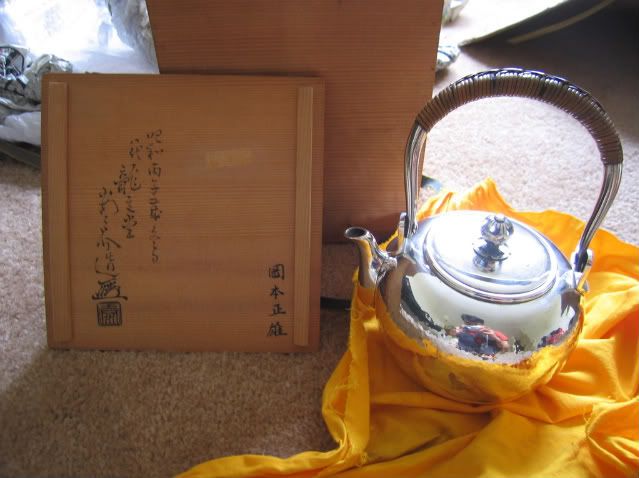
This thing just came in the mail. No, it’s not mine (I wish!). But I do get the privilege of playing with it and using it for a little bit before handing it off to the friend whom I helped source this item. You can see my reflection in the kettle :).

Since there’s very little literature out there on these things, I figured I should tell you all what I have learned so far. Silver kettles come in different shapes and sizes. The small ones are very thin and were more like teapots than kettles — they often have an internal filter, and have an engraved surface with a flower or some other motif. Those are the cheapest and really not meant for water boiling. Then you have the medium sized ones like this one, which are good enough sized for brewing purposes. Compare:
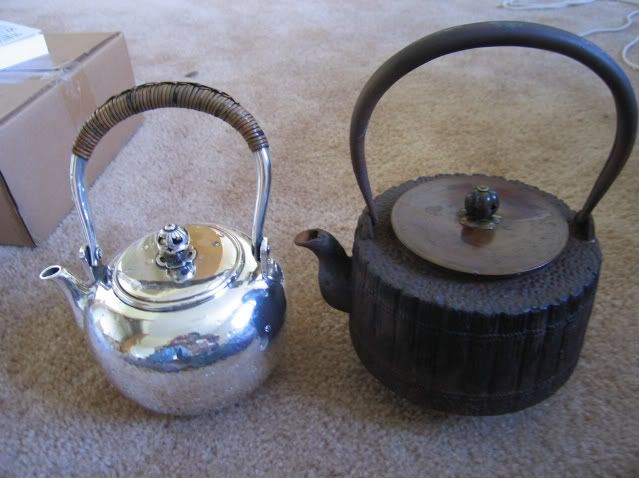
And my tetsubin is fairly large. To give you a better idea, from the tip of the spout to the other end, it’s about 6 inches or about 15.5cm. The seller said this weighs 570g including everything. Then you have the large ones — the largest ones I’ve seen are around 1100g in weight and correspondingly larger in size. It’s pretty heavy, and a lot of silver. Obviously, you have to pay more for those, but even those ones should be obtainable for under $1600 or so unless it’s extremely intricately decorated or special in some other way (famous person, etc..).

A really important thing with all Japanese wares that are of some age though is the box — as you can see in the first picture, the box has stuff written on it. Here, it had a date — winter 1936 (written as Showa “bingzi” using the old Chinese 60 years cycle system). That’s more than 70 years ago. The thing also says “8th generation Ryubundo”, and then a name, “made by”, and then a Japanese style signature and a seal. The name is probably that of the person who is the person holding the firm “Ryubundo”, a fairly famous metalworks maker (best known among aficiandos for their tetsubins probably). So, this is probably made by that guy — not a bad pedigree. The name on the bottom right was probably the owner of the kettle. Sometimes boxes also come with some insert — a printed name card or piece of paper that basically advertise the shop’s wares, but the important info is always what’s on the box itself, usually the lid and sometimes the bottom of the box. But wait — look at the exterior of the lid, and it says “Precious Pearl shaped Tetsubin”. Hmmm, tetsubin?

The box (and the yellow cloth) are both part of the packaging, and having the original (rather than just any random box for something else) can significantly change the value of the item — usually for the higher. Unfortunately, this kettle didn’t come with the original box, but for less than 3x the price of the silver it took to make the kettle at today’s crazy prices, one can hardly complain. This actually happens a lot, as I’ve bought a bowl or some other stuff that obviously didn’t have the original box but instead came in what fit. Still, having A box is handy — not least because it offers quite a bit of protection.

Then there are the details — like whether or not something is “pure silver”. From what I understand, the “jungin” stamp on silver items worked sort of like “sterling silver” stamps on western silver items — it’s not quite “pure”, but pure enough. And…. if something doesn’t have it, chances are it’s not actually “pure silver” — if you made the item with high purity silver, you’d want the people buying it to know. To do otherwise would be, well, stupid. Silver alloys are not bad, but with lower purity — it should command a lower price. The Japanese “jungin” seal is a tiny little thing, usually in the center of the kettle’s bottom — 4mm by 2mm, very small.

I think those are all the things to really look out for in a silver kettle. The rest are intuitive — is it well made? How was it made? This one you can see little hammer marks on it — a deliberate design decision. Some have hobnails. Others are more unique — swirls, etc. Once I saw one that was absolutely gorgeous, with a jade ball as a handle for the lid, and a very unique design. I still wonder why I didn’t jump on that thing.

How does it work for tea though?

I gave it a try today, although I don’t want to be too conclusive without more tries with it. Drinking the same tea as I did the last two days, I think I can say the tea came out a little more contemplative — there’s definitely an extra dimention in the tea that I haven’t tasted before, and that it gave the tea a very deep throatiness that lasted quite a long time. That itself was rather impressive. I am going to play with it tomorrow with another tea — a lighter fare, perhaps, to see how it goes.

Categories: Objects · Old Xanga posts
Tagged: , ,

Family portriat

June 22, 2008 · 6 Comments

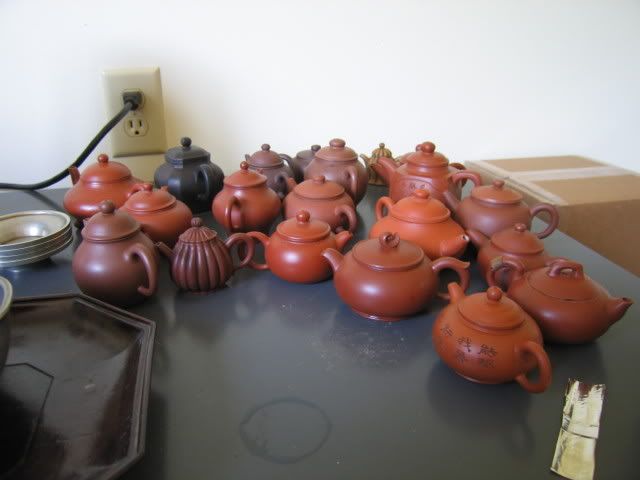
While I’m still unpacking and organizing things….

It’s missing the big one — one being used to brew Darjeelings, among other blacks. And come to think of it…. also one that I used to use for puerh but has been sitting in a box for quite some time now. Perhaps I should whip it out again…..

I do have too many teapots.

Categories: Objects · Old Xanga posts
Tagged: ,

Retry

June 5, 2008 · 2 Comments

Well, so I tried the tea today, with my stainless steel kettle, gaiwan (which I almost forgot how to use), small drinking cup…

Result? Inconclusive, as usual, but I ended much earlier than yesterday. The tea, somehow, wasn’t that interesting today. I do feel there was a little less complexity, or perhaps, it was a little less rounded. Seems consistent with the use of a porous pot — they are supposed to smooth out the rough edges. As should the water treatment.

The best, I suppose, would be if I could do this to somebody else, blind, but it is too involved and I am too lazy 🙂

This blog will be on a short break for a few days — traveling for a wedding in LA on Saturday, and then, meeting with those crazy people who drink tea on Sunday. Stay tuned 🙂

Categories: Objects · Old Xanga posts
Tagged: ,

Retrying Chen Guanghe Tang Yiwu Yecha, Fall 2006

June 4, 2008 · 2 Comments

I retried the Chen Guanghe Tang 2006 Fall Yiwu Yecha. I remember when I tried it last, which was quite a while ago, I thought it was no good. And I remember I was not the only one who thought so — some other bloggers and friends who are non-bloggers also thought it not very good (especially in comparison with the Chawang). This is my original post on the Yiwu Yecha. The impression stuck with me in Taiwan, where I found a place that sells those things for about $20 a piece. I thought it wasn’t that good anyway, so why bother (there were other, better things to be had for $20 a piece). So, the tea left my memory.

Until today, that is, when I tried to look for a young puerh to drink to counter the fried pork chop I had for lunch. Young puerh is great for cutting that feeling of pure grease in your mouth. I found this tea among my many bags of samples, and figured, why not.

(Sorry for a lack of pictures in recent entries — lighting in this apartment is atrocious in the summer when there’s a lot of foilage outside, and lacking a tripod, I’ve basically given up trying to take pictures).

The first thing I should say about this repeat, aside from the obvious fact that it has sat in the bag for a year and half, is that I am not using a single piece of equipment that I did last time. Last time it was filtered tap water, boiled in my Braun kettle, brewed in a gaiwan, through the fairness cup, and into my drinking cup. Everything, from water (still filtered tap water, but this one from Ohio) to cup has changed. So has my tastebuds. So has the tea itself, after more than a year in the bag.

The tea is decidedly better this time — more depth, more interesting notes, more body, less of the blandness I experienced last time. I think a good bit of it can be chalked up to the teaware — I have noticed, very obviously, that the tetsubin adds to the depth of a tea, especially puerh. It makes the throatiness much more obvious. The pot I use, the one that is rather odd looking and fairly porous, will filter out some of the nasty notes in a young puerh for me. That, and the extra year, might have made all the difference that needs to be made. Assessment: not too bad.

Now… it’s only fair if we give this tea a spin in conditions closer to what I used last time around — so, tomorrow, gaiwan and my trusty Braun kettle will do the work. Let’s see how it goes.

Categories: Objects · Old Xanga posts
Tagged: ,

Seasoning a tetsubin

June 2, 2008 · 3 Comments

The other thing that I discovered yesterday was by accident. We were making a red bean paste dessert for the guests, and when it boiled, it boiled over a little bit and spilled some onto the range. I didn’t think much of it, and when I went to heat up some more water as our first pot ran out, I put my tetsubin on the same range and started heating it.

It caught on fire, since there was some red bean paste on the bottom.

That, however, turned out to be a sort of blessing, for I finally found out how some of the other tetsubins I’ve seen get that old, black sheen — I think it’s from smoke and deposits on it, or some such. Maybe it’s also just the seasoning from putting some oil on it and then firing it, but it seems like good old smoke will do the trick on its own (or am I wrong?). My tetsubin, in some of the places where there was that fire, now has a bit of a black sheen to it whereas the other parts are still brown as before.

Now I am thinking…. a brazier might be in order….

Oh boy, the list of stuff to get is, indeed, endless

Categories: Objects · Old Xanga posts
Tagged: ,

Teaware porn

May 31, 2008 · 5 Comments

At the end of the day

I really shouldn’t line my pots up like that with cats around.

Categories: Objects · Old Xanga posts
Tagged: ,

How it happened

May 22, 2008 · 1 Comment

So, how did I break the thing anyway?

No, it did not involve catastrophic drops or bangs or anything, in fact, it was quite routine — which made it all the more surprising.

See…. this pot (and many others I own) have a single hole design. Single holed pots are more prone to leaves getting stuck in them. Personally, I don’t mind it very much. I actually prefer it to multi-holed pots. Don’t ask me why.

Normally, when a pot gets stuck, I use the little tool that we all have — that long, thin thing that was designed for this purpose. Ok, good, except that this time, when I was pulling it out, it seems that the slightly oval cross section means that one side was wider than the other, and when the pulling out was coupled with a slight (unwitting) turning motion….. it pushed on the walls of the spout, and it snapped.

Older yixings tend to be a little less sturdy. This is a well known fact — people I know in HK who are more experienced than I in older pots all tell me to be careful with them, especially the handles, which break off all the time. Alas, it applies to spouts too.

So, now I am going to be very careful using that spout clearing tool. I know I’m not the only one who had this happen — Danica of the LA Tea Group also had (from what she described) an identical accident with an older pot. Be careful when you use that thing!

Categories: Objects · Old Xanga posts
Tagged: ,

A minor disaster

May 20, 2008 · 10 Comments

I’m fully guilty of causing this.

I have the original piece…. and it sort of still fits. I’m thinking of just using super glue.

Despite all the talk about glue maybe changing the way the tea taste… I can’t really bear the sight. The pot is still usable right now, but I don’t think I can use it in this condition.

How much formaldehyde can be released by a small amount of super glue to stick this piece back on anyway? Not much, right? Don’t our bodies produce that stuff anyway? I’m sure with enough tea… the carcinogenic effects of this wonderful compound will be neutralized….

Sigh, excuse me if I seem to be moody today.

Categories: Objects · Old Xanga posts
Tagged: ,