A Tea Addict's Journal

Entries categorized as ‘Information’

Traditional, not wet

January 25, 2011 · 30 Comments

In the puerh storage world there has been a fierce debate in the past decade or so between those who believe in “dry storage” and those who don’t.  Until the appearance of “dry stored” puerh, there has only been one way to handle this tea.  The vendor (and it’s always the vendor — individual consumers didn’t buy raw puerh cakes, period) would take in his big order (we’re talking hundreds of cakes or more).  Having evaluated the tea, which usually comes through a middleman who handles the actual transaction, he would decide what to do with it and how to handle it.  Then, the tea goes into the “ground storage” 地倉unit, which is usually some basement in a building on a hill or something similar, so that it’s quite damp and dark.  Usually, the storage unit already has lots of tea in there, aging, and the vendor would make room for the tea.

Now, this environment is usually high humidity and high heat — it gets hot in there for natural reasons (Hong Kong can get to 30C+ in the summer).  Now, the tea isn’t just stored in there forever, and isn’t just going to stay in there for the duration of its life until it’s sold.  The teas were put on little wooden platforms so they don’t touch the ground, and likewise they do not hug the walls — all to avoid excessive moisture accumulating.  Also, the teas would get “rotated” every few months, which is actually a fairly big operation.  What it does is to even out the aging process.  So, a jian of tea that was sitting in the darkest, wettest corner of the storage unit won’t stay there forever, but instead moved out to the front where it’s drier and airier.  The stuff that has been in the open before now gets the dark corner, etc.  The same is true for how high the tea is placed (stuff on top gets moved down, vice versa). It is, I think, important to emphasize that they want to avoid excessive moisture.

This storage process differs by the tea and the vendor, but generally speaking, from the different vendors I’ve talked to, a tea normally would not stay in a ground storage facility for more than two years.  Then the tea gets moved to a regular, dry storage facility, where the “removing the storage” 退倉 process begins.  This would take much longer — six, eight, ten years, or whatever the vendor deems sufficient.  It is only then when the tea is ready.

When I first started talking about wet storage on rec.food.drink.tea, I remember there were people who were quite skeptical of what good could possibly come of wet stored teas.  In their experience, wet stored stuff was bad — unmitigated disaster, basically.  Moldy, smelly, ruined, and dangerous — it was something to be avoided at all costs.  For those who’ve never seen this stuff before, it can indeed look pretty frightening, especially the stuff that has a lot of white frost on them, like this:

Photobucket

Photobucket

It’s not that obvious here, but you can see white here and there on the leaves.  If you don’t know what you’re looking at, you can easily take this to be bad, spoiled tea, only fit for the garbage.  It looks bad, and it even looks bad when it’s in a cup — dark, almost pitch black sometimes, and generally looking somewhat murky, with that musty smell.  If the “removing the storage” part hasn’t really been completed, or done poorly, it can still smell strongly of the ground storage unit, which can sometimes be a bit offensive to the untrained palette.

However, I am pretty sure this stuff is safe.  After all, millions of people in Hong Kong drink this sort of thing every single day in restaurants everywhere.  If it’s dangerous, its dangers are not apparent.  Also, this method of storage means that each teahouse has its own flavour — after a while, if you keep going back to the same stores for different kinds of puerh, you’ll start to notice that each have their distinct “house” flavours, no doubt related to how they store and handle their teas.  In this way, buying a puerh is as much buying a product of the original producer, as you are buying a “finished” (as opposed to raw) product from the tea vendor.

Now, dry storage — this is a term that really started showing up in, I believe, the 90s, and took on a whole new life after 2000.  It is often attributed first to Vesper Chan of Best Tea House, although that distinction is questionable, but he’s probably the guy who’s the earliest and biggest beneficiary of this.  What dry storage proponents believe is that traditionally stored puerh has a crucial flaw — that the process of putting the tea in ground storage fundamentally alters the way the tea tastes and smells, and some would also claim that it weakens the tea’s qi, and all the other stuff.  On the other hand, something stored purely in a dry environment, meaning without ever going into that ground storage unit, would not have this problem.  It retains the strength and the aroma of the original tea better.  The downside is that it takes a lot longer to age.  The tea also keeps its astringency a lot longer, as well as the bitterness.

It is also important to keep in mind here that dry storage doesn’t mean bone dry, “store it in a desert” storage.  It means keeping it in an environment where there’s still a healthy amount of moisture (it’s Hong Kong, after all) and let it age naturally.  Also, dry storage proponents, the ones who practice it on a large scale anyway, don’t generally store their teas in open air places — they are still storage units that are mostly closed off, shut off from sunlight, and stored carefully.  Leaving it in a really airy corridor in the middle of an open air terrace in Arizona is not their idea of dry.

I think when it comes down to it, whether you like dry or traditional is really a matter of personal preference — there’s no easy answer to this.  Those who use the “health” argument against traditionally stored teas are, I think, wrong, and increasingly, my friends in Northern China who used to hate that stuff are coming around to it.  Dry stored teas have their place as well, I think, as it is really the theory that underpins home stored tea — before this, as I mentioned, nobody bought raw cakes.  When YP, a really knowledgeable tea friend in Hong Kong, went with her friends in search of green, raw cakes in the 90s, the vendors basically stared at them like they’re from Mars, asking “you want WHAT? Why would you ever want that stuff?”  It just wasn’t done until pretty recently.  The fact that we all have tongs of teas in our own houses now is because we think we can do it ourselves.

One problem with traditionally stored tea is that it is often confused by consumers with fake tea — those teas that have been sprayed with water and (as one report had it a few years ago) literally left in the pig sty to age, or stuff made with discarded tea leaves not fit for human consumption, but made to look old.  Traditionally stored puerh is most definitely not fake.  It may not be your cup of tea, but it is very, very real, and it has been around longer than dry stored teas.

With that in mind, I would like to propose a shift in nomenclature — the use of the term “traditional storage” to substitute for the term “wet storage”.  We can relegate “wet storage” back to where it used to be — where the fake teas belong.  Traditional storage, on the other hand, is a venerable method of preparing tea for consumption in a very specific and technically skilled method.  I think it deserves its place in the sun.
Categories: Information
Tagged: , , , ,

Absolute and relative quality

January 17, 2011 · 11 Comments

A question that I have discussed on a few separate occassions with friends over the last month or so has been the question of how to determine quality in a given agricultural product — in this case, tea, but more generally the usual suspects, such as wine, whisky, etc, came up as well over the course of discussion.

The problem is: how do we determine whether tea A is better than tea B?  What are the standards, and who determines these standards?  Is there such thing as a tea A that is unequivocally better than tea B?

Let’s start with the basic question.  How do we determine what’s better and what’s worse?  There are obviously different ways of approaching the question.  The “scientific” one is one that bases itself on various metrics that are somehow measurable and readily testable.  For example, something about dissolved materials in the water, amounts of various kinds of chemicals (name your favourite antioxidants, for example) and also the absence of unpleasant things.  It’s a very scientific way of measuring tea, and coupled with more physical traits, such as the size of the leaves, the amount of variation in such traits, etc, you can arrive at a way to grade certain kinds of teas in a rough “best to worse” sort of way.  Any buyer of Longjing would’ve encountered such a grading system — they are meticulously graded from high to low, with corresponding prices.  The highest grade is the best, the lowest grade the worst.  Simple, right?

Well, maybe, maybe not.  I have met many people over the years who do not like the highest grade of Longjing — mingqian longjing can often be too soft and light, and for many, it is on the wrong side of being bland.  For them, it is much better to drink something slightly lower grade — a yuqian, for example, or some other teji type Longjing.  They find the flavour more robust, and the tea more interesting.  The same can be said for people who prefer second flush Darjeelings over the first, etc.

That leads me to the question at hand — is that “objective” quality scale really a measure of quality, and is it absolute?  In other words, can you really just say that a mingqian Longjing is better than 4th grade Longjing, period, no qualifications?  Or can we only say that “for me, this mingqian Longjing is better than the 4th grade one”?  Is there such thing as an absolute measure of quality?

When talking this over with a wine sommelier over the Christmas break, her argument is strongly in favour of the existence of some sort of absolute quality.  One can indeed say that this Grand Cru Burgundy is better than that Beaujoulais, period (I know, not a fair fight, but I’m trying to make a point).  Likewise, applying the same logic, one could say that this dahongpao is indeed better than that Taiwanese jinxuan oolong.  The key to this measure, especially when one compares things that are not directly related to one another (as opposed to our Longjing example earlier where everything is supposed to be the same type) is the tongue of the expert, or perhaps a group of experts, who have tried a multitude of things and are very knowledgeable in their field of expertise.  They can use their knowledge to evaluate the goods in question, and then arrive at some sort of measure of quality that puts different wines or teas or whatever into a ranking of one over another.  In other words, there is such thing as absolute quality.  I had a similar conversation with a friend’s friend, who, among other things, sells whisky.  The logic was similar – the expert knows best, basically.

I must say I am not entirely convinced.  What, exactly, does it mean when we say something is “better”?  That it is of a higher quality, that it is more worthy of our money, or that it should be more pleasurable to partake in?  Or, perhaps, none of the above, or some combination of all of the above?

That’s where I really have a problem with the idea that there is some absolute scale of quality.  I know, from my own vantage point, that I have a personal scale of things that I think are higher quality than others.  I know which teas I deem to be great, which ones good, which ones bad.  I also know, however, that my ideas change, that what I think half a year ago as great may, upon further inspection, feel less great.  There is, of course, also the question of interference — I am predisposed to think that a certain tea is better if I were told that it was some ultra rare tea that came from Zhou Yu, than some no-name stuff that one picked up from the Kunming tea market, and this is before I even take a sip of anything.  In this case, one can make the case that the expert and his blind tasting, a la Robert Parker, is really the best way to judge a tea, but then, there is also the argument against blind tasting.  The problem here really is a relativistic one — just because some expert out there, who presumably knows far more about tea/wine/whatever than the average joe, thinks A is better than B, does that make it really better?  Does that actually MEAN anything?

I spent the past weekend with a tea friend who knows far more about black tea than I do.  He drinks all manner of them, and also a number of darker oolongs and some puerh, mostly of the cooked variety.  I’ve been trying to find this friend some quality raw puerh that he might like, but generally, I fail, because of a problem that never goes away — apparently, he is very sensitive to bitterness.  I knew this all along, but it has been confirmed again, probably definitively, this time around.  Because of this sensitivity, young, raw puerh in general tastes far too bitter for him to enjoy, and unless it is old or well stored in a traditional storage, the bitterness overpowers everything else a tea has to offer and is therefore unenjoyable.  It doesn’t matter what I or anyone else thinks of these great young puerhs — even if it’s top flight, super high end stuff, he probably will still feel it’s too bitter and impossible to drink in an enjoyable way.  Each of us, I think, have similar preferences and therefore will have our own personal scale.  What, then, does it really mean when someone else who “knows” rates one over the other?  So what?

We see this phenomenon with puerh all the time.  Some critic out there, presumably someone who sits on a large stash of tea A, for example, goes on some magazine or internet forum and says that said tea A is excellent.  Meanwhile, he is slowly feeding the tea to the market through various channels.  Before you know it, the tea makes it big, gets famous, prices shoot up, all the while the tea itself is really…. not that great.  But surely, these critics must know what they’re talking about, because they are, well, knowledgeable, right?  They have twenty years of drinking experience, no?  If you drink, say, tea A, and think it’s just ok, it must be because you don’t know how to appreciate it yet (and sometimes some of these critics will actually come and tell you that, in no uncertain terms — this happens more on Chinese forums than anywhere else) and that you just, well, need another ten years under your belt to really appreciate it.

Now, someone like Robert Parker doesn’t do that, I know, but even then, these wine critics do have their skin in the game, sort of.  Even if a critic has no agenda, he or she is still biased by his or her own tongue in ways that we cannot know.  Wine drinkers lament the direction in which the market is headed, just like how tea drinkers in Hong Kong lament the demise of traditionally processed tieguanyin, but nonetheless, the market moves that way, often guided by a number of influential individuals who prefer their drinks a certain way.  In
the case of tea, the process is infinitely more complicated because the drinker is also, indirectly, the maker — you brew your own tea.  The critic/expert is not there to make it for you, so although the expert, in his expertly way, might make the tea a certain way and come to a certain conclusion, for the drinker reading said criticisms, that might not be relevant at all.  If the drinker is, say, an expert in making tea grandpa style, but the critic is drinking his with 10g of tea in an 80ml zhuni pot…. do the critic’s comments still apply?  Really?

This is partly why I basically no longer post tea reviews of any sort, save for ones I find particularly interesting or when I really feel like having something to say.  With tea I just find that the room for variation is very large — it basically all depends on how you make the tea, and to a very large extent, the water you use.  What I find to be excellent is not always going to go down well with other people, and while I am convinced that I have some basis in what I say, it does not mean that what I say applies to anyone else, really.  One person’s “butchering” of a tea in terms of brewing methods can be another one’s “perfect”.  What’s more important than figuring out the supposed absolute quality of a tea is to figure out how to get the most out of the tea.  That, I think, is the key to tea drinking.

Categories: Information · Old Xanga posts
Tagged:

An upgrade in taste

January 8, 2011 · 4 Comments

As I returned to the US and brewed up my first pot of tea here… I find myself deeply dissatisfied with what I’m drinking.  When I left, I would be quite happy drinking this.  No more.  Now this tea, some aged, broken cake, seems thin and weak.  It’s got decent flavours, but the body is not there, nor does it have the depth that I need.  The $100 cake I bought a few days ago that is traditionally stored since 2001 seems leaps and bounds better.

Uh oh, I think my tongue just got upgraded.

Categories: Information · Old Xanga posts
Tagged: ,

How much tea do you really need?

January 7, 2011 · 3 Comments

Once in a while, I get into a discussion with tea friends about how much tea you really need.  Assuming I drink 10g a day, every day, for 50 years (let’s say I get to live 50 years from now).  That’s about 182,500g of tea, or in puerh terms, about 73 tongs of tea.  That is if I don’t drink anything else — no oolongs, no greens, blacks, whatever.  That’s also assuming I don’t drink with friends, drink more than 10g a day, or give tea away.  So let’s say those two things balance out (oolongs/greens/blacks vs gifting) which means that I need a total of about 6 jian of tea, if we go by 12 tong jians.

6 jians is not a lot.  In fact, I know a lot of people who own more than that right now.  That leaves a question — what can they do about all that tea?  I don’t see an outlet for such things, other than the tea market — and the production volume of puerh in the past 10 years far exceeded anything we’ve seen in the 80s and 90s, which means that in years to come, there’s going to be a steady stream of aged puerh, of varying quality (storage and otherwise) that will show up.  If I have reconfirmed anything this trip to HK, it is that storage is of utmost importance, and that not every place is going to be good for storing tea — dry places like Kunming just aren’t going to cut it.  I had a number of “pure dry storage” teas recently, and most are, unfortunately, insipid and uninteresting.  The best teas I’ve had are the slightly traditionally stored ones.  You just need that moisture, and if your storage doesn’t have it, fix the problem now before it gets serious.

Or, you can just buy from the secondary market five years from now.  I can’t see a puerh shortage coming any time soon, as long as you’re not in the market for pre-1995 teas.

Categories: Information · Old Xanga posts
Tagged: ,

What’s a bad tea?

January 3, 2011 · 1 Comment

We talk about looking for good tea often enough, but what about bad tea?  After all, there’s arguably far more bad tea out there than good tea, so it’s useful to be able to spot bad tea, no?

I think we can divide bad tea into various categories.  What I can think of off the top of my head are the following.

1) Extremely low quality stuff
2) Adulterated tea – including fake tea trying to be something it isn’t, anything flavoured from Teavana, anything with a lot of added stuff, etc
3) Tea that is odd in some way – not necessarily bad, but has problems, usually one that is so significant that it makes it impossible to drink in an enjoyable way
4) Tea that is overpriced significantly

I think (1) is easy enough — everyone’s tried something like that before.  If you don’t know what I’m talking about, visit your local McDonald’s and ask for a tea, and then take out the leaves from the bag and make it the way you normally make tea — yeah, that’s bad tea.  No, I suggest you not actually try it.  Insipid teas go here.

Category (2) is more difficult — I think what I am aiming for here is tea that has been tampered with in some fashion, to the point where the tea is no longer recognizable as tea.  Anything overly fruity/sweet/artificial will fall into this category, as will, say, a cooked puerh trying to pretend to be a 1950s tea with added colour/chemicals/whatever.  There are some genres of tea, such as Earl Grey or Lapsang, that is supposed to have this added element, but then, you sometimes have Earl Grey that is nothing but Bergamot oil or a smoke-only Lapsang — that however would fall into category (1) for me, rather than (2).

Category (3) is I think what puerh drinkers, and to a lesser extent oolong drinkers, encounter the most.  The tea itself may be ok, but something is wrong, and you know it when you drink it.  These flaws are often not obvious when you just look at the dry leaves — the tea can look perfectly fine, normal, even good.  Once you pour hot water over it, the smell usually signals trouble, but it’s usually when you actually try it when the problems become apparent — odd flavours, weird texture, strange reactions (from you) are common.  I bought some cheap, cheap loose puerh recently that falls straight into this category — odd smell, odd taste, don’t know what it is.  I think it’s some Vietnamese border tea type thing, and with enough traditional storage and aging, it’ll gain that border tea spicy flavour.  As it is, when it’s still pretty green, it’s disgusting.

Then there are the more subtle ones — for example, a puerh that won’t age, or an oolong that’s been over-roasted.  Some people might like those things, so it’s not a universal “bad”, which is why I generally would put such teas into the “I don’t like” bin rather than simply “bad”.  There’s a small distinction, but I think it’s an important one.

Category (4) is, of course, everyone’s favourite — overpriced tea.  Overpriced tea, of course, is a relative term — a tea is only overpriced if you can get another similar or better one for less money, and everyone’s idea of a tea that is overpriced is different.  I would generally consider a tea overpriced if I can find something subtantially cheaper with the same quality, while factoring into things such as distance from source (a US vendor is going to cost more, no matter what) and type of establishment (online vendor should be cheaper than a real world one).  Aside from that though — it’s really dependent on your ability to find cheaper AND better teas.

What I think is most important though is for the drinker to be able to tell when something is wrong — when a tea is off, when a tea has oddities, or intractable problems.  Initial impressions are not always right.  I recently tasted a tea with a friend that was heavily traditional stored and has some pretty strange flavours in the first few infusions, only to see those odd tastes go away and turn to something fairly ok.  Problems, if they are real, will never go away even after many infusions.  Knowing what a good tea SHOULD taste like is half the battle in weeding out the bad ones.

Categories: Information · Old Xanga posts
Tagged:

Tea gifts

December 20, 2010 · 3 Comments

It’s the holiday season, and gifts are flying.  As the known “tea” person in your social group (if you read this blog regularly, that’s you) you will probably receive some teas as gift.  You may also be expected (or at least they think) to give tea out sometimes, as what you buy will inevitably be “better” than whatever they have at home.  It’s, I think, a very interesting dynamic.

On the receiving end, I think we’ve all been there before — people buy you tea as a gift, knowing you love tea.  It’s a very kind gesture, and something that I always appreciate.  Depending on the person who gifts tea, you may end up with something quite nice (I got some decent lapsang recently) or some butterscotch vanilla peppermint lemon rooibos.  Thankfully, the latter never happened to me.

Gifting tea is harder though.  What to buy?  What to give?  Of the major tea groups, I think puerh is almost by definition out of the running, unless the giftee specifically asks for it, or you know the giftee is an avid drinker.  Puerh is just too much of an acquired taste for it to be a viable gift.  Blacks are obviously the most gift-ready, since most people are familiar with it and it’s difficult to mess up, brewing wise.  I tend not to gift Ceylon, just because they’re terrible, and will not gift anything from these newfangled tea producers (Kenya is getting more popular) unless I’ve personally tried them.  I find Assam to be quite safe — solid Indian black, and if I have access to good Keemun, I almost always choose that over other blacks.  Darjeeling I personally find them to be more fickle — they are more demanding on the brewer, and can end up horribly wrong if the person making it is not careful.  They’re great teas — but not always appreciated.

The same can be said for oolongs and greens.  If the person is already somewhat into tea, I may gift them some oolong — it’s often a good “gateway tea” for people to really get into drinking more and more varied kinds of tea.  I find Taiwanese teas to be, by far, the best in that regard — not so much because they’re necessarily better, but because I am more likely to be getting what I think I’m getting.  With teas from the mainland, the quality can vary quite wildly, and I wouldn’t give anything I haven’t tried before.  With Taiwanese stuff, I find them to be more likely to be of a known quantity.  I like to give Jinxuan and Oriental Beauty.  Gaoshan tea is more of a hit or miss — too easy to overbrew and end up in a bitter mess.

I only give greens if the person already likes tea and has a preference for greens, and I almost always give Japanese greens rather than Chinese ones — good Chinese greens cost far, far too much for any normal gift, and for anyone who’s not used to drinking these, it’s always a waste (I don’t even buy good Chinese green for myself).  Japanese greens, I find, can be nicer without the difficulty of Chinese greens and the prices are not exorbitant for some reasonable, drinkable tea.  I’m personally inclined to drink gyokuro (the two times a year I drink greens), but I know opinions differ wildly there.

I think of a gift of tea as a pretty practical gift — you can almost always find ways to use it, although in the case of people like us, we probably have already way too much tea, and so the gift needs to be tailored to the person’s collection and likes and dislikes.  For people who are not quite as enthusiastic, I think of a gift of tea as an introduction — I always try to push the boundaries of what they might accept as good tea, and perhaps convert another hapless one to the habit.  After all, if your friends all think of you as the “tea person”, you can’t just give them a tin of Twinings Earl Grey.

Categories: Information · Old Xanga posts
Tagged: ,

Young puerh

December 9, 2010 · 2 Comments

I have been drinking a lot of younger puerh recently, from both Yunnan Sourcing and various shops on Taobao.  I think production of younger puerh has generally changed — teas these days seem more delicate and flowery, in a way that I personally do not find appealing or good.  A lot of them seem to be green-tea ish, which to me means it won’t age well.  I could be wrong, but I’ve tried cakes that were like this when younger, and a few years down, they have aged terribly.

I think some of this goes back to what puerh is actually for.  Is it really meant for aging?  Is it meant for drinking now, and is only aged by accident?  How long is the optimal age?  I think opinions differ considerably on these points.  Even though most people seem to agree that puerh is meant for aging, there are, I think, producers who are making things that are really more suited for drinking now than anything else.  A lot of the cakes I’ve tried in the 5-7 years old category are not very good at all.  Only some are, and I think if anything, the common denominator is that it was decent leaves, and also, decent conditions — not too dry and not too airy

I’ve been rethinking the whole “buy it now and store it for later” idea.  I’m not sure if it’s really wise to do so, or if the end result is really going to be that desirable.  For certain people who live in certain places (Hong Kong, for example) that can definitely be true.  Nevada?  I’m not so sure.

Categories: Information · Old Xanga posts
Tagged: ,

What is a scam?

November 30, 2010 · 2 Comments

This story in the Economist has me thinking — what exactly constitutes a scam?  $130 is really not that much, in terms of tea, even in China, especially if the buyer is buying a number of gifts.  So, price itself is really not a determinant.

I think in general, a scam requires two things: price gouging, and false advertising.  Just overcharging people on tea without actual deception is, I think, not quite a scam — it just makes you really expensive.  Someone selling a pencil for $20 is price gouging, but until they promise you that the pencil can do your homework for you, it’s not quite wrong — you’re just paying too much for a pencil.

It is when lies enter the picture when a simple overpriced item becomes a scam.  I think this can be quite overt — this tea is a 1950s Red Label, when it is in fact a 1990s remake of inferior quality.  The consumer is led to think that he is purchasing something he isn’t — that is a scam.  When a cooked/raw mix is being sold as aged raw tea (which happens more than you think) it is a scam.  When an overly roasted oolong is being sold as an aged oolong, that is a scam.  Price, in some ways, does not matter.

Then there are more subtle forms of deception that are a little harder to delineate.  For example, what if someone says a certain tea is particularly high grade, when in fact it is only of medium quality?  What about price discrimination, when the price changes depending on the purchaser?

My general advice for people going to China is that unless they know exactly what they’re doing with tea, don’t buy any.  More often than not, people who don’t know what they’re buying will end up overpaying for stuff that aren’t worth half the price of purchase.  It’s even worse when person A asks their friend, person B, who’s going to China, to buy tea for them.  That’s just like asking for bad tea for a bad price.

Are they being scammed, or are they just sold inferior goods for too much money?  It’s a fine line.  I think of paying $15 for popcorn and a drink at the movie theatre as grossly overpriced, which is why I never do it, but I don’t think it’s a scam, so to speak.  They’re just exercising their monopolistic power within the theatre to stop you from bringing in outside food and thus forced to pay for theirs instead.  For tea, however, there’s no such restriction.  Unless the seller is lying, it’s not technically a scam, but it does make it a bad deal.  So, unless you know what you’re doing, or are willing to take the risks, don’t bother with the source and get it from your local, reputable vendor — let them take the risk of buying bad/fake tea.

Categories: Information · Old Xanga posts
Tagged: ,

Evaluating tea for purchase (4) — the leftover

November 9, 2010 · 4 Comments

Now…… there are loose ends to this too.  These are things that, I think, are useful, but your mileage may vary.

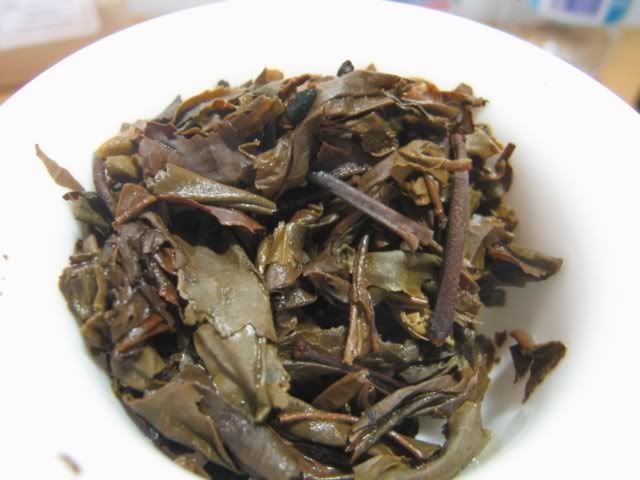
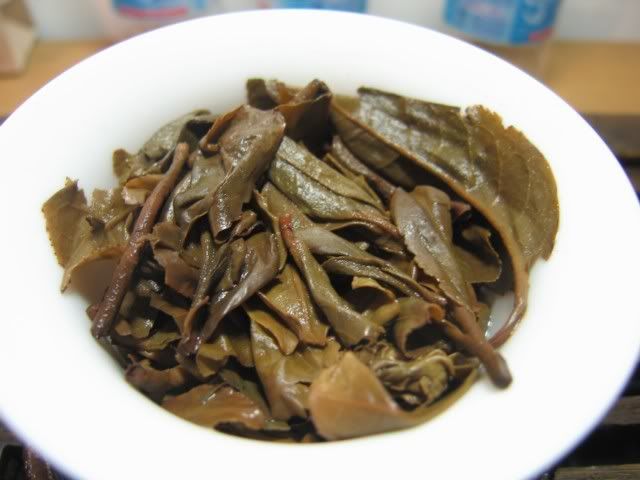
Spent leaves — this is really quite interesting, as I think spent leaves often tell you a lot more about the tea than one would initially realize.  I think spent leaves tell you a lot about the processing and (in the case of aged teas) storage conditions of the tea in question.  For example, look at this

versus this

Two different teas, clearly.  I don’t remember much about these, as they were taken quite a few years ago, but if I’m not mistaken, the top tea is probably younger than the bottom one, and is of the “smaller factory” variety.  There’s not a whole lot that one can reliably tell from spent leaves alone, especially without the accompanying smells and tastes, but there are things that one can do to, for example, verify what was in the cup during the tasting.  It can, in other words, help confirm or deny theories about the tea.

Lengxiang — literally “cold aroma”, this is what’s left in the cup long after the tea has been consumed.  It is not so useful, again, especially since lengxiang is rarely nasty (although it is possible).  Nevertheless, another piece of the puzzle.

Cold tasting — the later cups, for example, can also be drunk cold, or at least, cooled.  I think sometimes when tasting tea that is too hot it is actually difficult to get much out of it — the aromas or the tastes can be obscured by the temperature.  Cooling the tea down by waiting or other, more artificial means, can actually help enhance the sensory sensitivity.

Now……. the last problem is of course price, but that, really, is a separate topic that I have talked about many times before.  On that, no more.

Categories: Information · Old Xanga posts · Teas
Tagged:

Evaluating tea for purchase (3) — the less obvious things

November 2, 2010 · Leave a Comment

I only talked about tasting last time, and Walt rightly pointed out that you can’t divorce that from smell and other sensations.  The reason I didn’t mention those was because I wanted to talk about them separately.

Let’s start with smell.  Smell, I think, is one of the most elusive and difficult to discuss traits of a tea.  One problem with smell is that they are extremely fickle, and everyone has a different idea of what something smells like.  Generally speaking, I find smell to be very unreliable in evaluating teas, especially things that are non-puerh.  They are also harder to tell apart — so a cheap tieguanyin may not smell so different from an expensive one, so on, so forth.

There are a few things that you can use smell for though.  The first, I think, is storage condition for older teas, and not just puerh.  Obviously, if a puerh has been traditionally stored, there’s often a traditional storage smell (which will manifest itself clearly in taste as well and appearance).  Also, for newer, drier stored things, the smell can often give you some clue as to how the tea was made and what it’s like.  Smelling dry leaves can be deceiving, however, whereas smelling wet leaves or brewed tea can give you a lot more info.  I’ve been drinking some randomly purchased ~5 years old puerh recently, and some share a distinct “stale green tea” smell — teas that, I think, will not age well in the long run.  Good puerh will have a solid change by 5 or so years, accompanied with a thickness and depth that is lacking in some of these “stale green tea” types.  I can’t quite describe how they are like, but I know one when I see one.

Aged oolongs can also be evaluated using smell, in this case partly thanks to how the tea has been stored — has it been roasted?  Stored well?  Does it smell sour?  Aged?  New pretending to be old?  All those things, with experience, are at least somewhat discernable using smell.  I think the same principles can be applied to every tea, to a greater or lesser extent, and smell acts as a confirmation signal — it can help you figure out things, but on its own, can be somewhat misleading.

Now, the other aspects of tasting a tea is more ephemeral.  I’m talking about what I normally call “depth,” which really means how a tea feels when drunk.  There are two parts to this.  One is a physical reaction on a sensory front — how a tea feels in the mouth, and how it feels down the throat.  Good teas often will trigger a reaction in the throat area, as well as feeling very full and thick in the mouth itself.  It coats the mouth with sensory stimulation that weaker teas do not provide, and this is often the difference between an ok tea and a great tea.

The other is something even more difficult to describe, and which some will call “qi,” meaning energy/substance/stuff in Chinese cosmology.  It is difficult to explain what it is, but I think the best way I can describe it is that it is a physical reaction to a tea that goes beyond the mouth, throat, and stomach.  For me, it manifests as a sensation that creeps up my back.  For others, it’s a different reaction.  Great tea will usually be accompanied by this — an obvious sense of qi rushing up.  It is something special, and a lot of teas do not have such a thing.  This is not to be confused with a caffeine high, however.  They are most definitely not the same.

Categories: Information · Old Xanga posts · Teas
Tagged: