A Tea Addict's Journal

Entries tagged as ‘young puerh’

An afternoon of tea

April 13, 2007 · 2 Comments

As I stepped out of the west gate of the Forbidden City, I noticed that it was a nice, bright, warm day. The archives close early on Fridays at 3pm, and I had a choice of going home, or going somewhere else. I decided, the tea addict that I am, to go to Maliandao.

Part of the reason is that L’s business partner in Beijing is back from their trip from Yunnan, and I was eager to talk to her to get some news from the battlefront, so to speak. I got there, and we started chatting over some tea. We started drinking some longjings they brought from Hangzhou last month, fresh from the spring picking (they are all pretty decent, with obvious differences among the three). Meanwhile, I learned about the new prices. They go something like this (all in RMB/kilo and only to the best of my knowledge — subject to change anytime!!!)

Lao Banzhang – 1200 (and rising)
Jingmai – 600
Yiwu – 400 to 500
Other area ancient/old arbour tree teas, at least for places in Menghai and Xishuangbanna – 250 to 350 ish, depending a lot on where, what, and who

Which is insanely high, as this is about double last fall’s prices, and more than double last spring’s. These are per kil of maocha, so divide by three if you want a rough estimate of how much a tea cake from these regions should cost. If the base cost of the materials of a Banzhang cake is 400 RMB, anybody retailing the tea in China will probably have to sell it for 1000 to make a reasonable profit of any sort. That, I think, prices a lot of people out of the market. Of course, plantation teas are much cheaper…. maybe only 20% of the cost of the ancient tree teas or thereabouts.

I got some free samples from her — maocha they bought from Nannuo and Banzhang. I’m going to try them out in the next few days.

I then went to the Mengku puerh shop to see when their new stuff will arrive. Early May, they said. That’s a long time, but for bigger factories, the delay is usually quite long. I guess I’ll find out what they’ve got in the spring this year. Right now, their store is deserted — no stock at all of anything. It’s almost all sold out, and it looks eerie.

I ended up in a store where I bought a cake before, and started looking through the newer stuff they got. They press their own cakes, so they have some pretty interesting stuff. I ended up spending quite a few hours there, trying 3 different kinds of Yiwus and some cooked stuff. The guy even bought dinner, so I felt sort of obliged to buy something. I ended home with one Yiwu, a 2006 fall tea, and I think was decent and not too expensive. One can always try a new cake and compare it with the stuff you’ve already got.
Categories: Old Xanga posts · Teas
Tagged: ,

12 Gentlemen Jinggu-Yangta

April 12, 2007 · 5 Comments

Today I had a sample that has been sitting around for months without me touching it. I was rummaging through my cupboard looking for something interesting to drink, and this one popped out among the many little bags of samples that I have. Why not?

Yangta, from what I understand, is a part of Jinggu, which in turn is an autonomous county for the Yi people and under the jurisdiction of Simao, although it’s quite close to Lincang city. The tea that makes Jinggu famous is the Dabaicha, or “Big White Tea”. It’s a great looking tea — very big, broad leaves, thick looking, with lots of silvery hair covering it and thus makes any cake look good. There are some truly stunning looking cakes that are made by these teas, but from what I know, traditionally this hasn’t been used for puerh. It’s either made as a green tea, or as dianhong. Nowadays though, puerh commands top dollar and so they switch to puerh instead, but even then, Dabaicha isn’t an expensive kind of puerh. Good cakes clock in at under 150 RMB a cake. I have also heard of factories adding a bit of Dabaicha to their cakes to make their cakes look better. Visually it’s quite pleasing.

This is just a sample that I got along with the two other 12 gentlemen series. Somehow I never got around to drinking this particular one.

This is the piece I used today… breaking of parts of it

This piece is a few inches long, and really looks quite nice.

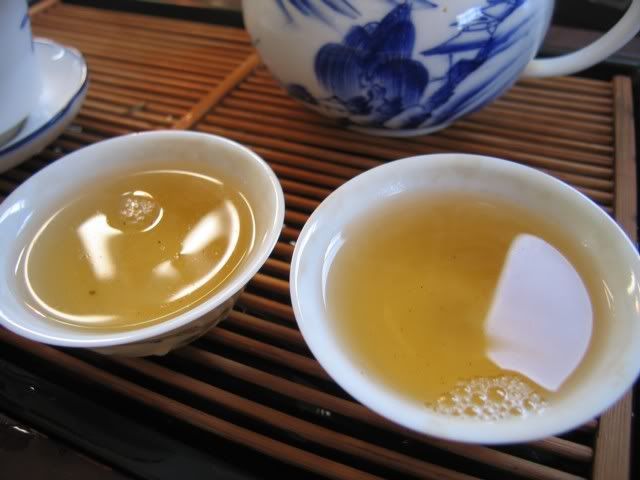
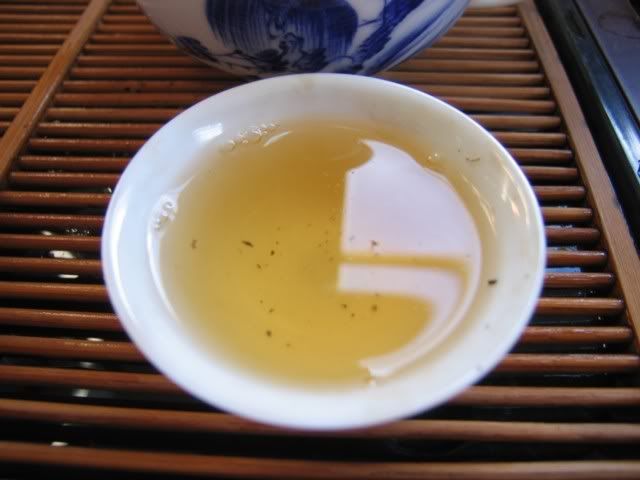
The tea brews a rather thick brew, very light colour in the first infusion

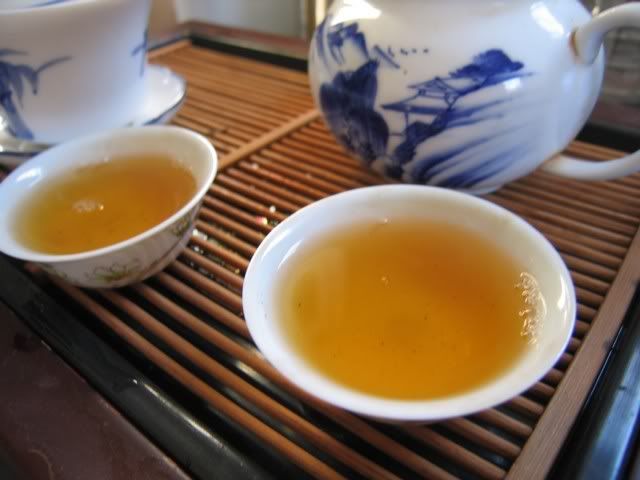
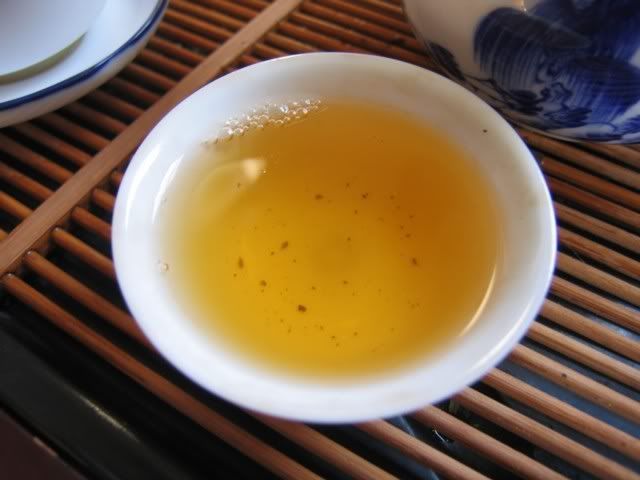
Darkening from the second on

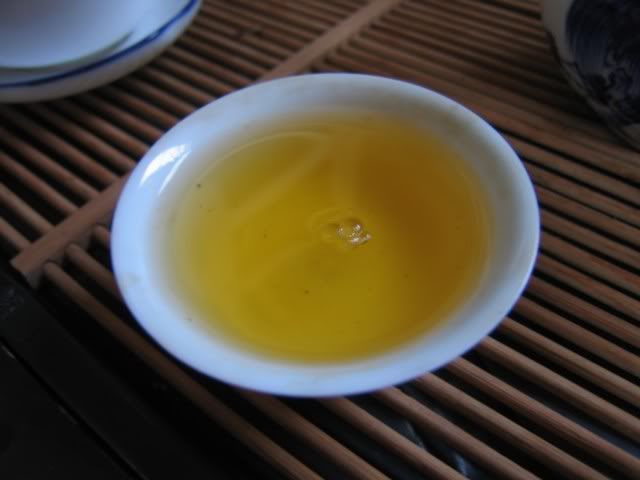
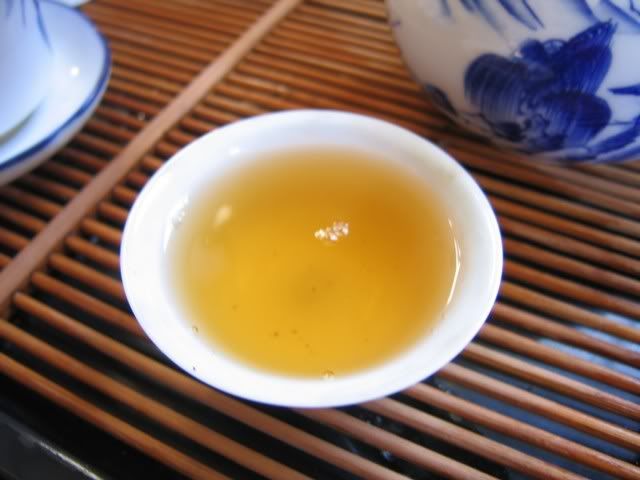
And the third

Colour stays pretty uniform after that for quite a few infusions, all from about 7g of leaves.

The tea is very sweet, with a light floral fragrance. It’s great to drink now, although it gets a little rough after infusion 5 or so. Before that though, the tea is very pleasant. I think of this as a green tea, at least the way I probably really should brew it, I should brew it as a green tea — low temp being the key. But then again, a proper puerh should exhibit signs of roughness when brewed with higher temperatures, because otherwise it’s probably too weak for aging. When you add a generous amount of tea, using hot water, brew it, and the tea doesn’t exhibit signs of bitterness or roughness…. and this is a puerh meant for aging…. then we’ve got problems.

There is a vague similarity between this tea and some weaker Yiwus I’ve tried. I think the overall profile are slightly similar, although all similarities are superficial once you take care to look.

The tea lasted quite a few infusions and I actually gave up before it did. It just got a little boring for me, and I don’t think I can drink this stuff very often. If I want something that tastes like this… I go drink a good green tea, which is better than this stuff.

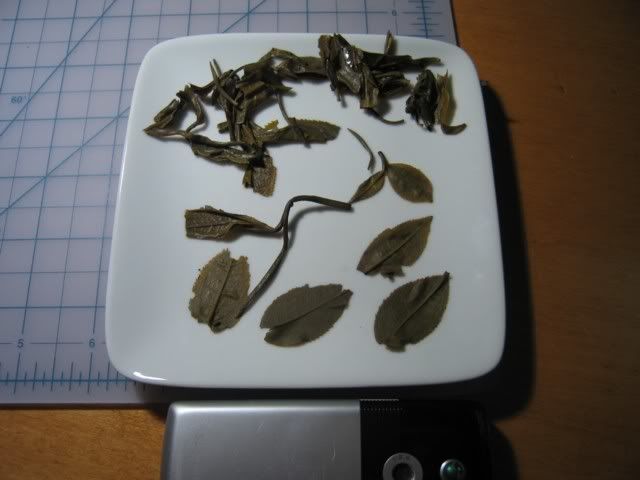
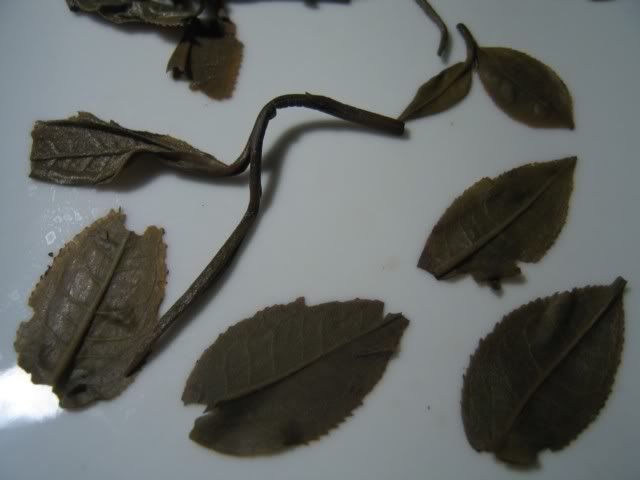
Leaves look pretty meaty, and feel pretty meaty. All in all, a good looking tea, but don’t let the looks deceive you.. I think there are better puerhs out there.

I need to pass the rest of the sample out… there is something like 40g of it left, and I don’t think I’m going to drink it.

Categories: Old Xanga posts · Teas
Tagged:

Back to Beijing

April 8, 2007 · 3 Comments

Today was a lovely day, with warm temperature and great weather, and the sky was actually blue and not some shade of yellow. I am rather jet-lagged… feeling sleepy around 12pm. What better way to try to keep myself awake than to walk around on this sunny day while pumping myself full of caffeine?

Yes, I went to Maliandao. Surprised? Didn’t think so.

When I got there, I had this strange feeling that everything felt foreign, somehow. I know the place pretty well now, but somehow today, when I went there, I felt odd. Maybe not having been here for more than a month did the trick and made me feel a little odd.

In order to get myself into the mood, I went into Jingmin Chacheng to see what’s there, and if there’s anything new. I went into a store that I have never really went to previously, looked at some cakes, sat down to taste some, and I think I gradually got myself back into the mode of drinking tea with strangers while there.

I originally didn’t want to try anything there, but ended up trying three different kinds of tea. The first is a quite delightful Bulang cake, and quite reasonable too after hacking off more than 50% off the list price. I didn’t end up buying one, as the guy offered me those discounts without me asking for it (oddly enough). I told him I’ll probably go back and pick up a few. I think he’s basing on the assumption that I’ll buy a tong (he’s quoting me those prices) but I don’t know if I actually want a tong of tea….. it’s a little too much at this moment. At most I want two or three cakes.

The second was a Banzhang, which, while being about 5 times the Bulang at something like $50 USD, is not as good. It doesn’t strike me as a good tea, and is expensive merely by being Banzhang (everything Banzhang is astronomical these days). That’s why I don’t generally buy anything Banzhang…. price/quality wise, it’s not usually a good deal.

The third tea is a mixed cake of some sort, and the guy couldn’t tell me where it’s from. From the taste it’s from the Six Mountains, probably something like Manzhuan. It’s not too bad, but too pricey and not good enough.

I didn’t buy anything. I might go back for the Bulang… and to try their spring teas, which are coming down in a week or so.

I then proceeded to L’s store, where I sat down to have some dianhong. The girl who’s usually there, L’s business partner Xiaomei (L’s usually in Shanghai) is down in Yunnan with L and others to check things out for the first time. So only the assistant was there today. The dianhong is of the larger leaf variety, quite nice, but a little weak. I think they didn’t steep the tea long enough and were brewing it like young puerh, which is not the way to go. After drinking it, I thought to myself that I should really go check out redteas everywhere.

I ended up in a Wuyi tea store that is opened by a relative of one that I often go to. I tried perhaps half a dozen teas there, and bought 100g of one. It’s a heavily roasted Shuixian, quite nice, and good chaqi. It’s not that cheap, but I think it’s worth it for the price. I have, of course, more than enough Wuyi to handle, but not quite so much that I’ll have to worry about not finishing them. Part of my calculation is that I need “drink it now” teas more than “storage” teas, and this falls into the “drink it now” category. Young puerhs…. gotta really think about them before buying a bit lot of them at this point.

Some of the other teas I tried there were older dahongpaos, which were of varying degrees of interest (some were quite good!). One tea stood out as interesting… a variation on Zhengshan Xiaozhong. I didn’t like it, but it was interesting to look at the leaves and taste the tea… which was like ZSXZ, but not really….

I got pretty pumped up by caffeine, but that didn’t stop me from feeling extremely sleepy once I got home…. I think I am heading to bed.

P.S. Seems like all blog websites are down in China!

Categories: Old Xanga posts · Teas
Tagged: , , ,

Tea gathering

April 4, 2007 · Leave a Comment

Today I had two tea guests over, and together we drank four different teas. As is generally the case at these meetings, everybody has way more tea than we can possibly drink in one session, and we really only got to drink a fraction of the stuff that we actually had.

The first was a very light dancong, unroasted. The tea is quite nice, subtle, and sweet, although I think I probably could’ve made it a little stronger and make it better. I usually am not a big fan of light dancongs, although this one I could handle. Sometimes they are just too fragrant… taste almost fake.

The second was an oddball of a tea… the Eiabora King Tea Biscuit from Dadugang. Now, the name of the tea itself is a little odd, but in this case, the smell was even odder. It has been sitting in a plastic bag, as far as I can tell, but that shouldn’t be a problem. Instead, it seems as though something is happening with the tea. When I sniffed the dry leaves, it smelled funny with an undescribable smell. Then, when brewed, it somehow came out even stronger.. a nasty smell that is rather unpleasant. One of my guests commented that this is rather like that of a rotten fruit smell… which is probably pretty close to what it is. We had two infusions of this before deciding to give it up. There’s a possibility that this is just spoiling instead of aging — it’s turning into something bad. The tea just didn’t taste right at all and had some very odd flavours to it… entirely unpleasant.

Then, to wash it out a bit, I offered to make my Yiwu maocha, which I now increasingly think is a mixed Yiwu and Menghai area teas. While it has a hint of that Yiwu taste, it also has that smell that I seem to find in a lot of Menghai area teas. The tea is still nice… it’s just not exactly what it claims to be.

We didn’t have a lot of time today to drink a lot of tea, so we ended up with my broken Guangyungong bits as a finish. While it took only about an hour to drink the three previous teas, we spent probably just as much, if not more, time on this puerh. Before my guests left, it was at least at infusion 12 or 13. The tea keeps giving, and I can just let it drag out longer and longer in infusion time and still get a cup that, while losing the woody and thick aromas, retain just enough to make it much more interesting than drinking water. It is sweet and smooth, and leaves very little doubt that this is an aged tea — the longevity is not matched by your usual cooked puerh.

It’s too bad that I’m leaving soon, because otherwise we could have another such session. Alas, I must go back to China soon to keep doing my work there.

Categories: Old Xanga posts · Teas
Tagged: , , ,

Yummmmm

April 3, 2007 · 2 Comments

When I was looking for a tea to drink today, I found this mystery bag of young puerh. I have no idea what it is, having written nothing about this particular sample that I got. All I could tell is that it is rather young…

I figured it wouldn’t hurt to try it. I opened the bag… smelled it. It smelled like smoke, which is all right. A lot of young puerhs smell like smoke.

I brewed it up as I normally would, taking pictures and all. The first infusion was rather bland…. the tea wasn’t opened up yet. You could tell it’s not very good tea already, but I figured I’d give it a few more infusions before making any judgments.

Well…. there have been reviews of other young puerhs where the reviewer likened the tea to bugspray. I have never tasted bugspray before, and I have no idea what that might actually be like. However, if bugspray means “something that smells and tastes really foul”….. well, I think I found it.

It was nasty. It was bitter. It tasted odd. It left a bad aftertaste in my mouth. It was terrible. I ate a few cookies to wash out the taste of the tea, and stopped after about 3 infusions. I’m not even going to bother with the one picture that I took. Whatever.

Thankfully this is only a sample. I feel sorry for whoever bought this tea.

Categories: Old Xanga posts · Teas
Tagged:

Kung Fung Yung young puerh

March 31, 2007 · Leave a Comment

This is my first young puerh cake… or is it puerh? I think it is, or will be, anyway.

Last time I tried this was a year ago. I haven’t touched it since. When I bought it from Kung Fung Yung I knew nothing about puerh, and I was attracted by the way this tasted and thought this will be good. I wasn’t thinking about aging so much as just buying it for the novelty value. I certainly overpaid for it…

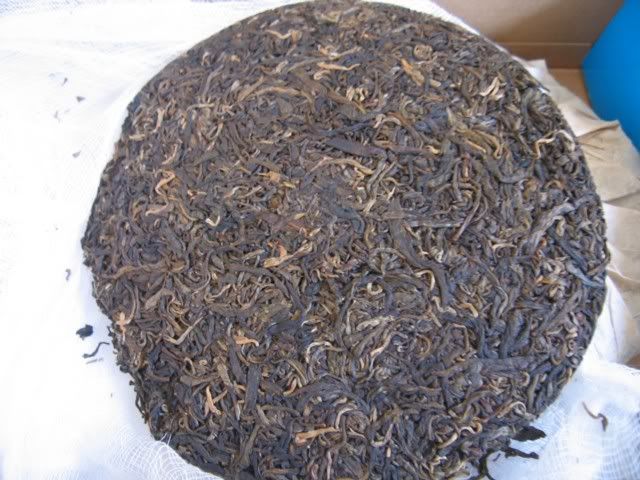
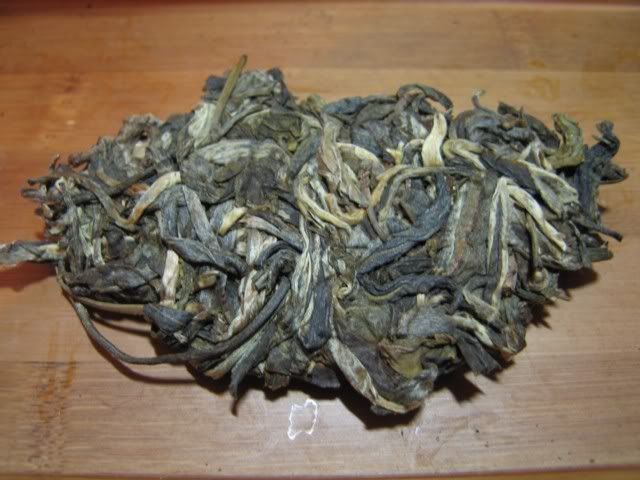
Anyway, here’s the cake

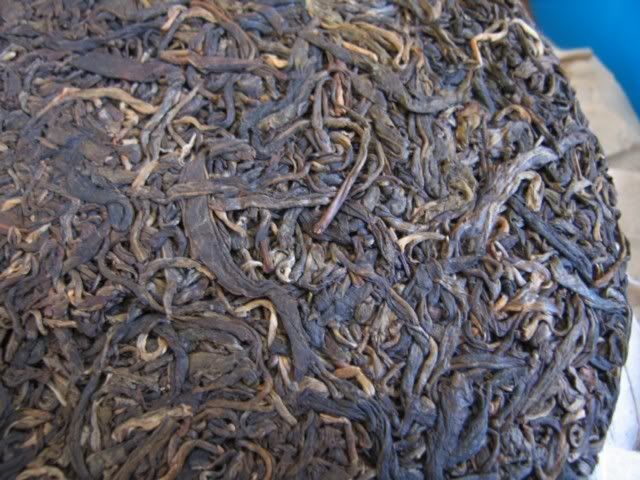
You can see this cake consists of mostly small buds and leaves.

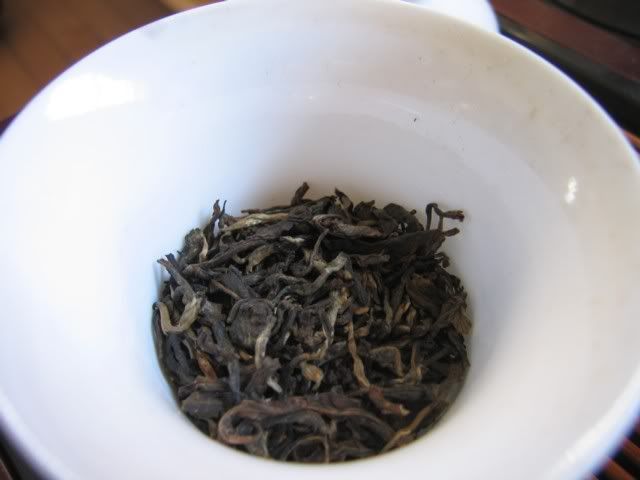
I peeled some teas off and put enough in a gaiwan to make a good cup

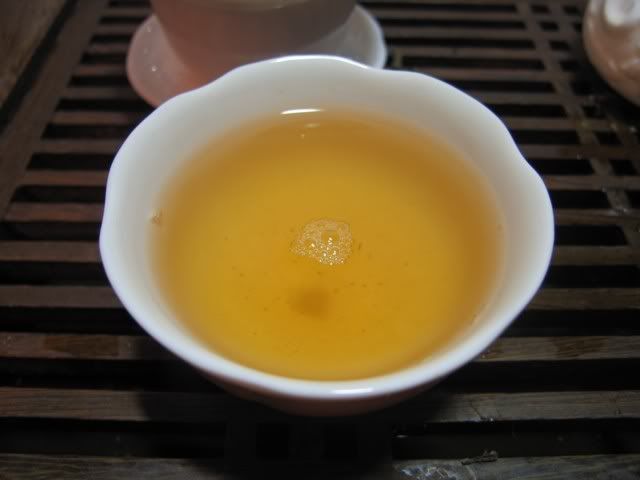
The resulting liquor in different infusions

1st

3rd

14th

The tea is rather interesting to taste again after having been away from it for a year. The colour of the cake has darkened a little, as has the colour of the liquor as I remember it. The taste has most definitely changed a bit though — it has developed a more fruity aroma, whereas I remember it last time as being a bit more on the green tea side of things. There is a plum/berry like taste, which is what reminds me of the XZH 97 Yiwu cake — only this tea is from 2003. The profile, however, seems to be moving that way. I certainly don’t know how this will age in another 5 years, but right now…. that’s what I think of when I am drinking it.

The tea is very smooth for a young puerh, with very little of the roughness but still being thick instead of thin. It develops a good aftertaste, although not obviously strong, with some reasonable cha qi. I would think the overall profile of the tea pins it somewhere in the six famous tea mountains, but the smaller leaves might put it in a place like Yibang, where leaves are generally smaller, than a place like Yiwu, where the leaves are big. Either way though, this has to be a spring tea, given the size of the leaves…

That’s my phone in the bottom for scale. I think given the sizes, in the 1-10 scale it is probably a grade 3 tea, mostly. A closeup…

When I go back to Taiwan later in the year, I’ll definitely go back to this store and try it there and see how theirs might taste different, given different aging environment. I don’t think I’ll buy another one, as it’s expensive for what it is, but it’s certainly instructive to try this tea.

Categories: Old Xanga posts · Teas
Tagged:

Retaste of Chenguanghe Tang Yiwu Chawang

March 30, 2007 · Leave a Comment

I tasted this tea a little while back, and wrote some notes on it. I figured I will revisit it today. The Yecha is almost not worth drinking again.

Let’s cut to the chase and show you the infusion notes I took… I usually don’t, but after 3 infusions today I thought I should.

1st — good qi, clear, light, smoke

2nd — BITTER, rougher, unpleasant, but feeling the qi quite strongly

3rd — similar, weaker
4th — sour, smoke still there, rough, bitterness dying a bit
5th — sourness persist, with a hint of smoke, bitterness remains
6th and on — more of the same…. in weaker permutations

I think as the notes say… the tea is bitter, strong, and I’d say powerful. There isn’t as clear a note of huigan as I noted last time, probably because I consciously used less leaves today to see if the tea tastes different that way. The bitterness in the second infusion was almost overwhelming… if I were a regular tea drinker, I would’ve given up. I have to say that from that point on… the tea was largely unpleasant until about the 8th or 9th infusion, when it got weaker again.

The taste of the tea also doesn’t really jive with what I understand as a Yiwu tea. Over the past year or so, I’ve tasted at least a few dozen cakes that are labelled Yiwu. Obviously, not all of them taste the same, as Yiwu is not a tiny area and there is definitely some variation in the taste of each production. However, there is an underlying taste profile that is largely similar and is very distinctive of what I now understand as the “Yiwu taste”, and I’d say most of the teas that are creditably Yiwu share that Yiwu taste, especially among the higher end stuff that I’ve found from various sources. I can smell a bit of this Yiwu taste in the dry leaves of this cake, but I can’t say I’m really tasting it in the tea that I am brewing with this. Now, Mr. Chen is obviously a big name in puerh circles, and I’d imagine he knows what he’s talking about when making a Yiwu tea, but at the same time, I cannot but help wonder if this is truly Yiwu at all, or if it might be one of those “greater Yiwu area” teas. This cake stands out among the higher end stuff to be called Yiwu but not tasting much like any of the other ones, so I really wonder if this is what it claims to be. I’ve tried one cake, for example, by Zhongcha this year, also Fall 2006, that is precisely one of these “greater Yiwu” teas, and one of the things is the much more pronounced bitterness from that cake.

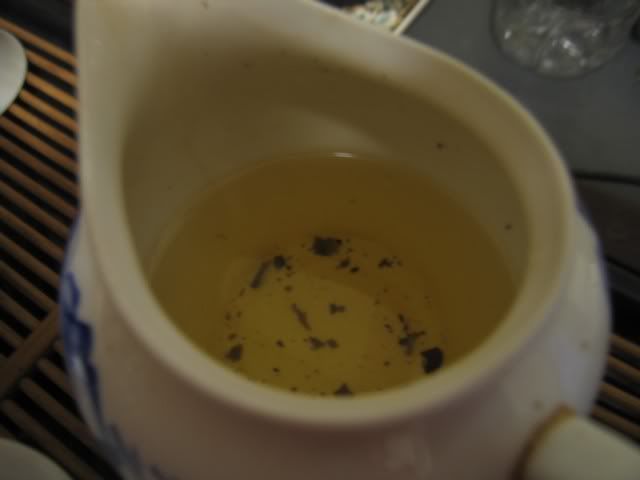
Another of the things I noticed more obviously this time is the sheer amount of broken bits of leaves in this tea. I threw one whole piece of the cake in without breaking it apart, but every infusion I got a lot of bits of leaves in the bottom of my fairness cup. This is from something like the 12th infusion:

Sorry it’s dark, but you can see there’s still a fair amount of stuff (I clear out all the broken bits every round, so what you’re seeing is all coming from one infusion).

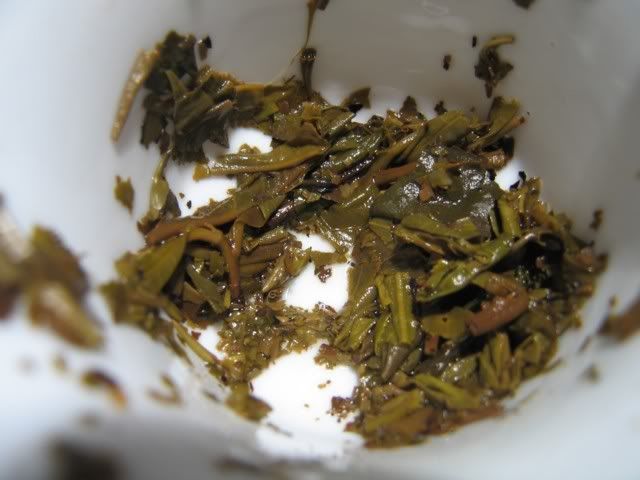
You can also see the amount of broken leaves from the wet leaves. For example… I poured out the wet leaves, but inevitably some leaves are left in the gaiwan… look at this:

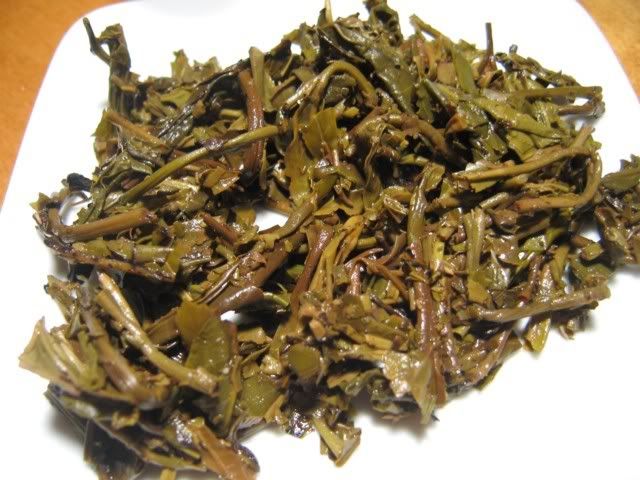
And the leaves that were poured out:

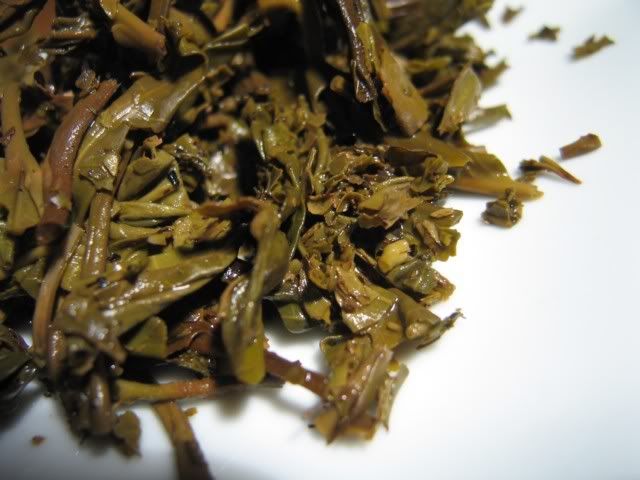
Closeup:

The amount of small, little pieces is very high. I couldn’t pick up any leaves without getting my fingers covered with little pieces, each no more than about 1mm-2mm long on each side.

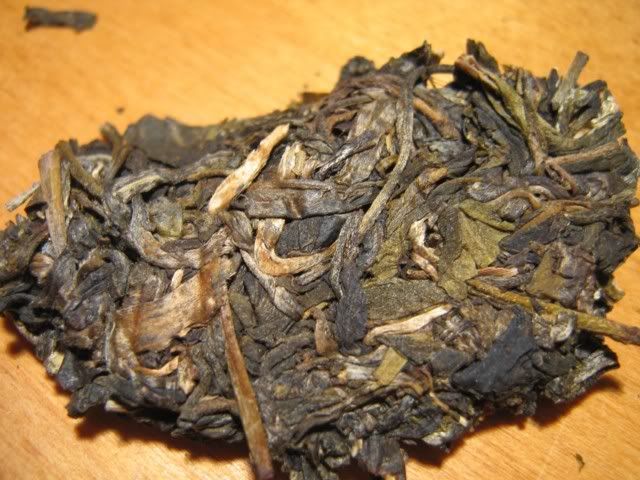
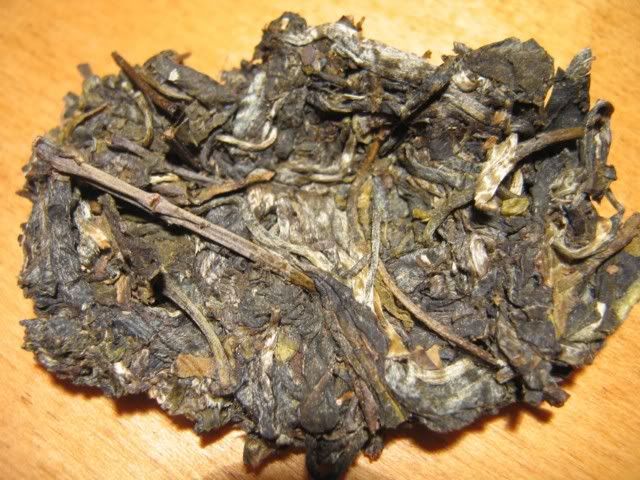
This prompted me to go back to the one piece of the tea left remaining in my bag. I took it out and took some pictures. What I did today to get the tea I brewed was to break the one big piece remaining into two halves, and I used one while keeping one. I split the piece down the middle horizontally, so that I basically peeled half the piece off. You can see the one intact side of the cake:

And the side that I peeled off

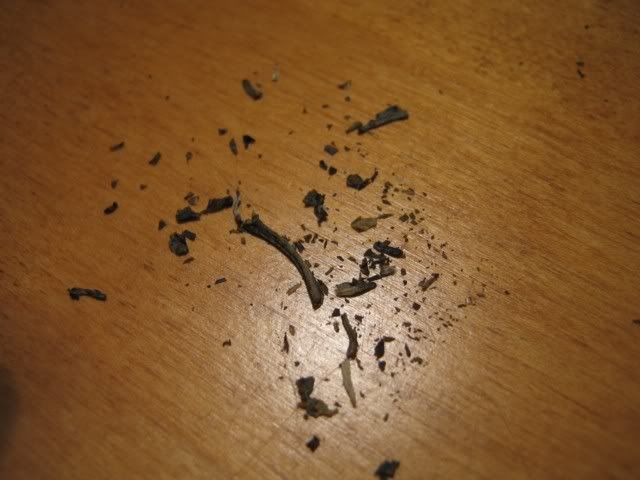
Not a lot of broken bits obvious in these cases. I tried tapping the piece thoroughly to see what comes off, and this is the result:

This still doesn’t come close to the amount of fluff that I got from the tea. I have a lingering suspicion that mixed in with the cake is a lot of leftover bits of leaves that is a result of processing/transportation. Instead of sifting them out before pressing…. they all got dumped into the cakes and pressed together inside. Otherwise, I simply could not explain the amount of broken tea that is in this, seeing as I didn’t break the piece into small bits before brewing it.

Is this deliberate? I haven’t seen a high quality cake that has such broken leaves. I’m sure the broken leaves contribute to the roughness and the bitterness of the tea. They infuse faster and stuff come out faster. Could this possibly be good for aging? I don’t remember older cakes being filled with such fannings (this is fannings). All I can think of is that somebody is being sloppy.

Categories: Old Xanga posts · Teas
Tagged:

Tea Gallery

March 29, 2007 · Leave a Comment

Today was a total loss for tea, spent traveling, etc…

Yesterday, however, was not. I went in the afternoon to the Tea Gallery in NYC. Many of you have probably heard about this place. If you haven’t, it’s basically… the best place to go for tea if you want Chinese tea in New York City, as far as I am aware anyway.

They apparently have regular Tuesday gatherings there, and I met, again, Toki, but also another friend whom I’ve only corresponded with on RFDT. When I walked in, they were already drinking — four teas from different cakes of a private production, but somehow all tasting quite different. The first was smokey, the second a little more bland and weak, the third and fourth tasting more like Yiwu, but different in their own ways. All were different and with varying degrees of bitterness and thickness. It would be rather difficult to believe they were all from the same production if I wasn’t told, even though the dry leaves don’t immediately look different. The colour of the wet leaves are also different…. some were darker, some lighter. The variation is simply quite striking. I think at least part of it has to do with a slightly uneven production process — not all the cakes were made/pressed at the same time or using the exact same batch of leaves.

Then we tried a dancong I brought over. This is a gift from somebody in China, supposedly of some pretty decent quality leaves. The tea is very sweet, with a nice hint of something like apricot, but the taste is a little on the light side. I need to try brewing it with my own pot and experiment with it. I might go back and buy a little more if the price is right.

We also drank a very nice, fragrant, and deep shuixian. I’m not sure where it’s from, and neither does Michael, the owner of the Tea Gallery. He got it from somebody in Taiwan, and it is, from what I gather, a gift. It was nice drinking though.

There were people coming in and out of the place while I was there. It was pretty busy. We all had fun and it was particularly interesting drinking those four rather strong puerhs.

All in all, a good day, and finally got the chance to meet somebody I’ve been corresponding with but not met. It’s really a rare thing to have in the States to be able to sit at a teahouse and chat for hours on end about various things related (or unrelated) to tea. It is also a great thing to meet like minded people. If only we had such a place in Boston….

Or maybe it’s a good thing there isn’t one here. I know I won’t get work done if it exists!

Categories: Old Xanga posts · Teas
Tagged: , , , ,

Three time’s a charm

March 27, 2007 · 1 Comment

I started today’s journey to NYC with a cup off McDonald’s tea.  Yes, McDonald’s tea.  It tasted just like the decaf English breakfast the other day, only it doesn’t have the excuse of being decaf.  I even have
a picture to prove it.

Then in the afternoon, I got myself a teabag of Harney & Sons Darjeeling.  Not too bad.  The leaves were really green.  I was wondering if you can properly call this a black tea at all.

Then, tonight, after dinner with Lew Perin, programmer of the very useful Babelcarp, he treated me to a sample of the 88 Qingbing, which is far better than the one I remember from the Best Tea house.  It had some similarities, but this sample was much better in the fragrance department.  Better than the tea though is the company, which was what was really enjoyable about these encounters.  🙂

Categories: Old Xanga posts · Teas
Tagged: , ,

Why do we bother?

March 24, 2007 · 9 Comments

Sometimes I wonder why we bother at all with young puerhs.

I’m attending a conference these next few days, and today during lunch with some current and former colleagues, the topic of tea came up. Eventually it got onto the subject of puerh, and aged puerh, and other aged foodstuffs, and one person asked “can’t you just buy a bottle of scotch and age it too?” Well, you can’t, because you need to buy a whole barrel of the stuff to age to make it even drinkable, or something like that. I have never heard of anybody drinking raw whisky.

And in some ways, this is more similar to puerh than the usual analogy of wine. After all, a fine Bordeaux is still, from what I understand, very drinkable now, even when new. It just gets better with age, but it doesn’t need age to be a good drink now.

Puerh, however, is not quite like that. Sure, there are some puerhs that are decent to drink now, and I think generally speaking people are acquiring more of a taste for younger puerhs, but the fact is that the drink is designed to be aged — it’s the aged stuff that you’re after, not the young stuff. Many of us who buy young cakes are not buying for the “drink it now” category, but rather the “let it sit and get better” category, and it dawned on me that in some ways, it’s rather absurd. This is not like buying a case of wine and let it sit at home. Rather, it’s more like buying a raw barrel of whisky and hope that in 10, 15, 20, 30 years, it will get better with age and become a great barrel of whisky (yes, I know, that’s only the minimum age of the whisky in the bottle). The young product, with a super high alcohol content, etc, is not really what you will call whisky. The law, at least, governs that scotch needs to be aged for at least 3 years, and generally more…

Now…. the difference is that nobody ever buys full barrels of whisky or wine, take them home, and age them in their own rooms. That’s insane — the costs, the trouble, and the risks. Yet, we do it all the time with young puerh cakes. We run all the risk, and we don’t even know for sure, in many parts of the world, whether this stuff will age well at all. A Hong Kong tea merchant told me that he’s sold a container of puerh to Australia before, and within a year he took it all back, because the tea’s quality went down… it got worse over time in the rather dry climate there. Lots of people from Hong Kong believe that a tea only ages well in a wetter environment.

Who’s right? Who knows. People in Beijing think that maybe in 10 years, in addition to HK storage, Taiwan storage, Malay storage, we will have things like Beijing storage with a distinctive taste to it. I’m just afraid that Beijing storage might be bad, dry, rough young puerh with funny tastes. I’ve had one or two of those, and I’m afraid of seeing more.

Categories: Old Xanga posts · Teas
Tagged: , ,