A Tea Addict's Journal

Entries tagged as ‘young puerh’

Where do the wrappers go?

April 28, 2007 · 4 Comments

A constant on CCTV these days during prime time are these programs that essentially try to educate the viewers on the virtue and the intricacies of copyright.  As everybody knows, copyright in China is almost an oxymoron.  However, there is some real attempt, at least through government controlled television, to educate people to the problems with piracy and the importance of respecting copyright.  All the participants in these programs seem well versed in such matters, and when they get it wrong, the program hosts will quickly correct them and everybody will nod and smile.

Contrast this with the following image:  a tea store that is packing teas for shipment to somewhere else, and they do it by stripping the neifei, neipiao, and wrapper of each cake and rewrapping it with something else, or nothing at all.  However, all those wrappers (all the ones I’ve seen are Zhongcha) are saved carefully and meticulously.  They unfold the wrappers, put them in neat stacks, and obviously stock them away somewhere.  I don’t know where exactly, but somewhere.  This is stuff that you would normally throw away, but not here.  Instead, they are probably going to somehow reuse it.

I’ve seen this done at least twice now at two different places.  I can’t help but wonder where these wrappers go.  I’m sure they go somewhere, and I’m sure that of the many many new or semi-new cakes out there wrapped in Zhongcha wrappers…. at least some of them are faked this way.  Some will be used to fake older teas.  What can you do about it?

Then you have the practice of repackaging a tea with some other wrapper and calling it by a different name.  Lots of people do that.  Lots of factories do that — essentially the same tea but using a different neifei/wrapper, and all of a sudden, you have a different tea!  While some people might be able to tell you the minor differences between one and the other, many regular drinkers probably cannot (if there is any difference to begin with).  Since puerh changes over time, even in the span of a few months, it is not too hard to think that they taste different if it’s an idea already lodged in your head.  That’s one way that some factories could use to bolster their own lineup and also encourage more buying by tapping into the “I must collect all” mentality.  I’ve tried some factories’ cakes that are really very similar… and makes me wonder if they are really basically the same thing with a different name.

A variation of this is where one company buys a bunch of cakes from somebody, and strips the packaging from that company and puts on their own or none at all, and sell it as something else.  I’ve had a teashop owner complaining to me about this practice as he has been a victim of it.  He and a few others made a lot of one cake.  His had his own neifei in them.  Somehow most of his were sold, through a third party, to somebody else (let’s call him Person A) in that group who had sold out his own version of the same cakes, and that somebody else stripped the neifei out of the cake to prevent people from knowing they have a different provenance.  The tea is now a known item in puerh circles, and the name that it is known for is the one that Person A uses, not the original tea store owner’s.  He still has some of it left, and I saw it with neifei and all — it does look the same as the cake with the more famous name. I wasn’t entirely sure of the story, and since he now charges the same price as person A’s store… why would you buy the no-name one (even though the no-name one is actually the original)?  His loss all around.

Last but not least, there are just the out and out fake stuff.  There are lots of them, with big factory teas being the most commonly faked.  Some are poorly faked.  Some are well faked.  Some, at least according to those who’ve tried, are even better than the real stuff.  I don’t know if it’s true, but it’s possible.

This is all really depressing.  At least it’s reassuring that they’re trying to do something about all this through education.

Categories: Information · Old Xanga posts
Tagged: ,

Tea Expo Shanghai 2007

April 27, 2007 · 5 Comments

I went to the Tea Expo today.

First of all… the thing is a little surprising given the amount of puerh tea vendors in there.  Granted, puerh is all the rage these days and is the new darling of the tea industry in China, but I didn’t expect quite so many of them.  A fully 80% of the stalls, by my estimation, were puerh ones, and the best attended/decorated ones were definitely the puerh ones.

All the usual suspects were there… Menghai, Xiaguan, Mengku, etc etc.  Mind you, the Xiaguan stall was deserted (while the Menghai one was pretty well attended).  There were some green tea ones, and a few tieguanyin stalls, but not many.

The other thing odd about this thing is timing.  It’s obviously designed with green tea in mind, because this is a perfect time for manufacturers to showcase their newly picked green tea in late April.  However, for puerh it is too early.  Most factories present didn’t have their spring tea ready… many showed up with only the packaging of the teas, but not the teas themselves…. because they haven’t finished making them yet.  It’s a rather odd situation.  The “official puerh vendor” of the expo only had one spring cake ready — the rest were still in various stages of production.  It was a strange thing.

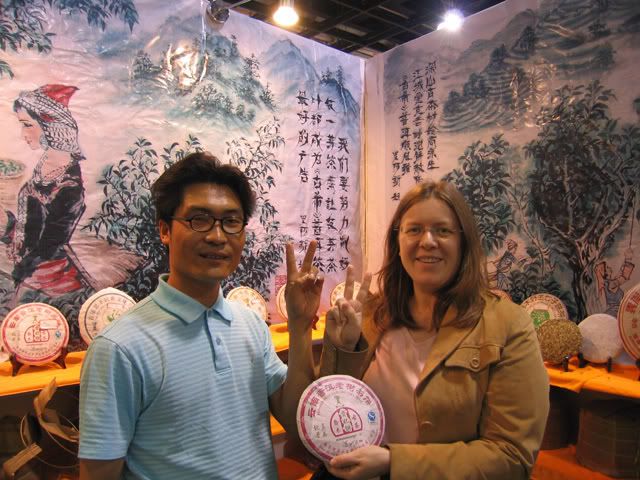
Here are a few sights from the place… it wasn’t too big, and we went through a backdoor (we don’t even know where the front door was) and just walked right in.  You don’t need to pay anyway to get in, so it doesn’t really matter.


The prices at the expo were actually fairly high by Maliandao standards.  One store quoted me something that was 4x what I could fetch at Maliandao… so why should I buy from the expo?  I don’t know.  Prices in general were quite high, and no bargains were to be had, as far as I am aware, especially considering this was the “trade” day.  Non-trade visitors were only supposed to visit tomorrow and Sunday.

Then again, as at all expos, there were freebies to be had.  Action Jackson, especially, got a free cake from some gentleman from a relatively unknown factory

Sometimes, it pays to be a foreigner in China.

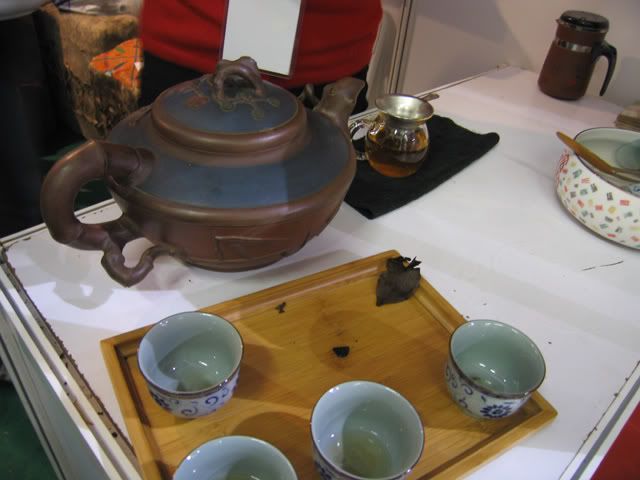
I also had my first experience drinking tea from a huge teapot today

The tea inside is similar to what I had at the Xinjiang restaurant, except with a bit more spiciness in the tea.  Maybe it’s the same thing brewed a little stronger.  If it’s what I think it is… it’s Fu Bricks from Hunan.

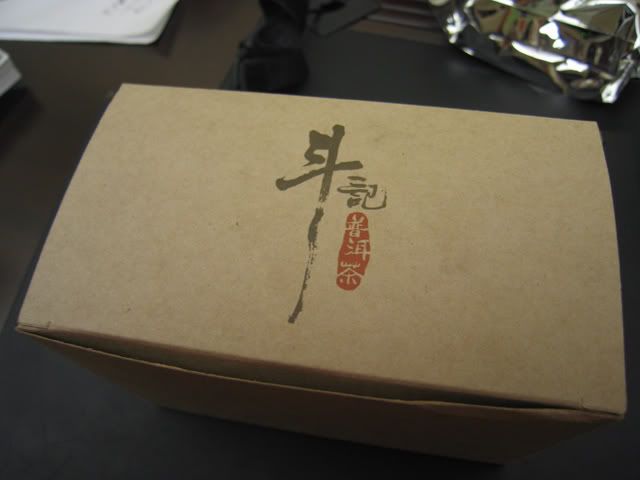
Thanks to L’s connection, all of us got some freebies as well from the puerh sponsor.  He knows the manager of their factory in Yunnan, who was there today, and he gave us this:

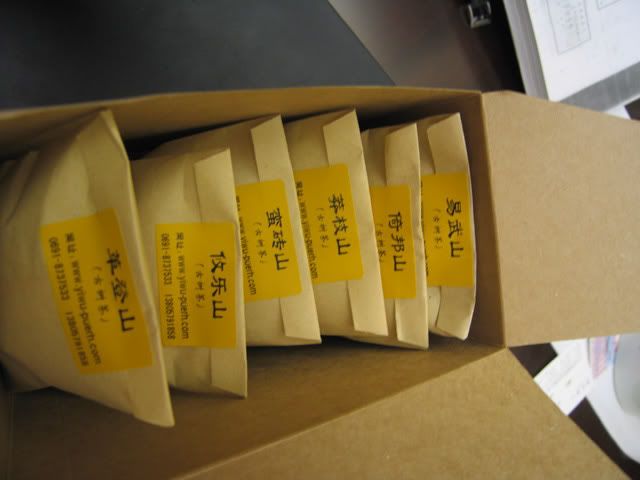
Which, if opened, reveals the goodies:

This is maocha from all six of the Six Mountains.  In order from top to bottom they are Yiwu, Yibang, Wangzhi, Manzhuan, Youle, and Gedeng.  Yes, I’m going to try them all, and of course, you’ll all hear about them when I do.

After the tea expo, where we only spent about two hours and change, we went to Tianshan Tea City to buy some stuff.  We stopped at a Wuyi store, drank a few things, including a fairly interesting, but very high fired, Wuyi tea.  This stuff was black and tasted quite strong of charcoal taste.  I liked it, Action Jackson didn’t, and neither did L’s business partner from Hangzhou.  L himself wasn’t around, but I don’t think he would’ve liked it either.

We made it out of there with a bit of tea, then looked around for the cheapest gaiwan we could find.  I finally have a gaiwan for the house now for a whooping 5 RMB.  I don’t have a cup, but that is easily fixable.  I also saw some curious cakes on our way out, but I already had enough.

We drank even more tea as we went to L’s office, including a 2003 Purple Dayi and a cooked cake of some kind from Zhongcha.  All this while a few Menghai factory dealers were there drinking stuff and basically saying only Dayi teas are good.  It was too much for me… and my stomach complained when we didn’t get to eat dinner until after 8.  Sigh.

All in all, a long day for tea.  Gotta get some work done tomorrow to compensate, and at some point in the near future, I need to head back to Tianshan to try some tea I don’t get to try in Beijing.

Categories: Information · Old Xanga posts · Teas
Tagged: , ,

Breaking news

April 25, 2007 · 8 Comments

It seems like the disorderly exit that I semi-predicted has begun.

L just called me.  He said that there have been news that he heard that the markets in Kunming and in Guangzhou have started the big decline… and nobody is asking for Dayi (Menghai) goods at this point.  Makes a lot of market sense, really, since as soon as the prices start dropping, everybody who wanted to buy will wait till the prices stabilize a bit before jumping into the fray again.  All the tea investors who’ve been buying will want to let go of their goods very quickly.  One of L’s customers in Tianshan Tea City told him that the biggest Dayi distributors in Shanghai has already called him a few times, asking him to help sell stuff for prices that you could only dream of a month or two ago.

This is welcomed news, really.  The prices for a lot of these younger cakes has reached astronomical levels, with new, fresh off the mountain cakes selling for things like 250 RMB each, and a lot of these are cheap plantation teas that aren’t really worth that much.  Many people I know who are the end customers for such things — tea drinkers like you and me, think that prices are simply far too high to buy any more new cakes.

I had thought that given the fact that much of the country still has to tap into the puerh craze, that there might be enough future customers to sustain the run for a little longer.  However, once a fall happens it is hard to stop if everybody wants to exit the market, or at least withdraw from active buying.  I think it started with Xiaguan teas — it briefly reached 220 RMB for a stick of 5 tuochas.  That price was about 7x what I could’ve bought the same tea when I first arrived in Beijing.  Somebody made a lot of money from investing in Xiaguan tea in the short term, but more people have now lost a lot of money.  Xiaguan prices already fell a bit when I left Beijing for Shanghai.  I wondered, at the time, whether it will cause a drop in Dayi teas too.  Seems like people have woken up to the fact that investing in puerh is a risky business, and are no longer willing to take that risk.

We’ll have to see what happens in the next few weeks, but I think it will be hard for prices to pick up anytime soon.  Hopefully this will usher in an era of more rational purchasing, as well as more sustainable development of products and farming techniques.

I am going to go to the Tea Expo in Shanghai this Friday.  If what I’m hearing is actually true — this will definitely make it a very, very interesting experience.

Categories: Information · Old Xanga posts
Tagged: ,

Very very dry storage

April 22, 2007 · Leave a Comment

After doing dim sum with a friend and his colleague today, and hanging out with them a little afterwards, I went to L’s place to see him and drink some tea together.

As usual, we went through quite a few teas today, only we also went through the pictures he took of his trip to Yunnan.  Looked like a lot of fun, and I wish I had the time to go.

Among the teas we had were:

97 Fengqing Tuocha
07 spring Nannuo maocha (two of them)
90s “orange label”

The two Nannuo maocha, which they got this time to Yunnan, were quite interesting.  One was supposedly from hundred year old trees, while the other one was from ancient trees of even older origins.  By the way things looked, the ancient trees one did look better.  The taste of the teas, when compared with each other, had the 100 years old tree ones being slightly floral and vegetal, while the ancient trees one tasted a little less potent and present up front, but I think had a bit more character in the end.  Both had a Nannuo taste to it, which I personally am not too fond of.  Yet, to distinguish the two between one of good and the other of excellent quality was really quite difficult.  I don’t think I could tell you, independently of one another, which one was better.  Maybe if I had drank them even more carefully, it would’ve been a little more obvious, but the bottom line is it’s very difficult to tell.

It’s not difficult if it’s between plantation and old tree tea.  I think the different grades they have between old tree teas, however…. is quite difficult.

The 97 Fengqing Tuo is best described as mediocre.  It’s presenting some of those Fengqing flavours at this point, and you can tell it’s a bit aged, but neither was it aged long enough to deliver a really sweet brew (and lose the astringency), and it was not really interesting enough as it is.  All in all, a very mediocre tea.

The 90s Orange Label is a little more interesting, because the owner of the tea, who is a friend of L’s, think it quite good.  It’s obviously a dry stored tea, although as soon as one drinks it, it calls into question the authenticity of the age of the tea.  If it were stored in Shanghai most of the time, then I would say this is definitely not something from the mid-90s (as they seem to think it is).  In fact, I think it could be the case that this is one of those teas produced after 2000 using older wrappers.  It just doesn’t taste quite right, with no sweetness and lacking in all forms of aftertaste.  It’s not great now, and I don’t imagine it will turn better given that it already has had a supposed 10 years of aging.  If it doesn’t, then of course the merchant is lying….

The problem with this tea, and to a slightly lesser extent, the Fengqing, is that both are very rough and quite bitter.  I think, especially in the Orange Label case, that if it really were real, the bitterness should at least be starting to give way to sweetness, and the astringency should be subsiding as well.  Instead, I got so thirsty at the end I could physicall feel uncomfortable with the tea.  I think that’s where I stopped… The point though, is that teas bought in such markets and also sold (to merchants) in such markets is just quite crazy and can be quite bad.. sigh, we might have to enture a permanent rise in tea prices…..

Categories: Old Xanga posts · Teas
Tagged: ,

No tea today

April 20, 2007 · Leave a Comment

But fret not, I’m fixing the problem by making some loose puerh in a cup.  On my way home here I was feeling the onset of a slightly dull headache, which, if unchecked, will turn into a rather unhappy headache in a few hours.  By about 4 or 5am, it will be bad enough to wake me up.  Very bad.  I’m not going to let the lack of caffeine disrupt my sleep (it’s happened before).

The dry tea of this puerh has been stored in my tea cupboard for a few months now without me distrubing it.  I noticed just now, when I took it out of my bag, that it has acquired a bit of that young puerh smell.  The smell of other teas around it must have infected it.  Tasting it, however, doesn’t show any of that note — it’s strictly the nose.  The tea has mellowed out a little since I bought it though, no doubt due to the airing and so dissipating some of the wet storage smell.

The train ride was uneventful, but it was a real eye-opener, being able to see the landscape change from a rather bleak and dry north to the more plentiful, greener, and wetter south.  As the train moved from Shandong province to Jiangsu, the landscape gradually became softer and greener.  There’s a reason why the cultural capital of China has always been in the Jiangnan area, which is the Yangtze River delta.  Production is just obviously higher, even to somebody who’s passing by the countryside in a train.

I’m also in green tea country, but I’m sure you’ll hear more of it in the next few weeks.

Categories: Misc · Old Xanga posts
Tagged: ,

Random shopping

April 19, 2007 · 3 Comments

I went to Maliandao today to pick up some stuff for L in Shanghai. Meanwhile I went and did a little shopping for some teaware — to bring to Shanghai to use. It’s one of those alcohol lamp + glass kettle combos. While I complained about the smell, in Shanghai I know I can open the windows wide with good ventilation — where I stay there’s such a spot. I also have a water dispenser that dishes out already-hot water, so the boiling times will be minimal.

Interestingly enough, going to the store that sells such things with L’s business partner has toned the price tag down by a few notches. I got it for the below-wholesale price of 50 RMB for the whole thing (wholesale is 52). I was expecting to pay around 60. I remember paying around 80 when I bought my set here after arriving in Beijing. In fact, for almost everything I can now confidently say that I have a pretty decent idea of how much things should be, having spent a good amount of time in Maliandao and also have quite a few people who now at least have seen me once or twice (thus making them think I work in Maliandao). Initial quotes for a lot of young puerh have dropped from those 200+ range into the 100 range, or even lower. One guy voluntarily halved the price of the cake he was trying to sell me, without much prompting on my end, and quoting me what I believe to be honestly a wholesale price. It’s amazing what a little time can do for you.

I also got to taste some teas. One was a maocha from Yiwu, fresh this year, that are from those plantations — those same plantations that everybody loves to hate. Taste is sweet, mellow, but weak… easy going down now, and infinitely drinkable, but lacking the strength (in terms of feeling the tea AFTER you swallow) and the depth that one finds in better Yiwus. In fact, it is a great drink-it-now tea. If you brew it like a green tea, it’s very nice, not bitter at all, and can hook anybody onto young puerh (if you can even call this young puerh). It’s just not what you necessarily want in a tea for aging. It also has the advantage of being quite cheap.

Another tea I drank was purchased in Yunnan when Xiaomei and L went there a few weeks ago. It says “Yiwu Gushu Cha” (Yiwu Old Tree Tea), but I think it has been poorly made — green tea pressed into bing. It has all the right characteristics of a green tea, and not really of a puerh. It was especially obvious when she told me this is from 2004… the tea doesn’t taste right. It’s always a delicate situation when somebody has a tea that you think is horrid, but don’t know what to say. I could only say that there was some huigan. After being largely silent for a while, I think she figured out that I didn’t quite like it, and even offered it up herself that “This tea is really fragrant — I wonder if this is green tea”. Whew, the awkwardness was broken. Otherwise I had to suffer more infusions of this rather bitter and unpleasant tea….

While there, a customer came in looking to buy a whole jian (or several) of the “Weizuiyan” cooked puerh from Menghai, produced last year and now fetching about 3x the original price when I first heard about it. He sat for a while, deliberating, but eventually walking. He has heard that prices for some puerh has dropped, which is actually true for Xiaguan — prices have toned down a bit, apparently, in Kunming. Menghai, however, still rides high…

But can this last? Will the drop in price for one factory cause a cascade? Will it be the warning sign of the risks of puerh investment? I wonder. There are obviously those, like him, who are trying to buy teas for cheap, hoping that prices have gone down a bit to a more acceptable level. But can it not keep dropping? After all, I think much of the newer stuff have simply lost connection with their inherent value. Menghai cooked puerh is not so much better than everybody else’s that they deserve to be three or four times as expensive, and raw puerh of this sort are quite undrinkable, relatively speaking. A lovely Wuyi tea or dancong can be had for less. Longjing is the exception to the rule… where prices are always high, but that’s because there’s the demand for it, and a good, top shelf longjing is really quite good.

Oh well, the ride continues…. but tomorrow, I’m off to Shanghai!

Categories: Old Xanga posts · Teas
Tagged: ,

Banzhang fall and spring

April 18, 2007 · 5 Comments

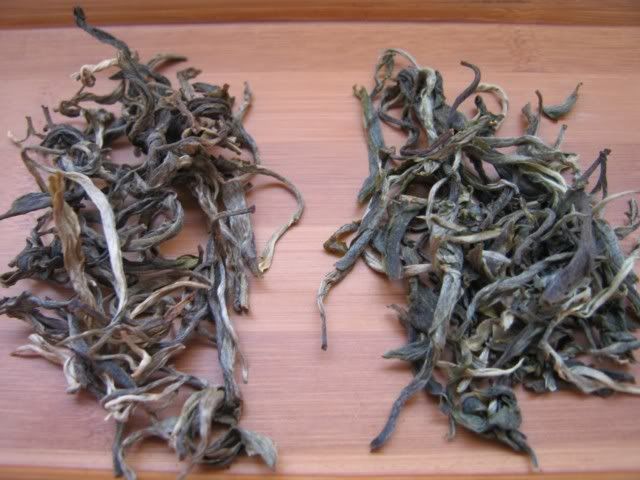
I have in my hands two maocha from Banzhang, one from fall of last year, and one fresh picked from the mountains this year. I thought it will be interesting to drink them side by side

When I opened up the bags and took them out, I was slightly surprised by the colour difference between the two. The darker, redder one is the fall 2006, while the spring is the greener one on the right. The colour difference is only a shade or two, but it’s noticeable.

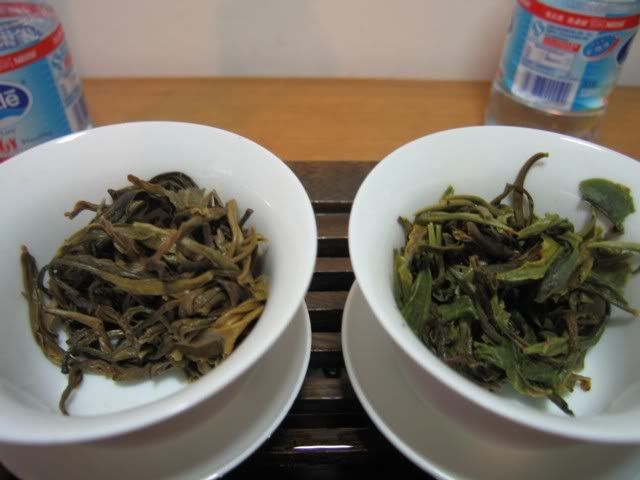
It’s even more obvious when they are wet

The Fall 2006 on the left tastes like a Banzhang I normally know… somewhat bitter, with a characters strong taste but turns a little sweet in the finish. It’s a penetrating tea, and quite thick and nice. There’s a hint of smoke in there too, but not too strong. The Spring 2007, on the other hand, was surprisingly floral. It reminded me of one of those light dancongs out there — there’s a definite connection, with hints of grass and some high floral notes that I only usually expect in a very light oolong. I suspect this tea, inadverdently or not, was oxidized a bit before kill green. It sometimes happen deliberately, but can also be the case of just the tea farmers needing some time to reach their home and light the fire to do the kill green. Either way… it was an interesting contrast. The two teas don’t really share a lot of common notes, except in the finish… a bitter turning sweet, your classic huigan. Even then, the affinity is pretty remote.

The liquor is not as different visually as the leaves:

The Fall is only slightly darker in colour throughout the session, with the spring taking on a more vegetal green hue.

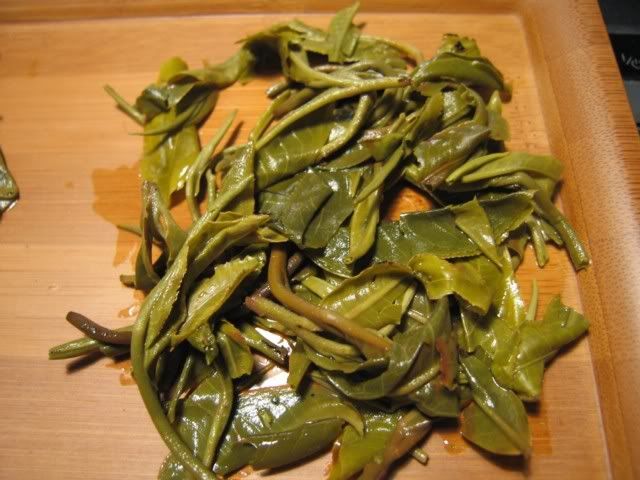
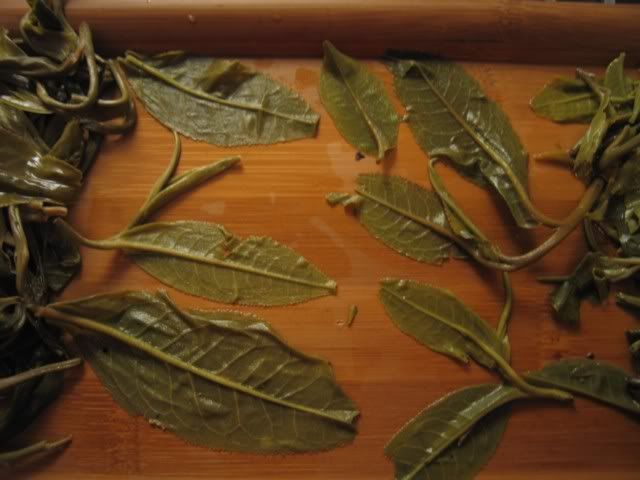
The wet leaves:

Should be pretty obvious which pile is which

Leaves sizes are different, with fall being obviously bigger and the spring more tender. There’s a sort of thinness in the spring tea, for some reason. I don’t know if it’s overpicking, or if it’s just young buds/leaves being smaller/thinner in general. I suspect it could be a bit of both.

Banzhang is still not really my cup of tea, especially given the prices, but I can see how in 5-6 years this tea might turn into something more to my taste. Right now… I’ll go for a Yiwu for sure, which is only selling at one third the price of a Banzhang anyway. Prices are just sky high.

Categories: Old Xanga posts · Teas
Tagged:

The East is Red, China, and… Tea

April 16, 2007 · 5 Comments

I just bought my train ticket for Shanghai for Friday at the Beijing Station. As I was leaving, while passing right in front of the McDonald’s across the street from the station, the clock struck nine, and the bells of the station started chiming The East is Red. It was surreal, as I never expected that in this day and age, this tune would be played anywhere near so public as the Beijing Station. But there it was, the bells ringing probably the same thing it did forty years ago during the height of the Cultural Revolution. Here I was, standing in front of the McDonald’s, with a ticket in hand that puts me on the newest train in China, and listening to the bells chime The East is Red. I was only maybe two kilometers away from the Tiananmen Square, where forty years ago hundreds of thousands of university students rallied to see Mao, loudspeakers blaring with this very tune I was hearing. I helped teach a course on the Cultural Revolution last year, but I have no personal experience of it — only through books and tales from my family. I am sure if I were in front of Beijing Station (which I definitely wouldn’t be — because I would be busy doing Red stuff) I would be able to hear the massive chants of the rallies down Chang’an Avenue. In a way, I felt connected with those people there, back then, if only ever so slightly. It was a strange feeling.

It is obvious that China is no longer the same. The very fact that I was standing in front of a McDonald’s was proof positive of it. The fact that we can talk about all these different kinds of teas, of all the different factories, and most of all, the incredible rise in tea prices in Yunnan the past few years, signifying, among other things, the great amount of wealth generated in the past three decades. A mere twenty years ago all tea factories were state owned, production standardized, and innovation was pretty much nil. There were some new cakes, made at the behest of merchants from Hong Kong or other places, like the 8582, but by and large, it was a stale business. Liberalization, at least in the economic sector, changed all of that. Menghai, Xiaguan… all those big factories are now private companies, run by shareholders or other investors. The whole tea distribution system is private, market based, thus giving us the dizzying price rises, and also the accompanying speculative fervour.

How to identify good teas in this sea of innovation and change is a constant concern among tea lovers all around. We’ve all paid our tuition before and bought tea that was horrid (only we didn’t realize it then). With puerh, it has gotten to the point where the market is taking away the enjoyment of the tea itself. On a place like Sanzui, discussions recently have all centered around “What are the prices now for xxx?” and “When is the crash coming?”. Nobody talks about tea anymore, it’s all about the price.

Are we better off than before? I’d like to think we are. After all, given all the choices out there, we’re bound to find good stuff. It made the job more difficult, but in some ways, it’s also more rewarding. We buy puerh on the hopes that some of it will turn out good. Hope, I think, is powerful. It’s probably more powerful than anything else in human nature. Hell, after all, is a place with no hope, and nobody wants to be in hell.

I drank a new maocha today, given to me by L’s business partner, Xiaomei. They picked this themselves from the trees, and watched it being fried and dried. They went to Yunnan this spring to study teas there. They made no cakes, but bought a whole bunch of maocha to try for themselves and also to give as gifts. I got a little bit of this Nannuo, along with some Banzhang. I’m sure when I go down to Shanghai and see L, I will see his Yiwu teas too, which they also picked. They go and spend all this time not only because they’re interested in tea, but also because this is their enterprise, and they are willing to invest the time and money to try to improve themselves so they can do the job better. I was thinking today, while drinking this maocha — if there is a crash in puerh, if there is a panic exit from the market, if the unwinding is not orderly but disorderly… are they ready for it? With hope comes disappointments, and disappointments are hard to swallow sometimes.

Every little cake we buy is a piece of that hope… expectations that the tea will age into greatness. Every time we drink the tea again, we want some sort of validation of our hope… that we got it right, that it is, indeed, moving towards something good. Maybe that’s why puerh is so captivating, because we are invested in it, and because of its uncertainty. But that’s what makes life exciting.

Some pictures of the tea today… a young little thing, green to the core, grassy, notes of green beans, not too thick, but surprisingly smooth. Good qi, as I got dizzy after a while, and decent huigan. Not a bad tea at all. A little too green… I was a little suspicious, and you can see how green the tea is in the pictures (natural light today). I don’t know anymore what’s good and what’s not.

I rambled on and on today, sorry.

Categories: Old Xanga posts · Teas
Tagged: , ,

A beautiful mistake

April 15, 2007 · 1 Comment

I went to Maliandao today. There was a cake I saw last time that I wanted to try at a store I’ve never been to (there are lots of those), so I went there today and asked to try it.

We sat down, the girl brought over a cake, face down, and she started peeling tea off it and rinsed it. I took it in my hands to look…. and noticed it’s the wrong cake. Oops. I told her, pointed out the one I wanted. She wanted to throw the tea away, but I said since she rinsed it already… let’s try it.

The mistake was a Bulang cake, which is something I usually don’t fancy. I find the stuff not that interesting, especially when compared with Yiwu. Bulang is quite expensive these days, mostly thanks to Banzhang’s proximity, but nevertheless… I’m not a huge fan.

The cake I actually wanted to try was a Manzhuan cake. It looks nice, and it’s got a good price. The Bulang is a little more expensive, about the same age (3 years or so), but not as nice looking, cake wise. Both are from Quanji, whose tea I own some of already. I liked it last time, and this is the first store I’ve seen that carries it in Beijing besides the one where I bought my last lot from. I figured I could give them a go. Since I am usually a fan of the Six Mountains area tea…. Manzhuan was the obvious choice.

We started off with the Bulang, as it was ready. It was immediately obvious that the tea was decent. It hits the back of the mouth with a bit of a cooling effect. It is somewhat bitter, but leaves an aftertaste. There’s qi. The tea is not that rough, especially for a young tea. The taste is changing… losing the very green sort of taste you’d come to expect in very young puerhs. The few years of aging, wherever it was done, has done something.

The Manzhuan, on the other hand, is sweeter. The tea, however, was less strong…. less powerful, and has less feeling in general. It doesn’t penetrate as deeply as the Bulang. It was especially obvious after a few infusions, where the Manzhuan started acquiring a slightly puckery feel to it. The Bulang stayed the course and delivered strong infusions round after round, even when we were more than 10 infusions into the tea. The Manzhuan, on the other hand, started running behind, lagging. It acquired a bit of a water taste after a some infusions. It was obvious when you compared the two. Oddly enough, while the Manzhuan was brewing a stronger coloured brew, the taste was obviously weak and flat in comparison to the Bulang, which was lighter in colour but yet deeper in flavour.

I think I would’ve thought the Manzhuan to be a pretty decent tea, if I had not had the Bulang to compare. The puckery feeling was not strong, and the sweetness that it delivers is quite alluring, at least initially. I might’ve written off the weakness later on to amount of leaves or time brewed, and it’s always harder to tell such things when you have no basis for comparison. This is proof positive that, when trying to evalute a tea…. it’s best to have something against which to compare, and the question of which one being better and which one being worse will reveal itself very quickly. I had that with the two grades of Lapsang Souchong, where it’s essentially the same tea, but I am seeing this again very clearly in this instance.

I ended up not buying any of the Manzhuan, and picked up two of the Bulang. It’s probably one of the best young cakes I’ve had in the past few months. I am contemplating picking up more… I’m just a little weary of buying more teas, as I already have a bit of a stash. Then again, this cake really is quite good, and if I think I have extra room when I’m leaving town… I’ll go buy more of this.

I went around Maliandao some more, but nothing too interesting to report, especially not after this.

Some tea pictures….

I think you can see how one side of the cake looks more compressed than the other. I suspect the person doing the filling/rolling of the bag didn’t do it too evenly. Doesn’t matter.

Categories: Old Xanga posts · Teas
Tagged: ,

On storage, again

April 14, 2007 · 5 Comments

One of the first things I did when I returned from the US to Beijing is to open the cupboard that holds all my puerh here.

Sorry, it’s a little messy, but I leave all the bags open so they all breath, and between that and finding enough nooks and crannies to store all the little pouches of samples that I get, it gets a little messy.

On the right you can see two bowls — one on the top shelf, one on the bottom. Only the top is filled with water right now, but when I left Beijing for Hong Kong, I filled both up to almost the brim. I figured in the dry weather here some water won’t hurt.

When I got back and opened the cupboard, I expected two things. First, the water from both bowls should be all gone. That was exactly the case… it all evaporated, as it should since I was gone for more than a month. All that was left was a lot of salt deposits, testament to the high mineral content of tap water in Beijing. I figured leaving water in the cupboard can hardly be a bad idea given the dry weather here.

The second expectation was that I would smell a strong whiff of tea. Before I left, whenever I opened the cupboard, I can smell that scent of young, green puerh. It’s pretty strong, and I think it smells pretty nice. In fact, when I wake up in the morning and open the door to the living room (where the tea cupboard is) I can often smell the tea faintly. It obviously seeps through the not very tight doors of the cupboard and into the room.

When I got back and opened the door, however…. there was very little smell. I smelled a whiff of sweetness — that sweetness that you get from a 3-5 year old dry stored puerh. It’s not the same raw green smell of a very young puerh, but rather something that has aged a bit. It’s a difficult smell to describe, but anybody who’s had some slightly aged puerh, especially of the Yiwu variety will know what I’m talking about. Even that smell, however, was fairly faint. This was unexpected since the tea was left undistrubed for quite a while. I thought the smell would accumulate instead of dissipate given that the door would be closed all along.

So I added water to one of the bowls, and left the tea in peace except for when I was getting stuff from it. I have a humidity indicator both in the cupboard and in the living room. Throughout the week, the humidity in the living room was significantly higher than the humidity in the cupboard. My meters don’t give precise readings, just general “humid-dry” scale. But the difference was obviously significant enough so that it’s not a product of some mechanical error.

After a few days, I have noticed that the smell that I was expecting has returned… the teas in the cupboard once again give off that young puerh smell that I thought I was going to get when I came back. The humidity of the cupboard was still lower than the room. Even though I opened the door for a while to let in the air in the room, thinking that it will equalize the humidity in the two places, humidity in the cupboard remains stubbornly lower.

This has led me to think that perhaps, just perhaps, the teas are actually soaking up the water in the air in the cupboard, contributing to the lower humidity there despite efforts to equalize it. After all, humidity in and out of the cupboard should theoretically be the same if I left the cupboard door open sufficiently long, and since it’s really not a big thing, you would think that amount of time is pretty low.

The return of the tea smell, or rather, the more pronounced nature of the smell, leads me to think that with higher moisture, the smell of the tea gets stronger — the aromatics in the tea get released into air, I presume, with water. Is that a good thing? I’m not sure, but since they say you need moisture in the air to age the teas, I would think this is only a natural development and not a bad thing. I did notice that in Hong Kong, my rather moist cakes had a strong whiff of tea to them. I didn’t think much of it then. Now I think there’s a correlation and probable causation.

The other thing is that since the bowl of water was replaced, it has lost about 15-20% of its contents already in the past week. This is a little faster than I thought.

All this makes me think that the slightly more moist air that has accompanied my return (it rained for two days, and there’s also my human additions such as steam from the shower, me boiling water, etc) is giving the teas more water to work with.

This would also explain the teas that have been on shelves in Maliandao for too long — they are usually devoid of any smell, and you have to breath into them to get any whiff of tea out of them. In Hong Kong, you never need to do that — you stick your nose up to the cake and you can definitely smell it. Concensus has it that Hong Kong stored teas are probably better tasting than Beijing ones. The few Beijing stored cakes I’ve had indicate the same… they’re not very good and don’t age much. Teas that people have brought back from places like Xinjiang, despite their advanced age (10+ years) taste terrible.

I might try adding another bowl of water, but I think that won’t make much of a difference as there should be a natural equilibrium of how much water gets released into the air, depending on the humidity inside the cupboard. One or two bowls shouldn’t change that very much.

I’d like to think I’m moving the tea in the right direction, at least in keeping the tea a little room to work with, rather than drying them out as they would if I didn’t put any water in the cupboard. For those of you who live in drier climates — have you experienced something like this before? When you open your cupboard, can you smell your tea? Does it get stronger when you’ve had a prolonged period of moist weather? Have you had teas stored in two different places… and have them taste different after a while? Curious to know.

Categories: Old Xanga posts · Teas
Tagged: , ,