A Tea Addict's Journal

Entries tagged as ‘history’

Troubles with a bush

September 30, 2009 · 10 Comments

Recently there’s been some discussion of the nature of dancong online at various places, and one of the topics of discussion was the proper nomenclature of dancong itself.  I was not too convinced by what was being said, simply because some didn’t sound right, so I went and investigated.

The discussion centers around the word “cong” and which character should be used and what it should mean.  I first went to my trusted source, the Hanyu Da Cidian, which is a 12 volume monstrosity and is the Chinese equivalent of the OED.  I first looked up 叢.  Its basic meaning is “group”, and can also mean “a bunch of plants growing together”.  No surprise there.

Then I looked up 欉, which, to my surprise, is NOT in the Hanyu Da Cidian.

Now, of course, since 叢 simplifies into 丛, one would assume that 欉 simplifies into 枞, and it is extremely common to see 单枞 being used as the phrase for the tea we know as dancong.

However, there is a problem, because æžž is also (or perhaps, only) a simplification of the word 樅, which means fir.  When you search for æžž in the dictionary, you’re going to find the definition “fir”, but that’s because you’re actually looking up the word 樅, not 欉, which is what you should actually be looking for.  People write æžž for 欉 because they assume that’s what it is, and indeed it might, but they are two distinct characters and when you search for words using simplified characters, you always run the risk of it returning erronous results because there are multiple “source” words for one simplified character.

Since the Hanyu Da Cidian doesn’t have 欉, I thought I’d look up 單欉 or 單叢, but it seems like the editors of Hanyu Da Cidian are not tea drinkers, and they are not in the dictionary.

So I went to another useful resource for weird words — the Kangxi Zidian, which was edited in the 1710s.  Here, we do find a reference to 欉, and the definition given is quite simple — In Jiangdong (an area roughly corresponding to the region around Shanghai, Suzhou, Hangzhou, Nanjing, etc), a group of plants growing together is called 欉.  The word, interestingly enough, is recorded as 4th tone in the Kangxi Zidian.  As for its definition for 叢, it is essentially the same as the Hanyu Da Cidian.  There’s no difference, basically.

I think what is clear is the following:

欉 has absolutely nothing to do with the fir tree.  We can strike that from the conversation.

欉 or 叢 have essentially the same meaning.  叢 has a wider range of meanings, but they are unrelated to plants.  For the definition that has anything to do with plants, they are synonyms.  In that sense, you can probably see 欉 as a variant of 叢.

There is absolutely nothing in the definition that implies anything growing from the same root or coming from the same plant.  The only definition given has to do with growth in groups and bunches.  One tree cannot be a 叢 because it is not part of a group, especially if it’s a taller tree that’s growing by itself.  It must be a number of plants, or a bush.

So to get back to our problem then — what exactly does dancong mean?  Aside from the very great possibility that it is simply some romantic, nice sounding name, as is so often the case in Chinese teas, we have the characters to work with.  “Dan” generally means lonesome, single, but can in some cases also mean thin.  Normally, we translate dancong to mean “single bush”.  Perhaps owing to the relatively rocky nature of the growing areas, dancong, as originally harvested, was indeed a collection of leaves from lonely bushes growing on their own.  That, to me, seems like a better explaination than some “single origin” theory, mostly because plants don’t work like that, nor do farmers who plant these crops.  So, instead of translating it as “single bush”, perhaps an alternative would be “lonely bush”, denoting the way the trees grow in the rocky setting.  Unlike tea farms in some other places, dancong trees don’t grow quite so closely and densely.
Categories: Old Xanga posts
Tagged: , , ,

Lotus flower tea

September 25, 2009 · 3 Comments

I think a lot of us “serious” teaheads tend to dismiss flower infused tea as inferior and bad, and for good reason.  For the most part, these flower infused tea (along with orange peel tea, etc) are made with relatively inferior tealeaves and generally are not very good.  These days they are also often infused with artificial or “natural” flavourings and that sort of thing, further compromising their value.

However, even in the Ming dynasty, people were already doing such things, except their procedures were much more elaborate and difficult, and certainly not meant for large scale commercial production.  Consider the following for a “Lotus flower tea”:

When the sun is not yet risen, open the lotus flowers that are only halfway to full bloom, and put a small amount of fine tea into the center of the flower, and tie the flower loosely with a little raw hemp, and leave it overnight.  Next morning, pluck the flower, pour out the leaves, and use paper to wrap it and roast it dry.  Using this process again, pour the leaves back into another flower, repeat this a few times, and then finally dry it and store it for use.  The fragrance is incomparable.

Try that at home.

Categories: Old Xanga posts
Tagged:

Boiling with charcoal, part 2

September 24, 2009 · 5 Comments

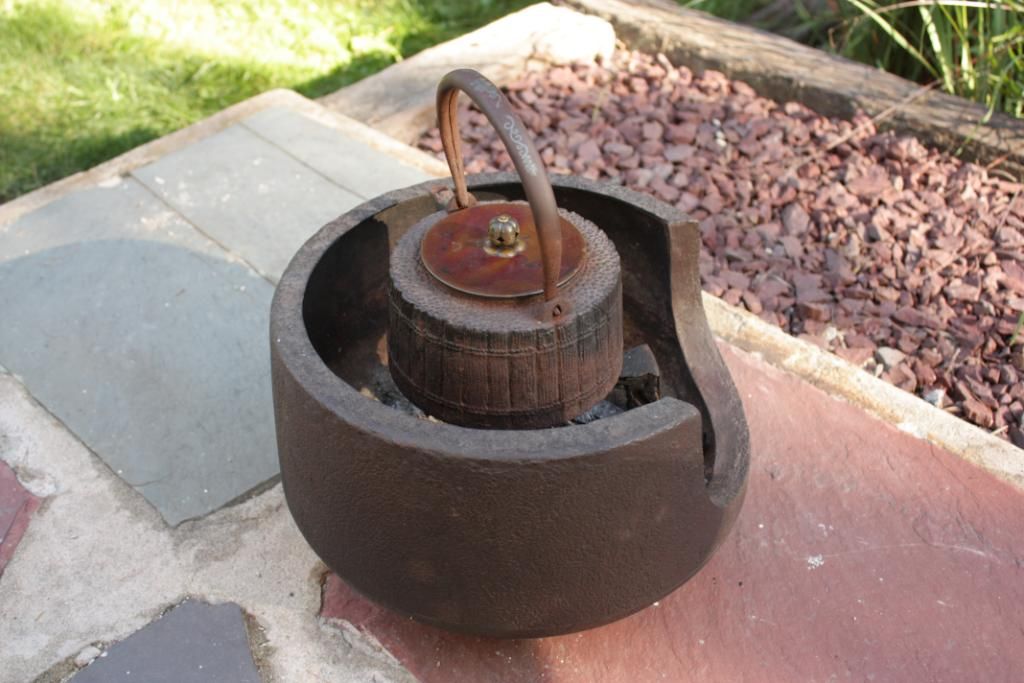
So here it is

My brazier with one of my tetsubins on top.  Ideally, I’d use a kama, but kamas are a pain, because then you need all the right tools to use it with — from the rings you need to lift the kama up, to the ladle, etc, and using a tetsubin is just so much easier.

Last time I tried boiling water with charcoal it took a long time — almost an hour.  One of the problems was that the charcoal was not hot enough.  I bought myself a charcoal starter chimney, and it worked like magic — the charcoal was red hot after a few minutes and was ready to go.  The water still took almost half an hour to boil, but not nearly as long as last time.  I could’ve probably made it even faster if I used more charcoal today, and next time I might do just that.

The largest constraint today was the number of chasen available — one.  I only brought four bowls with me today, because I decided that with one chasen, it doesn’t really matter how many bowls there are out there.  With fourteen students, it turns out four bowls was plenty — by the time the first person was done drinking, the fourth person isn’t even starting to whisk yet.  Some students are quite good at the whisking, while others are learning the difficulties — creating foam, getting rid of lumps, etc.  With usucha, it’s not so hard to get rid of lumps, and I’d imagine with koicha it could be much more of a problem.  We’re not even going there.

Obviously, it is quite impossible to follow any protocol or rules when you have a group of students making matcha for the very first time (except one or two with previous experience).  Then again, they do experience the one thing that definitely happens when you drink tea in a group — you start talking, excitedly.  The caffeine, especially in the powdered form of matcha, can do wonders.

Categories: Old Xanga posts
Tagged: ,

Remaking powdered tea

September 11, 2009 · 5 Comments

How do you keep adding water to powdered tea?

That’s my question when I read Daguan Chalun, because Song Huizong seems to think you can.  In fact, he mentioned adding water seven times.

Because of this description, I’m not entirely certain what he’s talking about.  If it’s anything like today’s matcha, then… adding water in seven steps without adding tea seems strange… after all, the tea will just get really, really thin.  This is, in some ways, more mysterious than Lu Yu’s boiling, which is actually relatively straightforward.

Categories: Old Xanga posts
Tagged:

Making Tang tea

September 11, 2009 · 7 Comments

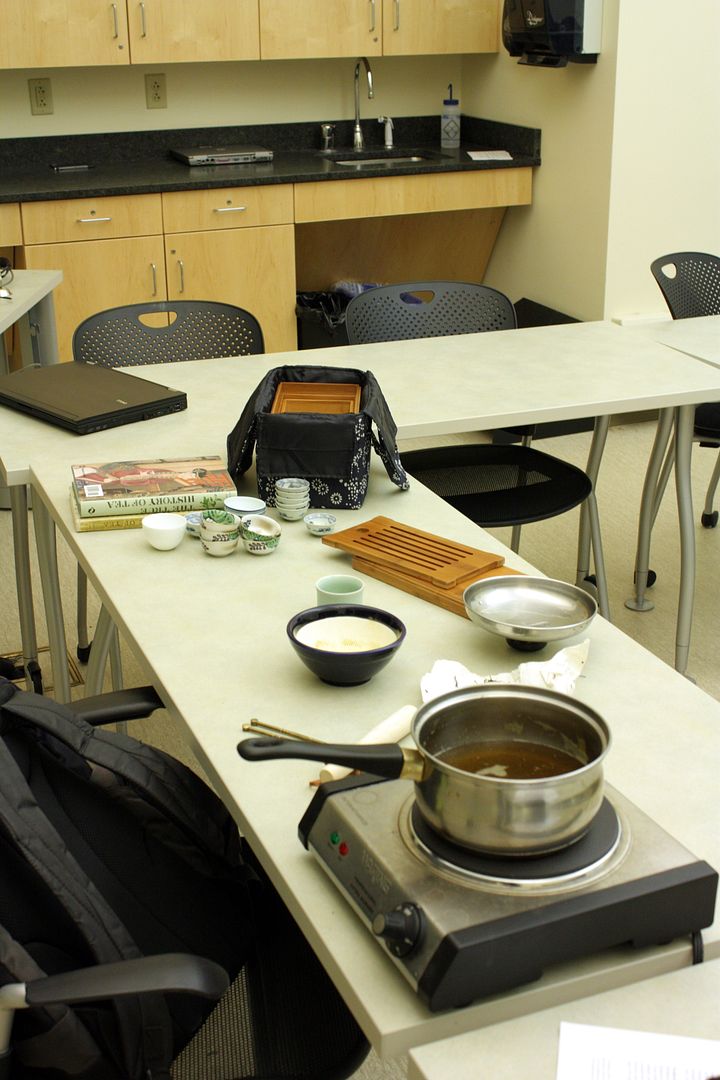
So, we did it today in class, making Tang dynasty tea as best as modern, inferior equipment will do.

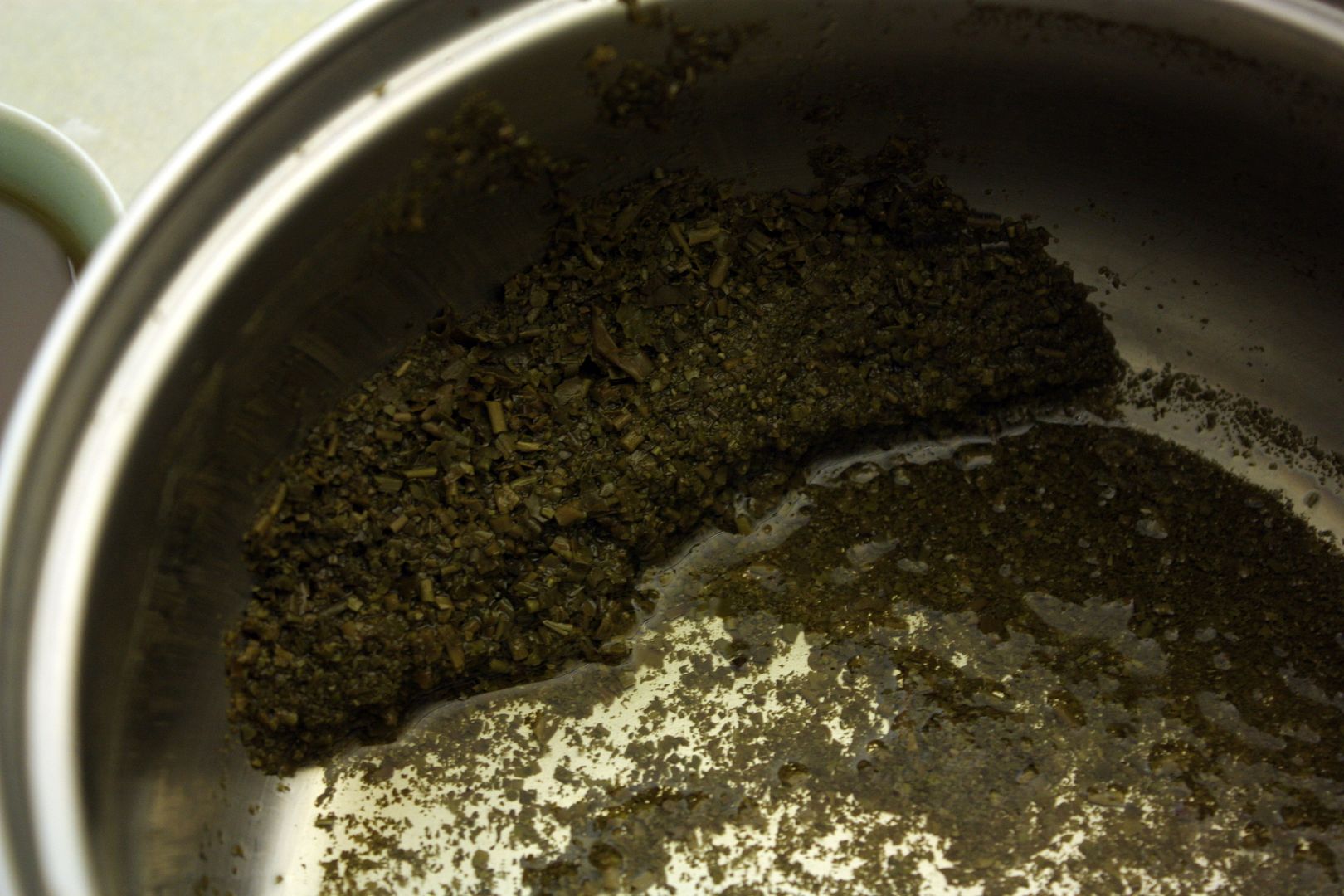
What you see here are the remnants, having already finished.  I first asked them to work out from the Chajing what procedures we should follow.  The served as our discussion, mostly.

We ground the dok cha up (thanks Corax and Maitre_Tea for the reminder of using dok cha), using what I estimate to be about 5g of tea in a big pot of water.  The cheap Walmart bought mortar and pestle grounds it surprisingly well.  Despite the fact that it’s not a Famen Temple silver grinder, it does the job.  It’s certainly not as fine as, say, modern day matcha, but I don’t think it was supposed to be nearly as fine.  We did roast the tea a little bit, but I’m confused about Lu Yu’s suggestion that it should be roasted so that the leaves are tender — I’m not sure how that’s possible without steam.  Dry roasting will only make the tea drier, whereas if it’s tender, then the tea will be mushy and won’t ground well at all.  Unless, of course, that’s the idea, but that creates all sorts of problems…. and would fundamentally change the way its taste.

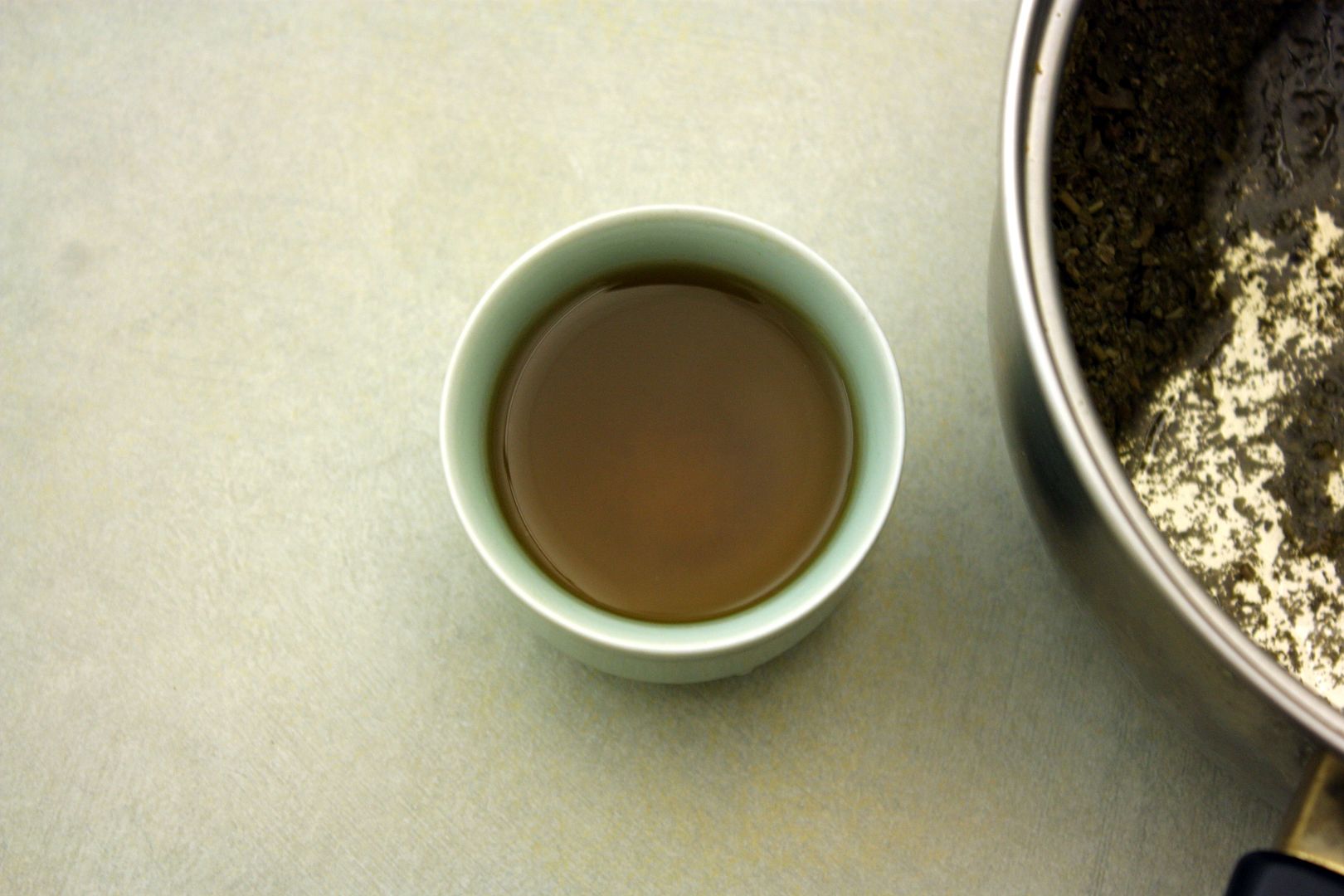
We did skip the salt (I forgot to bring it, but probably a good choice anyway) and threw the tea in right after the fish eye stage.  At this point, something rather interesting happened — the tea immediately formed a foam, a fairly thick one at that, which was unexpected.  I turned off the heat, but allowed the pot to stay on the stove, as it’s going to be kept warm for a while.  Students lined up to use the spoon to pour tea into the cups, which might be a little bit of a health hazard now that I think about it, swine flu and all (it’s going around).  The tea is interesting in taste — greenish, not nearly as sweet as matcha, but definitely sweet.  As I sort of expected, my students find it a lot more bitter than I did, which is normal.  I think us teaheads have no idea what bitter means anymore, at least when it comes to tea.

You can see the tea is darkish.  There’s plenty of huigan.  Can’t say much about the qi.  Drinking with or without foam made little difference.  Some students went for seconds, as our cups were quite small.  I think I ended up having about four to five cups (some while cleaning after class — didn’t want it to go to waste, after all).

You can see the grounds — pretty roughed up.

Was it a success?  I suppose in the sense that we did something, and it turned out better than I imagined, yes, it was.  Pedagogically, I thought doing something like this will highlight the differences in how you make something so long ago that can’t really be explained by words alone.  I do wonder, though, about how interesting this actually is.  I am a teahead, and if you’re reading, chances are you are as well, so naturally, this stuff excites you.  Lu Yu was also writing for fellow teaheads, I think, and also trying to gain converts, if there were any.  For students, especially first years, I can’t tell how much of this is actually interesting, and how much of it is just stuff.

Of course, there are all sorts of problems, chiefly is Lu Yu’s rather spare instructions — we really have no idea exactly how much tea for the water, how long to boil, etc.  He’s not very clear, and rightly so — he was writing for people who knew these things, much like I never talk about how much tea to put when brewing puerh, or oolong, or whatever, because I assume my readers know.

Whatever it is though, I think, as I’ve said before, that Lu Yu, while great and historical, is really irrelevant as a source of tea wisdom.  The tea he drank was too different, too remote.

Categories: Old Xanga posts
Tagged:

Tang dynasty tea

September 8, 2009 · 5 Comments

The rather relentless schedule of a new semester is making it hard to drink much tea, much less talk about it.

For class this Thursday, we’re talking about Tang dynasty tea, which means that I will at least give it an honest try to make it in class.  I’ve never done it before, nor has anybody else I know.  It’s a bit complicated, because if you read Lu Yu’s (sparse) instructions, there isn’t much to go on.  There are a lot of problems.  First is selection — what tea to use?  Nothing we have nowadays approximate what was produced back then.  The closest might be some sort of poorly sha-qinged green puerh.  Then, the roasting, which should be done on the spot but is again a difficult thing to negotiate.  After you roast, there is the mashing/grinding.  Obviously, I don’t have the proper grinder for tea — I need to find some silversmith to make me one, some day, somehow.

Even thinking about this, not to mention the salt that I might add to the water, really makes you appreciate how truly different tea was back in the day.  We’ve come a long, long way from Lu Yu.

Categories: Old Xanga posts
Tagged:

Classes

August 29, 2009 · 1 Comment

Have to prepare for classes that are starting in less than a week, which means not a lot of time to sit down and drink tea.  I did, however, open a new bag of my favourite aged oolong these days…. and my, what a difference it makes compared with the sun drenched and sun baked bag that went through three Western states.  In comparison, this one’s sweeter without the nasty aftertaste.  Proof positive that uncontrolled heat is no good.

Categories: Old Xanga posts
Tagged: ,

Some things never change

August 7, 2009 · 3 Comments

From a broadsheet printed in 1664 on tea (spelling revised to modern standard as best I can)

The Peculiar Virtues are these:

It maketh the Body active and lusty, strengthening the Muscles and Sinews
It helpeth the Headache, Giddings and Heavings thereof
It removeth the Obstructions of the Spleen
Its very good against the Stone and Gravel, cleansing the Kidneys and Ureteries
It taketh away the difficulty of breathing, opening Obstructions
Its good against Lipitude, Distillations, and cleareth the Sight
It removeth Lassitude, and cleanseth and purifieth adult Humors, and Hot Liver
Its good against Crudities
It stregtheneth the weakness of the Ventricle or Stomach, and causeth a good Appetite and Digestion
It vanquisheth heavy Dreams, easeth the Brain, stregtheneth the Memory
It overcometh superfluous Sleep, and prevents Sleepiness in general, a draught of the Infusion being taken, so that without trouble Whole Nights may be spent in study, without hurt to the Body, in that it moderately heateth and bindeth the mouth of the Stomach.
It prevents Agues, Surfets, and Fevers, by infusing a fit quantity of the Leaf, thereby provoking a most gentle Vomit, and breathing of the Pores
It assuiageth the Pains of the Bowels
It cureth the Colds, Dropsies, and Scurvys, by a proper Infusion, purging the Blood by Sweat and Urine, and expellenth Infections
It purgeth safely the Gall

Now all we need is
It cureth the Cancer

And we’re good for an ad for the newest Snapple Peach flavoured iced white tea.

Categories: Old Xanga posts
Tagged:

Quick review: The True History of Tea

June 17, 2009 · 10 Comments

I don’t normally do book reviews, and I know that Corax of Chadao will be doing a much more thorough and thoughtful review of this book at some point or another, so here are just my quick thoughts on this nice, new, shiny book.

The book is by Victor Mair and Erhling Hoh.  I know nothing about Erling Hoh.  Victor Mair I do know by reputation — he’s a professor of Chinese language and literature at UPenn, and is very prolific with both scholarly work on philology, literature, and also translations of classical texts.

The pedigree of the author matters, because I feel that the authors of many of the books currently on the market that talk about tea, especially ones that purport to discuss the history of tea, are not familiar with the country they’re discussing, nor well versed enough in the language to use primary sources that are reliable.  While this may be all right for a book that only makes gestures towards explaining the history of tea in East Asia, they inevitably have to rely on second hand evidence or anecdotes from other sources.  They also tend to over-rely on Lu Yu’s Chajing because it along among older texts on tea is translated, giving it a place that is well deserved but not entirely representative.

This book does indeed try to fill that very large hole, not only in talking about the history of tea pre-Lu Yu, but also that of the period that came after but before the Europeans arrived to bring tea to their own shores.  The authors really do try to cover the entire history of tea, from inception in China, its spread to Japan, the Islamic world, and then to Europe and the New World.  They do so with a better command of the sources and materials than I’ve seen in other works on the same subject, and organized into a logical and easy to follow sequence.  Great stuff for a quick, fun read, but also well suited for the course I’ll be teaching next semester on the history of tea.  I’m ordering this for a textbook.

There are some glaring holes, however.  There’s virtually no mention of Korea anywhere in this, and I think it’s always easy to forget that much of China’s cultural influences on Japan passed through Korea at one point or another.  I’m sure tea is no exception, although that part of the story is really quite murky as far as I know.  The other is that as someone who works on later imperial China, the history of tea in the last six hundred years of imperial rule was dealt with rather quickly in the space of one chapter.  I know the story is richer than that, and I do think there’s room for more, not least becuase what happened in those years had a direct impact on what we’re drinking now.  Maybe that’s for another work.

But either way — I’d highly recommend this book.

Categories: Old Xanga posts
Tagged: ,

Interesting reading

November 5, 2008 · 5 Comments

Among the things that have been keeping me very busy these days is job search — I’m looking for an (academic) job, which means that I have to write stuff, send stuff, and pray, very hard, for a reply. If you have any suggestions for an efficacious deity to whom I should direct my prayers, I am all ears.

One of the things I have to write are syllabi for new courses that I might teach. One of the courses that I tried to write up is a topical survey of tea in East Asian history. I hope to cover, in broad strokes, history of the drink from a variety of perspectives, from the first written record (Lu Yu in the Tang dynasty) to its dissemination to Korea/Japan and the rest of the world, tea trade, and so on, so forth. It’s not easy to find stuff that are both academically sound and relevant to the topic — most of what’s been written on tea are, by and large, not robust enough as pieces of scholarship to stand up in a university classroom, which is quite unfortunate. Heck, we don’t even have much in the way of translations of texts other than the IMHO over-valued Classic of Tea. C’est la vie.

I did, however, come across something interesting while searching for readings that will work for the class. If you have access to JSTOR (an online journal storage) or some good public library (which will have JSTOR) you should be able to find this:

Gardella, Robert, “Tea Processing in China, circa 1885: A Photographic Essay”, The Business History Review, Vol. 75, No. 4 (Winter 2001), pp. 807-812

I showed it to a few people, and much of the response is “things really hasn’t changed that much in the last 100 years”. They’re right. Take a look if you have time. Or, if you have suggestions for other things I might be able to use for the class, please do let me know.

Categories: Old Xanga posts
Tagged: