A Tea Addict's Journal

Moving

June 28, 2007 · 5 Comments

Moving a good amount of tea is hard work. Last night I packed up my tea cakes as best I could, by first tying them into tongs of varying sizes, then double wrapping them in food bags that are more or less like saran-wraps, I then hauled the tea over to the post office here with my girlfriend helping me. The thing about China Post is that all packages must be inspected before they are sealed — they want to know what’s going into them boxes here in China. At the post office closest to me, the guy who does the packaging said he can’t ship tea like this — too much tea is considered commercial goods, and have to go through the central international post office. Thankfully, that’s not too far away, and we went there — only to discover that there’s no restriction on tea export (as I have guessed). It’ll be insane to tax goods going out of your country, after all.

Most of the time packaging is also sold through the post office. There are almost no stores that will sell you paper boxes here — people reuse old ones, mostly, and if you’re shipping stuff, you buy it from the post office (since you have to bring stuff over for them to inspect anyway, it’s almost pointless to pre-pack anything). Unfortunately, most of the boxes there are not the right sized, so I couldn’t put all my tongs in one or two box, as I have hoped. Instead, I put about two tongs of tea in each box, buffered by other things including my loose teas, canisters, teaware, etc etc…. all in all, it took about 5 boxes to send all my tea related stuff over to Hong Kong. Most of the stuff will then stay in Hong Kong, at least for the near foreseeable future — I think my puerh will age better there than anywhere else, and since I’ll be moving around a lot… it’s better to stick them in one place.

Meanwhile, I am traveling to Shanghai tomorrow, with only one tea that I didn’t pack up — a maocha I bought on one of my very first trip to Maliandao this year. The rest… I’ll have to find my good friends who own more tea than I do to supply me for a few days while I’m there 🙂

→ 5 CommentsCategories: Misc · Old Xanga posts
Tagged: ,

Last Maliandao trip of the year

June 27, 2007 · Leave a Comment

I arrived in Beijing on September 1st 2006. I came here to do research, but I also happened to have come here to study tea on the side. Now, almost 10 months later, I’m about to leave here. This certainly marks an end to one stage of my graduate student career, but also definitely marks the end of one stage of my tea education.

I went to Maliandao today, although the trip was cut short by heavy rain — I didn’t go as early as I had hoped. I went to Xiaomei’s store, to pick up some Benshan that I wanted her to get for me. 500g of benshan costs 40 RMB… so that’s about 5 USD. Selling benshan as tieguanyin can obviously make you big bucks.

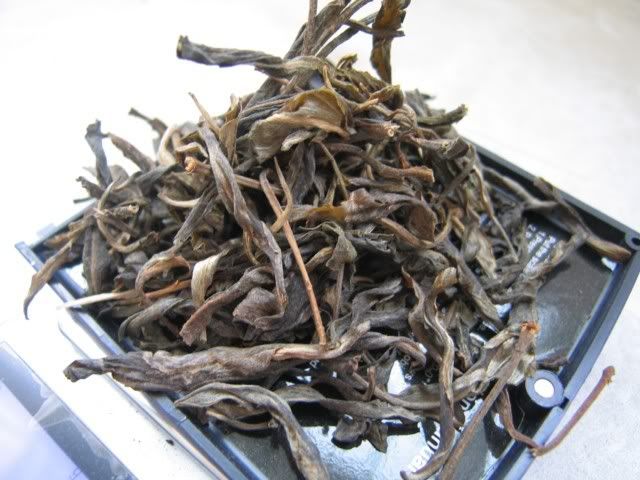
While there, I tried a tea that was very odd. It’s a maocha of some sort, a year old, supposedly. Yet, there’s something in that maocha that tastes old. If it weren’t for the obvious and harsh bitterness of the tea, I might even believe that it is an older tea, dry stored. The guy who brought it there said it’s a maocha deliberately made to taste old, and if pressed into cake, it is indeed not too easy to tell and can masquerade as something aged in a dry environment. The leaves are, actually, mostly yellow leaves, of the large and rough kind, and the taste is that of a rougher, harsher, more bitter variety. But it was very odd… probably one of the oddest young puerh I’ve ever tried.

We also had a 3 year old Yiwu that was smooth and mellow, although lacking in any sort of real punch. I think this will develop into a high fragrance kind of Yiwu. Decent potential, and not too expensive. Alas, I’m not in the market for more tea at this point.

I then walked around the market a bit, noting how there are still so many stores I’ve never really been to, or looked at. Yet, I don’t have time anymore, not on this trip anyway. Maybe next time, when I return to Beijing (whenever that is) I will get to go to them, but they may very well not be around by then. As I’m writing this, I just packed up all my puerh cakes, readying them for shipping to Hong Kong tomorrow. I should probably take a picture of how I packaged them, but that’s for tomorrow.

I must say I feel a little sad leaving Maliandao. I’ll be back, of course, and I have learned a lot just wandering the different markets there. I think I have progressed from somebody who only knew a few things about younger puerh to somebody who can at least make some sense of a young tea I’ve never tried before. I am still woefully unknowledgable when it comes to some other kinds of tea. I am hoping that when I go to Taiwan in August, it will remedy my deficiency in Taiwan oolong just as Maliandao has helped me understand young puerh.

→ Leave a CommentCategories: Misc · Old Xanga posts
Tagged: ,

Back in Beijing

June 26, 2007 · Leave a Comment

After a longish ride on the train from Shenyang, I’m back in Beijing.

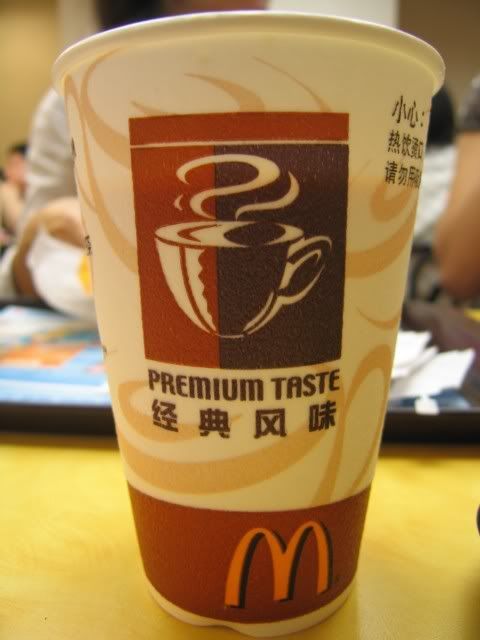
There isn’t much to report, other than it’s really frustrating when you need a cup of tea, and the only place that sells teas to go in China is either a Starbucks or a McDonald’s. It’s sad. It’s sadder when the server made the mistake of pouring you coffee and you only realized when you walked out and into the train station, waiting in line, and sniffed….

Tomorrow afternoon I might make my last trip to Maliandao in quite some time. It will be kinda sad 🙁

PS: I was notified that the picture for the jade gaiwan for my entry two days ago didn’t show up. That has been fixed. Thanks DH for pointing it out!

→ Leave a CommentCategories: Old Xanga posts · Teas
Tagged:

TenFu

June 25, 2007 · 5 Comments

One of the things that I never really said much about in the 10 months I’ve been here is Tenfu, also known as TenRen, or in the States, Ten Tea. For those of you who don’t know them, they are a very big organization, and at least in China and Taiwan, they’re everywhere.

When you walk into TenFu here, you’ll be greeted by a salesgirl (they’re all salesgirls) who will ask you what you might need, and especially if you look foreign (as I, mystifyingly, apparently do sometimes) they will be presenting you with a cup of jasmine tea. On one wall you will see an array of those golden colour tea canisters, with name of tea on them and their price. On the other wall will be a slew of teaware.

The array of teas that TenFu sells basically goes something like… a few kinds of green, some with a few levels, a few kinds of other oolongs, and maybe a million different varieties of tieguanyin, all of the relatively green kind. Prices range from the 100 RMB/500g to the 20000RMB/500g (or even higher, I think). Their puerh are extremely overpriced, and so are everything else, for that matter.

They are ubiquitous in China. Everywhere you go, as long as you’re in a reasonable sized city, you will see at least one. I’ve seen them a few times in Shenyang already, usually in the most central shopping areas, or next to certain sites, or… next to the provincial government, in this case (for the gift-buying crowd). They are one of the few tea stores in China that will sell tea in packaging that is one level up from the ugly foil bags, and they are also a place where they will actually let you taste whatever you want, pretty much (a lot of smaller tea stores that are not in tea markets are a little reluctant about that, sometimes).

The good thing about them is that they do introduce a lot of people who otherwise don’t care much about tea a first entry to decent tea. My friend L, who now runs a tea business, got started with TenFu. He said his family, two generations ago, were tea merchants in Tianjin. Then came the revolution and communism, through which they lost their company, but he picked up interest in tea again when he got involved in tea lessons at TenFu. He’s just one example of many people who are like that. TenFu is actively involved in giving lessons to people in tea, and they have a nice community going. The amount of work they do in promoting tea is certainly worth commending.

The downside is, of course, their price. They are expensive. Everything they sell is overpriced. When I first got to Beijing, I bought a small set of teaware from them that cost me 100 RMB. I probably could’ve bought everything in that package from Maliandao for about 20. That was a lesson learned. A lot of ex-TenFu customers I know now no longer buy stuff from them, because over time they have learned that TenFu sells them stuff that are way overpriced. Far more people, however, just keep buying from them because they just trust them, somewhat blindly, I think. I think it is mostly because it is just too much trouble sometimes for what isn’t really that much money, or uncertain quality, or something like that. Many are happy with what they provide, and that’s that. At the end of the day, I suppose it’s just a matter of “to each his own”, regardless of what it is, where it’s from, or how much it is. So long as TenFu doesn’t lie about their teas (which I don’t think they do), it’s not really a problem. I think when lying starts happening, it’s a different matter entirely.

I do blame them for popularizing the ever lighter oxidation/roast of tieguanyin though, making it hard to find the higher roast stuff. Oh well.

Back to Beijing tomorrow. I think while Shenyang is nice… it’s enough to spend a week here especially with the lack of tea. The archives are not too useful here, for me anyway, although it’s a good thing I finally got to see the old palace here and some unexpected cultural treasures.

→ 5 CommentsCategories: Information · Old Xanga posts
Tagged: ,

Shenyang

June 24, 2007 · 2 Comments

Sorry for not posting updates the past day and half. I’ve been out touring the city, but also because the internet here is really spotty — up and down whenever it feels like. I’ve never had a stable enough connection to do much of anything — even my emails are only getting checked slowly.

Mind you, there isn’t a whole lot to report on the whole tea drinking thing here in Shenyang. One big reason is because they don’t seem to drink much of it here. Unlike most of the places in China that I’ve visited, which are either big cities or in tea producing regions, Shenyang is not a big city (I guess it’s better called a second or maybe third tiered city in China) nor in a tea producing region. It seems like people here aren’t really into tea drinking. There are very few stores that are dedicated to tea, even in the touristy areas, and the few that do have your very generic selection of regular offerings — jasmine, greens, a few tieguanyins, some oolongs, and maybe a puerh or two. I’ve encountered two puerh only shops, but the prices are not exactly low, and the selection lacklustre. All in all, a boring place for tea.

The “tea” we had today for lunch was a good example of people’s attitude here towards the drink. This is what was in the 500ml metal pot

See those black specks? Those are the only leaves in the pot. I should add that they were reused from the previous sitting — i.e. they brew out the same leaves, from what I can tell anyway, for the whole day. Yeah. In fact, I haven’t had a single cup of tea here that isn’t ultra bland, except what I had this morning

Which is from…..

Shoot me now.

So as you can probably imagine, I haven’t been spending much time with tea, and drinking the Assam and the Lapsang Souchong I’ve brought along as my supply of decent tea.

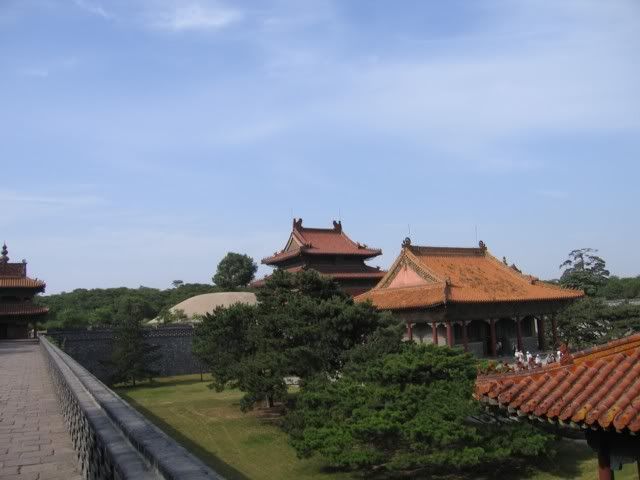
I have, however, been doing some touring of this rather pleasant city (apart from the lack of tea). As I’ve stated before, this was the capital of the Manchus before they conquered China, and so there are some historical sites here. Yesterday, we went to the Zhaoling, or the Luminous Mausoleum, for the second Manchu emperor Hong Taiji. The place is big…

If you look very carefully… you might be able to see a hint of the yellow roof of the main building in the distance. Or not. It’s big. The best part of the park was our ride around the park on a rented tandem bike (all 3 of us). Otherwise… it’s a lot of walking to get to places.

The actual mausoleum complex is not that impressive… but it’s the most elaborate this side of the Great Wall.

See that mound in the back? That’s where the ashes went.

The park has a conspicuous absence of any sight of a tea room — nowhere to drink tea. This further cemented my impression of the place as having not much tea.

We went to the Liaoning provincial museum today, which is a must-go. I was very very pleasantly surprised by both the quality of the museum itself, which was brand new despite the slightly ugly architecture

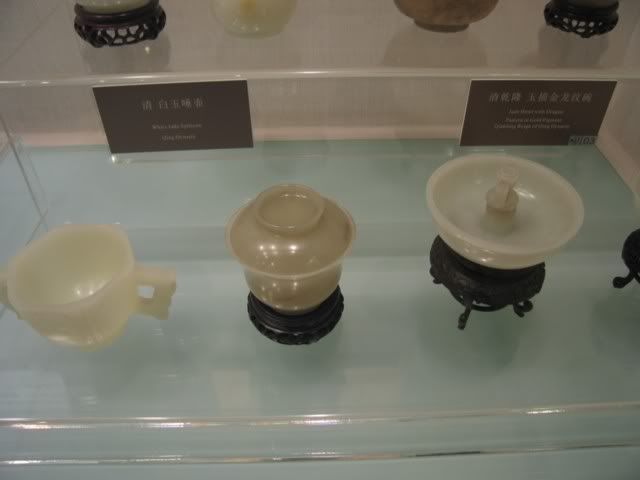
But they had a lot of Qing imperial collections, along with artifacts from earlier periods. Among which is one of my favourite calligraphers, Song Huizong, who is also the author of “Daguan Chalun” or the Treatise on Tea in the Daguan reign”. I took one picture of one of the stuff they had on display.

Among other collections, there was a nice jade gaiwan… note the more rounded lid (as opposed to the modern gaiwan with usually flatter lids). Gaiwans back then were used more for sipping tea out of (with leaves in there, I think) than just for brewing…. which I think might be part of the reason why.

We then went to the imperial palace, and the mansion of the last warlord who lived here, but that’s far too many pictures and probably not terribly interesting. Maybe another day, if it seems interesting enough. But if you ever come to Shenyang (4 hours train ride from Beijing, for those of you who might go to the Olympics or after) just remember to 1) bring your own tea and 2) go to the provincial museum!

→ 2 CommentsCategories: Information · Old Xanga posts
Tagged: ,

Traveling in China

June 21, 2007 · 10 Comments

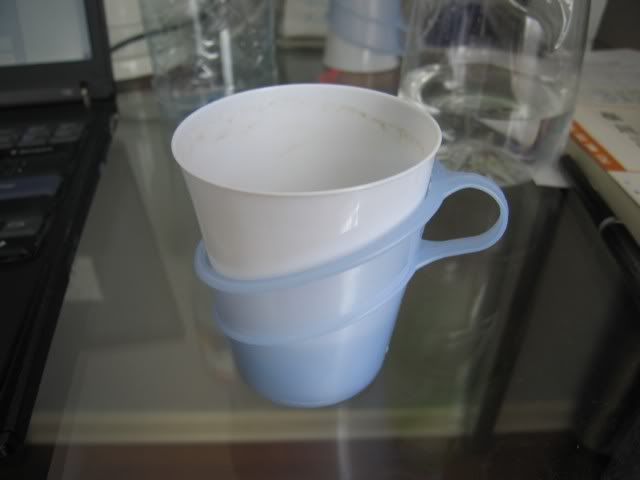
These days, wherever you go in China, as long as the hotel is semi-decent it is bound to come with a water boiler, of the cheap plastic kind. This one I’m staying at is no exception. Except, the hotel is fairly new and the water boiler still smells a bit like plastic. Also, they don’t have real glasses here. Instead, I get this:

The white cup is detachable from the base — in fact, it’s just a regular plastic cup slipped into a handle of some sort. It’s not very elegant, nor ideal for tea sipping, but since I wanted to travel light and not carry around a big load of teaware, this will have to do. The stains are from the previous tea that’s still in the cup.

I only took two teas with me on this trip – the Assam that Mr. Lochan gave me, and a Lapsang Souchong. I tried both in the plastic cup by now, and I must say I like the Lapsang Souchong better. It’s got a nice sweet aftertaste and mellows out evenly as infusions go on, whereas drinking the Assam, I really feel the lack of milk was making the tea less enjoyable than it could be. The tea is more bitter, and doesn’t quite turn sweet in later infusions the way the LS does. I think this has much to do with the intended market for such teas, and the preferences of the target audience. A tea like LS will not sell well in China if it doesn’t turn sweet, whereas the way this LS is is probably a touch too light to go with milk.

I think this might also account for the way the Indian Oolongs behave. They brew a bright, strong introduction, but then fades fairly quickly as infusions go on. I think they’re probably just not meant to be drunk that way at all, and drinking it Chinese style is probably not “getting” the tea. Perhaps if stuck in a big porcelain teapot, with some scones on the side, they will beat any Chinese oolong brewed the same way.

→ 10 CommentsCategories: Information · Old Xanga posts
Tagged: ,

Beijing

June 20, 2007 · 3 Comments

One of the questions I get asked most often is — what do you actually do in Beijing besides drinking tea? What I do is really quite boring (historical research on some obscure topic that nobody cares about), but where I do it is perhaps slightly more interesting.

Since my work involves a lot of flipping through dirty, dusty, poorly catalogued and a few hundred years old documents, guarded by staff that are only rarely friendly, the work is not always pleasant. The trip to the archives, however, can be somewhat pleasant, if the weather’s nice.

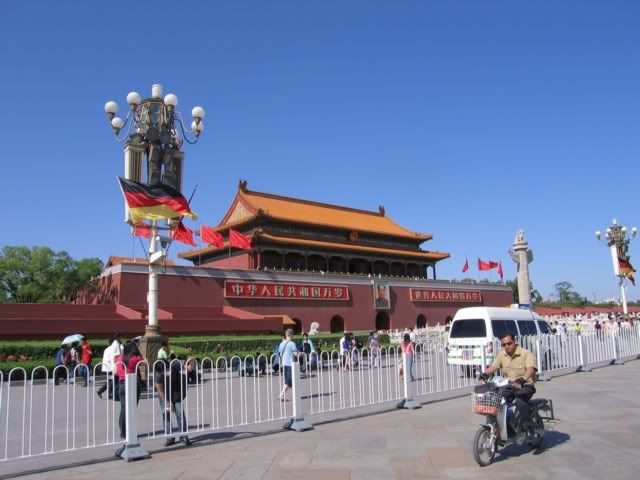
I get off the subway at Tiananmen West, which is, as the name implies, on the West side of the Tiananmen Square. On the one side, it’s the Tiananmen.

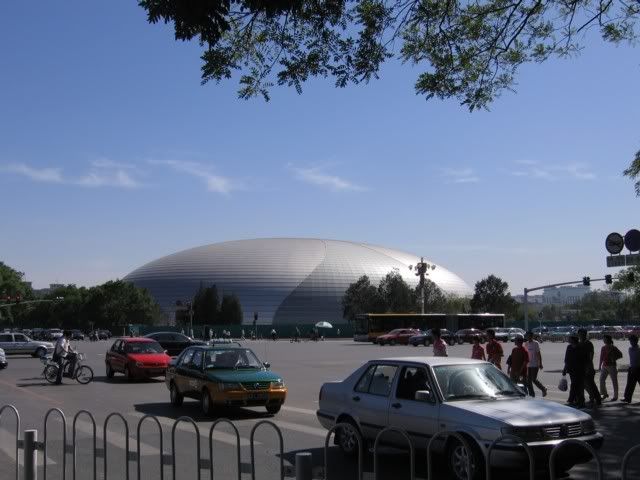
But in the opposite corner, there’s the very out of place Eggshell

Which is going to be the new National Opera House.

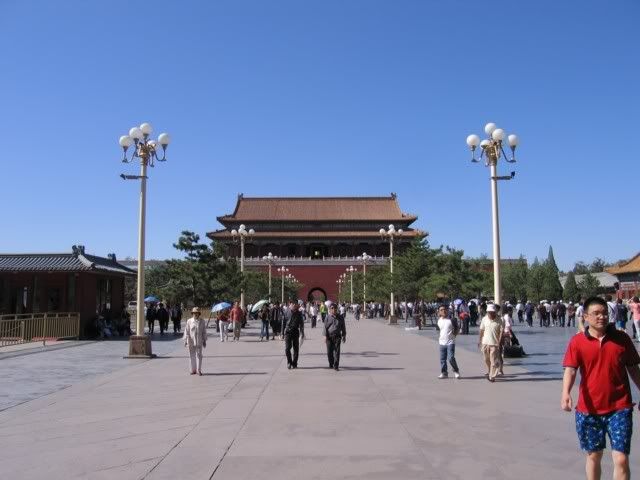
It might be an interesting caveat here to say that the Tiananmen is NOT the entrance to the Forbidden Palace… to get in, you have to walk through the Duanmen (seen from Tiananmen)

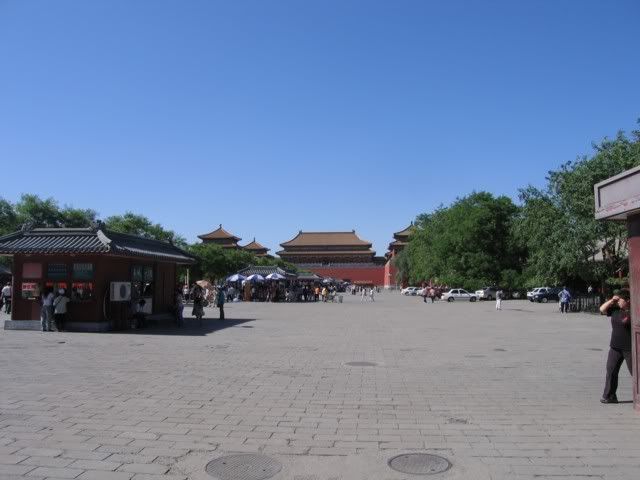
And then you’ll see the entrance — the Wumen (Meridian Gate), as viewed from the Duanmen.

It all looks rather small, but if you look here, you can see the buliding actually cuts an imposing figure.

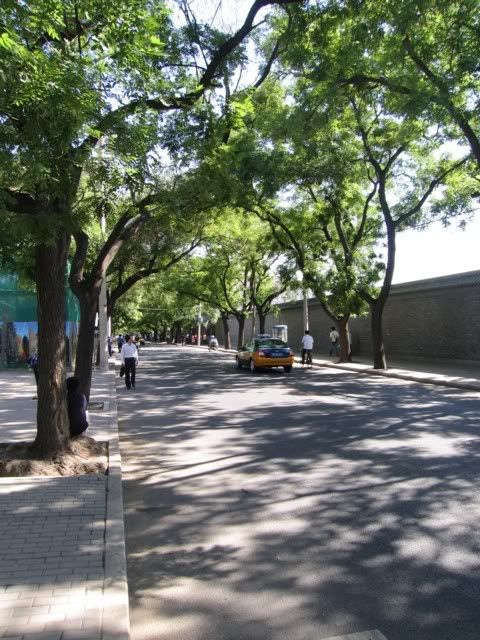
But I don’t get to walk through these places to go in to the archives. Instead, I go through the side — walking down a rather pleasant street

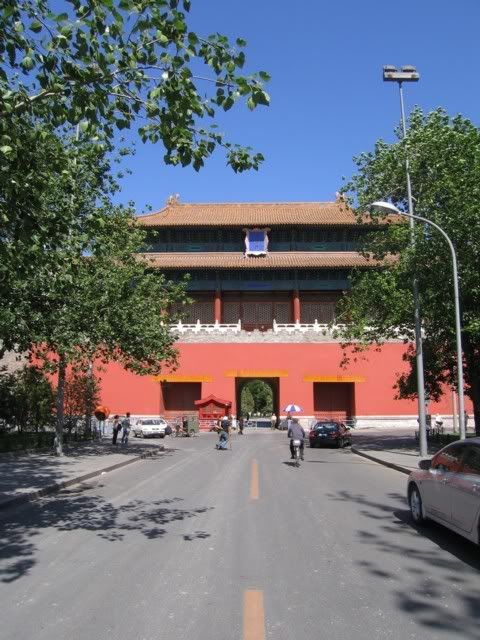
After a few minutes, I get to see the gate that I do get to walk through, the Xihuamen

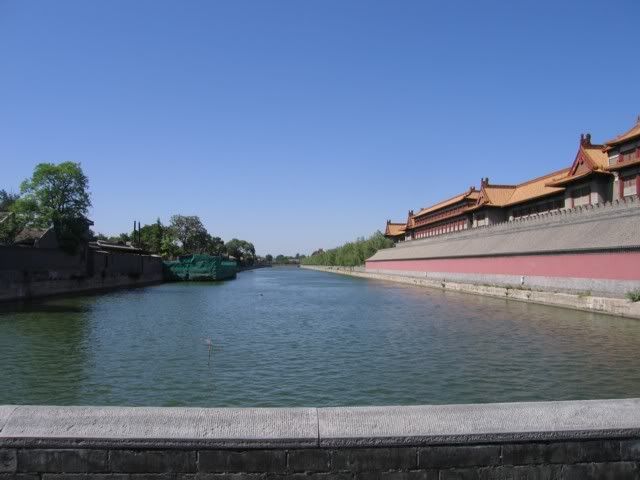
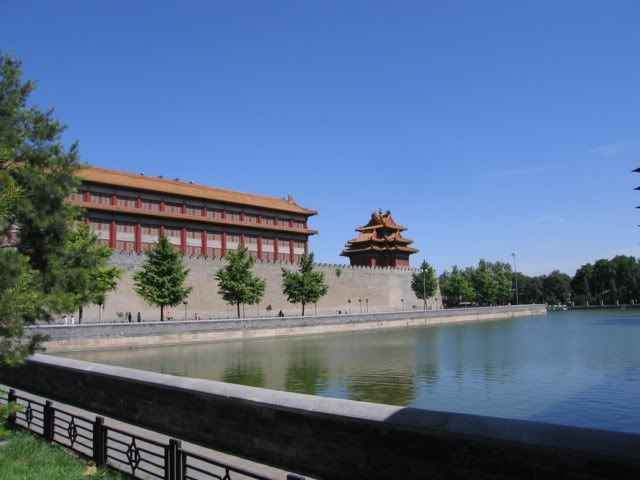
Which is across the moat for the Forbidden City — it’s not that obvious when you go through the front

In the first picture — those tall buildings right behind the wall are the archives, where I go look at my dusty documents.

Inside… you can still see the old buildings, but parts that one doesn’t get to see when you pay the entrance fee.

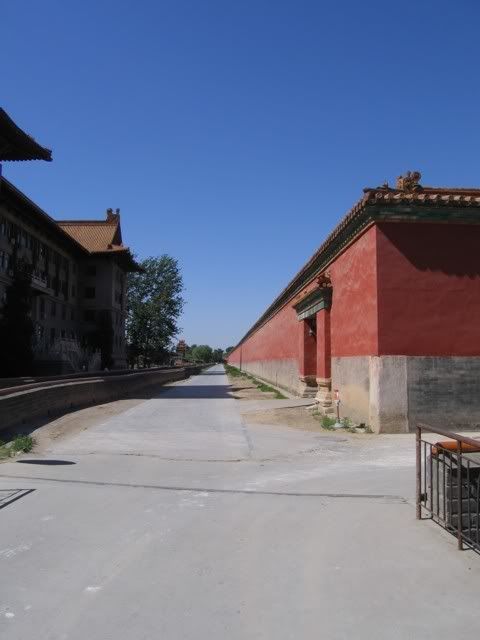
The building on the left is the archives, and the wall on the right circles some of the quarters that are for palace workers…. not even people who are related to the Emperor in any way. To give you an idea of the scale of the thing… the grey part of the wall is about 2 meters high. The distance is, of course, quite far.

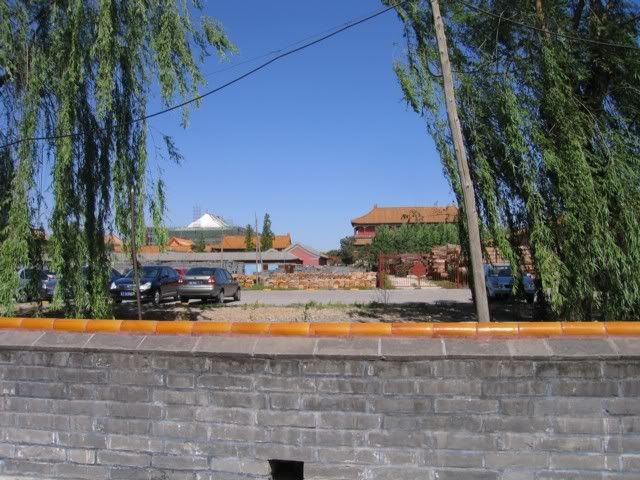
They are doing some serious renovations for the palace these days, partly to get ready for the flood of inevitable visitors during the 2008 Olympics. There are lots of building materials stacked up, and in the back — the draped over roof of the Hall of Great Harmony, which is the biggest building in the complex.

So that’s what I do everyday, until recently anyway. Now I’m sitting in a hotel room in Shenyang, the old Manchu capital, with very unreliable internet, having just dealt with even less friendly archivists here. Oh well.

→ 3 CommentsCategories: Information · Old Xanga posts
Tagged:

A bad day for tea

June 18, 2007 · 4 Comments

Weather was horrible today. Or more specifically, the air was horrible today. I walked outside this morning, and what greeted me was a nasty industrial smell. The air was yellow. It smelled like sulphur or something. Pollution at its worst. My eyes could feel the sting of the bad air. It’s that bad.

So I basically holed myself up at home. I should’ve gone for something safe, something nice, to cheer myself up despite the bad air. Instead, I went for adventure…

Going through the samples again, I found a bag that was given to me many moons ago by YP, a very experienced tea friend from Hong Kong. She gave me a corner of a cake she thought was interesting and worth experimenting with. It was a silver needle cake. I’ve now come to the conclusion that silver needles generally don’t age so well, but maybe YP has a better eye for these things than I do (I’m sure she does, actually). She said she bought it because she didn’t know what to make of it, so it was an experiment. Now it’s at least two years old. Let’s see how it went.

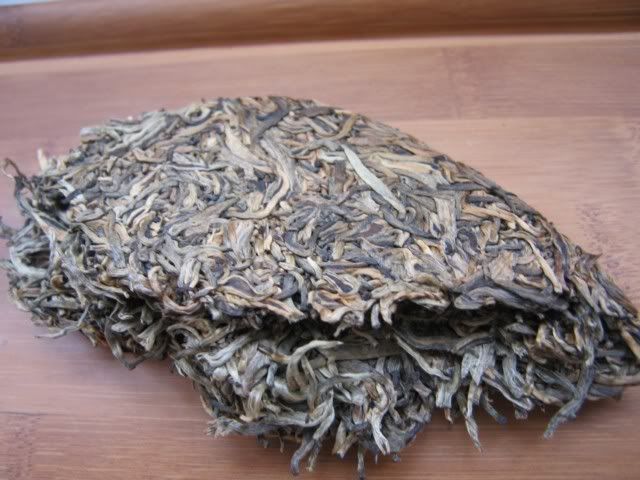
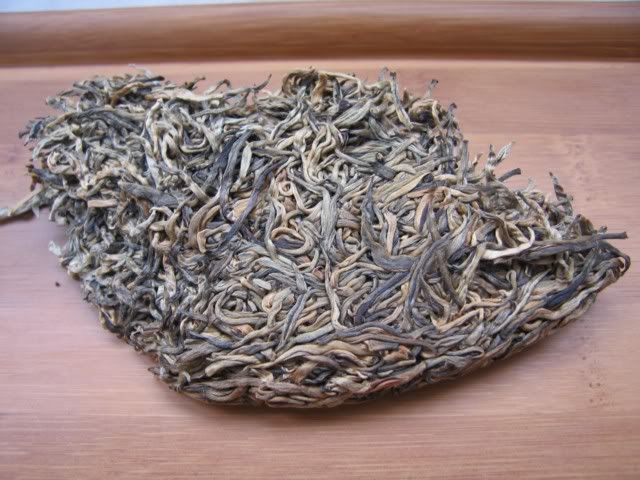
As you can see, it’s a big piece. In case you have any doubt about the fact that this is a silver needle cake

It’s 100% pure. The tea has a reddish tint now. If it’s a little redder, it could pass as a Yunnan Gold pressed into cake.

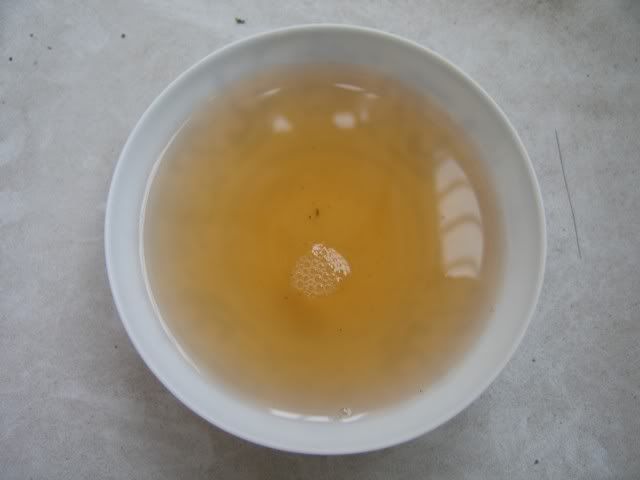
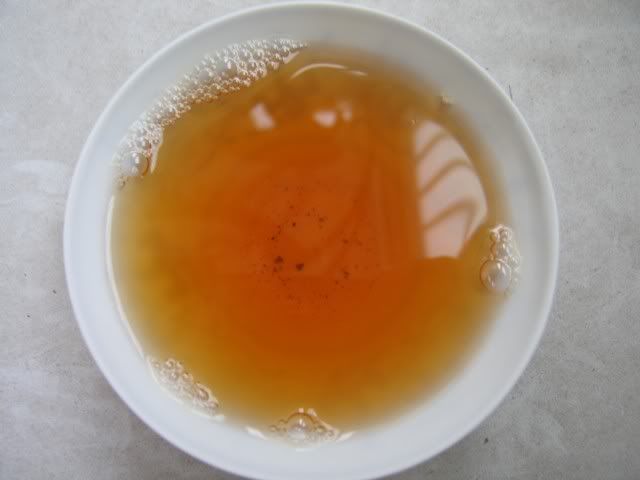
The first infusion was great. Light, sweet, fragrant, with a slightly odd but somewhat familiar smell/taste. I couldn’t quite pinpoint it. It was interesting. The second infusion was similar, but a little roughness crept in at the end. The third:

Was a little more rough…. a little more bitter. The fourth was worse… I think I can see where this is headed now, and I stopped before the tea turned nasty on me. Four infusions in, and the first was the best.

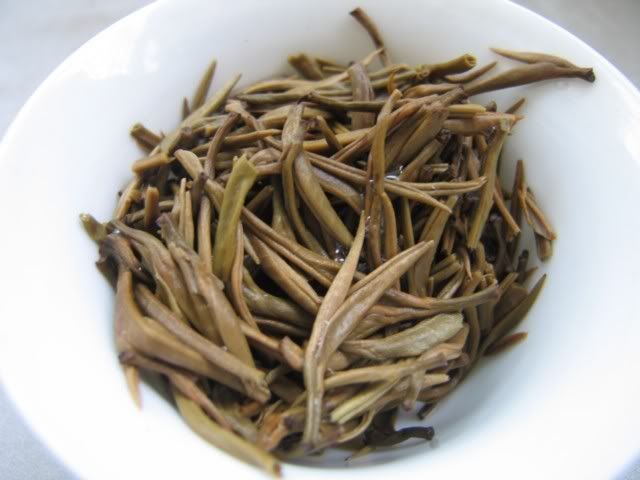
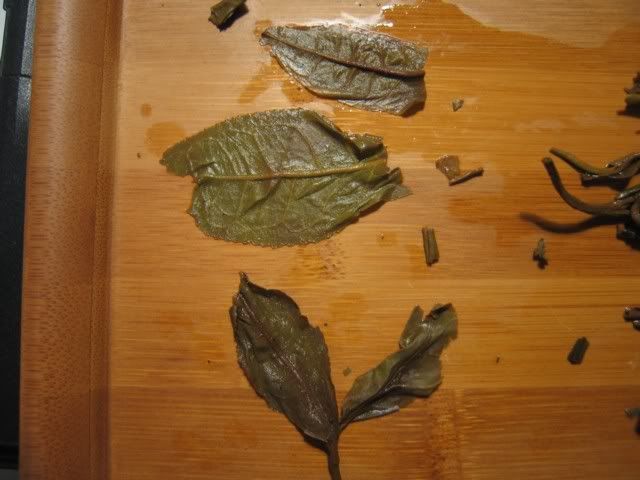
The wet leaves really make me wonder what I was drinking. Is this puerh? I’m not sure it is. Is this green tea? Maybe… stale green tea? I don’t know. What do you think? I know YP got it at a pretty cheap price. Good thing too. I don’t think it will compare to her Traditional Character Zhongcha in 25 years.

Dissatisfied by the rather lacklustre drinking session, I opted to drink another tea. I picked up the samples from iwii. The last two had some plastic bag smell in them, so I let them air on a dish. I sniffed… seems ok. So I picked up what he labeled as sample A, and which, he told me, is a Wisteria House (of Taipei) Yiwu via M3T in Paris, sent back to me in Beijing….

I forgot to take a picture of the dry leaves, but they are not really remarkable in any way — broken loose pu, a bit black/dark, and not too distinguishable from any other puerh that’s a few years old.

I brewed it up… and realized that even though the smell of the plastic bag was gone from the dry leaves…. the tea is already deeply infused with the plastic bag smell. Uh oh. I am drinking floral tea, except that this is not jasmine.

The tea brews a deep colour

Iwii said it’s 2003. It looks a bit dark for 2003, but it was probably stored in Taiwan.

Unfortunately, because of the plastic bag smell/taste, it made it rather difficult to pass any sort of real judgement on the tea. All I can say is that the tea is a little rough for my taste, after about 3 infusions, it started getting astringent. There’s some qi, and definitely something that resembles huigan (hidden in the sea of plastic). There’s also some throatiness, or is that my throat acting up because of some chemical component doing something to me? I’m probably making it up here, but whatever it is… I don’t know what to say about it. I feel this is sort of an ok tea, but not a great tea, but I really shouldn’t say that because I’m shrouded in a sea of plastic bag smell…. I’m sorry Iwii, I should’ve waited. In fact, I should let the rest of the samples sit around for much longer than just a few weeks before trying them ever again.

I was still dissatisfied, but my body has had enough caffeine. Oh well.

The wet leaves of the sample doesn’t look all that impressive.

Some of the leaves are more yellow-leaf like, or seem a little stiff. I wonder why.

Now I’ll wake up in a few hours to catch an early morning train to Shenyang, in Liaoning province in the northeast in China, for about a week. Among other things, Shenyang was the capital for the Manchus before they conquered China (it was retained as a nominal capital after they moved to Beijing). I wonder if I can find cheap puerh there like Hobbes did recently. Somehow I don’t think that’s likely.

→ 4 CommentsCategories: Old Xanga posts · Teas
Tagged:

Market fragmentation

June 17, 2007 · 5 Comments

I went to Maliandao today, and saw my friend L who came up from Shanghai. I think he had some business to deal with.

He did bring something good, supposedly, anyway. It’s a sample of a Yellow Label from, ostensibly, the 70s. We tried it… nice, but in almost the exact same way that my loose GYG pieces are nice. They taste virtually identical. I’m sure the person who got the Yellow Label cake paid many multiples of what I paid for my pieces. It was a happy thing to know.

I also tried a number of other things, both at L’s store and elsewhere. They include an 03 Yiwu that’s been in Yiwu storage, which is reputably pretty wet and which shows when I tried the tea — there’s a sort of mustiness to it. I also had an 07 “rainfall” (aka summer) Yiwu maocha. Very bland, relatively speaking. Pleasant enough to drink, but not good enough for anything else. There’s a reason summer teas are used for cooked puerh. In fact, I think it’s a waste to bother to pick them – the taste is boring and flat, despite long infusions and generous amounts of leaves. It was definitely interesting to try though. I also had a mass production cake from Zhongcha this year. Smells nice, decent aromas, but a little too aromatic and too little bitterness for me to feel like I’m drinking young puerh.

Then I went on to the store that sells Douji puerh. I tried two things there. One was their 06 Fall “Yu Pin”, which literally means “jade product”, but is from the fringes of the Bulang area. Another cake is a self-produced cake by the owner of the store, who went to Yunnan this spring to press the tea himself (500 cakes of it) and who doesn’t really sell it except as gift packs. The cake is a Guafeng Zhai spring first flush. He pairs it with a real Lao Banzhang, and the set sells for a staggering $330 USD. Not cheap by any stretch of imagination, but then, he had high costs as well as real financial backing (I think tea is entirely a side business for him — he runs some other company). The teas were collected at above-market rates, and he only used first flush tea. The Guafeng Zhai tea is nice, but somehow, I don’t think it’s spectacularly nice to demand such high sums. I mean, it’s got good qi, but only so so huigan and not a lot of throatiness. I’ve read that sometimes for puerh it is better not to use first flush, which is sometimes too tender. Perhaps that explains the relatively subdued nature of the tea. The qi lasted a good bit, and the tea made my stomach hurt, but really… a lot of teas can do that for far less money. He also used an extremely generous amount of tea, which makes me think it has something to do with the strength involved.

One interesting tidbit the owner of this store told me today though is that he’s tried a number of 07 teas so far, and he thinks they are all weaker compared to the 06 version. There’s been talk that because of low rainfall, the tea this spring should be better, but he thinks that when rainfall gets too low… the tea suffers in quality. He might have a point. I haven’t really seen an 07 cake thus far that has made me feel like it’s worth buying. Prices for cakes this year are also much higher than those of years past, simply because the raw materials have gotten so much more expensive. When a lot of 03-05 cakes can be had for less money, why buy 07? It makes almost no sense to do so.

He also told me that many factories are pulling in tea leaves from other provinces to cut cost as well as to keep production going. After all, the total capacity for producing puerh in Yunnan right now has far outstripped the supply of raw maocha in Yunnan, especially given the low production yields this spring (one reason why maocha prices are up, supposedly, and also why a lot of factories haven’t produced much 07 teas yet). Like the story I posted about a week ago of Li Jing, who started a factory but has received few orders, most factories need to make tea to stay alive. Overcapacity, however, is a real problem, and I think many such small factories will be heading for a fall. What that might mean for the owners of such factories… who knows.

Right now there’s a lot of uncertainty in the market. If you’re a bull, you will cite the fact that puerh is still 1) very cheap, relatively speaking. 2) It’s only popular in the coastal cities. 3) Brands are still forming. 4) The tea’s inherent advantages, like rebrewability, ageability, etc. If you’re a bear, then you’ll cite 1) overproduction/capacity. 2) High, bubble like prices. 3) Unpalability when young. 4) Extremely volatile market.

How it goes only time will tell, but I think we’re seeing now a healthy segmentation/fragmentation of the market going on, with real consequences for us regular buyers. On the one hand, you have the big factories producing regular stuff that are, more or less, known items. Menghai and the like are prime examples of that. On the other hand, you have these small, boutique shops that make high priced teas catering to the wealthy and (perhaps) knowledgable. These are the ones with very well defined terroir, limited quantities, and high prices to go with it. These are also shops that can’t possibly do this on a grand scale for simple reason of economy and supply.

One huge problem though is that nobody, as far as I know, has good access to a steady source of such tea production areas. Everybody who is in the business rely very much on contacts in Yunnan, trying to score good maocha from the farmers. The way land ownership and production works in such areas is that nobody can buy out a whole mountain — the most I’ve heard of is somebody securing the promise of local farmers to only sell to him. Even that is difficult to enforce/police, and creates problems for a sustained level of quality, especially in a difficult to manage agricultural product like puerh tea.

Another factor that is complicating the issue is the appearance of drink-me-now puerhs. The oolong-ized or the green-tea-ized puerhs taste great now, but nobody really knows how well they age in the long run, and very few (myself included) can really tell them apart with good certainty. Whether such teas are worth the money depends on your tastes — do you want to buy it for aging, or buy it for drink it now?

I know I buy puerh hoping they’ll age into something great for the future. I’m more of a fan of aged teas than young teas, even though my current drinking habits would seem to indicate that I like them young. Rather, I’ve been trying them as much as I can while I have good access to it, and I expect myself going back to more oolongs in the near future when I won’t see as much young puerh. It creates a lot more work for me, and I noticed I’ve gravitated to small production, higher priced, but more individualistic puerh. Soon, however, I’m afraid I’ll be priced out of that market, if current conditions continue, and I think I will, because, as I’ve said before, I think old tree teas, the real ones anyway, won’t drop significantly in prices. Can’t say the same for the mass produced stuff.

Maybe I need to nurse my collection and hope they will all age to greatness, because I might not be affording some of them anymore a few years down the line. Let’s hope I’m wrong on this one!

→ 5 CommentsCategories: Information · Old Xanga posts
Tagged:

Revisiting a Yiwu maocha

June 16, 2007 · Leave a Comment

I thought about this tea after drinking the Yiwu Zhengpin a few days ago. As I noticed an obvious change in the Yiwu Zhengpin, I wondered if this tea I’m drinking today has changed as well since I last had it, probably sometime in December in Hong Kong with Tiffany. I got this from the Yiwu girl when I was dealing with her, trying to get the tong of tea from her that I wanted. The tong is now with me, and I still have some of this maocha left. Not a whole lot, mind you, but enough for a few more sittings.

I duly measured 7g of tea.

Last time I drank it and actually posted a full set of notes, I thought it was nice, very nice, in fact. Of course, back then my experience with young teas was considerably less than what I know now, purely because I’ve had so many more teas in the past year 8 months (wow, it’s been that long). I think this tea is memorable for the fact that it was the first time when I felt all those things that people talk about but I have only seen glimpses of — the throatiness, the huigan, the qi, all mixed into one. I’ve since had other teas that are like that, but this one was the one that first allowed me to taste what I now seek in young puerhs.

I’ve really liked the results of me taking pictures of the liquor of the tea in my little clothes-drying area — the lighting in the afternoon works well to give it a consistency that I needed, and looks more natural than artificial light. Too bad I’ll be leaving Beijing soon and have to find some other way to replicate this.

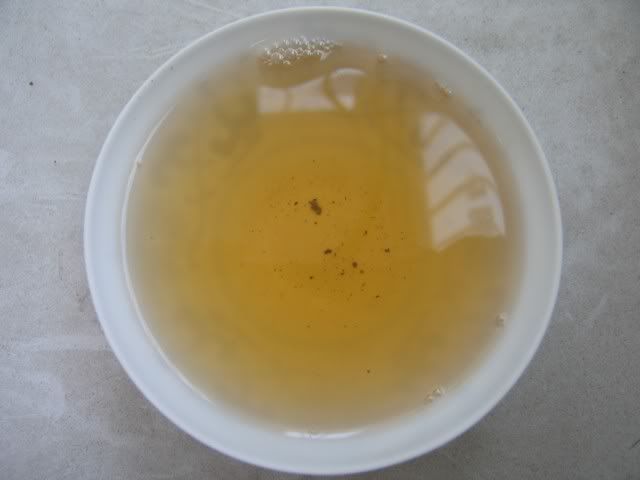
The colour of the liquor, I think, is comparable to the last time I tried it. Although the dry leaves do look a touch redder than the last time, the tea doesn’t taste that way. It’s slightly bitter, sweet, an obvious Yiwu taste, and good huigan as well as qi. The tea is medium bodied. There’s some throatiness as well, more, I’m sure, if I brew it for a little longer, as I employed fairly short (5s or under) infusions until about the 7th.

The tea is smoother than last time, I think, and only displayed some minor roughness when hitting the 5th or 6th infusion, but it died soon after as the tea turned to a sweeter taste. Bitterness is more obvious if I employ longer infusions, but I’ve tried avoiding that.

A very interesting thing is the way the different teawares smell after each infusion. After I pour the tea out from the gaiwan into the fairness cup, I smell the bottom of the lid, which smells like that slightly sour, slightly off smell of young puerhs — some have called it “stinky green” in Chinese parlance. It’s not an aromatic smell. Rather, it’s more like an odor. Some have said this is the sun smell. I’m not sure, but I have taken it to be a typical young puerh smell. The leaves themselves don’t display much of a smell at all.

Then, pouring the tea from the fairness cup into my drinking cup, I smell the fairness cup, which, in this case, smells quite floral. It’s that Yiwu smell. After drinking, I smell the drinking cup, which is sweeter than the fairness cup.

It’s quite fun smelling all the different things. I think a wenxiangbei will only give you one kind of smell. I am personally not a fan of those things, as must be obvious, and it seems my preference against it is shared in some circles, more in mainland and Hong Kong. In Taiwan they seem to employ it more often.

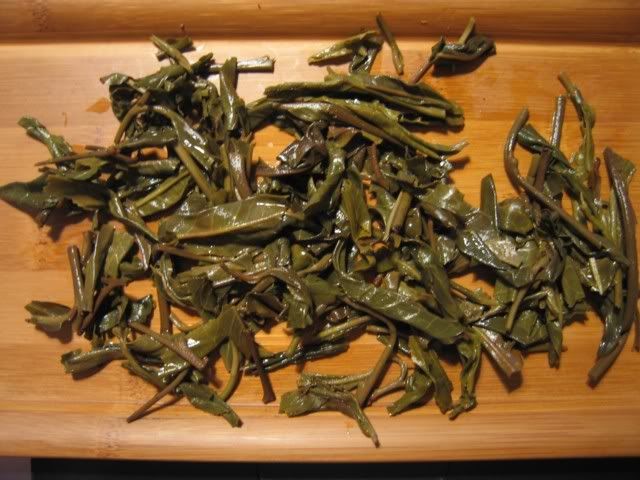
After quite a number of infusions, I poured our the leaves

Since it’s maocha, it’s pretty.

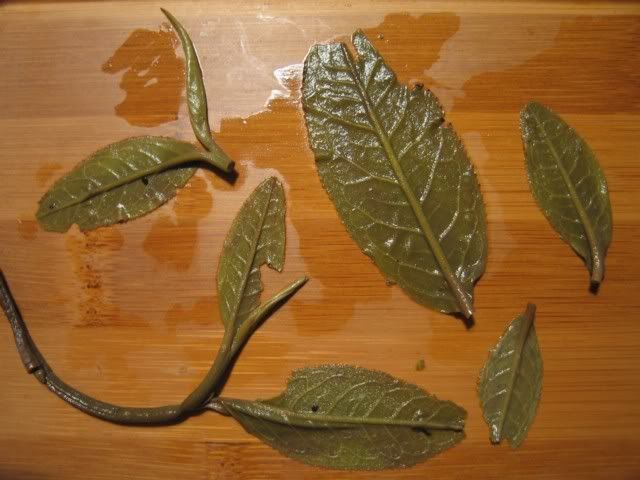
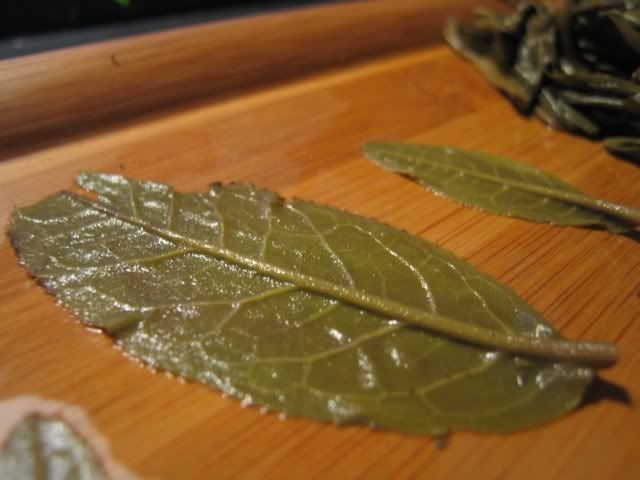
I should note, at this point, that I no longer think thick center veins have anything to do with the age of a tea. I’ve seen plantation teas with very thick center veins. I do, however, think that if the secondary veins are obviously popping, that could be an indicator of the fact that the tea is from older trees. Don’t ask me why, and I don’t know if biologically this makes any sense, but among the teas I’ve seen, obviously popping secondary veins are pretty rare, and seem to happen most often with old tree teas. This picture might make my point clearer

In the pictures for the 6 mountain maocha series that I drank (link to the left), you can also see this in action. Although, I don’t think that is universally true and certainly shouldn’t be used as a reliable indicator. Rather, it’s more like an observation….

→ Leave a CommentCategories: Old Xanga posts · Teas
Tagged: