A Tea Addict's Journal

Infidelity

September 11, 2007 · Leave a Comment

I am not terribly faithful when it comes to drinking tea. You, the observers, can probably tell that I drink a different thing every day. For me, that’s part of the fun — to try new things, to experiment with something different every day. I know some people do it with food, others with movies, etc. Tea, however, has that added advantage that no two sessions are ever exactly the same, at least for me.

I went back to the aged shuixian I have today, and it tasted quite different than last time. It’s less heavy — more airy and aromatic. It opened with an incredible sweetness, but then faded a bit to a dull, slightly boring tea. When I overbrewed it near the end though, the sweetness came back (which means I probably brewing a touch too fast in the middle). There was also something creamy about it at the end. I don’t know what that is.

It’s not a terribly exciting tea, but there’s always a sense of something new… some sort of discovery when one makes a cup. Maybe this is why I don’t use a timer (I tried putting those times down in my blog a few times…. and realized it’s really not for me to do it). It’s more fun that way. I can probably make more consistent cups if I always use a scale (which is mostly used these days to make sure I don’t overstuff my pots with young puerh). I think when one worries too much about the details… how hot exactly the water is, how long exactly the water’s been in the cup… one loses focus on the more important things, which is to relax and enjoy a cup of tea, preferably with friends, but even when alone, there’s much joy to be had.

→ Leave a CommentCategories: Information · Old Xanga posts
Tagged: ,

Bangwei 2006 Fall

September 10, 2007 · Leave a Comment

I had something relatively benign today, after yesterday’s long tea session. It’s one of those samples from Beijing that are still kicking around. This is a tea from a guy who sells through Sanzui, and from whom I have bought a few things. He always sends free samples along after you buy stuff as part of the shipment, and this is one of those samples that I got. They come in very big chunks (50g or more in a few cases) so he practically gives you a free cake when he sends you 3-4 samples.

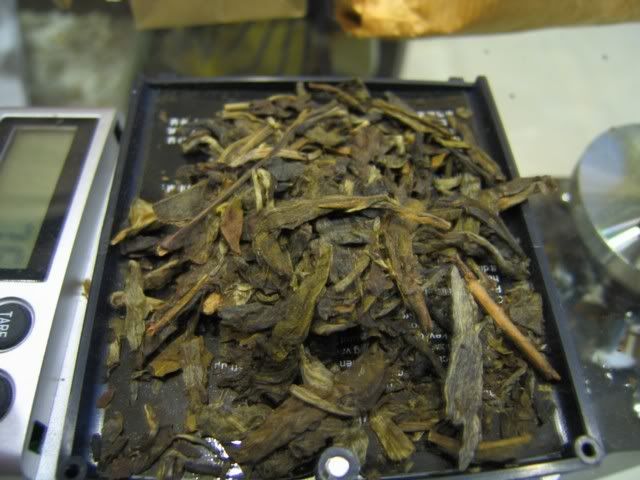
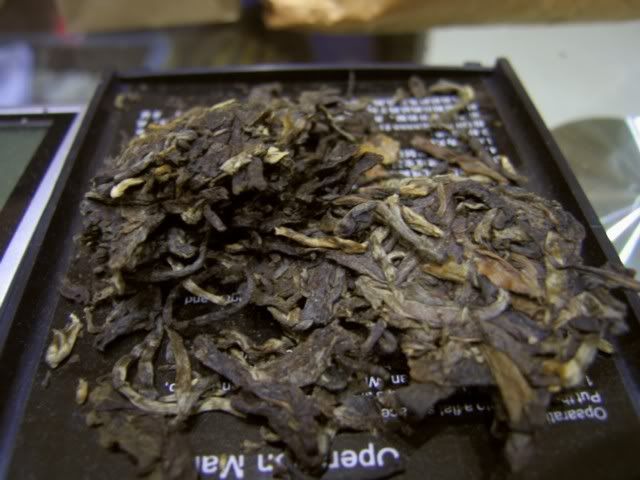
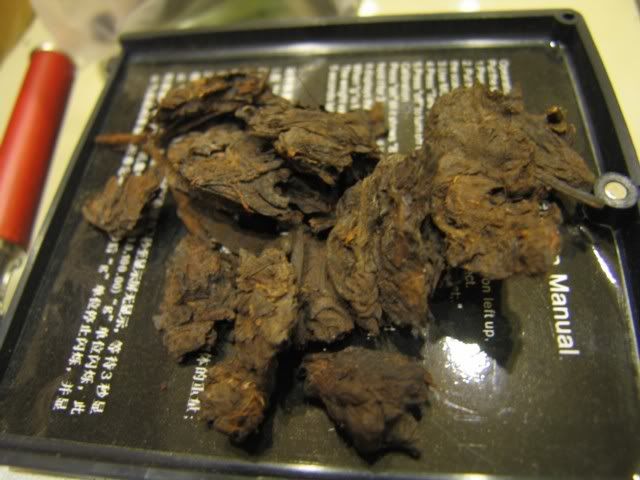
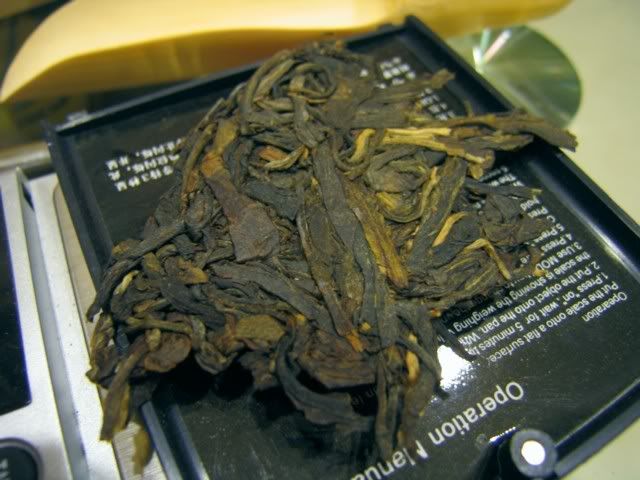
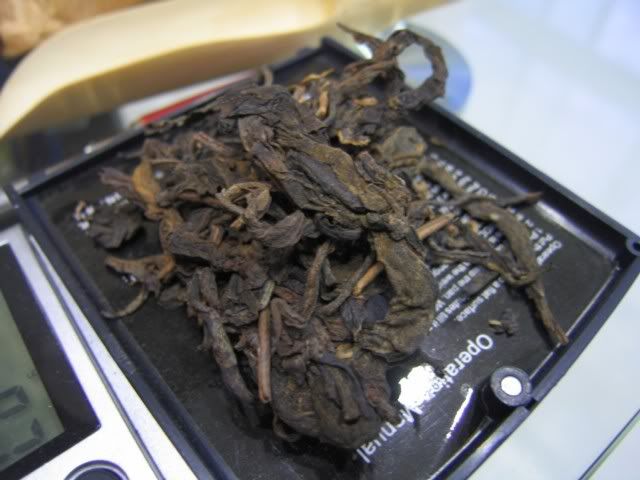
I remember I was pretty impressed by this tea — it had strength. When I tried to break it up this time, I noticed that the tea is well massaged when they were rolling it in the cloth, readying it for compression. Rolling it around a little is essential, because otherwise the leaves are not intertwined and the cake will fall apart easily. My sample is one solid piece, and when I tried to pry it apart, the leaves stuck together pretty well. Not all cakes are like this — sometimes the leaves are basically layered and can be peeled easily. Not this cake. After some breaking:

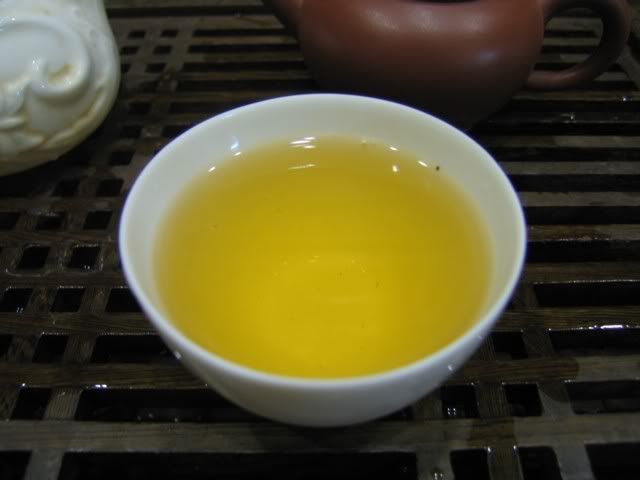
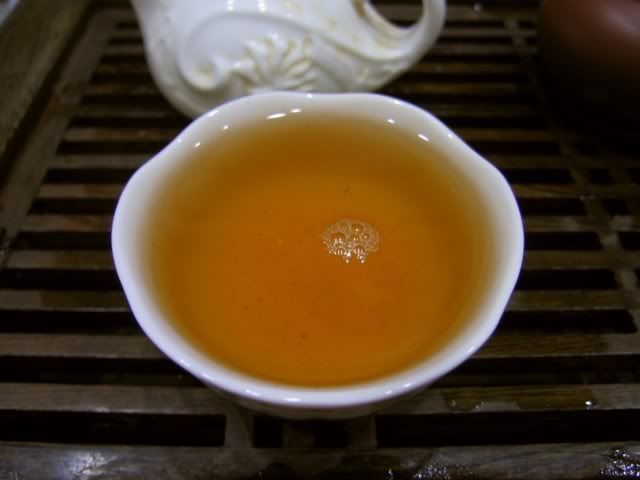
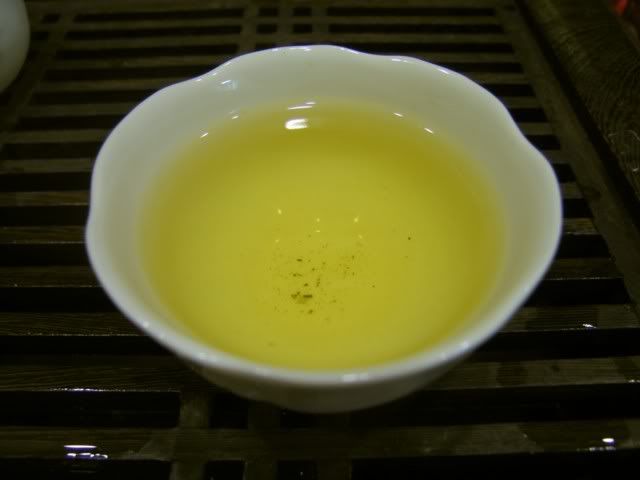
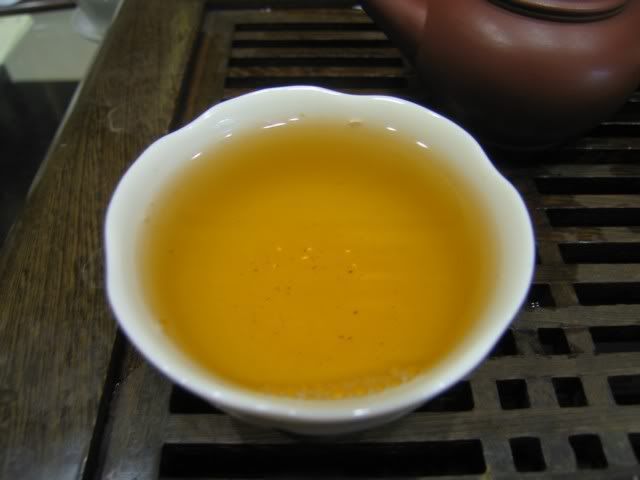
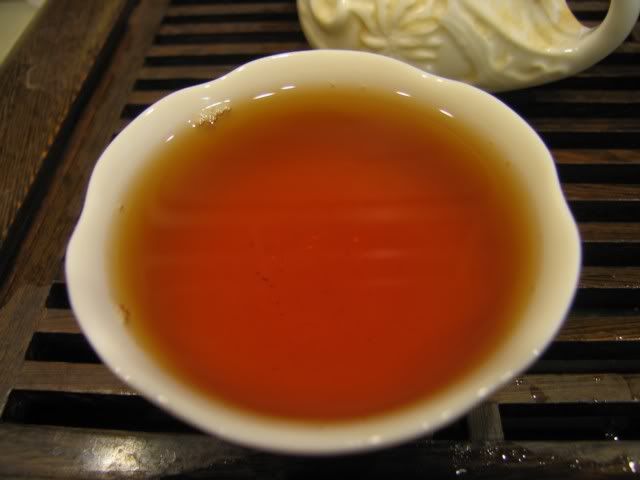
It yields a golden yellow liquor:

Ever so slightly smoky, but otherwise, a bit floral/fruity in its aroma, and has good strength overall in its qi and depth. I still like this tea. I didn’t buy it though — I bought the spring version instead. Some people say Bangwei tea is no good, but I’ve found at least this particular one to be pretty decent, and it’s much cheaper than more famous mountains, which is also a plus.

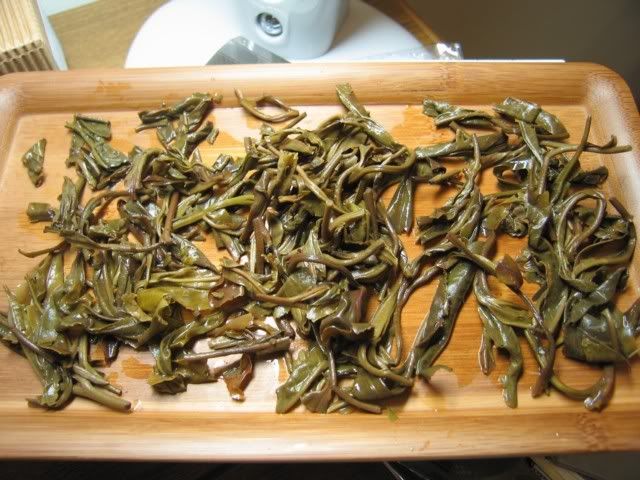
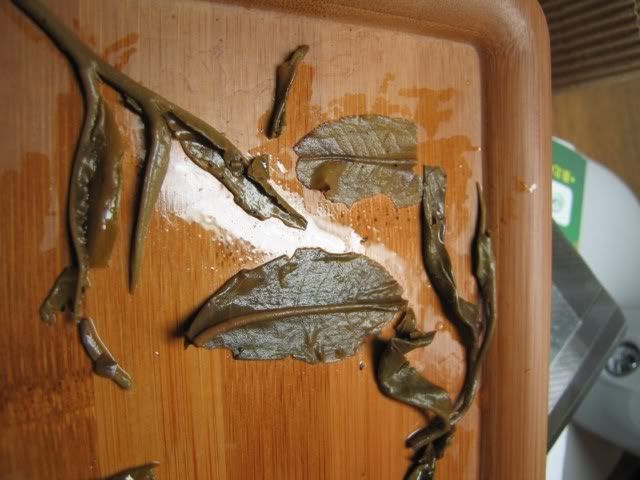
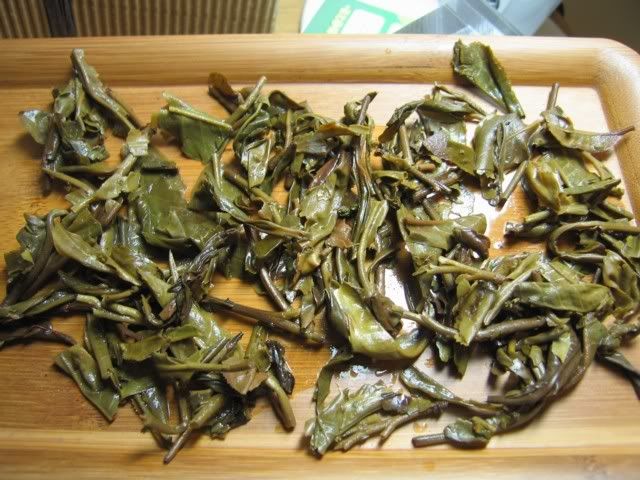
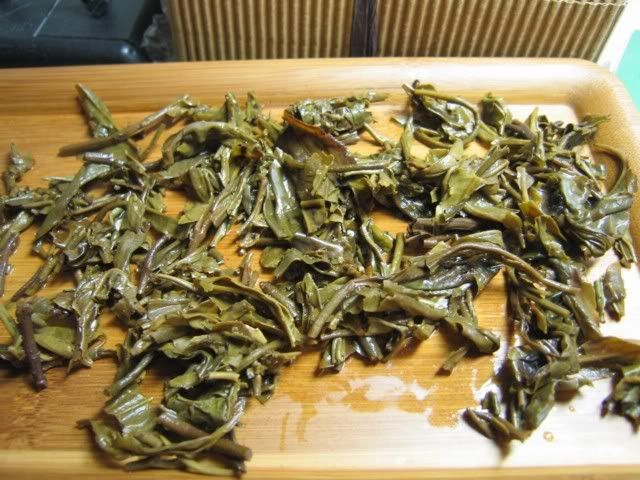
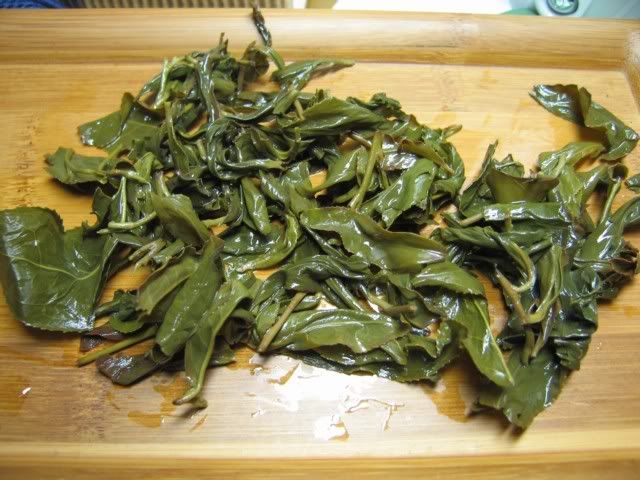
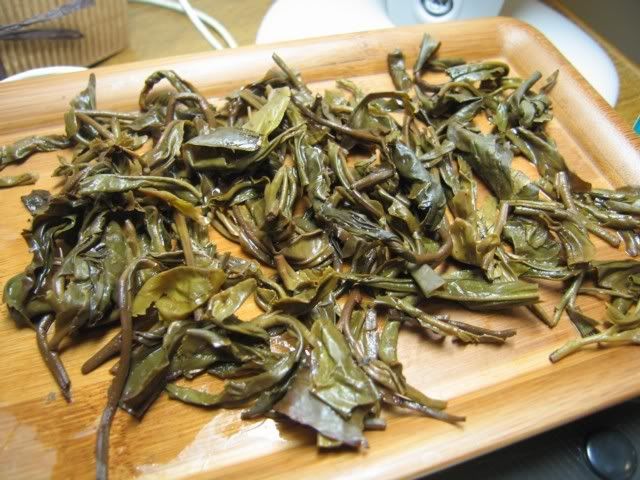
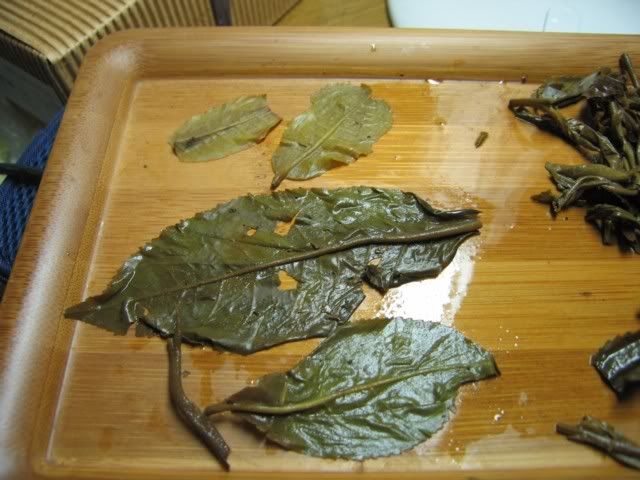
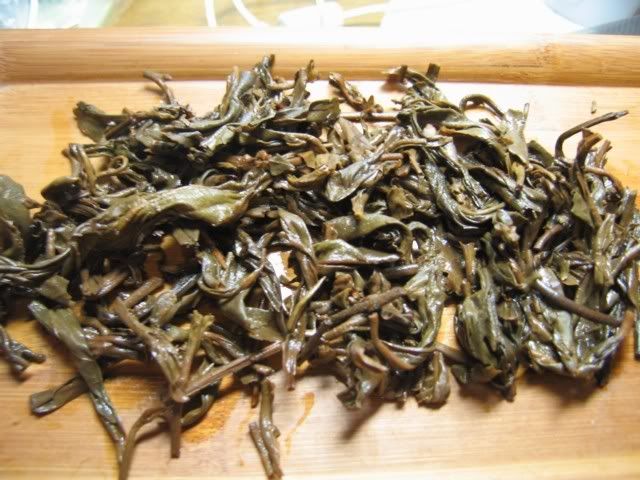
The leaves are large, stems long, but all very soft and not much of reddishness (a little bit here and there).

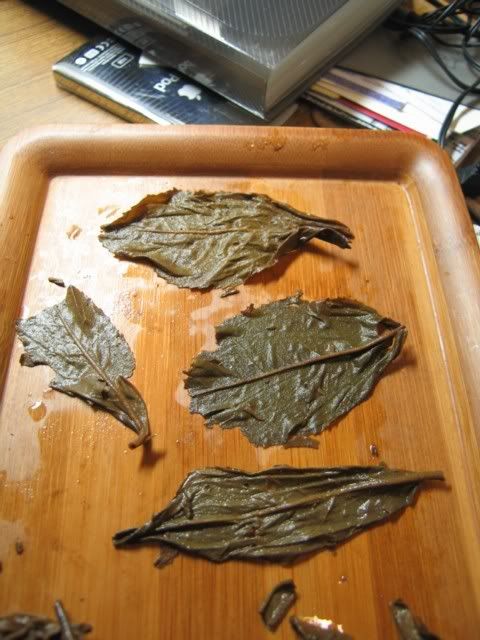
Leaves don’t all unfold, which I actually think is not a bad thing. I have heard of problems of tea makers trying too hard to make sure the leaves are whole and unfold, and end up doing too little rolling during the making. Since the rolling is essential to break down membranes and also induce fermentation, etc, when it doesn’t happen enough the tea really suffers in the future — slower aging, or problematic aging. More rolling also makes it more bitter/astringent. I wonder if maybe that’s partly why they say things like the Yellow Label were nasty to drink when they were young.

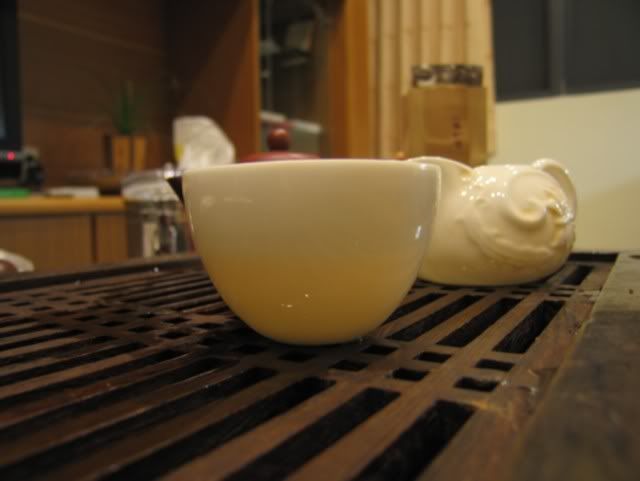
The cup you see in the picture, by the way, is one of the things Aaron gave me yesterday

I don’t know if it has a name. The most interesting thing about this cup is that it will right itself if tipped. Obviously it will tip over if you’re determined enough to push it, but it does have the tendency to right itself, even with water inside, so even if you tip it over, you will only spill about half a cup — it will not pour everything out like most other cups of more conventional design will. I like bigger cups, and this cup is on the large side. I’m going to use it for a while and see what happens 🙂

→ Leave a CommentCategories: Old Xanga posts · Teas
Tagged:

A visit to Miaoli

September 9, 2007 · 7 Comments

Miaoli about an hour and half from Taipei by train, and generally speaking, not much there holds interest for a foreign tourist. I didn’t really go there for the sights today though, as I was there to see Aaron Fisher, most recently of the magazine Art of Tea fame, as he’s the Editor in Chief of that publication.

After picking me up from the train station, we went to his place and quickly got down to business… tea drinking.

We first started out with a Taiwanese oolong he picked up recently, I believe, from Lugu Village in Nantou County, which is a major center of tea production in Nantou. The tea, he says, is organic, etc, and he used his silver teapot to make it. It’s an interesting thing, because I think the silver teapot does achieve a certain concentration of flavour that you otherwise won’t get, although since I haven’t tried the tea any other way, it’s hard to tell if it’s a function of the pot or if it’s just the tea. The tea is very good though, sweet, clear, smooth, a touch grassy, very good qi, and overall very pleasant without the sort of overbearing aroma that I dislike in some Taiwanese oolong. It’s I think reasonably oxidized but not roasted. If I can get a hold of this, or similar tea, I wouldn’t mind getting some.

We then moved on to an aged oolong, a 60s Gaoshan Oolong, if I remembered correctly. Now, he whipped out his silver kettle, a gorgeous little thing, somewhat similar to the one I saw a few weeks ago, but with a smoother surface and a more refined look. I tried a cup of water from the silver kettle (before the water boiled) and it tasted sweet. Then, without thinking about the experimental implications of it, tried a cup of the same water without going through the silver kettle. Not so sweet. Very interesting. Various vessels do change the way a water/tea taste. I do wonder how reproducible this is, but I think it should be fairly reproducible. Then, it’s a matter of whether or not such things are worth the price of admission… and that I suppose depends on your personal preferences, priorities, etc

I’ll buy a silver kettle before I buy a big screen TV though.

Anyway, the aged oolong. As I’ve said somewhere before, I think all aged oolongs tend to converge in taste so long as it’s been stored properly and of reasonable quality. This one is the same — a very pleasant aged oolong taste, no roughness or harshness remaining at all, with that “old” taste that is so characteristic of a tea of this type. I am a big fan of aged oolongs, and I think anybody who hasn’t tried one should definitely try to get their hands on some of this stuff. It’s I think less of an acquired taste than puerh, and it is also usually without all the potential health worries that some people have with puerh, primarily because if an aged oolongs has any mould growing on it… it’s no longer good. Too bad such things are rarely available outside Taiwan, and if they are, they’re too pricey.

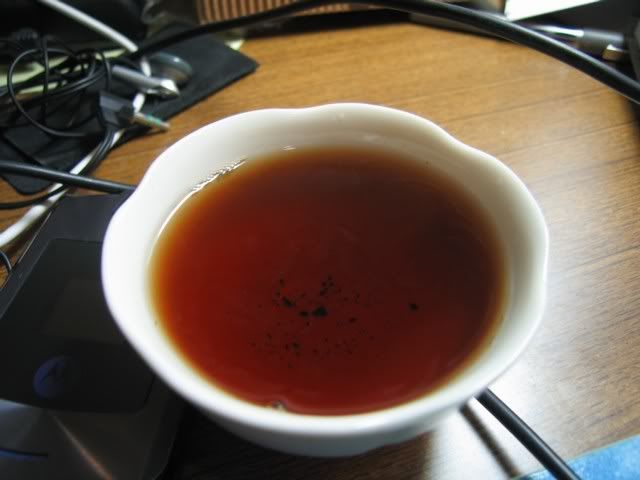
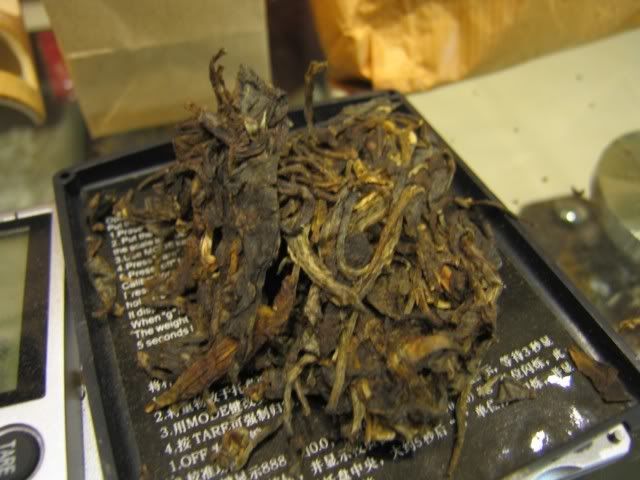
We took a short break, and then went back at it. This time it’s a dry stored puerh from the early 70s. I believe the dry storage claim, because though the tea is a reddish black, the leaves are very clean, it doesn’t smell of musty books, and it is very light, meaning it has lost almost all water content. The tea brews a clear ruby liquor, round, smooth, one might say fruity. Oddly enough, the brewed leaves are rather dark, but then, lighting was not bright in the room so it’s difficult to tell for sure what it is like, but whatever, it doesn’t really matter. One need not pursue such things too much as long as the tea is good in the cup. This tea lasted, basically, the rest of the afternoon.

Of course, during all this time we’re not just talking about tea, or teaware. Conversation wandered, and tea was just, in some ways, serving as a lubricant for conversation. Tea is fun, but it’s only part of the fun.

We went to one of the teashops in town that also sort of doubles as a vegetarian restaurant, and then ended up having a little more tea there — this time an 80s tuo, wet stored, but quite decent. It lasted many infusions, and is reasonably priced. Not dirt cheap, mind you, but perhaps worth considering. I’ll have to do some more thinking in that regard.

As if all that was not enough, my host sent me away with many bags of teas to try and experiment with, including some truly interesting pieces of tea (or bits, or balls….), as well as all three issues of the magazine in print and a cup that he designed. I felt ashamed that I didn’t have much of anything to reciprocate, the bad Asian that I am. I’ll most likely talk about all of these things in the not too distant future in detail, as I drink/use/play with them. For now, though, I must thank my host of the day for his hospitality, and I’m quite sure I will bother him again before I leave Taiwan.

→ 7 CommentsCategories: Misc · Old Xanga posts
Tagged: ,

The dangers of unlabeled samples

September 8, 2007 · 5 Comments

Rummaging through my box of samples, I found a clear plastic bag with no labels and a bit of tea in there. Why not? So I took it out and weighed it — 7g. Ok, good for one sitting I guess. It smells like Banzhang. I can’t remember any Banzhang that hasn’t been accounted for…. so heck, I’ll just make it.

I went through the motions and it produced a nice looking golden tea.

The tea is quite smooth, obvious strength, and decent penetration. Hmm, I think I know which one this is. This is the Xizihao 2005 Banzhang that I removed from the paper bag and put into a plastic one. The paper bag was giving the tea a bit of a paperbag smell, and the plastic ones I used from Beijing breath a lot, and don’t smell like much of anything.

The tea is quite decent, and obviously Banzhang in its flavour and what not. I remember the first time I tried this tea I got really dizzy and didn’t feel too comfortable. This time… I paid the price in an upset stomach. It doesn’t happen with all Banzhang, just this particular tea, for some reason. I’ve had other old tree Banzhangs that don’t do anything like this to me. I really don’t know why this is special, but it is.

Oh well, I will have to remember to label them next time.

The wet leaves are quite a mix of things — stems, big leaves, small buds, bud systems…. you’ve got a bit of everything here

I tried an experiment with the leaves after I was done drinking. My friend L, when he went to Yiwu, talked to some guy there who makes cakes. He said Banzhang teas are no good, and that the current craze over it is misguided. The reason is that the leaves of the Banzhang teas are really not very good leaves at all. As an example, he said that if you put a wet leaf of any Lao Banzhang tree between your fingers and rubbed it — it will turn to nothing. All you will be left is a bit of the leaf’s stem, and everything else will be gone — rubbed away. Yiwu, he said, won’t do that.

I tried that today, and hmmm, it’s true.

Now, what this means, if anything, I don’t know. After all, it might be a good thing for a leaf to be easily destroyed by your hand — would that mean more things are soluable in water, thus making a better cup? I don’t know. What I do know is that in China, if you talk to somebody who makes tea, they will always have one conclusion — their own productions are the best. The reasons vary, but the conclusions are always the same. So I will take that comment with a large grain of salt.

Any botanist out there who can shed some light on this?

Anyway, I’m off to bed as I have to get up early to catch a train to Miaoli to see Mr. Aaron Fisher. I’m sure I will have things to report tomorrow 🙂

→ 5 CommentsCategories: Old Xanga posts · Teas
Tagged:

Xiangshu 2004 Anniversary cake

September 7, 2007 · 1 Comment

I got a sample of this tea from iwii yesterday, so I tried it today. I’ve been curious about this tea for a little while now.

I’m not entirely sure this is actually from the Mengyang Guoyan factory. On the wrapper it says “Xiangshu Tea Enterprise” and it says it’s commemorating the 20th anniversary of the Xishuang Banna Mengyang factory, and also the establishment of the Xiangshu Tea Enterprise. No mention of Guoyan anywhere, which makes me think this might not be linked to the Mengyang Guoyan we’ve been hearing about recently.

But it doesn’t really matter.

The tea is buddy. Quite a few tips in the leaves, and not many big ones. The colour of the dry leaves are more or less consistent with the picture shown on ebay — maybe a touch greener

The tea brews a golden colour, slightly reddish

It’s quite smooth, thanks to the tips. Even at its roughest, around infusion 4-5, the tea is still acceptably smooth. The Menghai characteristics of the tea shows quite prominently. It has that bass note that is quite characteristic of the area, and that finish is quite typical as well. Iwii thought it’s a bit bland, but I like it. It’s not something to jump up and down in joy about… but it’s not too bad either.

The tea’s been pretty dry stored, but I’m sure it can use a few more years before drinking again.

The leaves… as you can see, are mostly buds

With some bigger leaves mixed in. I need to try this tea again, but first impressions are not too bad.

→ 1 CommentCategories: Old Xanga posts · Teas
Tagged:

Water issues again

September 6, 2007 · 6 Comments

Before I get on to the topic of water… some unfinished business from yesterday.

This is what yesterday’s tea looked like when I brewed it this morning

This is what it looked like late afternoon

The top cup is yesterday’s tea. The bottom is today’s Wuyi…

And this is how the leaves look when I finally cleaned the teapot

So, yes, suspicions of cooked tea still remains, but the longeivity of the tea itself, and the fact that he has really no good reason to lie to me, makes me think that he’s not lying. It doesn’t matter much, because the tea tastes a bit cooked. I can probably boil it with water and get a few more cups of rather tasty tea out of it, actually.

Anyway, water. I’ve been fiddling with my water here, since I am starting with a new supply and not the steady Nestle water I used in Beijing. I have noticed over time that filtered tap water here is slightly acidic… just a hint of acidity. I don’t know why that is the case, but it is. The building is new. Will new pipes lead to a slightly acidic water?

The effect on tea, however, hasn’t been really obvious until today when I brewed the Wuyi that I thought was slightly sour. I thought I should drink it up, so I made the tea again. Only today, because of a water supply problem (something broke in the building so they shut down water for a few hours) I bought a big bottle of water from the convenience store across the street. The water is light in minerals and quite sweet in its taste. Not a bad water. I used about half tap water (I still had some left in my filter) and half of this bottled water. The effect is dramatic… the Wuyi tastes better than last time, and the sourness? Gone. Absolutely gone. There was perhaps a tinge of it somewhere in the first infusion, but it is so faint that it could very well be placebo.

This of course reinforces the well known fact that water is very important, but since the water itself doesn’t taste sour when drunk, I was surprised that the tap water did that much damage to the taste of the tea and the manifestation of sourness. I always knew that water will do a lot of things to the body of the tea and the way it acts in the mouth, but I didn’t think something like whether or not an oolong will turn sour is so affected as well by what must be a small shift in the ph of the water.

Well, lesson learned. One of these days, I should re-do my water experiment from way back…. when I first started the blog, I drank the same tea for four or five days in a row, each day using a different kind of water. I remember the differences were big, but these days, I think I can probably better discern and describe the differences.

→ 6 CommentsCategories: Information · Old Xanga posts · Teas
Tagged: ,

Zhengshan

September 5, 2007 · 4 Comments

I buy samples sized things a lot because it’s fun, and because it exposes me to different kinds of tastes. Oftentimes they are educational in one way or another, while other times they’re just…. bland and boring. That, and all the things people end up sending me, means a lot of oddities and small bags of tea that are left around to drink. It’s part of the fun.

Today’s another one of those “leftover bag of samples” day. This is a tea that is sold at an old tea store in Hong Kong, labelled simply as “Zhengshan”. It’s basically a very (and I do mean very) wet stored cake that was supposedly raw puerh when it was first made. It’s hard to tell for sure given the way the leaves are

These are some pretty hard little nuggets of tea. They’re not cha tou though.

I used up the remaining bag, maybe about 10g or so. The first infusion was particularly interesting — it had a very strong taste of Chinese almonds (which are apparently apricot seeds). I don’t know how a tea can acquire the taste of almonds… but here it is in unadulterated form. That in itself is quite interesting.

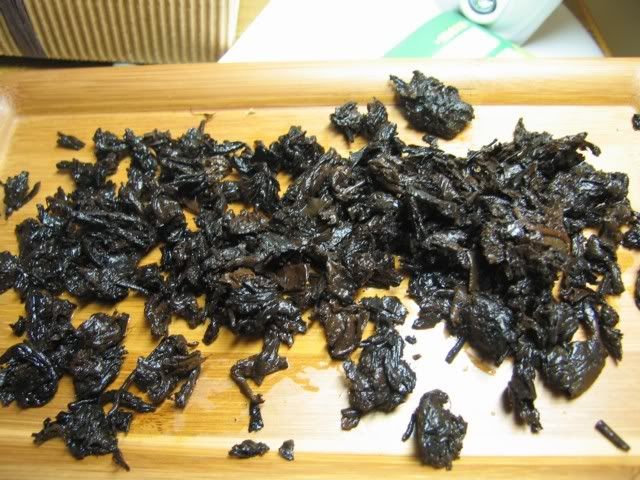
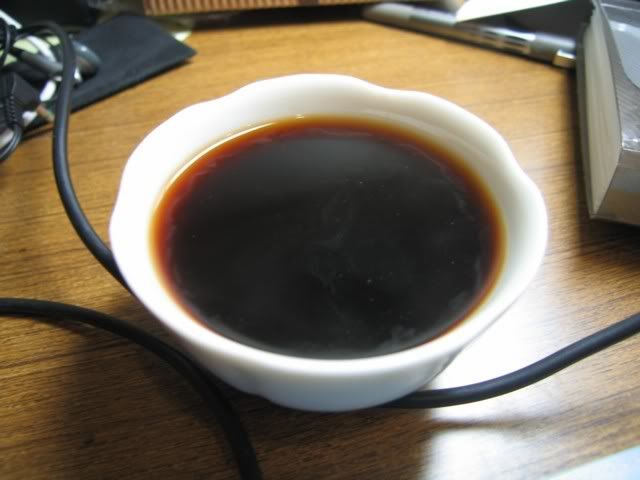
The tea, however, will probably scare any novice tea drinker by the way it looks

Yum. Some of you are probably thinking “you sure this is not cooked tea?”. I’m not 100% sure, to be honest, but the owner has no good reason to lie to me, since it’s not expensive at all. Other stuff that is priced higher he tells me are cooked, so it would be odd for him to try to lie to me about this particular tea. I do think, however, that this is tea so wet stored that it is effectively cooked over the years that it’s been in the storage (I think he said 10+).

After the almonds went away in 2 infusions, the rest of the tea tastes like very sweet, mellow, and rich puerh, but not really like a cooked tea. It doesn’t have that nasty cooked taste, and it also lasts much longer — this is what it looks like in maybe 12 infusions

It’s not a particularly lively tea. It doesn’t have a lot of qi. It doesn’t have that exciting factor that a well stored raw tea will have. But as a drink, I’d take this over any regular cooked puerh any day.

There are better offerings at that store, such as the broken Jiangcheng bricks, so there’s no good reason to buy this tea again. But for what it’s worth… it’s kinda fun. I think I’ll drink some more tomorrow morning when I get up, since I definitely haven’t exhausted it yet, so it’s being left alone in the pot for now.

→ 4 CommentsCategories: Old Xanga posts · Teas
Tagged:

Baozhong revisited

September 4, 2007 · 1 Comment

I wanted something light today, so I figured drinking the baozhong again, this time in my little pot, will be a good thing. Last time’s double tasting means I couldn’t taste each tea very well, individually. Those tasting sessions are great at alerting you to differences in mouthfeel, flavours, etc, but are not so good if you want to really examine a tea on its own with no interference, because the other tea there is interference.

I opted for the more expensive one to drink, but as I noted last time…. when dry, they look basically identical. When brewed:

They also look pretty much the same.

I tend to brew light Taiwan oolongs delicately. Temperature of water is still kept high, but poured from high up and in a small stream, but that depends on what’s going on and can change… There are different schools of thought of what makes a good cup, and as I’ve observed it really runs the gamut, but I find it just fine like this usually. Add to the fact that my body generally doesn’t like a large amount of Taiwan oolongs that are not roasted, and it makes perfect sense why I brew it this way….

The resulting tea is overwhelmingly sweet, with a soft floral aroma and just a slight hint of grassiness if I overbrew it a bit. There’s some qi there, as I could feel my body reacting to the tea after the first few sips. The body is thick enough, and all in all, quite a pleasant drink. It’s a bit mellow, and perhaps less strong than some of the better stuff could be, but those are sometimes too punchy for me in their flavour, making it taste almost artificial. There’s a sort of saccharine quality to that kind of aroma/feeling that I don’t personally enjoy.

The tea passed on with about 6 infusions. It’s not an overly complex tea, but once in a while… it’s good for what it is.

→ 1 CommentCategories: Old Xanga posts · Teas
Tagged:

Yangqing Hao 2006 “Hundred Years Fragrant Tea”

September 3, 2007 · 6 Comments

This is a sample I received from somebody on a Chinese forum. The guy was generous enough to send me two samples of Yangqing Hao teas. One of them, the 04, was once available on Hou De but has been long gone. This one, the Baisui Xiangcha, or “Hundred Years Fragrant tea”, I don’t believe has ever been sold there…

The leaves are quite dark when dry. It’s supposed to be a mix of six mountain tea, so not all Yiwu like many of his other cakes. I think this is a lower grade cake, relatively speaking.

The tea brewed a golden colour — quite pretty

The first cup was extremely smooth and soothing. There was a fair bit of bitterness, in a very subdued fashion, in the first cup. It’s an interesting feeling — the bitterness is simultaneously there and not there. The smell on the bottom of the lid was a reassuaring grassy/green smell, while the fragrance lingered in the bottom of the cup. The tea, however, gradually got a little more rough as time went on. There was not a lot of qi, and the aftertaste/throatiness varied in degree, depending on which infusion. Sometimes it’s stronger, sometimes it’s weaker. It started turning sweet around infusion 5, and then got sweeter, while still remaining a bit rough.

The wet leaves are …. interesting

They come in all shape and sizes and colours

The blending is obvious, both in the way the leaves look but also in the cup. While it does taste like the six mountains area, there is a fair bit of change going on in the cup and in that sense, the tea is quite interesting. I don’t, however, believe the leaves are of very high quality. I think it is a blend of old and new tree teas, and while the body is fair, the strength, in terms of aftertaste, qi, and that kind of thing, are not quite there. The blending part can does make up for some of the deficiencies in other areas though…

→ 6 CommentsCategories: Old Xanga posts · Teas
Tagged:

Jingye Hao revisited

September 2, 2007 · 3 Comments

This is a sample I bought from Hou De probably a year and half ago. I remember trying it once, and then forgetting about it while it sat in Beijing. I discovered it today while looking for things to drink… so I pulled out a few grams of it

The leaves look big and are quite long, not too hardly compressed and easily broken off. The leaves are on the reddish side of things. They look very clean — dry stored.

I brewed it normally


(Still trying to figure out the lighting, sorry)

The tea has a dry stored taste for something 6 years old, with a lot of high aromatics, a bit of that sweetness, some roughness, and in the second infusion, a clear flash of sourness. The tea is not very thick at all — in fact, I’d say it’s a bit thin. This is a bit of a contrast to what I remember from my last tasting, when I thought it was quite good. It could be the fact that much traveling and a year of Beijing storage in a paper bag did some damage to the tea, or maybe a year more of drinking teas actively and thinking about what I’m drinking has made me notice these problems. I have noticed that by blogging about the teas I drink, I’ve gotten more sensitive to things I see in tea — perhaps because I actively process them while drinking, rather than just drinking them.

The leaves of this tea are quite green, still

And more importantly… they are a little on the thin side

As well as oddly shaped, I might add.

I still have more of this. Maybe I’ll keep it and see what happens after another year and half.

→ 3 CommentsCategories: Old Xanga posts · Teas
Tagged: