A Tea Addict's Journal

Evaluating an aged oolong

December 13, 2007 · 3 Comments

How do you tell a good aged oolong from a bad one? After drinking a few months of this stuff, I at least have some tentative thoughts on this issue.

Let’s take today’s tea — a bag of tea I picked up yesterday in exchange for the bad aged oolong I got last time. I’ll get to why that one was bad later.
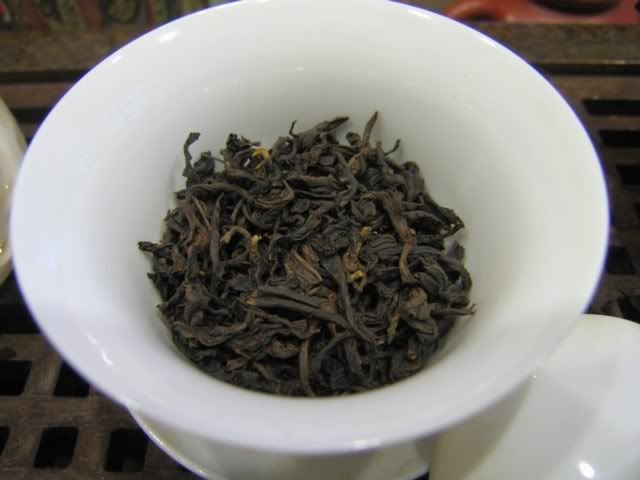
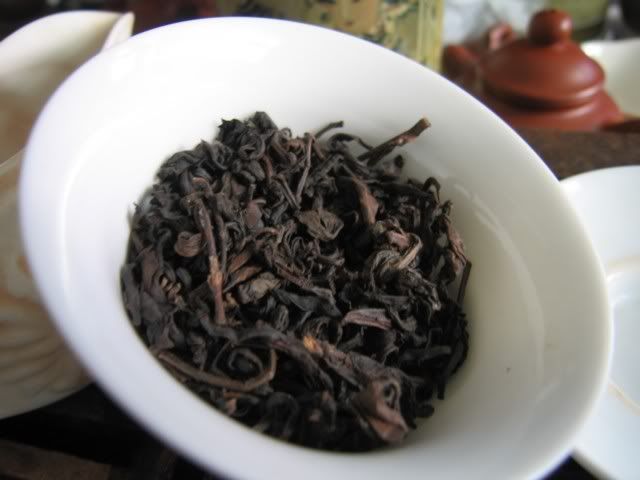
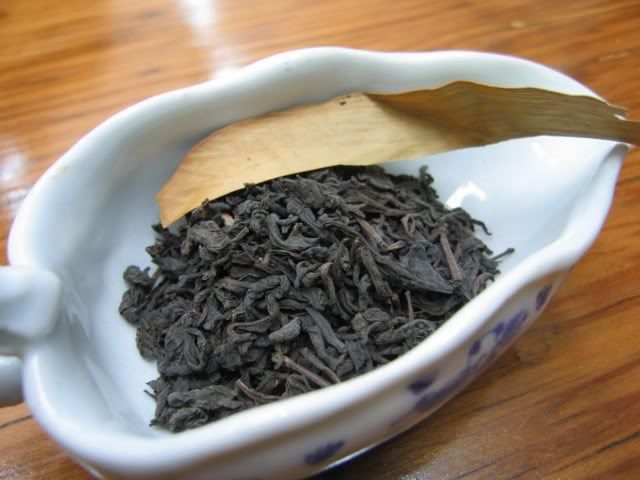
The dry leaves’ physical appearance will rarely tell you anything too useful. Colour of the leaves are almost always dark. Sometimes it’s darker than others, but that in and of itself is a very useless indicator of anything. The shape of the tea might tell you something about what it could be, but even then — not a very useful indicator.

The smell of the dry leaves, however, can. For teas that have turned somewhat sour, you can sometimes smell a sour note in the aroma of the dry leaves. If you want to cheat, you can always breath into a little leaves (that you of course placed in your hands and don’t really intend on throwing back into the bag). That way you can smell the aroma much more clearly. Sour? Give it up already, it’s not worth your time.

Assuming it passes the initial sourness test, then there are the teas that are musty or not musty. The ones that aren’t musty are often re-roasted, the ones that are musty, as I find over time, are usually less re-roasted or not at all. Makes sense — the roasting will kill any musty smell. Sometimes you can also smell the roasted nature of the tea from the dry leaves. Now, done with the dry leaves. Let’s move on to making the tea.
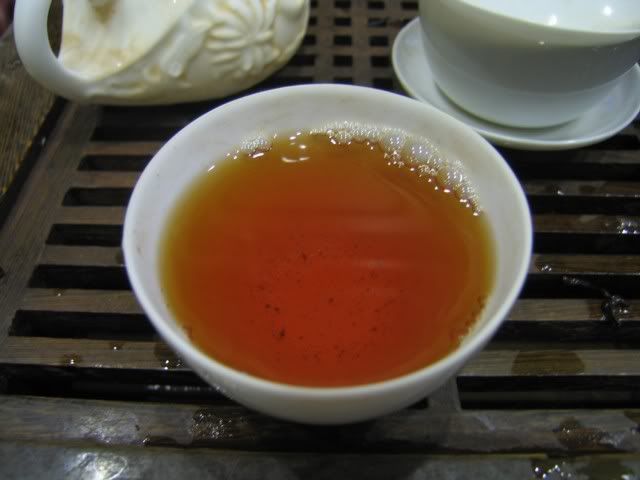
I usually fill the gaiwan with 1/2 to 2/3 full of leaves when I make this stuff, at least for a first try. Sometimes the sourness is subtle, and if you brew it with less leaves you don’t always notice the problem. Now, teas that don’t smell sour can still be a bit sour, but usually, those are sourness that go away in an infusion or two. That, personally, I find acceptable. I also find that teas that don’t taste sour at all when hot can sometimes take on more of a sour note when cooled a bit. That’s something to look out for.

For the really roasted stuff, you have to feel the body of the tea to see if it’s aged or not. Sometimes that charcoal taste masks a lot of things, including age. A highly roasted but not very aged tea will lack that nice sweet note at the end, and it will also be less thick, at least in my personal experience. Some of the really roasted stuff will need a bit of time to mellow out and let the charcoal taste go away a bit before drinking, but even for current consumption they can be good — if you are into that kind of thing. I don’t buy a lot of that stuff, but I do have some. It’s fun.

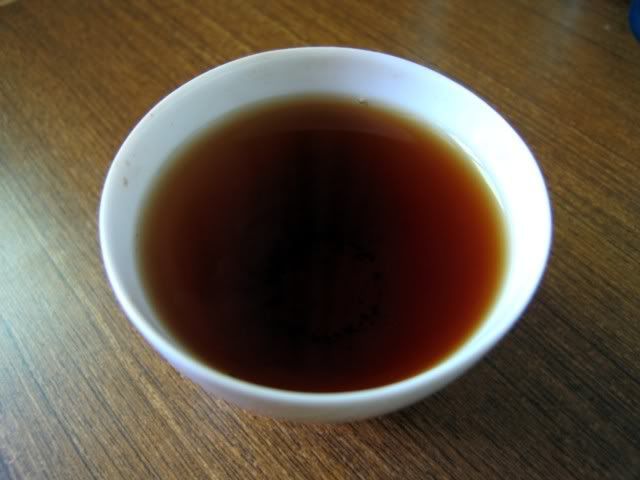
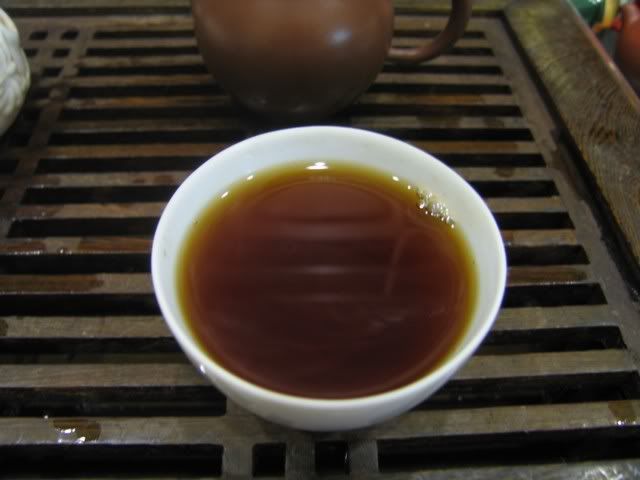
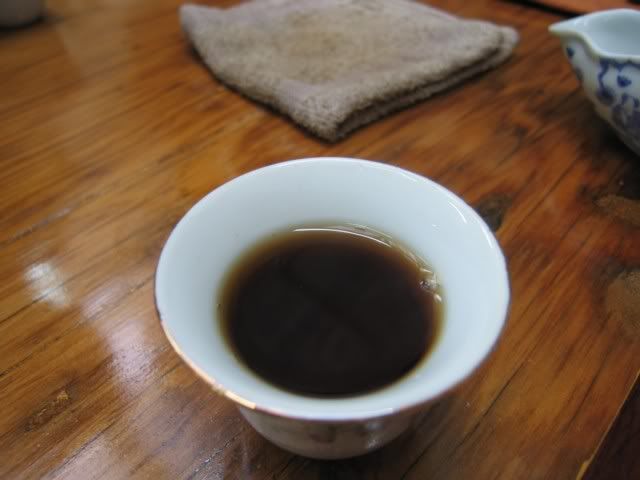
I personally like the less roasted stuff. They take on a puerh-like note the first few infusions, then mellow out into a sweet tea that will more closely resemble a young oolong. In the end you will get back the young oolong taste/finish without much aged note at all other than the extra sweetness. It’s very interesting that way. Even aged and somewhat roasted stuff can do this. The tea that I originally wanted from the store is exactly like this — the first few infusions taste almost like a liu’an, and then into a softer, sweeter aged oolong taste, and then ending up as a younger tea would taste. I like this kind of tea the best. Today’s tea is sort of like that — I felt almost like I was drinking a new oolong near the end, without the harshness of a young tea. Also, aged oolongs tend to go on forever. You should be able to get 10+ steepings from it easily.
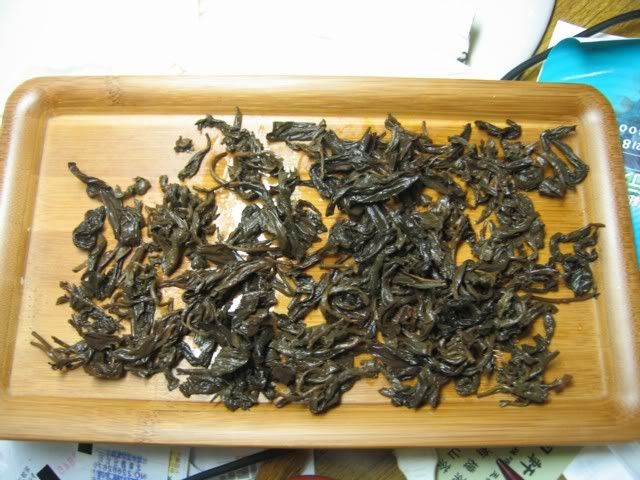
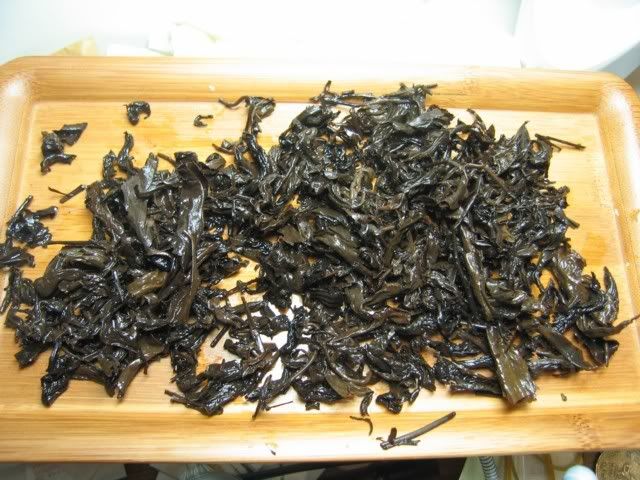
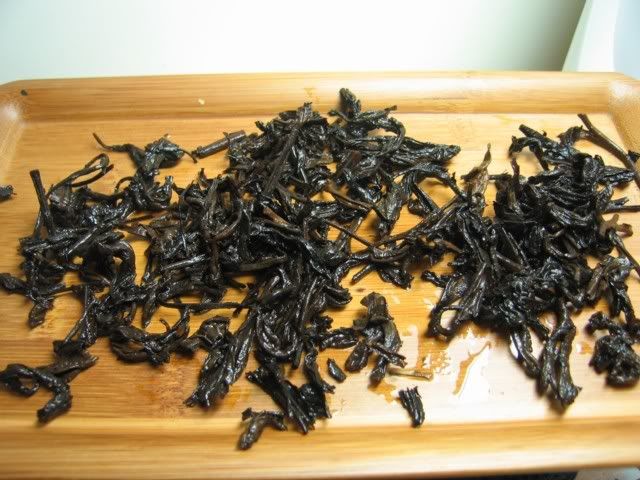
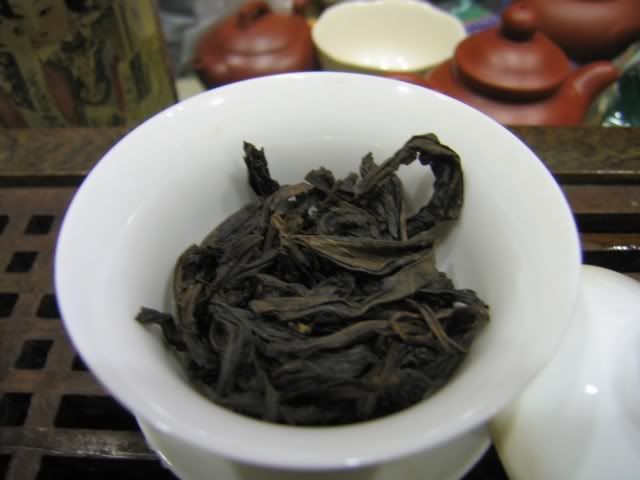
Wet leaves says a lot about what you’re drinking. In fact, I think wet leaves tell you more about what you’re drinking than anything else other than the physical act of drinking the tea. It will confirm what kind of tea you’re actually drinking, usually, and it will also tell you the condition of the tea, whether it’s mixed or not, etc, things that aren’t always apparent in a cup but usually more apparent when you can spread out the leaves. Today’s tea hasn’t been reroasted much — that much is obvious. The leaves unfurl easily, with a greenish scent. Decent tea.

So, what was the tea that I rejected like? It was roasted — tastes like charcoal the first infusion. But the body of the tea was thin and died fast. It was not aged, or not much aged. I’d venture to guess it’s less than 5 years old, which is why I was so unhappy about it.
→ 3 CommentsCategories: Old Xanga posts
Tagged: , ,

A mixed success

December 12, 2007 · 4 Comments

Well, I went back to that store today. The owner was nice enough, and I think it could’ve been a semi-honest mistake. What I think actually happened is this: this store has basically three labels for their teas. Not old, 35 years old, and 60 years old, it seems. This is more of a marker of price than actual age (or quality). Age inflation is also at work here. As the 35 years old I took home yesterday showed, some aren’t so hot, while others (like the one I actually want) is actually pretty good. The thing is, she has no idea what I got the first time, I think. Even though it looked like she knew who I was, she didn’t really, or, rather, she has no idea which particular tea I picked up last time. I actually lucked out that she gave me the right bag last time. Instead of actually trying to figure out what I got last time, or whatever, she just gave me the 35 years old that she has handy — even though it’s actually a totally different tea (and I think she knew it). Oh well

So… I told her my problem, basically having been given the wrong tea. She started saying “oh?” and when she brewed the two, she knew she couldn’t fool me — she had that “hmmm” look on her face. We searched around the store… in the back, in the front, and couldn’t find a single bag of the stuff that actually tasted the same. In the meantime, we tried probably 10 different kinds of aged oolongs of various quality. One or two was decent, some were ok, and others were crap (sour, weak, or a combination of the two). Her teas taste more aged than the candy store teas, although I think it has to do with roasting (her teas are more repeat-roasted than the candy store stuff) and also storage condition (in big plastic bags just sitting in the storage area, instead of inside big canisters that are pretty air tight). That might also explain the loads of old, somewhat sour oolongs she has.

After a lot of searching and no luck, she said she will call up to her storage (or is it home?) on the mountains and ask them to bring the tea down. That’s where they do the roasting, apparently. Ok, sure, but I have to return at 8pm to pick up those teas. Fine. I did, however, swap half my teas with her for another oolong we discovered while rummaging through the stacks of stuff. It’s different. It’s a strange puerh-esque oolong. Taste more aged than the candy store stuff, but not bad. It’s got that puerh musty smell. I haven’t gone wrong with aged oolongs like those yet, and it isn’t sour.

So I did go back at 8pm… she lined up some tea on the counter. Two bags she said she found in the back that should be the same batch as the one I got. I opened them and lo and behold, it is the same tea. The other stuff (the 8pm delivery stuff) however…. are not. Roasted, with a roasted taste. The stuff I bought completely lost the charcoal roast taste long time ago, so it’s not the same. No way, Jose.

So, I did end up returning some of the tea I bought, swapped them for some of the real stuff, and some other random aged oolong. No idea what any of them really are, at this point, as I think she makes things up as she goes along. If I had the time and money, I’d sit there in her store, drink through every bag, and buy up whole bagloads of this stuff if it’s any good. There are bargains to be had here (although the same can be said of the candy store…)

→ 4 CommentsCategories: Old Xanga posts
Tagged: ,

Screwed

December 11, 2007 · 6 Comments

I went to the store that sold me the claimed 35 years dongding to get some more of the tea. I got the bags, paid, left. I even got a sample of something she claimed to be 60 years old, ok.

I came home, made the 60 years old which tasted more like 16 years old. Well, no matter, that’s free.

Then…. I started having second thoughts about the other bags of tea I got, and decided to try them out….

Hmmm

I think I got screwed. The tea is definitely different — not the same thing I bought last week. I haven’t opened all the bags, but among the ones I did open, they all tasted the same, and none of them taste like the one I bought last time.

Now, I hope this is an honest mistake, but there’s also the possibility that she thought I wouldn’t get to these teas until it’s way too late to go back and go argue with her. Heck, in a way, it’s already too late as she can claim I switched teas on her. I don’t know if I’ll get my way tomorrow, but I know I’m going to be going back and trying to get my money back.

Any suggestions on particular tactics?

→ 6 CommentsCategories: Old Xanga posts
Tagged: ,

Random aged shuixian

December 10, 2007 · 4 Comments

Another sample from my candy store.

This was some random tea from a random bag with a random (obviously wrong) label. Looks like shuixian though — big leaves, rolled, not too roasted….

The tea tastes like shuixian, aged some. It’s a bit…. bland, which I find to be true for a lot of older shuixian. Maybe the tea just isn’t very good for long term aging? Maybe I should try crushing the leaves and then piling it in. With a normal amount, it just doesn’t pack enough punch. Sweet, mellow… good for big pot brewing, come to think of it.

You can see the big leaves. She quoted a higher price for this than anything else. I have a feeling she is trying to test to see if she can get away with it. I’m afraid she picked the wrong tea to do it with.

→ 4 CommentsCategories: Old Xanga posts
Tagged:

Brewing techniques

December 9, 2007 · 12 Comments

I went down to Miaoli today again to have tea with Aaron. It was, as usual, a good day with good tea.

One of the topics that came up during the course of conversation was the little things you do that can make the tea better. He went to Malaysia recently, and rediscovered the warming of the pot. Heating the pot before and after adding water makes a difference (as well as pouring water into the cup to keep it warm between infusions). I myself have also started to neglect doing it recently, even though I used to do it before. It’s time to try it again and keep it in my habit.

One other thing though that came up — making tea isn’t like doing experiments in a chemistry lab. Measuring out the amount of water, checking the temperature, using a timer…. those might be things that help make somebody starting out more comfortable with the making of tea, but if too much attention is paid to those things, the person making the tea can actually get too busy, too distracted to actually make a good cup. A good story I’ve heard from Action Jackson a while ago was that she’s met a couple who made tea for her, and who were so obsessed with the timer and how long each infusion should be that they completely forgot about keeping the water warm. So, it was a perfectly timed cup with lukewarm water. If they didn’t obsess about the time, perhaps they would’ve remembered to do the other things right, but they didn’t.

The point being, doing all those things (and perhaps even taking meticulous notes on the side while doing all those things) can actually take the person away from the actual drinking of the tea. Maybe while worrying about the temperature, the time, the amount… the actual tea gets lost in the process. There isn’t a right or wrong (just look at how so many tea experts disagree with each other). There isn’t an optimal amount of leaves or water that will make a tea come out perfectly. I know if I used the exact same parameters, teaware, water, etc as somebody else and make tea together in the same setting, the taste will still not be quite the same. Maybe it’s that jerk of the hand, the force of the pour, etc. If one were looking for a scientific explanation, there might be one that’s usable to explain the difference. But does it really matter? Can one truly control all those things? We try our best, but I have always found the best tea making happens when I’m focused and not distracted, then things go smoothly without me having to worry about each specific little thing. When I’m doing other things, sometimes I am drinking tea, but not really drinking tea. After a few cups, I don’t even remember what I drank, basically. Then it’s just a beverage and I might as well be drinking Lipton teabags.

For those of you who use a scale, timer, thermometer… try ditching it for a change. It might mean you will screw up the brewing sometimes, maybe too much tea, too long a steep, etc, but that can happen with those aids anyway. It’s best to try it with a tea you know well. Then move on to things that you don’t know so well. You might just surprise yourself when your eyeballs, hands, and mind do better than scales, timers, and thermometers.

→ 12 CommentsCategories: Old Xanga posts
Tagged: , ,

Old Dongding

December 8, 2007 · Leave a Comment

On the way to my candy store yesterday, I passed by another tea shop that is old looking. It’s terribly shabby. From the door of the shop to the table where the owner, his wife, and some guest were sitting, there was a corridor formed by boxes (some empty), bags, and what not… on both sides stacking taller than me. It was full of junk, literally. The whole store, in fact, was filled with junk. I walked in to look at some of the oldish teapots they had there (70s/80s stuff, I think). Most of it was crap.

At a place like this, they usually serve you a cup of something — whatever they happened to be brewing. I got a cup, of course. It was dark, blackish. I drank it… and I was thinking “hmmm, what is this? Liu’an?” It tasted old, not really puerh like, but not really old oolong like either…. I asked what it was, and she said it was an old (35 years is the claim) dongding.

Hmmm

I went to the candy store first, but when I was on my way back, I couldn’t resist, and picked up a little of this tea to try for myself at home.

This shot is from about 10 infusions after I started… the first shot I took turned out to be horribly out of focus

As you can see, still pretty dark. As I brewed it today, the liu’an like taste isn’t quite as strong, but I can still sense it being there. This is, I think, what Zhou Yu referred to simply as the “old taste”. He said such tastes you can get from the liu’an we tried that day, but also from old Taiwan oolongs of around 40 years or more. I am getting some of it here, I think. It’s a smooth tea, not bitter at all. Not much roasted flavour either, but it is definitely a strongly roasted tea (or repeatedly roasted one, rather). As the drinking went on, there is a slightly greenish flavour that crept into the tea — something that reminds me of the 1990 dongding and the 1980s tieguanyin that I’ve been drinking recently. It’s in that same family of taste, but here only as an aftertaste, a hint, rather than what was at the forefront. I suppose much of that flavour has been changed over time, through aging and roasting, into what is now the “old” flavour.

In some ways, despite its older age, I think I actually prefer the younger stuff — I like that strangely aromatic taste. This tea is a bit more mellow, very interesting, very calming, but lacks a bit of that extra push. Then again, maybe that extra liveliness will wear thin after a while, and stuff like this will, on the other hand, be always welcomed on a coldish day in winter.

The wet leaves are a bit of a mixed bag. There are a few leaves that are more flexible and brown, while some others are black and stiff.

Good stuff, and it’s not expensive either. Considering that this is definitely older than the 80s/90s teas I’ve had…. I don’t think people who sell this stuff are really making much of any money from it.

→ Leave a CommentCategories: Old Xanga posts
Tagged: ,

Border tea

December 7, 2007 · 4 Comments

New candy from my candy store.

I went back to the candy store to see if she has any more teas for me. One of the reasons I keep going back to this place is because unlike a lot of old shops, the laobanniang is very kind here and lets me do my thing, and doesn’t mind me asking questions, asking to see things, play with things, etc. A lot of these shops don’t really want to deal with you, and that makes things hard. When it’s a shop like this where the varieties of teas are in probably the hundreds when you account for all the various vintages (among which are gems and duds) it’s not possible to go through everything at once. If I had my way, I’d have all the bins open and spend an afternoon there opening every single bag. But alas, I can’t.

I picked some stuff up, and rummaged through some of her bins. Among the things she showed me were an aged qianlixiang (thousand miles fragrance), old oriental beauty, a slightly sour huangjingui, two bags of old puerh — one cooked, one a mixed bag of cooked and raw — and then some of these old pieces of puerh she has. Old is relative, of course. They sit in the back of the room, in this wall cabinet full of crap, basically, and in there are some leftover puerh from when they still sold this stuff (it’s gotten too expensive for them to buy these things, and they’re not really in this business anymore). Nothing too interesting, but I found this cake above, and it’s very cheap, so I figured, why not.

From the looks of it it looks like border tea — probably Vietnam tea. At first I thought it looked like Guangdong bing, but then the shape of it is not right, so that’s ruled out. It looks the most like some of the “new” Tongqing cakes that some Taiwanese guys made in the 80s. Those are usually wet stored to high heaven. This one’s not too wet, but definitely hasn’t been dry stored either. The dark and smallish leaves, and the smallish indentation in the back, sort of made me think this is the same thing, without the neifei (which is basically just slightly stuck on anyway). Things like this sell for a ridiculous price at M3T in Paris, at least I remember seeing one of them from a guy who bought it there.

The colour of the tea looks ok

But the taste is distinctly different. If you’ve had these a few times, you’d know what it is. I remember reading about it — how in Hong Kong, back in the day (and even now) loose puerh is sometimes (or often) made with Vietnam tea because they’re cheaper, and because back then, the supply of puerh was inconsistent. They probably go into blends, among other things. Even now, they’re supposed to be making their way into puerh cakes and what not.

This stuff isn’t high grade stuff, and don’t taste as good and rich as real Yunnan puerh. There’s a certain edge to it, and the sweetness is not quite there, in comparison. I’ve always wanted a more or less authentic cake of unadulterated border tea. I think I found it 🙂

I also came home with some supposedly 35 years old dongding that really reminded me of the liu’an I had yesterday, oddly enough, as well as some of the biyuzhu I had last week. I should’ve gotten a sample of the old oriental beauty. Oh well, there’s always next time.

→ 4 CommentsCategories: Old Xanga posts
Tagged: ,

An opening party

December 6, 2007 · 5 Comments

Today I went with Aaron Fisher to Jingmei Tang, Wushing Publications’ teahouse, so to speak. They’re not normally open, but only for events. There’s an event today — the opening of a 1920s (or is it 1930s?) jian of liu’an that they found in some Chinese medicine shop.

So we went there at 2pm sharp. Everybody was already there, and the prize was there too, sitting in the middle of the room. Now, liu’an is a tea that is generally packaged in baskets. When they first come out, they’re basically green tea steamed into the basket — sort of like liubao, although liubao usually comes from Guangxi, and liu’an comes from the Huizhou area, near Huangshan, the same places that give us Qimen, but NOT the same place that gives us liu’an guapian, the loose green tea (that’s farther to the west and has nothing to do with Huizhou). The most famous brands of these is the Sunyishun, and this is what we’re opening today.

Before we went on with the opening (and drinking) though, we first drank the 1930s liu’an that they opened a month or two back and featured in the current Chinese issue of Puerh Teapot.

The bamboo leaf is part of the wrapping of the original basket, and in some cases you brew the bamboo leaf along with the tea (depending on preference, really). The bamboo leaf itself is so old and mixed with the tea for so long that it has taken on medicinal quality. So has the tea. Sitting across me was a gentleman whose family originally was in the medicine business. He said back in the day, teas like this were used as medicine for certain ailments. I can believe him.

So Aaron did the honours in our corner of the room and brewed. The liquor is very much looking like a liu’an

It tastes like a good liu’an, mellow, medicinal, good and obvious qi, but in a pleasant way, and generally a pleasure to drink.

But you don’t want me to babble on about this, so on to the video. This is Lu Lizhen, another one of the Taiwan tea experts, who was doing the honours. Zhou Yu did some introductions and background info for the tea in question.

And in case you want to see pictures of the jian of tea in detail

There are ten stacks of tea in this bundled together, each stack consisting of six baskets. The small writing on the canes that hold the baskets together says “Xin’an Sunyishun zihao jianxuan yuqian shangshang yinzhen”, which means, “Top grade (literally top top) silver needles selected by Sunyishun company of Xin’an”, with Xin’an the older name for the Huizhou area.

So of course we drank this too… stronger, more lively, and more aggressive. The tea’s been kept in excellent condition, and the finish of the tea even has a hint of that greenness that you find in younger teas. I even came home with a sample of it…. which is worth quite a bit, considering the whole ball of tea, 60 baskets in all, is said to be something like $400,000 USD.

Aaron and I stayed behind to drink some more tea with the owner of Wushing Publications, a good tieluohan and an extremely good shuijingui, both of them Wuyi varietals. It was a pretty good outing.

→ 5 CommentsCategories: Old Xanga posts · Videos
Tagged: ,

Lazy brewing

December 5, 2007 · Leave a Comment

Sometimes when I don’t really want much tea… I get lazy

Big pot, big glass…. not much leaves, and just brew easy.

The requirements for such tea are

1) lots of water for the amount of leaves
2) for some kinds of tea, water temp might want to be slightly lower than boiling — too hot, and it can be too bitter
3) long steeps, but not too too long

Those kinds of parameters can make almost everything taste good, even young puerh that is usually nasty. What you lose, of course, is the depth and complexity, but if you just want a pleasant drink, this is not bad. I’ve also noticed that sometimes if a certain tea is particularly strong in the throatiness department, doing it this way actually makes that more obvious — perhaps because it doesn’t have to compete with all the flavour in your mouth.

→ Leave a CommentCategories: Old Xanga posts
Tagged: ,

Some theories apply to all

December 4, 2007 · 5 Comments

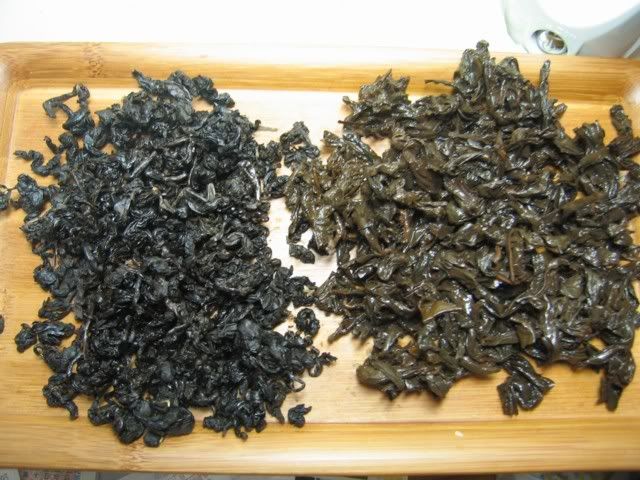
The above photo consists of two sets of leaves. On the left are the leaves of the roasted oolong I had yesterday. On the right are the aged tieguanyin I had today. Put together, I think the contrast is much more obvious. You can not only see the colour differential, but also the way the leaves are — one’s much more open, flexible-looking, and lively, while the roasted one is quite black, don’t really unfurl, and if you try to pry it open, breaks apart as it is very brittle.

Reminds me of cooked and raw puerh… or maybe wet stored and dry stored puerh.

Now, obviously, the parallel isn’t exactly. The tieguanyin in this case must’ve been roasted as well, as some of the leaves show evidence of that. However, it is the degree that matters… and I find, in the case of aged oolongs, that lightly roasted and then left alone, they produce the most interesting results. Lively and vibrant, they retain some of the original character of the tea while having changed enough so that you won’t recognize it. The roasted stuff are softer, mellower, but lacking in that liveliness that really spices things up (sometimes literally). I like it still better than cooked puerh though.

→ 5 CommentsCategories: Old Xanga posts
Tagged: ,