A Tea Addict's Journal

Wednesday April 19, 2006

April 19, 2006 · Leave a Comment

Not much interesting today, other than that I am again drinking the Kung Fung Yung tieguanyin again. I realized that my nongxiang tieguanyin pot has actually seen very little use recently — after I ran out of the good stuff from Hong Kong I haven’t opened a new pack, so it’s really about time. It’s also a small pot, so I can limit my caffeine intake that way even though nongxiang has a pretty high caffeine level.

Busy day tomorrow, so take out tea again 🙁

→ Leave a CommentCategories: Uncategorized

Monday April 17, 2006

April 17, 2006 · Leave a Comment

Well, I just got back from my college friends’ wedding in Syracuse, NY. Interestingly enough, of all places, we went to a teahouse last night before the wedding. Specifically, it was the Roji Tea Lounge. There seems to be a few teahouses in Syracuse, but this one is supposed to be pretty good. It also has good reviews from Tea Map. So, I went with some expectation.

The decor of the place is simple, with a sofa, a few tables and chairs, and a small tatami area. The place is staffed by two people. From the looks of it, most people order some form of bubble tea, although there are some who drink real teas that are not sugar bombs as well. There were 8 of us, so we all crowded around the little round table at the tatami area. It worked well enough.

The menu (which strangely isn’t available on their website) consists of a number of different kinds of teas, with maybe 2-3 varieties in each category of green, oolong, red, white, etc. There were more choices of herbal teas than anything else (and most of my companions chose some sort of herbal). They also had chai, which the groom to be happily ordered, since he’s Indian (and I think he approved, more or less). Prices were somewhat steep, ranging from about $4 to $9.50 for the Oriental Beauty. I opted for their tieguanyin, having no idea what I will actually get. I figured that since I’ve been drinking so much tieguanyin these past two weeks, I will be able to better judge the quality of their offering that way.

They served us relatively quickly, considering that there were lots of people who came in after us (and the place was packed). Everyone ordered something different, so they had to bring it out in a few rounds. The red tea and the herbals were brewed in a glass pot, with a glass cover, and a glass filter/separator that can be taken out. They open the teapot, let you smell the cover, then take out the tea leaves and put it aside. The chai came in a large bowl, and it came with a side of syrup, but I have no idea how you’re supposed to serve chai.

Then came my tea. I saw them preparing it with a gongfu set, so I wasn’t sure what their plans were (some places brew it for you with a gongfu set without actually giving you the set itself). They ended up giving me the whole deal — pot, smelling cup, drinking cup, fairness cup, and the “tea sea” for excess water. The tea came washed already, so they just added water and gave it to me. They didn’t, however, give me any extra water, so I wasn’t sure what I was supposed to do. I didn’t look inside the teapot initially, and just poured it out after the normal interval I will allow for a tieguanyin — about 5 to 10 seconds for the first infusion. The pot was rather large, enough for maybe 5-6 cups. It was definitely too big for one person.

When I began pouring, I knew it was trouble — the tea was far too weak. I thought perhaps their tea just brews a light colour, so I drank it (after going through the smelling cup procedure), and indeed, it was far too weak. The smelling cup yielded little fragrance, and the tea tasted insipid. I looked in the teapot, and there it was the answer — too little leaves. The pot was only about half filled with leaves after they’re now wet and expanded, which means that they put in at best 1/8 to 1/10 of the pot with dry leaves. That is far too little for making proper tieguanyin (it should be at the very minimum 1/5 for qingxiang, I prefer about 1/4, adjusting for individual teas). So, I tried next infusion (after asking for water, which came in a thermos that pours VERY poorly) with less water and more time. It still came out insipid. Then I realized the second problem — the water is probably not hot enough. I think that while it might be advisable to use less than boiling water for the 3 minutes brew method, for gongfu tea, tieguanyin should take hot water. They, however, gave me, I think, 180 degress water. That made for weak brews.

The tealeaves themselves may also be somewhat dated, but since it was dark and I never saw the dried form of the leaves, I couldn’t tell if that was the case. It certainly tasted weak and smelled weaker. Any of my tieguanyin at home beats those hands down, even with that level of tea leaves/pot size ratio.

On top of that, the pot they use I think is not actually yixing, but of some other material. The worksmanship was nice enough, but I think it is some other sort of clay. The water that I poured onto the pot didn’t cling at all, but rather slipped off easily, and the texture felt funny. It was dark, and I couldn’t tell very well. That’s sort of an unknown.

All that negative criticism doesn’t mean, however, that I didn’t enjoy the night. It was good company, especially since I haven’t seen my friends (the ones getting married) for quite a while. Catching up was nice, as was the mere fact that in Syracuse, NY, there is still a teahouse trying to do proper tea. It can certainly be improved, and I think I might even send in an email to suggest such things (after all, if they’re charging me $8 for the tieguanyin, they can afford to give me a little more leaves). Perhaps next time when I go back I will have a better cup of tea.

→ Leave a CommentCategories: Uncategorized

Saturday April 15, 2006

April 15, 2006 · Leave a Comment

I just realized something….

In my seasoning of the pots, I consistently neglected to pour tea over the bottom of the pot. I’m good about the lid, but the bottom…. ooops.

So, compared to the rest of the pot, the bottoms look unpolished and lack the lustre that the seasoned bodies have. The good thing about this is that it gives me a sort of control — to see how far my pots have progressed. However, when I lift it up and look at it, it’s not a pleasant sight.

Should I work on them? Or should I just leave them as the unconditioned surface? Hmmm

→ Leave a CommentCategories: Uncategorized

Saturday April 15, 2006

April 15, 2006 · 1 Comment

Well, today was another qingxiang tieguanyin day. I thought I wasn’t going to have any more, but a newly made friend over at ChaDao sent me some 2005 spring pick tieguanyin that he wanted me to try. So here I am, giving it a try before I head off tomorrow to a friend’s wedding in Syracuse.

The tea comes in small individual packs. Here, I will digress a little and talk about this packaging method. While it is great that it keeps the tea fresher and lets you open them in small batches instead of all at once, it does have the slight problem that if your pot or gaiwan happens to be of the wrong size, i.e. one bag is not enough for it, and two bag is a little too much, then you’re in a bit of a bind. Do you use one and half bag? Then you leave half a bag out, you have to keep it around until the next time you drink it again. It’s a bit of a dilemma, and I decided that since it’s only a shade too much, I went with two bags (one is way too little for my pot).

The tea itself is very green, and upon opening, it smells great. That familiar, slightly “buttery” smell of qingxiang tieguanyin is very distinctive. The leaves still look very fresh, as no doubt the double wrapping (there’s a small bag inside the individual wraps) has done a good job of keeping the tea in nice condition.

As I brewed it and tasted the first brew, the immediate thought was that this tastes remarkably similar to the tieguanyin I got in Beijing this time. That was supposed to be an autumn pick, while this is a spring, but the tastes are still rather alike. This one is slightly more oxidized — but only slightly. First infusion leaves a very vegetal flavour, which fades away after the second. The third, usually the best for tieguanyin, was quite nice. There’s a decent bit of cha qi, as I started to break a little sweat while drinking, although the aftertaste is a little meek. That, if anything, is the part that’s a little disappointing. The liquor is also a shade more yellow than the stuff from Beijing, but then, the difference in lighting (this one I had at night) could be the difference. They are, by and large, rather comparable.

It’s hard to compare it with the tieguanyin that I got from Beijing this time without me trying the Beijing stuff again (since I’ve only had it once as well). It will be more instructive if I tried them together, in a gaiwan, and give them a taste test that way. Unfortuantely, by myself, that’ll involve drinking a good amount of tea that I don’t wish to do, for fear of getting drunk. I will certainly give my own Beijing stuff another shot to see how it compares.

No matter what, this is still a very nice tea to drink, so many thanks to my friend for the free tea. It is nice to meet like-minded people who are interested in this great hobby (or addiction).

→ 1 CommentCategories: Uncategorized

Friday April 14, 2006

April 14, 2006 · Leave a Comment

Today ended up being green tea day, which is rare. It’s mostly thanks to a teachat friend who sent me some tea in exchange for the loose aged puerh I sent him. The tea he sent me is called “Snow Monkey”, which is probably a name made up by whoever was selling it in the States to make it sound fancy. I much prefer the pinyin names that actually tell you what it is. As it is, I have to guess.

My guess is Huangshan Maofeng, since it tastes like a Huangshan Maofeng. Not overly fragrant, with a little bite that is distinctive, and it’s just that mixture of tastes that reminds me of Huangshan Maofeng. There’s an almost minty aftertaste, which was interesting. Green tea’s varieties are endless, and each and every one of them tastes somewhat different. It’s really hard to pinpoint what it is, especially if it doesn’t have a name and looks slightly generic. This one has some broken leaves and some buds. It’s not an early spring pick, but it is still buds. The colour of the leaves are a darker shade of green, and there are some hairs on some of the leaves — which doesn’t really yell “dragonwell” or “bilochun”.

I ended up drinking a second round, since one round of that Huangshan Maofeng didn’t feel enough (I suspect the vendor might have had it for a while). I ended up consuming a little of my mingqian Dragonwell. It’s now almost a year old, although I only opened the pack a few months ago. It’s still that nice green tea, very light in colour when brewed, but surprisingly flavourful. It’s not the most exciting thing, so I don’t drink it all that often. However, given how much it costs, I really should.

→ Leave a CommentCategories: Uncategorized

Wednesday April 12, 2006

April 12, 2006 · 1 Comment

I’m so caffeine buzzed. Greedy me.

I didn’t have time to drink any tea until around 8pm today after dinner. Since I’ve been drinking qingxiang tieguanyin the past few days (well, not counting the take-out tea days) I felt I needed a change, so I went to nongxiang tieguanyin instead. Yes, a big jump.

I have lots of this stuff of various stripes. Specifically, I have three kinds of this stuff, but I have a substantial amount of each of them, which is bad news. I can’t clear it fast enough. Anyway, so I decided to open up a new pack of it, since the only one that’s open right now is the Athelier stuff which I’ve talked about a while ago. This time, what I’m opening is from Kung Fung Yung. They are a teastore in Taipei, tucked away in a street that’s really not very busy most days. My girlfriend somehow found this place when she was there two years ago, and brought some gifts back. I went with her last summer when I was there, and also brought some stuff back.

When the website does work, you will see that it is easily the nicest website of all the Chinese teastores in the world, at least among all the ones I’ve seen. A number of mainland ones will tell you they have a website, but the links are often dead or content nonexistent. The Hong Kong ones generally are also fairly poor (I think some people buy from Grand Tea). The only ones with good website are American ones, but the tea on offer is often pretty poor. So this store’s website is a nice change of pace as it doesn’t cater to the American audience yet has a functional and nice website. They also have nice packaging, which makes for great gifts. But what about their teas?

Since they’re a Taiwan firm, they sell mostly oolongs, although there is a sizable selection of puerh cakes as well when I went, mostly raw stuff that they repackaged. Quality at the store are generally fairly good, although variety is a little lacking compared to the Hong Kong ones. Prices are also not cheap, as one would expect given the way the goods look.

The tea I opened today is a tieguanyin that is fired and aged, which gives it a very brown hue and a heavier flavour. They are often refired every year or so during the aging process, and it doesn’t age like puerh where you can just leave it out and let it sit. When I brought some to my Hong Kong teashops, one guy, commonly referred to as Big Brother Hong, panned the tea. I don’t think it is quite as bad as he says it is, and since he has a vested interest (he’s one of the guys in charge of firing teas at the place) I honestly don’t know how much I should listen to him.

I used my nongxiang tieguanyin pot to brew this stuff today. It’s a very small pot that makes about two small cups. I filled about 1/2 of the pot with leaves, and brewed normally. One thing you notice about this tea is that fragrance is high. I think it caters to Taiwanese taste that way, and in fact, I have some suspicions that it might actually be a tieguanyin from Taiwan, rather than Fujian, which makes it an inferior grade. The reason I say this is because the body of the tea is thin, and while there is a high fragrance, the aftertaste is a bit lacking. Smells great, tastes wonderful the first few brews, but it falls after about the 4th/5th infusion. Depending on how you make it, there could be a hint of sourness in the back, but I think I controlled it pretty well today to avoid it and rather enjoyed the tea.

But then…. I felt it wasn’t enough. Perhaps I was caffeine starved all day, and perhaps the pot is a little smaller than usual, I wanted more. So I waited half an hour, and then brewed the Athelier stuff in a small gaiwan (makes one cup, it’s tiny). The Athelier stuff may actually be a little more fired than the Kung Fung Yung tieguanyin, and I think this is from Fujian, although they probably preserved it less well and some of the flavours have escaped. There is, unfortuantely, a distinct harshness about this tea when drunk immediately after the Kung Fung Yung, and the differences are obvious. There’s a bit of sourness, and the fragrance is not nearly as good. The aftertaste and body is slightly superior, perhaps, to the Kung Fung Yung, it is not nearly enough to make up for the difference in taste. If you have it on its own, it’s not bad. Having it together with something else, however, and it doesn’t compare so well. The fact that I used a gaiwan may have also made a difference. I might try it again with the teapot another day.

I might try the new stuff I got from Beijing that is also a nongxiang tieguanyin on a different day, but right now, I’m too buzzed to do anything.

→ 1 CommentCategories: Uncategorized

Sunday April 9, 2006

April 9, 2006 · 4 Comments

Well, Sunday afternoon was reserved for another day of tea tasting, this time the new qingxiang tieguanyin I got from Beijing a week ago.
Compared to the stuff I tried yesterday, the packaging cannot be more different. When I bought it, they essentially took the tea out of a big, vacuum sealed bag (the bag probably held about 2-3kg of tea). Scooped some out, let me try it, and when I decided to buy it, weighed the stuff and then put them into small, 50g bags that are obviously generic tea vacumm bags. The vacuum seals on the qingxiang tieguanyin broke while on my way back, while the ones for nongxiang held. The store itself was barebones, with no real decoration to speak of. They were one among the dozens of stores in the tea mall on Maliandao. The way the building was set up, it was basically a series of large cubicles — walls that don’t go up to the ceiling – and each store was about 100-200 sq. ft. At least I know that whatever price I’m paying, not much is going to packaging or rent.

They had a dizzying array of qingxiang tieguanyin, of various grades. When I said I wanted one, she asked, very specifically, what type I wanted. I said I would take one that is qingxiang, higher in fragrance and preferably not too bad in the mouthfeel department. Then I had to choose a price range. It was a process that required some knowledge, and I can see people who don’t know much about tea getting pretty lost in that area.

Anyway, on to the tea. The tea leaves themselves look rather similar to the ones from yesterday, except this is greener in colour and the colours are, in general, a little fresher looking. The dry leaves also smell a bit stronger than the stuff from yesterday.

When I brewed it, the first few infusions yielded a light green liquor. Yesterday, the Fook Ming Tong stuff, was darker, more yellow than green. The taste of today’s tieguanyin is very much a fragrant one. There is a strong note of vegetal taste. As I went into the 3rd/4th infusion, the liquor changed into a yellower tone, and the taste got a little more robust and less vegetal. There a nice aftertaste that lingers well beyond a few seconds throughout. The “cha qi”, however, seems a little weaker than yesterday’s tieguanyin. I didn’t buy the really expensive grade of tieguanyin, and it shows. The greeness of the tea though is a little surprising — I don’t remember it being quite so green in the tea store. Then again, they used a pot, rather than a gaiwan, to brew it, therefore it was possible that some of the taste I was tasting was from the pot. This is always a danger of testing teas that are made from the pot. If it’s seasoned enough, and tea store ones generally are, you’re never quite sure what it is you’re actually drinking.

I’d consider this a good buy, and a nice variety to have around compared with the other ones I’ve had the past few days. Too bad I can’t just go to Maliandao again to try some other stuff. I remember that day, by the time I got to that store, I was already rather high on tea and was on the verge of getting drunk.

Four days is enough for tieguanyin though, and I’m ready for a change. Too bad tomorrow is a work day that will keep me from home, which means take out tea. Yay….

→ 4 CommentsCategories: Uncategorized

Sunday April 9, 2006

April 9, 2006 · Leave a Comment

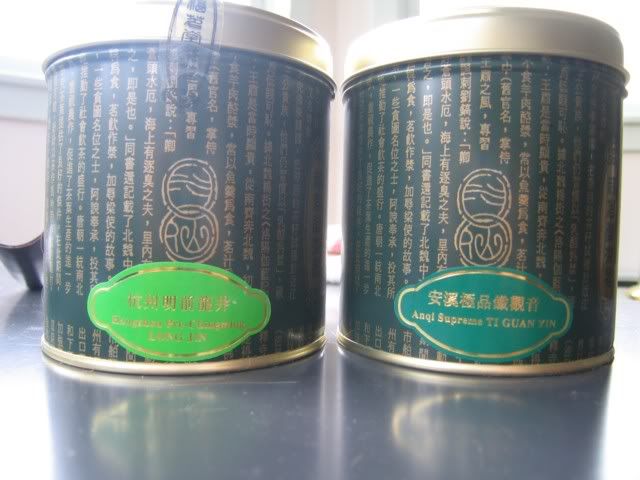
I actually forgot that I have one other qingxiang tieguanyin. This is a gift from someone else for my parents. Since my parents aren’t the tea drinking type, they generally keep all their unopened tea gifts around until my annual visit to Hong Kong. They let me see all the stuff, and I take it back with me as I see fit. Among other things this past Christmas, I took back a nice gift box of two kinds of tea — one longjing and one tieguanyin. They are from a tea store called Fook Ming Tong. These guys are a tea store that started up less than 20 years ago, and are generally catering to the upscale, gift giving market. Now you can find their outlets in, among other places, the IFC Mall. That means one thing — not cheap, and half of it is going to rent. The other half is going to packaging. Look at these:


Nice cans!

They also came in a nice gift box, which I discarded for the purpose of saving space in my luggage.

The labels on the cans would seem to imply that they are the best of the best. Mingqian longjing, and Supreme Anxi Tieguanyin. That should mean it’s pretty nice stuff. Whoever bought it for my parents probably dropped more than $100 USD on it, since these guys are not cheap. I actually haven’t opened either of them since returning to Cambridge after Christmas, so this is high time to try out the tieguanyin (the longjing really ought to be drunk, but I don’t drink fast enough).

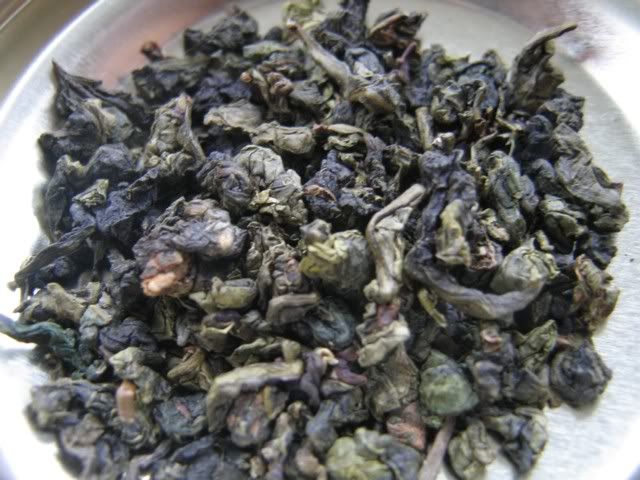
So I opened the box, took out the bag, and emptied it into the can. I should be more careful about preservation, but I am too lazy. Anyway, here’s the tea itself:

Looks good enough.

I brewed it using my qingxiang tieguanyin pot. The taste is better than either the Upton or the Xuefeng tieguanyins. Its fragrance is more intense, and the body is smooth and not rough like the Xuefeng. There is a nice aftertaste of slight bitterness, but we call it sweetness (there’s no such word in English). The tea has “cha qi”, which makes you sweat, and is a sign of a decent tea. It’s not bad at all, and rightfully so, I suppose, since this is their second best grade of tieguanyin (there’s apparently one even better than Supreme, go figure). I think this is an autumn pick, partly because the taste fades faster — only after 4-5 brews it starts going weak, which is short for a tieguanyin. I also put in, perhaps, slightly less leaves in than last time, and one of the brews might have been too long.

It’s a nice tea, especially since it’s free. I’ll compare it with what I got this time from Beijing tomorrow.

→ Leave a CommentCategories: Uncategorized

Friday April 7, 2006

April 7, 2006 · Leave a Comment

Second one — the Xuefeng tea that I’ve had before and talked about before. This tea is a little odd, actually, because it is winter picked (packed in early November). It tastes a little perculiar, as tieguanyins go, which I think is largely attributable to the picking date.

The leaves are very strudy, thick, with a little stem included. They’re rolled somewhat tightly. I think this is where the Taiwan style comes in — they’re trying to imitate the Taiwanese look and taste by rolling it tighter. The tea itself, in taste, is high in that typical Taiwanese type fragrance. It lacks a little of the character of typical Fujian tea in favour of more fragrance, I think. There is a hint of sourness, not overly pronounced, but it’s there. The tea comes out with a long aftertaste, the guanyinyun, and is nice in that sense. However, the tea brews somewhat rough — its body is not smooth like some tieguanyins. I tried to be more careful in how I brew, but I didn’t get that smoothness. Perhaps this is also due to the picking date, although that’s hard to say.

Opening of new tea tomorrow. That will be the one I got in Beijing this trip. When I tasted it there, it was really good. Let’s see if it repeats.

→ Leave a CommentCategories: Uncategorized

Thursday April 6, 2006

April 6, 2006 · Leave a Comment

Since I recently bought a deluge of tieguanyin tea, ranging from poor to good, I am in desperate need to kill some off to make way for others. One of them is the Upton tieguanyin that I got a while back. So I decided to drink all my qingxiang tieguanyin in the next few days at least once — to compare them and guage their respective quality.

So I used the final two packs of tea that is left from that shipment in today’s brew, using my qingxiang tieguanyin pot. Drinking it again now, it tastes almost completely different. Well… that’s not really true. It tastes the same as when I tried it for the first time, but back then, I was starved of qingxiang tieguanyin and hadn’t had any for months. I was just happy to drink any kind of tieguanyin at all. This time, however, I’ve had much more recent experience, and tasting this tea again, it’s quite different.

The tea is still the same. It is low on fragrance, but it retains the bite and astringency of the tea. The body of the tea is not very thick, but the tea itself, when drunk, does cause a little sweat, which means that the tea leaves are not poor. Somehow, the fragrance just isn’t there. Having tried a few tieguanyin on this trip, I no longer think this tea very good. There is, however, an explanation.

This tea must be a 2005 spring picked tieguanyin. For some reason, 2005’s spring pick was poor in quality, and I remember now trying it once in Hong Kong this past Christmas at the Best Tea House. I was asking them if they have any tieguanyin for me to buy, and wanted to try a spring pick, but the sales girl said the spring pick was poor. We tried it, and indeed it was — weak, low fragrance, not very impressive at all. The tea leaves of this Upton tea consists of mostly small leaves — buds, not big leafy leaves. It does look very much like a spring tea, which I think will explain the taste.

One down. Two more to go. One’s from the Xuefeng store, and the other from my most recent purchase.

Amendment: someone commented, and I feel I should correct something. I do not mean to say that all spring 2005 teas were terrible. There are obviously better and worse examples of it, but by and large, from what I understand, it was not the best season. This particular rendition of it is not particularly great, and I don’t think it is only because of the timing, but it most likely played a factor in determining the taste.

→ Leave a CommentCategories: Uncategorized