A Tea Addict's Journal

Cooked loose puerh from Lam Kie Yuen

February 20, 2007 · 2 Comments

When I went to Bonham Strand a few days ago I bought a little loose puerh from Lam Kie Yuen. The owner of the place, who is a very kind old gentleman with a lot of knowledge of the tea business, described this tea as having been through “swimming” storage. I’m not exactly sure what that means, but I’d imagine it’s a little wet.

I should note here, by the way, that the term in Chinese that describes dry or wet storage is “shicang 濕倉” (wet) and “gancang 乾倉” (dry). The word “cang” in this case is better translated as “storage” as in “storage condition”, but the word literally means “warehouse”. So you can also translate those terms as “wet warehoused” and “dry warehoused”, or some such. When talking about a tea that has been wet stored, it is usually only referred to, in Chinese, as “this tea has been through storage”. This issue led Mr. Lam to quip “people have been asking me a lot lately whether this or that tea has been in storage. What kind of a dumb question is that? Where am I supposed to store my tea if not in my warehouse? Under my bed??”

Anyway, Chinese lesson over. The tea, when dry, looks like any other loose puerh…

Almost impossible to tell what it is. All I know is that the grade of the tea is fairly high.

The liquor is a dark matter…. slightly opaque. It’s got none of the “fermentation” taste of a young cooked tea. Instead, it’s just …. old, kinda sweet, and somewhat bland in a way. Smooth, although not 100% smooth. There was a slight unpleasantness in the back of the throat… very slight, but detectable. This is supposedly a by product of wet storage that hasn’t been fully aired-out, so to speak.

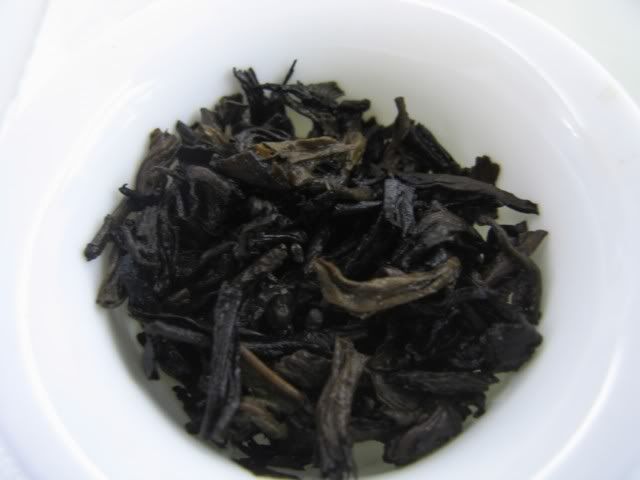
The wet leaves are…. not too remarkable

But the fairness cup, after using it, shows how much stuff was dissolved into the tea liquor… and the viscosity of the tea.

The reason I’m drinking this at all (I’m sure some of you are wondering why) is that ZH from Beijing wants me to look for some cooked puerh for him, preferably aged. This is supposedly about 10 years old. He wants to try putting ginseng with the tea in a sealed jar to let the tea be infused with ginseng smell, sort of as an experiment. I’m going to send him a sample of this and see if it meets his approval.

→ 2 CommentsCategories: Teas
Tagged: , , ,

Housekeeping issues

February 19, 2007 · 10 Comments

A few administrative things…

I am thinking that at some point in the future I may want to migrate to another blog host, or possibly to get myself a domain name of some kind, find a host, and use one of those blogging software to make a blog. It will be much more flexible, I’d imagine, than the current system, and it might allow for more user participation. If anybody has any ideas about what to use, how I should do it, etc (I know there are computer types reading my blog) feel free to make suggestions.

In the meantime, my girlfriend bought me a Xanga premium membership. This means that I can have a custom module on the left. I am thinking of putting links up, but bear with me… I’m slow.

I’m also slow about tagging old entries. This will, at least, provide some sort of navigation tool to the old posts. If you click on one of the tags (again on the left hand side) it will bring you to posts that have been tagged with that term. I haven’t finished tagging yet, as it’s a rather slow process, but I’m moving.

Not too much happened today with regards to tea, other than having tried a generic “English Breakfast” that was rather nice. I am hoping tomorrow I will have more time by myself to drink tea more seriously….

→ 10 CommentsCategories: Misc · Old Xanga posts
Tagged:

Passing the year

February 18, 2007 · 1 Comment

Not much of an interesting tea day, as I drank, interestingly enough, teabag teas. Well, not exactly. I had a so-so Darjeeling with my breakfast this morning, and then had a Tazo teabag in the afternoon. Neither were exactly nice, and I just didn’t have a chance today to brew my own teas. I was hoping to make something nice.

Chinese New Year is a pretty festive affair. Families get together to eat and chat and just gather for the sake of gathering together. At one point about 12 people were crammed into my grandfather’s room, all chatting about family stuff. It was quite nice, and something I certainly haven’t done for quite a while.

However, Chinese New Year isn’t quite so benign in its mythical origins. The Chinese term of going through the new year’s is “Guonian” 過年, which actually literally means “Passing the Nian”. Nian is year, but Nian also refers to an ancient mythical beast that comes once a year. It will come up from the deep seas, where it resided, and eat and rampage its way through the lands. People were scared of it and left home every year on the 30th to avoid the beast. One year, an old man showed up and asked the villagers to let him stay there — if they would, he could make sure the Nian won’t harm them. The villagers obviously thought he was crazy, and left anyway. He stayed behind.

When the Nian came, everybody except the old man had left already. Suddenly, however, there was a loud burst of sound with a lot of red confetti flying around — a red firecracker went off. Nian was badly scared. Turns out that Nian is afraid of loud noises and the red colour. The old man appeared, wearing red, and Nian ran away.

So, the legend goes, the tradition of decorating the houses in red with parallel banners and lighting red firecrackers became the custom each year to scare the Nian away. This, of course, is just a legend that justifies a lot of people’s festivities during this time of the year, but I’m sure at one point people perhaps really believed in such things. Either way, it’s a time when everybody is supposed to have a good time. Kids get their red bags stuffed with money. Adults exchange gifts when they go visit each other, and everybody is encouraged to eat lots of special food and wear red. It’s a good time.

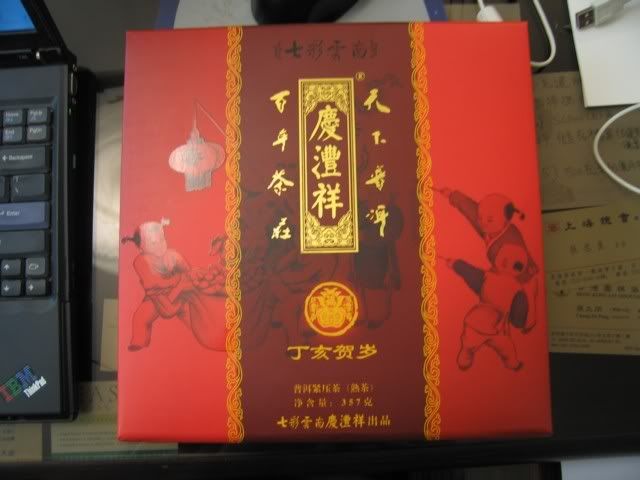
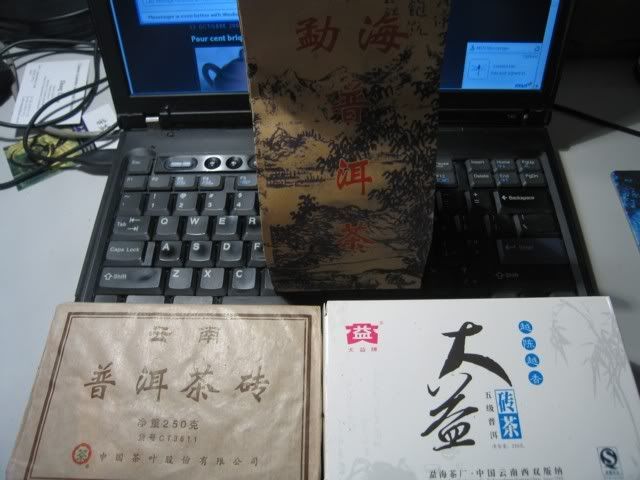
Among the things I got was, surprisingly, a cake of puerh, from my uncle who got this thing from a friend of his in Kunming. I don’t think this is the best of teas, but it’s a nice gift and comes in a really nice packaging.

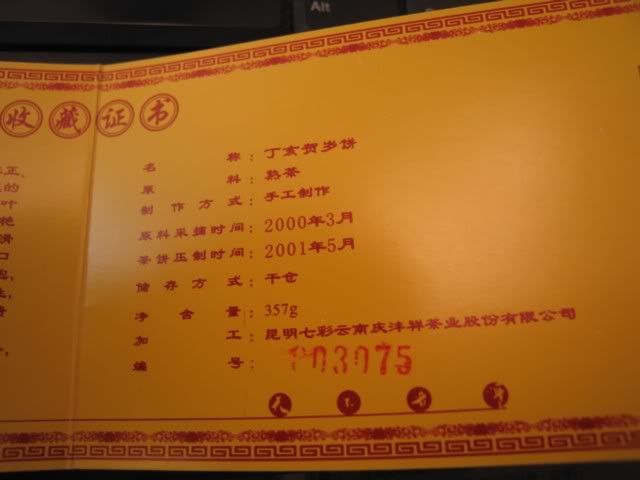
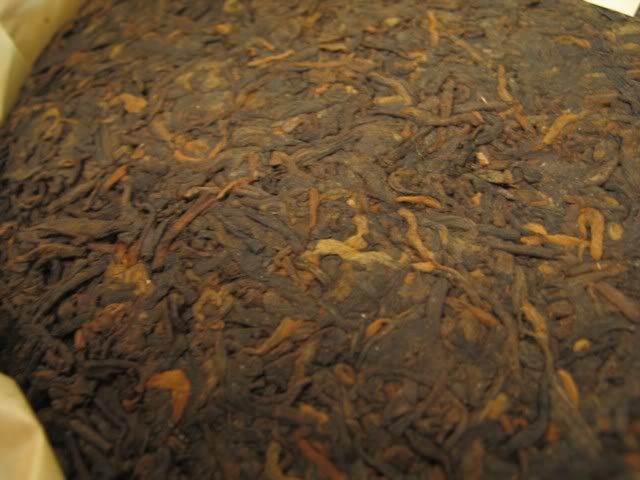
The tea itself is cooked, and supposedly 6 years old now if you read the little booklet carefully. It looks…. like a cooked cake, and cooked cakes….. are impossible to distinguish in terms of age. It smells strong. I don’t know how it tastes.

Festivities continue tomorrow, with fireworks at night!

→ 1 CommentCategories: Information · Old Xanga posts
Tagged: ,

Passing the year

February 17, 2007 · 3 Comments

Today’s the final day of the year of the dog, and tomorrow (in about an hour) we usher in the year of the pig. In China people would be lighting firecrackers like crazy at midnight, and sleeping might be difficult for a few hours. In Hong Kong, no such things are allowed (all firecrackers/fireworks are outlawed — too dangerous in a place with such a high concentration of population). Nevertheless, people celebrate, mostly by eating dinner at home or outside, but definitely with family. This is about the equivilent of the Thanksgiving Dinner in the US, where families try their best to gather together and have a long dinner. We just finished ours.

During the day today, as you can imagine, it was rather quiet outside, but a little gathering was going on in the Best Tea House. It was, surprisingly, an exceptionally busy day for them. I stopped there earlier with my cousin, but it was so crowded with (mostly Japanese) tourists that we had to take a walk. When we came back, I saw somebody unexpected — sjschen of the LJ Community. He is in town visiting, and by chance found the Best Tea House a few days ago. We ended up chatting a good bit about the teas they had, and started brewing some.

Among the teas we drank was a somewhat wet stored cake, which tasted like a 10-15 years old tea and was still a little sour/green in the undertones, but generally starting to taste like aged teas. Then it was a loose tea from, supposedly, the Menghai area. It’s starting to taste like a real old tea, with a shadow of the Red Labels I’ve had. It’s not quite as strong in the qi, but the taste is very similar. It’s sometimes quite interesting to see these changes in puerh.

Then we tried the puerh I bought for Rosa, which I personally now think is good value for the money. It’s not a great tea now, but it has some signs of a good one to come. The chaqi is strong and the tea is generally good. Rosa was happy with the purchase.

We finished with a high fired tieguanyin. Always nice to drink such things after a bunch of puerh. We didn’t get to the one cake I recommended sjschen to try, but oh well, what can you do. Maybe they went back to the store after dinner? I’m not sure. Either way, we had to leave and so we all left. It was nice meeting another tea friend in person, and it reminds me again of the real benefits I get from this blog — I get to meet all sorts of people from all over the world, people who I would have never met otherwise, all because we share one common interest.

I wish you all xinnian kuaile (Happy New Year), gongxi facai (wishing you to be prosperous – standard Cantonese new year’s greeting), and most importantly, xinnian he haocha (drink good tea in the New Year!)

→ 3 CommentsCategories: Old Xanga posts · Teas
Tagged: , , , ,

Young puerh prices (2)

February 16, 2007 · 3 Comments

I went to Bonham street today and looked at, among other things, a bunch of loose puerh. That, I think, is also an important thing related to prices. Loose puerh in general do not come with packaging, at least not in the “this is vintage xxx from xxx factory” way that cakes/bricks/tuos do. So when you pay for it — you’re paying for the quality of the tea, with no reference to who made it, etc.

Unfortunately, the lack of information I talked about earlier makes it so that there is a serious hunger for any sort of information. I remember recently reading an article in the Economist, I think, that says studies show that human behaviour is easily affected by those surrounding them. A music store online that shows how often a song has been downloaded will see sales gravitate towards the few “winners”, whereas stores that don’t show such information will have a more even spread of sales. The herd instinct is alive and well.

The same is true for puerh, especially in a marketplace as crazy as puerh market is right now. Any sort of hype surrounding any sort of product will often create a buzz among puerh collectors. An article in a magazine, a good review from an “expert”, or even just a well documented thread on a place like Sanzui can create a buzz for a particular product that will drive the price up. I’ve fallen into the same trick. When BBB and I bought the Mengku stuff partly because I heard about it from online sources, etc, which in turn came from an article in a magazine. Prices for said tea shot up over the past few months, as far as I can tell, and somebody’s profitting from it.

Is that tea necessarily that good though? When we tried it, the Yuanyexiang was not that much better than the 2002 cake we also tried, but the price was much higher. The price differential is even larger now. Why did these people buy it though? Is it really because the tea is that superior? Or is it just because somebody talked about it, written a good review, and …?? I’m not so sure anymore. These products that are featured are also often used as a “guiding” product, and the prices of EVERYTHING produced by said factories will tend to go up after an episode of such a price rise. It’s unfortunate, but in an arena with such a lack of information…. price changes in one thing is often the only piece of info that is seen by the general consumer, and will affect a lot of other things and pull prices up all over.

So the loose tea offers a good lesson. Buy the tea based on how the tea is, not on what other people have to say about it. It’s extremely difficult to do that, however. Doing blind tests help. Doing head-to-head tastings help. It’s not easy to be objective when you know that one of the teas you’re brewing is going to cost you $90 and the other is $10.

The other thing is that it entirely depends on what you want to do with the tea. Are you buying it for drinking now? Drinking later? Trading for something else later? Selling? Investment? Those all affect the purchasing decision. If one were to buy something for investment, for example, you would want to buy a tea with a brand name, a pedigree. Those command a premium right now, but those will also have a more reliable future price. On the other hand, if one were to buy teas for one’s own consumption in the future, then it might be best to buy cheaper teas right now.

Are these “wild”, “old”, “arbour” teas really going to be 10x, 20x better than the plantation tea, 20 years down the road? Does anybody know? After all, most of the classic teas that are so highly valued today are plantation stuff. I personally don’t know the answer to this question, and I’m not sure if anybody really does. Those who claim they do generally have a heavy financial stake in the business, so I’m not even sure if any of those words can be trusted. The claim is that these old tea trees will yield a better product, will age with more qi, more depth, more complexity, etc. I’ve had some 10 years old “big tree” teas, and while they’re decent…. I’m not sure if the price differential now between old tree and plantation tea will really show in the future anymore.

Which is why these days I’ve been buying some cheaper stuff…. I think at this point, where I don’t know the answer to such questions, I am just going to have to apply the shotgun method and buy something of everything so that I will have something good to drink down the line, and also I will have learned something useful. It is also why I tend to buy teas that aren’t made by big factories, because they command a premium that I don’t think necessarily reflects the quality of the tea itself. Maybe 10 years from now, I will know better what will really age well, and what won’t. Right now, however, I am afraid I don’t have a good grip on such questions.

Unfortunately, nobody who knows something about this seems willing to talk about it. I have rarely, if ever, seen real recommendations on how to select tea without talking about specific products. Or, they are phrased in such vague terms that they are hardly useful. Perhaps at the end of the day, it takes experience to do such things…. I wish I could offer more, but at this point, I don’t want to mislead anybody 🙂

→ 3 CommentsCategories: Information · Old Xanga posts
Tagged: , , ,

Young puerh prices (1)

February 15, 2007 · 4 Comments

I went back to the Best Tea House today for my usual visit. I dropped off some of Rosa’s tea, although most of it is still with me. I also tried a bunch of teas, none of which I’ve had before. They got some new goods, and so I was eager to give them all a shot. Talking about them, however, would be boring. Instead, something else popped into my head today.

Prices at the Best Tea House, for young, raw puerh anyway, is all over the place. For example, I tried a very expensive new cake today from the Jingmai area that was entirely unremarkable and boring, not to mention weak and unappealing. Tiffany tried it once before, and thought she just didn’t brew it right because she was rushsed. After today’s tasting, however, she realized that it wasn’t so much that her brewing was bad, but that the tea was bad. The price, however, is mystifying. It’s much more expensive than some of the older stuff which are also better. No idea why, really…

Then you have some cakes that are really quite cheap (relatively speaking, anyway). The one I bought last time was one of them. Of course, then I discovered that I could get it off taobao for a slightly lower price, but given the hassle of using that service and the shipping cost, the price was basically the same… and this is from a store with a much higher overhead!

In some ways, this is sort of a microcosm of the young puerh market in general. Prices are all over the place for all sorts of reasons, most of which aren’t even logical. Much of this, I think, derives from a lack of information on all fronts. There is a lack of information on the side of the purchasers, of course. Services like taobao and access to markets like Maliandao (provided you’ve done a lot of walking on the street) will give the consumer a good idea of what might or might not be a fair price, but both activities take a substantial amount of time to do. Most consumers don’t have that kind of time. When you can only rely on your local teashops and when you only shop for tea once every, say, two weeks, it’s hard to know what’s a fair price for what kind of goods.

There is also a lack of information for the retailers as well. Many times the retailer is simply selling stuff that they got from whatever source they have, and mark it up the usual % and resell it. Quality is not always involved in the calculation of the prices. Much of this is also arbitrary and unpredictable, depending on many factors such as storage, fame of the cake, production numbers, etc, all of which affect the price of a particular tea. At the Best Tea House, for example, I have seen 15-20 years old cakes, wet stored, going for half the price of a 10 years old cake, dry stored. This is quite normal. I have also seen entirely new cakes be almost 10x different in prices, despite a similar quality. I cannot understand the pricing. I think how much the tea cost the retailer in the first place plays a heavy role.

On the other hand, there are the genuine attempts to deceive consumers. At a place like Best Tea House, you can be assured of a fair quote, no matter who you are. That is not true on the mainland, where everybody gets a different quote. For example, I have asked L to get quotes for me from the Haiwan Factory store for some of their cakes. He got them for me. I then went back with him a week later, asking the same question for the same prices. I think I got a different salesperson that day, and not surprisingly, the quote was different by about 15%. It was actually lower, but it could’ve been higher as well. We just laughed it off as a funny incident (especially since he’s actually a tea vendor, when I’m not), but without transparent prices, such things happen all the time. I’ve personally experienced them many times on Maliandao, and I’m definitely not alone.

While prices are lower at a place like Maliandao, getting the low prices involves substantial work and a reasonable amount of knowledge and experience in dealing with these people. I have seen a dramatic decrease in the prices I pay for puerh in Beijing over the coures of the year. Although you might think it is nice to get the low prices, in some ways, those buying tea from the US or Europe or elsewhere, especially those purchasing tea over the internet, have a much better and easier time. Even though prices are obviously higher through ebay vendors than what I could get at Maliandao, prices are also transparent and more importantly, stable. While prices do rise, they do so in a slow and predictable fashion. Whereas Dayi tea in China over 2006 has seen times when it was literally “one day, one price”, internet prices through ebay were the same for the same 7542, 601 batch. That itself is a bit of a blessing. In fact, some of the ebay items are selling at basically no premium over what the current market prices for the same tea in China. Since ebay consumers probably won’t tolerate a 40% price hike in the course of a few months, the prices can only stay the same, or more or less the same.

Raw material prices for old, big arbour trees in Yunnan have been shooting up by something like 50% a year. This year, from what I have heard second hand anyway, raw leaves prices are the highest in Lao Banzhang, reaching 550-600RMB for one kg of maocha. Yiwu is second, clocking in around 280-300 or so. Jingmai is a bit lower, and then you have the rest. This is only what I have heard. Work in some attrition of maocha during production, add in sundry costs like pressing and transportation and overhead and stuff, and you can roughly work out how much a cake of these old wild arbour trees should cost to make and to be sold at a profit by the people who first made them.

How much they retail for, however, is an entirely different subject. As I have noted, pricing is all over the place, but I think it would be quite unreasonable to charge anything more than 300% of raw cost of the tea for retail, more if it’s being sold overseas (as it’s been through somebody else’s hands). The more hands its been through, the more it would cost. Other factors come in, such as the kind of market the store serves (i.e. stores that are located in CBDs with pretty salesgirls and fantastic decor will sell the same tea for more, obviously). Factory reputation come in (the Dayi premium, for example). The stories, unfortunately, also come in (this is tea made by so and so when he discovered a new field of tea trees in xxx area, unharvested for a long time!).

More on prices tomorrow. This is getting too long.

→ 4 CommentsCategories: Information · Old Xanga posts
Tagged: , ,

Tea everywhere

February 14, 2007 · 2 Comments

Let’s see, how many teas have I had today?

I had my first tea after lunch. It was one of the samples that Mr. Lochan sent me, one of the Darjeeling oolongs. I don’t want to say much about it yet, as I think I brewed it under sub-optimal condition, and also because it’s the first time I’m trying it. It’s a new genre, I’d say, so I think I need to try it a few times before I know how to brew it properly and form a concrete opinion on it. It’s strong in some places, and weak in others.

Then, I went out to see a movie. After that… it was dinner with my cousin, where we ate at a very old Hong Kong restaurant (since 1860) serving HK style western food (they’re famous for their Swiss chicken wings). They pour you regular “tea” for drink (think of the role of iced water in Western restaurants, but substitute it with hot tea). The tea is a watered down version of the traditional Hong Kong milk tea (but without the milk). Then, to finish off dinner, we both had a cup of milk tea, but neither of us added milk. It was strong, bitter, sour, full bodied, but VERY smooth. This is stuff that is boiled in stockings. From what I know, it is a mix of a blend of Indian tea plus some puerh to give it a sweet edge. It’s a very unique taste that is not replicated anywhere else other than Hong Kong style restaurants everywhere in the world. This particular blend tasted a bit coffee-ish, given its harshness. Best with milk, but I was bad today :p

Then…. I picked up my mom from her dinner with her friends, and there, I had some watered down biluochun. I think it was biluochun anyway. It was pretty watered down and I could only get a hint of the taste.

Tea everywhere, as you can see. Caffeine intake here is quite high in the course of a normal day, so I really need to watch myself when drinking tea at teahouses, because otherwise…..

→ 2 CommentsCategories: Old Xanga posts · Teas
Tagged: ,

Hong Kong is wet!

February 13, 2007 · 7 Comments

I got back, got off the plane, and the familiar scent of a slightly damp city graced my nose. Hong Kong is always wet, and it seems like the super wet weather of spring is hitting early this year.

This leaves me a bit uneasy with my tea stash here. In Beijing I never worry about moisture, because it’s always too dry there (I put two bowls of water in my tea cabinet, so to make sure that the water doesn’t run out before I return). Here, though, you can feel the wetness.

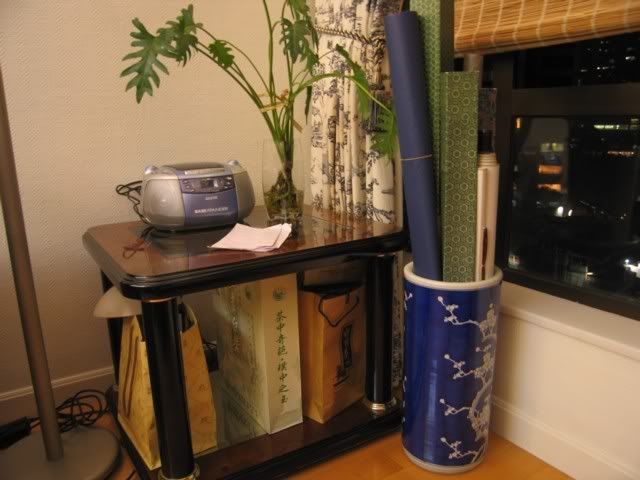
This is where the tea was stored

The place, as you can see, is not ideal. It’s next to the windows, so when the windows are open (as it was when I came back) there was a slight breeze. It brings a lot of moisture through the air. Although what’s stored there are just two tongs (the other loose cakes are in a paperbag on one of the bookshelves), I worry about it. I could sort of smell the tong wrapping. I opened one of the tongs up to check… the cake almost feels damp. It’s wet all right. Time to move them.

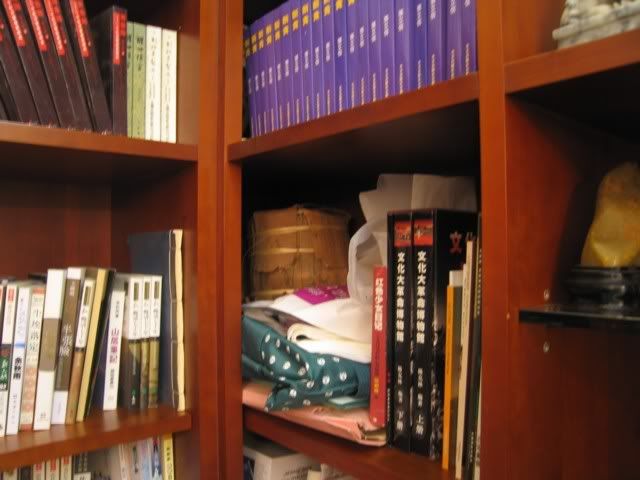
So I cleared out a little corner of one of the bookshelves and put my tongs there. Take a peek

I need to clear the area out a little better, but it will do. I am thinking of making one shelf tea related stuff, if my dad will let me. After all, I don’t have a room in this place and sleeps on the murphy bed in the study.

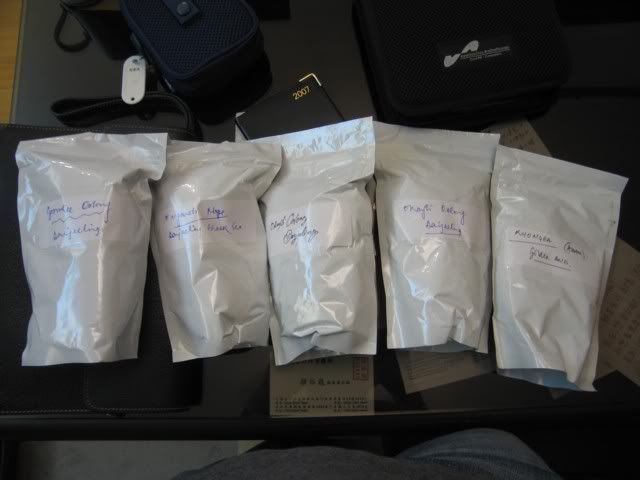
Other than my puerh stash, I also got a nice package in the mail:

These are tea samples from Mr. Lochan of Darjeeling. They’re actually all big bags… 100-200g each, I think. That’s a lot of tea to drink. I might give some to the Best Tea House folks to try.

Anyway, time to turn in. I think I am going to deliver Rosa’s tea tomorrow (which, incidentally… put my luggage over the weight limit…)

→ 7 CommentsCategories: Information · Old Xanga posts
Tagged: ,

The traveling tea salesman

February 12, 2007 · 3 Comments

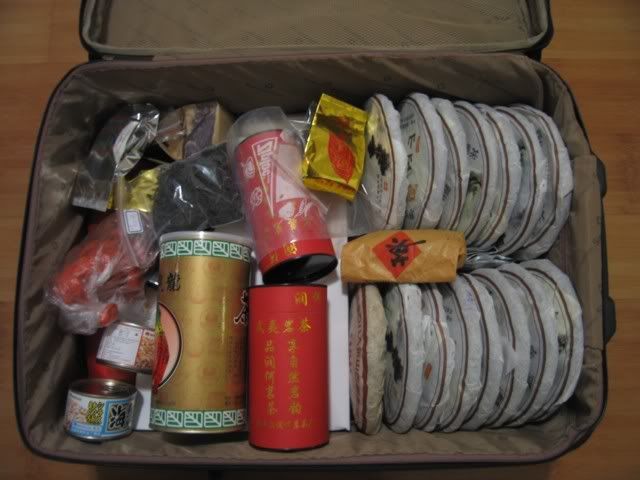
This is one of my luggages for my flight tomorrow to Hong Kong.

Most of this, I hasten to add, is for other people. The vast majority of it is for Rosa of Best Tea House (the two tongs and the stuff in the white bag in the back). Others are for a few other friends… only the small bags here and there are for myself.

I must look like a tea fanatic.

→ 3 CommentsCategories: Misc · Old Xanga posts
Tagged:

Three time’s a charm

February 12, 2007 · 2 Comments

I went to Maliandao again today, partly because my friend DY wanted to go and she’s really unfamiliar with the territory, and partly because I still have some unfinished business there.

We just went to L’s store, where we sat down and started drinking. We first had a Yichang Hao 2006 Yiwu cake, which was a gift to DY from a friend of hers. I amazed myself by guessing that this is one of her Shenzhen friends (Shenzhen is across the river from Hong Kong). I asked because it tasted like a Hong Kong/Guangzhou area storage condition — i.e. the tea changed faster than it would in Beijing, smoother, and generally better. I was right! She was impressed I could tell where her friend is from just by drinking gift tea. I have to say I was happy 🙂

We then proceed to have a few cooked puerhs. I ended up buying a sample of all of them:

These are all directly or indirectly for my girlfriend. The two bricks are going to be gifts for people in Inner Mongolia, but I am not sure what kind of taste is better, because this will be used to make Mongolian milk tea. Since she’s much more of an expert on such matters than me, a pathetic Han weakling who knows no such things, I will defer to her judgment and going to bring the samples over to the States. The mini-tuos are also for her to make yuanyang, which is a mix of robust tea and coffee. She wants to try this with espresso and cooked puerh, and these mini-tuos are VERY robust tasting. I think it will work.

Lastly, we had another tea from DY, an almost border tea from a region near Burma. It was, surprisingly, very good. Very light, pleasant, fairly smooth as young puerh goes… and generally quite enjoyable. It lacks a bit of depth, but really…. for a tea that shouldn’t cost more than 20 or 30 RMB a piece, it is quite nice. Now, her friend bought it from a touristy area in Yunnan and told her it was “very expensive”, so….. somebody got robbed….

We then walked around a little to buy necessary teaware, but nothing exciting there. I am still in the hunt for a shui ping pot for Chaozhou style gongfu tea, but haven’t found a suitable pot yet…. maybe I can find it in Shanghai. Either way though, this will be my last Maliandao trip in almost two months. Tomorrow, I fly back to Hong Kong, and I won’t be back here until early April….

→ 2 CommentsCategories: Old Xanga posts · Teas
Tagged: ,