A Tea Addict's Journal

A beautiful mistake

April 15, 2007 · 1 Comment

I went to Maliandao today. There was a cake I saw last time that I wanted to try at a store I’ve never been to (there are lots of those), so I went there today and asked to try it.

We sat down, the girl brought over a cake, face down, and she started peeling tea off it and rinsed it. I took it in my hands to look…. and noticed it’s the wrong cake. Oops. I told her, pointed out the one I wanted. She wanted to throw the tea away, but I said since she rinsed it already… let’s try it.

The mistake was a Bulang cake, which is something I usually don’t fancy. I find the stuff not that interesting, especially when compared with Yiwu. Bulang is quite expensive these days, mostly thanks to Banzhang’s proximity, but nevertheless… I’m not a huge fan.

The cake I actually wanted to try was a Manzhuan cake. It looks nice, and it’s got a good price. The Bulang is a little more expensive, about the same age (3 years or so), but not as nice looking, cake wise. Both are from Quanji, whose tea I own some of already. I liked it last time, and this is the first store I’ve seen that carries it in Beijing besides the one where I bought my last lot from. I figured I could give them a go. Since I am usually a fan of the Six Mountains area tea…. Manzhuan was the obvious choice.

We started off with the Bulang, as it was ready. It was immediately obvious that the tea was decent. It hits the back of the mouth with a bit of a cooling effect. It is somewhat bitter, but leaves an aftertaste. There’s qi. The tea is not that rough, especially for a young tea. The taste is changing… losing the very green sort of taste you’d come to expect in very young puerhs. The few years of aging, wherever it was done, has done something.

The Manzhuan, on the other hand, is sweeter. The tea, however, was less strong…. less powerful, and has less feeling in general. It doesn’t penetrate as deeply as the Bulang. It was especially obvious after a few infusions, where the Manzhuan started acquiring a slightly puckery feel to it. The Bulang stayed the course and delivered strong infusions round after round, even when we were more than 10 infusions into the tea. The Manzhuan, on the other hand, started running behind, lagging. It acquired a bit of a water taste after a some infusions. It was obvious when you compared the two. Oddly enough, while the Manzhuan was brewing a stronger coloured brew, the taste was obviously weak and flat in comparison to the Bulang, which was lighter in colour but yet deeper in flavour.

I think I would’ve thought the Manzhuan to be a pretty decent tea, if I had not had the Bulang to compare. The puckery feeling was not strong, and the sweetness that it delivers is quite alluring, at least initially. I might’ve written off the weakness later on to amount of leaves or time brewed, and it’s always harder to tell such things when you have no basis for comparison. This is proof positive that, when trying to evalute a tea…. it’s best to have something against which to compare, and the question of which one being better and which one being worse will reveal itself very quickly. I had that with the two grades of Lapsang Souchong, where it’s essentially the same tea, but I am seeing this again very clearly in this instance.

I ended up not buying any of the Manzhuan, and picked up two of the Bulang. It’s probably one of the best young cakes I’ve had in the past few months. I am contemplating picking up more… I’m just a little weary of buying more teas, as I already have a bit of a stash. Then again, this cake really is quite good, and if I think I have extra room when I’m leaving town… I’ll go buy more of this.

I went around Maliandao some more, but nothing too interesting to report, especially not after this.

Some tea pictures….

I think you can see how one side of the cake looks more compressed than the other. I suspect the person doing the filling/rolling of the bag didn’t do it too evenly. Doesn’t matter.

→ 1 CommentCategories: Old Xanga posts · Teas
Tagged: ,

On storage, again

April 14, 2007 · 5 Comments

One of the first things I did when I returned from the US to Beijing is to open the cupboard that holds all my puerh here.

Sorry, it’s a little messy, but I leave all the bags open so they all breath, and between that and finding enough nooks and crannies to store all the little pouches of samples that I get, it gets a little messy.

On the right you can see two bowls — one on the top shelf, one on the bottom. Only the top is filled with water right now, but when I left Beijing for Hong Kong, I filled both up to almost the brim. I figured in the dry weather here some water won’t hurt.

When I got back and opened the cupboard, I expected two things. First, the water from both bowls should be all gone. That was exactly the case… it all evaporated, as it should since I was gone for more than a month. All that was left was a lot of salt deposits, testament to the high mineral content of tap water in Beijing. I figured leaving water in the cupboard can hardly be a bad idea given the dry weather here.

The second expectation was that I would smell a strong whiff of tea. Before I left, whenever I opened the cupboard, I can smell that scent of young, green puerh. It’s pretty strong, and I think it smells pretty nice. In fact, when I wake up in the morning and open the door to the living room (where the tea cupboard is) I can often smell the tea faintly. It obviously seeps through the not very tight doors of the cupboard and into the room.

When I got back and opened the door, however…. there was very little smell. I smelled a whiff of sweetness — that sweetness that you get from a 3-5 year old dry stored puerh. It’s not the same raw green smell of a very young puerh, but rather something that has aged a bit. It’s a difficult smell to describe, but anybody who’s had some slightly aged puerh, especially of the Yiwu variety will know what I’m talking about. Even that smell, however, was fairly faint. This was unexpected since the tea was left undistrubed for quite a while. I thought the smell would accumulate instead of dissipate given that the door would be closed all along.

So I added water to one of the bowls, and left the tea in peace except for when I was getting stuff from it. I have a humidity indicator both in the cupboard and in the living room. Throughout the week, the humidity in the living room was significantly higher than the humidity in the cupboard. My meters don’t give precise readings, just general “humid-dry” scale. But the difference was obviously significant enough so that it’s not a product of some mechanical error.

After a few days, I have noticed that the smell that I was expecting has returned… the teas in the cupboard once again give off that young puerh smell that I thought I was going to get when I came back. The humidity of the cupboard was still lower than the room. Even though I opened the door for a while to let in the air in the room, thinking that it will equalize the humidity in the two places, humidity in the cupboard remains stubbornly lower.

This has led me to think that perhaps, just perhaps, the teas are actually soaking up the water in the air in the cupboard, contributing to the lower humidity there despite efforts to equalize it. After all, humidity in and out of the cupboard should theoretically be the same if I left the cupboard door open sufficiently long, and since it’s really not a big thing, you would think that amount of time is pretty low.

The return of the tea smell, or rather, the more pronounced nature of the smell, leads me to think that with higher moisture, the smell of the tea gets stronger — the aromatics in the tea get released into air, I presume, with water. Is that a good thing? I’m not sure, but since they say you need moisture in the air to age the teas, I would think this is only a natural development and not a bad thing. I did notice that in Hong Kong, my rather moist cakes had a strong whiff of tea to them. I didn’t think much of it then. Now I think there’s a correlation and probable causation.

The other thing is that since the bowl of water was replaced, it has lost about 15-20% of its contents already in the past week. This is a little faster than I thought.

All this makes me think that the slightly more moist air that has accompanied my return (it rained for two days, and there’s also my human additions such as steam from the shower, me boiling water, etc) is giving the teas more water to work with.

This would also explain the teas that have been on shelves in Maliandao for too long — they are usually devoid of any smell, and you have to breath into them to get any whiff of tea out of them. In Hong Kong, you never need to do that — you stick your nose up to the cake and you can definitely smell it. Concensus has it that Hong Kong stored teas are probably better tasting than Beijing ones. The few Beijing stored cakes I’ve had indicate the same… they’re not very good and don’t age much. Teas that people have brought back from places like Xinjiang, despite their advanced age (10+ years) taste terrible.

I might try adding another bowl of water, but I think that won’t make much of a difference as there should be a natural equilibrium of how much water gets released into the air, depending on the humidity inside the cupboard. One or two bowls shouldn’t change that very much.

I’d like to think I’m moving the tea in the right direction, at least in keeping the tea a little room to work with, rather than drying them out as they would if I didn’t put any water in the cupboard. For those of you who live in drier climates — have you experienced something like this before? When you open your cupboard, can you smell your tea? Does it get stronger when you’ve had a prolonged period of moist weather? Have you had teas stored in two different places… and have them taste different after a while? Curious to know.

→ 5 CommentsCategories: Old Xanga posts · Teas
Tagged: , ,

An afternoon of tea

April 13, 2007 · 2 Comments

As I stepped out of the west gate of the Forbidden City, I noticed that it was a nice, bright, warm day. The archives close early on Fridays at 3pm, and I had a choice of going home, or going somewhere else. I decided, the tea addict that I am, to go to Maliandao.

Part of the reason is that L’s business partner in Beijing is back from their trip from Yunnan, and I was eager to talk to her to get some news from the battlefront, so to speak. I got there, and we started chatting over some tea. We started drinking some longjings they brought from Hangzhou last month, fresh from the spring picking (they are all pretty decent, with obvious differences among the three). Meanwhile, I learned about the new prices. They go something like this (all in RMB/kilo and only to the best of my knowledge — subject to change anytime!!!)

Lao Banzhang – 1200 (and rising)
Jingmai – 600
Yiwu – 400 to 500
Other area ancient/old arbour tree teas, at least for places in Menghai and Xishuangbanna – 250 to 350 ish, depending a lot on where, what, and who

Which is insanely high, as this is about double last fall’s prices, and more than double last spring’s. These are per kil of maocha, so divide by three if you want a rough estimate of how much a tea cake from these regions should cost. If the base cost of the materials of a Banzhang cake is 400 RMB, anybody retailing the tea in China will probably have to sell it for 1000 to make a reasonable profit of any sort. That, I think, prices a lot of people out of the market. Of course, plantation teas are much cheaper…. maybe only 20% of the cost of the ancient tree teas or thereabouts.

I got some free samples from her — maocha they bought from Nannuo and Banzhang. I’m going to try them out in the next few days.

I then went to the Mengku puerh shop to see when their new stuff will arrive. Early May, they said. That’s a long time, but for bigger factories, the delay is usually quite long. I guess I’ll find out what they’ve got in the spring this year. Right now, their store is deserted — no stock at all of anything. It’s almost all sold out, and it looks eerie.

I ended up in a store where I bought a cake before, and started looking through the newer stuff they got. They press their own cakes, so they have some pretty interesting stuff. I ended up spending quite a few hours there, trying 3 different kinds of Yiwus and some cooked stuff. The guy even bought dinner, so I felt sort of obliged to buy something. I ended home with one Yiwu, a 2006 fall tea, and I think was decent and not too expensive. One can always try a new cake and compare it with the stuff you’ve already got.

→ 2 CommentsCategories: Old Xanga posts · Teas
Tagged: ,

12 Gentlemen Jinggu-Yangta

April 12, 2007 · 5 Comments

Today I had a sample that has been sitting around for months without me touching it. I was rummaging through my cupboard looking for something interesting to drink, and this one popped out among the many little bags of samples that I have. Why not?

Yangta, from what I understand, is a part of Jinggu, which in turn is an autonomous county for the Yi people and under the jurisdiction of Simao, although it’s quite close to Lincang city. The tea that makes Jinggu famous is the Dabaicha, or “Big White Tea”. It’s a great looking tea — very big, broad leaves, thick looking, with lots of silvery hair covering it and thus makes any cake look good. There are some truly stunning looking cakes that are made by these teas, but from what I know, traditionally this hasn’t been used for puerh. It’s either made as a green tea, or as dianhong. Nowadays though, puerh commands top dollar and so they switch to puerh instead, but even then, Dabaicha isn’t an expensive kind of puerh. Good cakes clock in at under 150 RMB a cake. I have also heard of factories adding a bit of Dabaicha to their cakes to make their cakes look better. Visually it’s quite pleasing.

This is just a sample that I got along with the two other 12 gentlemen series. Somehow I never got around to drinking this particular one.

This is the piece I used today… breaking of parts of it

This piece is a few inches long, and really looks quite nice.

The tea brews a rather thick brew, very light colour in the first infusion

Darkening from the second on

And the third

Colour stays pretty uniform after that for quite a few infusions, all from about 7g of leaves.

The tea is very sweet, with a light floral fragrance. It’s great to drink now, although it gets a little rough after infusion 5 or so. Before that though, the tea is very pleasant. I think of this as a green tea, at least the way I probably really should brew it, I should brew it as a green tea — low temp being the key. But then again, a proper puerh should exhibit signs of roughness when brewed with higher temperatures, because otherwise it’s probably too weak for aging. When you add a generous amount of tea, using hot water, brew it, and the tea doesn’t exhibit signs of bitterness or roughness…. and this is a puerh meant for aging…. then we’ve got problems.

There is a vague similarity between this tea and some weaker Yiwus I’ve tried. I think the overall profile are slightly similar, although all similarities are superficial once you take care to look.

The tea lasted quite a few infusions and I actually gave up before it did. It just got a little boring for me, and I don’t think I can drink this stuff very often. If I want something that tastes like this… I go drink a good green tea, which is better than this stuff.

Leaves look pretty meaty, and feel pretty meaty. All in all, a good looking tea, but don’t let the looks deceive you.. I think there are better puerhs out there.

I need to pass the rest of the sample out… there is something like 40g of it left, and I don’t think I’m going to drink it.

→ 5 CommentsCategories: Old Xanga posts · Teas
Tagged:

HK Return commemoration brick

April 11, 2007 · Leave a Comment

I drank this today

Another view — USB for scale

Yes, this is tea. Very very very hard, compressed tea.

I was pretty proud when, after struggling with it for about five minutes, I finally was able to split it into two

It was the good, trusty puerh knife (the one with the faux-wood handle) that did the job.

This piece was given to me when I was visiting New York. I wasn’t told much about it other than what it was. I think this is supposed to be aged somewhat, although I’m not sure when. 1997, perhaps? I don’t know. I’ve seen some of those Hong Kong return commemoration bings that were made pretty recently…

The conventional wisdom on commemoration cakes/bricks, especially the ones that are so hard compressed, is that they are no good. They are more display pieces than for consumption, and you drink it at your own peril. There’s a term for this kind of tea, gongyi cha, which means “craft tea”. What it means, really, is that this is tea that is valued more for the way it looks than the way it tastes. However, I was told that this piece is not too bad, and that I ought to try it, so I did.

Smelling the dry leaves, you can detect some nice, slightly aged puerh smell. It’s of the sweet variety, and quite pleasant to smell. It seems promising.

I rinsed it twice — the first time to soften the piece up so I can peel it into pieces, and then the second time so that all the leaves actually touch water at least once before I start brewing. The aroma is the same as the dry leaves… smells nice!

The first infusion was a bit bland… with a slightly off taste in the back. It’s the first infusion after all.

The second was a little stronger

The first sip is quite nice…. with that sweet aroma coming through, and a bit of a sweet taste. Something still there that was sort of off, but not really obvious. I took a few more sips…. the tea is a little bland and a little weak in the taste department. It hits the back of the mouth with a bit of a cooling effect, which is nice, but somehow tastes a bit like water, which is not nice.

Then, in the next two infusions, I had more of the same thing, except that the off taste is becoming more prominent. By the fourth infusion it was clear that something is not quite right. While the first sip of each infusion was rather smooth and sweet, the next sip comes off as sour… there’s a puckery feeling on the sides of the tongue, and it becomes very unpleasant to drink. The colour of the brew is stronger

But the taste remains more or less the same, other than the more pronounced effect of the sourness of the tea. The tea is also a bit drying on the mouth… I feel my mouth dry up as I drink it, and it doesn’t really moisturize the mouth like some teas do. Instead, it sucks water out of it.

I tried the tea for two more infusions and gave up on it. It wasn’t really improving. It’s truly an odd tea. The initial impression is quite favourable, and I even thought that this might be a tea that is nice enough to defy the “commemoration cake is bad tea” rule. Then, as I go deeper into the tea, things change and the problems show up. The sourness is particularly unpleasant, but it is interesting how it only shows if I drink more than one small sip of the tea in each infusion. I even thought it’s something that’s a little denser than water that’s causing tihs… that somehow the stuff causing sourness settles, so I tried shaking the tea up before drinking, but the result is the same. When there’s no sourness, the tea is quite pleasant, though a bit bland. When the sourness is there, you just don’t want to drink this.

I used about 8g of tea, which is almost half my sample. I don’t think it was too much tea, as I did very fast infusions later on to try to reduce the effect of the unpleasant tastes, thinking that I may have overbrewed them. It didn’t work, and the sour feeling eventually got me to stop drinking the tea.

The leaves are a bit broken, and small, as one would expect in such a highly compressed sample. It almost feels like there are two kinds of leaves in there…. one that gives off that nice sweet aroma, the other that gives you that sour taste. The sour taste, unfortunately, wins out.

It was an interesting experience though, regardless, as I rarely drink this sort of thing.

→ Leave a CommentCategories: Old Xanga posts · Teas
Tagged:

Two shuixians

April 10, 2007 · Leave a Comment

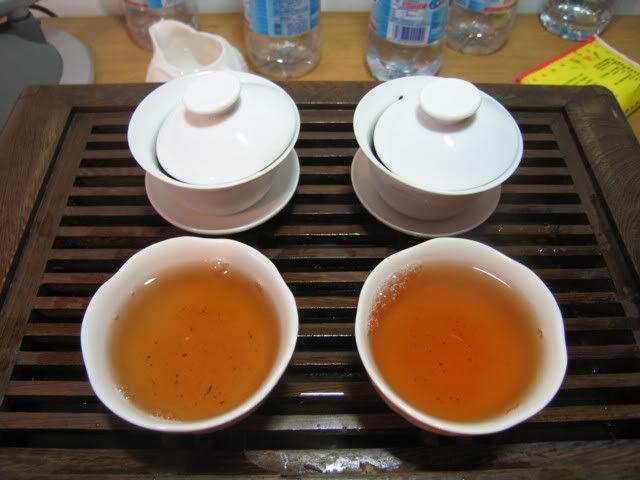
I tried the new shuixian I bought recently against an older one that I had.

One of them is 4x the price of the other. Any guesses?

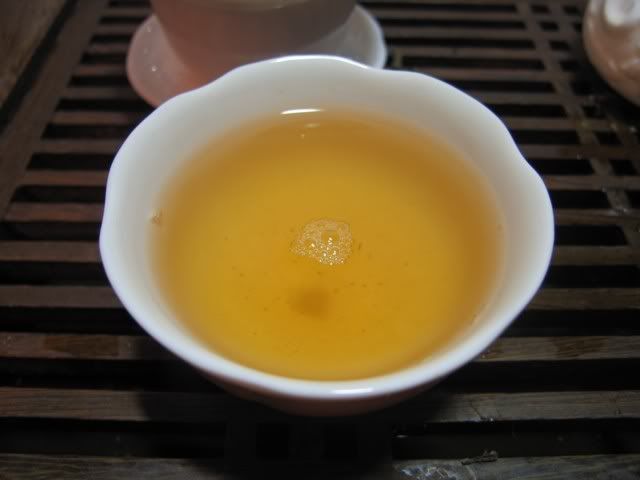
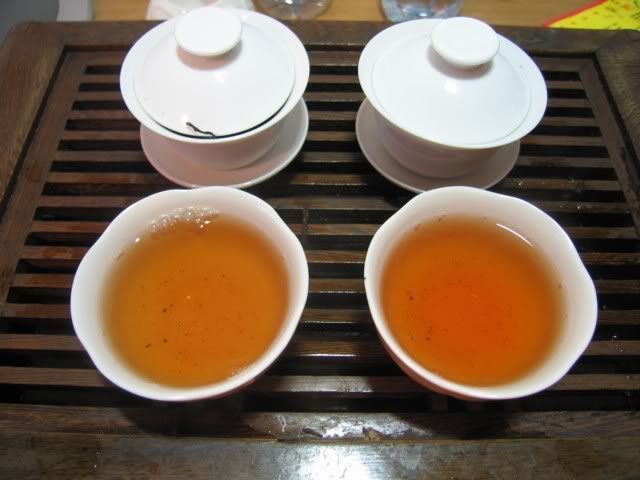
I used 3.5g for each side to ensure consistency in the amount of leaves. The teas brewed a very similar colour — the right side being slightly, ever so slightly, darker. It’s difficult to tell.

First infusion

Third or fourth infusion? Something like that

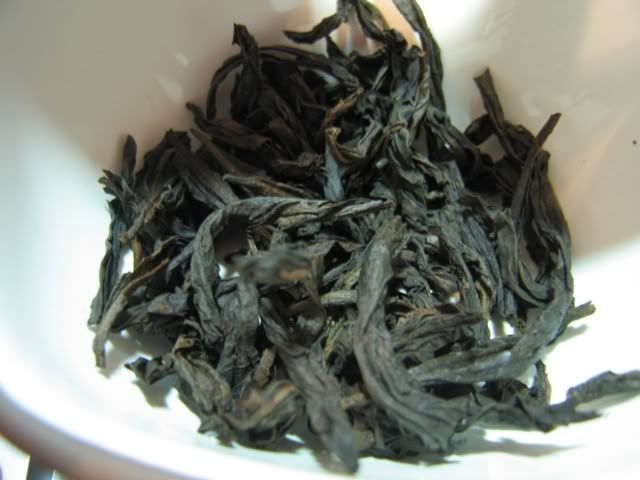
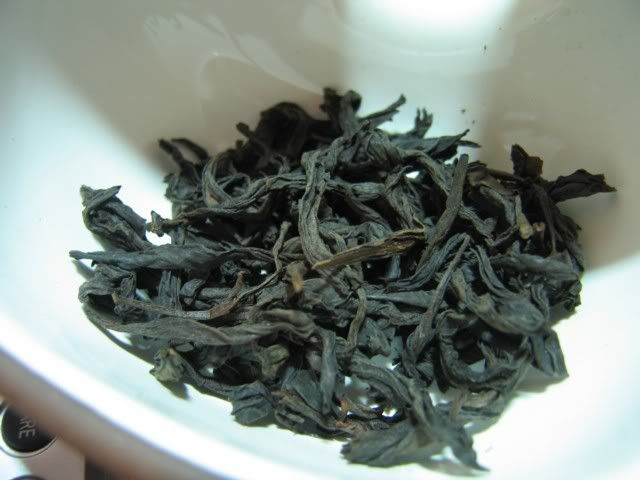
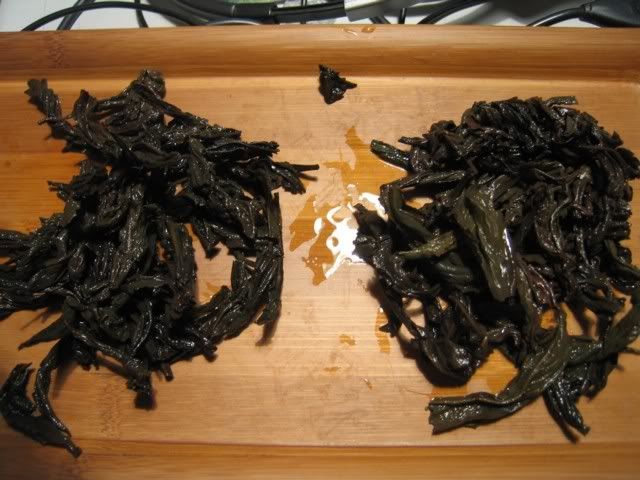
This is how they look when wet and done

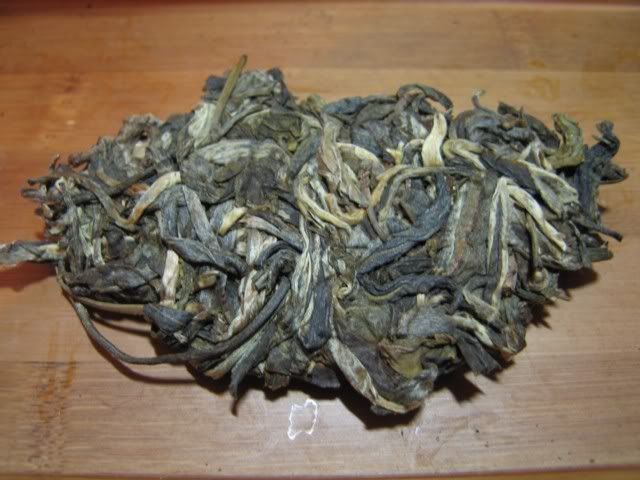
The left side is the newer one that I got, while the right is the older one that I already had (but I’m only opening the right side for the first time). The flavours… the left side clearly has a bit more roasted character than the right, and you can taste a bit of the roasted charcoal sort of flavour in the left sample, while the right one, though roasted some, doesn’t have that charcoal sort of taste. The left was clearly superior though, with a deeper character that penetrates down to the throat and leaving an obvious and immediate “rock aftertaste”. The right sample, while giving you some of that “rock aftertaste”, is weak in comparison. This was especially evident after around four infusions, where the left sample was still going strong while the right, tasted against the left, feels watery and bland.

The wet leaves show that the left side is somehow more rolled and maintains its rolled character, while the right side leaves unfurled more quickly. Upon closer inspection, the right sample seems to have mixed in it a few different kinds of teas, some more roasted, some less, and it’s the less roasted stuff that unfurl more easily. The more roasted ones, with those goosebump filled leaves, stay in their shape for longer. The left sample, being uniformly more roasted, stayed that way more or less over the infusions.

I don’t think the difference in taste is entirely attributable to roasting levels, and has instead something to do with the basic character and quality of the tea. The tea on the left was simply better, with that sort of aftertaste and depth that the right sample doesn’t match. Thankfully (or not…), it’s also the one that costs more.

→ Leave a CommentCategories: Old Xanga posts · Teas
Tagged:

New Shuixian

April 9, 2007 · Leave a Comment

I tried my new shuixian today.

The first two or three infusions were great…. and then the dropoff was rather sudden. I don’t know what happened. I don’t know if it’s the way I brewed them, the amount of leaves used (this tea takes up a lot of space so I couldn’t stuff as much tea in there), or what, but the tea somehow didn’t come out as good as I had hoped.

The tea is medium roasted, with very long leaves and looks pretty good when dry. The longer leaves you see in this picture are more than an inch long. I had to break a few of them to make them fit into the pot.

The first few infusions were great… with that roasted aroma, but also underneath it something very fragrant. It’s like an incense for some reason — smells like those Chinese incense, but I’m not sure what they’re called in English. It was an odd thing to detect in tea, but a pleasant one.

Then around infusion 4 something didn’t go quite right. The tea experienced a bit of a dropoff that was pretty obvious. The tea got more watery, etc. I wonder if it’s because I didn’t add enough leaves. Normally I would use more for this type of tea, but this one I couldn’t because of the way the leaves are. I might have to crush some to get more into my pot. Right now they just prop each other up and thus making the total tea/pot ratio to something like 1/3.

I’ll try it again soon and see what happens.

→ Leave a CommentCategories: Old Xanga posts · Teas
Tagged:

Back to Beijing

April 8, 2007 · 3 Comments

Today was a lovely day, with warm temperature and great weather, and the sky was actually blue and not some shade of yellow. I am rather jet-lagged… feeling sleepy around 12pm. What better way to try to keep myself awake than to walk around on this sunny day while pumping myself full of caffeine?

Yes, I went to Maliandao. Surprised? Didn’t think so.

When I got there, I had this strange feeling that everything felt foreign, somehow. I know the place pretty well now, but somehow today, when I went there, I felt odd. Maybe not having been here for more than a month did the trick and made me feel a little odd.

In order to get myself into the mood, I went into Jingmin Chacheng to see what’s there, and if there’s anything new. I went into a store that I have never really went to previously, looked at some cakes, sat down to taste some, and I think I gradually got myself back into the mode of drinking tea with strangers while there.

I originally didn’t want to try anything there, but ended up trying three different kinds of tea. The first is a quite delightful Bulang cake, and quite reasonable too after hacking off more than 50% off the list price. I didn’t end up buying one, as the guy offered me those discounts without me asking for it (oddly enough). I told him I’ll probably go back and pick up a few. I think he’s basing on the assumption that I’ll buy a tong (he’s quoting me those prices) but I don’t know if I actually want a tong of tea….. it’s a little too much at this moment. At most I want two or three cakes.

The second was a Banzhang, which, while being about 5 times the Bulang at something like $50 USD, is not as good. It doesn’t strike me as a good tea, and is expensive merely by being Banzhang (everything Banzhang is astronomical these days). That’s why I don’t generally buy anything Banzhang…. price/quality wise, it’s not usually a good deal.

The third tea is a mixed cake of some sort, and the guy couldn’t tell me where it’s from. From the taste it’s from the Six Mountains, probably something like Manzhuan. It’s not too bad, but too pricey and not good enough.

I didn’t buy anything. I might go back for the Bulang… and to try their spring teas, which are coming down in a week or so.

I then proceeded to L’s store, where I sat down to have some dianhong. The girl who’s usually there, L’s business partner Xiaomei (L’s usually in Shanghai) is down in Yunnan with L and others to check things out for the first time. So only the assistant was there today. The dianhong is of the larger leaf variety, quite nice, but a little weak. I think they didn’t steep the tea long enough and were brewing it like young puerh, which is not the way to go. After drinking it, I thought to myself that I should really go check out redteas everywhere.

I ended up in a Wuyi tea store that is opened by a relative of one that I often go to. I tried perhaps half a dozen teas there, and bought 100g of one. It’s a heavily roasted Shuixian, quite nice, and good chaqi. It’s not that cheap, but I think it’s worth it for the price. I have, of course, more than enough Wuyi to handle, but not quite so much that I’ll have to worry about not finishing them. Part of my calculation is that I need “drink it now” teas more than “storage” teas, and this falls into the “drink it now” category. Young puerhs…. gotta really think about them before buying a bit lot of them at this point.

Some of the other teas I tried there were older dahongpaos, which were of varying degrees of interest (some were quite good!). One tea stood out as interesting… a variation on Zhengshan Xiaozhong. I didn’t like it, but it was interesting to look at the leaves and taste the tea… which was like ZSXZ, but not really….

I got pretty pumped up by caffeine, but that didn’t stop me from feeling extremely sleepy once I got home…. I think I am heading to bed.

P.S. Seems like all blog websites are down in China!

→ 3 CommentsCategories: Old Xanga posts · Teas
Tagged: , , ,

New teapot

April 6, 2007 · Leave a Comment

This is a new teapot I got for my girlfriend. I got it in Beijing, and we’re doing the work to season it for the first time today.

This thing is destined for cooked puerh… so now it’s simmering in a slow cooker with a lot of cooked puerh smell going around the room….

→ Leave a CommentCategories: Objects · Old Xanga posts
Tagged: ,

Black and white

April 5, 2007 · 2 Comments

Yesterday I had a black and a white tea, which made for an interesting contrast, I suppose, although really, they are all just shades of brown.

The black is an assam given to me by Mr. Lochan of Lochantea. It brews great in a cup, with nice caramel aromas and soft body. It gets a bit tannic after sitting in the cup for some time, but for the first few minutes the tea is quite drinkable, and great for a cold, snowy day, as we just had recently.

The white is a silver needles from Adagio. It’s being served in a cafe in our undergrad library’s cafe, and it’s the only non-adulterated tea in their offerings. They gave me probably what amounted to 1.5g of tea in a pretty big cup, which brewed a fairly flavourless cup of tea. On the bright side, it’s really not too bad, and serves up a good cup of sweet, flavoured water…. but not much of a tea. I needed more leaves.

I’m flying back tomorrow to Beijing, so not much is happening, tea wise, as I rush to do last minute things. There are only very few things I miss from Beijing, Maliandao being one of them.

I’ll report back once I get on the ground again 🙂

→ 2 CommentsCategories: Old Xanga posts · Teas
Tagged: ,