A Tea Addict's Journal

Entries tagged as ‘young puerh’

Reading tea leaves

December 15, 2006 · 2 Comments

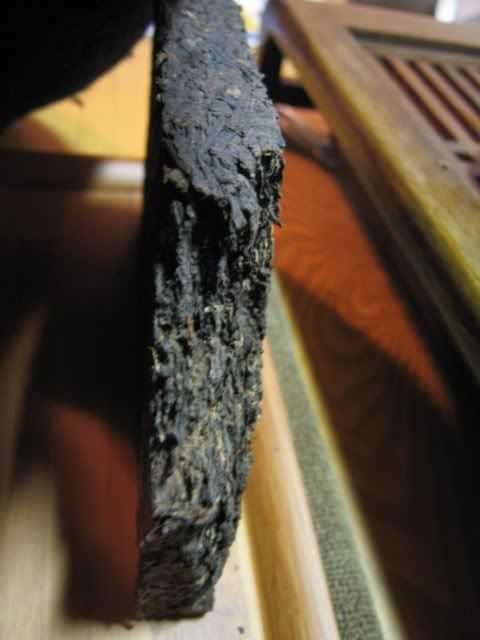
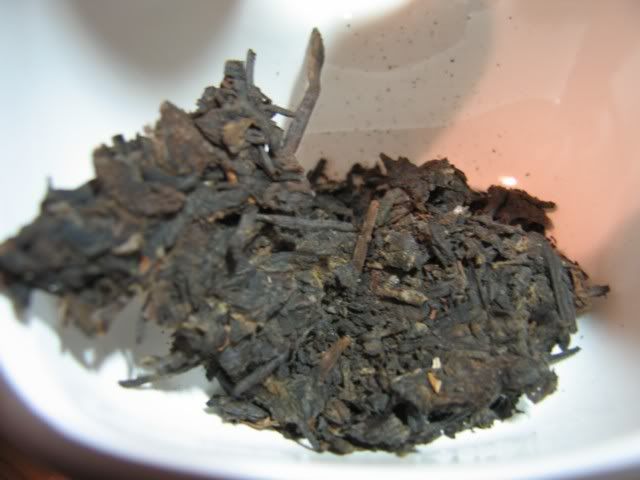
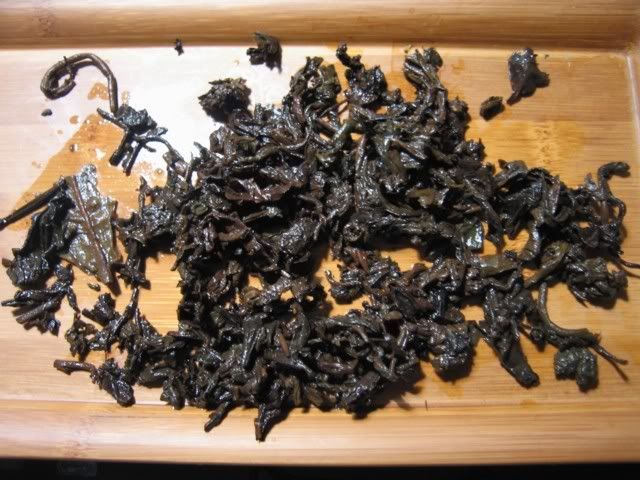
Today I drank the pieces I broke off yesterday from the cheap brick that I got in Hong Kong:

The pieces in question:

I realize that now that I have a scale … I am actually using less leaves. I never realized that sometimes I was putting upwards of 10g in my teapots/gaiwans. I ended up with about 7g of tea in my puerh pot.

Anyway, so I brewed it, but this time without the two long washes that I subjected it to last few times I made this tea. I originally did it because I was worried about my health (the tea looks a little nasty, with little white bugs on it). Now that I’ve been airing them out for close to 4 months here in this rather dry weather (I’ve kept it out of the tea closet, figuring this is better to get rid of the off taste/smell), I feel more confident with the tea.

This time the off taste is basically gone. Whereas the first infusion when I first tried it was a slightly odd, and uncomfortable, aroma of something sort of medicinal, now it is a more orthodox “somewhat aged” puerh taste. There’s still something off about it though… but the tea goes down smoothly and nicely enough. It’s very soothing for the throat… doesn’t feel dry at all, and there’s a sense of coolness that I like that extends down the throat. This is mainly the reason why I bought the tea to begin with.

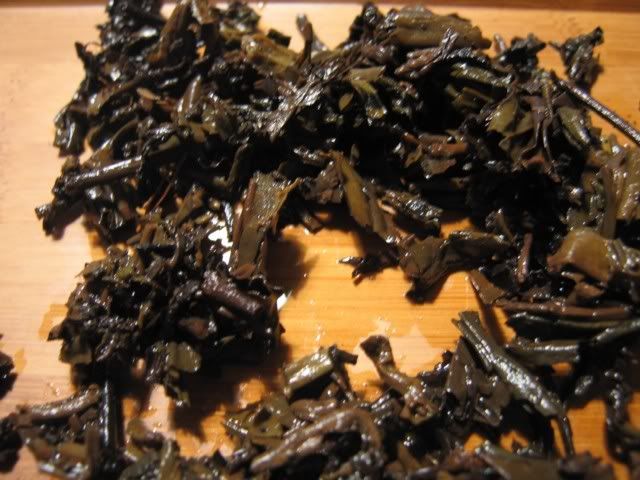
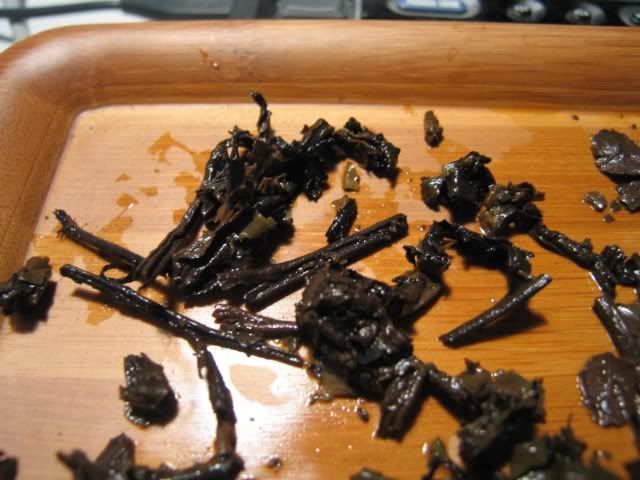
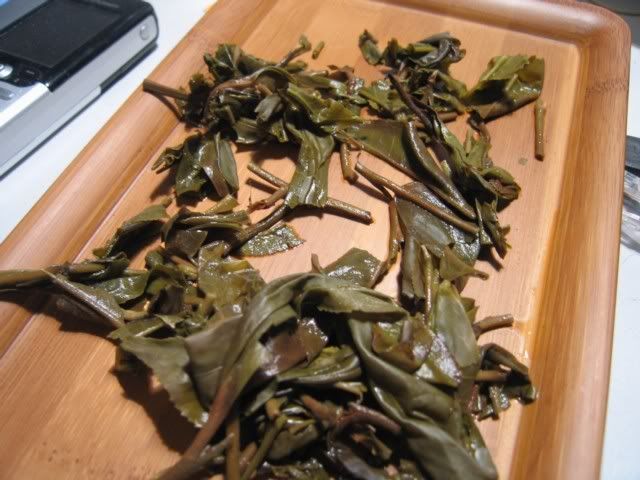
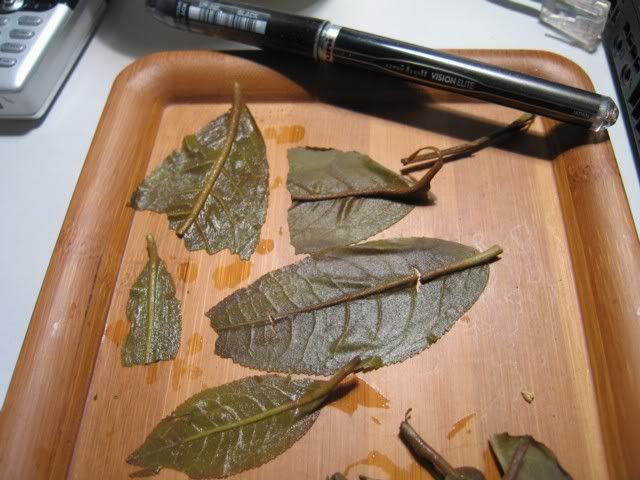
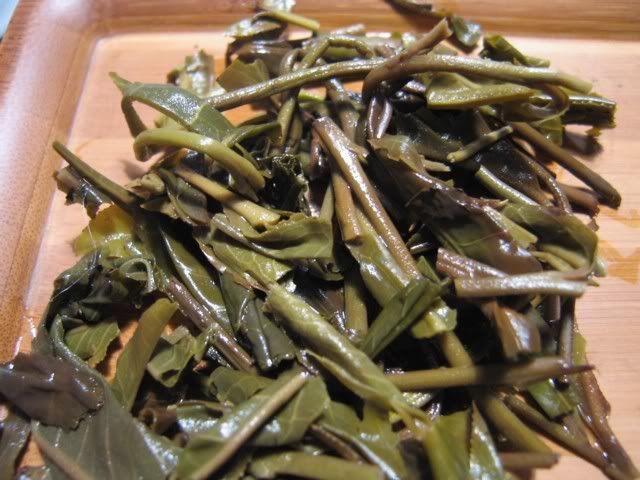
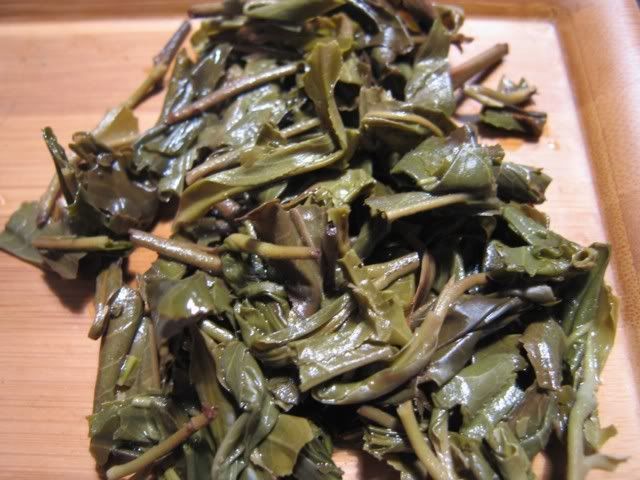
Looking at the leaves… I think I am learning a little more about the particular variety of tastes in this tea

Look at them…. tell me what’s wrong

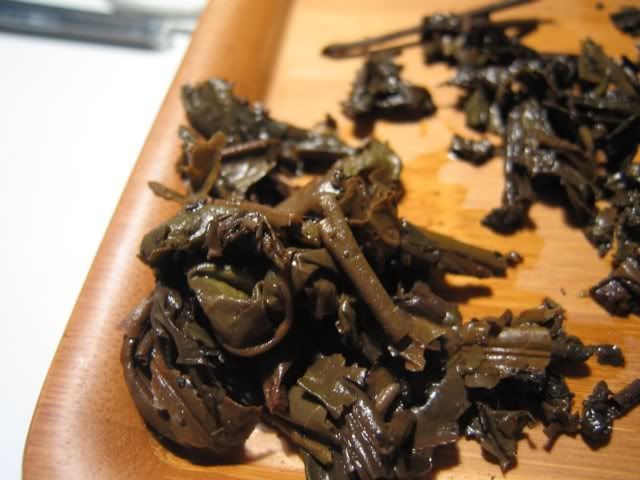
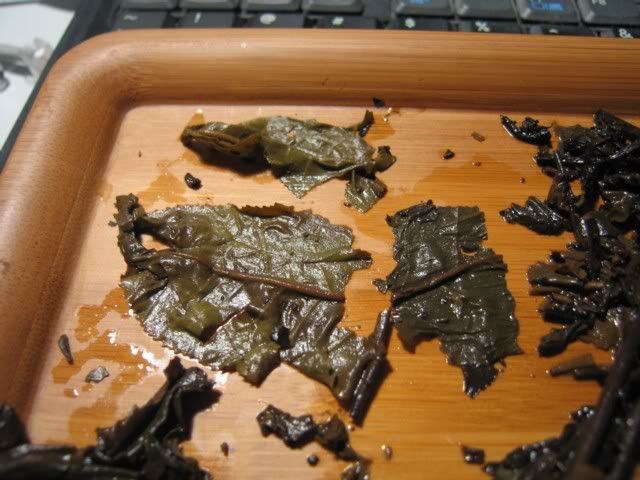
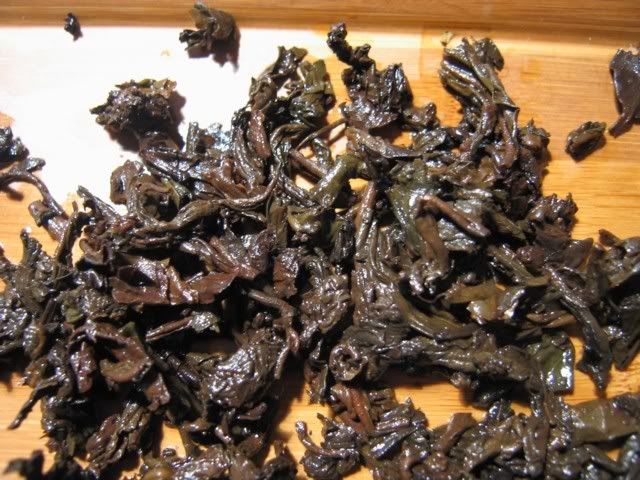
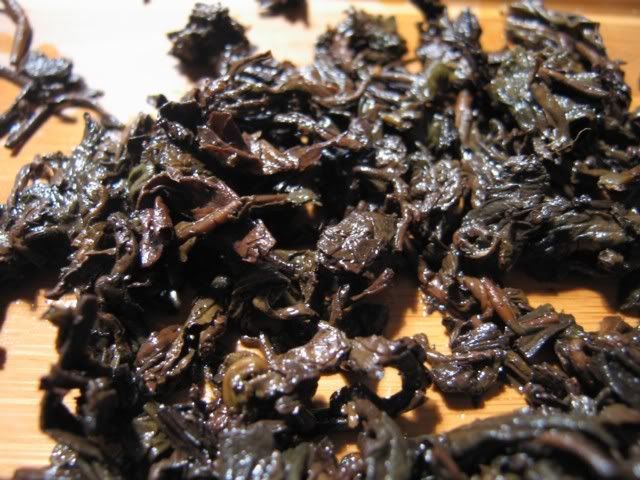
Some closeups

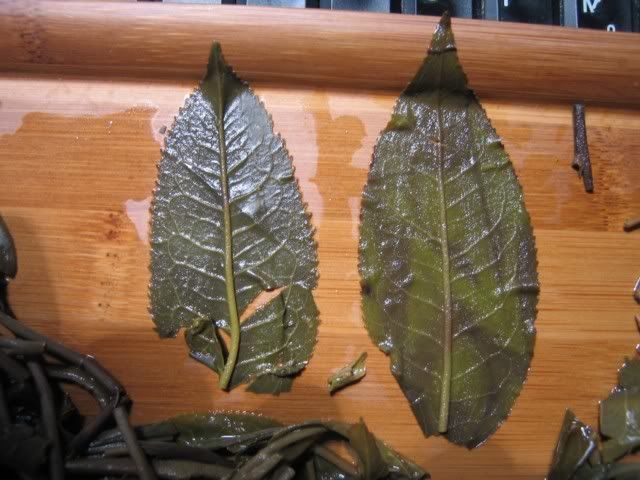
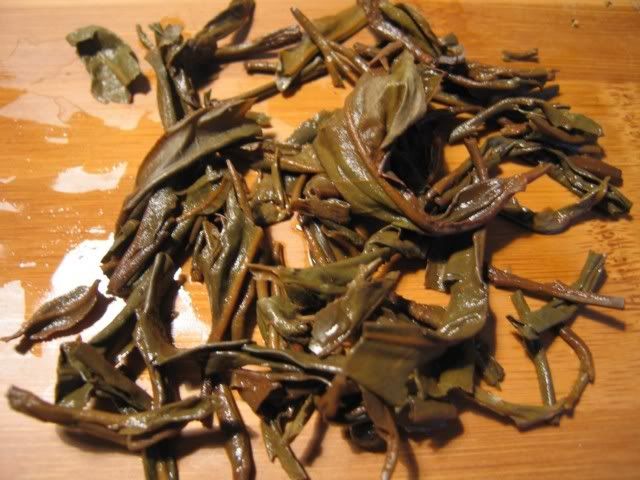
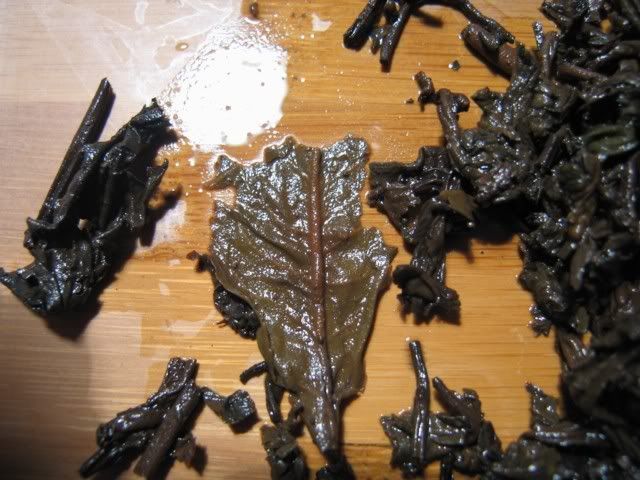
Basically…. I think the tea is a raw/cooked mix. The picture of the pile of stuff in a corner are the big, beefy leaves that look like this when unfurled

And then you have the other stuff… skinny, black, dried up looking things, that disintegrate when touched. I don’t think it’s bad storage, but rather, I think it’s just cooked puerh. This might explain the slightly odd mix of tastes. There’s that nice sweet, mellow, smooth nature of cooked puerh in the back, coupled with the punch of the raw. The cooling sensation produced by this tea cannot be a product of cooked stuff. The leaves also are not, mostly, cooked leaves. There are, however, a scattering of the black pieces that fall apart when I try to unfold them. If the tea is uniformly like that, then I’d say it’s probably bad storage, but it’s not… some of the leaves are incredibly green (as you can see) and a lot of it are brown…. I think it’s just a mix.

It might also be the case that this tea is recompresed maocha mixed in with cooked puerh. The bad thing is that this is probably done to cheat people (i.e. saying this is well aged tea). The raw leaves have some years, as most of them are some shade of brown. But it’s not all old… but then, maybe the stuff that are more green are the ones in the middle of this very tightly compressed brick, and thus having had less aging done to them?

I really don’t know, and it’s a bit of a mystery — a mystery that I can’t pinpoint for certain beyond what I’ve just said. However, I enjoy drinking it, and I think it will get better with age. After all, one of the favourite puerhs I’ve tasted… the Zhongcha Simplified Character from YP, is a cooked/raw mix. That one is very good……

Categories: Old Xanga posts · Teas
Tagged: , ,

Fall 2006 Yiwu “tea farmer’s” cake

December 14, 2006 · 2 Comments

I was originally going to brew up my wet stored bricks of some years today, and was ready to go with broken pieces and boiling water, but then my house guest came back and requested to try the cake from the Yiwu girl, since I talked about it in quite positive terms. So…. I brewed that instead.

I didn’t measure how much tea I put in, but I didn’t put in too much as my guest is sick. I brewed it up, doing it lightly this time, with quick infusions instead of those 30/60/30 types. The resulting tea… is sweet, with a hint of bitterness. The liquor is quite smooth, thick early on, but getting thinner as infusions go on. Since it wasn’t a lot of leaves (I think about 4g) the tea was rather mild, although, there was a drying note after a few infusions, leaving the throat slightly dry. It wasn’t serious, but it was there. I wonder if this has to do with the weather having been exceptionally dry the past few weeks (we haven’t had percipitation for a month now, I think). My guest also thinks it is floral, like jasmine, in some ways. I’m not sure if that’s good or bad in terms of aging… but it tastes good now.

The tea, when brewed with fewer leaves and quicker infusions, seem bland when compared with the more punchy puerhs. The age of the tea is still young. I wonder how this tea will age. I think it might develop some sort of flowy aroma, talcum powder, perhaps, and not the usual heavier taste.

You’ve all seen the cake, so nothing new to show, but I will shoot a few pictures of the leaves

Closeup:

As you can see in the closeup… the veins are popping on the leaves. The same is true for all the leaves.

However, I do wonder… it’s supposed to be a fall tea, but somehow, the variation in leaf size is quite large, with some stuff being very large, and some being very small. Do trees in the fall have such small leaves (like the one on the left)?

On a blog administration note — I’ve decided to organize my posts a little better, with titles, and also start using tags so that at the very least, if you click on one of the tags (you can find them to the left) you can see all posts related to that. I haven’t done the tagging of older posts yet — only a few. It will get done, eventually.

Categories: Old Xanga posts · Teas
Tagged:

2004 Yangqing Hao vs 2004 Changtai Yiwu Zhengpin

December 13, 2006 · 1 Comment

Lots of photos today — be warned

That, of course, means I’m doing a double tasting again when photos will tell more about the teas, especially since something interesting does happen… 🙂

The teas in question are:

2004 Yangqing Hao Yiwu Chawang, and 2004 Changtai Yiwu Zhengpin. Both of them are samples from Hou De. I figured it’s going to be an interesting comparison to drink these two side by side. The Yangqing Hao is made by a Taiwanese tea merchant who started pressing puerh a few years ago (as it is fashionable to do in Taiwan these days) and the Changtai cake is made by the Changtai tea factory, recently famous for their Yiwu products. The Yangqing Hao costs something like $90 a cake, while the Changtai is $29.50 (both prices from Hou De), or one third of the Yangqing Hao. Is the Yangqing Hao three times as good?

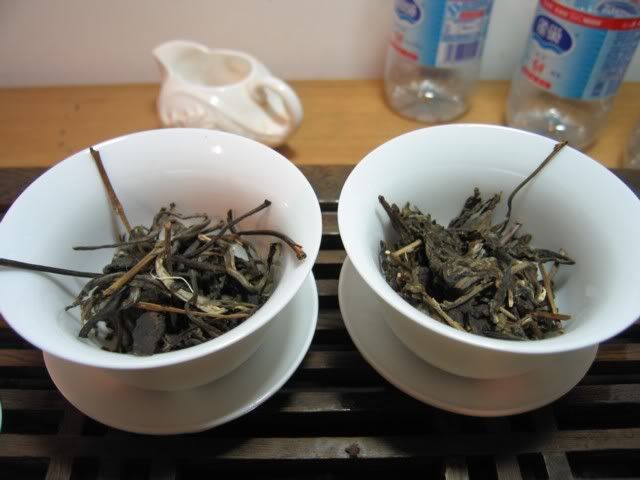
Let’s look at the dry leaves

YQH:

Changtai:

The YQH is very meaty, big, bold, while the Changtai is quite broken and thin and weak in comparison. I think this much is obvious. Both are 4g of sample (thanks to my new electric scale). I tried preserving the leaves’ completeness as much as possible by breaking up the bigger pieces by hand. You can even see very fine, small shavings of leaves in the Changtai piece that I got, whereas in the YQH piece you can tell that everything is big, whole leaves. The YQH leaves are also lighter in colour, whereas the Changtai is very dark. So in terms of dry appearance, YQH wins, hands down.

But puerh’s not for looking. Puerh’s for tasting.

My gaiwan is very small. I’m not sure exactly how many ml it is, but it must be less than 100. My guess is that it’s around 70ml or so, but I could be off. Either way, 4g of tea is not too little… as you will see in the next few infusions

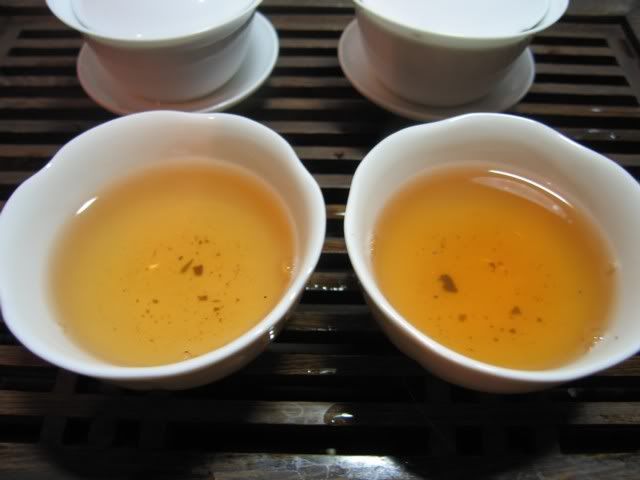
Infusion 1 (30s)

Infusion 2 (60s)

Infusion 3 (30s)

Infusion 4 (30s)

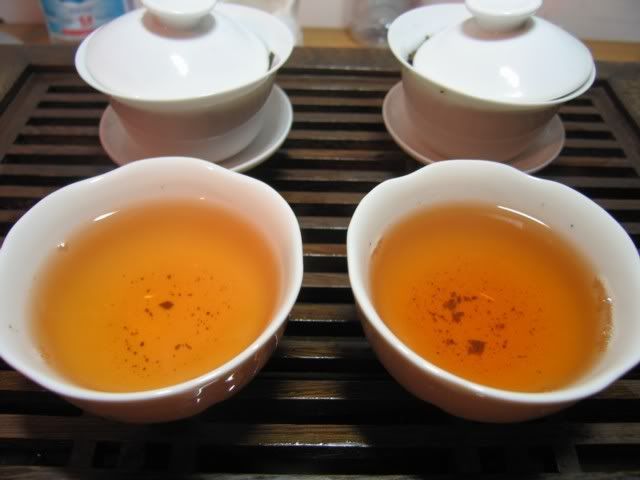
The Changtai, on the right, brews up a much darker brew. The YQH, on the other hand, is lighter in colour.

In terms of aroma and taste… the overall aromatic profile of the two teas are actually similar, as they probably should, since they are both Yiwu teas. Smelling it, you can sense that the YQH is a little more refined, a little more subtle, while the Changtai is a little more aggressive. The taste… the YQH is soft, supple, aromatic, slightly bland in the first infusion, with a hint of aged Yiwu in its taste. The Changtai has some of those notes, but one thing stands out in the back to back comparison — it’s sour. It’s not terribly sour, but it’s sour. The sides of my mouth felt that astringency distinctly. Also, the tea is more bitter, and it’s less smooth than the YQH. Whereas the YQH is soft and moisturizing, the Changtai is rough and drying. The sourness persists into infusion 3, after which it disappears. This, coupled with the bitterness, must’ve been why I thought it tasted green tea like the last time I tried this Changtai cake.

I have read on Sanzui (according to someone who claims to be a puerh expert) that the sourness is a sign of higher temperature “kill green”. Whereas high temperature “kill green” plus high temperature for final drying will produce a green tea, a high temperature “kill green” with low temperature final drying (such as drying under the sun) produces a puerh tea that will be somewhat sour. Is this it? I’m not sure. But it sounds awfully like it.

Moving along…

Infusion 5 (extended infusion time)

Infusion 6

Infusion 7

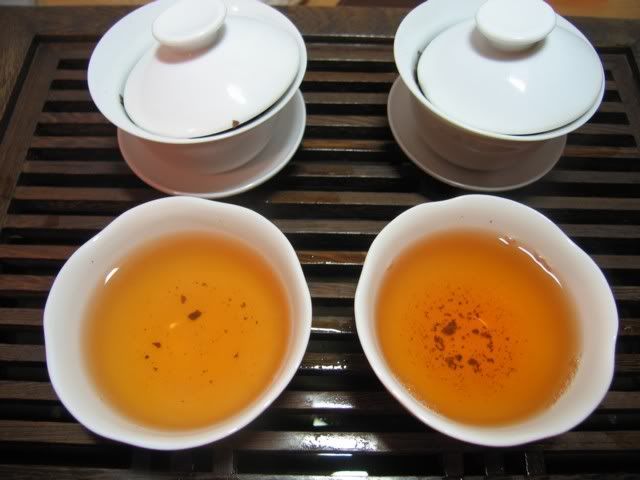
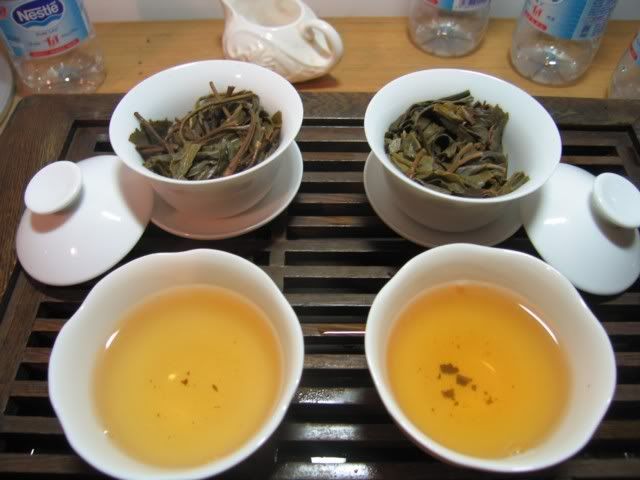
The colour of these infusions show that the two teas are now brewing similar coloured teas. The taste, as well, show that they are approaching. The YQH still holds an edge in smoothness and being more moisturizing, but the difference is quite slight… it’s won’t be terribly obvious if I weren’t tasting them side by side.

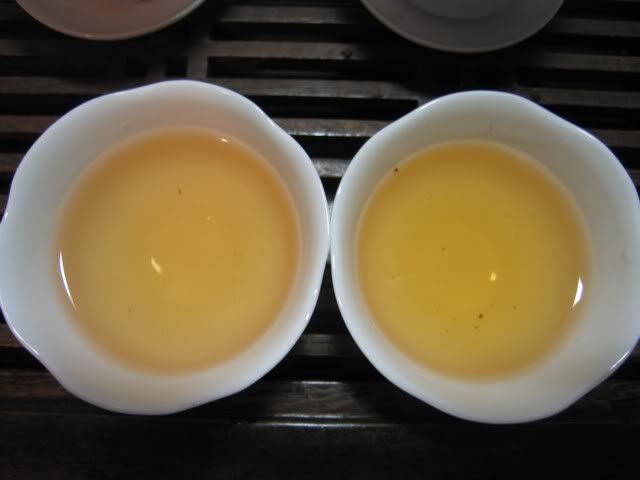
Then something funny happens

Infusion 8

Infusion 9

Infusion 10

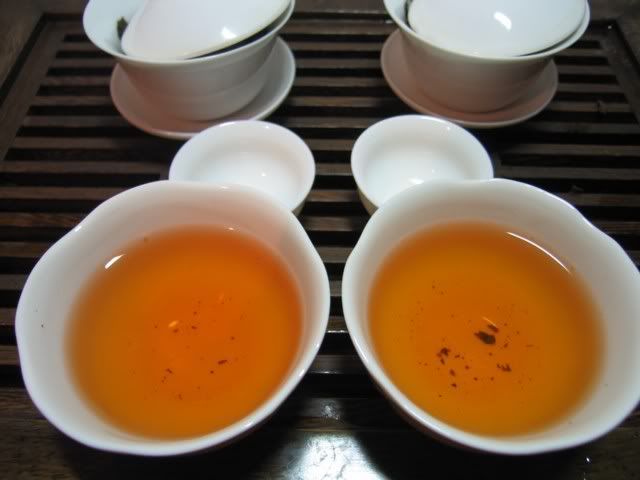
The YQH is starting to get darker than the Changtai. This is not a result of the camera doing funny things. The tea actually showed in person how the YQH was brewing a darker brew by infusion 10 or so.

The taste… as my house guest describes it, the YQH at this point (the house guest didn’t get to drink the earlier infusions) was more fruity, whereas the Changtai was more metallic, which I think also implies that the Changtai is thinner. It is definitely a little thinner. I was, by this time, a little uncomfortable with the amount of (rather strong) young raw puerh I’ve consumed by then. So I stopped.

I think part of the reason the Changtai died out faster is because of its brokenness. The tea simply infused faster and gave out more earlier, and thus couldn’t last as long. I suspect this might have some implication in future aging. The broken nature of the Changtai is more obvious when you look at the wet leaves

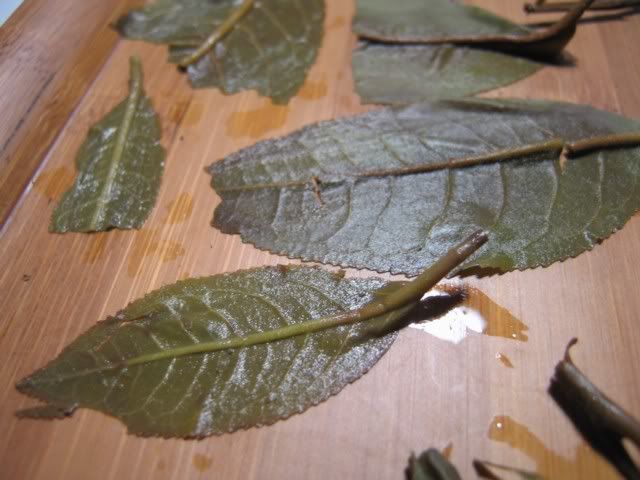
Small bits, shavings, incomplete leaves, broken stems… whereas the YQH is whole, looks nice, soft, etc. The YQH leaves feel strong, sturdy, while the Changtai ones, when I can find a complete one (there were only two in the whole sample I brewed) were flimsy. The two leaves I unfurled — the YQH one is clearly nicer, with an obvious sawtooth edge, while the Changtai one has a very undefined edge and is thinner. The veins are also much more obvious on the YQH.

But it was surprising to see that the aromas aren’t THAT different between the two. In fact, I might have trouble telling one or the other apart just by aroma alone — it’s the other stuff, such as mouthfeel (like me feeling the sourness, but not tasting it) and thickness of the tea that really tell them apart.

Does the similarity in aroma mean that they will age similarly in the future? If the price differential is based on aromas alone, the YQH cannot command 3x what the Changtai sells for. It’s not that different. However, how will they age?

I think judging by what people like YP has told me… it’s the mouthfeel that counts. Is this what commands 3x the price? Of course, YQH, being an operation in Taiwan and all that, is going to cost more regardless, but 3x? I’m not terribly sure myself.

But if nothing else, I think this goes further to show how important it is to look for the other signs of a puerh, and not be too carried away with just focusing on the aromas of a tea, at least if we’re talking about young puerhs meant for storage. It’s the other stuff that you can use to tell apart an average te
a from a great tea, but that is so much harder than just tasting the tea as a nice tasting drink.

Categories: Old Xanga posts · Teas
Tagged:

Weekend Maliandao excursion

December 9, 2006 · 2 Comments

I was originally not going to go today, but then I remembered I promised a vendor there to bring her some of the old loose puerh from the Best Tea House to try, so … I went. This is the same person who sold me the Quan Ji puerh a few weeks ago. I enjoyed talking to her, and I think it’s probably rare for her to get a customer who likes the stuff she sells. A lot of times people just come in, browse, and then leave. Since none of her teas are name brand, it’s difficult business, I think (and as far as I can tell, her livelihood does not depend on it).

After drinking that supposedly 30 years old loose puerh, I tried two of her teas. One is a cake of Lincang puerh, using old maocha (2-3 years old) but pressed this year. It’s not bad, tasting like Lincang tea — a bit like the Mengku stuff, with its odd aroma that is rather unique. It’s bitter, but Lincang tea tends to be that way.

The second one is a Jingmai tea. Her store, interestingly enough, has LOTS of Jingmai teas of various kinds. She said it’s because she likes the taste and aroma of Jingmai teas, so she keeps a lot of them around, and will in fact go to Jingmai next spring to press some cakes. She has at least four or five different big tee Jingmai cakes, a few Jingmai bricks, Jingmai tuo… you name it.

The cake I tried was actually pretty good. Very nice aroma, mellow, not bitter, got some nice cooling sensation in the throat. Not bad, and I might consider it, but… the Quan Ji is better, I think. I’m still debating if I should get a second tong of them…

By then, I was feeling the tea. It’s been a long parade of young puerhs the past few days, so I think my tolerance has been lowered. Also, the Jingmai tea was brewed with an incredible tea-water ratio (i.e. very high), so …. it was strong.

I excused myself from their store, not having bought anything. I’m sure I’ll go back there again. The owner is nice (unlike the manager).

I then thought I should stop by the Wuyi rock tea store before heading home (as it was already 6pm). It’s nice, and I thought I should buy some other kinds…

I went there, and they were, just as I was walking by, ready to go out for dinner. I ended up eating with them at a local shop that specializes lamb shoulders, stewed. It’s quite good, and did a good job of restoring my stomach, although one of the guys eating with them kept pressing beer on me, which I really wasn’t in the mood of (especially just bland Tsingtao)….. but I obliged.

After dinner we went back to the teashop, and had three different teas. We also had a nice long chat about different kinds of Wuyi, how to differentiate them (basically, you can’t tell by looks unless you’re in the tea making business, and even then, it’s not easy), and some of the processes that they do to make the tea. I find my education in Wuyi tea pretty lacking. Although I can, on a whole, appreciate what is a good and what is a bad Wuyi tea, I cannot, for example, tell apart some of the more similar varietals by taste. The spectrum of possible tastes that a Wuyi tea possesses is quite wide, and I’m afraid I’ve only scratched the surface of it. Sadly, I can tell puerh apart better than I can Wuyi teas. That’s a shame.

So I need to fix that.

An interesting side note… while the first two months I was here I was always asked the “where are you from?” question, nowadays, I get more the “do you sell tea?” question. I’m not sure why it is that people started asking me this all of a sudden, but there have been at least a dozen different people who asked the same thing — if I sell tea one way or another, and when I tell them no, I only drink for myself, it’s usually met with some skepticism. I suppose someone who asks a lot of questions is going to prompt that comment….

Lastly, I got an electronic scale. No more caffeine overdose when I do a double-tasting 🙂

Categories: Old Xanga posts · Teas
Tagged: ,

Two 2006 Spring Yiwu Big Tree Teas

December 8, 2006 · Leave a Comment

Two more Yiwus today, spring 2006 production. The one on the left

Is this:

The same guy who made the fall 06 production that I tasted, also on the left, two days ago.

The other is the 12 gents Yiwu 06 that I’ve tasted before.

It will turn out that I put far too much leaves in, and it’s making me a little uncomfortable.

Anyway, some pictures of the tea, starting from infusion 1 and each subsequent one:


I think you get the idea.

The leaves on the left are quite complete — I broke them from the cake

While the ones on the right are more broken. Some, no doubt, due to poor breaking by whoever broke the sample for me. However, since I mostly broke this piece from a much bigger piece, I think as a whole the tea is also just a little more broken as the compression is harder, and perhaps during the processing more leaves were crushed.

So…. how does it taste?

You can see the tea is lighter in colour on the left. The amount of leaves are similar, so it’s not a matter of that. I think the left sample brews up a milder brew as well. It is less tannic, less bitter, less astringent, and sweeter. The right side, especially in infusion 2 (60 seconds), was VERY bitter. VERY bitter. I mean, VERY bitter. This, somehow, does not jive with the notion that it is an arbor big tree tea. The bitterness, moreover, did not really turn into a huigan/sweetness. It lingered on and on as just plain bitterness. Last time I tried this tea I thought it has green tea mixed in it. This time, I think I am maintaining the same stance — that some of the leaves (not all) of this cake were processed at a much higher temperature than normal and thus produces this bitterness that won’t go away. There is also a hint of sourness on the side of the tongue in the first 3-4 infusions for sample R, again, something that shouldn’t be present in a proper young puerh, but would happen if you have high temperature processed tea mixed in it. The broken nature of the leaves didn’t help matters, I’m sure, but it’s not the sole reason, I think.

At first I thought it was just that the quality of the leaves in sample R is less old/good compared with sample L, but I have noticed by now that among the puerhs that have suspicion of “green tea” in them, one common factor is that the bitterness lingers and will not go away (unless you wash it down with something else). While some of these initially tastes quite good — sweet, mellow, fragrant, smooth — after a while that taste will turn to bitterness, or the bitterness, at least, will increase. It’s most obvious when you brew them for a longer period, instead of very short infusions. That’s what happens with green tea too — if you overbrew a longjing, it will get very bitter on you. Same idea, and it seems to make sense.

The leaves of the L sample also generally looked better, this is one sample

Since they are about the same price, if I were to buy one, I’d buy the one on the left. No doubt about it.

Categories: Old Xanga posts · Teas
Tagged:

Two Fall 2006 Yiwu Big Tree Teas

December 6, 2006 · 6 Comments

A long entry today…. be warned.

As promised, I decided to taste two teas today using my new supplies. The two cakes are:

Both Yiwu fall production tea. The one on the left, funny enough, is the one that BBB tried to buy but had problems with. The one on the right is the one I got from the Yiwu girl, and unfortunately, I think it’s not on the market at all.

The front of the cake on the left (let’s call it the L cake) is in yesterday’s post. This is a shot of the back

And the R cake’s back — you’ve seen this before long time ago when I first tried this.

Lacking a scale, I tried to eyeball it

I brewed them with basically the same parameters — pouring water in one first, then the other, and then pouring them out in the same order. There are, of course, tiny variations, but that’s about the best you can do. The dry leaves of the L cake smell a little smokey. The R cake is more fragrant and lacking any smoke — mostly just floral notes.

This is what turned out first

The one on the right is a little darker, as you can see. It would remain darker for the rest of the brewings. At first, it’s probably because it ended up that a little more leaves were on the R cup than the L cup. I took some leaves out of the R cup after two or three infusions, but the colour differential (which isn’t going to be noticeable if I brewed them separately) remained. I think it can be partly explained by the slightly smaller and more broken leaves in the R sample — the cake is more compressed, so when I took pieces out the tea was a little more broken.

The taste…

L tastes a little smokey at first. The smoke would stay for about 7-8 infusions, under the 30/60/perpetual 30 rule (although later on I just brewed however long I wanted). It’s less sweet. The huigan is less obvious. R tastes more intense, the tea is probably a little stronger, with a sweeter taste and a much more obvious huigan. There was cooling in the throat, although since that is often a delayed reaction, I’m not sure which one was responsible.

In some ways, R is more immediately appealing, although I wonder if L might be longer lasting, and will taste just as good in the long run. It’s almost flavourless, in a way. The undertones are quite similar, both having that Yiwu taste, with R, again, being more up front about it. They are from different villages, so that might also account for some of the minor differences in taste. L is slightly more bitter. R is a little less, and the sweetness comes on almost immediately. Both are hardly bitter by normal standards.

A little later:

And even later (this one looks darker than the last because I left the water in for quite a while):

Finally:

The last picture is probably around infusion 15. Both still tastes like tea, although getting rather weak. I gave up and decided to take pics of the wet leaves.

L:

R:

L has more sticks, R has more leaves. This might also explain why L was more bitter than R, and R tasted a little more intense. R’s leaves also contained more buds, whereas L is mostly big leaves. Could this also have an effect on taste? It seems like it might. Maybe R is a mix of spring and fall leaves, instead of pure fall leaves. There are just a little too many small buds for it to be a creditable fall only cake, I think…

Some exemplary leaves — again comparing L and R:

All in all, a pretty interesting experiment. I think at least in terms of rebrewability, they are about equal. In terms of strength, intensity of flavour, and that kind of thing, R comes out a bit ahead of L. I think some of the answers might be supplied by the sort of leaves present in the sample. That, and the tiny regional variation, as well as whatever other factors (processing, etc).

Was it useful to have done this? I think so. Was it a little tough on the body? Yes. At one point, I was sweating a lot (this was after 3-4 cups). Even with the tiny gaiwan, I’m still drinking a lot of tea, and big tree tea is going to be strong.

I sort of want to get more of both, and see how they taste say 5 years down the line. It will be very valuable to have that sort of comparative experience to know exactly what sort of thing will age well. Unfortunately, it might be difficult to get my hands on more of either of them. This is intensely frustrating.

It’s sort of stiffening my resolve a bit to go to Yunnan next spring to find my own tea.

Meanwhile… I stuffed the leaves (almost all of them) back into a single gaiwan and trying to get more cups out of them. Shouldn’t let good tea go to waste. 🙂

Edit: I’m drinking some water right now, and somehow…. when I was breathing with the cup in “drinking” position, I could sort of smell the Yiwu….. ahhhhggg, I think it’s withdrawal.

Categories: Old Xanga posts · Teas
Tagged:

Maliandao day

December 3, 2006 · 2 Comments

Maliandao day today, although I had some errands to run so I didn’t get there until a bit later than usual.

I wanted to get some gaiwans — two, to be exact. Two small ones. This way, I can brew two teas together, and have a comparative tasting using the same water, same infusion time, etc, to let me better compare teas. This will also mean buying new fairness cups, that sort of thing. I should probably also invest in a scale. However, I never got around to shopping for this.

The other goal was to taste the Meng Pasha from Haiwan factory, which BBB seemed to like a lot. Since I finally located their factory store, I went there. It’s in a new building behind the Beijing Tea Corporation mall — tucked in the back. That’s why i never found it. I already need to update my map of Maliandao, and it’s been less than two months since I blogged about it!

I was pretty straight to the point and asked to taste the cake right away. It was brewed… and to my surprise, it tastes a lot sweeter than I imagined it to be. I thought it’ll be a somewhat bitter and harsh tea, but powers down my throat. Instead, it’s not quite that. It’s bitter, of course, but not THAT bitter. The tea is a little thin, and while there’s a certain amount of huigan… I’m not sure if I want to pay that much for this tea. It’s quite expensive for what it is, and the looks of the leaves, at least in the one cake I saw, wasn’t terribly good. It was pretty broken up. I’m not sure if this is due to the way they broke the leaves, but it seems like the leaves themselves aren’t very complete… there are also lingering doubts about the temperature it was processed, as I got some notes of sourness as well as green-tea like bitterness from it (i.e. bitterness that doesn’t really go away)

The price/quality ratio calcualtion is made after I also tried the “Deep Mountain Old Tree Tea”. It’s half the price of the Meng Pasha, but more than half as good. I generally liked the way this cake tasted a little better than the Meng Pasha. I ended up with two. Probably not the greatest buy, and it’s 1kg of tea…. I am quickly buying too much tea.

I then walked around Tianfuyuan. There’s a store with Chamasi’s teas in there, so I walked in. They were doing some calligraphy thing in there. The whole place is very well decorated…. almost too well. Then I realized that they really just sell older puerhs, and the Chamasi stuff is just a sideshow (and discontinued — just really their leftover teas). The owner sat me down and gave me a cup of what they were brewing. I tasted it… it’s weak and a little thin. The aroma is like a cooked puerh, with that slightly ricey taste. I asked if this is a cooked puerh…. the owner and another guy laughed.

I looked at the wet leaves… then I realized that this can’t be cooked puerh, but some really old stuff. According to the guy, it’s a 50 years old loose tea. The pot was too big, not enough leaves were put in, and while the tea is very good quality — I started feeling the coolness in the throat about two cups after the fact (there was no initial feeling, thus meeting all the criteria for a cooked taste) — it was too weak to taste the nuances. Too bad. They’re almost wasting the tea.

After chatting with the customer who was sitting there and having a few more cups, I left. It was about time Tianfuyuan closed, and I decided to call it a day. So much for the teaware….

Categories: Old Xanga posts · Teas
Tagged: ,

Drinking tea with ZH

December 1, 2006 · 5 Comments

It’s my birthday today, which is part of the reason I invited ZH over for tea. Of course, I would’ve invited him over anyway. I like other tea nuts.

We didn’t waste too much time and got down to business. First up was my Yiwu maocha that I got almost two months ago. I thought I would ask his opinion on the tea.

The tea, I have to say, changed a bit since it was picked. Now, the bitterness is coming through a little stronger. It’s a little more bitter, the colour’s a little darker, and the overall profile has changed slightly. I remember it was sweet, fragrant, and all that. It’s still mostly that, but turned slightly more like a regular puerh. The Yiwu taste is very obvious, and ZH agreed with me on that. He also noticed some sort of numbing bitterness in infusion 3 or so, but only slightly and not very obvious. By infusion 4-5, the bitterness went away and turned into a smoother, rounder, tea.

We were puzzling over the tea’s origins, because while it tastes largely like a Yiwu, it doesn’t taste exactly like a Yiwu old tree tea, because of the current presence of the bitter element (a little much for a Yiwu — very low standards). He also thought the colour of the maocha is a little dark, and some of the leaves didn’t look like old big tree. I suggested perhaps it’s partly plantation tea mixed it… which could be the case (or just teas that are plucked from trees in the same area but of younger age — after all, you have to have young trees in a forest!). The mystery remains.

The next tea we tried was a free sample given to me by Hou De. It’s the Xizihao 2006 Taiji series Lao Banzhang. The one I got is the Yang. I broke some of the tea, and brewed it up. I have to say that having just had the Lao Banzhang maocha from ZH two days ago…. the Xizihao pales in comparison. It’s not nearly as good, and doesn’t have that requisite profile that only Lao Banzhang has. The taste is mixed, and ZH thinks that some of the tea is from other areas in the Bulang mountain. Sigh. I will try it again, next time with more leaves.

Then after debating over what to serve next, I decided to use the remaining bits of the 95 Zhenchunya Hao that YP gave me. There’s not a lot left…. only enough for basically half a brew, so I filled the gaiwan halfway up with water to brew the tea, resulting in two small cups each infusion. Still the same as last time…. a very odd flavour for puerh, and now that I’ve had a whole bunch of older Yiwu recently, I have to say this one does NOT taste like a typical aged Yiwu. There’s a bit of that older taste, but a more prominent trait of this tea is that it is a little fruity with a bit of a plum note. Last time when I had this with BBB, I didn’t think much of it, but now… I am starting to think that this might be a tea that went through pre-fermentation before the pressing, during the processing stage of the leaves, and thus the tea is not strictly speaking puerh, or not pure puerh. What I am tasting here is a mix of older puerh taste, and more importantly, of older oolong taste.

Of course — a big caveat — this is all speculation on my part. However, having had that oddly fruity and sweet aged red tea a few days ago… I feel like I have connected two dots. This will explain where the fruitiness of the Zhenchunya Hao is coming from (which, by the way, I don’t really detect in the version on sale at the Best Tea House now — they are different batches). Older oolongs do have a note that tastes somewhat similar to what I had. That, and an old puerh shouldn’t be so light in flavour and aroma. The typical Yiwu aged taste (detectable now in the Yangqing Hao 2004, and the Jingye Hao 2001, for example) is just not really there. This is not to say this is bad tea — far from it, it’s very interesting, if a little odd, and the tea is very pleasant to drink. It’s just a different kind of taste, and if you buy something like this, thinking it will turn into your typical Yiwu (for example — not that this is available for sale) you will be surprised, but probably not nastily surprised.

The leaves look nice:

I saved the best for the last, but this also made sense in terms of age progression. We had the Zhongcha Traditional Character that was given to me by YP. ZH sat up when he too the first sip, realizing that this is good tea. The tea, as I’ve said last time I brewed it, looks awful. If you just look at it, you’d think it’s a cooked cake. It looks like one, it smells like one, but it does not taste like a cooked cake, or at least not entirely. It’s a raw/cooked mix, at least that’s what YP told me, and I think you can tell that the cake was mixed because during the infusions some obvious “cooked tea” notes come through. Yet, there’s an unmistakable presence of aged raw puerh in the cake. There are more plum notes this time, and a very soothing mouthfeel — round, moisturizing, sweet, huigan… it’s all there. The throat feels cool after drinking, and stays cool. A beautiful tea, and I’m really, really glad that YP gave these pieces to me. I still have enough of the sample left to brew it one more time. I’ll have to save it for some other occasion.

I decided to take some pictures of the wet leaves of the Zhongcha

Closeup

Even closer

This leaf is a little odd — the lone leaf that unfurled easily and that is particularly light compared with everything else

A nice meeting over tea, and I’m sure we’ll be meeting over tea again. It’s obvious that he is not nearly as expereinced as, say, some HK tea people, but he makes up for it by his enthusiaism. If I can go to Yunnan with him next year, that’ll be nice.

Categories: Old Xanga posts · Teas
Tagged: , ,

Tenfu visit

November 29, 2006 · 1 Comment

Today was an afternoon trip with L and some of his business associates (tea people from Zhongcha). I first went to the store where L has a stake in at Maliandao. It’s in a new mall there that opened recently, and I finally found the Haiwan factory store. I need to go there next time to check that out and try the Meng Pasha cake that BBB likes so much. I also found a store that only sells Chamasi stuff, that I want to try as well.

At the store, we tasted many of the same things that we tried two days ago, as L and his associates were deciding what to order for stock. We also tried some Menghai stuff. I brought my Mengku along as a comparison with the one we had at Zhongcha’s office. It’s really quite similar. It has a little less age, since it was from 2002, but the profile is remarkably similar… and mine’s about 1/5 of the price of that piece of tea from Zhongcha. I can’t say I’m not happy about that.

I also brought the Yiwu maocha that I like… but something’s not quite right. It seems like the aging is doing something to the tea, and the taste is changing. I need to try it again myself in my own home, with me brewing it, and see if it’s the brewer doing things to the tea, or if it’s actually changing on me. I am losing that wonderfully fragrant and sweet maocha taste that so impressed me. I hope it doesn’t disappear as it turns to aging…. or whatever it’s turning into.

We ended our tastings here with, oddly enough, a tieguanyin… a super light fired tieguanyin that is what they call “qingxiang” in Beijing. When I asked the girl brewing the teas if she knew of a place that sells nongxiang (heavy fire) she said yeah, and then showed me a bag of stuff that I would also consider qingxiang…. basically, to them, stuff that is made with more traditional craft is “nongxiang” while I think a newer method, which results in a rather grassy and IMO disgusting tieguanyin, is what they call qingxiang. The leaves are unbelievably green, and the taste thin and grassy…. I had two cups and stopped.

After that we had dinner, and then went to Tenfu, where there was, basically, a graduation ceremony for a tea class at their Luyu Tea Center, where they hold classes. This is also where they developed their “Luyu Small Pot Method”, which, from what I can tell, is pretty similar to anybody else’s gongfu brewing, except with great attention to things like
1) keeping the brewing surface dry at all times with their proprietary tea desk (which is only slightly different from the usual ones)
2) using a TIMER!!!!!
3) …. that’s about it

I can’t seem to notice anything particularly exciting or new about it, other than their slightly modified proprietary desk which I’m sure costs an arm and a leg. Basically, instead of a screen with a water-capturing device underneath, so you can pour to your heart’s content, it’s replaced with a solid wood surface with a hole where the water goes. This means that if you don’t wipe the surface, water stays, so you have to constantly wipe the water off …. which I find rather silly.

There’s also not a whole lot of attention paid to the way the water’s poured into the tea. It’s done in a slightly haphazard manner, from what I can tell. Boo. The use of the timer’s just the last straw. I’m sure it helps beginners, I suppose, but when I took my first course from Best Tea House (before I realizing that such lessons are generally a waste of money) it was made plenty clear that times are only suggested, and should vary depending on the individual tea, amount of leaves you put in, personal taste, etc. Using a timer, IMHO, encourages a more rigid and scientific way to brew tea, but ultimately takes away the art of tea making which in my opinion is an essential part of the experience of brewing tea. After a while, you get an idea of about how long to use for each infusion anyway. It shouldn’t take a timer for someone with a few months, or even a few years’ of experience.

But of course, they should be applauded for bringing this sort of tea making and culture to people in China, and for that, Tenfu is very successful. Their presence makes it easier for people to approach the world of fine teas. Otherwise, many more Beijingers are going to be drinking jasmine tea only.

Anyway… I digress.

So while the students who are graduating today have this nice little gathering, with calligraphy, music, art, and tea making ceremonies (those little artsily set up stalls… each done up by the student and with them brewing tea), those of us who came with L just went upstairs to take a look. Some of them know many in the crowd, and stayed for the most part, while people like me who don’t know anybody in this group (or think it’s too many people, which it was) left quickly and went back downstairs into a more private room to brew more tea.

One of the guys from Zhongcha, as I mentioned two days ago, is a taster of sorts for them. He is also responsible for developing their puerhs. Let’s call him ZH. ZH was well prepared today — he joined us during dinner, and came with a whole bagload of tea. We ended up drinking mostly stuff from him for the rest of the night.

First up was a Mingqian Longjing. Supposedly, this tea came from a once-abandoned field of tea trees in Meijiawu area of Hangzhou, one of the more famous Longjing producing locales. Anyway, the brewing was a little… weak, thanks to a slightly low leaf-to-water ratio. However, you can tell that this was a nicely aromatic, smooth, and slightly different Mingqian Longjing than the usual. Its aroma is not quite the “bean” aroma that we normally ascribe to Longjing…. there’s a slight twist to it, and I am at a loss for words to describe that subtle difference.

We then drank a cooked puerh from Tenfu, supposedly from the Nannuo area. ZH said he can tell it’s from the Menghai area, but since it’s cooked puerh…. it’s extremely difficult to tell exactly where it’s from. To me, it all tastes about the same, and I don’t really have much of an interest to figure it out any further… suffice to say it was not bad, smooth, without too many of the nasty flavours you sometimes find in cooked puerh, but expensive. For the price I can buy a very nice Yiwu cake.

Then, we drank a very nice tea — a real Lao Banzhang maocha that ZH has, a spring tea. It’s sort of the only thing that’s truly picture worthy today
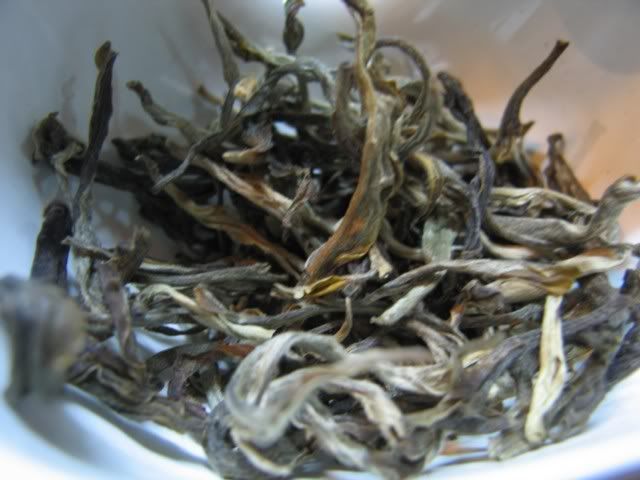
The leaves don’t look overly big in the dried form — very thoroughly rolled. You can smell the Banzhang even when it’s dry. The tea is very smooth, nice body, full flavoured like a Banzhang usually is — but far less bitter than your usual Banzhang tea. A good “throat feel”, but really, the tea goes down nicely, never being too bitter, as some Banzhang tend to be. There’s a sort of subtleness to the tea that you only find in higher quality maocha, and this is no exception. Even when overbrewed with long infusions…. it’s still not terribly bitter, and most improtantly, the huigan speed is very fast — meaning that the transition from bitterness to the resulting sweetness is extremely fast, which I think is why we don’t feel it’s very bitter. This is something that lower quality teas, and plantation teas, do not have…
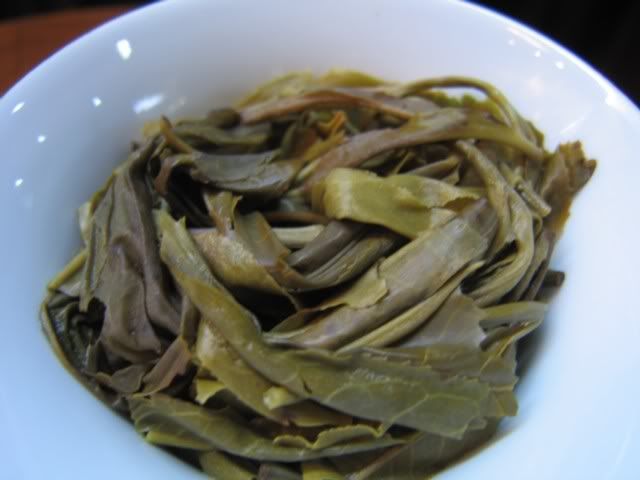
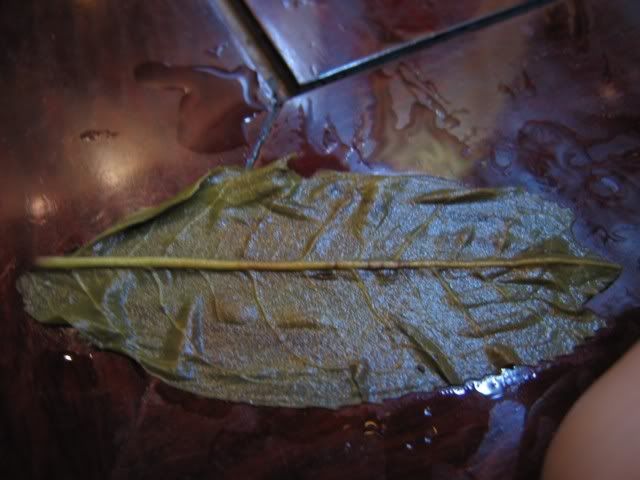
The leaf colour, when brewed, is very nice, with little evidence of redness. The single leaf is about 4cm long, I think, just to give you an idea. This will age really well, methinks, and best of all, ZH gave me the rest of his sample, enough for another brewing and half 🙂 🙂

After the Banzhang, we had a curiosity piece — he first didn’t tell us what it was. He opened a bag, which was vacuum sealed, and took out two mini-tuos that are about 2-3g each. He threw it
in the gaiwan, brewed it…. and it’s….. sweet. Really, really sweet, but with a tangy slant to it, sort of a citrus like taste/smell. The liquor is a nice orangy/red colour. I thought it could be puerh at first, but the taste told me no with the citrus smell. We made our guesses. Mine was either a puerh that was wrapped in a mandarin and aged a bit, or older teas of some sort, maybe a red tea that was placed together with chenpi, which are dried mandarin skins. No, ZH said — it’s just the tea, and this is the original seal that he just broke.

Turns out it’s a Yunnan red tea made for export, but somehow kept in its original seal all these years (something like 10 years old). The taste in the tea developed over time…. and I have to say while it’s not the greatest thing, it’s definitely a very, very curious thing. Something I’ve never quite tasted. It was odd, and it was fun.

Which reminds me that I still have a weird tea that I haven’t tasted since I bought it.

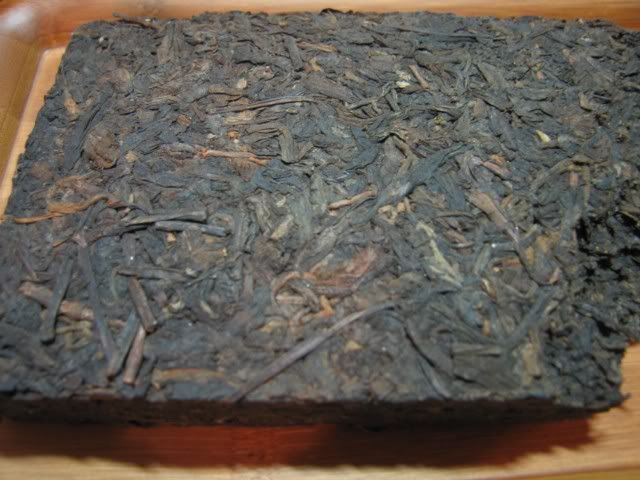
We ended the night with one more tea from ZH — a mini brick from Menghai, 1995, supposedly. It’s wet stored, or at least it got pretty damp at one stage of its storage. Some whiteness on the surface of the brick, and the taste is quite similar to the “home stored” loose puerh that I bought from the Best Tea House… except this is probably more expensive. He said this is what he liked two years ago, but now, he prefers the young Banzhang. Interesting. I think it’s just a wet stored tea that has gotten rid of most of the nastiness of wet storage taste, and thus produces a black, sweet, pleasant tea that most recognize as puerh. To the uninitiated, they might even think cooked.

That concluded the night, and I think I will be inviting ZH over for tea in a day or two. He did, after all, pull out a few good things, and you can sort of tell that he is actually interested and loves drinking tea in all its various guises. Also, he’s not trying to sell anything. He will be going down to Yunnan next spring again to press cakes for their company, and maybe, just maybe, I can tag along. That will be awesome.

Categories: Old Xanga posts · Teas
Tagged: , ,

Zhongcha visit

November 27, 2006 · Leave a Comment

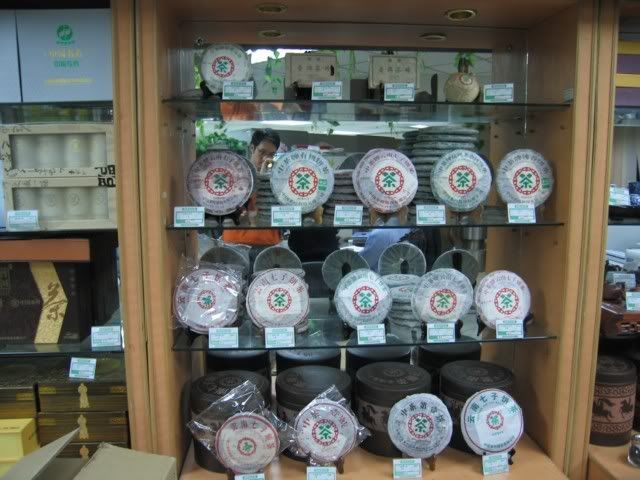
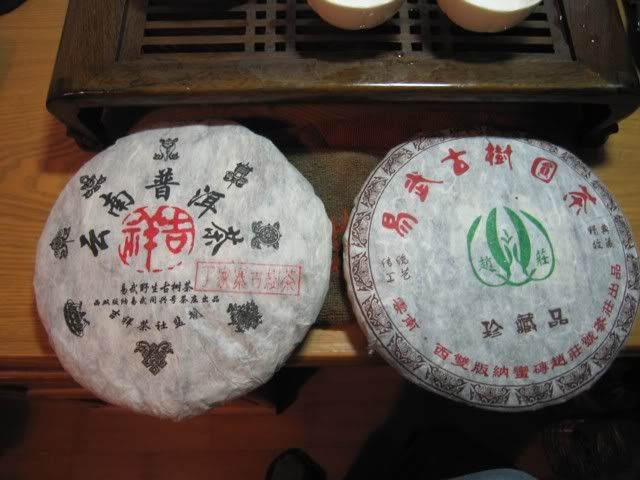
I went with L today to the Zhongcha offices to taste some of their teas. L is a budding tea merchant, intending to set up shop in Shanghai, and he’s hoping to get some goods from the Zhongcha folks. Zhongcha the brand used to be pretty much the only thing used — almost everything was CNNP Zhongcha brand, since it was a nationalized company. We all know the ubiquitous wrapper. Then things started to splinter, but CNNP’s Zhongcha was still used until basically the past few years, when the rights to use them were more or less revoked and factories mostly use their own brands to make tea, but it is obvious that we have Zhongcha stuff even in 02 or 03. Now, there are, apparently, plans to revive the brand with the China Tea Co. making their own puerh (unlike in the past when it was offloaded to factories to do the work and just slapping the Zhongcha brand on whatever they made — something like that). Some of their first efforts are here:

We tasted a few things. Although the first is not by Zhongcha at all, but rather, the Shuangjiang Mengku factory again. It’s supposedly a cake made in something like 1999 or 2000, when the factory was first starting to make puerh under the current management. They sent a few jian of this tea to CNNP, and it stayed in CNNP’s warehouse. L said this is a good tea and he wants me to try it, since I told him I have tried a few older Mengku stuff before from the same factory…

The tea is actually quite similar to the 2002 cake I bought, but it’s obviously a bit better. The aromas are largely similar — the distinctive Mengku taste profile is there. There’s a strong feel of mintiness in the throat, and it felt very nice going down. The body is quite full, and the tea is flavourful. Storage condition seems largely good, with a little bit of white notes here and there on the cake, but not obvious and won’t be noticed unless you search thoroughly. It’s not cheap, however, but nevertheless I think is a pretty good tea.

We then tried a green tea “puerh” that reminds me of the fake Menghai stuff I had yesterday. It was so similar, except the bitterness is less pronounced. The initial two infusions were very sweet, nice, basically zero bitterness, almost no sense of astringency, but then the tea turns nasty on you, losing the sweet edge and instead turns bitter over time. It’s mostly made of those silvery buds. I think these teas generally just turn out this way — sweet and nice initially, but then turning out to be bitter and won’t age well. The fake Menghai, after all, is 3 years old, and hasn’t gotten any better. Puerh should end up with infusions that are sweet and mellow, not bitter and harsh. This is what happens with these, it seems.

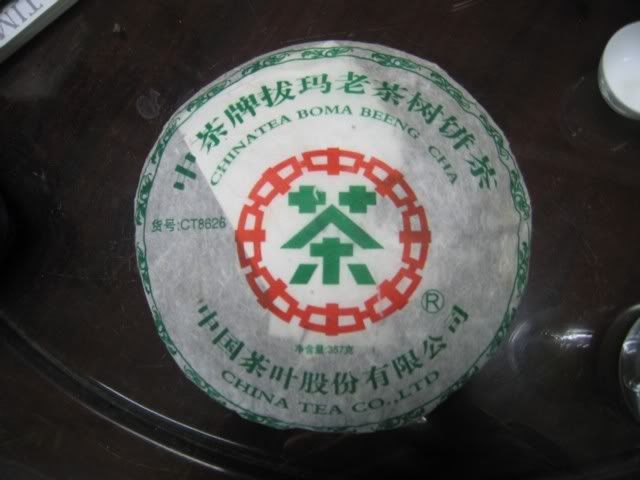
We then had a cake that I liked


It’s an arbor tree tea from an area called Boma, which, according to the guy brewing it (he’s some sort of certified tea taster working for CNNP), it is a village in Nannuo mountain. Its taste is quite nice, reminds me of the Nannuo maocha from Hou De. Not as fragrant, but quite full bodied. There was a maocha we compared it to that was obviously from the same region (by taste) but obviously worse than the cake. Properly made, and not too expensive. Mind you, I wasn’t buying tea today. I think you have to order by the jian, or at least in large quantities there. It’d be odd to buy one or two.
The guy who brewed it for us was nice though, and we were having a good chat and might also meet up again over time to taste other things. I’d like to get second opinions on some of these things I am drinking. He is also responsible to go to Yunnan to press cakes during harvest season, and if the timing is right, I might end up tagging along. It’ll be good to go with someone who is there on a mission and thus definitely have contacts on the other side. I think going by myself can be quite difficult.

L and I might go to a tea event on Wednesday night at (gasp!) Tenfu. He learned tea there before, and knows the people there. We’ll see what happens….

Categories: Old Xanga posts · Teas
Tagged: ,