A Tea Addict's Journal

Entries tagged as ‘young puerh’

Mystery Keyixing bricks

January 6, 2007 · Leave a Comment

Back to the City of Dust… where everywhere in the apartment has gathered a
fine (or not so fine) layer of stuff.  It’s also bone dry here.  And last,
but not least, is the internet… it’s too slow.  It’s much slower than when
I left, no doubt thanks to the reduced traffic capacity thanks to the
damaged cables that are still being repaired.  I’m asking my girlfriend to
post this for me, as I simply could not get to the edit screen, and forget
about uploading pictures….

I tried the Keyixing brick I bought here again.  If you need a reminder…
it’s the one that seemed to be aged raw puerh, supposedly re-pressed from
loose maocha.  There’s this odd aroma when I first try it.  It’s not quite
typical aged puerh tasting…. similar, but not exact.  It almost reminded
me of cooked puerh, but it’s not quite that either.  The best way to
describe the aroma is that it’s crisp.  In fact, the whole tea is crisp —
and a little thin.  The aroma is shifty, and not weighty enough as a good
puerh.  I debated for a long time whether this is a really lightly fermented
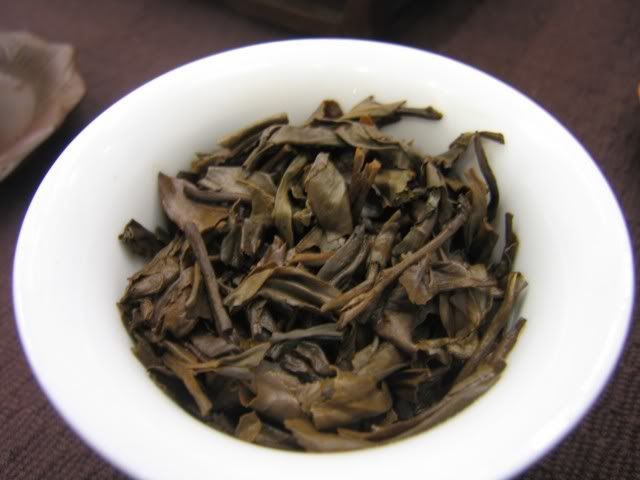
cooked puerh or not, but I decided, from looking at the spent leaves, that
it can’t be.  If it is, it must be cooked with some new method, because no
cooked puerh I’ve seen ever looked like this.

The tea is a bit bitter, but the bitterness does go away and turn to
sweetness.  There’s an obvious huigan, lingering in the back of the throat.
There’s a hint of “throat feel”, but not significant.  The bitterness is
most obvious in infusions 2-4, after which it dies down and gives way to
more prominent sweetness.  I wonder if further aging will make the tea
better and less bitter.  I suspect it will, as it still tastes quite young
in many respects.  I don’t think this can be more than 10 years, although
the colour of the tea suggests it’s probably more than 5.  I’d think it’s
between 5-8 years of age.  I also think there are leaves of various age
mixed in, as the leaves don’t look too uniform in age.

Not a bad tea, certainly not too bad for the price I paid, but not great.
Another experiment, so to speak, and an interesting one.  Too bad it will be
years before I know the answer to any of these questions.


Categories: Old Xanga posts · Teas
Tagged:

Tea shopping

January 5, 2007 · 1 Comment

I finally bought a few things after having had a whole bunch of free tastings at various shops. I do, after all, need to keep up the appearance that I’m somehow shopping for tea all along.

I tried three things today. One is actually a Wuyi tea that I brought over to the Best Tea House (for Rosa to try). She wants me to buy a whole jin of it, because it’s so cheap and yet tasting quite decent (for the price). It’s 1/2 of the price of the cheapest Wuyi tea on offer at the Best Tea House, and I personally think it’s even better.

The second is a small 100g cake of supposedly Yiwu tea. I don’t think it’s Yiwu, or at least it doesn’t taste like the Yiwu that I know. It doesn’t have that “Yiwu” taste. Not that great, and very expensive for what it is.

The third… is better. Some unknown origin old tree tea. Good chaqi, nice feeling down the throat that lingers for a long time… it’s hard to find tea that actually does it, and I am still wondering what it is that causes such a feeling down the throat (and why it’s only present in some, but not all, teas). It’s a bit of a mystery to me still, since you’d think that the same chemical will be present no matter what, but apparently not. Teas that look almost identical can have a great variation in how that particular sensation develops (or fails to develop). I think this is why YP thinks it is such an important indicator of a tea’s quality.

It is increasingly difficult to buy anything from Hong Kong though, simply because prices are high. I can usually find the same thing for much cheaper. I know I probably paid more than I need to for what I got today (which wasn’t much), but I can sort of justify it as payment for all the free teas I’ve had over the past two weeks.

Back to Beijing tomorrow, then Shanghai, then Beijing again, then Hong Kong, and then the States for a little bit…. the next few months will be busy!

Categories: Old Xanga posts · Teas
Tagged: ,

How do you make puerh?

January 4, 2007 · 2 Comments

How DO you make puerh?

Conflicting versions abound. From my understanding, puerh making is very simnple — picking of the leaves, kill green, some rolling, and sun-drying. There it is in its entirely, raw puerh maocha is done. Then you steam it (enough to soften the leaves) and press it. Then you have compressed maocha.

Puerh, properly speaking, isn’t quite finished until it’s gone through at least some fermentation. Raw maocha just compressed is more like green tea.

Technically, I think, maocha can be classified as green tea, because it goes through the essential processes that green tea goes through, but there’s a crucial difference in processing temperature, which allows something in puerh tea to retain its bioactivity and continues to ferment naturally (into something that tastes good) whereas green tea of our normal kind is processed at very high temperatures, and the tea gradually loses flavour over time and turns into something nasty.

However, some now process puerh with additional steps such as the withering of leaves and the intentional breaking of leaves (to encourage fermentation before kill-green). This, generally speaking, is what you do to tea that is destined for oolong. This process creates honey or fruity like aromas, along with lower bitterness and astringency (relative to raw puerh). It makes a nice tasting tea right away… which will mean the tea is easier to sell. It also means you have something more like oolong, and the aging prospects…. are suspect.

There are other raw puerh that are processed like green tea, and tastes like green tea (a la longjing type green tea). They might not age as well either. The jury’s still out on the long term prospects of these teas. Xiaguan mixes some of them into their tuocha, but it’s only a certain percent, not 100% of it. What happens to these things 20 years from now?

This is what we were debating in the Best Tea House today with Rosa and Tiffany. We don’t really know. Nobody seems to really know. So many developments are so recent that nobody really could figure out what’s a good way of making puerh, what will really age well, what won’t, etc. I’ve heard at least 10 different versions of what makes a tea a good tea for aging. The only common point so far is that it should be strong, somehow. If the tea is mild and weak right now, it won’t do well (Yiwu is weak in many respects, but not in chaqi and thickness of the tea). Is that the only indicator of a good raw puerh?

Categories: Information · Old Xanga posts
Tagged: ,

Provenance

January 3, 2007 · Leave a Comment

One of the things that distinguish a Hong Kong tea vendor from a mainland (at least Beijing) tea vendor is that Hong Kong tea vendors tend to be very imprecise about the provenance of their tea. Most vendors in Hong Kong cannot tell you if the tea you’re tasting right now is from 1989 or 1991. Most vendors also cannot tell you which mountain its from, or whether it’s a fall or spring tea, or what not. Some do, like Sunsing, but that’s rare. At the Best Tea House, for example, such information are usually qualified… i.e. “I think this is from xxx” or “we started selling it in 200x”. The Mengku Yuanyexiang, for example, is, I believe, a 2001 cake, but Tiffany always thought it’s from 2003, because they started selling it in 2003. They don’t always sell everything right away, and that is fairly standard practice. Usually they are not in a hurry to sell… and why should they, with prices going up so fast?

This is in stark contrast to Beijing tea sellers, who will tell you everything you ever wanted to know about the cake in question, from the production date, raw material origins, storage location, etc, down to every last detail. Sometimes it’s probably true, but more often than not, I think it’s probably at least sometimes fabricated. I’ve heard so many times from people in Beijing that their tea has always been dry stored since production in, say, 2001, etc etc, except that I find them sometimes to be slightly wet stored, damp, etc. They will always tell a story, but the story is not always true.

The other thing is… how many people can tell the difference of a tea when it’s ten years old? As far as I am aware, nobody knows what a 10 year old Banzhang tastes like. Pure Banzhang (substitute any mountian here) cakes didn’t appear until about 10 years ago. Before that, all we’ve got are recipe cakes, or cakes with leaves of unknown or only somewhat known origins. Who can say for sure where the leaves for the original 8582 was from? The season it was picked? Anything? Yet, we’re drinking them up like there’s no tomorrow (with prices to match). I recently heard someone tell me that this 1997 brick was made with Banzhang area materials. Huh? How do you know that? It’s not written anywhere. By taste? How many people can taste that much of a difference among these locations?

Yet, it is on this sort of information that prices are driven up. XXX cake is expensive because it’s a pure Yiwu from, say, 2001, and the 2002 and 2003 have correspondingly lower prices. If the materials (and the quality) are about the same… why buy the 2001 when its price is, say, 100% more? Your money won’t make 100% return in two years unless you’re a very good investor, so wouldn’t it be better to pay the 100% lower price to get the tea that is 2 years younger? There’s an opportunity cost involved. I guess if I were 65, I might pay the higher price to get the further aging, but otherwise… I’m willing to wait. This is mainly why I only buy cheap or loose aged puerh for current consumption, and buy mostly 5 years or younger compressed teas… because they are correspondingly much cheaper. At the end of the day, 15 years from now when I am drinking some of my current purchases (when they’re finally ready for consumption), I probably can’t tell the difference between the stuff I bought in 2006 or 2007.

Categories: Information · Old Xanga posts
Tagged: , ,

Bangwei 2006 Fall cake

January 2, 2007 · 4 Comments

While editing texts stuff like Xanga is ok, uploading pictures is still not really possible (too slow and unstable). So for now we have to do without pictures…

I tried the sample of Bangwei 2006 Fall cake that I received with the purchase of two Yiwu cakes from that guy on Sanzui. I have to say I really liked this tea, and thought it’s quite nice. There’s a robust aroma, with a hint of smoke, in the first few infusions, and the tea is not too astringent and also got a nice cooling feeling down the throat. The leaves are big, meaty, and soft. I gave up drinking before the tea gave out… around 10 infusions (I had to go somewhere). Even in the less than ideal setup of my home here, the tea tasted quite nice, so I can imagine if I were actually able to brew in a better environment, then the tea might taste even better.

It’s also selling at only about 2/3 the price of the Yiwu cakes, which makes this a little more attractive as well. I also think I need to diversify my holdings of tea. Right now, I have a disproportionate amount of stuff from Mengku for some reason (not all from the Shuangjiang Mengku factory). I also have some Yiwu, and a few other cakes, but in general, my holdings are pretty concentrated in a few areas. I should really branch out into some recipe cakes, and also some stuff from the “new” six mountains…

Categories: Old Xanga posts · Teas
Tagged:

Sunsing

January 1, 2007 · Leave a Comment

I went to Sunsing today for the first time since I got back. I don’t usually go there, mostly because their stuff, aged or otherwise, are all quite expensive (in some cases even more than Best Tea House). Also, the service I’ve gotten there before has always been sub-par. I’ve always found them to be a bit snotty and hard to deal with.

I tried three teas there today. The first two were Yiwu teas… one 2006 spring and the other 2006 fall, both made by Sunsing themselves. They are supposed to be Mahei teas, and honestly…. I found both to be pretty poor, especially considering the price they wanted for it. They were not smooth, not that fragrant, not that thick…. and just not that interesting. The fall one is especially poor, and charging the same price for both fall and spring, when there’s an obvious difference in quality, is a little…. meh

Then I tried the 2004 Yongnian cake… it’s a Manzhuan, and I don’t think I really liked that one either. The Manzhuan cake from Beijing that I bought was much better. Price is again a factor.

I think the next few days I’ll actually make some purchases. So far, I’ve only gotten a few loose puerhs in Hong Kong (and picking up the tong of tea I ordered in the summer). There are a few things that I want to buy and deem good enough for the price, and will start going around to buy them….

Time’s running out, but then, I’m going back to Maliandao. I think I learned something this trip to Hong Kong though… so that’s progress, at least.

Categories: Old Xanga posts · Teas
Tagged: ,

More puerhs…

December 24, 2006 · Leave a Comment

I went back to the Peninsula for a canister of their Darjeeling. It’s not that cheap, but it’s cheaper than I thought.

I went and visited Tiffany again in the afternoon, and tasted quite a few things today. The first was a puerh brick that they sell — a cake with no clear origin other than some vague “high altitude” claim. The tea was very buddy, with lots of young leaves. The taste was sweet, with a Jingmai taste, but not that impressive, and has some suspicion of green tea taste. It’s not terribly obvious, but Tiffany also said it reminded her of the organic green tea that they sell. We then chatted about the dangers of buying young puerh these days, and it seems…. basically nobody knows what will be good. Sigh

Then we tasted a purely dry stored Mengku cake… somewhat different from the stuff I’ve had before. It’s more refreshing in its taste, although I actually prefer the one that has been through some slight wet storage, as the taste is deeper and thicker. That tea didn’t last too long before we decided it wasn’t that good.

I pulled out the Jingmai sample that I have… and tasted it sort of in comparison with the first tea we had.

The one on the left is the brick, and the one on the right is the cake. You can really see the difference in size and completeness of leaves.

The Jingmai cake is a little less obviously sweet and aromatic, although I think it is still quite aromatic (the dried fairness cup smells a VERY strong floral fragrance). The cake also has obvious “throat feel”. I think maybe I should grab a few of these when I get back to Beijing.

At this point, some other tea drinker came in. She seems experienced, although mostly a client of another sales who works at the Best Tea House, and generally I don’t see her. She wanted to try something nice…. and so Tiffany pulled out the Zhenchunya Hao.

This sample cake they were using is at least poorly stored. You can see evidence of mould on the cake — some slight white dots on the leaves that weren’t on the surface of the cake. You can also smell the storage from the dry cake and the first few infusions. The tea… is nice and sweet, with an obvious Yiwu taste, but honestly… it doesn’t not merit the price being charged. The last Zhenchunya Hao I had at the Best Tea House in their main store was better — it was also better stored.

I heard that Mr. Chan of the Best Tea House actually bought this batch from somebody who originally got it from sources in Taiwan, and this is after he sold out (pretty much) his own supply. Therefore, storage conditions are not quite the same, and it’s obvious that this batch I’m seeing is not as well stored as the other ones…

Either way though, it just costs too much…. with a nice 25% markup to the price since I was last in Hong Kong… in August!

Categories: Old Xanga posts · Teas
Tagged: ,

More Best Tea House

December 19, 2006 · 1 Comment

I went back today to the Tsim Sha Tsui branch of the Best Tea House. When this was closed, it was a trek to go all the way out to their main store, so I didn’t go very often, but now… it’s much easier.

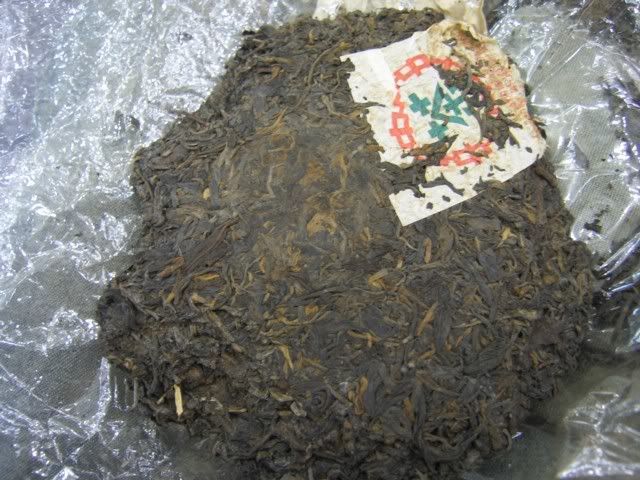
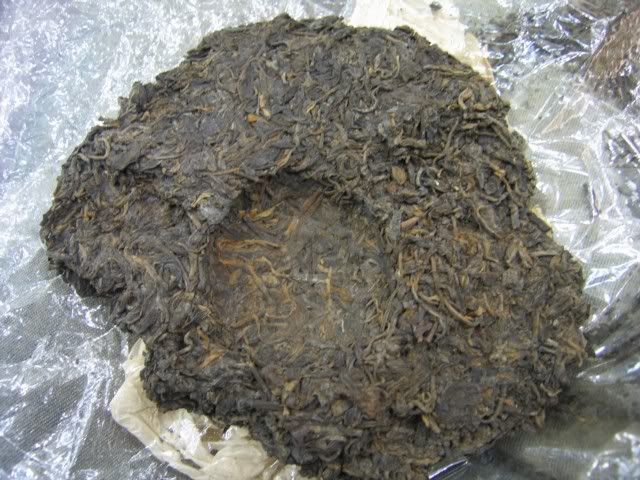
A younger tea drinker, B, was there, and they were just about to brew a 1975 old tree tea. The cake itself looks somewhat unappetizing:


Yes, that’s white stuff on the tea. It’s been pretty wet stored (or just pretty poorly stored). You can smell it.

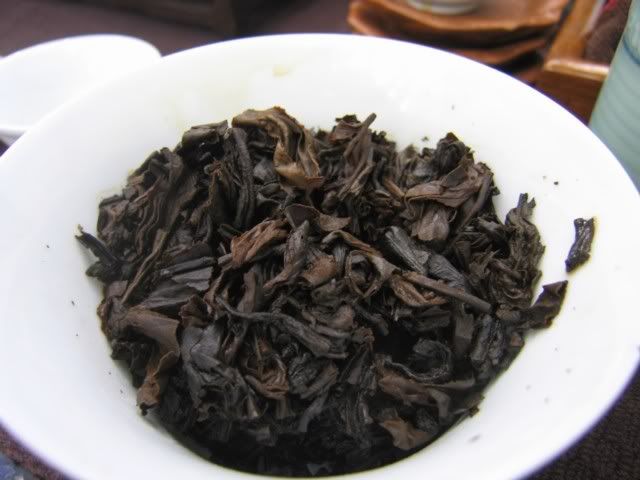
The tea brews a dark brown/black liquor. The first two infusion has a “wet store” taste to it, quite prominent, and somewhat unpleasant. However, it does clear up, as they usually do, after a few, and the resulting brew is still pretty reasonable, and nice to drink. I think wet storage really gets a lot of bad rep, but when it comes down to it, I think I might prefer this cake to the 88 qingbing, which was just a bit bland and flat. Of course, it’s got another 10-15 years extra aging, but still…. in terms of prices they are very close to each other.

The wet leaves:

Then some Japanese customers came in and they tried some tea, and bought a bit. After that, I pulled out my Mengku 2002 cake for them to taste. They all liked it — thought it was pretty decent and tasty, especially given the price. I told them that the Beijingers don’t really like this when I brew it for them, and they were surprised. I think the Hong Kong palette and the Beijing one are so substantially different. They look for different things, different tastes, different feels, and I’m not sure which one’s the right one. The Hong Kong one places heavy emphasis on how a tea feels — whether it’s soft, round, smooth or not. The Beijing one, although also taking these into consideration, is very particular about whether or not a tea is clean — something that Hong Kongers rarely consider. When they say clean, they mean whether or not there are traces of wet storage, and if there is, they generally don’t like it, even if it’s just a hint. I personally think that’s great, as it means that I can usually say “this cake was wet stored” and try to get a discount on the tea in question in Beijing. Can’t do it here.

We also tried the water experiment with this tea… and the tea tasted softer with more mineral water involved. Mark this down in the “mineral” column.

In the middle of this, two guys walked in, one being a famous calligrapher/painter and the other his friend (and host, I think) in Hong Kong. They sat down and tried some tea, and the calligrapher got very happy and wrote some words for Tiffany & Co. After they left, we drank a few more cups, and I took my leave.

On my way back to home, waiting for the Star Ferry, I am reminded of how nice it is to spend Christmas in Hong Kong

It’s good to be home.

Categories: Old Xanga posts · Teas
Tagged: , ,

First day back in Hong Kong…

December 18, 2006 · 8 Comments

and where do I go? I go to Tiffany & Co., of course… (actually, I prefer Cartier)

Anyway, I haven’t even been to the new Tsim Sha Tsui branch of the Best Tea House… and like bearsbearsbears said, it’s quite small. Here’s a shot looking out from the vantage point of the tea drinker/brewer

But believe it or not… it’s actually bigger, physically speaking, than the older branch. The older branch, however, was square, so even though it’s physically smaller, sitting in it feels better.

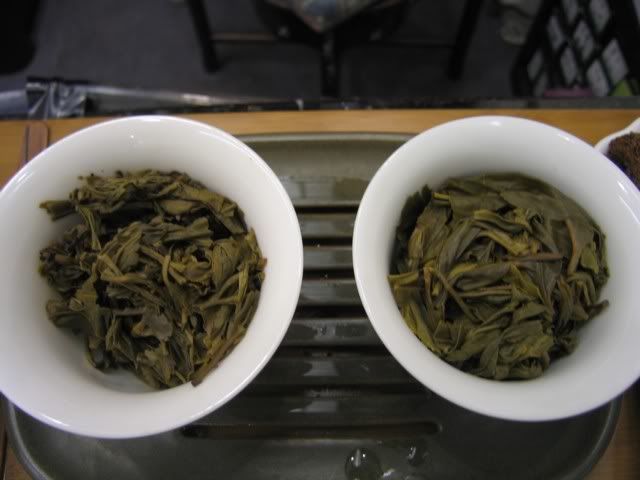
When I got there after lunch, there were already two older tea drinkers there. They were all getting ready to taste another tea (obviously much has happened already before I arrived). Tiffany was making the tea…. with two gaiwans. Here are the contents:

They are two “thousand taels tea”. The one on the left is an offering of the Best Tea House, whereas the one on the right is brought by one of the drinkers who were there. Thousand taels tea is basically a heavily compressed stick of tea — a very big stick. It’s usually some 5-6ft long, and the diameter is similar to a regular puerh cake. You can imagine how much tea that is. I believe it’s made with Hunan leaves… and it’s got all sorts of stuff in it.

These are how they are brewed, in the same left right setup. Although the way the tea reflected light makes it seem as though the right side is darker than the left, the reality is that they are very close.

The taste, however, is not. The left is sort of medicinal, but a bit thin. The right has everything the left has, but more, and has also a “chen” taste with a sweetness to it that the left doesn’t. Quite nice. Supposed to be around 50 years old (and in the hands of the tea drinker for 15 years already). I’ve tasted a very young thousand taels tea, and that one tasted very rough and unready for consumption. These are both drinkable, although not at these prices….

Then, we tried a Chaozhou gongfu tea — heavily roasted oolong. We brewed it in a pot — sour. We brewed it in a gaiwan… not sour. Something’s wrong with the pot. The owner (the guy who brought the thousand taels tea) said he’ll have to go home and re-season the pot thoroughly to get rid of the nasty taste.

Then… I brought out the two puerhs I brought (well, I brought more). The first is the Yiwu maocha, and the second is the Yiwu girl cake.

Everybody liked the Yiwu maocha… flavourful, smooth, full bodied. It tasted better than when I brew it, so I thought Tiffany’s tea brewing skills are obviously better than mine, for good reasons. I’m glad it tasted so good.

Then we tried the Yiwu cake…. and something was seriously wrong. It was thin, rough, not fragrant at all. Nobody wanted to drink it after three infusions, and I myself felt uncomfortable with the tea too. Something was wrong, quite wrong.

While we were discussing why this might have been the case, we brewed up a little 88 qingbing (88 raw cake) for taste. I’ve never had it, and neither has the other guy who brought the tea and the pot, so we figured it’s not a bad thing to try.

Boy, was I disappointed. Astronomical price tag aside, the tea is thin, bland, lacking in huigan, etc…. only of middling quality all around, if even, and did I mention it’s expensive?

A shot of the wet leaves

I asked a guy I know on Sanzui who’s also from HK about it… and he said “duh… anything left in the Best Tea House at this point that’s a 88 raw cake is not going to be good”. Good point. The good stuff is long gone — picked out by the people who bought it in bulk, or simply lucky enough to buy early.

Meanwhile, we figured that it was probably a water problem — namely that the water I use in Beijing and the water here are different, with the water here (filtered tap water) being very soft and low in mineral content, while the water I use in Beijing is harder. So, to test, I went out, found the closest 7-eleven I could find (2 minute walk away) and bought a bottle of Volvic for our experiment (my preferred option, Vittel, was not for sale there, and I don’t like Evian).

We mixed the Volvic into one of the water kettles, making it an even mix of the tap water and the Volvic, and the other was just tap water. We brewed the Yiwu girl tea up again after a quick rinse.

The result…. was a flavourful, fragrant tea, much, much smoother, and more full bodied. Closer to what I’ve tasted in Beijing. Not quite the same, mind you, but closer.

We then used the tap water to make another infusion of similar time… thin, rough, just like the first few.

Volvic water again… much better. This time the infusion time was short, and it was even more apparent that the tea OBVIOUSLY improved.

However, I think the maocha tasted better with the tap water. What gives?

We tried this with one other tea. This is a tea brought over by the other guy sitting there today, a Wuliang Shan young cake from 05. We tried it with both waters… and the tea was better with the tap water.

I’ve still got to figure out what it is that makes the Yiwu girl tea better with the high mineral content, while the other two better with the regular tap water. This is a bit of a mystery and needs much, much more experimentation.

Categories: Old Xanga posts · Teas
Tagged: , ,

Last Maliandao trip of 2006

December 16, 2006 · Leave a Comment

Tomorrow I’m flying back to Hong Kong, so today was the last hurrah of 2006 for Maliandao tea shopping.

It was the coldest day so far this season today… hitting something like -10 degrees (around 14F for those of you in backward countries that still use Fahrenheit). After freezing in the antique market at Panjiayuan, I and my house guest went to Maliandao for some tea.

We first stopped at the store that sells that aged dancong, where I bought 500g of the tea. I figured it’s good enough for some regular drinking, and since it will keep, I decided to buy more of it. Again, the tea is not great, but it is unique, and I’m basically paying for that unique flavour. It goes down smoothly enough, and I quite like it. We tried a few teas there aside from this one, but all were only so so (and one, a winter pick dancong, was not good at all). I think my business today is probably the first (and maybe the last) for him today. I feel bad for them — sitting in a corner of a big puerh/teaware store. I don’t think they get much business at all, selling dancongs in Beijing, but what can you do. It’s not an easy business.

Then…. we went to the Ruirong shop. These guys have their headquarters in Hong Kong, and I might very well visit them in Hong Kong when I get the chance. I tried two teas there today, but neither of them were good. The first was a Yiwu from something like 2001. It looks great. The leaves look thick and meaty, and the cake is well pressed. I thought it would be nice, but instead…. something’s wrong about it. It’s bitter, very bitter. I don’t think it’s Yiwu at all, but something else (or only with a small amount of Yiwu mixed in). The tea also had some off flavours that I can’t really describe, but which leaves a nasty aftertaste.

The second is a “Banzhang” which definitely was not Banzhang either. I thought my taste buds were off… but I don’t think it was me. The cake was slightly Banzhang-ish, but compared to some of the other Banzhang stuff I’ve had, especially the Banzhang maocha that was amazingly nice, this was…. crap. Both teas also suffered from being very coarse, and the seller of the tea was clueless (I think she was just subbing in for the regular shopkeeper who might’ve been gone for a while). All in all, disappointing.

With those two teas down…. it was KFC time to recharge, and then we went to Chayuna, and entered the Wuyi tea place again. My guest wanted some gift teas for family. I figured young puerh is not really a good idea, interesting though it may be.

When we went in, they just finished trying two tieguanyins, and they gave me a cup each of the xth infusion — pretty weak. I was happy to be able to tell the good one from the lesser one (800 vs 600 RMB per 500g). The pricier one is more “pure” in its taste, while the cheaper one, though initially more fragrant, has a subpar aftertaste. Not bad, mind you (600 isn’t that cheap) but not great either.

Again…. like everytime I go there, I get stuck drinking a dizzying array of Wuyi teas. Too many. All sorts of flavours. It’s really a difficult genre to fully penetrate, and I feel like I’m still just scraping the surface. I think I can now tell apart what’s a good one and what’s a great one with more accuracy now. Since there’s no aging worries… in some ways as long as you’ve got that down, you are ok.

Next time I go to Maliandao it will be 2007. Meanwhile…. Hong Kong calls.

Categories: Old Xanga posts · Teas
Tagged: ,