A Tea Addict's Journal

Entries tagged as ‘young puerh’

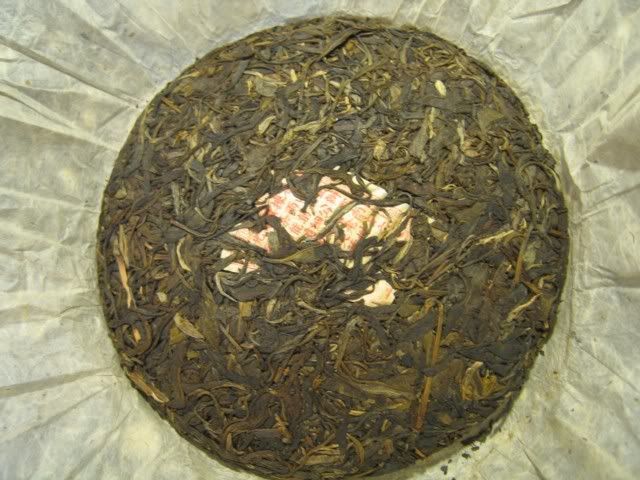
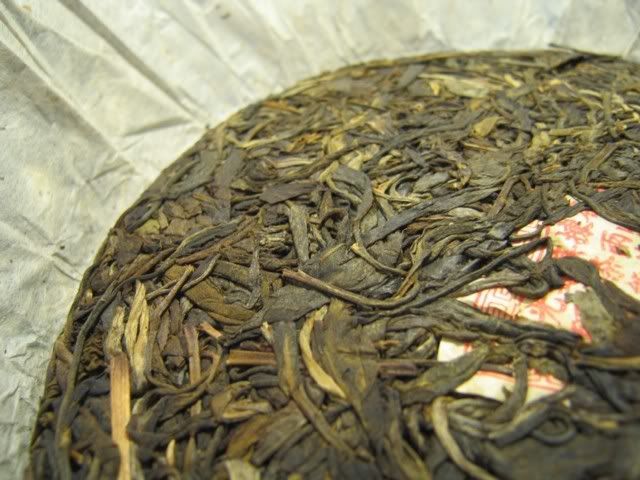
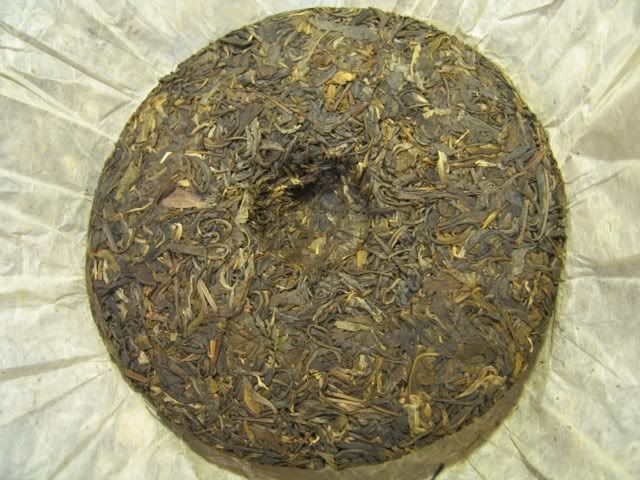
2006 2nd SE Asia Puerh Trade Fair Memorial Cake

March 22, 2007 · 1 Comment

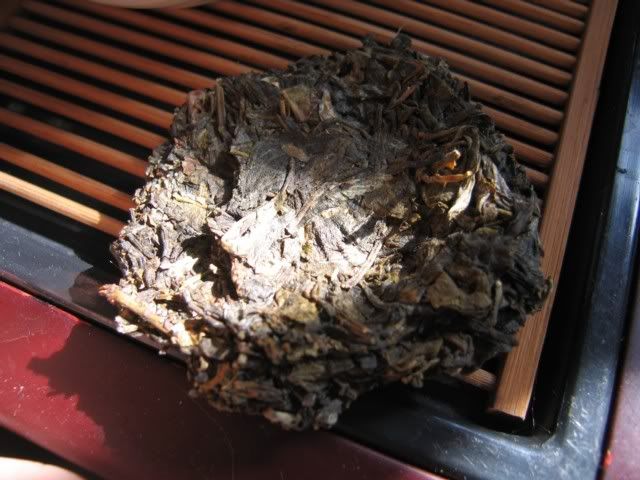
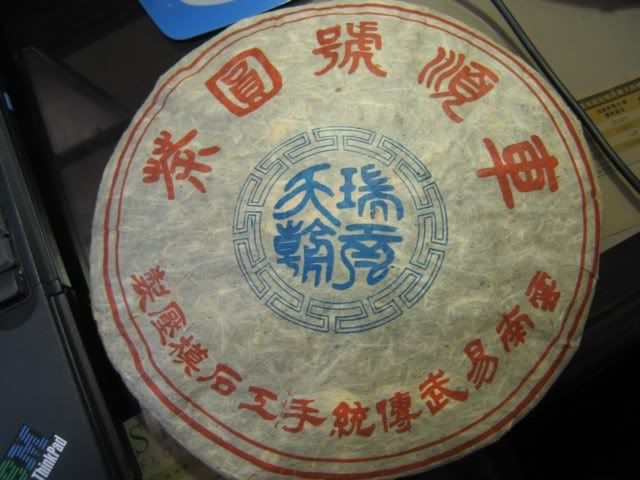
I tried the SE Asia trade fair cake today, the sample of which came from Hou De. This tea is also made by Chen Guang He Tang, the same company (really, same guy) who made the two Yiwus I tried a few days ago.

I got the center of the cake, with a neifei to boot. The piece is literally the centerpiece…
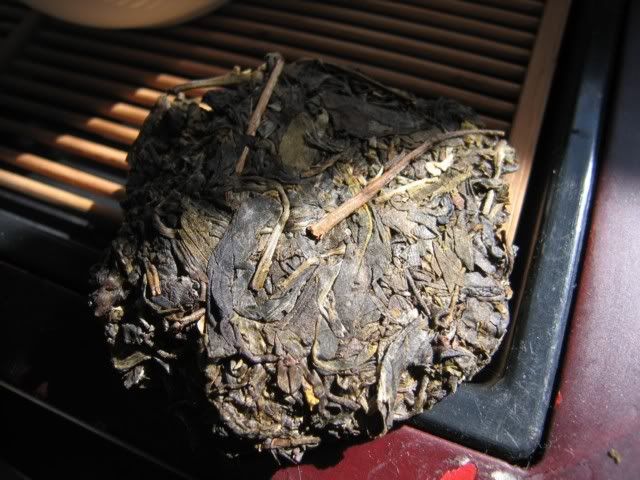
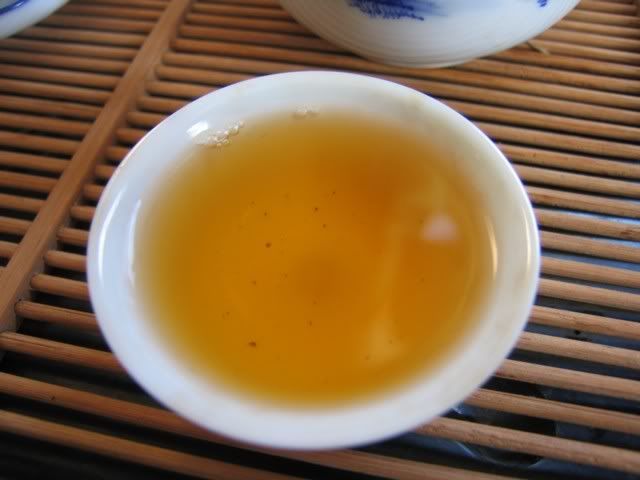
I added a moderate amount of tea to the gaiwan and brewed. The first two infusions were a little strange… there was a strange metallic note to the tea, and also a sort of vegetal taste that I don’t usually find in younger puerhs. In fact, I felt like I was drinking vegetable water at one point. The tea is not very thick, although not too thin either. It’s bitter, and remains so throughout. The vegetable taste goes away after a while, turning into a more traditional Menghai area tea taste. There’s always some huigan to the tea, and the level of huigan is somewhere between the Yiwu Yecha and the Yiwu Chawang.

Sweetness doesn’t really show up until at least 7-8 infusions in. The tea starts showing some sweet notes then on the tongue. Bitterness persists though. The tea was never too rough on the tongue — quite smooth, in fact, despite the bitterness.

Overall I think this is an above average cake, but not a whole lot better than that. One of those teas that is only enjoyable after some years of aging, I think. Right now it’s really too bitter to be a pleasure to drink. If the bitterness is obvious to me, then it must be even more obvious to those who don’t drink this sort of thing regularly, since I generally find myself rather insensitive to tea-related bitterness these days when compared to other people.

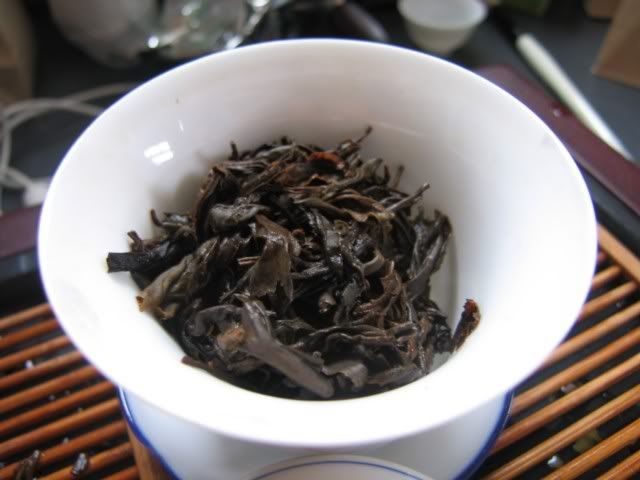
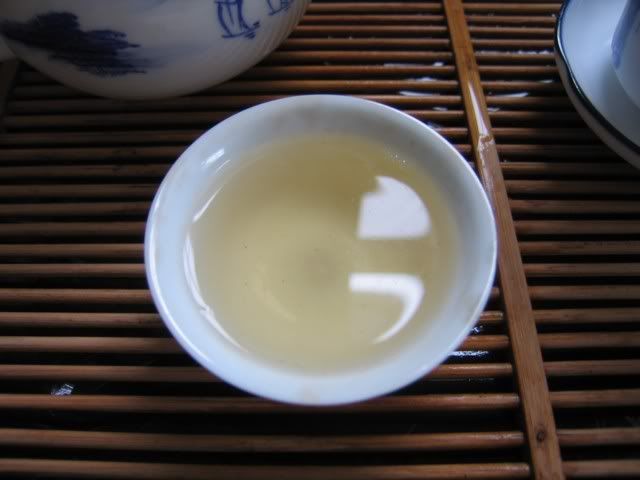
2nd infusion
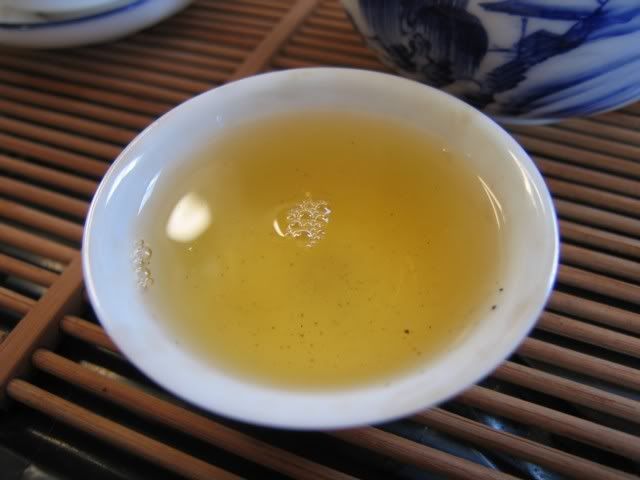
4th infusion
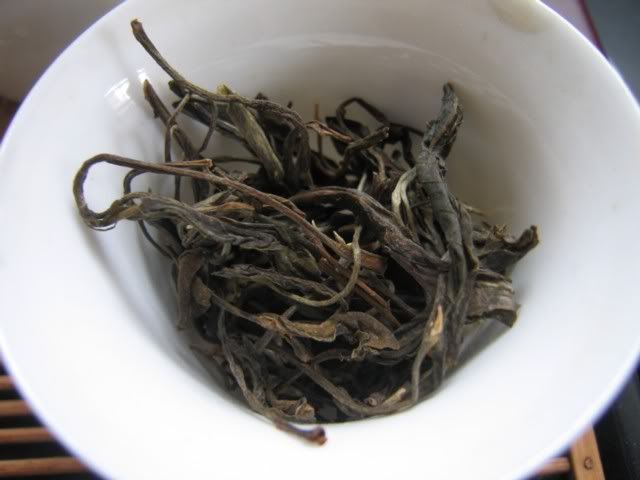
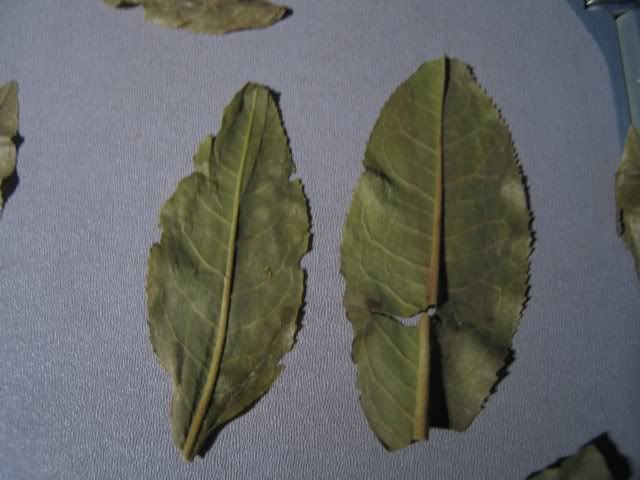
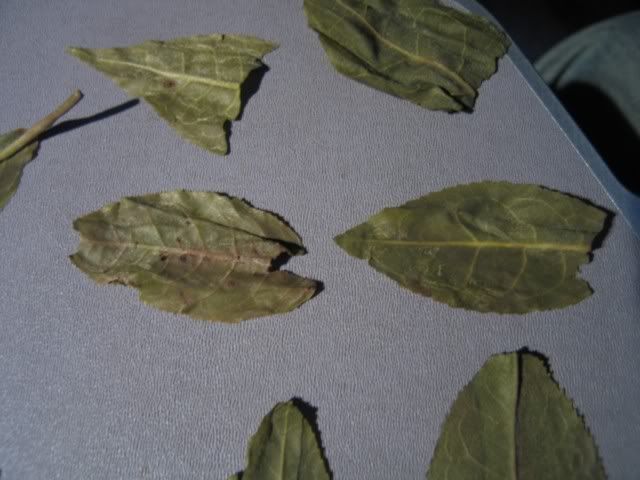
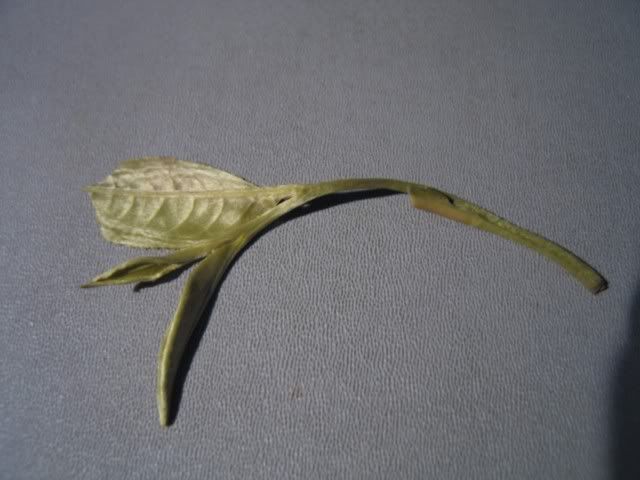
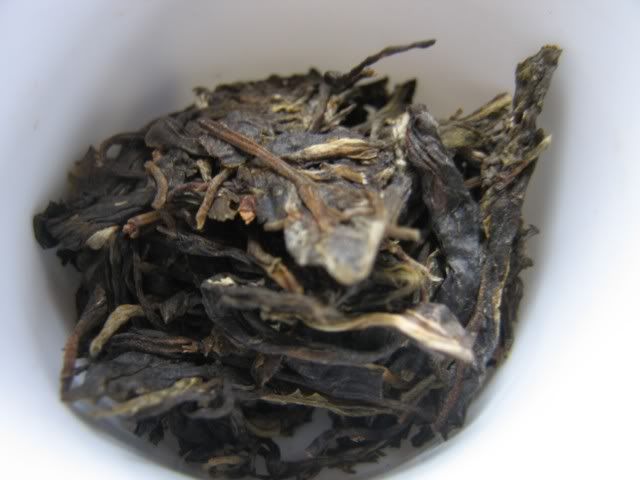
One thing I’ve noticed about these Chen Guang He Tang teas is that they consist of leaves that are more broken than usual.
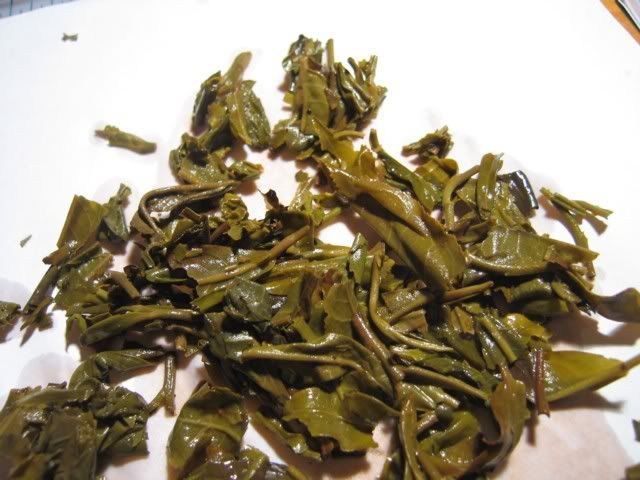
In the whole gaiwan I couldn’t really find any leaves that were intact. These were the best looking ones
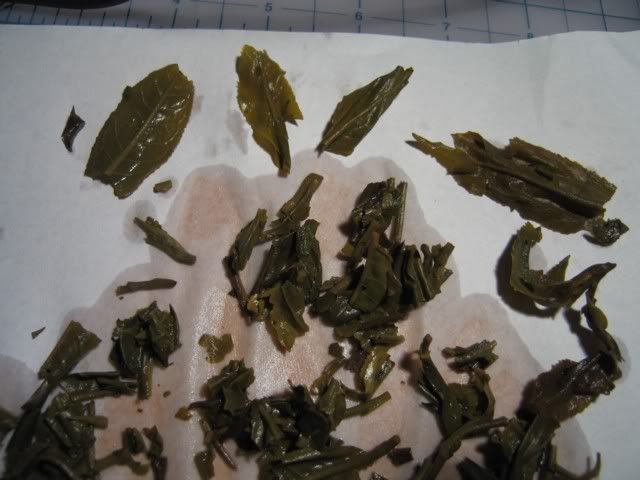
I suspect this has to do with the level of rolling they went through during processing. I suspect these teas are more heavily rolled than the usual ones we see in the market these days. Heavy rolling, according to what I’ve read, also contributes to the higher level of bitterness apparent in his teas. If this is true that heavy rolling is involved, then obviously Mr. Chen thinks that heavy rolling is good for aging. Is it? Only time will tell, I suppose.

On the other hand, I find that a lot of the leaves of his teas are actually quite thin and fragile to handle when wet. They seem to break more easily. Maybe it’s just a question of the general quality of the leaves… and that the stuff he uses are somehow thinner? Not sure.

Categories: Old Xanga posts · Teas
Tagged:

Two Chenguanghe Tang Yiwus

March 18, 2007 · 3 Comments

I, along with a number of other people, have gotten samples from Hou De for the new Yiwu teas they are offering, specifically the Chenguanghe Tang 2006 Fall Yiwus. There are two of them, one called the Yecha, or wild tea, and the other a supposed Chawang, or literally tea king. The Chawang is almost double the price of the Yecha. Since I’ve been drinking a lot of Yiwus these days, I thought I would give them a try.

The samples I got are both close to the center of the cake. Here’s a comparison shot of the dry leaves. The left is the Yecha, and the right is the Chawang:

The only noticeable difference between the two, in terms of their dry appearance, is that the Chawang has more whitish haired leaves, while the Yecha is darker. Other than that though, they don’t look all that different. Both smelled a bit of smoke when dried, certainly foreshadowing a taste of things to come.

I tried the Yecha yesterday with D. It was the first tea we had of the day, so my tongue was not adulterated by other things. I used a generous amount of leaves

Which brewed a decent coloured tea. I think this is the second or perhaps third infusion.

The overwhelming taste, at first anyway, is smoke. It was smokey. In fact, I would say that the first two infusions there was little else going on other than the smoke. Then in the third infusion, the smoke started receding a little, and a little more of the tea came out. However, I generally found this tea to be somewhat on the weak side, without much that appealed to me immediately. Chaqi was not particularly evident, nor was there a strong huigan. There was a bit of it, but it wasn’t lasting. The body of the tea was a bit thin. D didn’t particularly like it either.

The wet leaves… look a little old and thin. I can’t say I was particularly impressed by this tea.

Now, on to the Yiwu Chawang.

I put a very generous amount of tea in the gaiwan. The liquor from this tea is a bit darker than that of the Yecha.

It is also smokey, which is a little unfortunate. I would hope that the tea wouldn’t be so smokey, but it is. It does detract from being able to evaluate it on its own merit, but I suppose smoke is part of the tea now.

The tea is obviously stronger than the Yecha. Not only is the colour of the liquor darker, it is also generally stronger, with a more obvious huigan, and some chaqi. The tea, however, is quite bitter. It’s a little uncharacteristically bitter for a Yiwu, quite unlike a lot of the other ones I’ve had, many of which I personally think are very good teas. I’m not quite sure why that is the case, and I don’t think the fact that this tea is supposedly from Guafeng Zhai has much to do with that. A comparison with, say, the 2004 Yangqing Hao Yiwu would make the difference very apparent. I haven’t tried much of the recent Yiwu offerings from Hou De or any other US vendors recently, so I can’t really comment on anything else.

The Chawang lasted many infusions (I gave up on the Yecha before the tea gave up on me). That in itself is quite nice. I think this is a tea with some good aging prospects, but again… it doesn’t have the familiar Yiwu taste that I’ve come to know as the signature taste of the tea of that mountain.

The spent leaves of the cake show that they were a bit broken. Some is due to the fact that I used some of the shavings in my brewing, but others… I’m not sure what happened. I tried my best to squiggle the teas out of their position so as not to destroy the leaves, but somehow still ended up with a lot of broken bits.

Most of the leaves looked like this

Of the leaves that I could find (there were lots of stems) they were very heavily rolled, which I suppose could’ve contributed to the fact that I couldn’t find many complete leaves. I have also read that heavy rolling contributes to a bitter taste.

In my sample I could only find these leaves…

And this, which was paper thin…. there were another one or two that were also on the very thin side.

It is obvious that the Chawang is better as a tea. I’d even say it’s 2x better than the Yecha. On the other hand…. I’m not entirely sure if there aren’t better teas out there for that price, even in the US market. I know I am prejudiced given my access to teas in a much cheaper market, but even when compared with other teas available in the US market, whether this is good value or not is up to debate. I wonder what everybody else thinks.

Categories: Old Xanga posts · Teas
Tagged:

Tea meeting

March 18, 2007 · Leave a Comment

Yesterday I had tea from 1:30pm to 6:15pm with D, a local tea friend whom I’ve met last time we went to Royal East. We had a whole bunch of stuff…. including
1) Chen Guang He Tang’s Yiwu Yecha from Hou De
2) Lapsang Souchong I got from Beijing
3) 1990s Yiwu loose puerh from Hou De
4) Loose puerh, unkonwn age, from Hong Kong
5) Yiwu cake sample I have from Beijing

I’ll skip over 1, since I still need to taste the Yiwu Chawang to compare it against, and to post my results then. I might do that late tonight.

The lapsang I just find pleasant, and I didn’t use a lot of leaves (it’s very dangerous drinking tea with two people — very easy to overdose). It lasted…. 6 infusions? Something like that. It’s something that can, I think, be enjoyed anytime.

The 1990s Yiwu loose puerh is an interesting piece. D wanted me to try it because he thought it’s nothing like what he’s tried before. When I opened the bag and sniffed, I think I could smell what I know as wet storage smell… that musty, pungent smell that accompanies wet stored tea. The leaves look rather uniform. We used a gaiwan to brew it… and…. after the wash, I smelled it, and there was something odd about the tea. I couldn’t explain what exactly it was, and I don’t think D could either, although he said this is exactly what he thought was odd about it. We tasted it… and the tea is thin, with a little bit of bitterness in the undertones, and not really tasting like any puerh I’ve had before. The thing that it reminds me of is actually a Yunnan hongcha (red tea), or something similar.

The tea looks really good. It looks like a well aged puerh in colour, but when brewed it has none of that taste. Comparing it with, say, the Xizhihao Yiwu 1997, for example, this one is obviously lacking. I think the thing that I am missing is the sweetness that comes from puerh… it doesn’t turn sweet like a puerh should, but instead stays the way it is. We didn’t drink too many infusions of this… about 5 or so, before giving up and moving on.

I pulled out a bag of loose puerh I got in Hong Kong (I bought quite a few different kinds today). I haven’t tried this for quite a few weeks now, and it’s been sitting in the bag since I bought it. When I opened it, there was a strong, pungent medicinal smell coming from the tea. It’s definitely stored poorly as well, I think, and the age isn’t that old. I used my pot to make it, and interestingly enough… there was, underneath everything, a similar taste to the Yiwu loose tea, but with something overlaying that bitterness base. I don’t think the taste was entirely pleasant, and D didn’t think so either. It tasted a bit different from when I tried it in the store, and I thought perhaps it has to do with the fact that what I tried in the store was the surface of a big bucket of tea, whereas this is something that was scooped up. It was also sitting in the bag for a month now… which might make the unpleasant tastes more apparent. I think I need to air this tea out before drinking it.

Since we didn’t go too many infusions on this one, I left it in the pot and brewed it again today. Funny enough…. the unpleasant taste is not apparent anymore, and the tea is infinitely more drinkable. I’m not sure why. The guy who sold it to me told me that I should leave the tea out, all spread out on a flat surface, and let it sit during the days when humidity is high in Hong Kong. Then, take it back in after its gone through a few days of dryness. He thinks this will make the tea much better. I can’t do that, but it’s something to keep in mind.

Lastly, we ended with a sample of a Yiwu tea I got from Beijing. D said he hasn’t really tried a young puerh (under 3 years or so, I suppose) that he actually enjoys, and I thought this could be one that is enjoyable. This tea is… a little odd, in that it doesn’t really have much of the bitterness so characteristic of young puerh, yet not bland either like a lot of bad, un-bitter puerhs tend to be. I don’t really quite know what to make of it, but I bought a few liking the huigan and the overall complexity of the tea.

By the end of the session, we were both rather buzzed with caffeine. It was definitely an enjoyable afternoon, and it is not easy to find tea company around here to both talk about and to drink a lot of tea. I’m hoping that before I go back to China, that we will find time again to get to gether and drink some more tea.

Categories: Old Xanga posts · Teas
Tagged: , , ,

Yiwu maocha again

March 16, 2007 · 3 Comments

I was wondering what to drink today, and while I was contemplating, I took out the gaiwan that my girlfriend put in a box. I opened it up, thinking I’ll warm the cup and then decide… and found there was tea in it!

It was obviously maocha of some sort. I wasn’t sure just by looking at it what it was. I thought maybe this was one of the Hou De samples I got that I forgot about. Then I sniffed it… it’s a Yiwu all right. It must be what’s left of the Yiwu maocha that I gave to her in Paris.

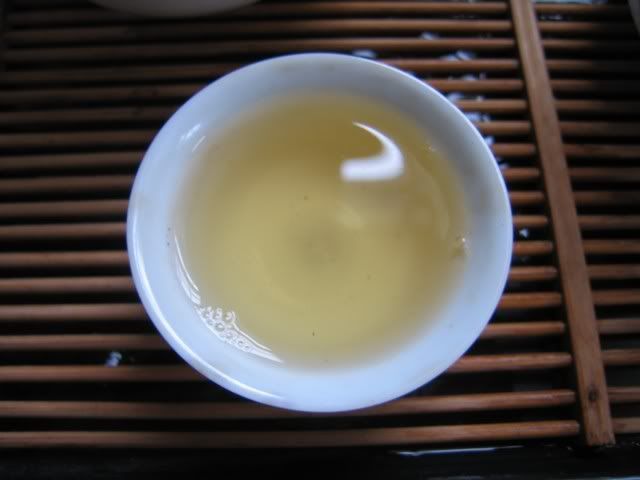
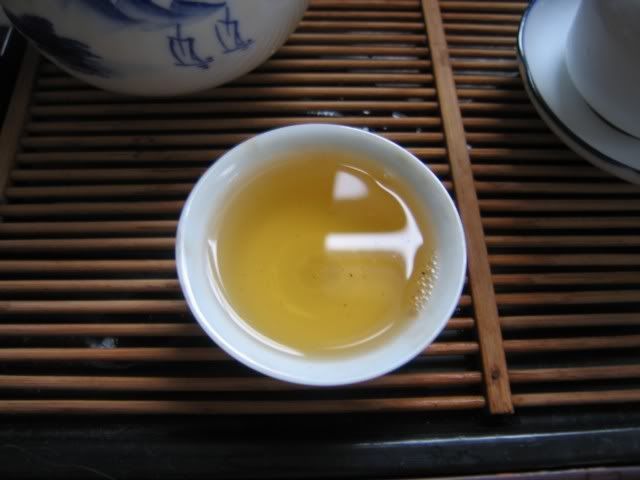
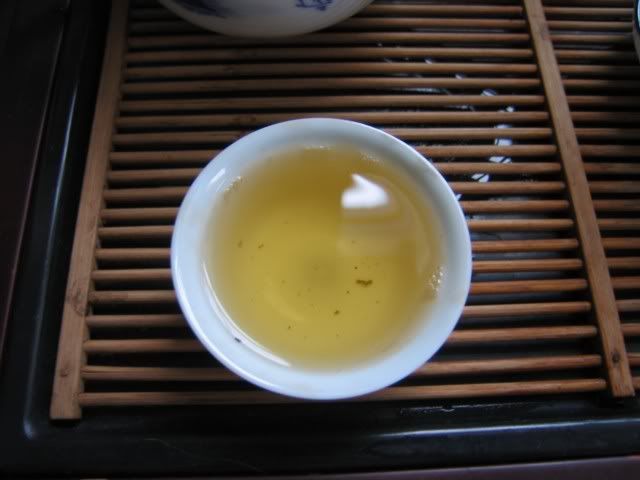
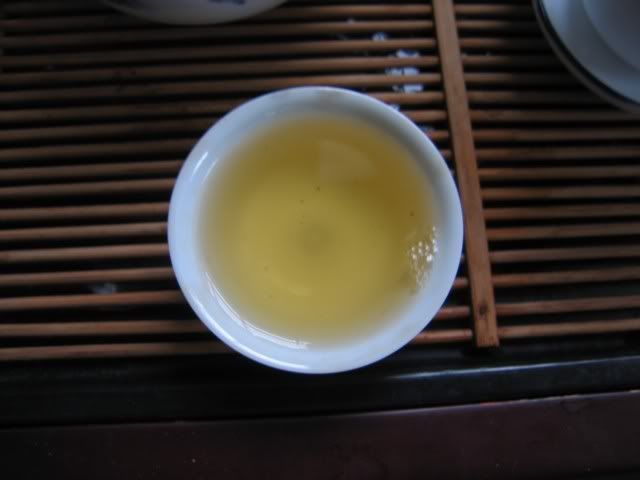
So, what the heck… I’ll drink it (I brought the whole bag of the maocha over). I took pictures of the first five infusions

The first two infusions were weak and slightly bland in the mouth, but delivered a wonderful aftertaste that lingers. The third infusion got rougher on the tongue, but a much stronger taste. The taste of this tea has by now definitely changed from when I first obtained it. Whereas previously it was rather nice and sweet, the sweetness is now giving way to something else, something a little more robust, a little more bitter too. The tea, in some ways, is passing through the very early phase of green-tea like taste into something a little stronger, but only just. From the third infusion onward the taste stayed more or less similar for a few infusions, before it started slowly descending into sweet-water, the usual ending for a young puerh. When brewed for 20 minutes or so, the tea can still give you a good infusion of tea after 15 infusions or so. It’s no longer a powerful cup, merely flavoured water.

One thing that was interesting is that the tea, when dry, smelled just like a Yiwu should. The liquor, however, doesn’t smell quite the same way. It’s odd. The tea is less sweet in taste than it is in dry smell. I’m not sure what to make of that.

Of course, a tasting is not complete with pictures of the wet leaves

Categories: Old Xanga posts · Teas
Tagged:

Reading leaves again

March 6, 2007 · 7 Comments

I’m bored, sitting here in EWR (Newark Liberty International Airpot) after what is probably the worst flight I’ve ever had in terms of service, and waiting now for my weather delayed connection to get into town so I can take it and then go back to Boston. I hate flying. You can guess what airline I’m flying by deduction.

So while I’m sitting here, bored, I figured I might as well blog, especially since I have pictures to show you. Thank god for Wifi in the airport (too bad you have to pay here — in HKG the Wifi at the airport is free!).

On the plane I’ve developed the habit of drinking the Yiwu maocha I have if I happen to be carrying it around, and this time on my lovely 14.5 hours flight it was no exception. I was finally starting to feel a bit of the caffeine headache at around 11pm Hong Kong time, after not having had tea for a whole day and some, so I took out my bag, brought it to the galley where the lazy flight attendants were sitting around reading Star!, and I asked for some hot water and put my tea in it.

The tea itself I won’t describe, as there is not much to say — it’s mild, sweet, kinda nice, kinda bland. The water is never hot enough for tea on the plane, so it’s really not a great way to drink tea. Oh well, it still beats the whatever mystery tea they are serving (I think it’s some really bad, overbrewed jasmine — didn’t try it this time).

Anyway, after drinking the tea, I laid out all the tea leaves I used and took some pictures, as it was a good way to kill time, among other things.

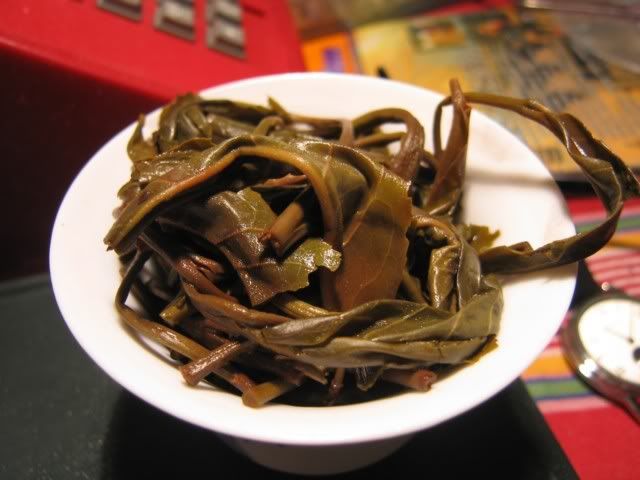
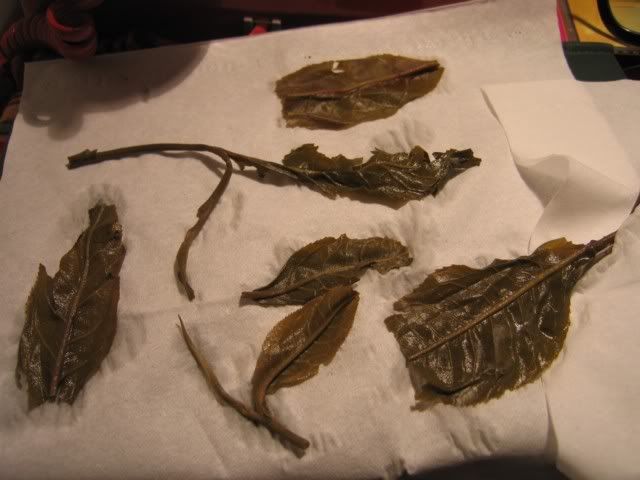
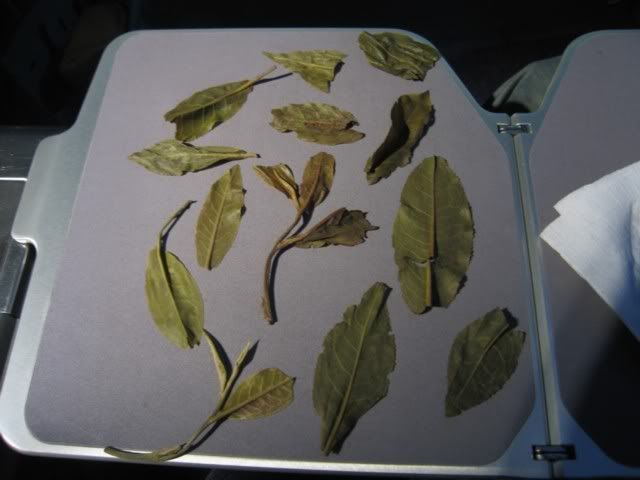
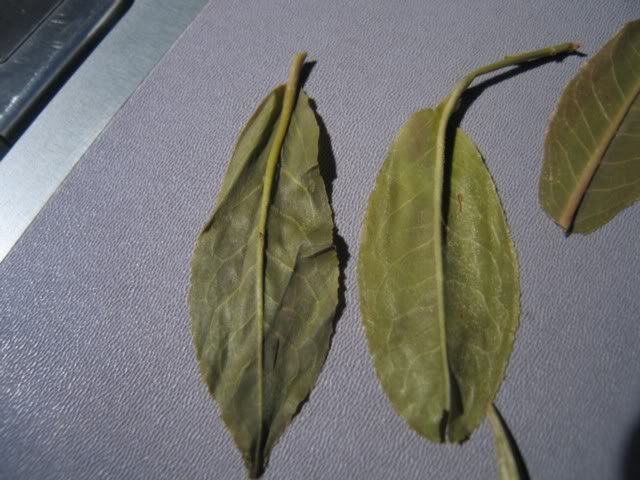
Some comparative pics — comments after

For the first two pictures in the above three… you can see two similarly sized leaves that are shaped quite differently. The ones on the left, with the thin, elongated shape and the pointy tip, is what I understand as a typical Yiwu leaf. The ones on the right, with the more rounded shape and no pointy tip, is what I understand to be NOT Yiwu like. I think that sort of shape is much more common in Menghai area leaves… nannuo, banzhang, jingmai, that sort of thing.

The third pic in the above three has a few broken leaves. The one on the top left is really pointy, and is only a tip of what looks to be a very large leaf. The two in the middle… the left one looks more like a Menghai type leaf, while the one on the right looks more like a Yiwu area type leaf. I’m not sure if this is really sceintific to any degree, and supposedly, with older trees, all the leaves look different because they are not planted by human intervention (i.e. not transplanted with branches from older trees). Instead, they were planted long ago using seeds. This means that the teas can have different genetic makeup. However, it does seem that different areas do have different kinds of teas, and so looking at the shape of the leaves can say something about where the teas came from. If I am not mistaken in this case… then I was probably right when I said, long time ago, that I thought this particular maocha tastes slightly confused with a few different kinds of teas mixed in, and not tasting quite like pure Yiwu.

I would really encourage everybody to take pictures of brewed leaves, and post them up. It is especially instructive when in a particular cake that is advertised as “xxx” that you find different kinds of leaves that look drastically different. It might be a sign of blending.

Lastly… a picture of a very nice, very furry bud. This is what I guess you can call “two spears, one flag”. Too bad the flag is slightly broken. I had to unpeel the bud myself to reveal the smaller bud in the middle, so perhaps this is really a “one spear, one flag”. I could sort of see a even smaller bud in there, but couldn’t quite get it out.

Back to waiting…

Categories: Old Xanga posts · Teas
Tagged: ,

Tea storage in Hong Kong

March 5, 2007 · 1 Comment

I went to the Best Tea House again… and tried that Yiwu small arbour sample that I have. Interesting observation — the tea got better, and changed character, since last time.

I don’t know what it is, but last time the tea brewed a rather insipid and boring tea, but this time, it’s much more flavourful. It’s still a bit on the weak side, but it came out a lot better. Part of it has to do with the sheer amount of leaves used, but I think the other reason is because it’s really changed a bit…. it’s different from the last three times I’ve had it.

Humidity here today is 98%. Somehow I think the taste change has to do with the very high humidity in Hong Kong. I think it ultimately makes teas change faster, and probably better. After all, almost all the older stuff we have on the market today came through Hong Kong. I am more and more convinced that a place like Beijing will develop terrible tasting teas.

Categories: Information · Old Xanga posts
Tagged: ,

Diagnosing strange teas

March 2, 2007 · Leave a Comment

When drinking a large variety of teas, one ends up encountering a lot of stuff that is surprising, and most of them are not pleasantly surprising. Since teas are unlabeled, with unknown source and unknown provenance, what the vendor tells you is all you really know about it until you’ve tried it. Even then, it’s not always obvious what happened to the tea to cause it to be the way it is.

I had two teas today, both of which were a bit off.

The first was a puerh sample I have from somebody. I no longer remember who gave it to me, what it was, or really anything about it. I brewed it up at the BTH, hoping to try it and see if I can remember anything from it. The tea tasted like a Menghai tea. What struck me, however, was the extreme cloudiness of the tea. It looked like a chicken soup with the chicken meat ground up in it. The tea was really, really cloudy…. I was a little afraid of drinking it, even (and that’s a rare thing). Cloudiness is supposed to be a product of high moisture content in the tea, but this was just a little too high. Rosa said that apparently some tea makers, at least she heard anyway, made teas that were mixed or coated with a sort of rice liquid. This gives the tea more body when you drink it, but of course, it clouds up the tea. I seriously wonder if this was done to this particular tea. The cloudiness didn’t improve until maybe the 6th infusion. The taste of the tea was fine… not too bad, in fact. I could feel the power of the tea, although it’s a little unstable. Overall though, I don’t think I’d buy something like this.

The second thing was a special grade Tieluohan, a Wuyi tea from the BTH. I brewed it like I normally would… and it was sour. The second infusion was so sour, I was tempted to stop drinking the tea right then and there. I persisted. The third infusion, with really just a flash infusion, was better. Then the sourness dissipated into a sort of fruity tartness. There’s a strong note of fruity taste throughout the tea, but the sourness was just…. not really acceptable.

It’s only been opened for two months at most, so I’m not sure where the sourness is coming from, but I suppose moisture could’ve done it. However, sourness is really quite nasty in any sort of tea, and I would not buy sour teas from now on. That was just sour. What happened?

Diagnosing teas can also be fun though.

Categories: Information · Old Xanga posts
Tagged: , , ,

Back to the BTH

February 21, 2007 · 1 Comment

Yeah, I know, it’s not very exciting when I’m in Hong Kong, because I just keep going back to the Best Tea House for drinks.

I tried a bunch of stuff there, as usual. I finally got to try the Best Tea House version of the Yuanyexiang, which tastes almost exactly the same as the one I got in Beijing. This is quite reassuring, as I bought it for a fraction of the price they charge in Hong Kong.

Another noteworthy tasting today was another sample cake of the Zhenchunya Hao. This particular one is a little poorly stored — probably got wet at some point, somehow. It looks like a slightly wet stored cake, and it tastes like it too. Funny enough, it also tastes a bit like the Yuanyexiang… I think this is what some might call the “storage” taste. The tea itself, after washing itself off the storage taste, is a little on the fruity side, but it’s not as good as other examples I’ve tried before. Price rise since July 2006 — 60%

I also tried a few different high fire oolongs/tieguanyins. It was interesting to taste them back to back.

As I was contemplating leaving, sjschen came back, and so we proceeded to drink one of the cakes I recommended him to try but didn’t get to last time. I bought a few of these last time I was in Hong Kong, and thought it was good enough for the price. To show you how weird young puerh pricing is, this cake is selling for less in Hong Kong than in mainland (in the only place I’ve seen). Granted, it wasn’t on Maliandao, so the markup is high, but higher than the Best Tea House? It’s odd.

I still think it wasn’t a bad purchase. I won’t say it’s the greatest thing ever, but it’s not too bad. I like the fact that the feeling of drinking this tea lingers on long after you’ve swalloed the tea, and it extends quite far down the throat.

Anyway, some pictures

Categories: Old Xanga posts · Teas
Tagged: , ,

Passing the year

February 17, 2007 · 3 Comments

Today’s the final day of the year of the dog, and tomorrow (in about an hour) we usher in the year of the pig. In China people would be lighting firecrackers like crazy at midnight, and sleeping might be difficult for a few hours. In Hong Kong, no such things are allowed (all firecrackers/fireworks are outlawed — too dangerous in a place with such a high concentration of population). Nevertheless, people celebrate, mostly by eating dinner at home or outside, but definitely with family. This is about the equivilent of the Thanksgiving Dinner in the US, where families try their best to gather together and have a long dinner. We just finished ours.

During the day today, as you can imagine, it was rather quiet outside, but a little gathering was going on in the Best Tea House. It was, surprisingly, an exceptionally busy day for them. I stopped there earlier with my cousin, but it was so crowded with (mostly Japanese) tourists that we had to take a walk. When we came back, I saw somebody unexpected — sjschen of the LJ Community. He is in town visiting, and by chance found the Best Tea House a few days ago. We ended up chatting a good bit about the teas they had, and started brewing some.

Among the teas we drank was a somewhat wet stored cake, which tasted like a 10-15 years old tea and was still a little sour/green in the undertones, but generally starting to taste like aged teas. Then it was a loose tea from, supposedly, the Menghai area. It’s starting to taste like a real old tea, with a shadow of the Red Labels I’ve had. It’s not quite as strong in the qi, but the taste is very similar. It’s sometimes quite interesting to see these changes in puerh.

Then we tried the puerh I bought for Rosa, which I personally now think is good value for the money. It’s not a great tea now, but it has some signs of a good one to come. The chaqi is strong and the tea is generally good. Rosa was happy with the purchase.

We finished with a high fired tieguanyin. Always nice to drink such things after a bunch of puerh. We didn’t get to the one cake I recommended sjschen to try, but oh well, what can you do. Maybe they went back to the store after dinner? I’m not sure. Either way, we had to leave and so we all left. It was nice meeting another tea friend in person, and it reminds me again of the real benefits I get from this blog — I get to meet all sorts of people from all over the world, people who I would have never met otherwise, all because we share one common interest.

I wish you all xinnian kuaile (Happy New Year), gongxi facai (wishing you to be prosperous – standard Cantonese new year’s greeting), and most importantly, xinnian he haocha (drink good tea in the New Year!)

Categories: Old Xanga posts · Teas
Tagged: , , , ,

Young puerh prices (2)

February 16, 2007 · 3 Comments

I went to Bonham street today and looked at, among other things, a bunch of loose puerh. That, I think, is also an important thing related to prices. Loose puerh in general do not come with packaging, at least not in the “this is vintage xxx from xxx factory” way that cakes/bricks/tuos do. So when you pay for it — you’re paying for the quality of the tea, with no reference to who made it, etc.

Unfortunately, the lack of information I talked about earlier makes it so that there is a serious hunger for any sort of information. I remember recently reading an article in the Economist, I think, that says studies show that human behaviour is easily affected by those surrounding them. A music store online that shows how often a song has been downloaded will see sales gravitate towards the few “winners”, whereas stores that don’t show such information will have a more even spread of sales. The herd instinct is alive and well.

The same is true for puerh, especially in a marketplace as crazy as puerh market is right now. Any sort of hype surrounding any sort of product will often create a buzz among puerh collectors. An article in a magazine, a good review from an “expert”, or even just a well documented thread on a place like Sanzui can create a buzz for a particular product that will drive the price up. I’ve fallen into the same trick. When BBB and I bought the Mengku stuff partly because I heard about it from online sources, etc, which in turn came from an article in a magazine. Prices for said tea shot up over the past few months, as far as I can tell, and somebody’s profitting from it.

Is that tea necessarily that good though? When we tried it, the Yuanyexiang was not that much better than the 2002 cake we also tried, but the price was much higher. The price differential is even larger now. Why did these people buy it though? Is it really because the tea is that superior? Or is it just because somebody talked about it, written a good review, and …?? I’m not so sure anymore. These products that are featured are also often used as a “guiding” product, and the prices of EVERYTHING produced by said factories will tend to go up after an episode of such a price rise. It’s unfortunate, but in an arena with such a lack of information…. price changes in one thing is often the only piece of info that is seen by the general consumer, and will affect a lot of other things and pull prices up all over.

So the loose tea offers a good lesson. Buy the tea based on how the tea is, not on what other people have to say about it. It’s extremely difficult to do that, however. Doing blind tests help. Doing head-to-head tastings help. It’s not easy to be objective when you know that one of the teas you’re brewing is going to cost you $90 and the other is $10.

The other thing is that it entirely depends on what you want to do with the tea. Are you buying it for drinking now? Drinking later? Trading for something else later? Selling? Investment? Those all affect the purchasing decision. If one were to buy something for investment, for example, you would want to buy a tea with a brand name, a pedigree. Those command a premium right now, but those will also have a more reliable future price. On the other hand, if one were to buy teas for one’s own consumption in the future, then it might be best to buy cheaper teas right now.

Are these “wild”, “old”, “arbour” teas really going to be 10x, 20x better than the plantation tea, 20 years down the road? Does anybody know? After all, most of the classic teas that are so highly valued today are plantation stuff. I personally don’t know the answer to this question, and I’m not sure if anybody really does. Those who claim they do generally have a heavy financial stake in the business, so I’m not even sure if any of those words can be trusted. The claim is that these old tea trees will yield a better product, will age with more qi, more depth, more complexity, etc. I’ve had some 10 years old “big tree” teas, and while they’re decent…. I’m not sure if the price differential now between old tree and plantation tea will really show in the future anymore.

Which is why these days I’ve been buying some cheaper stuff…. I think at this point, where I don’t know the answer to such questions, I am just going to have to apply the shotgun method and buy something of everything so that I will have something good to drink down the line, and also I will have learned something useful. It is also why I tend to buy teas that aren’t made by big factories, because they command a premium that I don’t think necessarily reflects the quality of the tea itself. Maybe 10 years from now, I will know better what will really age well, and what won’t. Right now, however, I am afraid I don’t have a good grip on such questions.

Unfortunately, nobody who knows something about this seems willing to talk about it. I have rarely, if ever, seen real recommendations on how to select tea without talking about specific products. Or, they are phrased in such vague terms that they are hardly useful. Perhaps at the end of the day, it takes experience to do such things…. I wish I could offer more, but at this point, I don’t want to mislead anybody 🙂

Categories: Information · Old Xanga posts
Tagged: , , ,