Please post your comments for sample 1 here.
If you haven’t tried either of the teas, please do try to refrain from reading. The reason I tried to keep people from posting is so you don’t get go in the tasting expecting something 🙂

Please post your comments for sample 1 here.
If you haven’t tried either of the teas, please do try to refrain from reading. The reason I tried to keep people from posting is so you don’t get go in the tasting expecting something 🙂
→ 19 CommentsCategories: Old Xanga posts · Teas
Tagged: young puerh
Ok, since I talked to a bunch of people… seems like quite a few have had a chance to drink it.
So, please post your comments for sample A here. I will have another entry for sample 1.
Please try to include the method of brewing along with your comments. I have noticed quite a large discrepency in brewing methods and it does have an effect on taste. If you don’t have a Xanga account… I think it is now possible to post without one?
→ 22 CommentsCategories: Old Xanga posts · Teas
Tagged: young puerh
Well, maybe the title is a little dramatic, but it seems like this year truly is the spring that never came, at least when it comes to puerh tea.
What I am referring to is the fact that till now, spring teas have not arrived en masse in Maliandao, nor elsewhere, I believe. While here and there, there are some spring teas from this year, by and large they are still sitting in Yunnan, in various factories, in many cases unpressed yet. The ones that have arrived this year are mostly small productions pressed by individuals or what not. It’s already almost June, and most of the stuff from March or April should’ve been ready by now, but they just haven’t showed up and everybody is waiting in anticipation.
I first dropped by the Douji shop. Douji, if you may remember, are the folks who supplied that wonderful six-pack sample of maocha. I went to ask if there might be a few more available, and indeed, there might, although I might have to wait until June, because the owner of the shop won’t get more of them until later, and even then, it comes in pretty limited numbers. The guy has an amazing memory though, and even remembers what I bought last time despite the fact that it was quite a few months ago. We chatted about teas, tried a few of his, and such. Douji’s spring teas are not ready yet either — only one tea, from the Bada mountain, is produced. Everything else is not even pressed yet, so they probably won’t show up until at least late June, if not later.
I tried the Bada, which was ok, and then a Yiwu pressed by the store owner himself. It’s from Guafengzhai, and commands quite a premium price (I think something along the lines of $70 USD). Guafengzhai is also the place where the raw materials for the Chen Guanghe Tang Yiwu Chawang was made, and it’s actually a little away from Yiwu proper. I tried it… there’s some more Yiwu taste than the CGHT version, but still a little off, which I can understand now because it’s simply geographically off a little. Yet this is a spring tea, and I think it’s not bad, if not for the very high price. I don’t think it’s worth it.
Since there wasn’t much of interest, and the new teas haven’t arrived yet, I used that as the excuse to duck out. I then went to L’s store in Beijing, which is run on a day to day basis by his business partner Xiaomei. She was debating about whether to make a purchase decision for some Yiwu teas they got samples of earlier, from some place supposedly a bit away but less harvested…. one of the cakes I suggested no, because it tastes just like a green tea (with that characteristics bitterness that won’t go away). The other… we tested against the Yiwu cake I bought in Shanghai.
The two cakes are remarkably similar. In fact, I’d say that the base characteristics are more or less the same. The different between the two is that mine has an added layer of something… something a little darker, a little heavier. I couldn’t quite pinpoint what it was. It tastes a little odd… a little ricey? The one she has is a little lighter, and a little brighter in its complexion. The aroma is more pronounced, although when cooled, hers produce a slightly disconcerting green-tea like bitterness that isn’t that obvious when hot, while mine doesn’t. Both seem to have slightly different problems, and I honestly have no idea which one will age better. Then again, this Yiwu that she has is also from the same guy who supplied the green-tea cake to her, so I’m really not too surprised to find a bit of green mixed in there somewhere.
Meanwhile, there’s another cake of stuff, the Orange Label, that has us puzzling. L wants to sell this tea, but I have some reservations about it, as I feel like there’s a mustiness that I don’t like at all and that pervades through the tea. I don’t know, other people’s business, really, and I guess I shouldn’t get too involved.
→ Leave a CommentCategories: Old Xanga posts · Teas
Tagged: shopping, young puerh
A while ago the 2001 Menghai Factory Yiwu Zhengshan cake received a lot of attention for some reason (you can find links to other reviews through Tealogic’s entry). I tried it without knowing what it was, and didn’t really like it. I also commented that it tastes like something I already know. Now back in Beijing, it was the first thing that was on my mind — to compare it with what I think tastes quite similar, at least in my memory — the cheap but slightly problematic Keyixing brick that I bought a while back.
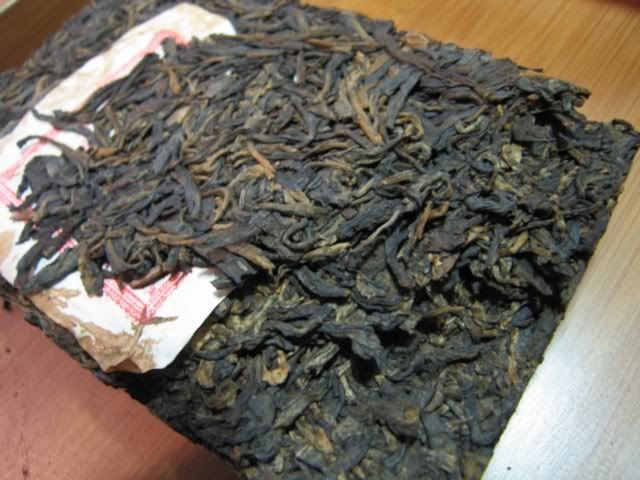
When I bought this brick very early on, right after I got to Beijing, I thought I found something good. Then, tasting it quite a while later, I decided it’s not so good. Something was off about it, although I couldn’t quite pinpoint what. It didn’t taste right. I now regard it as tuition. I never thought there will be another use for it — as a benchmark, of sorts.
I still have some of the sample A left for a side by side comparison — turns out it was 5.5g.
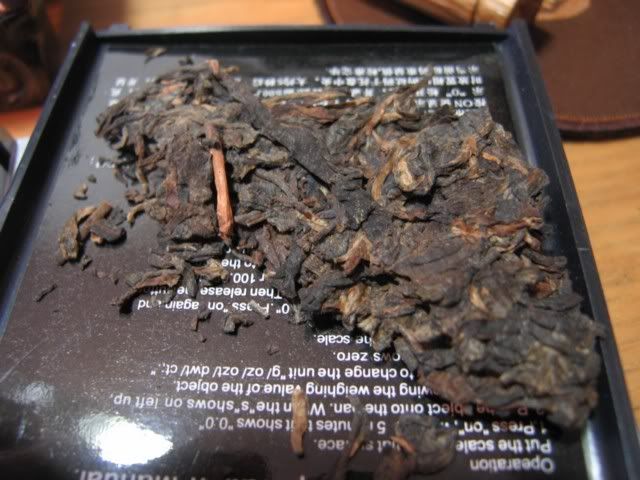
I used 5.5g from my brick too in a two gaiwan tasting.
Well, what happened?

The Keyixing brick is on the left, the Menghai on the right. You can see the colour of the liquor is very different — with the Keyixing considerably darker. So they must taste really different, right?
Wrong… despite the colour differences, the teas tasted remarkably similar. I was surprised when I first took off the lid to smell after I brewed the first infusion… while the Menghai was slightly fruitier in smell, the base of the smell and the overall profile were quite like each other. I drank the two teas…. wow… they are very much alike. The Menghai was indeed lighter, and has a bit of that fruity taste in the tea as well, but the difference really isn’t huge. The Keyixing is a bit deeper, shall we say, or heavier, with a more pronounced bitterness.
Second infusion… both have taken on a slightly sour taste. It’s more like a tartness, but it’s very obvious in both teas. When I tried the Menghai the first time, I thought it was a little sour, and this time, it was no different. What surprised me most was the way the Keyixing developed the sourness in the same infusion as well.
Then the third, the fourth…

The colour of the liquor remained different, with the Keyixing brick being darker throughout, but the tastes actually approached each other as infusions went on. The Keyixing continued its slightly more bitter note, while the Menghai is a little more airy, but one can definitely imagine how the Menghai might turn a little darker in a few years like that. Two things that came to mind when I drank them. One — when I closed my eyes, they felt more like a red tea… maybe a Ceylon, with that little tartness and astringency, but not too much, and that bitterness. It’s not a very refined red tea like Darjeeling or a smooth, sweet one like a Keemun. It was a regular, run of the mill red tea taste. Actually… a bad dianhong might taste like this.
The second thought was that if I served the 6th or 7th infusion of both to somebody who was blindfolded, and who doesn’t know that much about tea… they may very well think they are drinking the exact same tea, or at least, a different infusion of the same tea. The teas were extremely similar, and I really couldn’t find a huge difference between them. From the smell, to the taste profile, to the lack of a real huigan or throat feel (I need a better term than this!)… they were, well…. too similar.
I don’t think my Keyixing is Yiwu, and nobody has ever claimed that it is Yiwu. By extension, I also don’t think the Menghai is a Yiwu. The Menghai is slightly more tasty than the Keyixing, but that is only by a matter of some small margin, not some really obvious difference. In fact, if I were tasting it blind, I’m not entirely confident I can tell them apart.
You can see that the wet leaves show some difference.

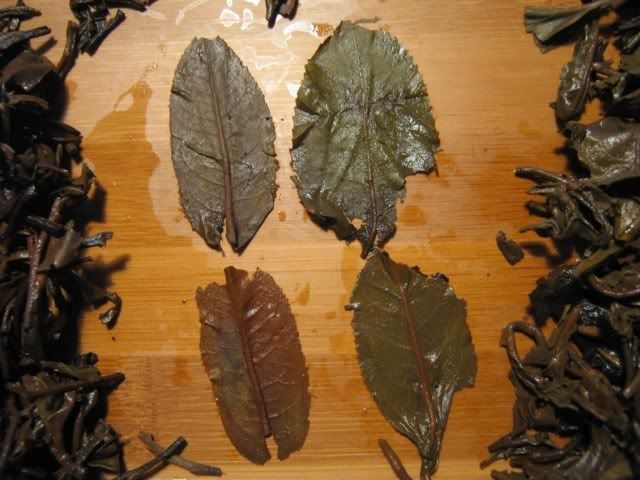
The Menghai cake is a bit harder pressed, but also, the leaves of the Menghai cake seem a bit rougher and stiffer. I tried opening some, and they felt rough and coarse, not the smooth and soft type that the Keyixing is. Some even felt like those “yellow leaves” type of leaf. I’m not sure why.
I hate to say I don’t think very highly of the Menghai cake… and definitely not for the price it was selling at recently. The Keyixing brick was about 1/10 of the price that was recently quoted for the Menghai…. and I won’t even buy THAT now.
→ 4 CommentsCategories: Old Xanga posts · Teas
Tagged: aged puerh
I went out for tea with L just now. He’s flying out of town tomorrow and won’t be back in Beijing for a while, so we decided to catch up over some tea.
While we talked about various things, including his very recent experiences of drinking a number of “Hao level” tea (i.e. stuff that is at least 60 years old), we drank a tea he brought over — a 1990s “Orange Label”. It’s a very strange tea. I think something was wrong with the storage, as it smells very musty, like the old books and documents that I deal with on a daily basis. The tea is reasonable… but personally, I did not like it. It didn’t have much qi, despite the liberal amount of leaves used, and it didn’t have a lot of aftertaste other than a somewhat uncomfortable astringency that is present very early on. The aroma…. is musty old books. L wants to try to sell it, but I don’t think I’d buy it if I were a customer.
Meanwhile, he was telling me some of the news from the market, including how Menghai’s 7542 is now “merely” 13000/jian, and even at that price there are very few takers. He met somebody at the recent Tea Expo in Changsha who bought 400 jian of this stuff at 18000 a piece. You can calculate his losses. New Menghai teas are still not on the market yet, and he said (don’t know if true or not) that Menghai has problems with the quality of the maocha they received and issues with their mixing of formulas, so until that got sorted out… no new teas will show up. Seems to make sense, as it’s been about two months since anything new has come out of that factory.
I guess I’ll find out all this for myself this weekend when I make my customary trip to Maliandao.
→ 1 CommentCategories: Old Xanga posts · Teas
Tagged: aged puerh, young puerh
10 hours train ride and 5 nuclear power plants later, I’m home in Beijing.
One of the first things I did was, of course, to check out my teas. They’re fine… and smells good, unlike last time when I came back when the tea was obviously starved of moisture. This time, the humidity in the cupboard is higher, and I can smell the sweet scent of young puerh. Good… the bowl of water is still there… very low levels, but not entirely dry yet. It means that the tea is done soaking up the moisture and the cupboard’s moisture level is more maintenance than anything else. I don’t know the exact humidity, but I’d guess it’s not too low.
On another note — I am thinking of asking for the reactions to the samples I sent out after the weekend. Most of you have gotten it now, except a few of you with exceptionally lethargic postal service. If you could make time this weekend to try the teas, I’d appreciate it.
→ Leave a CommentCategories: Misc · Old Xanga posts
Tagged: travel
Is there anybody who hasn’t gotten their sample yet? I think most of you have.
Let me know if you’ve had a chance to taste them.
→ 10 CommentsCategories: Misc · Old Xanga posts
Tagged: young puerh
So we covered the puerh stores yesterday. What happens when you walk into a non-puerh store? This covers, basically, green tea shops and oolong shops.
First of all, unlike puerh shops, non-puerh shops do not really display their teas in any meaningful way. What you might expect to find in a non-puerh store is basically rows and rows of bags or tins, all of which may or may not be marked. It is typical, for example, to find a tieguanyin store that has a dozen of those big (3kg?) vacuum bags sitting on the shelf. Are they all the same grade? All different? God only knows. A Wuyi tea store will more likely have boxes that all say Dahongpao, or perhaps tins that name the teas (but not necessarily correspond to the stuff in the tin). A green tea store will have similar setups.
So… you, as the consumer, has basically no idea what a store actually offers. You can, of course, know the general genre of teas they sell by looking, but that’s about it.
Which also means… you are at the mercy of the store keeper.
When you walk in to one of these stores, there’s not a lot of looking around you can do, since there’s not much to look. You basically sit down, and start drinking. What to drink though? Obviously, you have no idea as the customer. You only know they sell tieguanyin, for example…. which begs the dreaded question
“What price range of tea do you want to try?”
This, ladies and gentlemen, is a killer question. You can see the obvious problems in this one, I think. You are basically telling them how much you’re willing to pay. It doesn’t actually mean anything when it comes to what tea they give you. I think these are stores that are more likely to test you to see if you know what you’re doing, and whether or not you’re easy to scam.
So, say, you say “I want to try teas that are 600RMB/jin” where jin is 500g, then… you’re going to get what they show you as the 600 RMB tea. Most likely, it’s going to come out of a bag/box that looks just like any other. For all you know, it’s the 50RMB/jin tea.
This is where taste comes in. While I don’t think of myself as well versed in any of these teas in necessarily the same way as a younger puerh, I do think I know enough to tell between a good and bad one. Building one’s tongue to try these things out is important. Drinking the teas in direct competition with each other, with the same setup (two gaiwans, two cups) and the same amount of leaves/water is also important. Very quickly, one learns to distinguish between a good and a bad tea.
Of course, it’s one thing to know between a good and a bad tea, and it’s another thing to know whether the bad tea is a 500RMB tea or a 50RMB tea. That, unfortunately, takes time.
One usually not buy the first thing they try, not only because of the abovementioned problem, but also because it is a good idea to try out the teas of that shop before committing to buying. Usually it’s good form to at least give two or three a try, more if you’re in the mood.
Since prices are stated early on, it takes one thing out of the equation, although, now comes the bargaining. Almost all of these teas are bargainable. The marked/quoted price is never the real price. You can get it down to at least half, usually, although some stores abide by a no bargaining policy. You gotta figure that out… I find tieguanyin stores to have higher markups, whereas Wuyi stores seem to be closer to their real prices. I suspect that has to do with market demand, and since this is mostly observed in Beijing, and since Beijingers tend to drink more light fired tieguanyins… that might explain the “extra” they put in their prices.
I usually buy small amounts first, and come back for more next time. That’s one thing about these shops though… since none of the teas are labeled, you need to go back to the same store to find the exact same tea.
There are pitfalls to these shops too. I’ve heard stories of how one store actually only has two or three kinds of teas. They put them in different bags, and whichever price you ask for, there’s a corresponding bag… but only with the same two or three teas. If you’re imaginative about it, you can see how that can work….
→ 1 CommentCategories: Information · Old Xanga posts
Tagged: shopping, skills
This is going to be a two part installment, because the modus operandi between a puerh and a non-puerh store work somewhat differently. The standard procedure when I walk into a puerh store goes something like this.
I enter (usually after I spotted something interesting on the shelves — usually a cake). I walk in, beeline for the cake that seems interesting… then the struggle begins. They start asking questions or saying things such as…
“This is puerh tea. Do you like sheng or shu?”
“Are you looking for teas for yourself? Or to sell?”
“Why don’t you come sit down and try something?”
The first priority for me, usually, is not to sit down — once you’re sitting at that tasting seat, it becomes a lot more involved. It’s harder to walk out. It’s also harder to pick the exact tea you want to try, if you haven’t looked at all of them yet. In any given store there are likely to be at least a dozen cakes on offer, and I usually like to look through all of them (or most of them) to get a good idea of what I’m working with.
Most of these teas are likely to be things I’ve never heard of. Some stores make the job easier by having the cakes being easily accessible. Others make it impossible. Some even shrink-wrap them, so you have to ask to see them. Or, they only display the fresh-out-of-factory packaging — so you have to ask them to look at the sample. It’s very annoying when that happens.
Somewhere along the way, the (usually) girl will want to rewrap the cake for you. I usually insist on wrapping it myself, or at least do it quickly. While mine’s not perfect, it’s not too bad, and like I said, it’s one of those things you can do to gain instant respect. Doesn’t work in every place, but it’s worked often enough.
When I first got to Beijing, I think I was much more indecisive and often let the store keep give me cakes to try. Nowadays I have a much better idea of what might make a good tea and what I might like, and am thus much less likely to be driven by them. I also walk out more often before I get to the tasting stage. Since time is limited and the sort of puerh one can try is unlimited (essentially), one must choose.
So… you’ve chosen a cake, you sit down, they brew it… then what?
I usually drink as they brew, but sometimes I direct them a little in how to brew
“Brew it a little longer please”
Because sometimes they don’t really know what they’re doing, or they don’t do it in a way that you might do it yourself…
This is pretty easy going. You make small talk. Sometimes they ask for impressions on the tea, and start the hard-selling. I usually equivocate and say “mmmm” or “it’s ok”. In fact, I probably say “it’s all right” more often than anything else.
If a tea is no good… one can quickly get them to change to something else. Sometimes they will push a tea, and depending on the case, I might agree to taste it, or reject the offer. If nothing else is interesting… after the first tea is exhausted, it’s best to walk out quickly without asking for the price.
If, however, the tea is decent… then comes the second tension point. Price. How much is the tea? There’s a little tension and suspense involved here. Since almost no store label their tea’s prices (and the ones that do label it… it’s best to ignore the label) asking for the price represents another sort of commitment, however slight. Sometimes, one’s pleasantly surprised, as in the case of the Yiwu I bought recently. Sometimes, one’s nastily surprised, as is the case of many, many cakes I have never bought. Sometimes, the price is in an acceptable, but slightly high range.
For prices that are astronomical… I will usually walk out after saying something like “let me walk around a little” or “I’ll think about it”, but always after drinking a few more infusions of the overpriced tea. Walking out right away is rather rude (and they do remember you). It is also a good idea to ask for the name card of the place, as if you’re going to come back. If the price is right, then it’s just a matter of whether or not you want it badly enough, and how much of it to buy. If it’s in the bargaining range… then it’s a battle of wits.
I’m not a great bargainer, although now knowing prices of puerh teas in general helps my bargaining. It’s also a matter of what is acceptable for myself. Getting 15 or 20% off isn’t too difficult, usually, although that can really depend on the initial quote and the tea in question. As I’ve noticed more recently, prices quoted to me have gotten lower over time, which also means less room for bargaining.
Even paying can be a bit of a struggle. Even after you’ve agreed to the price and the amount of tea to buy, it sometimes takes a bit more sitting around, chatting, and maybe even tasting before you go and pay for the tea. I have a feeling that me being Chinese makes things a little more difficult, actually, because I need to observe common courtesy rules. Often, I will make up some excuse, such as “I need to go meet somebody” or “dinner time” to bring up the paying thing. It’s sometimes more awkward when another customer is around, because the shopkeepers might not want them to know how much you paid for the tea. Since pricing is arbitrary, if I have gotten a low price for a cake, they don’t want others to know. It’s best to suggest such things when nobody’s around, or when the other customer is busy with other things.
Maybe I can afford to be ruder now, just because I’m leaving China soon, but these people have amazing memories. For example, one girl from a shop that moved recognized me even though I have not been there for about half a year (and even that time, only briefly). I didn’t know it was the same store and definitely don’t remember her. It’s a small place, and so… keeping one’s reputation is important. Apparently, among some people anyway, I’m known as a picky customer. I guess I don’t mind that so much.
→ 4 CommentsCategories: Information · Old Xanga posts
Tagged: shopping, skills
I went to the tea market today, but didn’t accomplish what I wanted, and basically didn’t drink any tea. So I got home, and decided to drink some cooked samples I got from Teacuppa thanks to their generous offer of tea that Hobbes at the Half-Dipper organized.
Since I only got two of the three samples… I am tasting only two and don’t know which particular tea I’m missing, but the three possible candidates are:
1) 2005 Menghai Factory “Tiandiren” (Shupu)
2) 2005 Luxi Tea Co. Organic 8821 (Shupu)
3) 2005 CNNP (Shupu)
Anyway, so my two samples are from these.
I tried the first one:
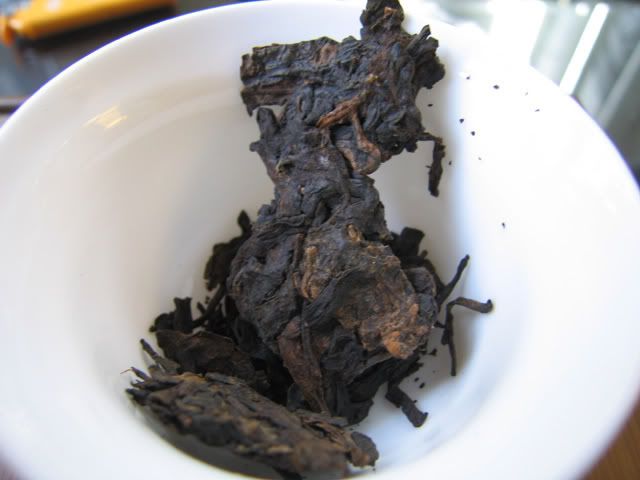
Smells mildly of cooked puerh. Nothing too exciting. When I rinsed it and smelled the lid… it smells, oddly enough, like a young raw puerh aged 3-4 years. I think it’s because it’s been stored with a lot of that kind of tea? When I tasted the first infusion… the overall impression was that it was fairly weak and bland. Ok, maybe I didn’t brew it strong enough. I let the second infusion go longer… still thin, a little stronger in taste, but doesn’t taste quite like a cooked puerh. A bit sour…. not too exciting, and a little off-putting. Third infusion… really, really sour now. This is no good. I gave up on the tea. If a tea doesn’t show anything good to me in three infusions (and in fact, got worse because it was really quite sour) then it’s not a tea I really want to drink, and given how weak it is, I don’t think it was going to improve.
Overall impression: weak, thin, not really like a cooked, more like a screwed up raw puerh or just something very odd. Didn’t like it at all…
The leaves don’t even look quite right
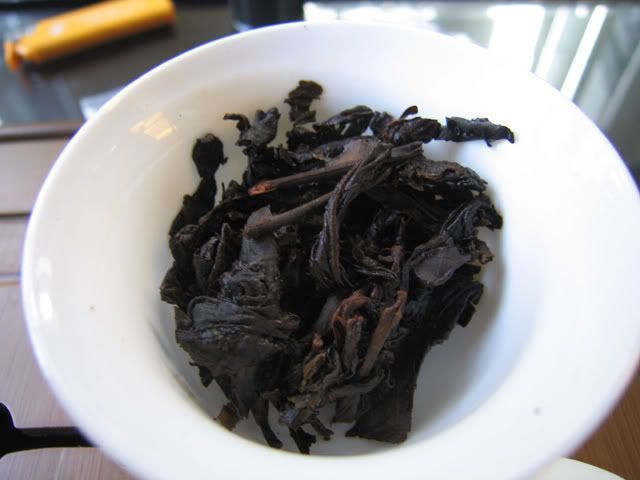
Something wasn’t quite right about this. I was telling vl that I can make a better cooked puerh than this.
Utterly unsatisfied, I went on to the next sample.
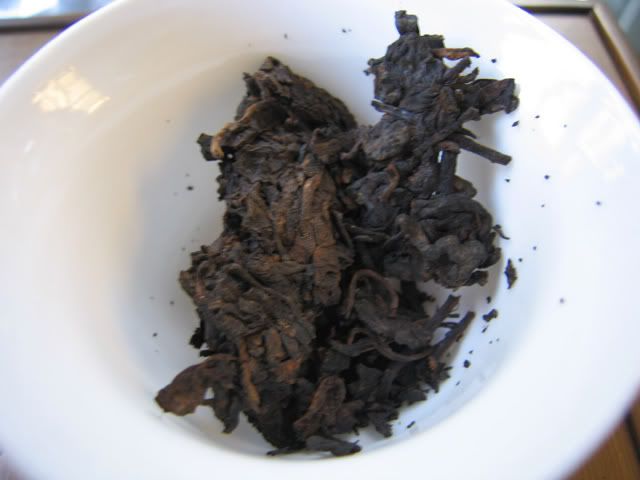
Looks more like a normal cooked to me, actually. The last one was a little black.
The tea tastes a little more like a normal cooked puerh. It’s lost that nasty pondy smell, but just has the regular cooked pu taste. A little too bitter for a cooked puerh, in my opinion, but it’s thick, at least. An average cooked tea…
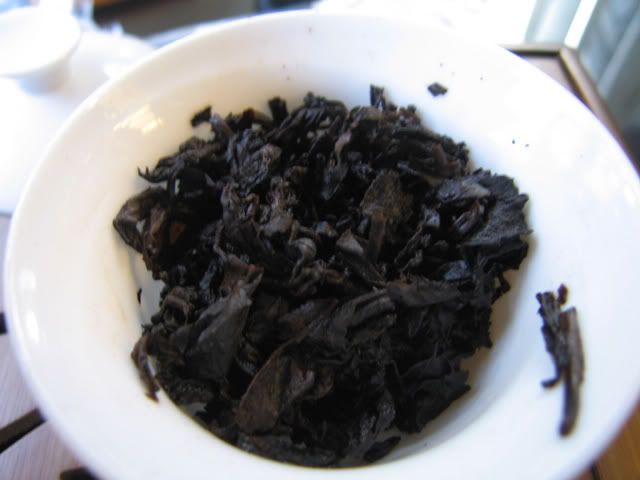
Since the colour of the actual tea is basically some variation of soy sauce… not a lot of reason to post the colour of the tea itself.
All in all… one tea that is really not good, and one that is so so. I have a suspicion that the bad one is the CNNP, and the so so one… the Tiandiren, perhaps?
→ 2 CommentsCategories: Old Xanga posts · Teas
Tagged: cooked puerh


Interesting.... would 250C in my oven work?

Hi! I've had the similar issue with one of the older pots I have - that nusty sticky stuff made…

May I ask why Jingmai has 'completely fallen out of favor'? I have just started watching videos from FarmerLeaf and…

I agree with Jakub about Brita-filtered tap water, I´ve tried many bottled variants and none was as good as my…
 RSS - Posts
I took you at your suggestion and have been reading some of your old post-Covid posts. I haven’t been to…