A Tea Addict's Journal

Hmmm, mould

November 23, 2007 · 5 Comments

I was examining the few cakes I have here that I keep as “taster” cakes, and noticed something funny — one of them, namely the Fuxing Zhangjiawan, has a little bit of mould on it.

It’s been pretty rainy here the past few weeks and I have paid very little attention to these cakes. In fact, I haven’t really bothered with them for a while now, and have just left them alone. I looked at all the cakes I have in the same area, in my living room (the non-taster stuff are kept up in a little loft). It seems like the Zhangjiawan is the only one with any noticeable mould. I think this makes sense. The Zhangjiawan was covered by the other cakes, and sat at the bottom of the pile. I suppose what happened is that any moisture accumulated in it was not easily dissipated, and so whereas the other cakes dried out a little when the weather turned drier, the Zhangjiawan never did. None of the other cakes had a problem, and the ones up in the loft do seem a little drier — I suppose moisture is heavy.

The other thing is that the mould is growing in one paritcular type of place on the cake — at the end of the stems. They’re not all over, nor are they on the leaves. They are at the end of the stems where the leaf was plucked. Could it be that the stems retain moisture the best, and therefore makes the best place for mould to grow?

YP told me that she noticed that aged oolongs are often very sour when it was never de-stemmed. She thinks the stems do retain moisture better and thus turn the tea sour faster. Perhaps the same effect is seen here?

Either way, this is pretty interesting. I am almost tempted to let the mould grow uncontrolled and see how the cake fares in a month’s time. But then…. maybe I should let it dry out a bit. I only have one cake of this with me now, and I’d rather try it as it ages slowly.

I think I made the right decision to store my tea in Hong Kong on shelves that are near the ceiling rather than near the ground.

→ 5 CommentsCategories: Old Xanga posts
Tagged: ,

Blend vs single mountain

November 22, 2007 · 8 Comments

The blend vs single mountain debate is an ongoing one in the puerh market. There are a number of different arguments over this, but basically it boils down to “which one is better?”. The single mountain teas are generally produced by smaller factories. Sometimes it’s even by individuals. They often cannot afford the time nor have the resources to haul large amounts of tea with them from mountain to mountain, so instead they buy maocha at each place and then press them into cakes, making single mountain cakes as they go to each different place and collect tea. Blended ones, on the other hand, are more likely to be made by larger factories that have the ability to collect teas from far and wide and then carry them back to their factory to be mixed and then pressed. It requires more resources to do and thus are difficult for small producers to pull off, unless you are somebody like Chen Zhi Tong who spends a lot of time in Yunnan and who ultimately has the help of some big factory.

We have precious little experience of single mountain cakes aging — everything produced pre-1990s was blended. Expert opinion on the antique cakes (pre- Red Label) are divided, but generally speaking many agree that those are also blended — with different mountain teas, and not from a single region. So… there is a theory that single mountain cakes are no more than a gimmick for smaller producers to sell their tea. Just because a tea is from a single region has nothing to do with its quality being high or low, but somehow it is sometimes taken as such in marketing information or in consumer response.

Think about this: I think most whisky drinker will agree that a Johnny Walker Blue Label (blended) is going to be better than a poor single malt. It is not the most distinctive, but I think it does what it does very well — a smooth, enjoyable, and generally well regarded drink. There will be the malt-snobs who think any blended whisky is crap and refuse to drink such things, but that is more likely to be a status thing than anything else.

At the end of the day, very few of us (myself included) can say with any certainty whether or not something is blended. There are many who sell cakes that claim single-region status, and then consequently justify its existence by saying that single-region is better and pure and all that. There are also those who espouse the greatness of blends, how they are rounder, have less flaws, etc. If whisky is a guide, then what it really will be is simply that single-region teas are more likely to give you all the characteristics of that region, flaws and all. Blends will be smoother, easier to drink, and (at least to novices) tastier, but perhaps less interesting or less engaging for the devoted. Still, a blend made with top notch tea will always be better than a poor single region, and vice versa. There simply isn’t a quality correlation there.

And since whiskies are blended after they’re aged… what’s stopping us from blending teas after they’ve aged as well? Somebody told me he puts in a bit of very young puerh when he brews his wet stored stuff. It gives the tea more liveliness and makes the drink more interesting. I can certainly see how that’s the case, and there’s really nothing stopping us from doing so. Drink what you like, not what gives go status.

→ 8 CommentsCategories: Old Xanga posts
Tagged: ,

Aaron sample 4

November 21, 2007 · Leave a Comment

I tried Aaron’s sample 4 today

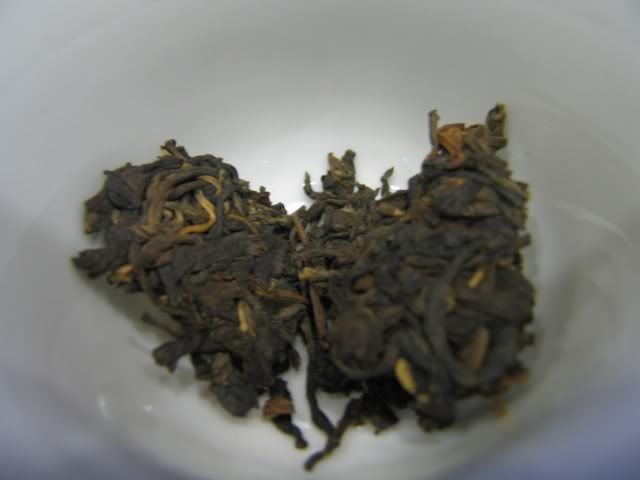
Small leaves from the dry bits I got. Nothing too interesting looking. Looks a little like a big factory recipe cake…

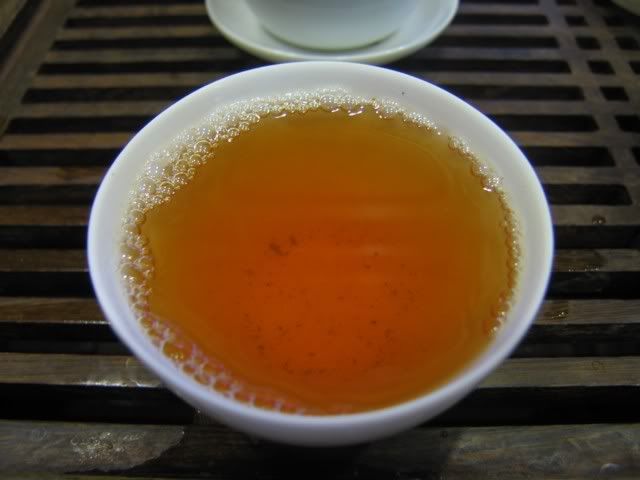
It’s reasonably dark in liquor, but that might be because I brewed it long. There’s a really weird note in the tea that I don’t know how to describe — other than just some massively “off” flavour in my sample. Plastic bag? Something else? Something wasn’t quite right, and it was definitely not a pleasant thing. It went away after a few infusions, but it was sufficiently strong to cloud my judgment. The tea is a bit harsh and somehow quite green. It feels like plantation tea and it doesn’t seem to be from 2001, or at least doesn’t taste like one — tastes a lot younger.

Strength of the tea is actually not too bad and it has a decent lingering aftertaste, but I just couldn’t say it’s a good tea based on the seriously off flavour and the greenness…. it’s also fairly bitter at this point.

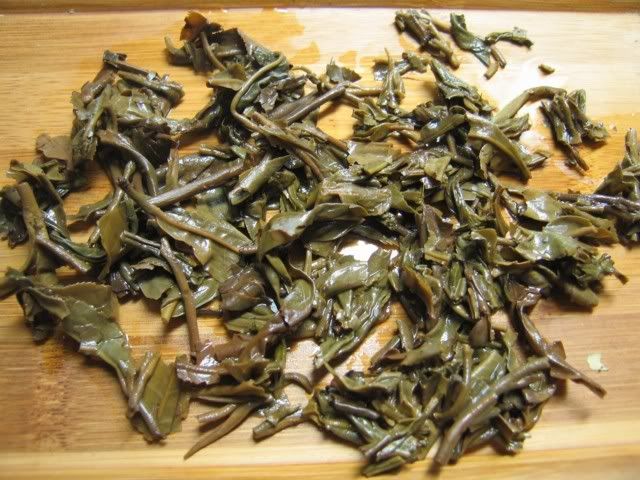
The wet leaves are also quite green

Strange tea…

→ Leave a CommentCategories: Old Xanga posts
Tagged:

The reality of tea…

November 20, 2007 · 6 Comments

Even though at times it does sound a bit like Taiwan has lots of good tea, good tea culture, etc etc…. the reality is that most people still don’t give much of a damn about tea here.

Today I went to a place called Cafe Lumiere, a little shop in a lovely old building that houses a theatre and is named after a famous Taiwanese movie. It’s your typical Western style coffeeshop kind of thing… cakes, etc. They served tea, mostly of the Earl Grey variety. What passed for tea was basically big teapots with round teabags — Republic of Tea, perhaps? The thing I had was a “Yorkshire tea”, which tasted like a weak version of English Breakfast. However, it had the typical problem of “drinking the last guy’s tea”. What I mean is… the teapots they used weren’t cleaned sufficiently thoroughly so that all the herbal teas that have been made in it has left a mark. So I ended up drinking Butterscotch Hibiscus Vanilla Cherry Black Chamomile…. a potpurri of flavours and smells that have been left behind by many a drinkers before me. At one point the lid of the pot smelled like detergent. Yum….

For dinner we went to Ding Tai Fung, a famous restaurant in Taiwan (best know for their xiaolongbaos). The generic tea they served was a really watered down stale green jasmine. Mind you, that’s just for the purpose of washing down your food as quickly as possible so that you will move out of the place for the next person (the waitresses had femmebot like efficiency) but you’d think watered down, low grade oolong is at least achievable instead of nasty stale green jasmine….

Tea is still very much just a beverage to be consumed in the course of the day while doing other things. Even here, where tea culture is perhaps more alive than any other place in Greater China, most people are quite happy with just a cup made simply, or even badly. Sometimes I think it is easy to forget that when reading about the latest thing, the strangest preparation methods, or arguments over the tiniest details.

→ 6 CommentsCategories: Old Xanga posts
Tagged:

Maokong trip

November 18, 2007 · 4 Comments

I went to Maokong today. Maokong is a hill near Taipei. I went there two years ago when I last visited, and I remember you had to switch from subway to a minibus to go up the hill. Between then and now though, they built the new Maokong Gondola. So now, instead of having to ride the very bumpy bus ride up to Maokong from Muzha station, you can just ride the cable car up to the mountain in 20 minutes. Very nice.

There are definitely more people there now, although today was rainy so the crowds probably aren’t nearly as bad as, say, a sunny day. There are lots of farms up there that a visitor can go see and brew tea at. It’s almost impossible to choose which one.

My girlfriend and I went to this Wutie place that I first heard about through RFTD a while ago. The place….. does microwaved tea. Sounds crazy? Yeah…

We ended up just having “Wutie” oolong. This is an Alishan oolong that they somehow concoted with a high fermentation and high roasting. The result is…. interesting. There is a sort of strange fruitiness to the tea beyond the usual roasted Taiwan oolong taste. I don’t know how to describe it other than the aroma of the roasted tea hits the nose very strongly. My grilfriend said bark dust/woody, I said old tangerine peels…. I’m not sure what it is, but whatever it is, it’s a very interesting aroma.

This is the setup they provided. It’s quite decent.

I didn’t get to try the microwaved teas, but I did see them

They’re big balls (1kg or more) of oolongs that were somehow rolled together and then somehow microwaved and then somehow kept in this shape. Very, very hard. I don’t know how they put it together, or how they peel it apart, or how it doesn’t rot. The “master” wasn’t there today, so I couldn’t ask. I wonder if it’s worth going back to figure it out.

But it’s a good place to drink some tea and just relax. We certainly had a great time.

→ 4 CommentsCategories: Old Xanga posts
Tagged: ,

Using teapots

November 17, 2007 · 5 Comments

I drank the Yetang aged dongding oolong today again, but using my new teapot I acquired a few weeks ago rather than a gaiwan. Even though I used less leaves, I think the result has been very good. What, though, is it that makes teapots work better? Temperature? The clay? I’m not totally convinced the clay is what does it entirely. I suppose the fact that a pot keeps higher temperature than a gaiwan might be part of the reason, but is that it? Or is it placebo?

I have friends who swear by pots and will never use gaiwan unless they have to for one reason or another. Then there are some (albeit a minority) who generally only use a gaiwan.

Over time I’ve migrated more and more tea over to pots… but it’s not always possible to do so, and when I evaluate a tea I’d prefer using a gaiwan sometimes, although even that’s changing these days. I can just see myself end up with a few dozen pots… oh, the horrors

→ 5 CommentsCategories: Objects · Old Xanga posts
Tagged: , ,

A busy tea day

November 16, 2007 · 5 Comments

Today was a busy day (yesterday internet died again). I first went out to get some tea for Action Jackson, who has a tea mule waiting for me to bring back stuff from Taiwan. I was on my way to get her some aged baozhongs, when, along the street, I saw a sign saying “Antique and Famous Masters Teapots, 6th Floor!” with some truly dubious looking pots in poorly taken photos next to the sign. Hmmm

What the heck, I had time, I thought, so I went upstairs to the 6th floor. It looked a little creepy. I thought about leaving. Then I saw the teapot sign…. the door was open, so I figured it’s not a bad idea to peek. Taiwan has a lot of scams going on, so I was a little worried about getting sucked into one. Inside that little office were a few shelves full of pots, and an older guy just walking around. I entered, and he greeted me and started talking pots.

This place was pretty interesting. There were, by my estimate, about 200 pots of various shapes and sizes on the shelves in that place. Every one of them had a little sign in front of it, listing the approximate age, the seal (or signature) and whatever else info there is. Most looked like credible zhuni pots. Many looked old, some very much so. They’re clean, well kept, and obviously in good hands. The only question is…. are they real?

The man claims he’s been collecting pots for about 20+ years. Makes sense. The 80s was when Taiwanese went nuts collecting yixing pots. What happened to puerh in the past few years happened to yixing pots in the 80s. Then, of course, the market went bust and prices of many of the older pots dropped dramatically. Tea probably won’t suffer as bad a fate, since it’s perishable and will continue to be consumed, whereas pots aren’t. Nevertheless… it is entirely possible that somebody’s sitting on a big stash of older pots.

The craft of many of these pots obviously look good. Some are very good, and have intricate details and fantastic calligraphy. Some have very rough finishes, especially on the inside, which I learned from another source is quite typical of older pots — it was not usual for them to make picture perfect finishes inside back in the day; it just wasn’t done. So you had a lot of what one might consider a rough finish now on the inside (outside all look good). I didn’t bother inquiring about prices, but some had prices on those labels and they ranged from what seems like a hundred or two all the way up to a few thousand. Age of pots range from the Qing dynasty (1644-1911) to 1970s.

I didn’t have much time there, only spent about an hour chatting with the owner, and looking through an incredible array of pots. The guy obviously wants to talk, and isn’t particularly pushy or anything. He clearly loves his stuff… and kept showing me pot after pot. Unfortunately I ran out of time and had to go (I still had to buy the tea and then rendevous with the tea mule). I will most likely go back to this place though.

The buying of the tea was itself fairly uneventful. I did drink some 20 years old cooked puerh mixed with osmanthus. That was interesting.

After dropping off the goods with the tea mule, I had to meet with two people — and we chose Wisteria as our meeting place. I haven’t gone there since I arrived in Taiwan, and figured it’s time to go. Their original location is under renovation. This is a branch of sorts.

Wisteria is mostly a place for you to drink tea (unless you want to buy stuff there). The way it works is this: you go in, you sit down, and you look at the tea menu (there are a few snacks, but no real food). Everybody has to order something… or at least, everybody has to order one serving of tea or its equivilent. So, for the three of us, we had to get three servings of something. I leafed through the menu. For a Taiwan oolong, say, one serving would cost 350NT. So for three of us getting something of that calibre… that’s 1050 NT or thereabouts.

Then I flipped to the back where the good stuff (Tongqing, Red Label, etc) are… for three-four people, a serving of a 30s Sun Yi Shun is…. 1980 NT.

Is this a no-brainer or what?

I suggested we go with the SYS. The other rationale is that it was near dinner time… and drinking something as green as a gaoshan oolong right before dinner is potentially suicidal.

The tea is as I remember a SYS to be…. nice, medicinal, mellow, had a soft kind of qi, easy on the body…. very durable. Nice tea, even if not mind blowing. People in Hong Kong told me to try to find them in Taiwan, as they think it might still be reasonably priced there for what they are. Either way though…. good tea needs good company. It always makes a tea more enjoyable 🙂

→ 5 CommentsCategories: Objects · Old Xanga posts
Tagged: , , ,

Aaron sample 3

November 14, 2007 · Leave a Comment

Third in the series

I have more of this sample than the other two, but I thought I should use approximately the same amount anyway for consistency sake. The dry leaves smell a little familiar. It’s not too tightly compressed. Looks dry stored, more or less

The tea is a bit more intereating than the last two, I think. When I first drank it I thought it tasted somewhat familiar — I’ve had something like this before. I couldn’t, however, come up with what it was that it tasted like. I just know that I’ve had something similar.

It’s decent enough, somewhat aromatic, hits the throat a little, although a bit rough on the tongue. The leaves smelled ok, if a little “green”. No real faults, but neither is it a real standout. The durability of the tea is good though — it withstood quite a few infusions.

Then I sniffed the pot where I put the wash… smells a little like some Lincang tea I’ve had. I wonder if that’s what this is.

The wet leaves are sort of whole — mostly smaller leaves and buds.

→ Leave a CommentCategories: Old Xanga posts
Tagged:

How do you learn about tea?

November 13, 2007 · 3 Comments

I was in a cab today and the cabbie started chatting. It got on the topic of tea, because I was picking some up for somebody. He then asked, “how do you learn what’s a good tea and what’s not?”

It was a tough question. How did I learn about tea?

I did take one introductory course (5 lessons) way back when. That was when I didn’t know white tea from green. It was useful, and I think something like that is good for everybody who wants to learn more about tea and get the basics down. Just make sure the place offering such lessons isn’t providing misleading information that basically means only their tea is good — this is actually quite common among “lessons” that are taught from teahouses.

But beyond that… it was just drinking, drinking, drinking, and talking about tea with other people. I find books to be generally useful, but specifically useless — none of those words translate into anything physical. They’re good for general information, but not at all when it comes to tasting and judging tea. With tea, somebody (myself included) talking about it doesn’t even come close to the experience of drinking and feeling the tea. What is huigan, anyway, if you have no idea what it is and have only read about it? What’s the difference between a “rough” and a “smooth” tea? What’s a “wetstore taste”? Mustiness? But dry stored tea can still be a bit musty. What’s that Taiwanese finish that I sometimes talk about? And let’s not even get started with flavours. I have no idea how a “plum” taste is different than an “apricot” one, and I definitely don’t know the difference between male and female urine, but since somebody has used “male urine” as a description for a tea before on a certain blog, I suppose they must have their unique flavour profiles. Not that I want to find out.

I ended up answering “just drink a lot” to the cabbie’s question. He was obviously dissatisfied with the answer, and kept asking. I don’t know what he was trying to fish for, and it was actually getting slightly creepy. Thankfully, the ride was short and I arrived at my destination. Whew.

→ 3 CommentsCategories: Old Xanga posts
Tagged:

Water’s too good for the tea

November 12, 2007 · 2 Comments

Water can sometimes be too good for a tea.  Today was such a case — went to the Best Tea House to see Tiffany and drop off stuff, and had one of the baozhongs I brought there… wow, the tea tasted awful.  Flat, thin, not aromatic, slightly rough — what happened?

It’s that super water filter they use!

I think the water’s so free of minerals, it tastes bad.  I’ve found this to be the case with a few other teas I’ve brought over too — flat, boring, thin.  You compensate by putting in more leaves, but I always forget that when I go there and make tea.  So…. the tea ends up tasting like crap.

So yes… sometimes water can be too good for a tea.  I’m not even sure if there’s ever such a need for such a good water filter in a place where the water system is quite well developed.  Beijing, maybe… but Hong Kong’s water isn’t that bad.  Its only fault is that it smells a bit like chlorine sometimes….

→ 2 CommentsCategories: Old Xanga posts
Tagged: ,