A Tea Addict's Journal

Reading old texts II

February 7, 2008 · 15 Comments

I was flipping through the collection of old tea texts again, and something caught my eye. This is stuff that I saw a few times today with some Ming dynasty (1368-1644) texts. It has to do with water.

Remember those lessons you’ve learned, on or offline, that you should use water that is at “shrimp eye” or “crab eye” meaning that the water hasn’t reached a full rolling boil yet because once you do, the water is “old” and isn’t good for tea anymore?

Well, it seems like people who wrote about tea in the Ming dynasty didn’t agree. In fact, they say that the only water that should be used for tea is stuff that reached a full boil. You shouldn’t brew tea using water that is anything less than a full boil, they say, because in those cases the water would still retain a “water qi” that interferes with the tea. If you boil it out with a rolling boil, then the water becomes fully cooked, and is suitable for making tea.

So who’s right? After all, Lu Yu, of all people, said water should not reach a full boil!

Well, one of the authors explained that there’s a reason for this discrepency. It has to do with, you guessed it, the way tea was brewed. Whereas in the Tang and the Song, tea was ground down and powdered, etc, and sometimes with added incense or other things to enhance the flavour of the tea, water that has reached a full boil will mess with the powdered tea’s texture and taste. That’s why it’s no good. Whereas with the switch to full-leaf tea in the early Ming dynasty, the whole bit about water not reaching a full boil no longer applies. If you leave it underboiled, what you end up is a mixture of water and tea that isn’t quite harmonious. Full boil, with a fire that is “open” (in this case meaning a live fire with charcoal, not a bunch of flameless charcoal that is just very hot) is the way to go. Anything less is not good.

Interesting food for thought. It is important to keep in mind that most of these later tea texts are generally ignored by current day “tea masters” who tend to go back to the few famous ones, such as Lu Yu’s Tea Classic, the Daguan Chalun that I talked about last time, and a few others that tend to be more often quoted. However, the fact that there was this change in these rather short and relatively unknown treatises on tea means that there are other theories out there, and given that three or four different texts I read today all say the same thing about water needing a full boil means that this idea probably had wide currency among Ming tea drinkers — even if they were copying each other, the only reason they’ll commit it to paper is if they thought it was right.

Another thing to keep in mind — the teas they were drinking were green teas, maybe slightly roasted, but largely speaking, what we now call green teas. Full boil water anyway. Yup.

→ 15 CommentsCategories: Old Xanga posts
Tagged: , ,

How fast do you drink your tea?

February 5, 2008 · 4 Comments

I brewed up the tieguanyin that Toki sent me a while back again. It’s a nice tea, a bit roasty, but soft and mellow and not really bitter at all. These days, I’m using mostly my black teapot, but today I pulled out my old (and small) tieguanyin pot. It’s a smaller pot that really only pours out one cup, and it works fairly well for teas like this

It’s a joy to see pots season over time and gaining a sheen that it didn’t use to have.

But something came to mind today while I was making this tea — how fast do you drink your tea?

The reason I ask is because there’s always this constant concern with brewing parameters, specifically how long each infusion lasts. I think readers of my blog probably know that I generally don’t pay a lot of attention to exactly how long I use for each infusion, and instead I just brew as they come. Yet….. how long you take to drink your tea matters. Why? Because while you’re drinking your cup, the tea is still brewing, sort of. The leaves are wet, and they are stewing in that little bit of water that you have left in the pot/gaiwan. Today, for example, in between a few infusions I took a little longer because I was a little occupied with other things… and the infusions after those are inevitably a little sour with a little more tartness.

So what does this mean? If you’re really serious about keeping time, then you ought to keep time you spend drinking your cups (i.e. time between infusions) as well. Otherwise… my parameters of 5, 5, 5, 10, 10, 15 might work for me because I am only brewing one small cup and drinking them, but not for you because you take longer to drink your two cups… something like that.

Which is again why I think it’s better if you just experiment with various times and figure out what works for your style and what doesn’t

→ 4 CommentsCategories: Old Xanga posts
Tagged: ,

Manzhuan laoshu 2004

February 5, 2008 · 3 Comments

I spent a year and half in China and Taiwan, and during that time, it seems like many online shops have opened that sell all sorts of tea, most of which were not even in existence when I left for Beijing. Being there, I obviously had no reason to buy anything from any of these shops. Now that I’m back, I thought I can give things a try.

The first one I decided to try my luck at is Puerh Shop, which, as I just noticed, has a sales going on right now (I wonder if I can get a retroactive discount?).

They shipped the tea very quickly, and within a few days it landed here, since they’re only one state over in Indiana… the tea I bought to try is a 2004 “Manzhuan Old Tree”. I bought the last one, so don’t bother looking for it 🙂 The reason I thought I should give that one a try is because I’ve found myself liking Manzhuan tea given past experiences. There’s also a bit of calculation at play here — Manzhuan, at least a few years ago, is something that you don’t really advertise. Unlike Yiwu, which is everywhere (and most of those are not really Yiwu), the likelihood of somebody falsely advertising a Manzhuan cake was much, much lower. So, given that this is a few years old, I thought my chances were pretty good at getting the real deal.

The cake looks unremarkable

And it smells and feel a little dry. I wonder what kind of storage these folks have. I used mostly the shavings from the cake that are already loose in the wrapper, plus some leaves that I pried off.

The tea brewed a darkish liquor

It’s quite thick and strong. There’s a hint of sourness in there somewhere, but it’s in the back end, reminding me of a bit of the Manzhuan fruity taste that I have experienced a few times. There’s definitely strength in this tea — I can feel it strongly in my mouth and body. The taste is not the most enjoyable, but it reminds me of the feeling I used to have (and don’t have as often these days) of puerh that feels very raw and strong when young. These days, a lot of the younger cakes taste more like a mixture of green tea and oolong, without that punch that I used to associate with young puerh. This tea had that, but not in a nasty Xiaguan way. I actually liked it… and rate it above yesterday’s tea, even though yesterday’s was surely more refined. I’m not even sure if yesterday’s tea was any better than this in terms of raw quality — there was something too refined about yesterday’s tea. I didn’t feel that coating of my mouth that I do today.

Of course, this might have to do with the fact that I used more shavings and thus stuff came out faster as I brewed, but it easily lasted 10+ infusions without significant drop off. If anything, it lasted longer than the tea yesterday…. probably not a good sign for the Xizihao.

As you can expect, the leaves look broken

Not a very pretty tea at all, but one that I think can keep well over some years. I’ll probably pull it out again in a year or two and check on its progress.

→ 3 CommentsCategories: Old Xanga posts
Tagged:

Return to Innocence

February 3, 2008 · 4 Comments

Today’s tea is the last of the three samples of Xizihao that I acquired, the Puzhen Yuancha. Puzhen is actually a reference to the Chinese idiom, “Fan Pu Gui Zhen”, which means “return to innocence”. According to Hou De, this tea and the Daxueshan “Diangu Yuancha” are the two limited productions for this season, with, of course, a price tag to match. I haven’t had a chance to try the Daxueshan, and since the thing sold out in a flash when it came on the market, I didn’t see a reason why I should. I do, however, admire those with the courage to buy teas they’ve never tried before.

Looking at the poster from Xizihao, it seems like there were only 999 cakes of this tea produced, and so it’s even more limited in quantity than the Daxueshan cake. Hmmm

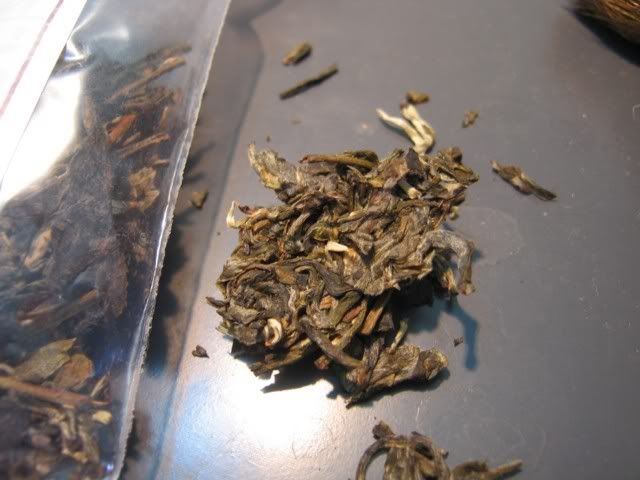
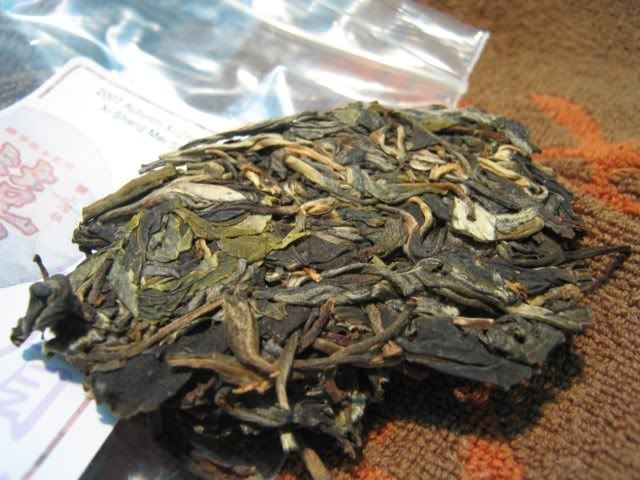
The dry leaves don’t look too remarkably different from the other teas, at least given the bits and pieces that a sample necessarily entail

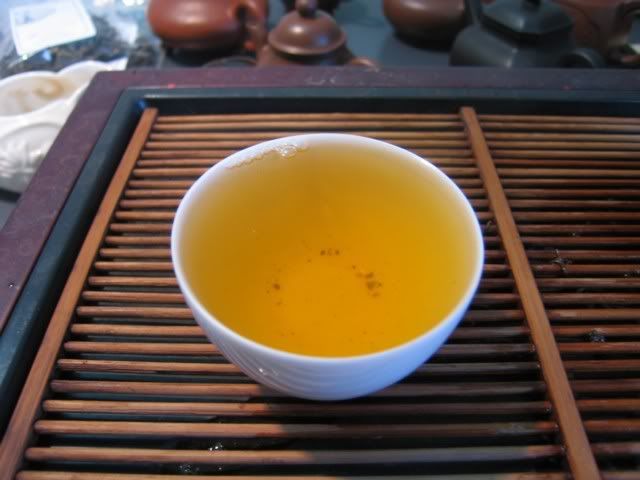
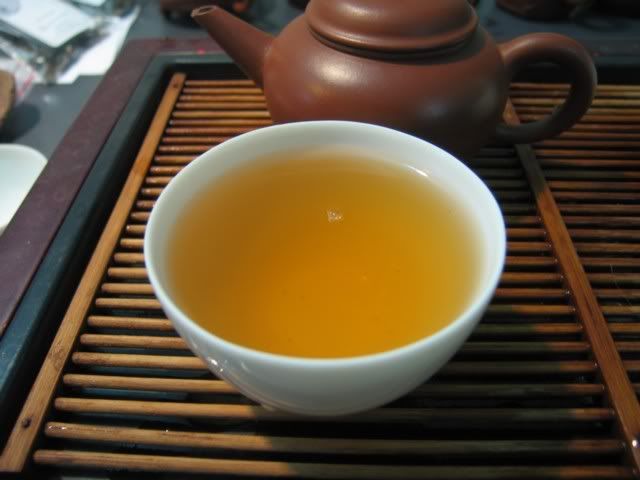
The liquor also don’t look drastically different

How does it taste? Compared with the Xishangmeishao, it has better strength, more pleasant, less of the weirdness, thicker, and just overall a better tea. It does, however, remind me of some of the Mengku stuff from a few years ago, tasting like they did when they were very young. Back then, of course, those cakes were quite cheap.

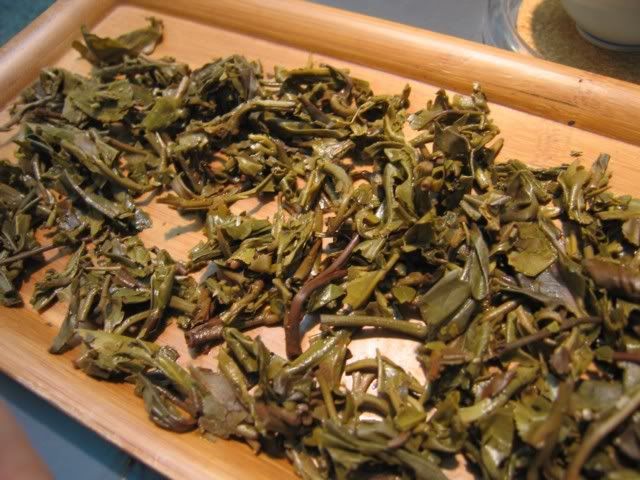
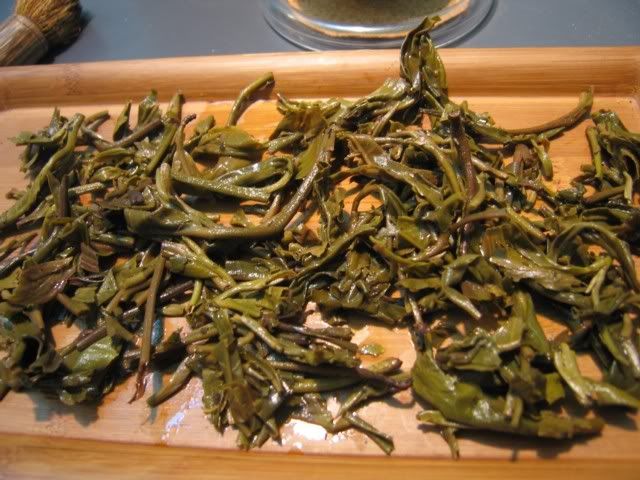
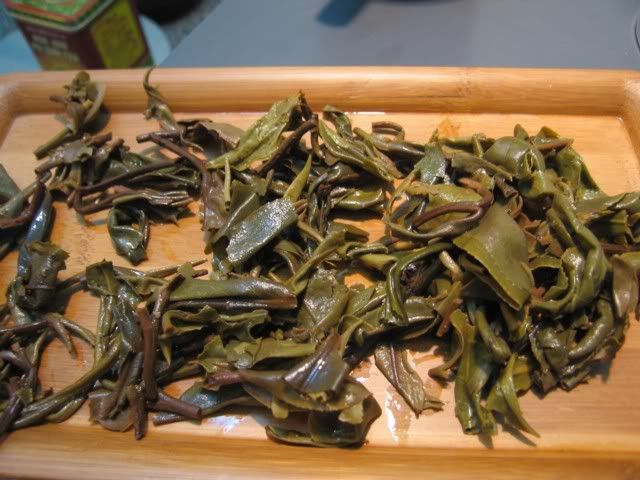
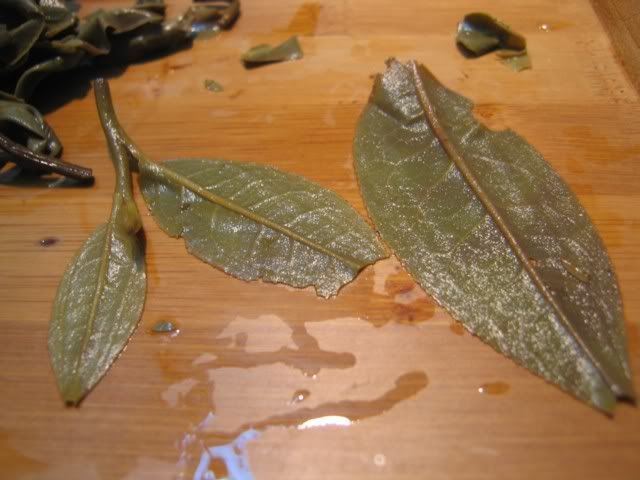
The wet leaves also don’t look quite so mangled

If the Xishangmeishao was a 5 out of 10, then this is probably a 7.5 or maybe an 8, depending on my mood. It’s quite a bit of an improvement over the Xishangmeishao (the nu’ercha is quite different and I won’t really compare them). These days, it seems like one needs to pay big bucks for what is really just ok quality. I’d definitely pay the few dollars extra if I have to get one of these, but I really don’t know if either of them are that interesting. As I think I’ve said quite a few times already, I haven’t really found anything from 2007 terribly exciting, and this is, unfortunately, no exception. A return to innocence this definitely is not — if it were, it would be back to the prices that such cakes charged 2 or 3 years ago. Alas…

→ 4 CommentsCategories: Old Xanga posts
Tagged:

The value of a cheap tea

February 2, 2008 · Leave a Comment

From time to time I drink something that is truly pedestrian, or even sub-pedestrian. It sets you straight.

Today is one such day, with a loose, wet stored raw puerh in my pot. It’s still got some bitterness in it, despite its storage condition. The thing was quite cheap when I bought it in Hong Kong, and to me, the incremental benefit of drinking good 10 years old raw from a cake, which will cost many times the price of this tea, does not make the compressed stuff worthwhile. It’s the market forces at play here — whereas compressed tea have a clear provenance and history to go by, loose stuff that have no packaging of any kind simply cannot command high prices in a place like Hong Kong, where this sort of tea is everywhere.

Yet, when you take such things to, say, parts of China where they don’t have much old tea to begin with, all of a sudden the value of it shoots up. Instead of just “random wet stored loose tea” it suddenly becomes “preciously stored aged sheng puerh” with a price tag to match.

Then you have the polar opposite…. I remember bringing some old puerh to a shop in Beijing, only to have it mistaken as cooked puerh, because, well, they’ve never had anything older than maybe 10 years that’s not stored in the bone-dry weather of Beijing. They thought my tea was fake.

Which once again goes to prove that one should only “drink what you like, like what you drink”, and not worry too much about price, hype, or any of those things.

→ Leave a CommentCategories: Old Xanga posts
Tagged: , ,

Republic of Tea

February 2, 2008 · Leave a Comment

I was out and about today, and on my way home, got a teabag just so I have something warm to drink while driving. The place where I went uses, like many others, Republic of Tea teabags. It brought on a bit of nostalgia. I still remember the first time I encountered RoT way back when I first got to college. My school’s bookstore sold RoT teas, and at that point, I was still a not-very-discerning drinker who mostly drank longjing and some occasional jasmine pearls. The first teapot I bought for myself is actually one of those English style RoT pots.

Over the years though, it seems like they have somewhat faded from view. They’re definitely still there, but many other companies have sprung up in the meantime, and RoT seems to not have really kept pace. Most of their new offerings, as far as I can tell anyway, are heavily flavoured stuff, or tisanes, or the extremely overpriced Chinese tea series.

I suppose it’s a good thing that so many other offerings are now available. Yet, in some ways, it’s nice when a decent cup of Earl Grey was enough to make me happy.

→ Leave a CommentCategories: Old Xanga posts
Tagged: ,

Reading old texts

February 1, 2008 · 5 Comments

I was reading, among other things, an old tea text by the Song Emperor Huizong called the Daguan Chalun (The Treatise on Tea in the Daguan Reign). That dates the text to 1107-1110. In it, he talks about making tea, processing tea, and brewing tea. Tea, of course, was not what we now know as tea. Back then, they were steamed, then pressed (to get juices out of the leaves…), roasted, and then eventually grounded and mixed with water to drink. Yet, it’s all very strange sounding. I was reading the text, and was having trouble figuring out exactly how the whole brewing process took place. It seems like you do have multiple infusions of the same tea, or, at least, add water multiple times during the process of brewing tea. I’m not exactly sure if before each additional water injection you drink the stuff you just made, or if you just keep making it until all the water’s added and drink in one go. That must be obvious to him, but not to me. Maybe I didn’t read the text carefully enough, I don’t know.

That would, I think, mean that it’s very different from how, say, Japanese matcha is made. So much is often made of how Japanese matcha is a direct descendent of Song period tea drinking, but the fact of the matter is that there’s almost nothing similar between Japanese matcha and Song tea, at least as described in the Daguan Chalun. While the tools used do sound more or less similar, with the use of a chawan, chasen, etc, the whole processing of the teas (they are steamed, pressed, and then roasted) and the way of making them (multiple infusions of water) don’t sound anything like what the Japanese would recognize as their matcha or tea ceremony. The steaming is ok, but roasted?

So perhaps next time somebody tell you that matcha is just like the way they made tea in the Song dynasty, you can tell them they’re wrong, because an Emperor of the Song said so (he was a very accomplished artist, poet, Daoist, painter…. but he did lose his country).

→ 5 CommentsCategories: Old Xanga posts
Tagged: ,

Water again

January 31, 2008 · 8 Comments

So I’ve been using the tetsubin to make water that I then use to brew tea. How has it turned out?

Pretty well, actually.

The tetsubin does make the water seem a little softer, instead of having that sharp edge that a stainless steel water kettle will provide. It also makes the water a little heavier. I’ve found that for my aged oolongs, which are my tea of choice these days, it means the tea comes out a little more flavourful. The iron ions or whatever are drawing stuff out of the tea. Today I had my aged tieguanyin from my candy store, and it came out particularly strongly in a way that wasn’t really true when I had this tea a week or two ago.

That said, it might interfere with certain types of tea, especially green teas, if the water is used for that. It will make the colour of the tea darker, and the flavour will be also darker accordingly. That might not be ideal in the case of, say, a good longjing where all you want is that light and crisp bean taste. You won’t get that with this kind of water.

One practical problem has been the size of this little thing — it’s a bit on the small side. Three infusions, and I need a new pot of water. That is a slight problem, and since boiling water on the alcohol burner takes forever, I need to go to the stove, heat the water up, and let the alcohol burner do the last bit of boiling. It’s not an ideal situation, but it’s the most sensible one. Curiously, the lid is actually very air tight. It’s fine when it’s on the alcohol burner, but when heated on the stove, it seems like the thing was never designed for such a high level of heat and water can start spewing out because of the lack of a vent on the lid (mostly because it’s such a flat thing so the spout is only slightly higher than the body). Pretty interesting.

→ 8 CommentsCategories: Objects · Old Xanga posts
Tagged: , ,

Xizihao Xishangmeishao

January 30, 2008 · 5 Comments

It’s taking me a while to get through these samples of the new Xizihao cakes on offer. After the nu’ercha I just haven’t really found the motivation and excitement necessary to get me to try the other two. Today I felt like maybe I should give the second of these a spin, so I took out the bag of Xishangmeishao, which literally means “Happiness that shows on one’s brows” (this is an awful and rough translation) and tried it.

Looks all right dry. There’s really not much one can say about a young puerh when it’s dry. However pretty it looks, it could taste awful. However ugly some teas might be, they can be fantastic. For puerh, looks don’t really mean much of anything. The only time it matters a little more is when it’s older and you can glean information about storage condition from them, or when the leaves are obviously chopped or poorly processed.

The colour of the tea looks all right too

When drinking it though, I couldn’t help but feel there’s really nothing to be happy about when consuming it. Aside from the fact that it’s got a relatively hefty price tag, the quality is not there to match the prices, never mind basic expectations of what is supposed to be an old tree tea. The flavour is…. subdued, let’s say. There’s a modicum of aftertaste in the mouth that lingers very slightly. There’s a strange sort of floral note that I felt was somewhat present in the nu’ercha, and also here, that makes me thing something strange was done during the processing of the tea. There is also a feeling that perhaps something is simply not quite right about this — is it overharvesting? Alternative processing? Or just bad tea? I’m not sure. It’s simply not very inspiring. Maybe I’m not in a particularly generous mood today, but at some point, I feel like the product description or basic expectations should at least be matched by the real McCoy, and drinking this tea… I just don’t feel it. When other, better teas can be had for less money, why buy this?

The wet leaves give us some clues of what’s going on

Looks ok enough, but in fact, some of the leaves look old — leaves that aren’t really buds of any sort, but are rather just leaves that might be older than they really should be for the purpose of drinking. The stems are many, and some are quite hard — wooden, almost. This is generally not a good thing. The other thing that worries me is the excessive amount of redness in the leaves. Often this means that the leaves were left around in the picker’s basket for too long (sometimes because of a long trip from the trees to the frying pan) but it also means that the tea has undergone a fair amount of fermentation before it was processed. It is not a very good indicator of leaf quality or processing, but I do find that cakes with a high proportion of red in the leaves often don’t stand up to scrutiny.

The tea does brew a fair amount of infusions with no problem, but the general level of activity and content is just not there. When there are so many other options that seem to offer much more for less cost… I don’t see the value of a tea like this.

→ 5 CommentsCategories: Old Xanga posts
Tagged:

Seals and Incripstions on Yixing pots

January 28, 2008 · 17 Comments

I’ve been thinking about talking about this subject for some time, as I feel that there’s virtually no information on this issue in English. The only one I’m aware of that is of substance is Billy Mood’s Yixing Teapot article, especially the section on “The Seal Chops of Zisha Teapots”. I’d also suggest reading the next three sections, as they also contain useful information about this topic of seals and inscriptions on pots.

One of the first thing that should be noted is that I am by no means an expert on this subject, but merely sharing what I’ve learned from various channels, both on and offline. There are also some basic things that I think can be better illustrated with some pictures, so I decided to use what I’ve got with me to do that.

Now, most yixing pots you see these days have a seal imprint on the bottom like this
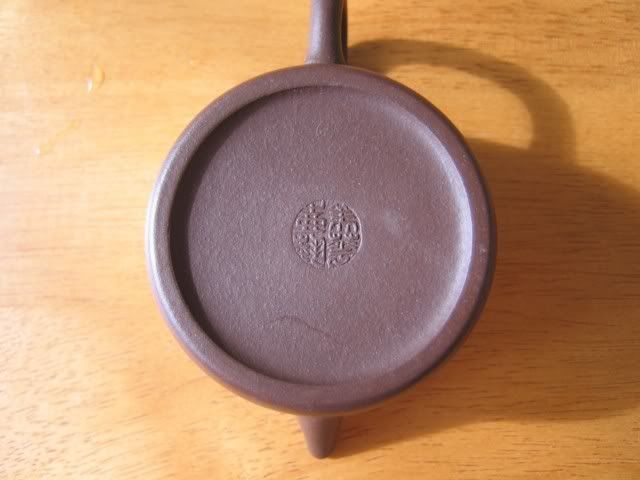
They are most typically four words constructions, although sometimes you might have six or even other arrangements. If it’s four words, the most likely thing it says is merely the name of the maker, which usually consist of three characters, and then the word “produced”. The reading order for the characters is top right, bottom right, top left, bottom left. There are exceptions to this, but the order above is easily the most common. They are usually in some sort of “seal script”, which is a writing style that is now only used for seal making and not much else (although you see it in other places, such as the wrappers of Yichang Hao puerh cakes in certain years). They are not easy to decipher, but with some practice they shouldn’t be too difficult either.

The bottom of the pot doesn’t always say the name of the maker. Sometimes it’s the company or the organization that made the pot that has the name on the bottom. Sometimes, it’s just “China, Yixing”. Sometimes it’s a generic seal that says “Jingxi Hui Mengchen Zhi”, which means “Made by Hui Mengchen of Jingxi”, with Jingxi being an old name for what we now know as the town of Yixing. Hui Mengchen is the name of a famous potter in the Qing dynasty, and for some reason or another, his name is often used for pots. Pots with those seals, such as this one
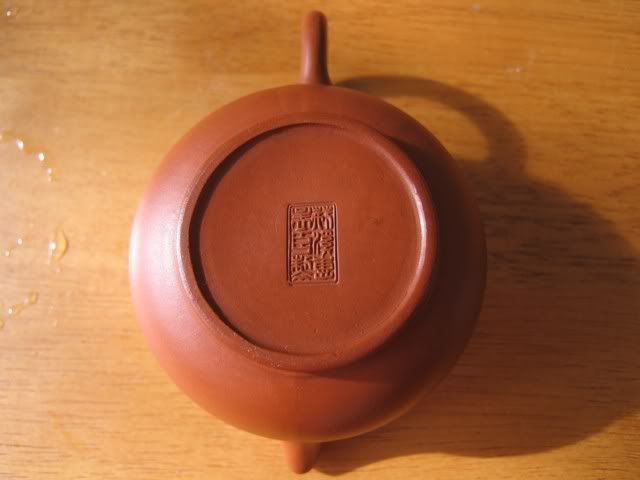
are not trying to masquerade as Qing pots. This is more or less just a generic seal that is used for many, many kinds of pots. Some people can go and date these seals, as different period ones or seals used by different people (but saying the same thing) have different characteristics. Some might be more valuable than others. This is sort of like tracing down different kinds of wrappers, looking for the tiny font differences, wording differences, the extra dot on the word, etc…. all pretty esoteric stuff that requires the patience of a librarian and lots of experience. I don’t have that sort of experience, nor patience.

Very often though, the name of the potter is actually under the lid, like this (same pot as the first one)
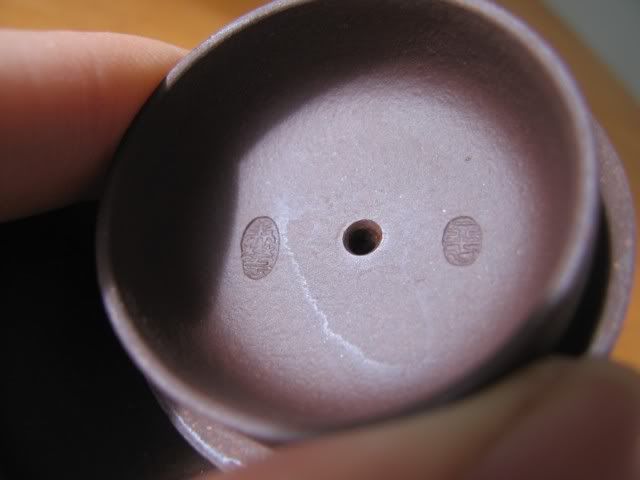
The small seal on the right is the family name of the potter, while the other is his (or her) given name. Sometimes a small imprint like this might go under the handle and not the lid, but so far, among all the pots I’ve seen on and offline, small imprints like this are most often the name of the potter. For a bunch of Republican period (1911-1949) pot workshops, their shop name is put at the bottom of the handle. Chances of most of my blog readers seeing a genuine article of these, though, is unfortunately fairly low.

There are also pots out there with nothing on the bottom
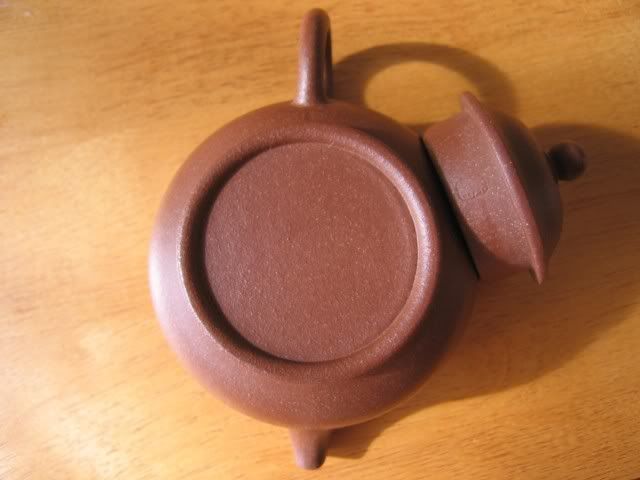
This is a reproduction Panhu (literally Pan pot). It is thus named because the person who made them famous was a Guangdong province salt merchant named Pan Shicheng. He would order them made, and used them as gifts, for family, etc. Panhu generally have no seals in the bottom, and only one on the “lips” of the lid (you can see it in the picture). This particular one is a reproduction because it’s not expensive enough to be a real one, and also because the shape is not quite exactly right. I am wondering if I should get rid of it, because while I like it, I don’t really have a use for it.

The point though, of course, is that some pots are going to have no seals of any kind, and that some have one on the lips of the lid. Just something to look out for.

Then we get into territory of inscriptions. This is something I bought while in Taiwan
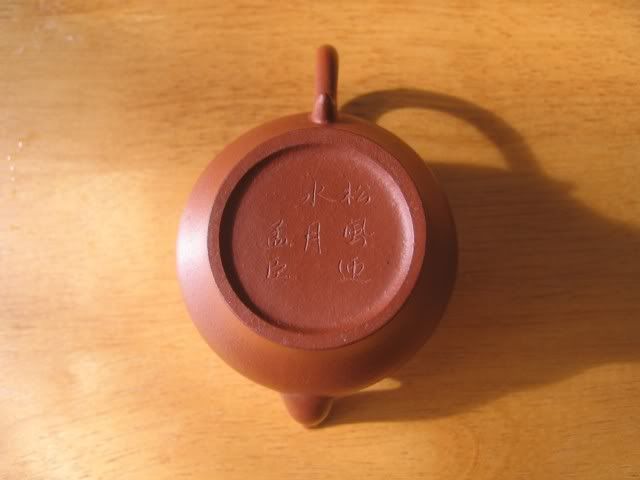
You can see the words are thin, almost wispy. The thing is a 5-2 arrangement. The five words (three on the right two in the center) is a verse of a poem. The bottom left two words are the maker’s name, or in this case, our friend Mengchen. Again, this isn’t a pot that he made, but rather a later reproduction. There are reproductions of Mengchen pots as early as the Qing, all through the Republican period to today, pretty much. Many such “reproductions” are also high priced items because they are decades or even a hundred plus years old. This particular sample probably isn’t very old. The oldest ones are carved with bamboo knives, as Billy Mood’s article noted. Words carved by those look more like this
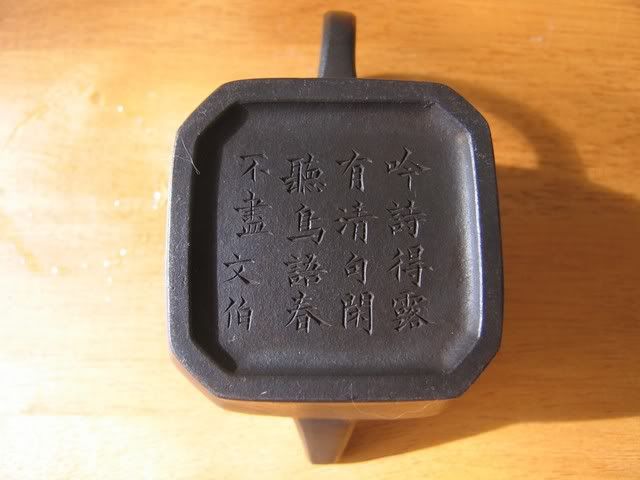
You can probably see the huge difference in the two. While the first pot’s writing is wiry thin, the second is not, with clear points of incision that lets you follow the strokes. This is actually two lines of verse — 7+7+2, with the two saying “Wenbo” a person’s name (in this case the name of the person who wrote these words on the pot, not the potter). The use of such a tool to carve words does not denote old age — it is entirely conceivable for somebody to do it now. The first pot’s wiry words are probably carved using a metal pen of some sort — just a wire, basically. There’s that evenness in the words, but at the same time, the calligraphy is also vastly inferior. Again, great calligraphy is not a sure sign of an old or great pot, but I’ve never seen a pot with poor calligraphy (sometimes with words that look like a kid’s handwriting — and not deliberately so) that’s great.

The arrangement of the words is also a useful indicator. This is quite a complicated subject which I’m not qualified to speak, really, but from what I’ve read, really old pots often have a 4+4 arrangement, later turning into 5+3 or 7+3 or 5+2/7+2. I have an oddball pot
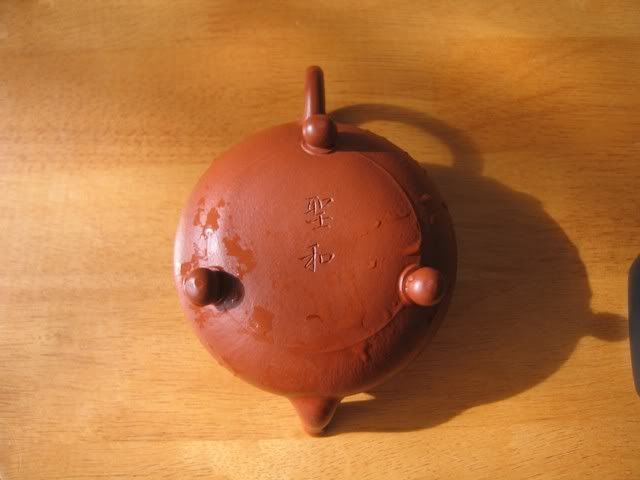
Which is just two words, supposedly denoting the maker. This is quite unusual, and chances are, it’s not actually from a hundred years ago as this is never really done, according to some people who seem to know the subject much better than I. It’s much more likely a more recent reproduction hoping to put a famous potter’s name on the bottom in the hopes of somebody buying it. This pot serves me well, as some of you may recognize it as my hotel survival pot. I just don’t have any illusions as to its old age.

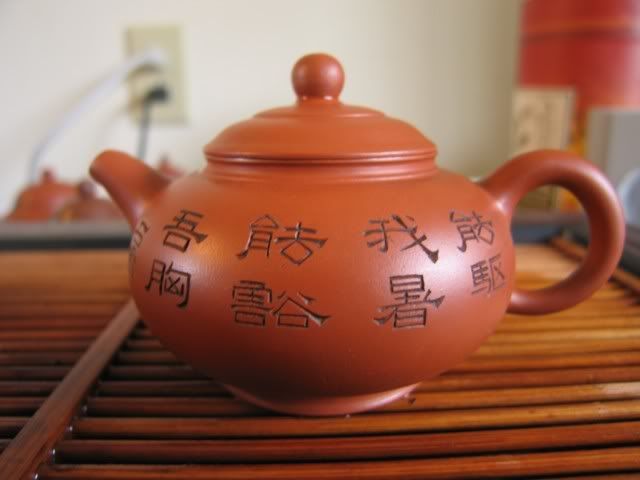
There are many things that I didn’t talk about, some of which are mentioned in Mood’s article. There is, however, one thing that I need to repeat from his article though… seals, chops, inscriptions…. these things are probably the least useful in authenticating a pot, because they are so easily faked or reproduced. Clay quality, make, craftsmanship style, etc, are all important markers in
the dating of pots, but even then, fake old pots abound. I wouldn’t even pretend I know much of anything about clay quality — even though I’ve handled quite a few pots by now, what is and isn’t great clay is still something I feel very uncertain about. But as long as one doesn’t go into these things with too much investment, it’s an enjoyable venture collecting teapots… until you’ve realized you have too many 🙂

→ 17 CommentsCategories: Objects · Old Xanga posts
Tagged: ,