A Tea Addict's Journal

New tools, old tea

February 27, 2008 · 5 Comments

I got some new stuff yesterday through the mail, one of which is this
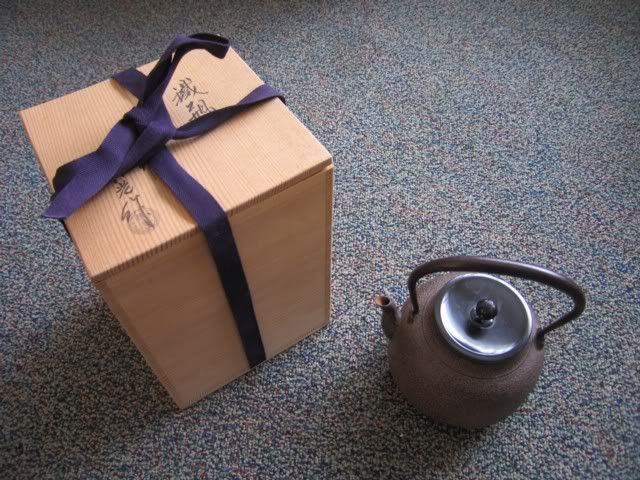
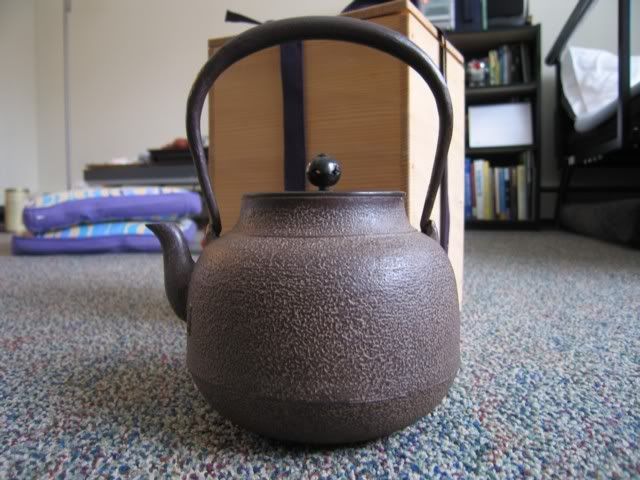
A new (for me) tetsubin that I bought a little while ago from Japan. The one I’ve been using, after much cleaning and what not, is still not entirely satisfactory. It’s basically too small, and the kettle is a little quirky to get right. This one, on the other hand, exhibits none of the problems I’ve had with the old one. It’s made by Sato Seiko about 30 years ago. The craftsmanship on it is much better than my more mass produced predecessor. The pouring is much more controlled, and the whole thing is easier to use, basically… not to mention bigger, thus less trips to heat up water fresh. I like it. The only problem, if there is one, is that it has absorbed the smell of the wooden box a little, but I’d imagine with some use it will clear up sooner or later.

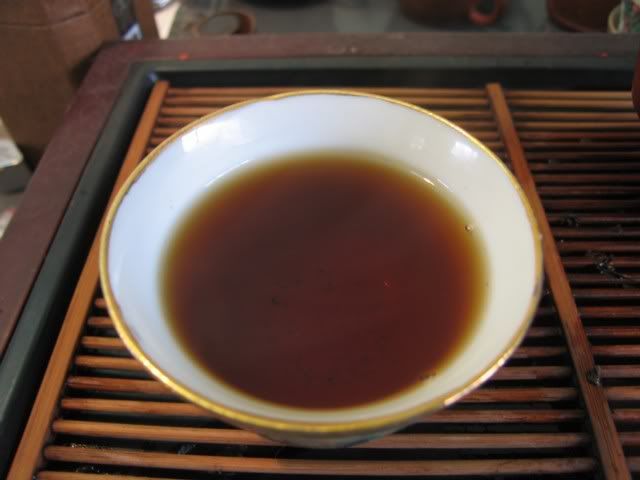
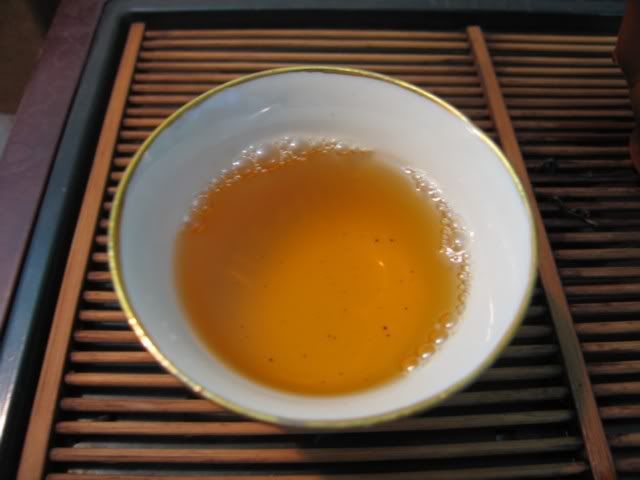
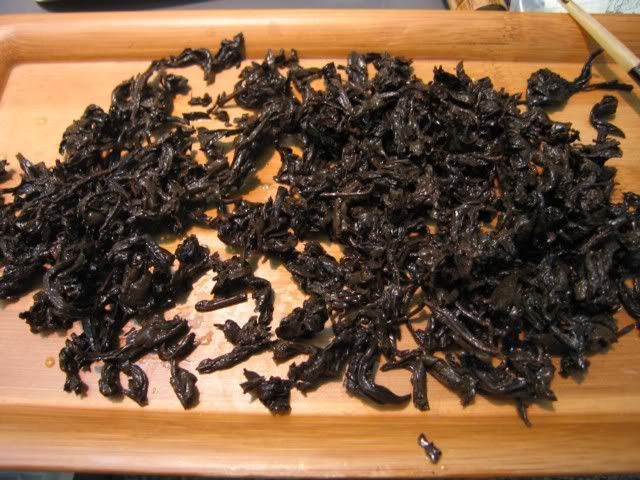
The tea I drank today is the 2005 Xizihao Lao Banzhang, something that is long sold out at Hou De. I remember I had this tea almost two years ago when I first started blogging, and the tea tasted a bit green to me — I remarked something along the lines of how it reminded me of longjing or something, and that it had gone to my head. Mindful of the potential power of this tea, I went a little easy on myself. The result is a sweetish brew — the tea has aged a bit, methinks, and I with it as a tea drinker. The tea no longer tastes green, and the liquor is a bit orangy, rather than yellow. The tea, overall, is subdued…. not terribly powerful, but I never thought it was in terms of taste. I did feel some of that qi coming from the tea, but even that seems a little mellower. Enjoyable, but not mind blowing.

I don’t know if it’s just me, or if the tea did change that way. It’s hard to tell with just a sample. Also, since I’m using all new teaware, compared to my gaiwan, electric kettle, etc that I used last time, not to mention different water and two more years of drinking experiences, maybe all comparison is moot.

→ 5 CommentsCategories: Objects · Old Xanga posts
Tagged: , ,

The gaiwan comparison

February 26, 2008 · 7 Comments

Since I mentioned it yesterday, today I whipped out my gaiwan and tried the same tea — the aged tieguanyin from my Taiwanese candy store, to see how the gaiwan fares.

The short version is: not too well.

I think there’s a temperature problem with the gaiwan, although I have a feeling that’s not the only issue. The tea came out a bit subdued — the aromatics and depth did not show up very much, although the throatiness of the tea presented itself strongly. The tea’s aromas were certainly lacking compared to the zhuni pot I used yesterday. Nor does it have the softness that I would get using my black pot. Did it have any redeeming feature? I’m not sure….

So, no gaiwan for aged oolongs. I knew this already, but this is a good confirmation.

I should note that I am not the only person to have tried something like this. Adrian Lurssen has written two pieces on the same subject of yixing vs gaiwan over at Chadao, dated Nov 27th and 30th. His results were more inconclusive, but I think it depends greatly on the tea in question. Gaiwans, I think, don’t do as bad with teas like greens or young puerhs, but I don’t drink a lot of those these days.

→ 7 CommentsCategories: Objects · Old Xanga posts
Tagged: , , ,

Gaiwan brewing

February 25, 2008 · 1 Comment

I realized today I haven’t touched any of my gaiwans since I returned from Taiwan.

I remember I used to use the gaiwan for everything…. from greens to blacks. Gaiwan was my weapon of choice. Gaiwan was the only thing I’d use, pretty much.

Then slowly, I started using more yixing pots. I gradually bought a few more, and found them, somehow, easier to use. Maybe it’s because I will no longer burn my fingers, as I do once in a while with a gaiwan. Maybe they provide more aesthetic variety. Maybe they do make better tea?

On the better tea question, I am now quite certain that some yixing pots will make softer tea (whether that’s better or not is up to individual taste). I’m still not sure exactly what goes on in a yixing pot that actually changes the tea. There are many theories out there, from temperature retention (sort of true…) to pores in the clay (really depends) to seasoning (maybe true, maybe magic…. and also depends, greatly). Gaiwans, though, still give you an “honest” tea, without really messing with the tea in any particular way.

I’ve also basically ditched the fairness cup these days, especially after I acquired those Hong Kong cups that will hold a pot of tea, regardless of which pot I used. I find myself enjoying my tea more without needing to re-pour from the fairness cup into my drinking cup. That, I think, is entirely personal — somehow, the fairness cup feels artificial, almost lazy.

Maybe I should pull out my gaiwan one of these days and revisit one of the teas I’ve been drinking a lot recently, such as the tieguanyin I drank today. I wonder if I can tell the difference.

→ 1 CommentCategories: Objects · Old Xanga posts
Tagged: ,

Brewing parameters

February 23, 2008 · 6 Comments

This question comes up again and again in the course of talking tea over the internet…. what’s your brewing parameters?

The same question, I find, is much less common in the Chinese online scene for tea. Either people all know it and don’t need to ask, or people don’t care.

I think the reason people keep asking this question is because of the belief that there’s an optimal brewing parameter for a particular tea, where the extraction of soluable things from the tea will be optimal (just right, not too bitter, etc). It might be 5/5/10/20/30/60, or it might be 5/5/5/5/5/5/5/10. I don’t know. Whatever it is, there’s a certain sense that there’s a “right” answer.

As my readers generally know, I am against timing infusions. I think if we start timing infusions, then one must also time the number of elapsed seconds between infusions — whether that is 10 seconds, a minute, or five. Leaves that have been infused three or four times will continue to cook in your pot/gaiwan until the next time you pour water in. As Dogma said to me, the water that you pour in does basically two things — bring the temperature up a little (it’s likely still very hot in the pot/gaiwan without the water) and it carries all the dissolved stuff out with it when you pour. The actual amount of time it spends in the pot/gaiwan isn’t that important.

For example, today when I made a rather commonplace wet stored loose puerh, I think my infusion parameters, as judged by time spent with water in the pot, runs something like 3/3/5/5/5/5/10/10/20. I guess I should tell you how big (in ml) my pot is, but I have no clue. Nor do I use a scale. I can tell you that my pot was about 1/3 full of dry leaves when I poured the wash in.

But that’s not the whole story. I spent considerably more time (proportionately) drinking the tea earlier than later. There was probably a minute or two of rest time in between infusions 4 and 5 (or was it 5 and 6?). Some infusions come out weaker than others. How do I account for all of these things?

I don’t, however, think I brewed this the “optimal” way, nor do I think there is an optimal way. I like my teas this way, because …. I find they come out just fine. I use similar parameters for almost all teas, unless they happen to be green or white, which I almost never drink these days anyway. So, the short answer is…. that’s how I brew my tea, and it applies to almost everything I post about here, which, oddly enough, seems to work remarkably well.

Scary thought, isn’t it?

→ 6 CommentsCategories: Old Xanga posts
Tagged: ,

Sample H

February 23, 2008 · Leave a Comment

Sample H today

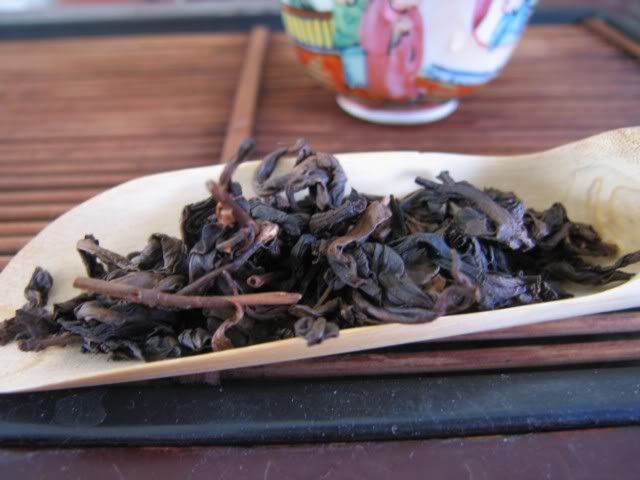
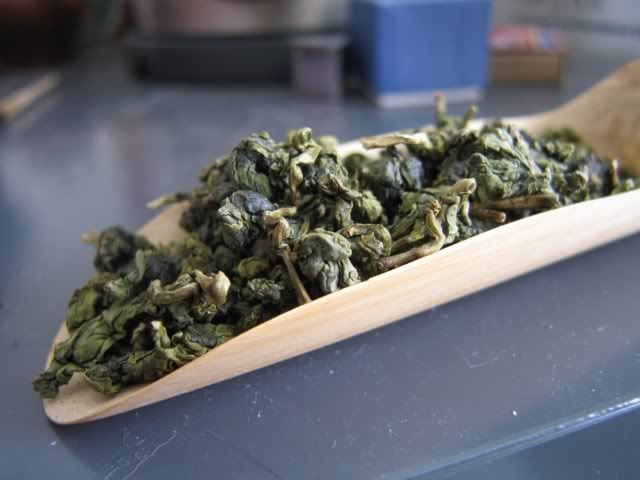
This tea was a little hard to identify. Looking at the dry leaves, I thought it could be some dancong, because of the long leaves and the relative greenness of it. Brewing it though

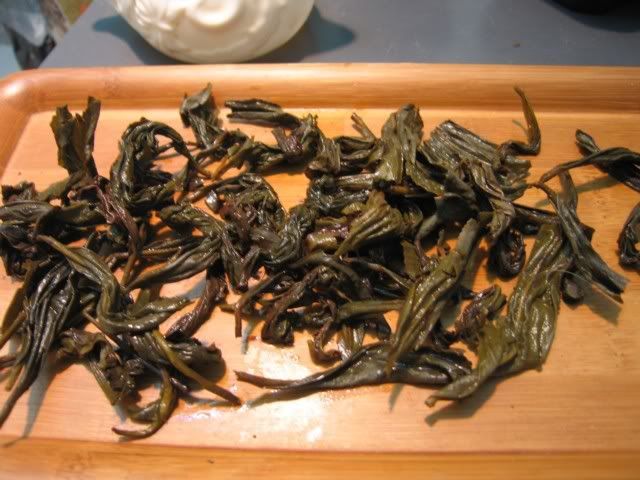
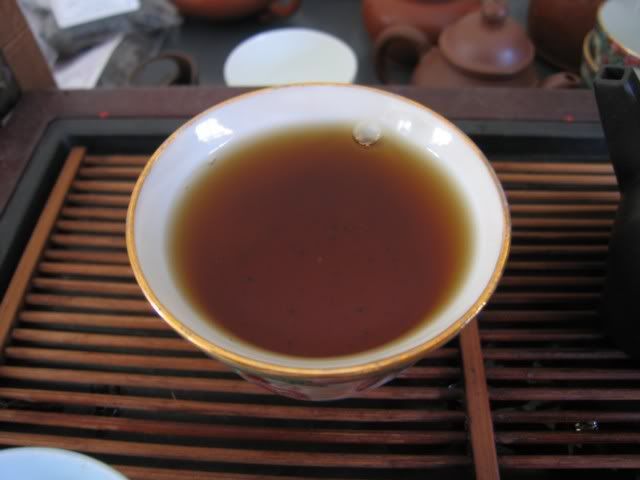
Revealed a yancha taste. So, yancha it is, but…. what kind? It might’ve been shuixian, one of the lighter roasted kinds. But then, shuixian is typically a little weaker than this — this tea was fairly strong, with a good amount of yanyun and a nice, full body, but a taste that I couldn’t quite identify. It was roasted right — not too little, and dare I say it, not too much. I am usually not a great fan of the lower roastings of Wuyi tea, because I tend to find them a little too green, but this one was enough so that the nasty greenness was gone and preserving a nice honey taste.

Talking to Will, I found out that this tea is actually called Changqingteng, literally evergreen cane. Never heard of it. Googling reveals nothing. My guess is this is a newfangled invention of the tea maker whom he got it from. Not a bad tea, I must say. Not something for everyday, but I think this tea can probably age well.

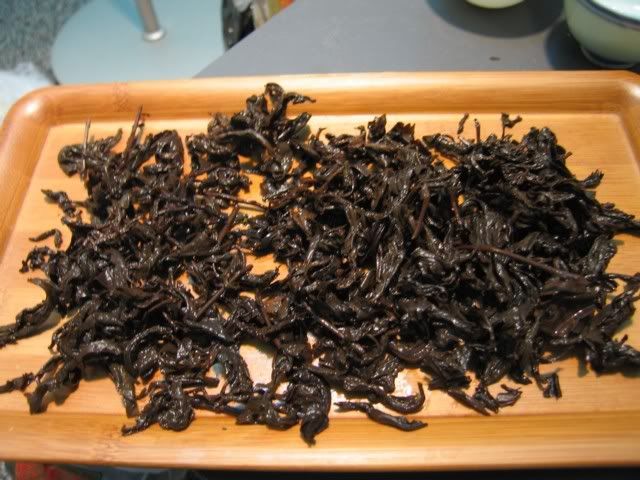
One interesting thing is that the leaves are extremely large — suggesting, perhaps, that it uses older leaves for the tea. I wonder if that’s what gives it the rather unique flavour.

→ Leave a CommentCategories: Old Xanga posts
Tagged: ,

Sample F

February 22, 2008 · 1 Comment

Before I go on about today’s tea…. if you noticed that the links to your left have disappeared, that’s because my Xanga premium subscription ran out. Xanga, you see, is cheap that way — you can only put up links to outside sites if you pay them (as far as I know anyway). I don’t think it’s really worth the privilege, since I think the ability to link to other places should come for free. So… sorry for no more links.

Anyway, today was another sample from Will. Sample F this time.

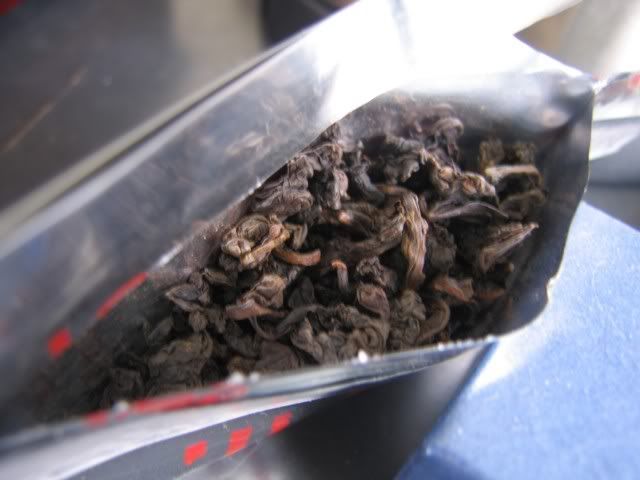
The tea is rather reddish in colour when dry. Smells a little sour, but not bad. Not heavily rolled. Lots of stems. Looks old.

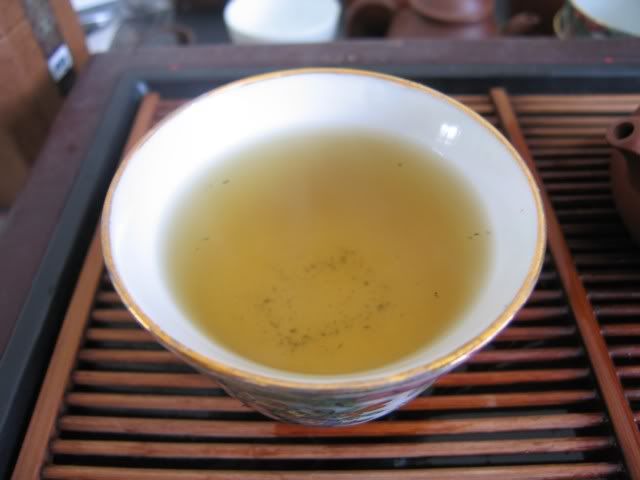
Colour came out all right

The tea is interesting. It is actually quite similar to a 15-20 years old competition tea I bought in Taipei just before I left. This tea is a little thinner than that one. The taste is also different somewhat — there’s an interesting (some might say odd) taste in this tea that isn’t in that one, which is mostly sweet and fruity. I don’t know how to describe the taste — it might be slightly medicinal. I am thinking that it might have something to do with the high amounts of stems in this tea versus mostly just leaves in that one of mine. Otherwise, flavour profile are quite similar from beginning to end. Mostly sweet, fruity taste. At the end the agedness came through with a slightly puerh-esque taste. Not a bad tea, so long as it doesn’t cost too much.

The leaves look standard — nothing too remarkable, but sometimes, nothing stands out is a good thing.

Two down… at least another half dozen to go!

→ 1 CommentCategories: Old Xanga posts
Tagged:

Benshan

February 21, 2008 · 2 Comments

As promised…

Benshan, otherwise known as fake tieguanyin, or at least, it’s often mixed into tieguanyin and sold as such. It’s very cheap — my 100g bag cost 10 RMB, which comes to around $1.20. And this is the good stuff — there’s stuff that’s about half the price.

I used my tieguanyin pot to make it

Yum

It’s really quite interesting. The tea isn’t terrible. It’s got a familiar taste — I KNOW I’ve had this tea before, or at least something quite similar. I recognize the aroma, and the aftertaste. It’s even got a nice aftertaste, although for all I know, it’s some chemical they sprayed onto the thing. I am quite confident that this can be sold easily as tieguanyin here for 30 cents a gram and nobody would notice. Mix in a little tieguanyin, and it’s probably even harder to notice.

That’s what they do in China, anyway, so a guy selling tieguanyin here might actually be selling you benshan, and he doesn’t even know it.

I really haven’t had tieguanyin often enough these days to discern all the minor differences between this tea and the real deal. All I can say is this was a little thin, the huigan and the yun a little slow in coming, and a little grassy at the end. All in all… acceptable, but since I don’t like drinking things like this anymore these days, it mattered little.

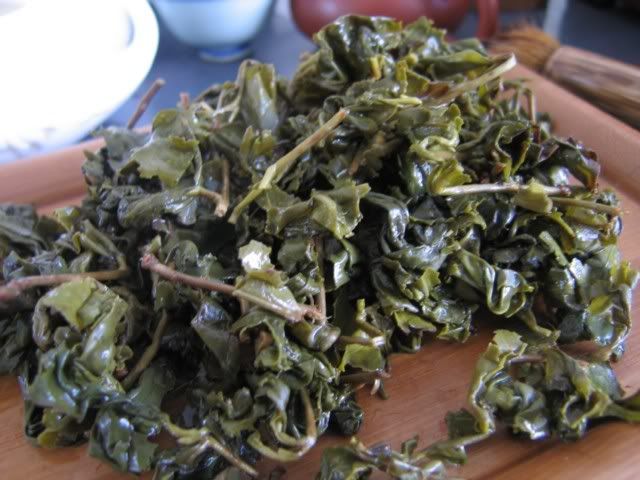
The wet leaves

Do they look familiar? I hope not. I was told that one way to tell Benshan is that the stem of the leaves tend to look a little like bamboo — with little indents on them. They also don’t tear apart cleanly — when you pull them apart, they don’t have a clean cut, whereas a tieguanyin would. Differences in stem structure, I suppose, although I have never tried verifying this for sure. Maybe somebody can do that test for me.

→ 2 CommentsCategories: Old Xanga posts
Tagged: ,

Sample G

February 19, 2008 · 4 Comments

As the slow boat from Taiwan arrived, I finally got my stuff, among which are samples — samples from Will of LA Tea Drinkers, in this case. I picked out a bag at random, sample G, so sample G it is.

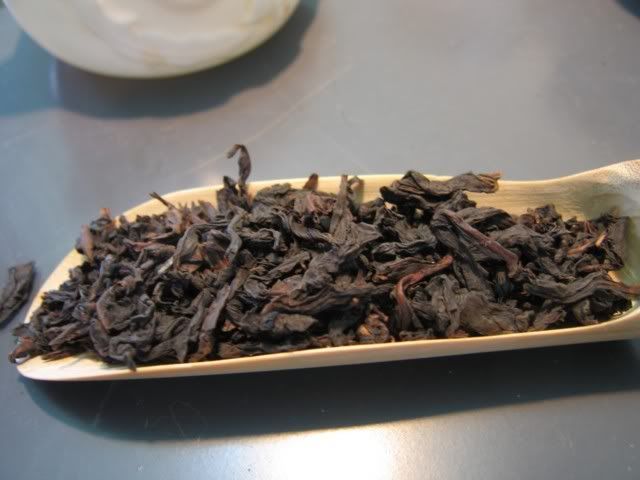
It smelled like a lot of “aged” oolongs I’ve had in Taiwan…. heavily roasted stuff, rolled, probably claiming to be 20 years old, but probably no more than maybe 5.

It looks like those tea brewed as well

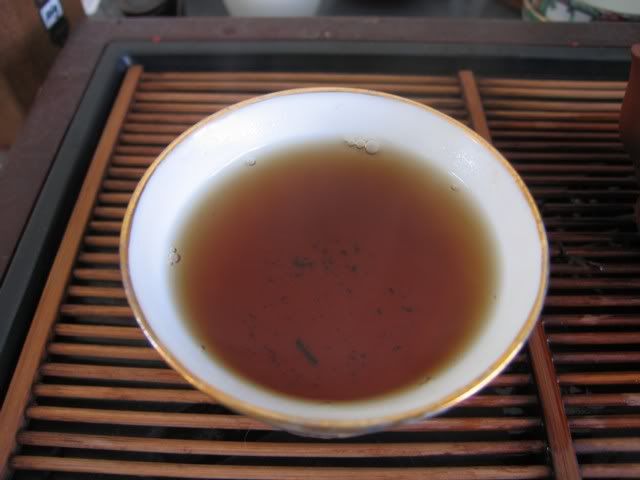
I don’t know if it’s obvious here, but basically.. there’s a difference in hue of the tea. The stuff that is heavily roasted but without much age is generally brownish, whereas the stuff that have been aged, roasted or not, are usually more reddish. It’s a subtle difference that probably barely shows up on screen, but when you see it in person enough times, it shows. The tea is a bit thin, with not much beyond the roasty taste. A little sour. It’s not horrible… but probably not as old and as good as it claims to be.

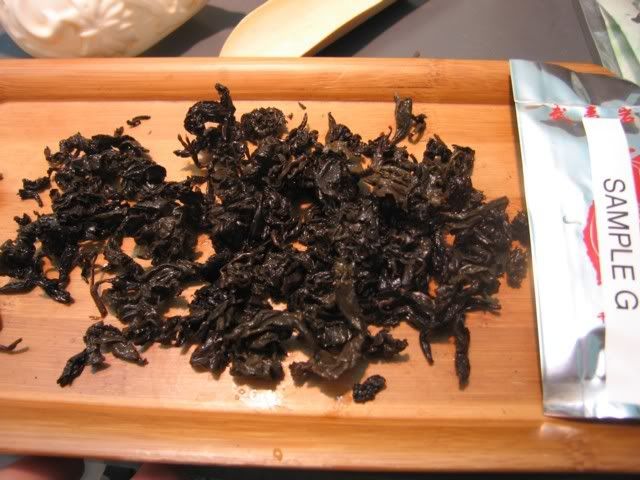
The wet leaves

Also look true to form. Examining them though reveals that they might be benshan, a cheaper varietal of tea that is often used to make “tieguanyin”. Which reminded me — I have a bag of benshan from Beijing that I’ve been meaning to drink all along, if for nothing else than self education. Maybe that’ll be tomorrow’s tea.

→ 4 CommentsCategories: Old Xanga posts
Tagged:

Revived from the dead

February 19, 2008 · 5 Comments

Over time, I’ve bought a bunch of stuff that I thought were duds for one reason or another. Sometimes it’s stuff that are, basically, no good at all. Other times, it’s tea that should’ve been good that had somehow gone bad. Or, perhaps, I made them bad (say, longjing I bought three years ago… anybody want some?). Today’s tea was supposed to be one of them.

I had a few boxes of stuff that recently arrived via the slow boat from Taiwan. Among them, of course, are a bunch of teas. Some are good, some are ok, some are things that I didn’t want to throw away, but not really good at all. This is a qizhong (literally unusual varietal) of Wuyi mountains, bought from the candy store. It was one of my first purchases there. Their tieguanyin became one of my staple teas in Taiwan. This one, however, wasn’t so good — too sour.

So it was with some trepidation that I picked this up today to try. I figured maybe, just maybe, it won’t be that bad.

It looks pretty good dry, which was why I bought it in the first place

Smells old, although, now that my nose is a bit more trained, it also smells a bit sour. But I wasn’t quite good at telling that apart from the “old” smell before.

Into my old oolong (1 person) pot it goes

The second cup

The …. 12th? cup

The residue

Since I lasted 10+ cups, you probably figured out that the tea wasn’t that bad. It was, in fact, far better than I expected. There was some sourness at first, but by the third cup it was gone. The Wuyi “rock” taste was very strong, with a potent minty sensation down the throat. Aged, of course, and I couldn’t detect any sort of immediate roasting flavour. Nicely aged and mellowed… a winner. Even better without the initial sourness, but I can’t ask that much.

What changed?

Well, everything, really. First, the water. It’s a different water (not my Taiwan apartment slightly problematic water). Boiled in a different vessel (my cheap tetsubin instead of the glass kettle). Brewed in a different thing (a supposed zhuni pot instead of a gaiwan). Drunk in a different cup (my newest purchase instead of another cup). And of course, just halfway across the planet.

Which one was the one responsible for making this tea better? I don’t know, but I suspect water, water prep, and tea brewing vessel all did their share. Or, maybe, after all this time brewing old oolongs, I myself am also a little different, and a little better at this. Can’t complain.

→ 5 CommentsCategories: Old Xanga posts
Tagged: ,

Aesthetics and tea

February 18, 2008 · 5 Comments

I think the first thing one should make clear when talking about Chinese tea is that there is no real ceremony involved. I don’t think of gongfu drinking as a ceremony. It’s more like a particular way of preparing the tea, much like, say, drinking espresso is not a ceremony, it’s a kind of coffee. It bothers me to no end when people say yixing pots are part of the Chinese tea ceremony, because I don’t know what that is.

What about those tea brewing performances? Yes, well, those are, of course, some sort of “ceremony”, but I find those things generally very stale and boring, and entirely contrary to the whole purpose of Chinese tea making, which is very singularly focused on the extraction of the best drink possible out of the leaves. Of all the stuff that were written in the past (in Chinese) about tea, I have seen very, very little that has anything really to do with the form of tea making. Rather, it all has to do with the purpose and the result of tea making — how do you get a better cup out of the leaves you’ve got (and in many cases, how do you get better leaves in the first place).

This, I think, is in quite a sharp contrast with the Japanese Chado, which is quite concerned with the aesthetics as well as the actual tea itself. In some ways, I sometimes even feel like Chado has things backwards — sometimes the form and the aesthetics pleasures of performing/participating in the ceremony is much more important than the actual cup that you’re drinking. A lot of attention is paid to the space, the setting, the equipment… all sort of things.

Now, I’m not saying that’s wrong. I’m just saying that’s different. I do think that if one is too concerned about form, the actual tea being made suffers a little. It’s most obvious when I see those tea “performers” making tea with that twist of the elbow or the little “presentation” they do with the pot…. all the while I’m just thinking “if I want to look, I’ll go to a chashitsu and get a lot more out of it”. I just can’t handle the overly stylized Chinese “ceremony”.

That’s not to say, of course, that we should ditch all sorts of aesthetic concerns either. There’s I think a fine balance between form and function, and in the case of Chinese tea, form should follow function (call me Modernist). I believe that one should make one’s tea making space as comfortable and beautiful as one would allow, but the beauty or decorations or whatever should not get in the way (not too much anyway) of the tea making.

I’m currently debating whether or not to ditch the tea tray I use to collect waste water, and switch instead to a wooden tray with a bowl to hold any runoff for the pot. The downside is, I need to have another place to dump the water, eventually — basically after every infusion, but it does also mean that there will be water sitting under the pot while I’m brewing, which might not be a bad thing. The upside, of course, is that it’ll be prettier, and I’ll also have more room to do things, instead of feeling constrained by the tray right now. Which leads me to an entirely opposite position — the environment we make our tea in greatly affects us, as the Japanese have obviously figured out. If the place is right, the tea will feel better, even if, objectively, it’s not. I still think form should follow function, but maybe if something is too function, it loses its magic.

→ 5 CommentsCategories: Objects · Old Xanga posts
Tagged: , ,