A Tea Addict's Journal

Shanshui aged foshou

March 12, 2008 · Leave a Comment

Another sample I picked up from Boston

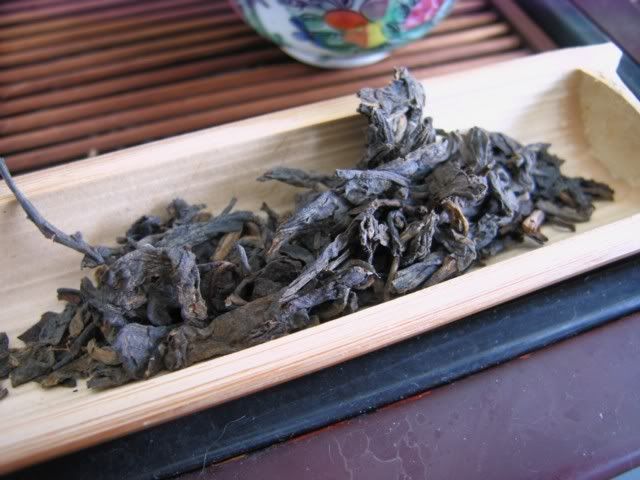
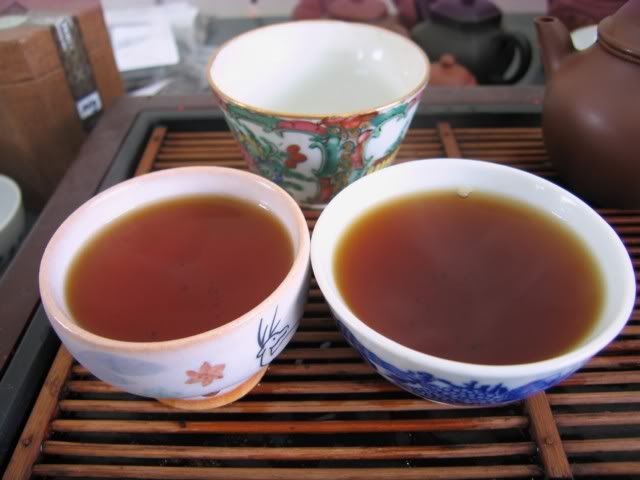
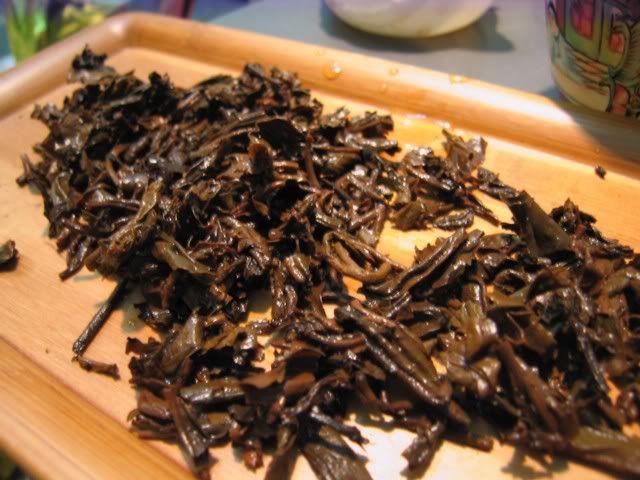
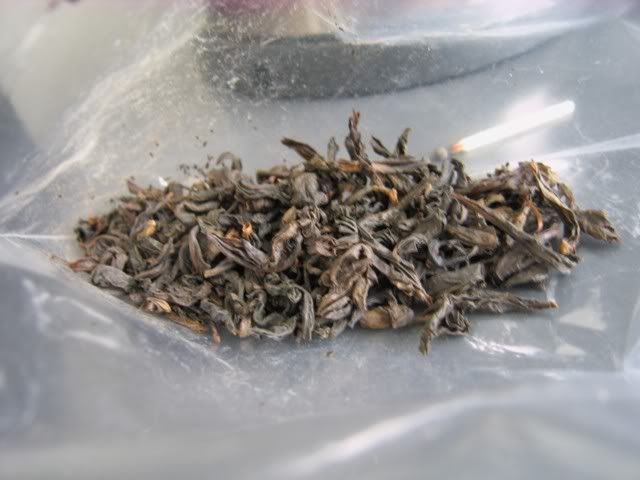
This time it’s an aged foshou, supposedly from Shanshui tea, if I remembered correctly. Smelled very roasty when dry. And it smelled even more roasty when wet

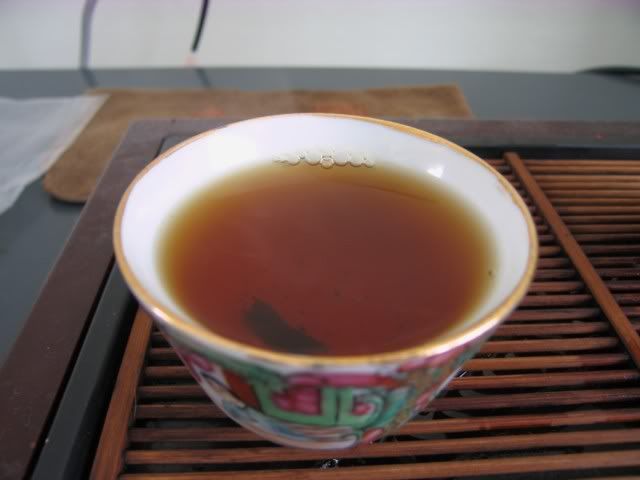
The tea falls firmly into the “roasted aged oolong” category, with a prominent taste of roasted tea in the cup and some sweetness that is obviously derived from age. However, I wouldn’t say this one is overly complex. It is stuff that one can find quite easily in Taiwan, often passed off as 30 or even 40 years old, but are often much less than that. Their strong roast is sort of a style, but often, I think, it’s just a way for the tea maker to pretend like it’s really old when it’s not. I strongly believe that drinking stuff like this against another tea that is properly aged is a good way to educate oneself as to what is just a strongly roasted, somewhat aged tea, and what is a lightly roasted and aged tea…. the notes that they share, such as the fruity flavour or the sweetness of the tea, are what all aged oolongs sort of share. However, I still feel that the best aged oolongs are the ones where the roast is almost undetectable (either because it’s been so long, or it’s never been roasted very strongly to start with).

This isn’t to say teas like this is bad. In some ways, this is more enjoyable than yesterday’s tea, because at least here there isn’t that lingering sourness that can really detract from one’s enjoyment. Yet, it isn’t the best an aged oolong can offer.
→ Leave a CommentCategories: Old Xanga posts
Tagged:

Jing teashop 1983 tieguanyin

March 11, 2008 · Leave a Comment

I picked up a sample of Jing’s 1983 aged tieguanyin on my swing to Boston — one of the persons I met gave me a session’s worth of tea.

The leaves look like an old tieguanyin — not rolled tightly, dark, a bit brittle. Smells somewhat sour.

The colour of the tea, when brewed, is also consistent with an aged oolong

The taste…. this is always the test, isn’t it? The tea is not too bad, with a nice throatiness and good sweetness. One problem though — it’s sour. I don’t know whether or not this is a product of the storage that it went through in my friend’s house, or whether it came like this or not, but since they mentioned “slightly acid aftertaste” in the product description, I’m going to guess that it was at least partly present already when it came.

Sourness, unfortunately, is the bane of aged oolongs, and sometimes it can thoroughly ruin a tea. I think there’s always going to be a hint of sourness in an aged oolong, but it’s a matter of how heavy and how presistent it is. There’s a certain tradeoff in having a sour tea and a heavily roasted one. The heavier the roast, the less likely it is going to be sour (especially when re-roasted). However, when reroasting there is inevitably something that is changed in the tea. The very best aged oolongs I’ve had to date are obviously very lightly or not at all reroasted over time. They give me the most complexity and flavour, and to boot, are only very slightly tart. They are rare.

The sour stuff… you can reroast them and they get less sour, but they develop in a different way over time, and I’m personally not sure if I like that stuff more. Some will tell you that that’s the only way to age oolongs; I beg to differ.

Still, for $21/100g, the tea isn’t too expensive. I do think they might actually be able to re-roast it again and hope it will improve a little more. Then again, trying to keep a tea like this under control in a place like Guangzhou is going to be an uphill battle all the way.

→ Leave a CommentCategories: Old Xanga posts
Tagged: , ,

The comforts of home

March 10, 2008 · 4 Comments

On this recent trip to Boston I made tea twice at somebody else’s place, and at both places I am reminded of how tied I am to my own tea setup, how my habits of tea making are determined by the teaware I use. It’s not the yixing pots or the cups or even the tea that really determined my tea making. It’s one specific thing of my kettle — the spout.

This might sound a little silly, but the spout of a kettle really determines how it pours, and that in turn greatly affects how I make tea. At the first tea meeting, I kept overshooting my pot (easily portable) when I tried to pour water into it. The spout on the water kettle there makes sure the water comes out at an angle that is not the same as the kettles I use, and thus I kept misjudging the first few times I poured. At the second place there was no such problem, although I am still reminded of how much I miss my kettle and my whole setup at home.

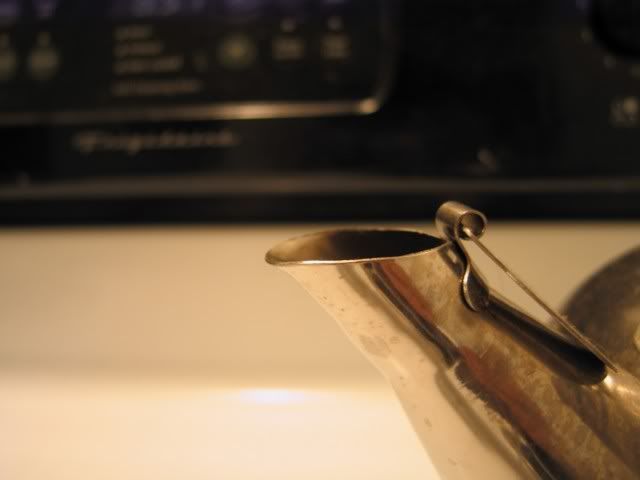
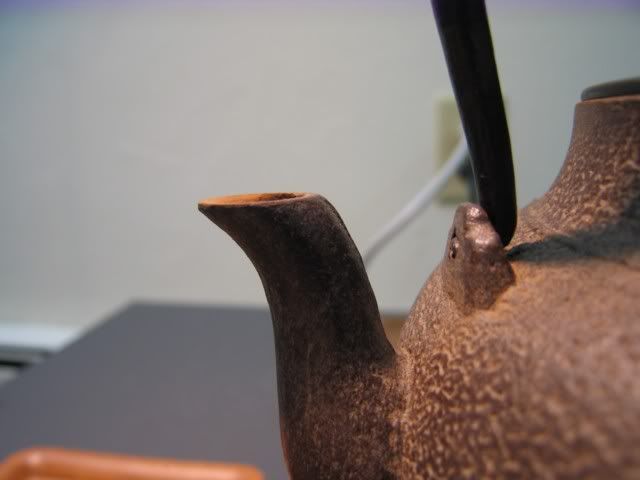
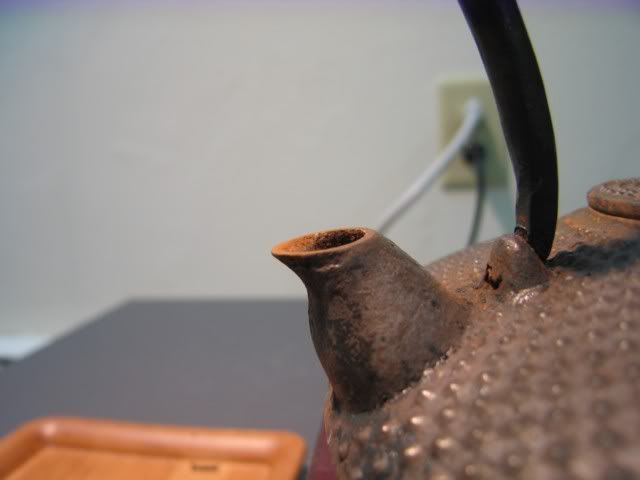
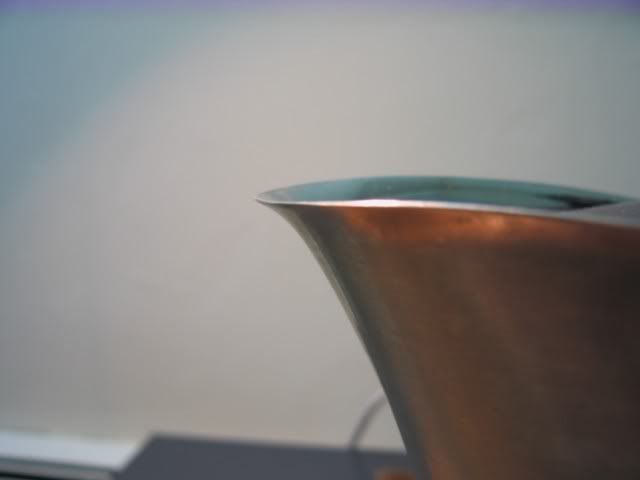
Kettle spouts come in all shapes and sizes. These are the ones I have at home

The one on my current tetsubin is the second, and not surprisingly, it gives me the most control in the speed of pouring. The last one is my electric kettle. It looks a little too wide, although it doesn’t drip at all, even though it seems like it might. It actually can pour a very fine pour, but it takes quite a bit of practice. The first is a spout on a simple stainless steel kettle. It does the job, but very hard to pour a fine pour of just a little water. The third is the flat tetsubin that I now have as a spare. It pours fine, except that it does drip a little (shorter spout and less tapering) and also is quirky because of the level of water vis-a-vis the level of the spout. Over time, I tihnk I am used to the higher levels of control that my kettles’ spout affords me, and also the perculiar ways they are shaped. The comforts of home, in this case, includes a familiarity with my teaware when I make my tea, and coming back to it makes me very happy.

→ 4 CommentsCategories: Objects · Old Xanga posts
Tagged: , ,

Stretching a tea

March 7, 2008 · 4 Comments

One question I sometimes get is — how do you drink 15 or 20 infusions of a tea?

On one level, that’s a volume question. How do I fit that much tea in my stomach?

If I give the impression that I drink them all in one go, I suppose I must revise that impression and point out that no, for the most part, anything after 6 or 7 infusions would normally be consumed over the course of a few, if not many, hours.

The other, bigger, problem, is that of the tea itself. I think in those cases, the first thing to note is that when I say 15 infusions, the last cup is usually much weaker than the first cup. Sometimes, the last cup is not much more than sweet water. However, even sweet water are not all created equal. Some are flavourful, full of character sweet water, sometimes even giving you some reaction along the throat when swalloing. Other times, it’s just flat, boring, sweet water. In some ways, I think these last cups tell you a lot about the tea you’re drinking — it puts certain information on display that might not be obvious early on. What separates a good tea from a great tea is partly its ability to be pushed very hard for very long — invariably, teas that will still come out with a meaningful cup 15 infusions later is likely to be the better one. In aged teas, those are the ones that are more prized because of their changing character throughout a session.

What I think sometimes is missing in many reviews I’ve seen is an indication of how far the tea was pushed. The 7th or 8th or 9th infusion can be 5, 10, 20 minutes, or half an hour…. or two hours, even. Whatever works for that particular tea in that particular volume/tea ratio. I think over time, one gets a better sense of what is appropriate. I’m not sure if people simply give up, or don’t want to talk about it anymore because it’s less interesting, or anything else. It helps that some forms of tea (such as the aged oolongs I drink these days) are devoid of any bitterness and so easier to experiment than others, but just like today in my session with DH here drinking some tea, when a tea is pushed hard with a long steep in boiling water, even after 10+ infusions, it can come back to life with something else, something that you never noticed was there in any of the earlier cups. Those are always good moments.

→ 4 CommentsCategories: Old Xanga posts
Tagged:

Teabag gongfu

March 4, 2008 · Leave a Comment

Brewing with a teabag can actually be a little tricky, and I’m by no means good at it. I think what it requires is a certain sense of timing — knowing when to pull it out. Too many times I leave my tea in the cup too long. What happens, I think, is that I sort of want a cup of strong tea. Yet… that usually means nasty bitter tea that really isn’t very good to drink. What I need to do is to resist the temptation to make a strong cup, and instead let the teabag out of the cup quite soon — definitely sooner than the usual five minutes prescription. Today I went to Peet’s to get my caffeine fix, and got a (not very good) Lapsang Souchong. I took it out around to 3 minutes mark…. and thankfully, the person who did the teabag didn’t over stuff the bag with leaves, so it actually worked out pretty well, despite the not-so-great tea….

I should, however, just bring some leaves with me tomorrow and make a real cup….

→ Leave a CommentCategories: Old Xanga posts
Tagged: ,

Enjoying tea

March 4, 2008 · 2 Comments

One of the great benefits of meeting somebody live for tea, rather than say just sharing samples through the mail, is that when you’re actually talking to the person, you know exactly what’s going on in the cup at the same time and can respond with meaningful comments, rather than having to guess what “fruit” or “astringent” means in any particular context. I always find tea meetings to be useful, even when it’s a tea you already know inside out, because somebody else’s tongue (and words) are always going to be different than yours. Today I had tea with dogma and the tea I made was an aged baozhong that I have had on many occasions, and which I find is great for traveling on the road. Among the qualities of the tea which I find are interesting are 1) the bitterness is nonexistent and, 2) it can taste a bit like hongcha. Both of which are confirmed without me needing to really say much of anything about it.

But of course, confirming what you know about a tea is not the main point of having tea with somebody. It’s just a side benefit. Like any addictions, I think this one’s best shared with others who truly enjoy in partaking in it.

→ 2 CommentsCategories: Old Xanga posts
Tagged:

Travel day again

March 2, 2008 · Leave a Comment

Long day driving…. only high point was drinking my aged baozhong in a paper cup with hot water from a coffee joint.

But boy, the tea made me feel good.

This blog’s called A Tea Addict’s Journal for a reason 🙂

→ Leave a CommentCategories: Old Xanga posts
Tagged:

Old yixing pot

March 1, 2008 · 8 Comments

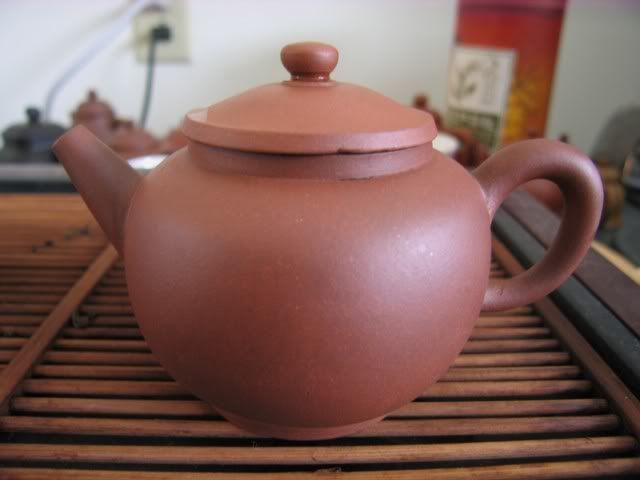
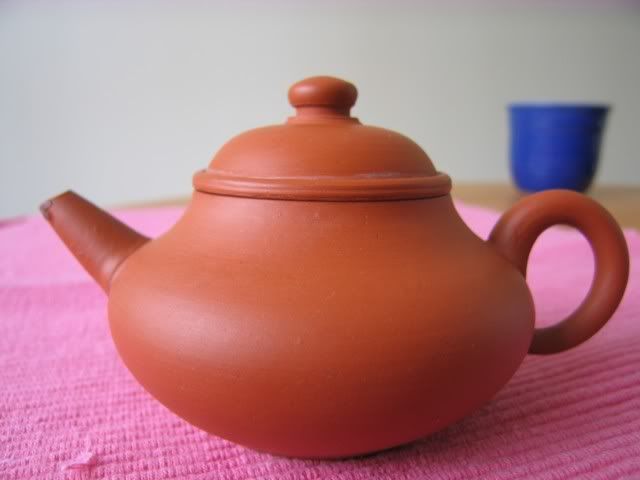
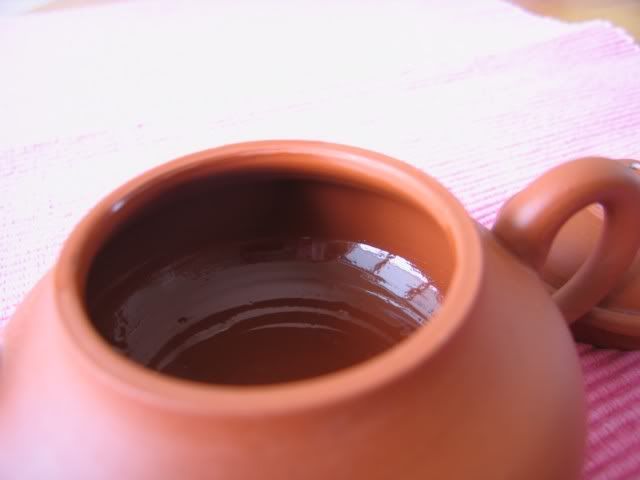
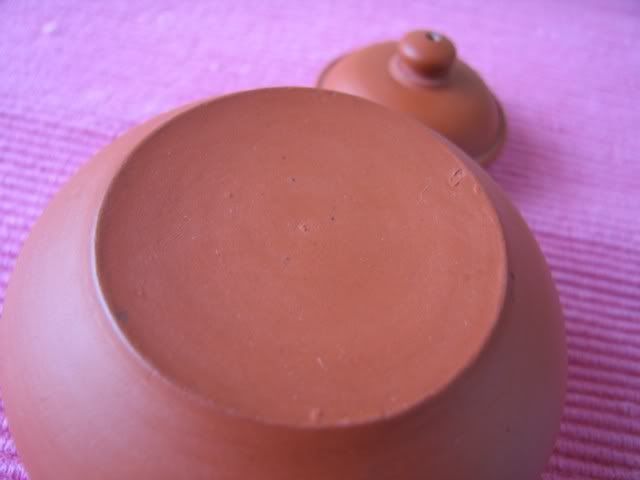
Among my recent shipment came this pot

Which, after some careful looking, I think is quite old. The original reason I bought it was because it looked very much like a pot that I saw at Wisteria in Taipei. When I saw a picture of this pot it immediately reminded me of it — they’re not the same in shape or size, but they looked very similar. When I finally got it through the mail and examined it in my hand, it seems more similar than I originally thought — the texture of the clay feels very fine, yet there’s a certain coarseness to it. Sounds contradictory, but it’s not really.

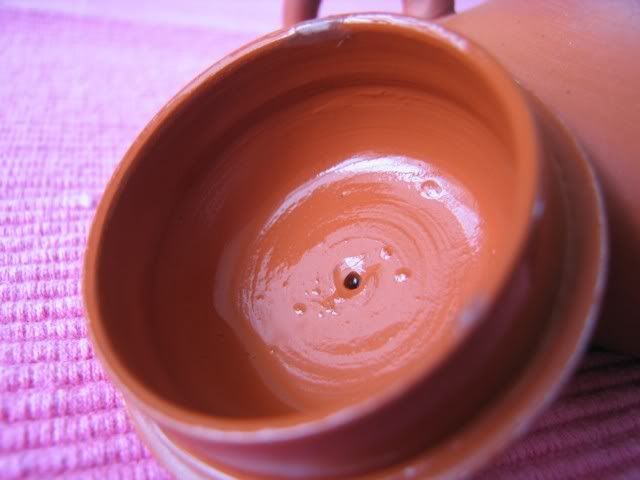
The most interesting thing is the lid

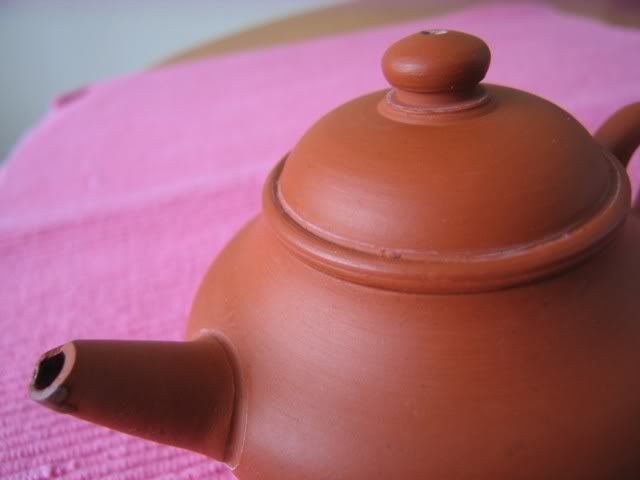
It’s not that obvious here in either of the pictures, but the colour of the lid is a few shades lighter than the pot itself. I’m not sure why that is. One possibility is that the person using this pot didn’t care much to season the lid. Another is that the lid wasn’t used much — possible if the pot was not used as a teapot, but as a shudei (water dropper for ink stones). You can also see how the interior of the lid is very rough — again, looking like the pot from Wisteria. From what I understand, Qing period pots that were made prior to the Daoguang era or so (roughly 1850) usually did not have their interiors “fixed”, i.e. they were left as-is. It was only after that that they had their interiors beautified by smoothing out the joint lines, etc. There’s an obvious joint line in the pot as well, although it doesn’t really show up in pictures very well.

Of course, it is entirely possible for fakes to fake the joint line, and all those other things…. but I don’t think anybody making a fake will do it as an unsigned pot with no name and such obvious problems, such as an air-hole that is a tad too small. Fakes are, not surprisingly, usually a lot prettier.

None of these, of course, makes a convincing case that this is definitely an old pot, but the clay and the work makes me rather inclined to believe it. Either way though… it’s been making good tea for me the past few days, and in some ways, I suppose that’s enough.

→ 8 CommentsCategories: Objects · Old Xanga posts
Tagged: ,

Tokoname yaki

February 29, 2008 · 10 Comments

Is this a yixing pot?

At first glance it might be, but look closer

Maybe not?

The pot is a tokoname yaki, which are sort of the Japanese equivilent of Yixing pottery. They are widely used to make tea, and most of the time, the pottery comes in the shape of a typical Japanese kyusu, with a side handle rather than the back handle like this one. However, in the 19th century I believe some guy from China (IIRC he’s called Jin Shiheng) went to Japan and taught them how to make Yixing style pottery, and so nowadays there are pots that look like this — sort of Yixing like in their appearance.

The clay, as you can see, is a bit on the orange side of things. It’s very fine. The pot is thrown on a wheel, I think, rather than being molded like a Yixing pot would. In this sense, it sort of reminds me of Shantou pots from China, which are also of an orange colour clay and thrown on wheels.

This particular pot was extremely dirty (and thus extremely cheap), and after cleaning, I discovered that there’s a nasty crack at the tip of the spout. It’s still usable, but doesn’t pour very well. I bought it partly as an experiment to see the clay for myself, and to play around with it, eventually. There’s a Yamada Jozan (four generations of them now) who is the most famous of these potters who make such back-handled pots. Prices for those can be rather high because that line is basically designated as National Living Treasures in Japan… and I am personally not sure what the value in them may be, other than as art objects.

Regardless, one more toy from Japan.

→ 10 CommentsCategories: Objects · Old Xanga posts
Tagged: ,

Zhongcha orange in orange

February 28, 2008 · Leave a Comment

I rearranged my tea closet yesterday, which helped me fully appreciate how much tea I am actually sitting on, and while doing it, dug up a lot of old samples that are slowly aging in their respective little bags.

Since there’s precious little point in keeping those around, I decided to start — or at least attempt — to eliminate some of them by, well, drinking them.

The first victim is the Orange in Orange Zhongcha sample from Hou De, which is, I believe, sold out long ago. The tea is from 1996, supposedly, and I’m sure if you dig far enough in this blog, you can find my last review of it.

The tea smells almost liked a cooked puerh, oddly enough

And the smell sort of persists into the first cup

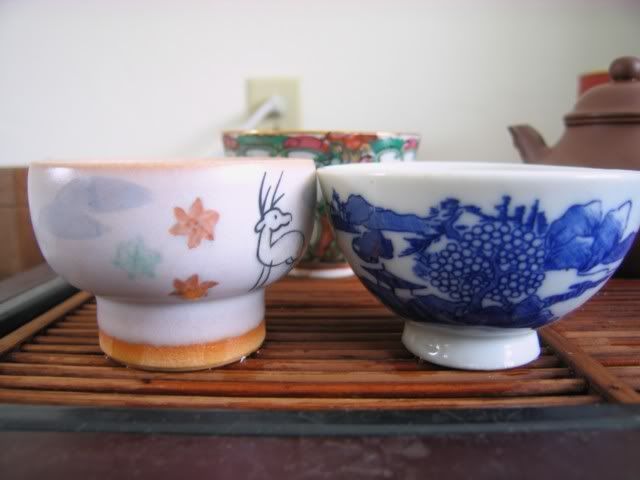
(Both of these cups, btw, are new acquisitions from Japan, along with the new tetsubin and a few other things — such as the bamboo tea spoon… although strictly speaking they are both intended to be used for sake, but I don’t care for such details)

The tea is…. quite unremarkable. It’s a bit cooked like at first, even though it is raw — wet storage can do that to you, but somehow for this particular tea, it’s a little more pronounced than usual. The tea switches into its “raw” mode after maybe 5-6 infusions, tasting greener and lighter, which, often enough, is the better part of a wet stored puerh. It’s not that interesting per se, but it’s not too bad either, and I’m sure back in the day when a sample means 2oz of tea, the price was sufficiently low to justify the purchase of many such cakes. Now…. I wonder if Hou De would even bother to list anything under $400 for somethig that’s about ten years old.

The wet leaves are, by and large, small and a bit broken. Clear signs of wet storage exist, but nothing so serious to have those carbonized leaves. Maybe wait another five or ten years and this tea should be pretty good, but these days, I begin to wonder if I will ever be patient enough to see my teas through decades of aging. If a tea that’s ten years old tastes only so so…. I don’t want to think about the implications.

→ Leave a CommentCategories: Old Xanga posts
Tagged: