A Tea Addict's Journal

Saturday May 27, 2006

May 27, 2006 · Leave a Comment

This is going to be a long post

I got the samples I bought from Hou De today – only took three days for them to ship it out and get it to me, so kudos to them. This is the first time I’ve bought stuff from them, and nothing’s better than fast shipment to leave a good first impression.

The two samples I purchased were the 95 Shui Lan Yin 7542, and the 94 8582 cake. I decided to try the 7542 first. There’s also a freebie of maocha (raw materials of puerh cakes, essentially). It’s a whole bag full of it, so I’ll probably drink that at some point….

Onto the tasting, this is rather exciting. I’ve had a number of older (20+ years) cakes before, mostly thanks to the kindness of tea friends from Hong Kong and the generousness of shopkeepers (but of course, I pay them many times over for their teas). I’ve also had a decent sampling of young cakes. Cakes in the 10 year range, though, I have not had many of at all. I don’t know why that is, exactly. I suppose it’s because tea friends, those who are kind enough to share, tend to have fantastic collections and they’d rather drink the older stuff now. So they bring out the good stuff (of course there’s also bragging rights!). Teashops will offer you any young cake you want to try, so getting to taste young stuff is never a problem. Older cakes are just expensive enough so that not every shop will want to share with you, but you won’t find a lot of older tea friends who have lots of them and opening them up for serious drinking. So, I guess, that’s why I’ve never had many of them.

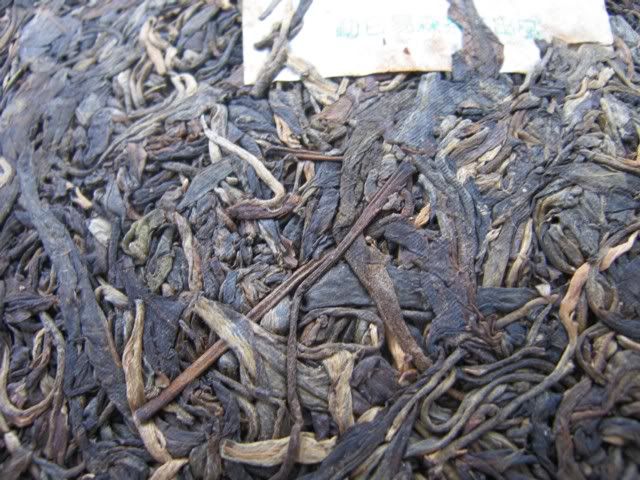
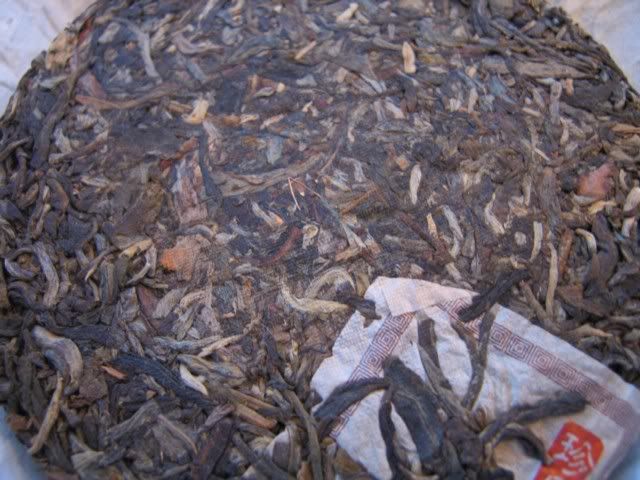
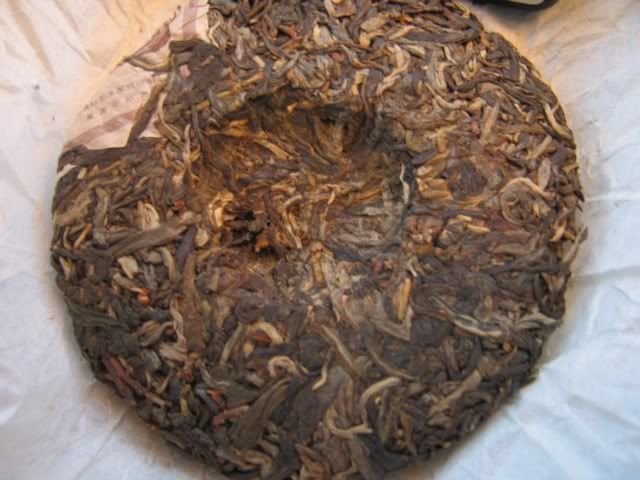
The sample from Hou de, when dry, smells a little musty, as many puerh tend to do. They sent me 20g, so I am using about half for my pot, and leaving half for a future tasting, perhaps when my girlfriend returns. The tea is very loose already, with some stuff easily falling off. I broke the longish piece into two, so it’ll fit in my pot, and on with the brewing.

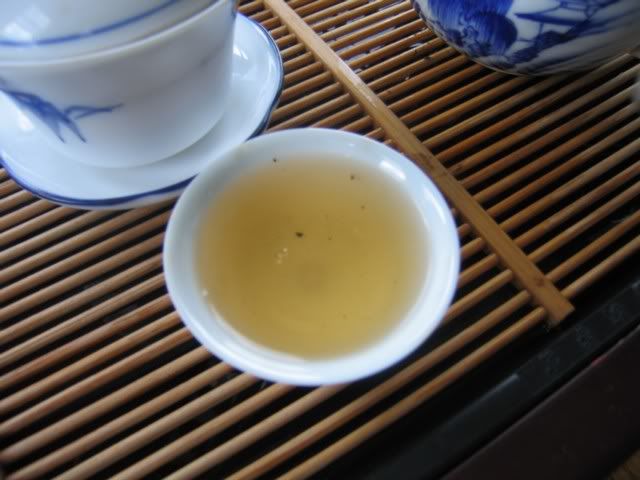
The wash came out brown, but not dark brown, and clear. Good sign, at least, that it’s clean. The first infusion – marked taste of camphor, with a hint of bitterness in the back end. After drinking, there’s a lingering taste that stays in the mouth that feels somewhat minty. It is that taste of raw puerh – the same thing you’ll get when you drink a good, strong, young puerh. The taste lingers in the back of the throat, feeling cool and a little minty. This is a sign, I suppose, that this cake is not fully mature and retains an edge of rawness in it.
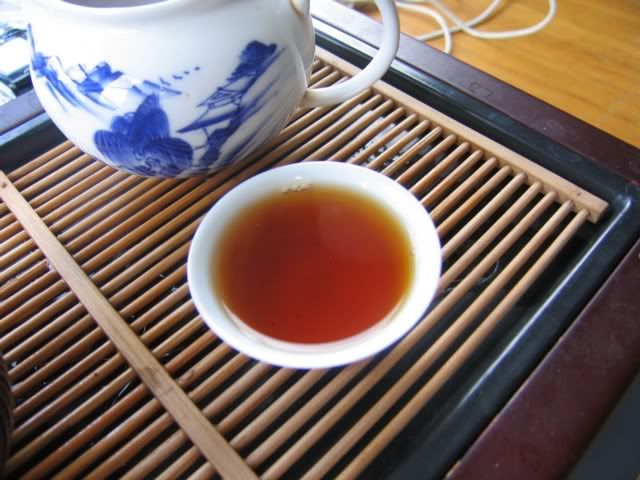

First infusion

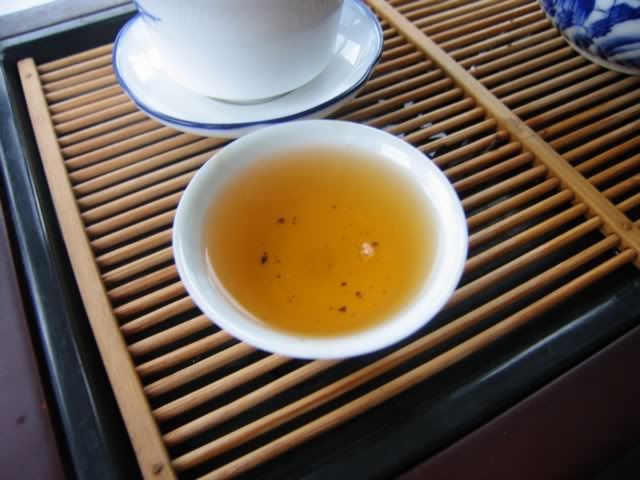
Second infusion is similar to the first, with stronger flavours and, in my second cup (my pot is more than one cup) a hint of sourness. There’s a sense of astringency. I’ve heard that Shui Lan Yin tends to be on the bitter side, and I think it shows. The rawness in the end is stronger and would be more obvious to those who don’t drink puerh. The liquor is thick.


Second infusion

Between the second and the third infusion I waited a bit, because I had to add some water and let it boil. I also tried something different – adding a bit of Fiji water to the filtered water. This is something the folks at the Best Tea House do. Instead of bringing 100% mineral water to a boil, they use mostly filtered water and add mineral water (about 1/5 of the entire volume, I’d say) to the already hot filtered water. According to Mr. Chan, the proprietor, bringing full mineral water to a boil from room temperature does funny things to the water and is not ideal. Dunno if it’s actually true, but it does dilute the water enough so you avoid all mineral deposit problems. Anyway, I digress

Third infusion – is this a placebo effect, or do I seem to feel this brew is somehow lighter in composition? I think the new addition of Fiji did do something to the tea, although it’s hard to describe. It’s almost made it a little…. Lighter. The flavours mellowed out a bit compared to the first two brews. The camphor is gone a bit (is this what Tim’s talking about?). Then again, maybe my infusion duration is slightly on the short side. Let me try a longer steep next round. The raw aftertaste though seems to be here to stay.

Fourth infusion – definite bitterness coming out from the tea, not in a bad way, but it’s there. The rumours are true. It’s what Chinese (or at least Cantonese) call “gan” 甘, which literally does mean sweetness, but it’s a sort of bittersweet taste . I think this taste shows up when something’s bitter enough for your tongue to compensate for it by tasting everything else as slightly sweet. The bottom of the cup smell turns more medicinal, slightly similar to my loose puerh, but not as strong. In fact, the aroma of the tea is not terribly strong – rather subtle. Since I’ve been drinking slightly fast, I am now starting to feel the cha qi. Even though it’s cooling down since I sat down and starting brewing, I’m still sweating.

Fifth infusion – the initial rush of bitterness and camphor taste is gone, giving way to a more mellow brew. In the taste there is slightly more medicinal stuff – I can’t really describe what it is, but it’s changed. The liquor’s gotten lighter. Maybe I need to extend brewing time even more than I thought. Hmmm.

Sixth – the tea is turning sweet. The liquor is determinedly lighter, both in colour and in taste. I already extended the brewing time to over a minute, but it’s the same. It’s interesting how this one drops off so quickly – a little unusual. I didn’t overfill the pot, but it wasn’t exactly a underbrewed either. Hmmm. A hint of camphor left.
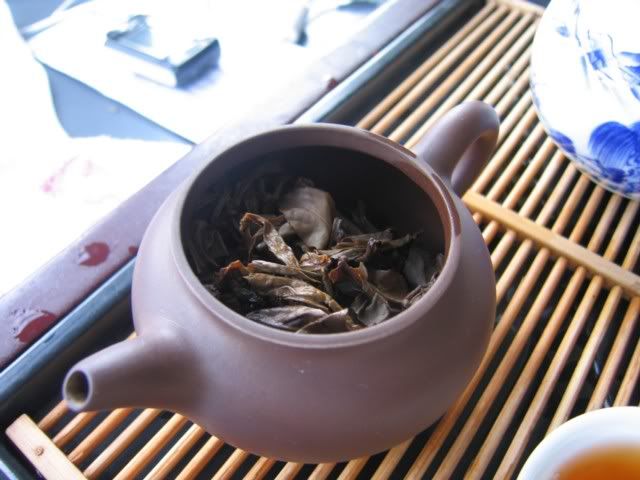

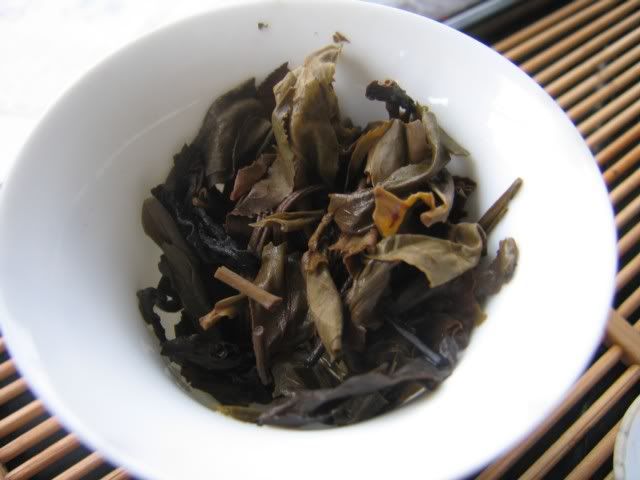
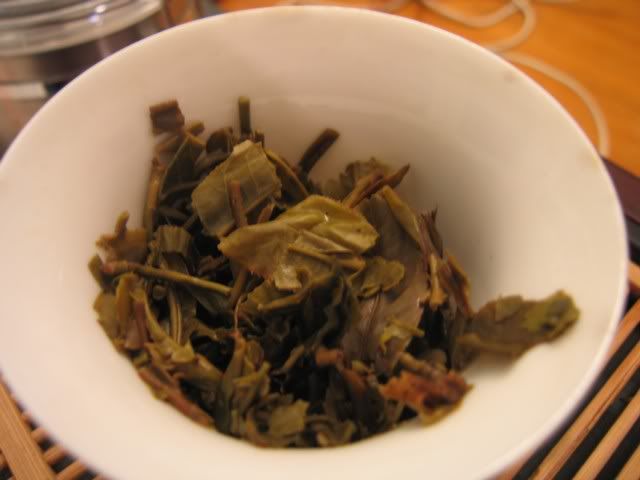
Amount of tea I used

7th onwards…. Hmmm, what happened? It’s really weak, and you can tell there’s not much left. I suppose 7 is ok, but I expected a little more…. I stopped at 8. It’s still got flavour, but it’s mellow and weak and not going anywhere even with 3 minute infusions. Time to wash the pot.
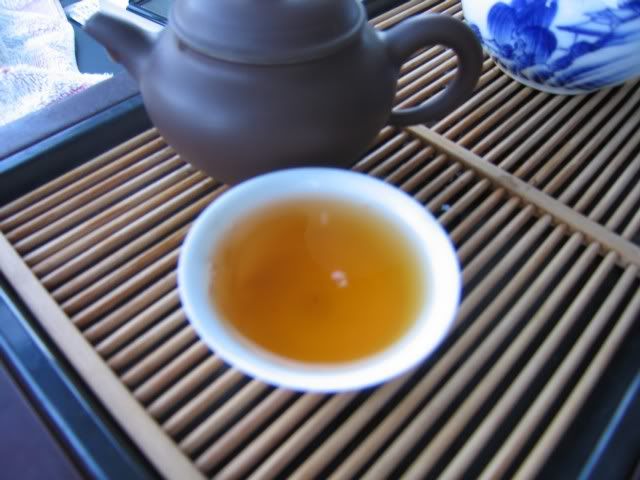

Tail end of things

Will I buy this again? Probably not. It’s decent, but not great, and I’m not sure if it’s worth this much money. It reminds me a little of the 30 year old loose puerh I’ve bought before from the Best Tea House, and from what I can remember, that was better. Regardless, that is cheaper, and this, while a good sample, is not a great sample.

Then again, perhaps with some age it’ll get better. I really don’t know, and that, unfortunately, is experiences and knowledge that I do not have right now. 🙁

→ Leave a CommentCategories: Uncategorized

Saturday May 27, 2006

May 27, 2006 · 2 Comments

I’m wavering, one tea per day from small yixing pots is hard. Gaiwans are bigger, and offer more…. ugh

Had my Beijing nongxiang today, oversteeped the 3rd infusion, came out slightly sour. Otherwise, it’s a pretty mild nongxing tea, as nongxiang teas go. The Best Tea House has a super fired one that’s rather strong, but it’s fun to drink and gives you a real buzz.

On a rather unrelated note, it is pretty interesting to see all the random visitors I get. There are people I know, but there are also people who I’ve never met in any way, shape, or form. To those of you (such as the Belgian and the Japanese visitor who seems to frequent here), hello! And thanks for reading 🙂

→ 2 CommentsCategories: Uncategorized

Thursday May 25, 2006

May 25, 2006 · 2 Comments

I’m a junkie….

No, I already know I’m a tea junkie, but I’m now a junkie to this site too….

Lots of good info, in quick succession. It’s a good resource for me since I plan on doing many purchases of puerh next year in China, where it’s nice, accessible, and cheap. Since many are sampled here, I can get an idea.

Continuing my lower-caffeine regimen, I brewed a rather weak dancong today….

→ 2 CommentsCategories: Uncategorized

Thursday May 25, 2006

May 25, 2006 · Leave a Comment

I am continuing my caffeine-lowering regimen, which means less tea. So I decided to drink a packet of the Xuefeng tieguanyin. It’s less than what I normally would use for qingxiang tieguanyin.

Brewing it today though, I found it to come out a bit sour. I don’t know what happened, but the first two infusions were sour. I tried a slightly shorter steeping time with slightly lower temperature, and that got rid of most of the sourness, but there was still a slight hint of it left. It also tasted a bit different after I’ve had days of the Fook Ming Tong stuff and a bit of the Beijing stuff. It is somewhere in between the two — less grassy than the Beijing one, and more fragrant than the Fook Ming Tong stuff, but in a strange way. It is a winter picked tea, so perhaps that explains most of it. The tea is also a little coarser in taste. Either way, it’s a curiousity.

→ Leave a CommentCategories: Uncategorized

Tuesday May 23, 2006

May 23, 2006 · Leave a Comment

While I didn’t overdose last night, I was rather buzzed and didn’t sleep till fairly late. Considering that, I decided today I’m going to go easy on myself… and drink some long-forgotten white tea. This is a White Peony from the Best Tea house. Cheap stuff, nothing to write home about, but a smooth, mellow tea.

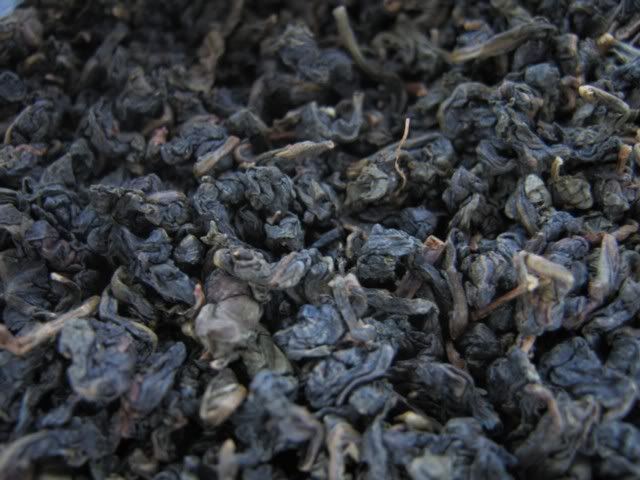
It’s basically dried tea leaves, mostly buds, but you can see how it’s not all buds here, and there are some broken leaves. Better grades are things like Baihao Yinzheng, but I honestly don’t think the difference in taste justifies the prices that they command. I’m ok with the regular stuff, especially since I rarely drink it.

White tea is now quite the rage, it seems, and everyone and their mom wants to sell you white tea, telling you it’s more healthy, blah blah blah. It’s only healthy if it doesn’t come with 40g of sugar per serving (and there being two servings in a bottle) and devoid of all sorts of “natural” and artificial flavouring. If people think drinking snapple white tea can make them healthier…. ugh

→ Leave a CommentCategories: Uncategorized

Tuesday May 23, 2006

May 23, 2006 · Leave a Comment

Had a little tea party with my students from my tutorial today (note: tutorial is Harvard-speak for a small, seminar like class, in this case with 6 students). We had a jolly good time, sharing three oolongs (a qingxiang tieguanyin, a jinxuan cha, and a dancong). Some liked the first, some liked the second, but I think the dacong came out the real winner. It is really quite an alluring tea, with nice, fruity fragrance and good body, while not being overpowering in the way a nongxiang tieguanyin can be.

I’m glad to have done it, and I will probably miss teaching this class, which has been fun. Smaller classes are better than large ones, but even then, a good mix of students is very important.

→ Leave a CommentCategories: Uncategorized

Sunday May 21, 2006

May 21, 2006 · Leave a Comment

More puerh tasting today.

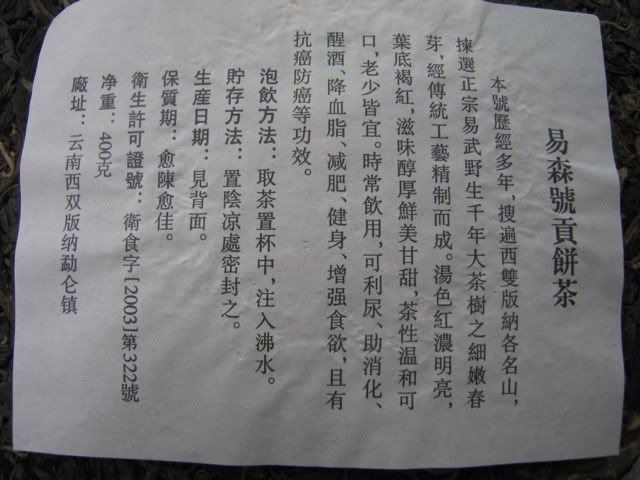
Yisen Yiwu Thousand Year Old Tea Tree cake… (yeah, right).

According to this info ticket in the cake:

It does everything except resurrect the dead.

On the back of the ticket they also conveniently stamped the date — which says 2003, April. So, this cake is slightly older than 3 years.

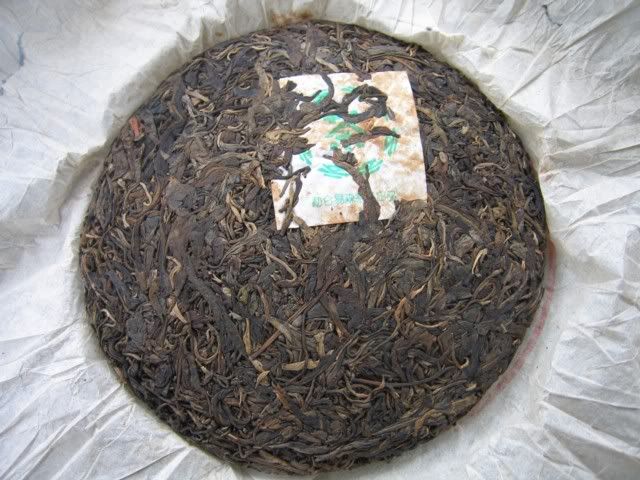
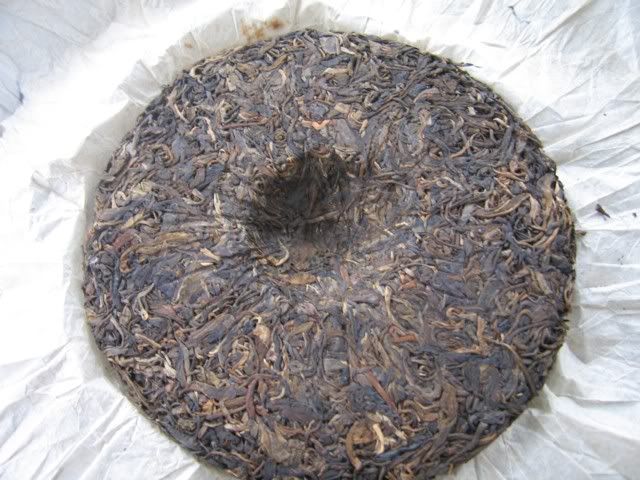
You can see the leaves are fairly big, as it should be given the claim that this is from old tea trees. The compression is not too tight — loose on the edges, although the center and the back are tighter. The colour is already turning from green to brown. The degree of fermentation varies. The dry cake smells… like green puerh. I took bits and pieces from the edges and brewed that. It is possible that this way I am tasting the slightly more fermented stuff than whatever may be in the middle of the cake.

Onto the brewing. I used my gaiwan, and didn’t use a whole lot of tea:

As I normally don’t when tasting a cake of puerh. Adding too much tea may just make it really bitter without any real effect, and masking the other flavours that are in the tea.

The first infusion:

Came out a little insipid. Little taste. Hmmm

Then it got better with the 2nd infusion onwards. I could definitely feel some chaqi coming from the cake. It is, after all, from older trees, and the bigger leaves do impart some qi. Smelling the lid of the gaiwan, I can sense the smoky flavours, but it’s not very present in the tea. The liquor is darker than I’d expect from a 3 year old, and is rather mellow in the sense that there are no sharp flavours that are sometimes present in cakes that are younger than 5 years. I do, however, have the feeling that it hasn’t been kept wonderfully well so far — and the price indicates that might be the case, as is the existence of little bits of white dots on a few leaves that may be mould.

The flavours early on are a bit of the smokiness, plus the typical woody puerh taste and maybe hints of Chinese medicine. Then on about the 6th infusion, I started getting something a little more fruity when smelling the tea, and the liquor also comes out slightly sweeter.

I never know what to make of the black leaves among the greener ones though. Is it just a particularly well fermented leaf? A mix of cooked stuff? It is not quite pitch black, but deep, dark brown.

It tastes a little like a less aged version of the brick my friend sent me. If it turns out that way, I’m fine with it. It’s not that expensive, so whatever — I’ll drink it up.

→ Leave a CommentCategories: Uncategorized

Sunday May 21, 2006

May 21, 2006 · 3 Comments

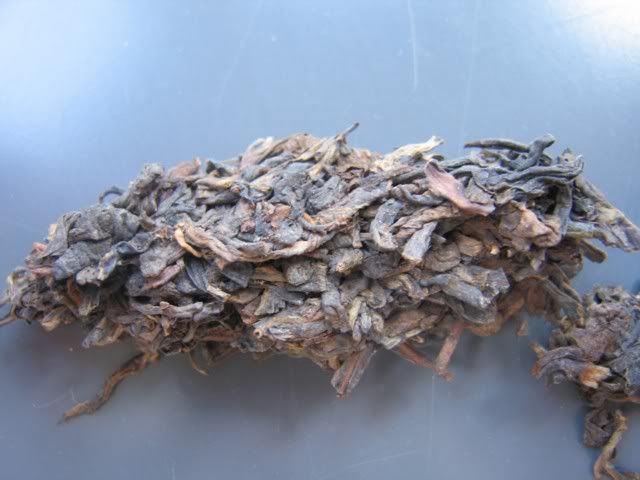
I am revisiting my aged puerh today, after drinking some of the cakes. It is a nice change of pace, and mostly very medicinal than anything else. The raw edge is certainly off in this sample, but the spicyness and the lack of a sweet finish tells you this isn’t cooked stuff, either. The grade of the tea itself is very low — you can see in the pics, there are lots of twigs and stuff that would look terrible, but the end product is not that bad. It isn’t a great puerh — but a very drinkable, everyday kind of puerh. I think it was kept reasonably but not exceptionally well. It certainly tells you that 1) looks can be deceiving in puerh and 2) bad grade tea doesn’t make for bad grade aged puerh.

→ 3 CommentsCategories: Uncategorized

Friday May 19, 2006

May 19, 2006 · 2 Comments

Nothing terribly exciting today, other than the fact that I drank some more of the Beijing qingxiang tieguanyin. After having had the Fook Ming Tong stuff for so long the past week during the water tests, I have to say the Beijing stuff is far superior in fragrance and body. The tea is simply better, with better, lighter notes and overall more cha chi. And, it’s probably cheaper (although the Fook Ming Tong is technically free, as it is a gift).

Just goes to show how you gotta go to China to get cheap, decent stuff — so long as you know what you’re buying. Can’t wait to go teashopping on Maliandao!!

→ 2 CommentsCategories: Uncategorized

Thursday May 18, 2006

May 18, 2006 · 1 Comment

I’m a greedy person, which is why I had two teas today. Sometimes, one just isn’t enough, especially when your pot is small.

I’m extra greedy, because the two teas are both new. The first one I opened is a nongxiang tieguanyin I got from Beijing on the trip in March. I’ve already talked about the qingxiang tieguanyin I got, but not the nongxiang one. I got 150g of this stuff at a fairly reasonable price, and figured it’ll be a good addition to the varieties that I have already. The Kung Fung Yung nongxiang tieguanyin tends to be a bit heavy and slightly overfired. The Athelier one just isn’t very good, and I’ve tried to dispose of it. This one is on the lighter side, with the leaves still brewing slightly green, rather than brown.

The taste is fragrant, retaining some of the characters of a qingxiang tieguanyin. They said it is from 1999, if I remember correctly. The firing wasn’t too heavy handed, and it is probably a good thing. There’s no hint of sourness. In fact, it’s a rather pleasant brew with some character. Not the best, by any means, but not bad at all.

But I didn’t feel that was enough. After all, my nongxiang tieguanyin pot is small. So, since I’ve been drinking some of my young puerh, I decided I might as well taste another one.

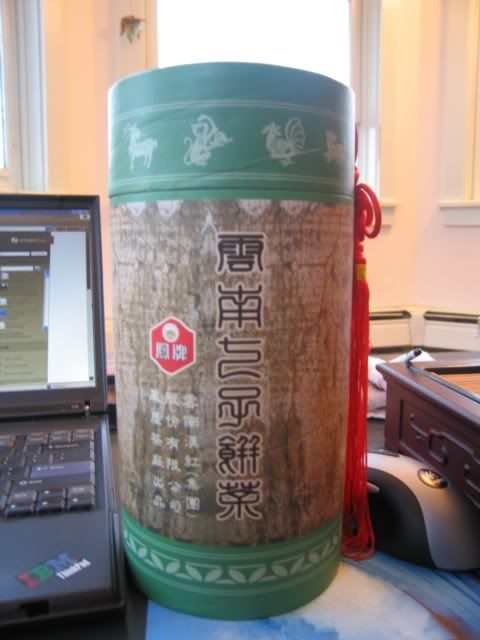
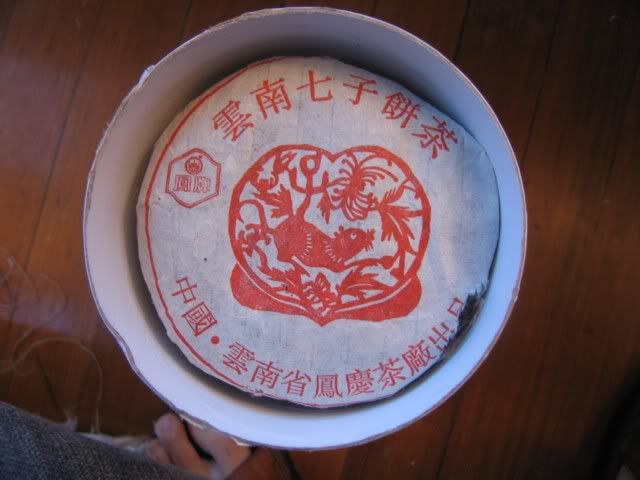
The one I picked is a cheap puerh I got from the Best Tea House. They are small cakes that came in a dozen — Chinese zodiac signs, although really it’s just a way to package 12 small cakes for sale.


The case — yes, that’s Teachat in the back


The wrapper of the first one — as you can see, coming from the Fengqing factory.

They were one or two years old when I bought them, and they’ve been sitting here for two years now, so all in all, about 3-4 years in age. I haven’t really touched them much since I got them, and this is the first time I’m trying them since my purchase.


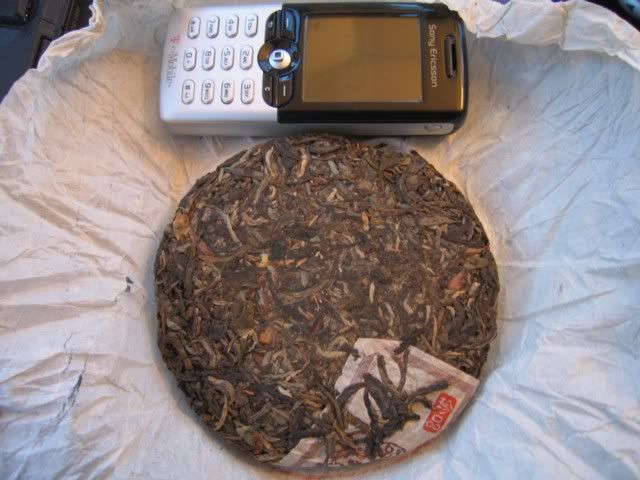
Cellphone used as a scale

The cakes are pretty small. I’m not sure how much they weigh exactly, but I’m guessing something like 50g? Like the Kung Fung Yung cake, this one is comprised of smaller leaves, although they’re not all buds (at least one of the leaves I brewed ended up being quite large — over an inch long). The compression is tighter than the Kung Fung Yung cake, but not overly so. I took bits and pieces off the first cake and made a cup of it.

The brew is slightly disappointing given the wonderful taste of the Kung Fung Yung cake I had two days ago. It is not nearly as fragrant, but still shares many of the general characteristics of the Kung Fung Yung cake. It is also a bit thinner, but then, I am not sure if it’s because there’s slightly less leaves in this cup than I used the other day.

It lacks a bit of cha chi and aroma, but again, it could be because I didn’t use enough leaves, not because it’s particularly bad. Of course, given the price differential, one would expect a difference in taste, and there certainly is that difference — anybody paying money would prefer the Kung Fung Yung cake over this one, hands down.
Since I have no idea how this one will age, we will just have to wait and see. Maybe when I come back from China, it will have progressed further and taste a bit better.

→ 1 CommentCategories: Uncategorized