A Tea Addict's Journal

Entries categorized as ‘Objects’

Old yixing pot

March 1, 2008 · 8 Comments

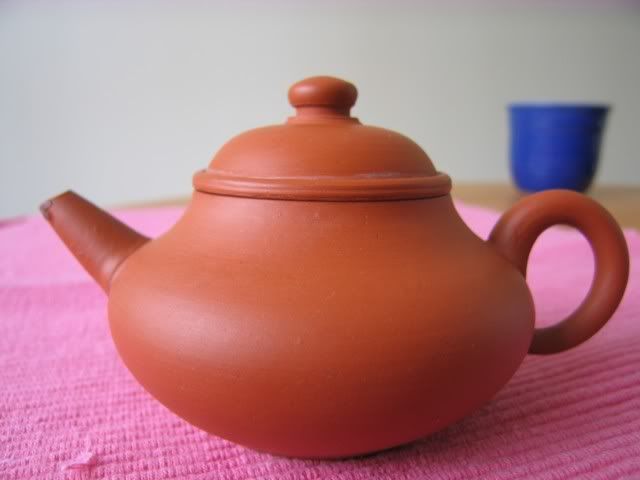
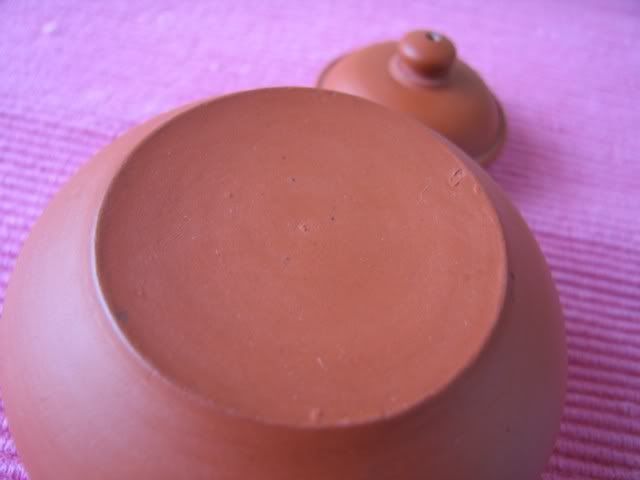
Among my recent shipment came this pot

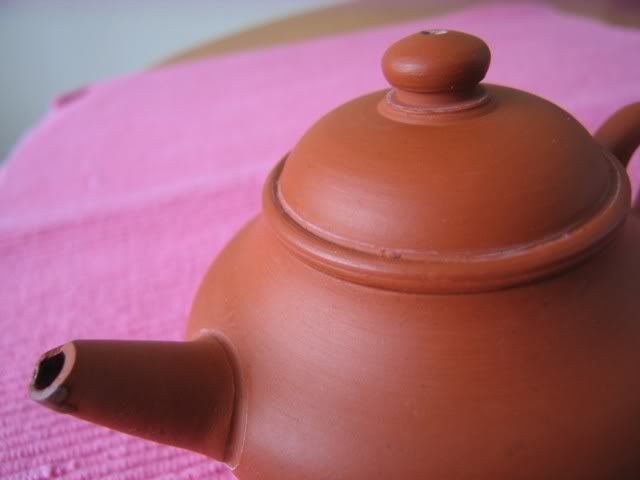
Which, after some careful looking, I think is quite old. The original reason I bought it was because it looked very much like a pot that I saw at Wisteria in Taipei. When I saw a picture of this pot it immediately reminded me of it — they’re not the same in shape or size, but they looked very similar. When I finally got it through the mail and examined it in my hand, it seems more similar than I originally thought — the texture of the clay feels very fine, yet there’s a certain coarseness to it. Sounds contradictory, but it’s not really.

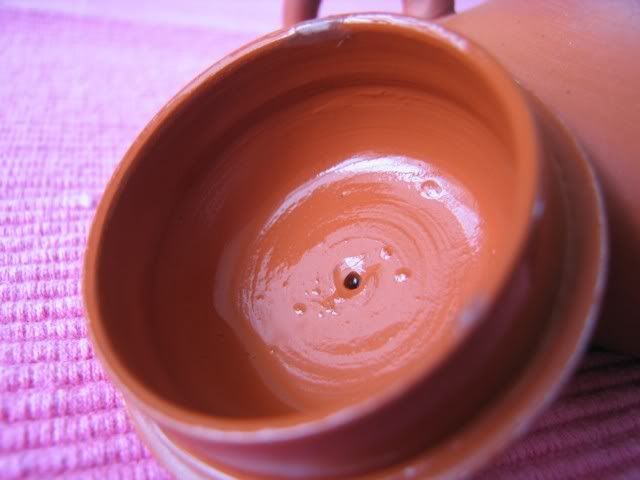
The most interesting thing is the lid

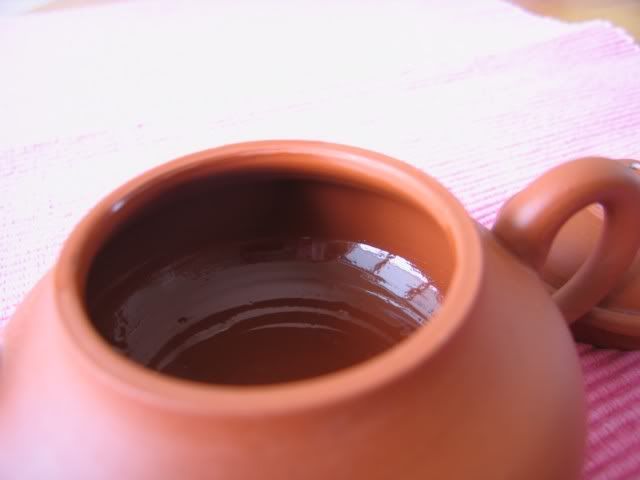
It’s not that obvious here in either of the pictures, but the colour of the lid is a few shades lighter than the pot itself. I’m not sure why that is. One possibility is that the person using this pot didn’t care much to season the lid. Another is that the lid wasn’t used much — possible if the pot was not used as a teapot, but as a shudei (water dropper for ink stones). You can also see how the interior of the lid is very rough — again, looking like the pot from Wisteria. From what I understand, Qing period pots that were made prior to the Daoguang era or so (roughly 1850) usually did not have their interiors “fixed”, i.e. they were left as-is. It was only after that that they had their interiors beautified by smoothing out the joint lines, etc. There’s an obvious joint line in the pot as well, although it doesn’t really show up in pictures very well.

Of course, it is entirely possible for fakes to fake the joint line, and all those other things…. but I don’t think anybody making a fake will do it as an unsigned pot with no name and such obvious problems, such as an air-hole that is a tad too small. Fakes are, not surprisingly, usually a lot prettier.

None of these, of course, makes a convincing case that this is definitely an old pot, but the clay and the work makes me rather inclined to believe it. Either way though… it’s been making good tea for me the past few days, and in some ways, I suppose that’s enough.

Categories: Objects · Old Xanga posts
Tagged: ,

Tokoname yaki

February 29, 2008 · 10 Comments

Is this a yixing pot?

At first glance it might be, but look closer

Maybe not?

The pot is a tokoname yaki, which are sort of the Japanese equivilent of Yixing pottery. They are widely used to make tea, and most of the time, the pottery comes in the shape of a typical Japanese kyusu, with a side handle rather than the back handle like this one. However, in the 19th century I believe some guy from China (IIRC he’s called Jin Shiheng) went to Japan and taught them how to make Yixing style pottery, and so nowadays there are pots that look like this — sort of Yixing like in their appearance.

The clay, as you can see, is a bit on the orange side of things. It’s very fine. The pot is thrown on a wheel, I think, rather than being molded like a Yixing pot would. In this sense, it sort of reminds me of Shantou pots from China, which are also of an orange colour clay and thrown on wheels.

This particular pot was extremely dirty (and thus extremely cheap), and after cleaning, I discovered that there’s a nasty crack at the tip of the spout. It’s still usable, but doesn’t pour very well. I bought it partly as an experiment to see the clay for myself, and to play around with it, eventually. There’s a Yamada Jozan (four generations of them now) who is the most famous of these potters who make such back-handled pots. Prices for those can be rather high because that line is basically designated as National Living Treasures in Japan… and I am personally not sure what the value in them may be, other than as art objects.

Regardless, one more toy from Japan.

Categories: Objects · Old Xanga posts
Tagged: ,

New tools, old tea

February 27, 2008 · 5 Comments

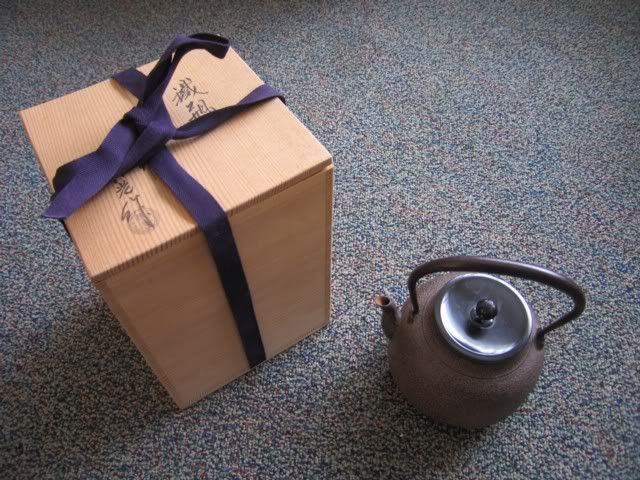
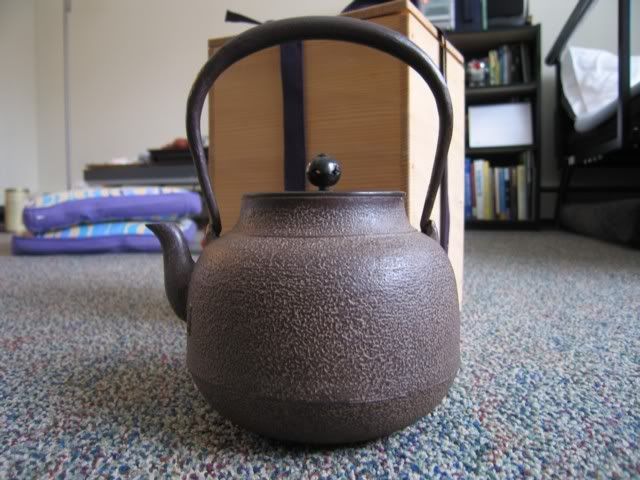
I got some new stuff yesterday through the mail, one of which is this

A new (for me) tetsubin that I bought a little while ago from Japan. The one I’ve been using, after much cleaning and what not, is still not entirely satisfactory. It’s basically too small, and the kettle is a little quirky to get right. This one, on the other hand, exhibits none of the problems I’ve had with the old one. It’s made by Sato Seiko about 30 years ago. The craftsmanship on it is much better than my more mass produced predecessor. The pouring is much more controlled, and the whole thing is easier to use, basically… not to mention bigger, thus less trips to heat up water fresh. I like it. The only problem, if there is one, is that it has absorbed the smell of the wooden box a little, but I’d imagine with some use it will clear up sooner or later.

The tea I drank today is the 2005 Xizihao Lao Banzhang, something that is long sold out at Hou De. I remember I had this tea almost two years ago when I first started blogging, and the tea tasted a bit green to me — I remarked something along the lines of how it reminded me of longjing or something, and that it had gone to my head. Mindful of the potential power of this tea, I went a little easy on myself. The result is a sweetish brew — the tea has aged a bit, methinks, and I with it as a tea drinker. The tea no longer tastes green, and the liquor is a bit orangy, rather than yellow. The tea, overall, is subdued…. not terribly powerful, but I never thought it was in terms of taste. I did feel some of that qi coming from the tea, but even that seems a little mellower. Enjoyable, but not mind blowing.

I don’t know if it’s just me, or if the tea did change that way. It’s hard to tell with just a sample. Also, since I’m using all new teaware, compared to my gaiwan, electric kettle, etc that I used last time, not to mention different water and two more years of drinking experiences, maybe all comparison is moot.

Categories: Objects · Old Xanga posts
Tagged: , ,

The gaiwan comparison

February 26, 2008 · 7 Comments

Since I mentioned it yesterday, today I whipped out my gaiwan and tried the same tea — the aged tieguanyin from my Taiwanese candy store, to see how the gaiwan fares.

The short version is: not too well.

I think there’s a temperature problem with the gaiwan, although I have a feeling that’s not the only issue. The tea came out a bit subdued — the aromatics and depth did not show up very much, although the throatiness of the tea presented itself strongly. The tea’s aromas were certainly lacking compared to the zhuni pot I used yesterday. Nor does it have the softness that I would get using my black pot. Did it have any redeeming feature? I’m not sure….

So, no gaiwan for aged oolongs. I knew this already, but this is a good confirmation.

I should note that I am not the only person to have tried something like this. Adrian Lurssen has written two pieces on the same subject of yixing vs gaiwan over at Chadao, dated Nov 27th and 30th. His results were more inconclusive, but I think it depends greatly on the tea in question. Gaiwans, I think, don’t do as bad with teas like greens or young puerhs, but I don’t drink a lot of those these days.

Categories: Objects · Old Xanga posts
Tagged: , , ,

Gaiwan brewing

February 25, 2008 · 1 Comment

I realized today I haven’t touched any of my gaiwans since I returned from Taiwan.

I remember I used to use the gaiwan for everything…. from greens to blacks. Gaiwan was my weapon of choice. Gaiwan was the only thing I’d use, pretty much.

Then slowly, I started using more yixing pots. I gradually bought a few more, and found them, somehow, easier to use. Maybe it’s because I will no longer burn my fingers, as I do once in a while with a gaiwan. Maybe they provide more aesthetic variety. Maybe they do make better tea?

On the better tea question, I am now quite certain that some yixing pots will make softer tea (whether that’s better or not is up to individual taste). I’m still not sure exactly what goes on in a yixing pot that actually changes the tea. There are many theories out there, from temperature retention (sort of true…) to pores in the clay (really depends) to seasoning (maybe true, maybe magic…. and also depends, greatly). Gaiwans, though, still give you an “honest” tea, without really messing with the tea in any particular way.

I’ve also basically ditched the fairness cup these days, especially after I acquired those Hong Kong cups that will hold a pot of tea, regardless of which pot I used. I find myself enjoying my tea more without needing to re-pour from the fairness cup into my drinking cup. That, I think, is entirely personal — somehow, the fairness cup feels artificial, almost lazy.

Maybe I should pull out my gaiwan one of these days and revisit one of the teas I’ve been drinking a lot recently, such as the tieguanyin I drank today. I wonder if I can tell the difference.

Categories: Objects · Old Xanga posts
Tagged: ,

Aesthetics and tea

February 18, 2008 · 5 Comments

I think the first thing one should make clear when talking about Chinese tea is that there is no real ceremony involved. I don’t think of gongfu drinking as a ceremony. It’s more like a particular way of preparing the tea, much like, say, drinking espresso is not a ceremony, it’s a kind of coffee. It bothers me to no end when people say yixing pots are part of the Chinese tea ceremony, because I don’t know what that is.

What about those tea brewing performances? Yes, well, those are, of course, some sort of “ceremony”, but I find those things generally very stale and boring, and entirely contrary to the whole purpose of Chinese tea making, which is very singularly focused on the extraction of the best drink possible out of the leaves. Of all the stuff that were written in the past (in Chinese) about tea, I have seen very, very little that has anything really to do with the form of tea making. Rather, it all has to do with the purpose and the result of tea making — how do you get a better cup out of the leaves you’ve got (and in many cases, how do you get better leaves in the first place).

This, I think, is in quite a sharp contrast with the Japanese Chado, which is quite concerned with the aesthetics as well as the actual tea itself. In some ways, I sometimes even feel like Chado has things backwards — sometimes the form and the aesthetics pleasures of performing/participating in the ceremony is much more important than the actual cup that you’re drinking. A lot of attention is paid to the space, the setting, the equipment… all sort of things.

Now, I’m not saying that’s wrong. I’m just saying that’s different. I do think that if one is too concerned about form, the actual tea being made suffers a little. It’s most obvious when I see those tea “performers” making tea with that twist of the elbow or the little “presentation” they do with the pot…. all the while I’m just thinking “if I want to look, I’ll go to a chashitsu and get a lot more out of it”. I just can’t handle the overly stylized Chinese “ceremony”.

That’s not to say, of course, that we should ditch all sorts of aesthetic concerns either. There’s I think a fine balance between form and function, and in the case of Chinese tea, form should follow function (call me Modernist). I believe that one should make one’s tea making space as comfortable and beautiful as one would allow, but the beauty or decorations or whatever should not get in the way (not too much anyway) of the tea making.

I’m currently debating whether or not to ditch the tea tray I use to collect waste water, and switch instead to a wooden tray with a bowl to hold any runoff for the pot. The downside is, I need to have another place to dump the water, eventually — basically after every infusion, but it does also mean that there will be water sitting under the pot while I’m brewing, which might not be a bad thing. The upside, of course, is that it’ll be prettier, and I’ll also have more room to do things, instead of feeling constrained by the tray right now. Which leads me to an entirely opposite position — the environment we make our tea in greatly affects us, as the Japanese have obviously figured out. If the place is right, the tea will feel better, even if, objectively, it’s not. I still think form should follow function, but maybe if something is too function, it loses its magic.

Categories: Objects · Old Xanga posts
Tagged: , ,

Seasoning pots

February 17, 2008 · 13 Comments

So yixing pots are supposed to be seasoned over time as you use it… but how exactly does that happen?

I’ve been more than puzzled by the exact process. Supposedly, the pots will slowly gain a shine as you use them. You’re supposed to use a wet cloth to sort of buff the pot, basically, after using them and while they’re still hot, ideally. But there are many, many theories out there about the way you raise a pot. Some say you should just leave leaves in them. Some say you should clean them out right away. Some say it’s good to polish them often. Some say it’s good to not do it very often. Some say it’s important to use only one tea in them. Some say it doesn’t really matter how many kinds of teas you use in your pot.

The information has been, on the whole, contradictory. I cannot help but feel though that much of it is magic, and not really true.

What I can say is this — that over time, at least for the pots that I have raised myself, they do slowly gain a shine. I usually pour the wash over the pot while I am brewing my first infusion. Otherwise, I just pour hot water over them. I rarely rub them with a towel — maybe once a month, if even. I don’t usually leave leaves in them over night. I clean them out after using them. The most obvious change happened to my young puerh pot, which was fresh from the kiln when I got it. Now it’s actually got quite a sheen to it after about a year’s use.

There is also the matter of the clay’s quality. I am currently running an experiment on a cheap pot that broke on its way from Taiwan to here. Basically, I’m soaking it in my spent tea leaves every night before I go to bed. I have noticed that it started doing what they call “spitting black”, basically, black spots that show up on the pot. They don’t go away. Supposedly, from what I’ve read online, they are the result of under-firing of the pot. The pores are too big, and the iron ions of the tea (supposedly one of the things in it) will infiltrate these pores and somehow a reaction happen and it turns black. All pots eventually do this, but really underfired ones are more likely to do this, and at a faster rate.

This is only what I’ve read. I don’t know if it’s true. It’ll be pretty interesting if it were true. The black spots, I should add, are quite numerous. Maybe I’ll show you all a picture when I get better lighting. The thing though is that before I used it, the pot doesn’t look that different from many other ones. I could sort of tell it was slightly on the low density side of things, but it was not obviously so.

Anybody got pot-raising stories to share?

Categories: Objects · Old Xanga posts
Tagged: , , ,

Cups

February 16, 2008 · 3 Comments

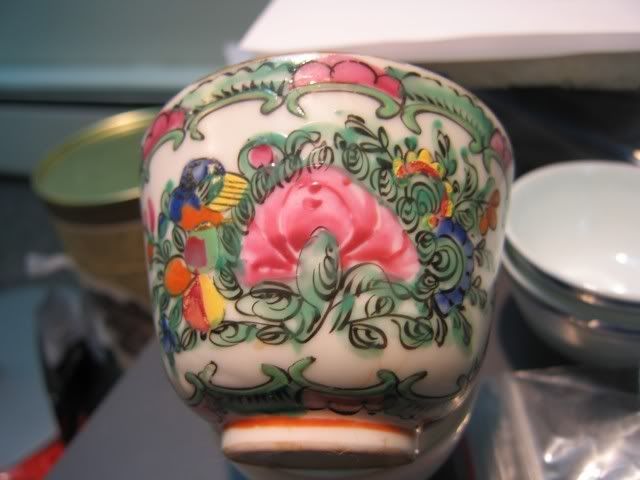
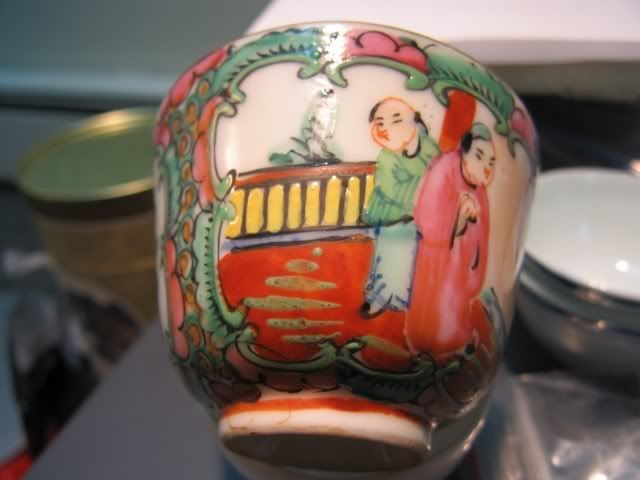
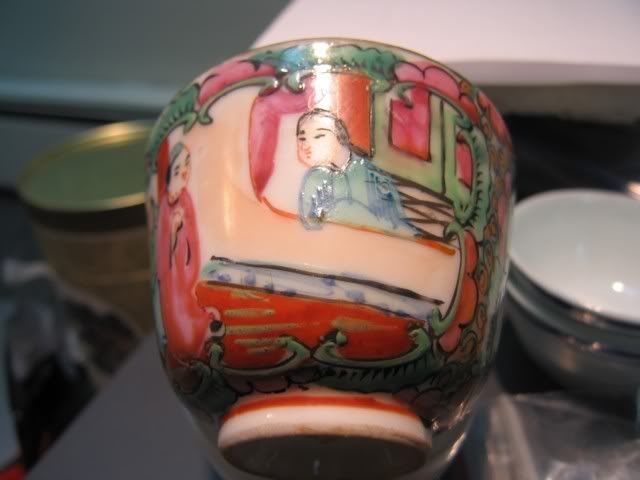
I bought a new set of cups recently — a set of 4. Here’s one

Hand painted, methinks, since they are all substantially different (but same patterns). I think it’s actually quite old, at least a few decades. Stamped “Made in Hong Kong” of all places.

They’re actually big — almost 3 inches in diameter. I like bigger cups personally. I find not having to use a fairness cup much more convenient and just over all being a nicer thing to do. The presence of those fairness cups, now that I think about it, really detract from my enjoyment, for some odd reason. I must say I don’t find much of a difference between different kinds of cups, but once in a while, I do think different cups make a difference. Very small cups and larger ones do make a difference in how you perceive the tea — I think mostly it has to do with the nose and whether you’re smelling it while sipping, or not.

But I’m enjoying these cups today, drinking my aged dongding. One infusion, one cup… just the way I like it.

Categories: Objects · Old Xanga posts
Tagged: ,

Buying teapots online

February 11, 2008 · 8 Comments

Since most of my readers are not located in places where there are shops that sell anything other than the worst of the worst yixing teapots out there, online is pretty much the only place where one can buy such things.

So online is pretty much the only option. The other is to find friends who’ll do it for you, or fly yourself over to China/Taiwan and buy them yourself. Not very good options, especially since I think teapot is a very personal thing. What works for one person rarely works for another, and there are so many shapes and sizes out there that individual preferences are bound to differ. Buying teapots for other people, as I’ve learned, is a dangerous business.

That leaves online stores and auctions. What I witnessed tonight on Ebay was a frenzy of bidding for a series of yixing pots that some seller in Florida put up. It must’ve come from somebody’s collection of yixing pots. There were some that I am sure were Republican period pots, and I considered joining in the fray — until the fray got too hot for me really quickly. It ended up that a few of them went for something like $500 per pot. Others were maybe more in the $100-200 category. While some of these are genuinely old pots, none of them were in the fine yixing category. Rather, they were commercial stuff, made very roughly, and generally sold for commercial purposes rather than as objects of art or even personal pleasure. It was a utilitarian thing. An equivalent would be if some of these awful $10 Chinatown pots these days are going on auction 100 years from now… not exactly stuff you really want for making tea in.

What I did learn though is that there is a substantial amount of interest out there for yixing ware. One of the bidders on some of the pots have bought dozens of them from Ebay already. Most of them, in my opinion anyway, are far, far overpriced. Others seem to only dabble in pot buying, while interspersing their purchases with LV bags, clothes… and whatever else suits their fancy. Of course, everything is fair on Ebay. Unless the seller deliberately mis-states information regarding the item, which they tend not to do by using qualifiers such as “I think this is…” or “probably 19th century…” and that kind of thing, they are not liable.

Auctions in Asia are not necessarily any better. Those in Taiwan, for example, are numerous in listing, but most of them are rather sub-par in quality, obviously fake, or both. I’ve bought a few pots through that route. If it’s not too expensive, and the pot looks/feels ok, it actually is not a bad place to get a few decently made pots, as long as one spends a lot of time trolling the sites and sifting through the garbage. Then there are the highly priced, “antique” pots. Whether those are real or not is hard to say, and without having seen them in person, risking large sums ($500+) of money on one single teapot is almost crazy.

Aside from the sometimes rather trecherous path of auction, trecherous both because of the possibility of inauthentic goods, and also of the risk of being carried away by the passion of the moment (“I must have this pot!!!”), the other option is online stores…. which offer much more peaceful means of obtaining pots.

Yet those are not without risk either. Increasingly, I’ve noticed that the prices of these things are generally quite high… higher than what I remember, a few years ago. I am personally still apprehensive about spending much money on pots that I can’t see in person, but I speak as somebody who generally has access to other avenues. I suppose buying pots from an online vendor, the first thing you want to know is if they have a return policy. Pots don’t always work out in person. I’ve received one or two that looked not nearly as good as the pictures shown, or the clay texture feels funny once you actually get a hold of it. I am also weary of claims of old age. Taiwan probably has the highest concentration of fake antique pots in the world, mostly because of the big boom in the 80s that created huge demands and made faking pots really worthwhile. I’ve seen heated arguments in Taiwanese forums that are quite fraught with claims of authenticity or otherwise. Honestly, they all look pretty good, but supposedly, those who are really in the know can tell.

Sometimes though, I wonder if it’s not just for bragging rights — “I can tell better than you”, or “mine’s real, yours is not”. I used to view all this with amused cynicism, preferring to stay with the non famous maker, pedestrian pots that served the purpose of making tea. At the end of the day though, some pot, somewhere, will call out to you, and you too, will take the plunge…. that’s what I discovered the expensive way.

Categories: Objects · Old Xanga posts
Tagged: , ,

Water again

January 31, 2008 · 8 Comments

So I’ve been using the tetsubin to make water that I then use to brew tea. How has it turned out?

Pretty well, actually.

The tetsubin does make the water seem a little softer, instead of having that sharp edge that a stainless steel water kettle will provide. It also makes the water a little heavier. I’ve found that for my aged oolongs, which are my tea of choice these days, it means the tea comes out a little more flavourful. The iron ions or whatever are drawing stuff out of the tea. Today I had my aged tieguanyin from my candy store, and it came out particularly strongly in a way that wasn’t really true when I had this tea a week or two ago.

That said, it might interfere with certain types of tea, especially green teas, if the water is used for that. It will make the colour of the tea darker, and the flavour will be also darker accordingly. That might not be ideal in the case of, say, a good longjing where all you want is that light and crisp bean taste. You won’t get that with this kind of water.

One practical problem has been the size of this little thing — it’s a bit on the small side. Three infusions, and I need a new pot of water. That is a slight problem, and since boiling water on the alcohol burner takes forever, I need to go to the stove, heat the water up, and let the alcohol burner do the last bit of boiling. It’s not an ideal situation, but it’s the most sensible one. Curiously, the lid is actually very air tight. It’s fine when it’s on the alcohol burner, but when heated on the stove, it seems like the thing was never designed for such a high level of heat and water can start spewing out because of the lack of a vent on the lid (mostly because it’s such a flat thing so the spout is only slightly higher than the body). Pretty interesting.

Categories: Objects · Old Xanga posts
Tagged: , ,