
I went and saw the movie Ratatouille today. A thoroughly enjoyable movie, and I would recommend everybody of all ages to go see it. In the movie there’s a character, Anton Ego, who’s a food critic who revels in being negative. This character made me think. It is easy to become simply critical of everything one encounters when it comes to tea, but it is important to not lose sight of the joys of drinking, and the hard work went into the making of the tea that we drink. Much of the tea out there are mere products of a factory, made with machine and devoid of any real soul, but others are crafted by hand, made with an attention to detail not unlike a cook does with raw ingredients for a dish. They size it up, they see what they’ve got, and then make the best of it. There is, indeed, much joy when one can truly praise something with no reservations, but even when the are criticisms to be made, the critic could only do so because somebody has bothered to make it. However, tea, in its final stage as a liquid to be drunk, is actually a symbiosis of both its creator and its critic. While we are evaluating the tea that was made by somebody else, we are, at the same time, evaluating our own rendition of the leaves that were given to us. In that sense, the critic is also a participant in the process of making the tea, and perhaps that’s why it is even more delightful to drink a great cup — both as the critic who delights in enjoying it, and as the co-creator who made it.
Thoughts after a movie
July 13, 2007 · 2 Comments
→ 2 CommentsCategories: Misc · Old Xanga posts
Tagged: musings
Back to the regularly scheduled programme
July 12, 2007 · 1 Comment
After almost two weeks of traveling, finally I’m settling down, at least for a little bit before I go again to Taiwan. Now comfortably situated in rural Ohio, I can finally get back to drinking tea that isn’t “100% leaf tea”.
Before I did that though, there’s the issue of water. Ohio’s not known for great drinking water. When I went to college in northeast Ohio, I remember the first sip of water I had there on the first day of having gotten to the school was very memorable — it was nasty. It tasted like swimming pool water. Having arrived from a city where one could get crisp, great tasting water straight from the tap, it was a big change. I eventually got a Brita filter, which served the purpose of getting rid of the foul chlorine taste, but it was still bad water.
I was reminded of the water problem here when I bought a big jug of “White Oak drinking water”. I thought it would at least taste ok, but I forgot to check the source — it’s apparently from an artesian well in northeast Ohio. Drinking it… it was… salty. I got more thirsty drinking the thing. A great way to sell more water, I suppose, but probably not good for me. I eventually ran all that through my Pur filter (which, by the way, I think makes much better tasting water than Brita). It tasted much better… sweet, not salty. We’re ready to brew.
I brewed up the first maocha I bought at Maliandao when I got there last year… sometime in September. I don’t actually remember where the maocha is supposedly from.
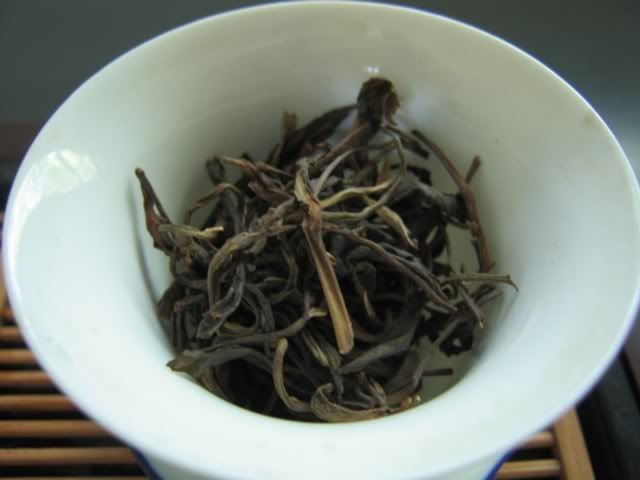
From the looks of it, it’s a six mountains maocha, but from the taste, it is not Yiwu or Manzhuan. Whatever it is, it has been sitting in my tea storage unit in Beijing for almost a year now before I took it with me to travel. I drank it on the trains to and from Shanghai, and also on the plane back to the US, each time in a cup with some hot water. It was nice and sweet, with a minty feeling, but I haven’t had it in a gaiwan for a long, long time. It’s time to try that.
The tea, as you will notice, is of a decidedly dark hue when brewed.
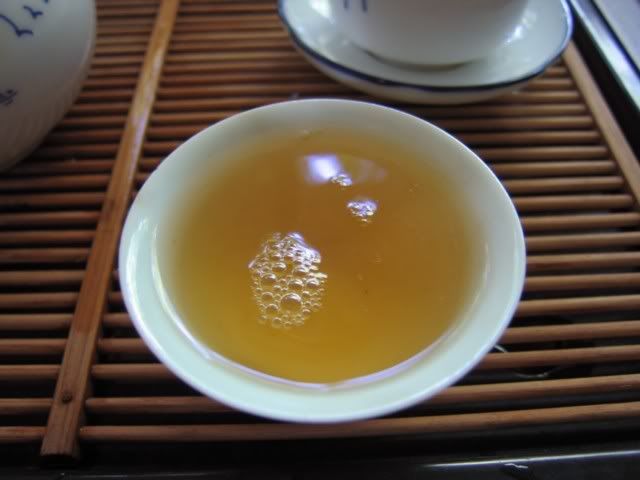
Colour wise, it looks very aged. In fact, I’d say that even when drinking it, it feels a bit aged — I think it can easily fake it as a 4-5 years dry stored tea. The taste is sweet, mellow, with some throatiness and not very bitter at all. Bitterness show up if I try to overbrew the tea, but for the most part, it’s very subdued. It’s lost a lot of the very green taste that you’d expect from a very young puerh, and starting to gain something like an aged dry stored puerh. Perhaps this is proof that Beijing storage, so long as it’s not overly dry, can be quite good?
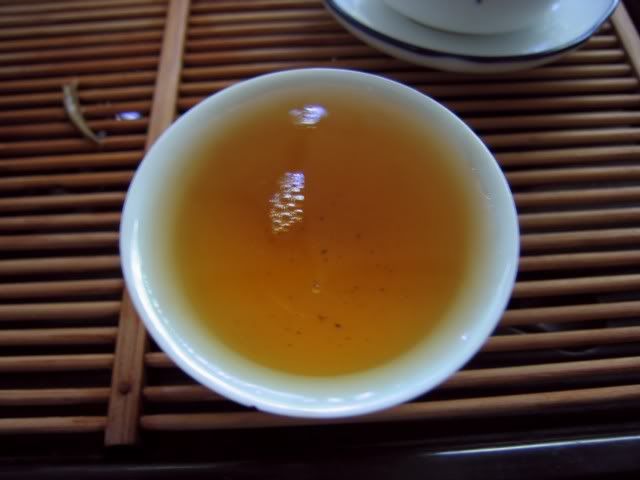
When I overbrew the tea, the colour comes out even darker, with a stronger sense of bitterness, but no roughness. In fact, the tea is smooth throughout, which is a very nice thing. It moves from being a bit minty to being somewhat fruity, but not in the same way that the mystery sample A was fruity. Here you know all along that this is a puerh of some sort, only that the fruity is there in the back when drunk. The tea has good endurance. It yielded many infusions, and when I brewed the last few as hour long brews, they still came out tasting rather good despite the abuse.
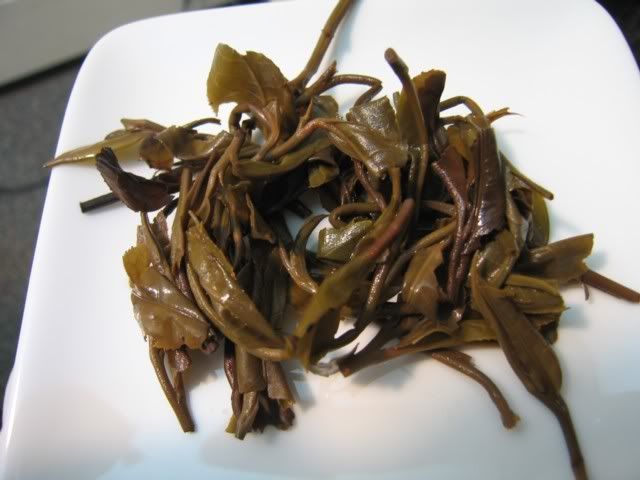
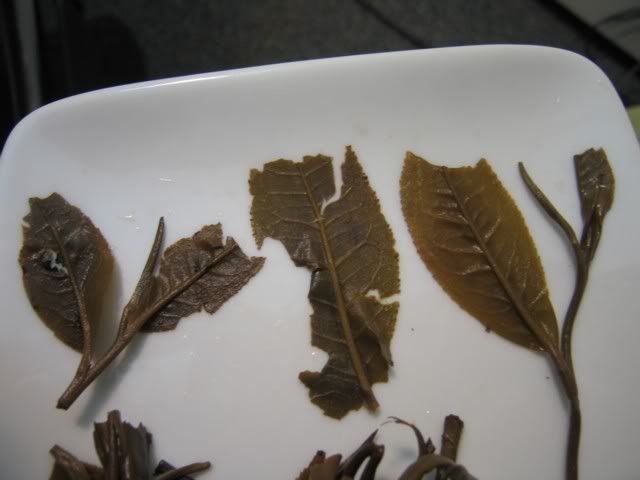
The leaves are a bit broken after all the traveling, but still keeping mostly to their original shape and not too chopped up. I must say I’m rather pleased by the tea. I know it didn’t taste like this when I bought it, although I no longer remember what it tasted like. I am now kicking myself for not buying more of it at the time… back then I think a kg of it was maybe half the price of what it would be now. Oh well….
→ 1 CommentCategories: Old Xanga posts · Teas
Tagged: young puerh
Welcome to Ohio
July 8, 2007 · 8 Comments
Well… sorry for the lack of updates, but as you have probably gathered, I’ve been rather busy moving from place to place. Finally, I’ve arrived at where the trip is about to end — Ohio. Took us a week to get from Beijing to Ohio. After driving for about 12 hours, we’ve gotten to Mount Vernon, Ohio…. and staying at a hotel for the night, look what greeted us when we got into the room.
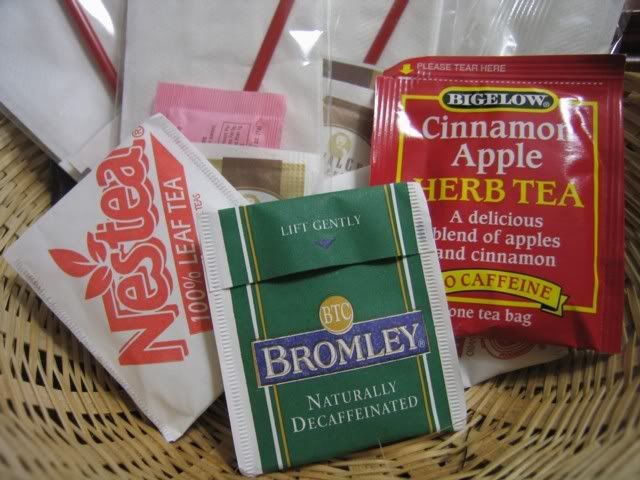
Yum. I can’t decide if the 100% Leaf Tea (is there tea that isn’t 100% leaf?) is better, or if I should go for the naturally decaffeinated tea (how can tea be naturally decaffeinated?). Cinnamon Apple… I know not to go there.
I decided to drink the loose wet stored puerh that I brought along. Thankfully, they at least have hot water that isn’t contaminated by coffee.
→ 8 CommentsCategories: Old Xanga posts · Teas
Tagged: teabags, travel
Long drive
July 7, 2007 · 2 Comments
Running around like a madman, trying to finish up all the errands we need to run so that we are ready for our rather long drive tomorrow to Ohio, where my girlfriend will be for the next year. I tried another Keemun today, from Karma Cafe in Cambridge. The tea was insipid, and far worse than the Tealuxe version. I know that I haven’t really spent much time on many other kinds of tea aside from young puerh for the past few months, and I feel now it’s time to revisit some old favourites and the like.
I’ve been poking around teamap to see whether or not there are places that sell tea around where she will be. Seems like slim pickings. Seems like my own stash of tea will come in handy when I come back to the States in 2008.
So the traveling continues….
→ 2 CommentsCategories: Misc · Old Xanga posts
Tagged: black tea, travel
Whittard of Chelsea
July 5, 2007 · Leave a Comment
I went to Whittard of Chelsea today, recently opened on Newbury Street in Boston. I remember when I first got interested in teas, I had some Whittard Darjeeling that I liked. Walking into the store, it wasn’t quite what I imagined it to be. The teas they had were mostly blacks, with some green or oolongs thrown in, but they were, by and large, very basic stuff. Most of the store was actually teaware of various sort, mostly of the very big ceramic pot kind. I must agree with DH that they’re not that impressive. They even had…. coffee… and some truly fantastically amazingly expensive coffee machines. Does a $1200 machine brew a better cup than a $700 one?
I think for the next few days I might just experiment with drinking various keemuns from various places. I had a keemun “Haoya B” from Tealuxe today…. must say it has nothing to do with the keemun I bought, almost. It’s more smokey, and less sweet. There’s a touch of vanilla taste in it. With a place like Tealuxe, one can never quite tell if it’s contamination from the next bin over.
→ Leave a CommentCategories: Old Xanga posts · Teas
Tagged: black tea, shopping
Plane tea
July 5, 2007 · 6 Comments
Why are teas on the plane so bad?
These days they put supposedly ok coffee (Starbucks) on planes, no doubt because they get a good deal from Starbucks so that they get publicity. However, the tea they serve is so, so, so bad. On my flight from Beijing, the food tasted ok, but the tea…. my god, coming from China, you’d think the tea would at least be palatable. Nooo, they serve those lovely tea powder type thing, the ingredients of which I still haven’t figured out. What exactly are those? They’re the same thing you get from cheap Chinese restaurants in the States. At the price of a dollar a kg for the cheapest green tea out there, you’d think they can afford something like that. Apparently not.
I promptly got myself a cup of reasonable English breakfast from Peet’s as soon as I landed in SFO. Too bad I couldn’t brew my own tea.
More traveling in the next few days before I get to settle down anywhere. I have a feeling it’s more teabag teas for me… in various forms. Sigh.
→ 6 CommentsCategories: Misc · Old Xanga posts
Tagged: travel
Traveling
July 3, 2007 · Leave a Comment
Flying back to the US tomorrow…. so not much time or opportunity to drink tea today, or yesterday, or tomorrow…
Drinking some loose maocha in a cup works well on the train though. In fact, I think that’s my favourite these days when traveling on some sort of mode of transportation that takes more than an hour or two.
I guess you won’t hear from me until I get back to Boston and in some semblence of consciousness.
→ Leave a CommentCategories: Misc · Old Xanga posts
Tagged: travel
Restaurant teas
July 2, 2007 · 2 Comments
Yesterday was the 10th anniversary of the return of Hong Kong to China. It’s been 10 years already, even though it seemed only like yesterday when the handover ceremony took place on a very rainy night. There were many things that set Hong Kong apart from China. There still are, even after 10 years. One such thing is the way tea is served in restaurants.
In Hong Kong, if you go into a Chinese restaurant or a Hong Kong style restaurant serving localized western or Chinese food (typically known as “cha chan teng”*, literally tea restaurant), tea is automatically served. The type of tea served depends on where you are. If you walk into a usual Chinese restaurant, the tea served is determined by you among the usual selection of “polay (puerh)”, “soumeh (longevity brow, or soumee, etc, a white tea)”, “teek guoon yum (tieguanyin)”, etc. You pick among the ones they have. In a “cha chan teng”, it’s usually some severely watered down red tea. It’s more like flavoured water. Tea is often free, or priced fairly low with a “tea and (Chinese) mustard” charge on the bill. It’s usually the same no matter what you order.
In China, however (with the exception of Shenyang, interestingly enough), teas have to be ordered. Even at pretty bad restaurants, the teas are often quite expensive, often rivaling a main dish or more. A pot of puerh can often cost you 50 RMB or even 100 (at the fancy places) even when it’s just a really bad, insipid cooked tea. I’ve been to places where the whole meal for two costs maybe 200 RMB, and a pot of tieguanyin would cost you 250. They’re almost never worth that much, and very overpriced. It makes ordering tea a real hazard here, without first checking the prices. You could be adding a lot of cost to the food bill without knowing it, and not getting nice tea in return. I often never order tea here at restaurants, but eating without drinking some tea makes me feel like I’m missing something.
Tonight, for example, as we’re having a dinner gathering with a few other grad students from my school here in Shanghai, we ordered a pot of longjing. I think it was something like 50 for a pot, but the tea we got wasn’t even longjing. It was at best what they would call a “Zhejiang longjing”, which basically means super low grade longjing that is merely a green tea, and called longjing for the simple reason that they’re grown somewhere in Zhejiang. Everybody noted how cheap the tea is. The food was good, the tea was not. It’s a shame that even when charging somebody for the tea, they couldn’t give us something slightly better.
I hope that eventually, China will have restaurants that start offering good tea for not much money (at least proportional to the quality and not outrageous). Right now though, I’d advise anybody coming here to avoid teas in restaurants.
*This is non standard romanization, as I am merely trying to replicate the Cantonese sound and not following any romanization scheme. Besides not knowing any well enough, there are a few competing ones and I feel that none of them make intuitive sense for people who aren’t already familiar with Cantonese.
→ 2 CommentsCategories: Information · Old Xanga posts
Tagged: musings, travel
A productive tea gathering
June 30, 2007 · Leave a Comment
I had tea with L today. Also present was a Taiwanese gentleman who apparently is quite an important man in the Taiwan tea business. We had a long discussion on various topics around tea, from puerh to green. The guy definitely has experience, and you can tell he knows what he’s talking about. Much of it is just him lecturing, since we all know so little about tea production.
One thing that definitely comes across is that knowing about how tea is made is essential for a higher level understanding of why a tea tastes the way it does. Being able to say “this tea is astringent because so and so did this during production” is very important. For all types of tea, there’s a different set of rules, but there are also common things that are true for all teas. It is obvious that knowledge from one kind of tea will transfer, at least somewhat, into others. This man, for example, gathered a lot of data and knowledge from individual farmers and tried his best to improve Taiwanese oolong. Everything from the wind direction, to the specific hour of the picking, to the location of the slope, soil type, etc etc are all important things to consider, and the way one processes a tea will change depending on any one of those factors. Whether a tea is good or bad depends greatly on whether or not one is able to grasp all of these variables and make the tea come alive, a term that he stressed throughout the day.
What’s also important is that I’ve actually never heard of this man before, and I doubt few outside the trade has. There must be many such low profile tea makers out there who are just really knowledgeable. The people who know tea best are the makers, and all pursuit in tea, ultimately, goes back to the production process. I wonder if it’s ever possible to learn so much, without being a producer myself. But it’s a nice thought and certainly one goal to aspire to.
→ Leave a CommentCategories: Misc · Old Xanga posts
Tagged: friends, musings, Taiwan oolong
Maocha in a cup
June 29, 2007 · Leave a Comment
I spent most of the day on a train from Beijing to Shanghai. On the way, I drank a maocha I bought way back when I first got to Beijing. I think I must’ve bought it on my second or third trip to Maliandao. I remember getting 100g of it, wondering whether it will age well, or if it’s good at all. I knew very little about maocha at that point, having not tried any before. It was all an experiment.
Almost a year later, I am brewing it, grandpa style, in a paper cup with train water. Unfortunately, I packed the cable for camera-to-computer in my luggage that I left in Beijing, so no pictures… but the tea is surprisingly sweet that way. Of course, I didn’t use much leaves. Using too much leaves will mean it will get nasty, bitter, and astringent. The key to making young puerh palatable, at least in these long, uncontrolled infusions, is to use little leaves and not quite boiling water. Then, almost everything tastes good.
The leaves are very thick, and the taste reasonable. It’s not too strong, although there’s some throatiness to the tea. I think it’s fall tea, or possibly summer tea. It’s definitely not spring picked. I need to evaluate it more properly in a gaiwan under normal conditions to be able to say anything definitive about it, but as a drink to pass the time on a train ride, it does its job admirably well. At the very least, I don’t think this is green tea puerh and should age.
→ Leave a CommentCategories: Old Xanga posts · Teas
Tagged: grandpa, travel, young puerh


 RSS - Posts
I took you at your suggestion and have been reading some of your old post-Covid posts. I haven’t been to…