A Tea Addict's Journal

Tea spirit… in practice

September 1, 2007 · 3 Comments

In a recent entry Hobbes has talked about the fact that some tea companions are better than others, and speculated as to the reasons why that is so. Today I had an interesting experience that made me think of this very topic.

I went back to the Yongkang area, since I haven’t really explored a lot of it yet, and there are places that were on Corax’s list of places that I haven’t visited. Why not? It’s a saturday when stores are still open (many shops close on Sundays in Taiwan) and the library is not open today.

I was tasked by a friend to look for some aged baozhongs specifically, so with that in mind, I went and hunted.

The first place I stopped at was Yetang, a secluded little place tucked into a back lane in the Yongkang area, completely unmarked, and impossible to find unless you knew the exact address. The place was a little dark, tastefully decorated, and very calming. You do feel like you’ve walked into a sort of urban sancturary, with the cups lining the wall and the dim lighting giving the place a warm glow. It just rained heavily, and I was soaked (even with an umbrella), so it was nice to walk into the place.

It was empty. There was only the proprietor and who I presume is his partner. I asked for an aged baozhong, and he said they ran out, but they have two other aged oolongs, a dongding and a shanlinxi. The dongding, he said, tastes more like the aged baozhong he had, so he’ll make that for me first. Sure, why not? I walked around the place (it’s not a store — at least it in no way feels or looks like a store, at all). There are some interesting teas there, but not a lot of it. I think most of the things he sells are hidden, only offered when you ask, or when he knows you better. The stuff on display are, I think, more likely to be stuff for the tourists who throng Yongkang.

The tea brewing area is a little medicine cabinet looking thing, and the chairs are on another side of the … space. He put down the cup for me on a table, and went back to his tea brewing cabinet. I think he was trying to let me drink in peace, although coming by myself, it was odd that way.

The tea itself is very nice. It feels like a dongding in the mouth, but tastes very aged with that unique sweetness and aroma that only aged oolongs will have. It has a long finish, and is a little numbing on the tongue. Very pleasant. Good qi. I really liked it.

I, however, slowly moved to the little work table that they had that was right next to the tea brewing area, because I needed to talk to somebody. It felt increasingly strange sitting there sipping the tea by myself while they did their own things around the cabinet. We chatted a bit, and I asked him to brew me the shanlinxi for comparison. It was much lighter, not too aged tasting, even though it’s only 3 years younger than the dongding. It’s mostly because of the storage condition — the shanlinxi was stored in a very well sealed container, while the dongding was not. Makes sense.

At this point, two tourists came in and walked around, tried a tea, and left. And then… some regulars started trickling in. I could feel more of them coming, so before more of them came, I bowed out, with a box of the dongding in hand. I felt awkward in that place, charming though it is physically.

Then I went to my second stop — Huiliu, barely 20 meters away from Yetang. Huiliu looks and feels a lot more commercial. I was at first mistaken as yet another Japanese tourist and was greeted with a friendly “o-cha desu ka?” (which is not really a correct way to ask this question… but no matter). I asked for an aged baozhong, which their new website (I was told it’s not entirely functional yet… they don’t know if payment and stuff works, and it’s a work in progress) advertises as being available. I was then told by the server (the place is more of a sit-down-and-drink-tea-with-friends-over-some-snack kind of place) that I have to wait for the owner to come back to try it, because they don’t know where that tea is stored exactly. While waiting, they kept me amused with this

A bowl of dongding oolong. It’s somewhat roasted. It’s new. It’s decent, and quite sweet when brewed this way.

The owner came back, a somewhat middle aged woman who looks very kind. She said no problem, let’s try it… and started rummaging through various things to find her aged baozhong.

As she was making the tea, a woman came by who the owner obviously knows… turns out she’s the person helping them to write the webpage. We started having a nice discussion of web buying practices, her upcoming travels (to SE Asia) and the like, and the owner chimed in… and I think that broke the ice. It was a sharp contrast from Yetang… where things were so quiet it was a little unsettling. I think it is partly a matter of personality, but also a matter of just the compatability of the people involved, the topics that come up, and the way the interaction has proceeded. We drank quite a few infusions of the aged baozhong, which tastes actually rather similar to the dongding, but a bit more aged and a little less powerful (all aged oolongs, if aged properly, start tasting broadly similar, IMHO). It was a good conversation.

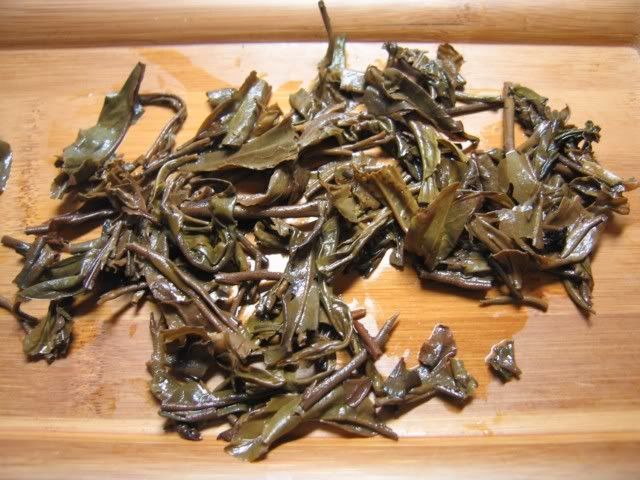
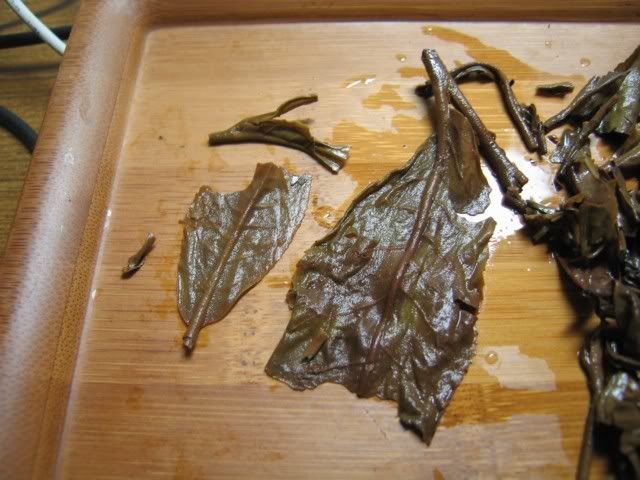
While the web-developer left, I tried another tea that they had — a “medicine tea”, as the owner called it, made by a man who now no longer makes tea (he’s in his 90s). This was the last batch, 2006 stuff. It looks sort of like a baihao and sort of like a baozhong, but lighter in colour. It’s hard to figure out what it is, but looking at the leaves, it doesn’t look very high grade.

When she brewed it… the taste is very similar to some green teas I’ve had. It has reminders of biluochun in it, but not quite. It’s very sweet, and mellow in the mouth. It’s a bit rough. But what is very interesting about the tea is the qi. It hits you very, very hard. I normally can feel a tea’s qi, but the reaction on me is usually mild. This one, however, started making my heart pump right away, and I could feel it creeping up my back and it forced me to sit up more properly. I was a little light headed — but not in a bad way. It was probably the closest I’ve been to getting a high from anything.

Ok… confessions aside, it’s a tea with very good qi ๐Ÿ™‚

We drank some infusions of this, while still chatting about tea and what not. I left the place with a few small bags of the baozhong, but also feeling like I made a friend in the place. I think, reflecting on it, that’s what was different about the two places. Even though Yetang is very non-commercial looking, I felt like I was treated as another tourist-customer who was just in and out. Perhaps the owner is naturally more reserved, and if I go back a few more times he will open up more. Then there is Huiliu, facing Yongkang park and very touristy, which is usually not a great thing, but somehow, it felt much more hospitable and welcoming. Maybe you’ll be writing it off as a matter of the quality of the teas, but really, the teas at both places were quite decent. I think it was more of a matter of a match in personality and expectations… and somehow, it just clicked better at Huiliu.

Both places, however, are worth repeat visits, as I haven’t tried all the stuff they’ve hidden away yet, so I’m quite sure I’ll go back to both in the not-too-distant future.
→ 3 CommentsCategories: Old Xanga posts · Teas
Tagged: ,

When teas turn sour

August 31, 2007 · Leave a Comment

… you should finish it quickly.

I opened up a canister of Wuyi yancha today, some stuff I bought early on last year when I first arrived in Beijing. I know I don’t have much of it left, and figured it’s time to drink it up.

It’s quite broken — partly because this is nearing the bottom of the pile. It’s also a little more broken to begin with, given it is heavier roasted.

When I brewed it though….

I noticed that it was sour ๐Ÿ™

It wasn’t terribly terribly sour, but it was definitely not sour when I had it last time, maybe two or three months ago. Now, however, it’s turned sour, a bit. There’s a puckery taste to it, and you can feel it pretty well. I adjusted the brewing time and managed to keep it under control. I also noticed that the sourness faded after about two or three infusions, so the damage is limited, so far.

However, it is probably only going to get worse from now, especially given the more humid climate here. A sour tea that isn’t too sour can be salvaged by roasting it again. A sour tea that is sour all the way through though is hopeless. Some people actually like a tiny litle bit of sourness to their yancha. I find any sourness to be detracting from the overall experience… which means that I should really drink the rest of this tea up quickly before it turns for the worse.

Oh well, at least I don’t have another 200g of this to go.

→ Leave a CommentCategories: Old Xanga posts · Teas
Tagged:

Water preparation

August 30, 2007 · 4 Comments

One of the perculiarities of Taiwan that I’ve noticed is that it runs a dual voltage. While most household sockets deliver 110v, some deliver 220v. I’ve noticed that it’s not just my apartment either — the subway station has clearly marked “110v” and “220v” sockets. Why any country would run two systems is beyond me…

But being mostly 110v, it means that I can’t use my water boiler from China. What I used to do was to heat up the water in the electric boiler, and then transfer it to my glass kettle with the alcohol burner. Since I couldn’t find the right fuel at first, I resorted to using the stove, which is basically a heating plate of sorts, with my glass kettle. It worked, but there was one problem — water was either not boiling, or boiling too quickly and reached a rolling boil in no time. I also couldn’t keep it on a constant heat easily, since it behaved strangely.

Thankfully, I finally located a place that sells the right kind of fuel. As an added bonus — it no longer smells at all, unlike the stuff they sold in Beijing. I wonder if there were some nasty impurities in the Beijing stuff.

What I do now is to use the stove to heat the water up sufficient so it’s close to boiling, and then let the boiling happen with the alcohol burner. I think this actually achieves a better boil — the water temp is kept high throughout a session easily, and I can also control the water temperature better by adding splashes of cold water throughout the session. With using the stove it was more like an all or nothing issue — since I don’t brew tea right next to the stove. Now I’m a happy man with the right water making equipment ๐Ÿ™‚

I think I would recommend something similar (not necessarily glass, although glass is useful for letting you look at the water). I think a small flame is always preferable over a heating plate type thing, not necessarily because of contact with metal or any such thing, but rather because it lets the tea maker have a much better sense of the temperature of the water being used and to maintain a more or less constant temperature throughout a session.

→ 4 CommentsCategories: Misc · Old Xanga posts
Tagged:

Mystery cake

August 29, 2007 · 2 Comments

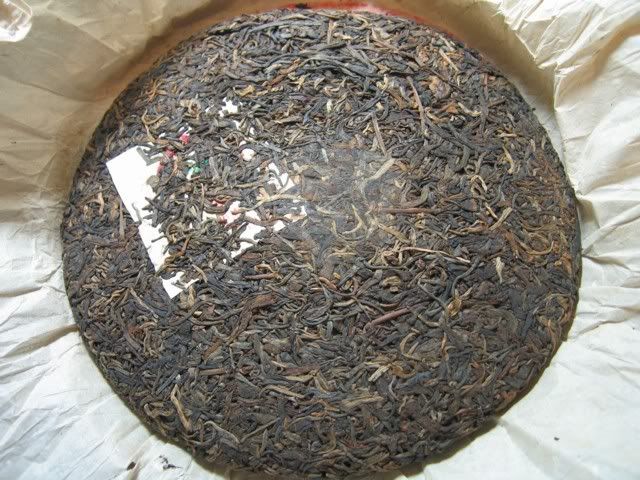
I bought this cake a week and half ago, and haven’t tried it yet since my purchase. Given that yesterday I had a 90s tea, I figured it would be a good thing to do to compare it with this cake. I know they’re not very comparable — this one being younger by a good bit, but it’s good to have a reference point sometimes.

The wrapper is a CNNP one — since I’m no wrapperologist, I am not sure what it is. The owner of the store said it’s a special order cake from Menghai. I have my doubts based on the way the cake is shaped. For people like us who are only buying the tea for personal consumption, factory provenance doesn’t matter too much as long as the tea is fair (and the price too, since Menghai and other big factories command a premium).

This is what it looks like unwrapped

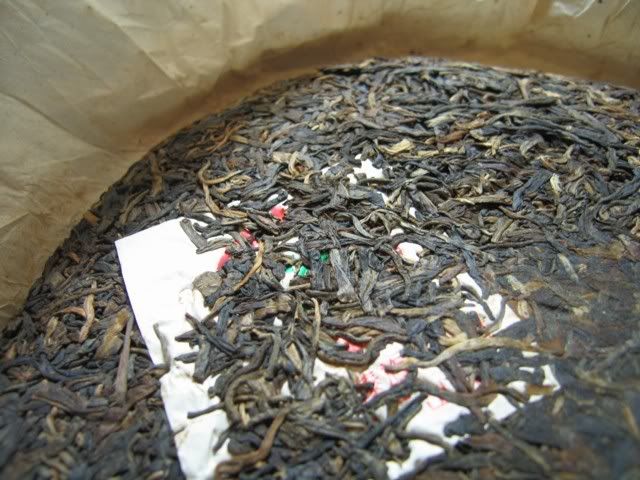
With a closeup

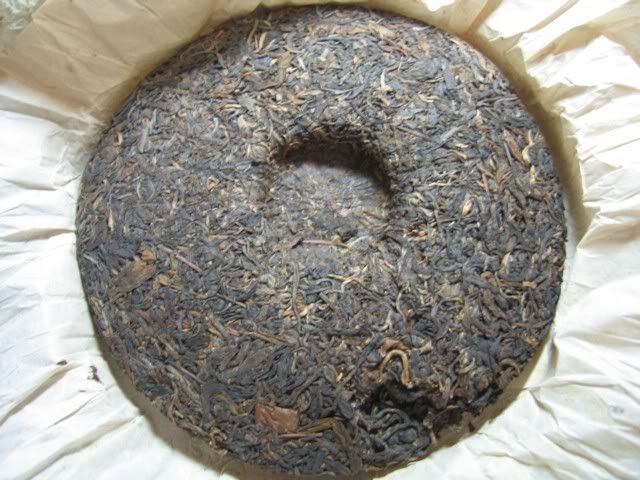
And the bit that got bitten by the mouse…. no, it was me ๐Ÿ™‚

It’s odd, but under this lighting it looks better than when I am staring at it live.

The tea is probably around 5 years of age, or thereabouts. I’m not sure.

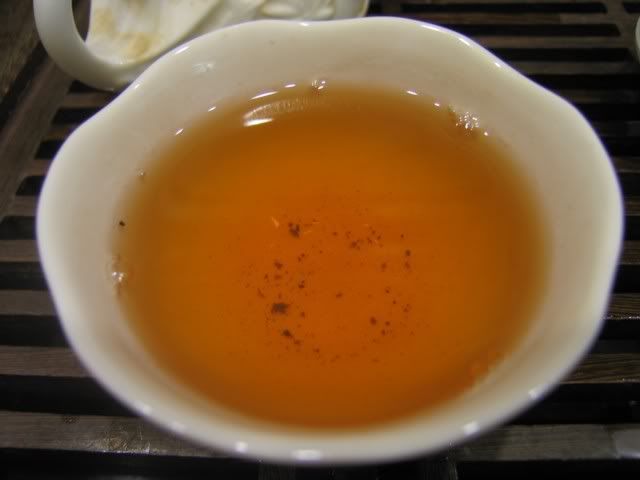
The first thing I notice is that the aromas are “higher” than the tea yesterday. It being younger and less aged probably has something to do with it. The liquor is also lighter in colour

The initial infusion was very sweet, with a bit of an aged taste showing. It gradually got a little rougher as I brewed it on, but the aroma also intensified. In fact, it took a good 3-4 infusions before the tea really hit its stride and I could feel the strength of the tea that I remembered trying in the store. The bitterness was kept well under control, but I know if you overbrew it (as the owner of the shop deliberately did) it will come out quite bitter. When it was good, it showed me some throatiness as well. It’s also got some qi, as I could feel my body reacting to the tea.

At the same time, there were a few infusions of this tea when I felt it was a bit watery — not thin, but watery as in lacking an obvious taste. The roughness was also a downside, although I suppose that can be remedied. The tea did eventually return to a sweet water state with no roughness, which is good, and after 10+ infusions.

So I don’t know exactly what to make of this tea. Maybe it’s in that transition phase between different stages of aging, and so tastes a bit like an awkward adolescent?

Here are some wet leaves

The cake comprises leaves of all sizes…

It might be interesting to drink this again after a few more years. I can see it changing, although I’m not sure in what direction.

→ 2 CommentsCategories: Old Xanga posts · Teas
Tagged:

1995 Shuilan yin

August 28, 2007 · 3 Comments

Before I start babbling today — congrats to Lew Perin, whose Babelcarp is now 2000 phrases strong. It’s a wonderful tool for those of you who don’t know Chinese and are (rightly) confused by all those funny phrases that annoying people like me sometimes throw out, or the strange spellings of teas you don’t recognize on some vendors’ sites… so if you haven’t yet, go take a look there and play around with it.

I went out for stinky tofu today for dinner, and after coming home, I wanted some tea, not having had any today (apart from some sweetened instant tea type thing with my lunch). As usual, I was looking through my tea cupboard and noticed a bag — a really flat bag. It was the sample bag of the 1995 Shuilan Yin from Hou De that I bought …. more than a year and half ago now, or thereabouts. There’s still a little left in there… 3.5g. Enough for a drink for post-dinner in my small gaiwan. Why not?

The dry leaves were mostly very very broken little bits. It’s not terribly interesting. It is, after all, the remains of what used to be solid chunks of tea. When I made it… this is what came out

Looks good to me.

I remember thinking this tea being a bit sharp, thin, and metallic in its aftertaste. Oddly enough, I didn’t find much of that this time. It tasted fuller than I remember the past two attempts. I also noticed that it has mellowed — less bitter than before. I think the fact that it’s been so broken up and sat around in a bag might have aired it out a bit? The taste is that of a tea that has at least been through some wet storage. Dry stored teas don’t taste/feel like this, I think. Not a problem though. Given its slightly bitter nature (there’s still a bit there — as well as a bit of roughness on the tongue) a pure dry stored tea might be rather harsh.

There’s not a lot to say about a really broken sample. It didn’t last too long — 6-7 infusions and the tea was getting pretty weak. The broken nature of the leaves, again, definitely has something to do with that. You can see it for yourself…. another 1/3 of the leaves were stuck to the bottom of the gaiwan, since they were all little fannings that don’t come off easily

It served its purpose. The thing is no longer available in any form anymore anyway. Anybody still has some? How does it taste now?

→ 3 CommentsCategories: Old Xanga posts · Teas
Tagged: ,

Roasted baozhong

August 27, 2007 · 3 Comments

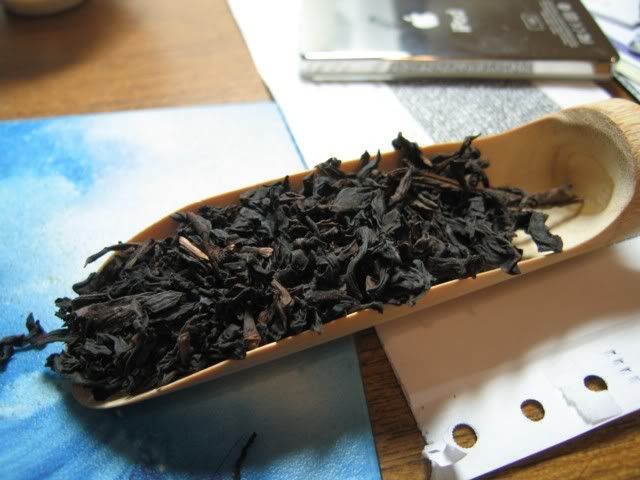
Along with the two green baozhongs I got was this roasted baozhong. I generally like roasted teas. They’re easier on the body (stomach and otherwise) and usually also require less attention to make, which enables them to be teas that can be drunk without too much attention being paid to how you make it.

Roasted baozhong, as the owner of the shop reminded me, are often teas from last year that weren’t sold. Since unroasted teas are no longer fresh and have lost some of their fragrance, roasting will enable it both to keep as well as to change its composition so as to make it marketable again. It makes sense. Why roast good, fresh crop when you have older stuff? Of course, there are teas that are made to be roasted by design, but in this day and age when lighter teas often command higher prices, it would be silly for a farmer to forego the higher income for a roasted tea.

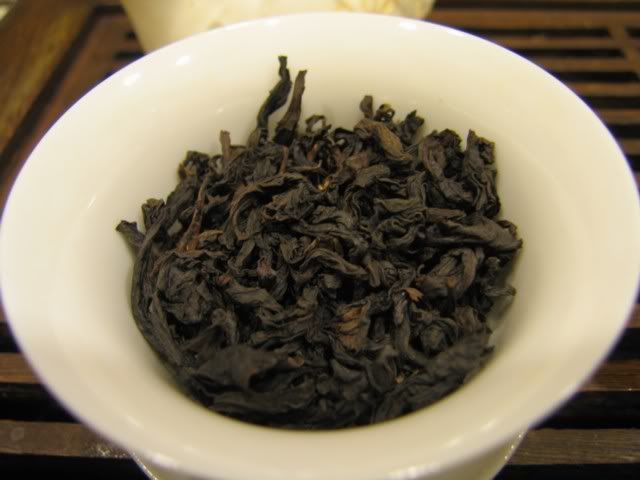
I made this once before since purchasing the tea, but last time I didn’t use much leaves as I only wanted something weak and mellow. Today I decided to push it a little harder and use a Wuyi yancha proportion

Which basically means stuffing the gaiwan.

The resulting tea is quite dark

And initially there’s a strong charcoal roasted flavour. It’s not, however, so strong that you feel like you’re eating charcoal (I’ve had those kinds of tea before). It’s a very fine line between over roasting and just right — when it tips into the “I’m tasting charcoal” territory, the tea… really isn’t so good anymore.

This tea manages to stay within bounds. Not much of the original flavour of the baozhong remains, of course. Instead, you get a deeper, heavier scent, something like a dark fruity flavour. This tea is not aged, at least not that I can tell, so it can probably benefit from some aging — both to lose a bit of the charcoal flavour and to gain a little more sweetness. It’s not that it’s not sweet, but I find that roasted teas, aged a few years, can have a unique mellowness and roundness that newly roasted teas can’t.

This predicates itself on having been stored correctly. Unlike puerh, generally it’s not a good idea to have them exposed to much air. They can turn sour if it’s moist outside. At the Best Tea House, for example, boxes of Wuyi yancha and other roasted teas sometimes go sour because they’ve been opened for a as samples but not finished in time. Some people actually like it a touch sour, but I personally think sour tea is just nasty. This tea doesn’t have any sourness, no matter how long I brewed it for. Neither is it rough or too bitter. Pretty decent, actually, and not a bad find for a tea that didn’t cost too much.

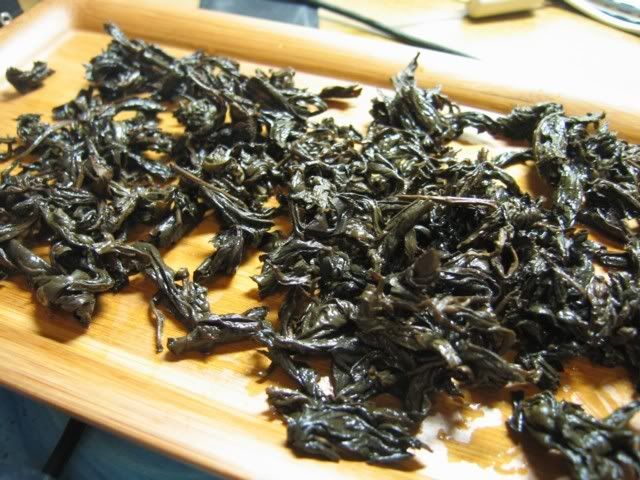
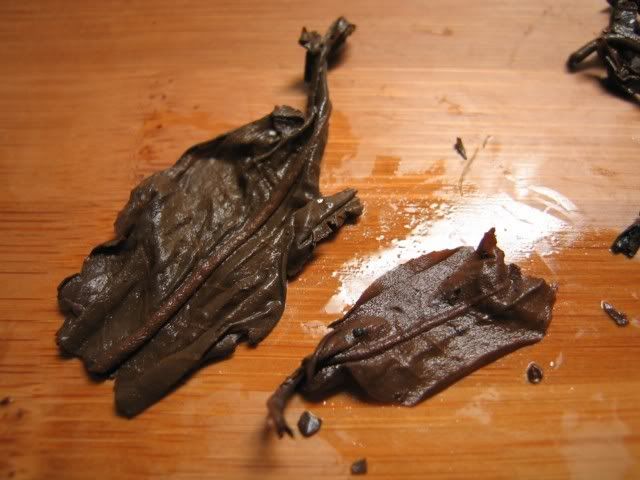
The wet leaves are a bit stiff — a lot of roasting happened. Not the heaviest I’ve seen though. It’s very strange, but extremely heavily roasted teas, when done properly, are incredibly sweet.

I might buy a few bags of this before I leave and let it sit at home. I think it will be worth it to have some of my own supply of aged baozhongs.

→ 3 CommentsCategories: Old Xanga posts · Teas
Tagged:

Jiangcheng brick, age unknown

August 26, 2007 · 2 Comments

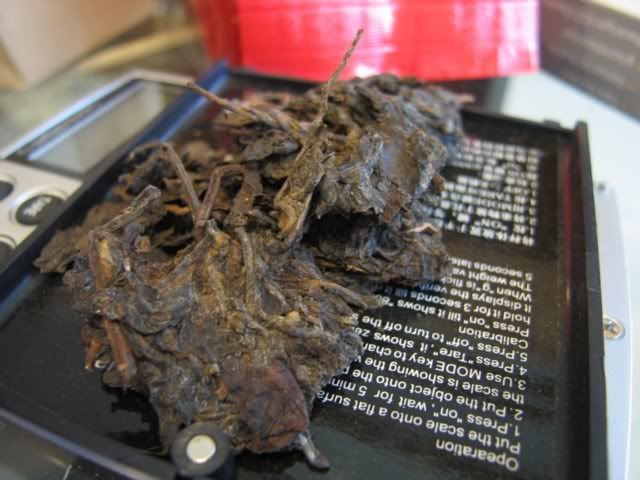
Today I had some broken pieces of a Jiangcheng brick that is supposedly 10+ years old. This was purchased from one of those older Hong Kong shops. General consumers who are not tea fanatics like you or me generally don’t buy whole bricks or cakes. They buy broken pieces that were blended by the tea shops. Each shop will tend to have their own blends and different tastes, but generally speaking, they served their local neighbourhood. This is probably something in between — an unblended but nonetheless broken brick (actually, lots of bricks). The target audience is still the general drinking public. If you want to collect, you can probably ask them for the full brick, although I don’t remember them actually selling it.

The sample today is what’s left of what I bought (about 1 Chinese ounce… or almost 40g).

There’s about 10g left, not really enough for two satisfying servings, so I threw everything into the pot.

I remember last time trying this, basically when I first bought it, and thought it was a little too harsh — that’s strong words coming from me, I think. It was on the bitter side of things.

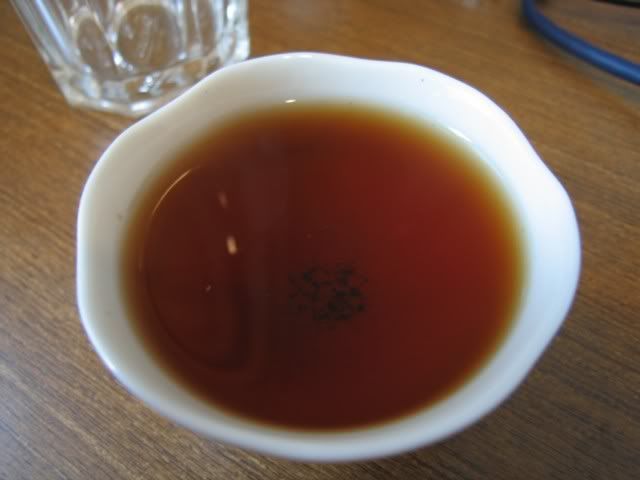
This time the tea is darker than I remembered

And the taste is similar — but somehow softer. I think brewing it in a pot (last time was gaiwan) helped. The tea is noticeably mellower. It’s sweet, but with an initial bitterness that is still there. It was entirely tolerable though, and not too nasty. In fact, the first two infusions made me think of dark chocolate — there are some aromas that smelled like chocolate, and combined with the bitter+sweet mix and the slight roughing of the tongue, it resembled a darker chocolate quite well, actually. Not the same, of course, but as far as teas go, this is pretty close.

A few infusions later the tea turned into something sweeter, with a “higher” fragrance. The chocolate notes were gone, giving way to something more perfumy. This is usually what I like best about drinking a raw puerh — even when aged some, the perfumy notes won’t go away. Cooked puerh don’t do this.

And finally, the tea turns into sweet water that is not too flavourful, but quite pleasant to drink nonetheless. At this point you’re drinking it partly just for the body and the feeling, and a little bit of that sweet perfumy notes remain. We’re talking 10+ infusions, of course.

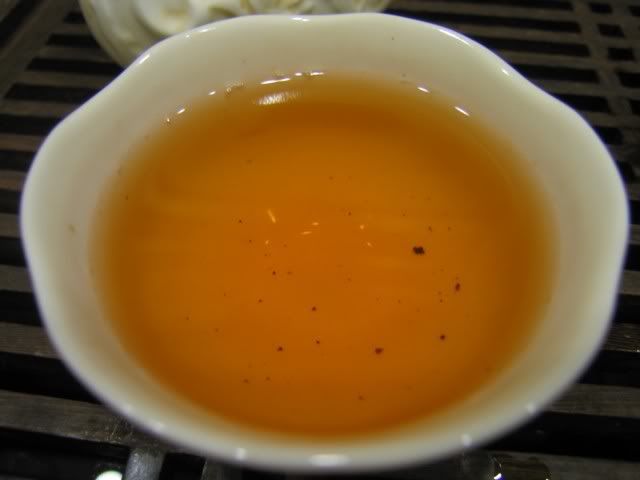
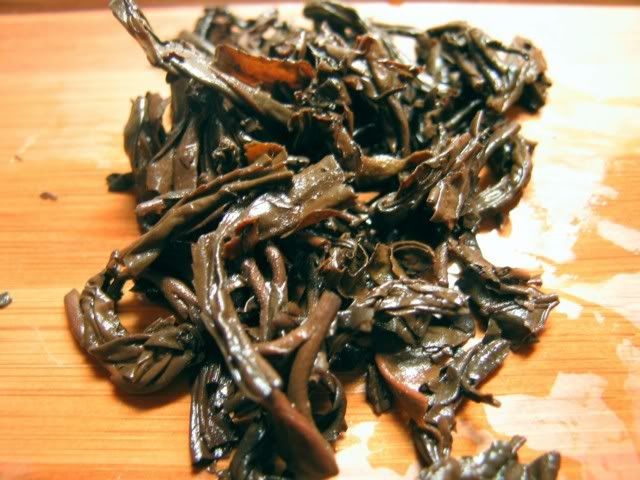
The leaves still retain some vitality. They’re not at all dark or stiff. They are well compressed though.

A few individual leaves — the small one is a bud-sized leaf, while the bigger one is obviously more mature

Having tried drinking it this way… and perhaps with a few months of aging outside of the big canister that it came in, the tea seems quite drinkable and decent, especially when one factors in the relatively low cost. Something to keep in mind when I go back to Hong Kong again….

→ 2 CommentsCategories: Old Xanga posts · Teas
Tagged:

Where everybody knows your name

August 25, 2007 · 2 Comments

I went book shopping today… except the bookstore was closed :(. I was bummed, since it’s a marvelous academic bookstore tucked away on the 10th floor of an apartment building.

The second stop was to find another tea shop around the bookstore, so I went back to the Yongkang area, since it wasn’t too far. I took Corax’s recommendation and went to Off-Chaism. I could’ve picked from the other places on the list, but figured I’ll work my way down.

The store is unassuming — you can’t really tell what they do from the outside. I walked in and nobody was there. We chatted a little, I mentioned Corax (who they remember fondly) and then we were off to drinking…

While trying various teas, mostly Wuyi yancha at first, people kept coming in and out. It’s obvious that most of them are regulars. One guy came in and started a scathing critique of a show of teaware being exhibited at the National History Museum, which I was not aware of and will now definitely go look. Another man came in, obviously a regular, but just sat down and didn’t say a word. In fact, for the most part he didn’t say much of anything until the first man left. Apparently they have a history… which I discovered when he finally started speaking. Then, a couple came in, and were there to pick up some stuff they had ordered. Some people emerged from downstairs who seemed to have been doing yoga or something while I was drinking tea upstairs. Couple A left, and couple B walked in, them from another city in Taiwan but have been living in Taipei for a while. etc etc…

You get the idea. This reminds me of the line in the opening song “where everybody knows your name” for the tv show Cheers. This place is, indeed, a place for the group of people who discovered it to go and hang out, to meet people they know, and to generally have a good time. A few people bought things, but others just went for the sake of going — in between errands, stopping by for an hour for a cup of tea or some such. In some ways, I was an anamoly — somebody who sits there for hours drinking various things. There were a few tourists who happened to drop by, but by and large they left pretty quickly. I was the odd man out.

It’s the same reason why I keep going back to the Best Tea House or Xiaomei’s shop in Maliandao. I rarely buy things there. In fact, I’ve almost never bought anything at Xiaomei’s, and I rarely buy things from the BTH. I go mostly to chat with people, some I know, some I don’t, but always a good time and an interesting discussion. Teahouses have always served this sort of function, and as my friend Joe’s paper shows… Taipei teahouses have an interesting history that made them what they are today.

I probably won’t have enough time here to really get to know a few places really well, but this place, I will probably go back again.

→ 2 CommentsCategories: Information · Old Xanga posts
Tagged: ,

Two Baozhongs

August 24, 2007 · 5 Comments

Since I bought two packs of different grades of baozhongs last weekend… I should actually try them.

Generally speaking, I’m not a big baozhong drinker. Nor, for the matter, am I a big Taiwan oolong drinker in general. That’s largely because my body doesn’t take it too well. A lot of Taiwan oolongs are really green these days with low oxidation and little to no roasting. It’s a bit much for me sometimes. But when in Rome… act like the Romans do, I guess.

The teas are actually almost indistinguishable in dry form.

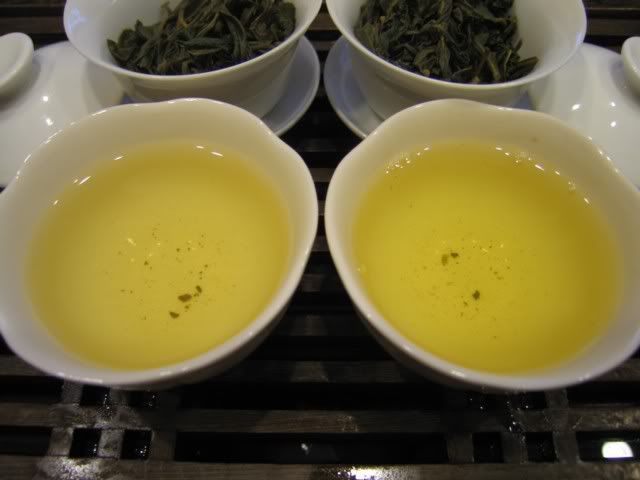
Or, for that matter, in the brewed form

Any differences in colour you see is mostly due to the slight difference in positioning relative to the light source. I’d say that if I had given one of these to you and asked you to guess, your chance of getting it right would not be much higher than 50%.

There is a bit of a difference in the dry leaves — the aroma coming from the tea when it hits the warmed gaiwan. The cheaper one (left) has a slight smell of something grainy — a little like some kind of lightly toasted grains. The right one is more floral — smelling like a gaoshan oolong.

The same is largely reflected in the taste. The left one is clearly the weaker tea, tasting a bit more watery, while the right one is more full bodied, with a deeper and more complex flavour. The teas are hard to tell apart when dry, but when in tea form and drunk, anybody with a tongue can probably tell which one is better. I used the same amount of tea in both gaiwan, measured by my scale, and the difference in taste is obvious. The better one also lasted longer — about 5 infusions, whereas the weaker one was tasting watery earlier. You might even say it tasted watery right away.

Then again, the better one is double the price of the cheap one. So you do pay for what you get.

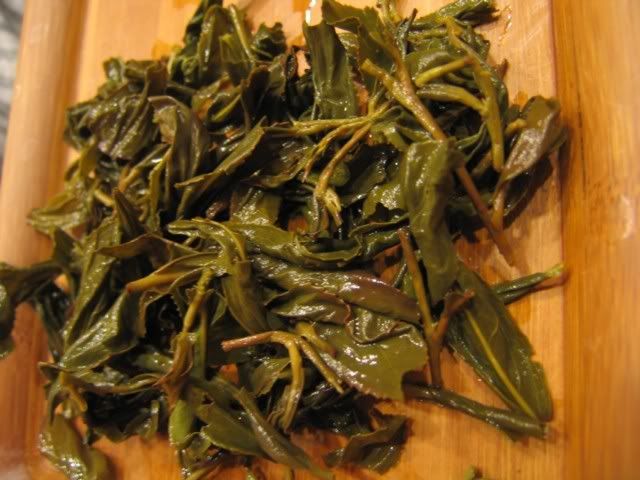
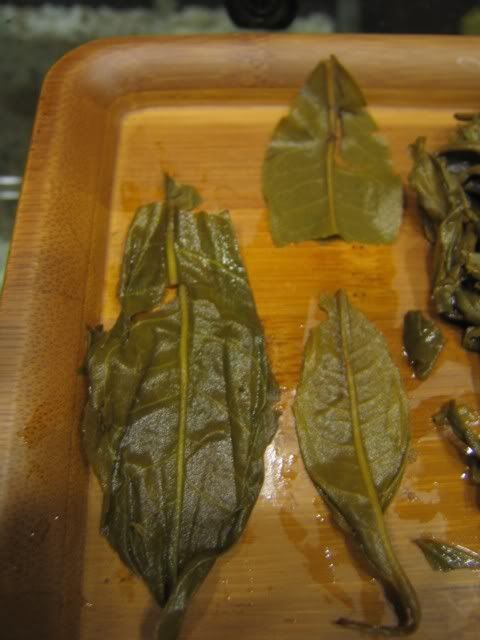
The wet leaves…. look similar, although I feel that the expensive one is a little more sturdy than the cheap one. It’s quite subtle though, the differences.

This is the cheap one

And the better one

So, the difference is really pretty much all in the taste (and smell). It was interesting, if nothing else. I still prefer them roasted.

P.S. I really need to fix the lighting situation for picture taking. It’s horrible ๐Ÿ™

→ 5 CommentsCategories: Old Xanga posts · Teas
Tagged:

Jingmai Fall 2006

August 23, 2007 · Leave a Comment

When I was organizing things in my apartment today I found a sample bag of puerh from last year, a fall 2006 Jingmai that I got from this guy who operates a shop in Kunming and who sells through Sanzui. I bought a few cakes from him, and he always gave generous amounts of sample with the cakes purchased.

The cakes this guy makes are all very pretty. He claims they’re all “pure material”, i.e. single mountain, and all using big old trees. For the most part, I find that bang for the buck, his teas are really quite decent. This Jingmai actually happens to be one of the lesser teas both in terms of quality, and especially in the price/quality ratio.

What’s wrong with this tea is that it is very rough on the tongue and the mouth. After about 3 infusions the tea turns extremely rough, and never really recovers. Unlike yesterday, this has nothing to do with water becuase I’ve tried it a few times before with different water and brewing methods, and none of them have gotten rid of this roughness. Today’s no exception. The flavours are actually quite decent, and one can feel a good bit of qi from this tea. If you’re going to store this thing in a regular home storage though, the roughness is not giong to go away given its prominence. Funny enough, the spring production does not have this problem at all. There, the roughness is very subdued and the tea is quite lovely. Since they’re about the same price (although now sold out, I’m sure) there’s almost no reason to buy the fall. This, I think, is one of those cases where one problem in the tea completely destroys it. Drier storage will never remove roughenss entirely — that requires more moisture and microbial action. Given that… it’s a no go.

The tea looks quite nice when dry, and wet

Notice the colour difference

I probably need to get a desk lamp. The lighting in this apartment is not quite ideal for tea picture taking….

→ Leave a CommentCategories: Old Xanga posts · Teas
Tagged: